Communication Capacity Development -
Planning for Gender Transformative Change
Dominick Shattuck, PhD
In collaboration with colleagues at FHI:
Miriam Hartmann, Michele Lanham
Overview
• Warm-up activity
• Communication Capacity Activity
• Research Foundation
• Model
Warm-Up
• Fartlek
• Monte Carlo Modeling
• Lorax
• Starting from the top, can anyone tell me what these
terms mean/are?
Warm-Up
• Where had you heard these terms before?
• How might your knowledge of these terms influence
your ability to articulate them to a peer?
Communication Capacity Activity
• Count off into groups
• One-way Communication:
– Identify one person who will describe the item I am
about to give them.
– Other group members will be note takers – listening
or writing notes only.
Communication Capacity Activity
• Describers
– Name your item for the
group.
– Describe the function of
your item.
– Explain the value of this
item to you, your family, or
the greater community.
• Note Takers
– Listen for:
– Key words
– What words would you
have used to describe the
item?
• Are they the
same/different?
– How did the description
and your understanding
change over time?
– How would this have been
different if you couldn’t
see the item?
Communication Capacity Activity
• Rounds:
– 1. Item only
– 2. Terms about item
– 3. More information about the item
Communication Capacity Activity
• Describers
– Name your item for the
group.
– Describe the function of
your item.
– Explain the value of this
item to you, your family, or
the greater community.
• Note Takers
– Listen for:
– Key words
– What words would you
have used to describe the
item?
• Are they the
same/different?
– How did the description
and your understanding
change over time?
Communication Capacity Activity
• How did common language facilitate your
understanding of the item?
– Give some examples of terms that you understood
– How differently would you have described the item?
• Did gender play a role in the descriptions of any
items?
– If so, how?
• How would two-way conversation change the
description process?
Gender Communication Capacity Activity
How could gender norms and one’s capacity to
communicate impact a conversation about:
• IUDs
• Partner violence
• Domestic responsibilities
• There is a need to both challenge gender norms, and
a responsibility to equip men and women with the
necessary language to have functional
communication.
Gender Communication Capacity Framework
• Previous attempts: Miller, Severy, Pasta (2003)
– Modeling fertility motivation in couples
– Navigates: desires, perceived desires and behavior
• similar to Interdependence Theory – Thibaut & Kelly, 1959
– Might it be easier and more equitable to teach people how to
communicate?
• Stepping Stones, Promundo, IMAGE, Salud y Género, SIDH, Men as
Partners, Male Motivators (among others)
– Identified communication between men and women as a facilitator of
change
– A goal of Stepping Stones: To enhance decision-making and
communication skills and ability to discuss sexual issues
• My intention was to develop a framework to help measure the
relationship between changes in communication capacity resulting from
interventions and the associated gender related outcomes.
Gender Communication Capacity Framework
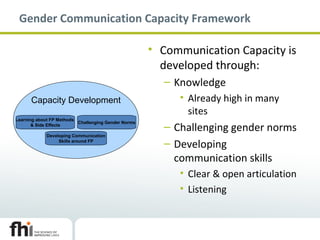
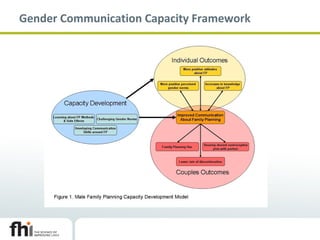
• Communication Capacity is
developed through:
– Knowledge
• Already high in many
sites
– Challenging gender norms
– Developing
communication skills
• Clear & open articulation
• Listening
Capacity Development
Learning about FP Methods
& Side Effects
Challenging Gender Norms
Developing Communication
Skills around FP
Gender Communication Capacity Framework
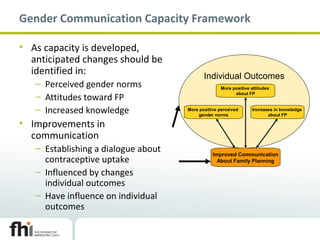
• As capacity is developed,
anticipated changes should be
identified in:
– Perceived gender norms
– Attitudes toward FP
– Increased knowledge
• Improvements in
communication
– Establishing a dialogue about
contraceptive uptake
– Influenced by changes
individual outcomes
– Have influence on individual
outcomes
Individual Outcomes
Improved Communication
About Family Planning
Increases in knowledge
about FP
More positive perceived
gender norms
More positive attitudes
about FP
Gender Communication Capacity Framework
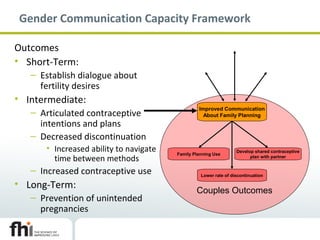
Outcomes
• Short-Term:
– Establish dialogue about
fertility desires
• Intermediate:
– Articulated contraceptive
intentions and plans
– Decreased discontinuation
• Increased ability to navigate
time between methods
– Increased contraceptive use
• Long-Term:
– Prevention of unintended
pregnancies
Couples Outcomes
Improved Communication
About Family Planning
Family Planning Use
Develop shared contraceptive
plan with partner
Lower rate of discontinuation
Gender Communication Capacity Framework
• Considered a component of larger gender-centered
interventions
• Framework developed in the context of family planning
– Adapted to GBV
• Lends itself to testing both direct and indirect relationships
between variables
– Anticipated analysis: SEM
• Conforms with the “hit-list” of gender-related factors, but
emphasizes the role of communication
• Focus – dyad, modifications need to apply to community or
peer groups

Communication Capacity Development Presentation

  • 1.
    Communication Capacity Development- Planning for Gender Transformative Change Dominick Shattuck, PhD In collaboration with colleagues at FHI: Miriam Hartmann, Michele Lanham
  • 2.
    Overview • Warm-up activity •Communication Capacity Activity • Research Foundation • Model
  • 3.
    Warm-Up • Fartlek • MonteCarlo Modeling • Lorax • Starting from the top, can anyone tell me what these terms mean/are?
  • 4.
    Warm-Up • Where hadyou heard these terms before? • How might your knowledge of these terms influence your ability to articulate them to a peer?
  • 5.
    Communication Capacity Activity •Count off into groups • One-way Communication: – Identify one person who will describe the item I am about to give them. – Other group members will be note takers – listening or writing notes only.
  • 6.
    Communication Capacity Activity •Describers – Name your item for the group. – Describe the function of your item. – Explain the value of this item to you, your family, or the greater community. • Note Takers – Listen for: – Key words – What words would you have used to describe the item? • Are they the same/different? – How did the description and your understanding change over time? – How would this have been different if you couldn’t see the item?
  • 7.
    Communication Capacity Activity •Rounds: – 1. Item only – 2. Terms about item – 3. More information about the item
  • 8.
    Communication Capacity Activity •Describers – Name your item for the group. – Describe the function of your item. – Explain the value of this item to you, your family, or the greater community. • Note Takers – Listen for: – Key words – What words would you have used to describe the item? • Are they the same/different? – How did the description and your understanding change over time?
  • 9.
    Communication Capacity Activity •How did common language facilitate your understanding of the item? – Give some examples of terms that you understood – How differently would you have described the item? • Did gender play a role in the descriptions of any items? – If so, how? • How would two-way conversation change the description process?
  • 10.
    Gender Communication CapacityActivity How could gender norms and one’s capacity to communicate impact a conversation about: • IUDs • Partner violence • Domestic responsibilities • There is a need to both challenge gender norms, and a responsibility to equip men and women with the necessary language to have functional communication.
  • 11.
    Gender Communication CapacityFramework • Previous attempts: Miller, Severy, Pasta (2003) – Modeling fertility motivation in couples – Navigates: desires, perceived desires and behavior • similar to Interdependence Theory – Thibaut & Kelly, 1959 – Might it be easier and more equitable to teach people how to communicate? • Stepping Stones, Promundo, IMAGE, Salud y Género, SIDH, Men as Partners, Male Motivators (among others) – Identified communication between men and women as a facilitator of change – A goal of Stepping Stones: To enhance decision-making and communication skills and ability to discuss sexual issues • My intention was to develop a framework to help measure the relationship between changes in communication capacity resulting from interventions and the associated gender related outcomes.
  • 12.
    Gender Communication CapacityFramework • Communication Capacity is developed through: – Knowledge • Already high in many sites – Challenging gender norms – Developing communication skills • Clear & open articulation • Listening Capacity Development Learning about FP Methods & Side Effects Challenging Gender Norms Developing Communication Skills around FP
  • 13.
    Gender Communication CapacityFramework • As capacity is developed, anticipated changes should be identified in: – Perceived gender norms – Attitudes toward FP – Increased knowledge • Improvements in communication – Establishing a dialogue about contraceptive uptake – Influenced by changes individual outcomes – Have influence on individual outcomes Individual Outcomes Improved Communication About Family Planning Increases in knowledge about FP More positive perceived gender norms More positive attitudes about FP
  • 14.
    Gender Communication CapacityFramework Outcomes • Short-Term: – Establish dialogue about fertility desires • Intermediate: – Articulated contraceptive intentions and plans – Decreased discontinuation • Increased ability to navigate time between methods – Increased contraceptive use • Long-Term: – Prevention of unintended pregnancies Couples Outcomes Improved Communication About Family Planning Family Planning Use Develop shared contraceptive plan with partner Lower rate of discontinuation
  • 15.
  • 16.
    Gender Communication CapacityFramework • Considered a component of larger gender-centered interventions • Framework developed in the context of family planning – Adapted to GBV • Lends itself to testing both direct and indirect relationships between variables – Anticipated analysis: SEM • Conforms with the “hit-list” of gender-related factors, but emphasizes the role of communication • Focus – dyad, modifications need to apply to community or peer groups

Editor's Notes

  • #4 Fartlek – running term associated with increasing and decreasing speed during a workout. Sometimes called intervals. Monte Carlo Modeling – statistical modeling that is performed using hypothetical data. The data is designed to meet particular criteria and then set into the model to estimate approximate outcomes. Sorta like a roll of the dice…with a little more control. Lorax is a Dr. Seuss character who struggles with the Once-ler to stop destroying the environment and endangering the animals.
  • #5 Goal – to show that familiarity of terminology enables articulate discussion and mutual understanding. Discussion question: What similar experience did those who knew the terms have? What types of
  • #6 Groups can be conveniently located (sitting nearby one another) Identify describers & note takers
  • #7 During this session, you should be
  • #8 This activity will occur in 3 successive rounds. During Round 1, the describer will try to tell you about the item by looking at it and showing it to you. Round 2, I will give the describer a card with a couple of terms about that item – they will not show the card to the note takers Round 3, I will provide the describer with a card with more detailed information – they will read and not show the card again After, we will pull it together and discuss the items and how the items were described to you.
  • #9 During this session, you should be
  • #11 Capacity communicate refers to the ability to use common language and listen to your partners thoughts and ideas about various topics. Examples: Until I was in graduate school, I had never seen, or actually knew anything of effectiveness provided by an IUD. None of my partners used them (as far as I knew) and it was never really in the method mix for me. Michele drew my attention to a somewhat current song by Eminem and Rhianna? Among other things it provides a good example of the role of communication capacity – in this case lack of capacity … (pass out words to song). Currently, men are reported to provide primary care for their children in 25% of homes. Expectations of fatherhood have increased, but at the same time, expectations of men as totally committed workers have not decreased. Men now report feeling more work-family conflict than women do. (center for contemporary families)
  • #12 From my own research and reading through the literature, I understood that communication was a central component to open and equitable uptake of family planning methods. Salud Y Genero – Mexico SIDH – Society for the Integrated Development of the Himalayas