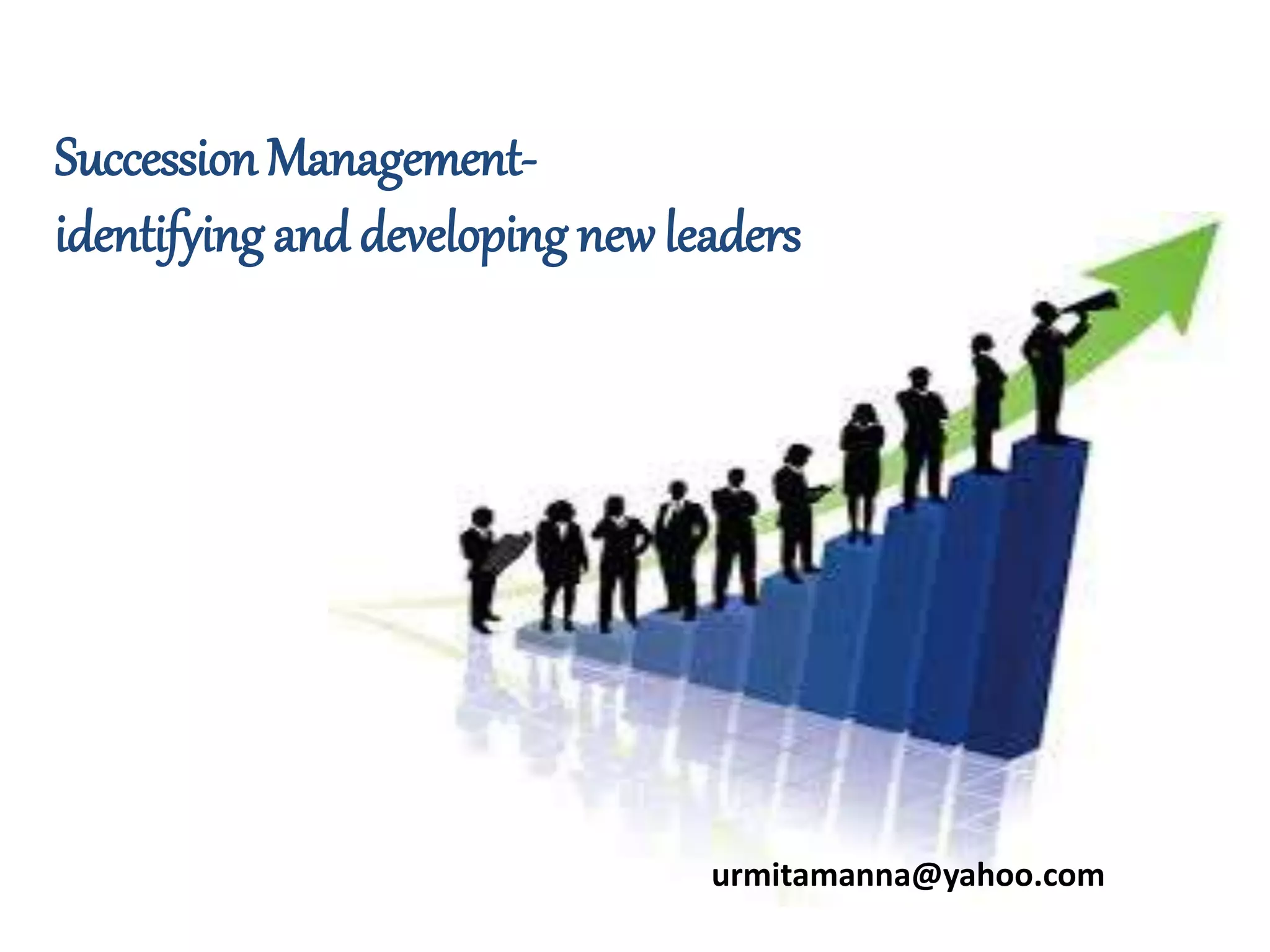
Succession Management-
identifying and developing new leaders
urmitamanna@yahoo.com
Succession management is the process of ensuring
that pools of skilled employees are trained and
available to meet the strategic objectives of the
organization.
It consists of identifying employees who have the
potential to assume key positions in the
organization and preparing them for these
positions.
Succession management continuity in leadership
develop the next generation of players.
Meaning of succession management
Succession planning
Succession planning is a process for identifying
and developing new leaders who can replace
old leaders when they leave, retire or die.
Succession planning increases the availability
of experienced and capable employees that
are prepared to assume these roles as they
become available.
Replacement planning
It can be defined as the process of finding
replacement employees for key managerial
position. Replacement planning is based on the
premise that an organization chart will remain the
same over time. It usually identifies “backups” for
all top positions in a company.
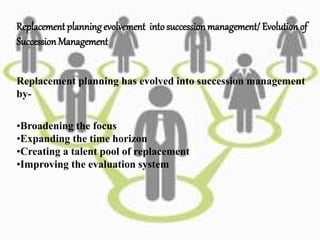
Replacement planning evolvement intosuccessionmanagement/ Evolution of
SuccessionManagement
Replacement planning has evolved into succession management
by-
•Broadening the focus
•Expanding the time horizon
•Creating a talent pool of replacement
•Improving the evaluation system
• Broader Focus: The focus of replacement planning is the job, and having, a
replacement ready to fill that job if the incumbent died or quit. Replacement planning
consisted of a periodically updated table of employees who might be nominated if a need
arose. this type of planning focus on the high potential candidates, all ready to step into
vacant position. This planning depend on stable future.
In replacement planning, the starting point is the job, where in succession
management, the starting point is the strategy of the organization. Employees are selected
based on long term goals, and the developmental plans for employees are aligned with
strategic plans, no position replacements.
• Time Horizon: Succession management looks at a longer term (after ensuring that
immediate replacement are in place) and focuses on a future of two years or more where
traditional planning approach was concerned with immediate and short term replacement.
In succession management , obviously it is harder to focus on future,and so
rather then identify one replacement, succession manager identify talent pools
• Talent Pools: Traditional model of HR planning looked at succession as the passing
of the baton to the next capable runner. Two or three employees were identified and they
would be in the race of getting executive promotion. Organizations have found that their
designated backup personal fill only 30% of the open positions for which they were
slotted. The organizations need a pool of talent and must develop many employees with
flexible job skills and competencies. Pool is great description of the next generation of
talented leadership. A talent pool is considered a corporate resource.
A succession management does not depend on only internal candidates, but also
track external candidates. This management does not rely on internal manager, new
generation succession management track high performers from external market.
• Rating Systems: In a succession management approach, several raters give current
evaluations on an employee’s performance. The increasing use of 360- degree feedback
mechanisms sheds light on various aspects of any candidate’s style and performance.
In the case of traditional planning, it relied on the identification of the
replacement people by a single rater. Only the boss of the high potential employee
supplied information about the employee , and the information could be out of date and
unreliable.
Replacement planningevolvement intosuccessionmanagement/Evolution of Succession
Management- continued
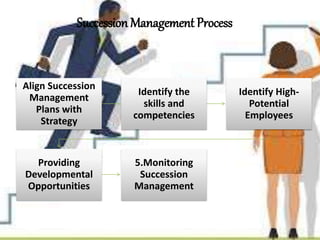
Succession Management Process
Align Succession
Management
Plans with
Strategy
Identify the
skills and
competencies
Identify High-
Potential
Employees
Providing
Developmental
Opportunities
5.Monitoring
Succession
Management
Be
proactive
with a
plan
Pinpoint
succession
candidate
s
Let
them
know
Step up
profession
al develop
ment
efforts
Do a trial run of
your succession
plan
Integrate your
succession
plan into your
hiring strategy
Think
about
your own
successor
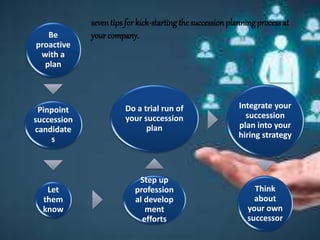
seventips for kick-starting thesuccession planningprocess at
yourcompany.

Succession management-identifying and developing new leaders

  • 1.
    Succession Management- identifying anddeveloping new leaders urmitamanna@yahoo.com
  • 2.
    Succession management isthe process of ensuring that pools of skilled employees are trained and available to meet the strategic objectives of the organization. It consists of identifying employees who have the potential to assume key positions in the organization and preparing them for these positions. Succession management continuity in leadership develop the next generation of players. Meaning of succession management
  • 3.
    Succession planning Succession planningis a process for identifying and developing new leaders who can replace old leaders when they leave, retire or die. Succession planning increases the availability of experienced and capable employees that are prepared to assume these roles as they become available.
  • 4.
    Replacement planning It canbe defined as the process of finding replacement employees for key managerial position. Replacement planning is based on the premise that an organization chart will remain the same over time. It usually identifies “backups” for all top positions in a company.
  • 5.
    Replacement planning evolvementintosuccessionmanagement/ Evolution of SuccessionManagement Replacement planning has evolved into succession management by- •Broadening the focus •Expanding the time horizon •Creating a talent pool of replacement •Improving the evaluation system
  • 6.
    • Broader Focus:The focus of replacement planning is the job, and having, a replacement ready to fill that job if the incumbent died or quit. Replacement planning consisted of a periodically updated table of employees who might be nominated if a need arose. this type of planning focus on the high potential candidates, all ready to step into vacant position. This planning depend on stable future. In replacement planning, the starting point is the job, where in succession management, the starting point is the strategy of the organization. Employees are selected based on long term goals, and the developmental plans for employees are aligned with strategic plans, no position replacements. • Time Horizon: Succession management looks at a longer term (after ensuring that immediate replacement are in place) and focuses on a future of two years or more where traditional planning approach was concerned with immediate and short term replacement. In succession management , obviously it is harder to focus on future,and so rather then identify one replacement, succession manager identify talent pools
  • 7.
    • Talent Pools:Traditional model of HR planning looked at succession as the passing of the baton to the next capable runner. Two or three employees were identified and they would be in the race of getting executive promotion. Organizations have found that their designated backup personal fill only 30% of the open positions for which they were slotted. The organizations need a pool of talent and must develop many employees with flexible job skills and competencies. Pool is great description of the next generation of talented leadership. A talent pool is considered a corporate resource. A succession management does not depend on only internal candidates, but also track external candidates. This management does not rely on internal manager, new generation succession management track high performers from external market. • Rating Systems: In a succession management approach, several raters give current evaluations on an employee’s performance. The increasing use of 360- degree feedback mechanisms sheds light on various aspects of any candidate’s style and performance. In the case of traditional planning, it relied on the identification of the replacement people by a single rater. Only the boss of the high potential employee supplied information about the employee , and the information could be out of date and unreliable. Replacement planningevolvement intosuccessionmanagement/Evolution of Succession Management- continued
  • 8.
    Succession Management Process AlignSuccession Management Plans with Strategy Identify the skills and competencies Identify High- Potential Employees Providing Developmental Opportunities 5.Monitoring Succession Management
  • 9.
    Be proactive with a plan Pinpoint succession candidate s Let them know Step up profession aldevelop ment efforts Do a trial run of your succession plan Integrate your succession plan into your hiring strategy Think about your own successor seventips for kick-starting thesuccession planningprocess at yourcompany.