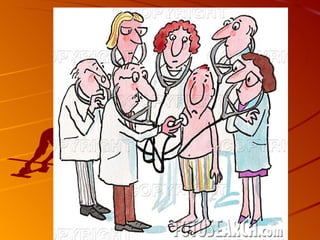
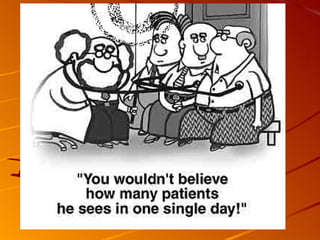
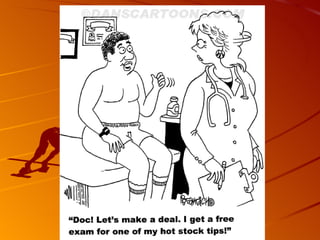
What will this workshop help you to do ? Manage your life better ! A doctor’s life is very different from a businessman’s or executives We have our own unique set of problems
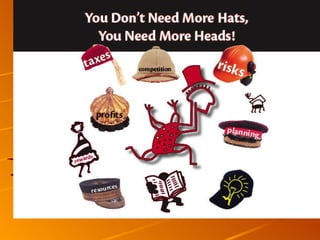
A doctor needs to wear many hats ! Clinician , who has polished medical skills Academician, who is a constant learner  Manager , who understands the business aspects of running a profitable clinic
A doctor needs to wear many hats ! CEO, who understands how to motivate staff and lead people; Financial expert, who can manage his money  Family provider Self caretaker, who know how to look after himself and fulfill his personal needs .
The problem Unfortunately, while doctors are quite eager to discuss medicine,  most are unwilling to talk about the nuts and bolts of practise management Don’t want to enrich the competition by giving away their “trade secrets” ! We can learn together and help each other
The solution There is no need to reinvent the wheel . The challenges are similar all over the world We can learn from our colleagues and from peers in other parts of the world Apply knowledge from other fields to ours !
Being a doctor today is not easy Do you find that there is: too much work too much hassle too much competition too much despair; and too little reimbursement ?
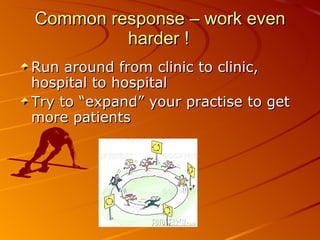
Common response – work even harder ! Run around from clinic to clinic, hospital to hospital Try to “expand” your practise to get more patients
Common response – work even harder ! Only 24 hours in a day ! Fed up and unhappy No time for yourself or your family
 
Are you fed up of… Long energy-exhausting hours and crushing workloads leaving little or no free time for yourself or your family ? Demanding dissatisfied patients ? Inadequate payment  for all your hard work ?
Need to work smarter – not harder ! Need to learn tools  which will: Give you control of your time;  Allow you to do work which you felt was worthwhile, for patients that you enjoy seeing; and Pay you well for your effort, so that you enjoy going to work every day.
Practise management skills Every doctor is an entrepreneur Needs to run a business These skills are never taught in medical college Some doctors never learn them, and struggle to manage their practise
 
5 stages of a doctor’s career Entry, when you are starting out;  Establishment, when you have created a name for yourself;  Exploration, when you look for new fields to conquer;  Specialization , when you settle down in your niche; and Mastery, when you establish yourself as the Expert in your area of interest.
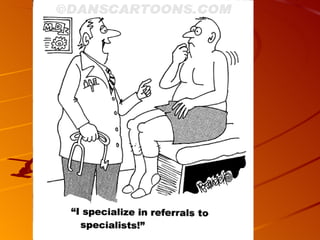
Specialise ! Need to carve out a niche for yourself Have a clear professional goal Shape your practise around your abilities – you will become extremely good at doing what you enjoy !
 
Please Prescribe   Information  ! Dr Aniruddha Malpani, MD HELP, Health Education Library for People www.healthlibrary.com
Carrot and stick 1. Promote your practise Well informed patients are more faithful Differentiate yourself from other doctors Good investment ! Can vouch for this from personal experience ! 2. Protect you from lawsuits Document that you have educated your patient
Patient autonomy Autonomy = freedom to decide Doctors need to  1. present the options to the patients and  2. allow patients to choose for themselves Informed  choice means patients need  information
Allowing patients to choose  With advances in medical therapy, there are often many treatment options available for any medical problem Do not choose for the patient – how can you read the patient’s mind or foretell the outcome ? Present the information and let the patient decide
Educating patients  Most doctors do not spend much time educating their patients.  This is a shame. The primary role of a doctor should not be merely treating an illness, but rather helping people remain healthy, and educating patients is vitally important for this.
Doctor ( docere) = Teacher In ancient India, doctors were paid only if their patients were in good health. If someone fell ill, the doctor’s payments were stopped until he treated the illness successfully. This was a very useful model, which should be more widely practised!
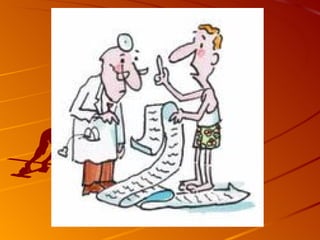
Barriers - 1 Most of us  do not have the time to encourage questions from patients.  Most doctors are just not very good at communicating with their patients.    Doctors are  used to talking medicalese
Barriers - 2 Educating the patient is simply not valued enough It is not seen to be glamorous It is not financially rewarding.  It can be quite boring to repeat the same stuff again and again.
 
Encourage questions ! Some doctors feel threatened by a patient’s questions. This is not the right perspective at all. Remember: both doctor and patient have a similar goal – to make the patient better – and questions should be encouraged and answered, rather than leaving doubts to fester – a situation that can create unnecessary problems in the future.
Benefits of patient education - 1 Happier patients , because  they have been treated as intelligent adults.  Patient education is  important as a practice promoter: patients appreciate that the doctor has taken the time and effort to inform and teach them.
Benefits - 2 Patients forget over half of what the doctor tells them, because of the stress of the consultation. Giving them printed materials to read at home will help prevent midnight calls .  Printed educational materials  help to increase patient compliance
Benefits - 3 Patient education helps to improve public health. Educational materials are read by the entire family, and community health awareness can help to  reduce quackery .  People respect the printed word – especially when given by the doctor !
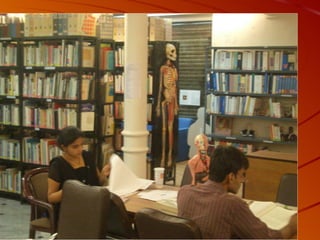
Best form of CME for the  doctor ! Remember that the inquiring and well-informed patient can teach you much more about medicine than any textbook ! A patient’s questions will make a good doctor think about things that otherwise he or she might take for granted.
Best form of CME for the  doctor ! Help you to improve the quality of your  medical practice. The well-informed patient may help make you aware of advances occurring in other parts of the world that you – as a busy doctor – might otherwise overlook.
Helps to improve empathy Reading information intended for the patient can teach you to look at things from the patient’s point of view. This helps to increase your empathy – a very desirable goal.
Reduce risk of complications Patient education can actually  reduce the risk of inadvertent  complications. After all, doctors are human and may make errors . The well-informed patient can sometimes point out possible problems with a treatment plan that the doctor may have overlooked (for example,  patients with G6PD deficiency)
Reduce quackery Educating patients will help prevent health fraud and quackery. If doctors teach their patients about what can be done to help them, as well as the limits of what we can offer them, they are unlikely to be cheated by quacks.
Reduce  medicolegal risks Educational handouts offer proof that the doctor has informed the patient of possible complications and risks .  Patient education is an integral part of “risk management” in medical practice today, and will reduce the risk of doctors being sued if complications do occur.
Patient education – key component of informed consent Don’t tell the patient what to do Present the information and the treatment options – and allow them to make up their own mind ! Empower patients with information – they will respect you for this !
Printed brochures Printed pamphlets form the core of  patient education. It’s easy to adapt, modify,  translate and print educational leaflets produced elsewhere – don’t waste time reinventing the wheel !  You can find many examples to copy at HELP ! Test them on your patients !
 
Printed brochures Remember that patients have different levels of reading skills Leave these in your waiting room, so that patients can gainfully use their time while waiting for you
Printed brochures Encourage your patients to take the leaflets and read them at home at leisure – this is a good way to promote your practice as well.  You can also give them the appropriate leaflet at the end of the consultation.
Please Prescribe Information ! All the information in the world  can never replace the doctor  !  Information can help you become a better doctor – and also help your patient to become a better patient !
Doctor.com Dr Malpani, MD http://www.drmalpani.com
Why bother ? Doctors have practised medicine  for many years without the Net Isn’t this just another new-fangled toy for kids to play with ? Isn’t the boom over ? I’m too old to learn !
 
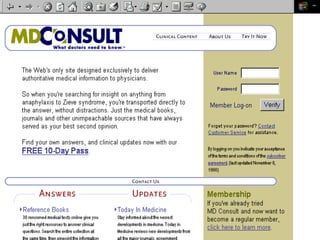
MDConsult.com Full text of over 30 medical textbooks, medical journals and Clinics of North America No advertising Specially discounted price for Indian doctors Subsciption can be provided by a pharmaceutical company
MDConsult.com For less than Rs 30 per day, you will never need to buy another medical book or journal in your life Constantly updated all the time Excellent patient educational information as well, which you can print out for your patients !
Get on the Net Today, it’s not enough to just have a net connection You need to have your own website ! Symbolic of how rapidly times are  changing !
Start your own website ! Patients are hungry for reliable information The internet is an excellent source of information, but a lot of this can be wrong and dangerous Provide reliable information to your patients through your own website Very cost effective !
Why is this important for you ? Why should you take the time and trouble of setting up  your own website ?
To promote your practice ! This is the simplest and easiest answer – and the one most doctors will understand ! A website is a very cost-effective way of getting more patients , because it lets patients all over the world know about your special skills ! Think global – act local !
How does a website help ? Provide value-added services for your existing patients. Provide clinic details ( how to get to the clinic, clinic timings) You can answer email queries You can provide reliable medical information about “hot” topics – such as the leptospirosis scare
How does a website help ? For example, you can put up a FAQ  ( frequently asked questions) section, which answers the commonest queries patients usually ask you. You can “refer” patients to your website at the end of the consultation, so they can educate themselves ! Patients appreciate this – and word of mouth will help you get more patients !
How does a website help ? Your website can help you to attract new patients ! Bombay is a medical center, and Indian medical care is very cost-effective. Valuable for attracting NRIs, for example Soon, it will become as routine for patients in India to do “ research “ about doctors, as it is in USA.  Your website can help  patients to find  you !
Website benefits Your website lets your patients know that you are upto date and familiar with modern technology ! At  our website at  http://www.DrMalpani.com  - we answer over 10 queries a day Get direct patient referrals from all over the world !
Internet positive patients Well-informed Demanding Affluent
Cannot afford to not use the Net  Integral part of medical practice for the future Communication with patients Communication with chemists, lab results, consultants, colleagues Billing – insurance companies
E-healthcare Patients will demand medical services to suit  their convenience  Smart doctors need to  be prepared Better to be proactive rather than try to  catch up later Doctors with their own websites will always be web-savvy and “clued-in”
Medical Tourism Enormous scope for Indian doctors to “export” their expertise without leaving the country ! Can provide online round the clock videoconferencing with patients, one on one, for a fee
Telemedicine Can help patients in the US to save money and time by offering personalized medical consultations – at a fraction of the cost in the USA Provide expert second opinions Very attractive for third party payors, insurance companies, HMOs
Matter of time What happens in the US will happen in India after a few years  The pace of change is rapidly accelerating and we are catching up quickly We can learn from the experience of doctors in the US !
 
Improving the doctor-patient relationship
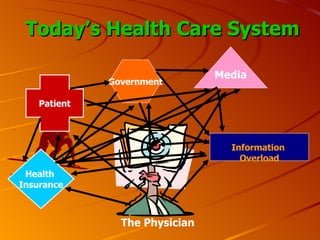
Today’s Health Care System Patient Health  Insurance Government Information  Overload Media The Physician


The foundation of the relationship Based on  TRUST Trust needs to be earned !
The past The Family Doctor Doctors were held in high regard Worked hard, were paid little, but were trusted and respected Held in high esteem
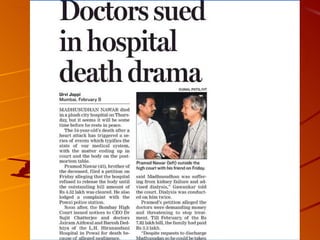
The present Today, doctors get beaten up because patients  or their relatives ) perceive they are getting poor medical care.  Medical negligence lawsuits increasing
The present The doctor-patient relationship is breaking down Patients feel exploited and believe that the medical profession has become crass and commercialized Doctors feel unappreciated, overworked, victimised and threatened.
How do we fix the problem ? Two players Doctors Patients It’s hard to change anyone else – you can only change yourself !
Polish your bedside manner The most important intangible Your patient needs to know how much you care Technical competence is usually taken for granted Simple measures – be polite; sit down while talking to the patient; smile; don’t interrupt !
What do patients expect from their doctors ? Expertise ( be well-informed and uptodate) Professionalism – look out for the patient’s best interests Accountability – be answerable; say Sorry ( if there is a mistake) Transparency – no unnecessary tests and referrals Respect their desires and their time Treat them as intelligent human beings
What do doctors expect from their patients ? Doctors expect that patients will: Treat them with respect Will say “Thank You” when things go well Will have realistic expectations of their treatment Will not unfairly blame the doctor anytime there is a problem Will pay their professional fees promptly and gracefully
Good doctors Good doctors spend a lot of time talking to their patients. They have an excellent bedside manner They build a relationship in which their patient can trust that the doctor will do what is in the patient’s best interests.  This is the hallmark of the true professional
Good doctors A doctor who is a good professional has a very close relationship with his patients, because he knows that he is in the service industry.  All good doctors are empathetic Just talking to the doctor can be therapeutic for many patients -  after all, doctors are active healing agents, who are often far more potent than an antibiotic !
Good doctors Doctors need to earn their patients’ trust – and they can do this by:  being generous with their knowledge;  showing their patients that they care;  respecting their time;  and fulfilling their promises.
Good doctors This is why senior doctors value their reputation so much – it is built on the foundation of a lifetime of hard work – and even though it is intangible, it represents the fact that patients have trust in them.
Good doctors Professionalism should be taught at all levels of medical education , so future generations of doctors will still be proud to be a part of this ancient and respected profession.
Dehumanising doctors Unfortunately, we do not encourage our medical students to develop their emotional skills, and medical college usually drains whatever natural empathy students have.  Students get marked for their academic excellence, cramming ability and surgical virtuosity – not their ability to establish a rapport with their patients !
Bad doctors Don’t respect patients - treat them as mentally defective idiots Don’t respect patients’  Time Preferences  Beliefs
Doctors are unhappy too * They are stressed out, because of the large number of patients they need to see * They feel that patients expect too much from them.  * The feel that patients unfairly blame doctors for all bad outcomes. Doctors are easy targets
Doctors are unhappy too The press enjoys doctor-bashing. This makes a bad situation worse, and the entire profession suffers because of a few bad doctors Many doctors also feel that patients waste their valuable time by asking stupid and irrelevant questions; because they are too disorganized; and don’t bother to educate themselves or do their homework.
Today’s problems in healthcare are because: * Everything is doctor-centric - the doctor is the center of the medical care system  * Healthcare is therefore fragmented and disorganised  * Too many specialists , most of whom have tunnel vision
We need to reform the healthcare ecosystem Put patients at the center  Patients are the largest untapped healthcare resource ! Patients ( or their relatives and friends) are intelligent and capable; and because they have a lot at stake , they are motivated to get good health care We need to provide the tools directly to patients !
Patient centered healthcare * Self-care  * Personalization * Transparency * Quality  * Control
 
The doctor-patient relationship is a two-way street Teach your patient how to be a good patient ! A well-informed patient understands what the doctor is doing and why; has realistic expectations;  and also understands that a doctor is not God, and that complications and mishaps can occur.  
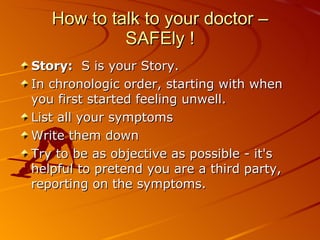
How to talk to your doctor – SAFEly ! Story:   S is your Story.  In chronologic order, starting with when you first started feeling unwell.  List all your symptoms Write them down  Try to be as objective as possible - it's helpful to pretend you are a third party, reporting on the symptoms.
How to talk to your doctor – SAFEly ! Assessment:   What do you feel is wrong with you ? You don’t need to diagnose your own problem - just to let your doctor know what you feel is responsible for your problem. After all, you are the expert on your own body !
How to talk to your doctor – SAFEly ! Fears:   What are you worried may happen to you as a result of your illness. Are you worried this will affect your ability to play tennis ? work ? affect your future fertility ? The best way to overcome your fears is to discuss these with your doctor.
How to talk to your doctor – SAFEly ! Expectations:  What do you want from your doctor ? Do you want him to run some tests to reassure you that all is well ? Do you just want pain relief ? Do you want an accurate diagnosis from your doctor  ?
Today - Doctor v/s patient This is sad ! We are all on the same side ! How do we fix the problem ?
Information Therapy Doctors need to “ prescribe information “ Patients will then have realistic expectations of what their doctor can do for them .  Information therapy - “ Prescribing the Right Information to the Right Person at the Right Time”  is the best way of bridging the doctor-patient communication gap today !
Non-verbal communication - SOFTEN S- Smile O - Open posture F- Forward lean T – Touch. This is a privilege – use  it ! E – Eye contact N - Nod
Develop empathy Learn from Munnabhai, MBBS Polish your EQ skills ! A high EQ is far more important than a high IQ Patients don’t care how much you know – until they know how much you care !
BATHE technique B = Background. What’s going on ? A = Affect. Feelings. What do you  feel about it ? T = Troubles. What troubles you  about this ? H = Handle. How are you handling this ? E = Empathy. It must be hard.
Stress management –  Preventing Burnout Learn to say No Learn to take care of yourself Balance your professional and personal priorities Develop a strong support system
Stress management –  Preventing Burnout Cut back on the routine work you find boring Challenge yourself daily “ Physician, heal thyself” ! Follow the advise you give your patients, regarding not smoking, not drinking, a healthy diet and exercising !
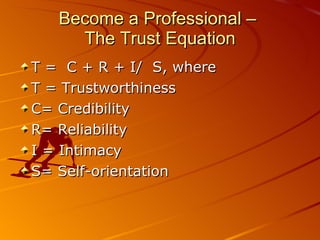
Become a Professional –  The Trust Equation T =  C + R + I/  S, where  T = Trustworthiness C= Credibility R= Reliability I = Intimacy S= Self-orientation
Become a Professional –  The Trust Equation Credibility = can your patient trust what you say ? Reliability = can he trust your actions, confident that you will act honorably ? Intimacy = is he comfortable discussing his feelings and emotions with you ? Self-orientation = can he trust your motives, knowing that you care about him, and will act in his best interests ?
The joy of practising medicine – how to be a happy doctor Care for your patients. Treat all your patients like VIPs .  A healthy doctor-patient relationship nurtures both patient and doctor !  Savor your patients. When a patient thanks you , relish that moment. Those moments are the real reward for being a doctor, if you can slow down to let them in.
The golden rule Patients are the practise Everything else is just paper work !
The joy of practising medicine – how to be a happy doctor When it comes to getting positive feedback, no profession in the world comes close to medicine !  A good doctor can have the best emotional income in the world ! Be thankful daily that you have the opportunity for helping others – expressing gratitude will help you find contentment and self-worth
 
Money ! Doctors are daily wage earners Don’t work – don’t get paid Need to plan for the future Develop stream of “passive income” Learn to use other people’s time and other people’s money to make more money !
 
 
Marketing Marketing is NOT a dirty word Doctors  have always marketed themselves Traditionally, it has been “word of mouth” marketing This is still the best type, but it takes time. This is most worthwhile investment of your time !
 
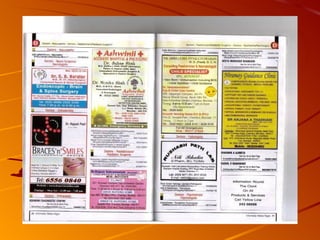
Promoting your practise Advertising can be very expensive, and is usually not cost effective Public relations firms have become very popular amongst doctors recently Satisfied patients are your best marketing tool – concentrate on keeping them happy !
 
Risk management Medicolegal problems How to prevent them Risk management How to deal with them
Practical problems Dealing with difficult patients Handling the angry patient How to talk to relatives Networking with other doctors
IQ versus EQ Most doctors have a high IQ This is NOT enough Need a high EQ to do well in practise These skills can be learnt Doctors are smart !
Employees ! Can be your  biggest asset – as well as your  biggest problem ! Keep your employees happy, and they will keep your patients happy Don’t skimp on their salaries Train them well Key test – how well does your clinic run when you are not there ?
Many other issues Time management Learning to keep upto date How to buy medical equipment How to keep medical records How to grow and expand Balancing family and career Retiring Ethics
 

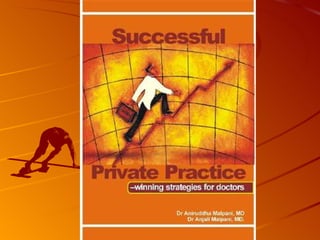
Successful Medical Practise Management

  • 1.
  • 2.
  • 3.
    What will thisworkshop help you to do ? Manage your life better ! A doctor’s life is very different from a businessman’s or executives We have our own unique set of problems
  • 4.
    A doctor needsto wear many hats ! Clinician , who has polished medical skills Academician, who is a constant learner Manager , who understands the business aspects of running a profitable clinic
  • 5.
    A doctor needsto wear many hats ! CEO, who understands how to motivate staff and lead people; Financial expert, who can manage his money Family provider Self caretaker, who know how to look after himself and fulfill his personal needs .
  • 6.
    The problem Unfortunately,while doctors are quite eager to discuss medicine, most are unwilling to talk about the nuts and bolts of practise management Don’t want to enrich the competition by giving away their “trade secrets” ! We can learn together and help each other
  • 7.
    The solution Thereis no need to reinvent the wheel . The challenges are similar all over the world We can learn from our colleagues and from peers in other parts of the world Apply knowledge from other fields to ours !
  • 8.
    Being a doctortoday is not easy Do you find that there is: too much work too much hassle too much competition too much despair; and too little reimbursement ?
  • 9.
    Common response –work even harder ! Run around from clinic to clinic, hospital to hospital Try to “expand” your practise to get more patients
  • 10.
    Common response –work even harder ! Only 24 hours in a day ! Fed up and unhappy No time for yourself or your family
  • 11.
  • 12.
    Are you fedup of… Long energy-exhausting hours and crushing workloads leaving little or no free time for yourself or your family ? Demanding dissatisfied patients ? Inadequate payment for all your hard work ?
  • 13.
    Need to worksmarter – not harder ! Need to learn tools which will: Give you control of your time; Allow you to do work which you felt was worthwhile, for patients that you enjoy seeing; and Pay you well for your effort, so that you enjoy going to work every day.
  • 14.
    Practise management skillsEvery doctor is an entrepreneur Needs to run a business These skills are never taught in medical college Some doctors never learn them, and struggle to manage their practise
  • 15.
  • 16.
    5 stages ofa doctor’s career Entry, when you are starting out; Establishment, when you have created a name for yourself; Exploration, when you look for new fields to conquer; Specialization , when you settle down in your niche; and Mastery, when you establish yourself as the Expert in your area of interest.
  • 17.
    Specialise ! Needto carve out a niche for yourself Have a clear professional goal Shape your practise around your abilities – you will become extremely good at doing what you enjoy !
  • 18.
  • 19.
    Please Prescribe Information ! Dr Aniruddha Malpani, MD HELP, Health Education Library for People www.healthlibrary.com
  • 20.
    Carrot and stick1. Promote your practise Well informed patients are more faithful Differentiate yourself from other doctors Good investment ! Can vouch for this from personal experience ! 2. Protect you from lawsuits Document that you have educated your patient
  • 21.
    Patient autonomy Autonomy= freedom to decide Doctors need to 1. present the options to the patients and 2. allow patients to choose for themselves Informed choice means patients need information
  • 22.
    Allowing patients tochoose With advances in medical therapy, there are often many treatment options available for any medical problem Do not choose for the patient – how can you read the patient’s mind or foretell the outcome ? Present the information and let the patient decide
  • 23.
    Educating patients Most doctors do not spend much time educating their patients. This is a shame. The primary role of a doctor should not be merely treating an illness, but rather helping people remain healthy, and educating patients is vitally important for this.
  • 24.
    Doctor ( docere)= Teacher In ancient India, doctors were paid only if their patients were in good health. If someone fell ill, the doctor’s payments were stopped until he treated the illness successfully. This was a very useful model, which should be more widely practised!
  • 25.
    Barriers - 1Most of us do not have the time to encourage questions from patients. Most doctors are just not very good at communicating with their patients.   Doctors are used to talking medicalese
  • 26.
    Barriers - 2Educating the patient is simply not valued enough It is not seen to be glamorous It is not financially rewarding. It can be quite boring to repeat the same stuff again and again.
  • 27.
  • 28.
    Encourage questions !Some doctors feel threatened by a patient’s questions. This is not the right perspective at all. Remember: both doctor and patient have a similar goal – to make the patient better – and questions should be encouraged and answered, rather than leaving doubts to fester – a situation that can create unnecessary problems in the future.
  • 29.
    Benefits of patienteducation - 1 Happier patients , because they have been treated as intelligent adults. Patient education is important as a practice promoter: patients appreciate that the doctor has taken the time and effort to inform and teach them.
  • 30.
    Benefits - 2Patients forget over half of what the doctor tells them, because of the stress of the consultation. Giving them printed materials to read at home will help prevent midnight calls . Printed educational materials help to increase patient compliance
  • 31.
    Benefits - 3Patient education helps to improve public health. Educational materials are read by the entire family, and community health awareness can help to reduce quackery . People respect the printed word – especially when given by the doctor !
  • 32.
    Best form ofCME for the doctor ! Remember that the inquiring and well-informed patient can teach you much more about medicine than any textbook ! A patient’s questions will make a good doctor think about things that otherwise he or she might take for granted.
  • 33.
    Best form ofCME for the doctor ! Help you to improve the quality of your medical practice. The well-informed patient may help make you aware of advances occurring in other parts of the world that you – as a busy doctor – might otherwise overlook.
  • 34.
    Helps to improveempathy Reading information intended for the patient can teach you to look at things from the patient’s point of view. This helps to increase your empathy – a very desirable goal.
  • 35.
    Reduce risk ofcomplications Patient education can actually reduce the risk of inadvertent complications. After all, doctors are human and may make errors . The well-informed patient can sometimes point out possible problems with a treatment plan that the doctor may have overlooked (for example, patients with G6PD deficiency)
  • 36.
    Reduce quackery Educatingpatients will help prevent health fraud and quackery. If doctors teach their patients about what can be done to help them, as well as the limits of what we can offer them, they are unlikely to be cheated by quacks.
  • 37.
    Reduce medicolegalrisks Educational handouts offer proof that the doctor has informed the patient of possible complications and risks . Patient education is an integral part of “risk management” in medical practice today, and will reduce the risk of doctors being sued if complications do occur.
  • 38.
    Patient education –key component of informed consent Don’t tell the patient what to do Present the information and the treatment options – and allow them to make up their own mind ! Empower patients with information – they will respect you for this !
  • 39.
    Printed brochures Printedpamphlets form the core of patient education. It’s easy to adapt, modify, translate and print educational leaflets produced elsewhere – don’t waste time reinventing the wheel ! You can find many examples to copy at HELP ! Test them on your patients !
  • 40.
  • 41.
    Printed brochures Rememberthat patients have different levels of reading skills Leave these in your waiting room, so that patients can gainfully use their time while waiting for you
  • 42.
    Printed brochures Encourageyour patients to take the leaflets and read them at home at leisure – this is a good way to promote your practice as well. You can also give them the appropriate leaflet at the end of the consultation.
  • 43.
    Please Prescribe Information! All the information in the world can never replace the doctor ! Information can help you become a better doctor – and also help your patient to become a better patient !
  • 44.
    Doctor.com Dr Malpani,MD http://www.drmalpani.com
  • 45.
    Why bother ?Doctors have practised medicine for many years without the Net Isn’t this just another new-fangled toy for kids to play with ? Isn’t the boom over ? I’m too old to learn !
  • 46.
  • 47.
    MDConsult.com Full textof over 30 medical textbooks, medical journals and Clinics of North America No advertising Specially discounted price for Indian doctors Subsciption can be provided by a pharmaceutical company
  • 48.
    MDConsult.com For lessthan Rs 30 per day, you will never need to buy another medical book or journal in your life Constantly updated all the time Excellent patient educational information as well, which you can print out for your patients !
  • 49.
    Get on theNet Today, it’s not enough to just have a net connection You need to have your own website ! Symbolic of how rapidly times are changing !
  • 50.
    Start your ownwebsite ! Patients are hungry for reliable information The internet is an excellent source of information, but a lot of this can be wrong and dangerous Provide reliable information to your patients through your own website Very cost effective !
  • 51.
    Why is thisimportant for you ? Why should you take the time and trouble of setting up your own website ?
  • 52.
    To promote yourpractice ! This is the simplest and easiest answer – and the one most doctors will understand ! A website is a very cost-effective way of getting more patients , because it lets patients all over the world know about your special skills ! Think global – act local !
  • 53.
    How does awebsite help ? Provide value-added services for your existing patients. Provide clinic details ( how to get to the clinic, clinic timings) You can answer email queries You can provide reliable medical information about “hot” topics – such as the leptospirosis scare
  • 54.
    How does awebsite help ? For example, you can put up a FAQ ( frequently asked questions) section, which answers the commonest queries patients usually ask you. You can “refer” patients to your website at the end of the consultation, so they can educate themselves ! Patients appreciate this – and word of mouth will help you get more patients !
  • 55.
    How does awebsite help ? Your website can help you to attract new patients ! Bombay is a medical center, and Indian medical care is very cost-effective. Valuable for attracting NRIs, for example Soon, it will become as routine for patients in India to do “ research “ about doctors, as it is in USA. Your website can help patients to find you !
  • 56.
    Website benefits Yourwebsite lets your patients know that you are upto date and familiar with modern technology ! At our website at http://www.DrMalpani.com - we answer over 10 queries a day Get direct patient referrals from all over the world !
  • 57.
    Internet positive patientsWell-informed Demanding Affluent
  • 58.
    Cannot afford tonot use the Net Integral part of medical practice for the future Communication with patients Communication with chemists, lab results, consultants, colleagues Billing – insurance companies
  • 59.
    E-healthcare Patients willdemand medical services to suit their convenience Smart doctors need to be prepared Better to be proactive rather than try to catch up later Doctors with their own websites will always be web-savvy and “clued-in”
  • 60.
    Medical Tourism Enormousscope for Indian doctors to “export” their expertise without leaving the country ! Can provide online round the clock videoconferencing with patients, one on one, for a fee
  • 61.
    Telemedicine Can helppatients in the US to save money and time by offering personalized medical consultations – at a fraction of the cost in the USA Provide expert second opinions Very attractive for third party payors, insurance companies, HMOs
  • 62.
    Matter of timeWhat happens in the US will happen in India after a few years The pace of change is rapidly accelerating and we are catching up quickly We can learn from the experience of doctors in the US !
  • 63.
  • 64.
  • 65.
    Today’s Health CareSystem Patient Health Insurance Government Information Overload Media The Physician
  • 66.
  • 67.
  • 68.
  • 69.
    The foundation ofthe relationship Based on TRUST Trust needs to be earned !
  • 70.
    The past TheFamily Doctor Doctors were held in high regard Worked hard, were paid little, but were trusted and respected Held in high esteem
  • 71.
    The present Today,doctors get beaten up because patients or their relatives ) perceive they are getting poor medical care. Medical negligence lawsuits increasing
  • 72.
    The present Thedoctor-patient relationship is breaking down Patients feel exploited and believe that the medical profession has become crass and commercialized Doctors feel unappreciated, overworked, victimised and threatened.
  • 73.
    How do wefix the problem ? Two players Doctors Patients It’s hard to change anyone else – you can only change yourself !
  • 74.
    Polish your bedsidemanner The most important intangible Your patient needs to know how much you care Technical competence is usually taken for granted Simple measures – be polite; sit down while talking to the patient; smile; don’t interrupt !
  • 75.
    What do patientsexpect from their doctors ? Expertise ( be well-informed and uptodate) Professionalism – look out for the patient’s best interests Accountability – be answerable; say Sorry ( if there is a mistake) Transparency – no unnecessary tests and referrals Respect their desires and their time Treat them as intelligent human beings
  • 76.
    What do doctorsexpect from their patients ? Doctors expect that patients will: Treat them with respect Will say “Thank You” when things go well Will have realistic expectations of their treatment Will not unfairly blame the doctor anytime there is a problem Will pay their professional fees promptly and gracefully
  • 77.
    Good doctors Gooddoctors spend a lot of time talking to their patients. They have an excellent bedside manner They build a relationship in which their patient can trust that the doctor will do what is in the patient’s best interests. This is the hallmark of the true professional
  • 78.
    Good doctors Adoctor who is a good professional has a very close relationship with his patients, because he knows that he is in the service industry. All good doctors are empathetic Just talking to the doctor can be therapeutic for many patients - after all, doctors are active healing agents, who are often far more potent than an antibiotic !
  • 79.
    Good doctors Doctorsneed to earn their patients’ trust – and they can do this by: being generous with their knowledge; showing their patients that they care; respecting their time; and fulfilling their promises.
  • 80.
    Good doctors Thisis why senior doctors value their reputation so much – it is built on the foundation of a lifetime of hard work – and even though it is intangible, it represents the fact that patients have trust in them.
  • 81.
    Good doctors Professionalismshould be taught at all levels of medical education , so future generations of doctors will still be proud to be a part of this ancient and respected profession.
  • 82.
    Dehumanising doctors Unfortunately,we do not encourage our medical students to develop their emotional skills, and medical college usually drains whatever natural empathy students have. Students get marked for their academic excellence, cramming ability and surgical virtuosity – not their ability to establish a rapport with their patients !
  • 83.
    Bad doctors Don’trespect patients - treat them as mentally defective idiots Don’t respect patients’ Time Preferences Beliefs
  • 84.
    Doctors are unhappytoo * They are stressed out, because of the large number of patients they need to see * They feel that patients expect too much from them. * The feel that patients unfairly blame doctors for all bad outcomes. Doctors are easy targets
  • 85.
    Doctors are unhappytoo The press enjoys doctor-bashing. This makes a bad situation worse, and the entire profession suffers because of a few bad doctors Many doctors also feel that patients waste their valuable time by asking stupid and irrelevant questions; because they are too disorganized; and don’t bother to educate themselves or do their homework.
  • 86.
    Today’s problems inhealthcare are because: * Everything is doctor-centric - the doctor is the center of the medical care system * Healthcare is therefore fragmented and disorganised * Too many specialists , most of whom have tunnel vision
  • 87.
    We need toreform the healthcare ecosystem Put patients at the center Patients are the largest untapped healthcare resource ! Patients ( or their relatives and friends) are intelligent and capable; and because they have a lot at stake , they are motivated to get good health care We need to provide the tools directly to patients !
  • 88.
    Patient centered healthcare* Self-care * Personalization * Transparency * Quality * Control
  • 89.
  • 90.
    The doctor-patient relationshipis a two-way street Teach your patient how to be a good patient ! A well-informed patient understands what the doctor is doing and why; has realistic expectations;  and also understands that a doctor is not God, and that complications and mishaps can occur.  
  • 91.
    How to talkto your doctor – SAFEly ! Story: S is your Story. In chronologic order, starting with when you first started feeling unwell. List all your symptoms Write them down Try to be as objective as possible - it's helpful to pretend you are a third party, reporting on the symptoms.
  • 92.
    How to talkto your doctor – SAFEly ! Assessment: What do you feel is wrong with you ? You don’t need to diagnose your own problem - just to let your doctor know what you feel is responsible for your problem. After all, you are the expert on your own body !
  • 93.
    How to talkto your doctor – SAFEly ! Fears: What are you worried may happen to you as a result of your illness. Are you worried this will affect your ability to play tennis ? work ? affect your future fertility ? The best way to overcome your fears is to discuss these with your doctor.
  • 94.
    How to talkto your doctor – SAFEly ! Expectations: What do you want from your doctor ? Do you want him to run some tests to reassure you that all is well ? Do you just want pain relief ? Do you want an accurate diagnosis from your doctor ?
  • 95.
    Today - Doctorv/s patient This is sad ! We are all on the same side ! How do we fix the problem ?
  • 96.
    Information Therapy Doctorsneed to “ prescribe information “ Patients will then have realistic expectations of what their doctor can do for them . Information therapy - “ Prescribing the Right Information to the Right Person at the Right Time” is the best way of bridging the doctor-patient communication gap today !
  • 97.
    Non-verbal communication -SOFTEN S- Smile O - Open posture F- Forward lean T – Touch. This is a privilege – use it ! E – Eye contact N - Nod
  • 98.
    Develop empathy Learnfrom Munnabhai, MBBS Polish your EQ skills ! A high EQ is far more important than a high IQ Patients don’t care how much you know – until they know how much you care !
  • 99.
    BATHE technique B= Background. What’s going on ? A = Affect. Feelings. What do you feel about it ? T = Troubles. What troubles you about this ? H = Handle. How are you handling this ? E = Empathy. It must be hard.
  • 100.
    Stress management – Preventing Burnout Learn to say No Learn to take care of yourself Balance your professional and personal priorities Develop a strong support system
  • 101.
    Stress management – Preventing Burnout Cut back on the routine work you find boring Challenge yourself daily “ Physician, heal thyself” ! Follow the advise you give your patients, regarding not smoking, not drinking, a healthy diet and exercising !
  • 102.
    Become a Professional– The Trust Equation T = C + R + I/ S, where T = Trustworthiness C= Credibility R= Reliability I = Intimacy S= Self-orientation
  • 103.
    Become a Professional– The Trust Equation Credibility = can your patient trust what you say ? Reliability = can he trust your actions, confident that you will act honorably ? Intimacy = is he comfortable discussing his feelings and emotions with you ? Self-orientation = can he trust your motives, knowing that you care about him, and will act in his best interests ?
  • 104.
    The joy ofpractising medicine – how to be a happy doctor Care for your patients. Treat all your patients like VIPs . A healthy doctor-patient relationship nurtures both patient and doctor ! Savor your patients. When a patient thanks you , relish that moment. Those moments are the real reward for being a doctor, if you can slow down to let them in.
  • 105.
    The golden rulePatients are the practise Everything else is just paper work !
  • 106.
    The joy ofpractising medicine – how to be a happy doctor When it comes to getting positive feedback, no profession in the world comes close to medicine ! A good doctor can have the best emotional income in the world ! Be thankful daily that you have the opportunity for helping others – expressing gratitude will help you find contentment and self-worth
  • 107.
  • 108.
    Money ! Doctorsare daily wage earners Don’t work – don’t get paid Need to plan for the future Develop stream of “passive income” Learn to use other people’s time and other people’s money to make more money !
  • 109.
  • 110.
  • 111.
    Marketing Marketing isNOT a dirty word Doctors have always marketed themselves Traditionally, it has been “word of mouth” marketing This is still the best type, but it takes time. This is most worthwhile investment of your time !
  • 112.
  • 113.
    Promoting your practiseAdvertising can be very expensive, and is usually not cost effective Public relations firms have become very popular amongst doctors recently Satisfied patients are your best marketing tool – concentrate on keeping them happy !
  • 114.
  • 115.
    Risk management Medicolegalproblems How to prevent them Risk management How to deal with them
  • 116.
    Practical problems Dealingwith difficult patients Handling the angry patient How to talk to relatives Networking with other doctors
  • 117.
    IQ versus EQMost doctors have a high IQ This is NOT enough Need a high EQ to do well in practise These skills can be learnt Doctors are smart !
  • 118.
    Employees ! Canbe your biggest asset – as well as your biggest problem ! Keep your employees happy, and they will keep your patients happy Don’t skimp on their salaries Train them well Key test – how well does your clinic run when you are not there ?
  • 119.
    Many other issuesTime management Learning to keep upto date How to buy medical equipment How to keep medical records How to grow and expand Balancing family and career Retiring Ethics
  • 120.