Successful Brand
        Management:
Moving from a Product-Centric
   to a Customer-Centric
      Business Model


               Suzanne Kushner
    Director of Marketing Communications
                  Mainsoft Corp.
           Suzannekushner@hotmail.com
Top 3 Things to Remember
       When “Branding”
1. Think of Branding as a way of doing
   business, not just a Marketing function
2. Look for ways to improve your Total
   Customer Experience more often
3. Service – good or bad – may have the
   greatest impact on your product or
   company’s brand image
Why is branding so important to
    high-tech companies?

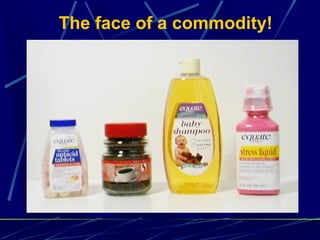
     Product commoditization
         Consumers have more choices than ever
     Harder to offer strong value
     propositions, differentiation in
     technology products
     Strong brands can command premium
     prices
        (Historically) Strong brands have driven
         strong stock prices
The face of a commodity!
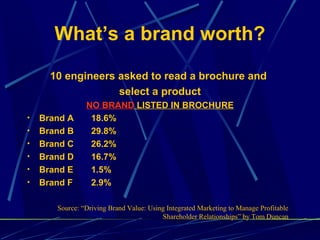
What’s a brand worth?

      10 engineers asked to read a brochure and
                   select a product
                NO BRAND LISTED IN BROCHURE
•   Brand A      18.6%
•   Brand B      29.8%
•   Brand C      26.2%
•   Brand D      16.7%
•   Brand E      1.5%
•   Brand F      2.9%

       Source: “Driving Brand Value: Using Integrated Marketing to Manage Profitable
                                         Shareholder Relationships” by Tom Duncan
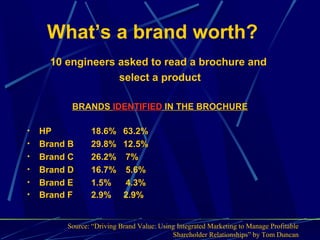
What’s a brand worth?
      10 engineers asked to read a brochure and
                   select a product

          BRANDS IDENTIFIED IN THE BROCHURE

•   HP          18.6% 63.2%
•   Brand B     29.8% 12.5%
•   Brand C     26.2% 7%
•   Brand D     16.7% 5.6%
•   Brand E     1.5%  4.3%
•   Brand F     2.9% 2.9%


         Source: “Driving Brand Value: Using Integrated Marketing to Manage Profitable
                                           Shareholder Relationships” by Tom Duncan
Do most High-Tech
companies have a branding
     strategy that
     really works?
Most aren’t sure!
• Most high-tech companies are run by
  people who don’t know what good
  brand management involves
• Most branding is left to Marketing to
  create logos and run ad campaigns


                                    XXX
To “brand” their products, here’s
       what they’re doing:

• Trying to gain mindshare via
  advertising and mass media
• Creating pretty logos!
• Creating interesting taglines
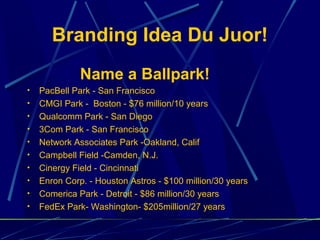
Branding Idea Du Juor!
              Name a Ballpark!
•   PacBell Park - San Francisco
•   CMGI Park - Boston - $76 million/10 years
•   Qualcomm Park - San Diego
•   3Com Park - San Francisco
•   Network Associates Park -Oakland, Calif
•   Campbell Field -Camden, N.J.
•   Cinergy Field - Cincinnati
•   Enron Corp. - Houston Astros - $100 million/30 years
•   Comerica Park - Detroit - $86 million/30 years
•   FedEx Park- Washington- $205million/27 years
High-tech branding is different
• Product lifecycles are short
• Innovation and change-driven industry so
  “secondary” brands don’t have a real impact:
   Sears:Kenmore/Craftsman
   GM: Chevrolet, Pontiac

• Often concentrate on brand of company, not
  product
• Most high-tech brands must grapple with
  global complexity; trademarking
  internationally is expensive
Biggest challenge for most high
       tech companies:
• Not one-voice, one-look, or lack of
  pretty logos - these are tactical,
  logistical
• Creating and nourishing long-term
  customer relationships

                                XXX
What is a brand?

   A brand represents a
relationship customers have
  come to know and value
                - Regis McKenna
What is a relationship?

What’s the company/product
 promising and what’s the
    company/product
         delivering?
So…sounds simple, but

  Making and keeping a
  promise - consistently -
 can be a powerful source
 of competitive advantage
Technology buyers are skeptical

•    Conditioned to expect unreliable products
•    Burned by old and new companies
     promising too much
•    Don’t think a company has their best
     interest in mind
•    Low expectations for good service

                                     msf
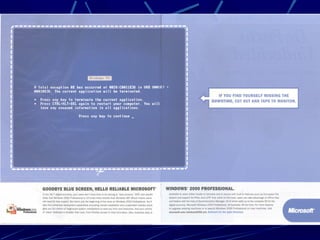
In high tech, the interpretation of
          “branding” is:

  Sell the promise but it’s OK to
   deliver only 40% of the time!
For many companies, the brand IS
          the company
 • Nordstrom
 • Volvo
 • SW Airlines
 • Tiffany
 • Kellogg
 • HP
 • Intel
 • Microsoft
 • Google
How do you create a brand?

OLD WAY
• Create a new category
• Displace a competitor

NEW WAY
• An active experience where the customer is
  actively involved and feels empowered
Today, branding is about…

 • Moving from product-centric focus to
   customer-centric focus
 • Realizing the ENTIRE customer
   experience can be the most significant
   driver to brand value
 • Any contact with your organization
   defines your brand
How do you build or enhance
  your company’s brand?
                OLD WAY
One-way communication: mass media
 via TV, print, word-of-mouth, broadcast
                NEW WAY
Two-way communication: All of above
 PLUS we must create 1-to-1
 relationships by communicating WITH
 customers; create purposeful dialog
5 R’s of “Purposeful” Dialog
1.   Recourse – Customers want to avoid risk when buying a
     product…
        - Make it easy for the customer to contact the
         company if there is a problem
2.   Recognition – Customers like to be personally recognized
        Address customers by name on solicitations
3.   Responsiveness – Do more than provide an 800-number!
4.   Respect – Dialog w. the customer when it makes sense for
     them
5.   Reinforcement – Reinforce your message w. mass media that
     has a call to action!
Types of Brand Messages
1.   Product Messages: Performance, price, distribution points:
         Ex. Price sends a message! What would you think of a
         Rolex watch for $15? Or a diamond ring in Kmart
         packaging?
1.   Service Messages: interactions your customers have w/your
     company
         Ex. Customer service reps, receptionist, delivery drivers -
         these can have a SIGNIFICANT impact
1.   Unplanned Messages: messages you can influence but can’t
     control
         Ex. news stories, word-of-mouth, special interest groups,
         chat rooms employees
1.   Planned Messages: (marcom)
         Ex. Advertisements, Brochures, data sheets, datasheets
Which “source” is often the
     most influential?
         UNPLANNED MESSAGES!!!
• Typically have more of an impact than
  marketing programs
• Sometimes you can influence them, but
  you can’t always control them
• Are these confirming your “planned”
  messages?
Do you need advertising/mass
   media to build a brand?


      Logos? Taglines?
Tip!

Marketing budgets are
determined by results!
What can advertising
(mass media) actually do?
• Create positive images; create
  awareness
• Position brand
• Reach multiple stakeholders


• AGGREGATE AND QUALIFY
  PROSPECTS – then move to 1-to-1
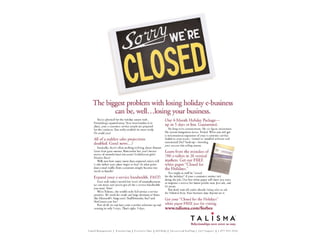
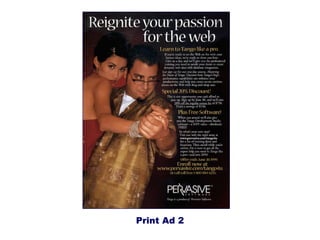
Print Ad 2
CAUTION!
• NON-ADVERTISING MESSAGES
  can negate the most brilliant
  creative work
• Building strong brand relationships
  means LISTENING to and
  RESPONDING to customers
This is all interesting, but
   where does Product
 Management/Marketing
            fit in?
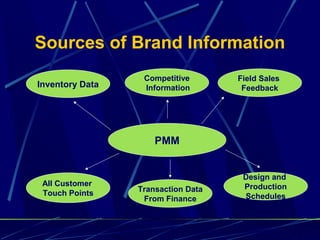
Sources of Brand Information
                  Competitive       Field Sales
Inventory Data    Information        Feedback


                     PMM


                                     Design and
 All Customer                        Production
 Touch Points    Transaction Data
                  From Finance       Schedules
How Product Management should
       view branding…

 Clearly understand the net worth of your
 current customers
 Know your customer touch points;
 determine which you can (positively)
 influence TODAY
 Postpone Marketing activities if more
 serious problems exist
 Hire a branding agency – not an ad
 agency
How companies should think
       about branding
• Make your brand strategy a way of doing
  business – not just a marketing function
• Shift emphasis from ACQUIRING
  customers to RETAINING and GROWING
  customers
• Communicate WITH rather than TO
  customers
• Better manage customer expectations
Measure Your Brand Through a
        Brand Audit
             Components of Brand Audit
•   TRUST – Does product do what it says it will do?
•   CONSISTENCY – Is product performance and service
    predictable? Are company policies and procedures consistent?
•   ACCESSIBILTY – Is it easy to reach your company?
•   RESPONSIVENESS – Are questions, inquiries and complaints
    quickly and thoroughly handled
•   COMMITMENT – To what extent is the company really
    interested in customers?
•   AFFINITY – Do customers identify with this brand? Do they
    relate to other people who use it?
•   LIKING – Do all stakeholders like to be associated with the
    brand?
Top 3 Things to Remember When
          “Branding”

1. Think of Branding as a way of doing
   business, not just a Marketing function
2. Look for ways to improve your Total
   Customer Experience more often
3. Service – good or bad – may have the
   greatest impact on your product or
   company’s brand image

Successful Brand Management

  • 1.
    Successful Brand Management: Moving from a Product-Centric to a Customer-Centric Business Model Suzanne Kushner Director of Marketing Communications Mainsoft Corp. Suzannekushner@hotmail.com
  • 2.
    Top 3 Thingsto Remember When “Branding” 1. Think of Branding as a way of doing business, not just a Marketing function 2. Look for ways to improve your Total Customer Experience more often 3. Service – good or bad – may have the greatest impact on your product or company’s brand image
  • 3.
    Why is brandingso important to high-tech companies? Product commoditization Consumers have more choices than ever Harder to offer strong value propositions, differentiation in technology products Strong brands can command premium prices  (Historically) Strong brands have driven strong stock prices
  • 4.
    The face ofa commodity!
  • 5.
    What’s a brandworth? 10 engineers asked to read a brochure and select a product NO BRAND LISTED IN BROCHURE • Brand A 18.6% • Brand B 29.8% • Brand C 26.2% • Brand D 16.7% • Brand E 1.5% • Brand F 2.9% Source: “Driving Brand Value: Using Integrated Marketing to Manage Profitable Shareholder Relationships” by Tom Duncan
  • 6.
    What’s a brandworth? 10 engineers asked to read a brochure and select a product BRANDS IDENTIFIED IN THE BROCHURE • HP 18.6% 63.2% • Brand B 29.8% 12.5% • Brand C 26.2% 7% • Brand D 16.7% 5.6% • Brand E 1.5% 4.3% • Brand F 2.9% 2.9% Source: “Driving Brand Value: Using Integrated Marketing to Manage Profitable Shareholder Relationships” by Tom Duncan
  • 7.
    Do most High-Tech companieshave a branding strategy that really works?
  • 8.
    Most aren’t sure! •Most high-tech companies are run by people who don’t know what good brand management involves • Most branding is left to Marketing to create logos and run ad campaigns XXX
  • 9.
    To “brand” theirproducts, here’s what they’re doing: • Trying to gain mindshare via advertising and mass media • Creating pretty logos! • Creating interesting taglines
  • 10.
    Branding Idea DuJuor! Name a Ballpark! • PacBell Park - San Francisco • CMGI Park - Boston - $76 million/10 years • Qualcomm Park - San Diego • 3Com Park - San Francisco • Network Associates Park -Oakland, Calif • Campbell Field -Camden, N.J. • Cinergy Field - Cincinnati • Enron Corp. - Houston Astros - $100 million/30 years • Comerica Park - Detroit - $86 million/30 years • FedEx Park- Washington- $205million/27 years
  • 11.
    High-tech branding isdifferent • Product lifecycles are short • Innovation and change-driven industry so “secondary” brands don’t have a real impact:  Sears:Kenmore/Craftsman  GM: Chevrolet, Pontiac • Often concentrate on brand of company, not product • Most high-tech brands must grapple with global complexity; trademarking internationally is expensive
  • 12.
    Biggest challenge formost high tech companies: • Not one-voice, one-look, or lack of pretty logos - these are tactical, logistical • Creating and nourishing long-term customer relationships XXX
  • 13.
    What is abrand? A brand represents a relationship customers have come to know and value - Regis McKenna
  • 14.
    What is arelationship? What’s the company/product promising and what’s the company/product delivering?
  • 15.
    So…sounds simple, but Making and keeping a promise - consistently - can be a powerful source of competitive advantage
  • 16.
    Technology buyers areskeptical • Conditioned to expect unreliable products • Burned by old and new companies promising too much • Don’t think a company has their best interest in mind • Low expectations for good service msf
  • 18.
    In high tech,the interpretation of “branding” is: Sell the promise but it’s OK to deliver only 40% of the time!
  • 19.
    For many companies,the brand IS the company • Nordstrom • Volvo • SW Airlines • Tiffany • Kellogg • HP • Intel • Microsoft • Google
  • 20.
    How do youcreate a brand? OLD WAY • Create a new category • Displace a competitor NEW WAY • An active experience where the customer is actively involved and feels empowered
  • 21.
    Today, branding isabout… • Moving from product-centric focus to customer-centric focus • Realizing the ENTIRE customer experience can be the most significant driver to brand value • Any contact with your organization defines your brand
  • 22.
    How do youbuild or enhance your company’s brand? OLD WAY One-way communication: mass media via TV, print, word-of-mouth, broadcast NEW WAY Two-way communication: All of above PLUS we must create 1-to-1 relationships by communicating WITH customers; create purposeful dialog
  • 23.
    5 R’s of“Purposeful” Dialog 1. Recourse – Customers want to avoid risk when buying a product…  - Make it easy for the customer to contact the company if there is a problem 2. Recognition – Customers like to be personally recognized  Address customers by name on solicitations 3. Responsiveness – Do more than provide an 800-number! 4. Respect – Dialog w. the customer when it makes sense for them 5. Reinforcement – Reinforce your message w. mass media that has a call to action!
  • 24.
    Types of BrandMessages 1. Product Messages: Performance, price, distribution points: Ex. Price sends a message! What would you think of a Rolex watch for $15? Or a diamond ring in Kmart packaging? 1. Service Messages: interactions your customers have w/your company Ex. Customer service reps, receptionist, delivery drivers - these can have a SIGNIFICANT impact 1. Unplanned Messages: messages you can influence but can’t control Ex. news stories, word-of-mouth, special interest groups, chat rooms employees 1. Planned Messages: (marcom) Ex. Advertisements, Brochures, data sheets, datasheets
  • 25.
    Which “source” isoften the most influential? UNPLANNED MESSAGES!!! • Typically have more of an impact than marketing programs • Sometimes you can influence them, but you can’t always control them • Are these confirming your “planned” messages?
  • 26.
    Do you needadvertising/mass media to build a brand? Logos? Taglines?
  • 27.
  • 28.
    What can advertising (massmedia) actually do? • Create positive images; create awareness • Position brand • Reach multiple stakeholders • AGGREGATE AND QUALIFY PROSPECTS – then move to 1-to-1
  • 30.
  • 32.
    CAUTION! • NON-ADVERTISING MESSAGES can negate the most brilliant creative work • Building strong brand relationships means LISTENING to and RESPONDING to customers
  • 33.
    This is allinteresting, but where does Product Management/Marketing fit in?
  • 34.
    Sources of BrandInformation Competitive Field Sales Inventory Data Information Feedback PMM Design and All Customer Production Touch Points Transaction Data From Finance Schedules
  • 35.
    How Product Managementshould view branding… Clearly understand the net worth of your current customers Know your customer touch points; determine which you can (positively) influence TODAY Postpone Marketing activities if more serious problems exist Hire a branding agency – not an ad agency
  • 36.
    How companies shouldthink about branding • Make your brand strategy a way of doing business – not just a marketing function • Shift emphasis from ACQUIRING customers to RETAINING and GROWING customers • Communicate WITH rather than TO customers • Better manage customer expectations
  • 37.
    Measure Your BrandThrough a Brand Audit Components of Brand Audit • TRUST – Does product do what it says it will do? • CONSISTENCY – Is product performance and service predictable? Are company policies and procedures consistent? • ACCESSIBILTY – Is it easy to reach your company? • RESPONSIVENESS – Are questions, inquiries and complaints quickly and thoroughly handled • COMMITMENT – To what extent is the company really interested in customers? • AFFINITY – Do customers identify with this brand? Do they relate to other people who use it? • LIKING – Do all stakeholders like to be associated with the brand?
  • 38.
    Top 3 Thingsto Remember When “Branding” 1. Think of Branding as a way of doing business, not just a Marketing function 2. Look for ways to improve your Total Customer Experience more often 3. Service – good or bad – may have the greatest impact on your product or company’s brand image

Editor's Notes

  • #2 Use Microsft Example
  • #10 Show the Lucent Msft shirt
  • #13 Pets.com