Group 4
-Amrutha
-Nabila
-Thushara
-Vineetha
INTRODUCTION
 The current global economic crisis is widely viewed as a glaring
example of limitless pursuit of greed and overindulgence at the
expense of caution,prudence, due diligence and regulation
 Financial crises of some kind or the other occur sporadically
virtually every decade and in various locations around the world.
 Financial meltdowns have occurred in countries ranging from
Sweden to Argentina, from Russia to Korea,from the United
Kingdom to Indonesia, and from Japan to the United States.
 Each financial crisis is unique, yet each bears some resemblance
to others. Ingeneral, crises have been generated by factors such
as overheating of markets,
-excessive leveraging of debt
-credit booms
-miscalculations of risk
-rapid outflows of capital from a country
-unsustainable macroeconomic policies
- off-balance sheet operations by banks
-inexperience with new financial instruments
-deregulation without sufficient market monitoring
 The financial crisis of 2007–08, also known as the Global
Financial Crisis and 2008 financial crisis, is considered by
many economists to have been the worst financial crisis since
the Great depression of the 1930s.
 [It threatened the collapse of large financial institutions, which
was prevented by the bailout of banks by national governments,
but stock markets still dropped worldwide. In many areas, the
housing market also suffered, resulting in evictions,foreclosures
and prolonged unemployment.
 The crisis played a significant role in the failure of key
businesses, declines in consumer wealth estimated in trillions of
U.S. dollars, and a downturn of economic activity leading to
2008-2012 global recession. and contributing to the European
sovereign-debt crisis .
 The active phase of the crisis, which manifested as a liquidity
crisis, can be dated from August 9, 2007, when BNP Paribas
terminated withdrawals from three hedge funds citing "a
complete evaporation of liquidity".
 (i) Boom in World Economy and Thriving Asset
Prices
 Following the global slowdown of 2001, the world economy had
recovered rather rapidly, posting record growth rates in 2004, 2005 and
2006.
 The long period of abundant liquidity and lowinterest rates prior to the
crisis led to a global search for yield and a general under-pricing of risk
by investors.
 Lending volumes increased substantially in many countries, due to a
decline in lending standards and increasedleverage, contributing to
bubbles in asset prices and commodities.
 The strong performance in financial markets was fortified by the strength
of asset prices.
 Globally, property prices had been rising rapidly acting as a
critical support for household spending. Their prolonged strength had
been especially in evidence in several developed countries including the US.
 Across a wide spectrum of asset classes, volatilities and risk premia
looked exceptionally low compared with fixed income credit, equity and
foreign exchange markets
( ii)Growth in us economy-interst rate cut and
deregulation
 According to one influential school of thought represented by among
others, Paul Krugman, there was ‘global imbalances’, the phenomenon
of huge current account surpluses in China and few other countries
coexisting with the unsustainably large deficits in the US.
 This imbalance was caused by the propensity of the countries with
high saving rate to park their savings often at low yields, in the US.
 The flood of money from these countries into the US kept interest
rates low, fuelled the credit boom and inflated real estate
and other asset prices to unsustainable levels.
(iii) Rapid increase in credit
 Against the backdrop of the historically low interest rates and
booming asset prices, credit aggregates, along side monetary
aggregates, had been expanding rapidly.
 Despite the rapid increase in credit, however, the balance-
sheets and repayment capacity of corporations as also the
households did not appear to be under any strain.
 The high level of asset prices kept the leverage ratios in check
while the combination of strong income flows and low interest
rates did the same with debt service ratios.
 In fact, in the aggregatethe corporate sector enjoyed unusually
strong profitability and a comfortable liquidity position, even
though in some sectors leverage was elevated as aresult of very
strong leverage buyout (LBO) and so-called
“recapitalization”activity.
 But debt-to-income ratios in the household sectors exhibited a
markedupward trend, on the back of a major rise in mortgage
debt.
(iv) Failure of the US Leadership in Anticipating the
Crisis
 During the housing boom, most of the US authorities failed to
comprehend the problem
 . Alan Greenspan, the then head of Federal Reserve,
in his book 'The Age of Turbulence', recalled what he used to say about the
housing boom: "I would tell audiences that we were facing not a bubble but
froth – lots of small local bubbles that never grew to a scale that could
threaten the health of the overall economy.“
 Even President Bush during his presidency never mentioned about the
housing boom in public pronouncements while it was happening.
 It is believed that the leaders in US were aware of the possibility of real
estate bubbles but they did not anticipate its devastating consequences.
As a result, the speculative housing market got considerable
encouragement in terms of investment leading to tangible losses to all
stakeholders in the event of the crisis
GENESIS OF THE CRISIS
 The crisis was an outcome of the interplay between both micro economic and
macro economic factors.
 Macro economic perspective-crisis has been attributed to the persistence of the
global imbalances,excessively accommodative monetary policy,lack of recognition
of asset prices in policy formulation
 Micro economic perspective-rapid financial innovations with adequate regulation
,credit boom and lowering of credit standards,inadequate corporate
governance,inappropriate incentive system in the financial sector and overall lax
oversight of the financial system
• Main reasons
• Monetary policy of the us and other western countries were eases aggressively
• Policy rates of us reached 1% in june 2002
• Monetary excess during 2002-2006 leading to boom
• Asset prices received strong gains-demand exceed supply
• Global imbalance due to low interst & accommodative monetary policy
• In 2006, following policy changes housig prices started to decline that lead to
large scale foreclosures of housing loans resulting in bank losses and drastic fall in
liquidity.this triggered the crisis.given the negative externalities and market failure
in the financial sector and linkages across markets and countries, crisis became
global
• Global growth contracted to 1.3% and trade volume to 11%
IMPACTS OF CRISIS ON INDIAN ECONOMY
 Off shoot of globalized economy
increasing integartion of indian economy and its fianancial markets
increase its risks from these types of international developments.in india the
adverse effect was on its equity markets,domestic forex market and liquidity
 IMPACT ON CAPITAL FLOWS
total net capital flows decline from us$17.3 billion in april-june2007
tous$13.2 in april-june 2008.
 IMPACT ON STOCK AND FOREX MARKET
the impact of financial turmoil was largely seen on equity market.indian
stock prices have been severly effected.sensex down from 20,000 to less than
9000 in these years.stocks have even lost 90% of its value.
 IMPACT ON INDIAN BANKING SECTOR
The Indian banking system is not directly exposed to the sub-prime
mortgage assets. It has very limited indirect exposure to the US mortgage
market, or to the failed institutions or stressed asset. A detailed study
undertaken by the RBI in September 2007 on the impact of the sub-prime episode
on the Indian banks had revealed that none of the Indian banks or the foreign
banks, with whom the discussions had been held,had any direct exposure to the
sub-prime markets in the USA or other markets.However, a few Indian banks had
invested in the collateralised debt obligations(CDOs)/ bonds which had a few
underlying entities with sub-prime exposures.thus, no direct impact on account
of direct exposure to the sub-prime market was in evidence
 IMPACT ON INDUSTRIAL SECTOR AND EXPORT
 It has slowed down industrial sector, with industrial growth declined from
8.1 per cent from to 4.82 per cent .
 In manufacturing sector, thegrowth has come down to 4.0 per cent in
April-November, 2008 as compared to 9.8 per cent in the corresponding
period last year.
 exports have declined in absolute terms for five months in a row during
October 2008-February 2009.
 IMPACT ON EMPLOYMENT
 A survey conducted by the Ministry of Labour and Employment states
that in the last quarter of 2008, five lakh workers lost jobs.
 The survey was based on a fairly large sample size across sectors such as
Textiles, Automobiles, Gems & Jewellery, Metals, Mining,Construction,
Transport and BPO/ IT sectors
 Employment in these sectors went down from 16.2 million during
September 2008 to 15.7 million during December 2008
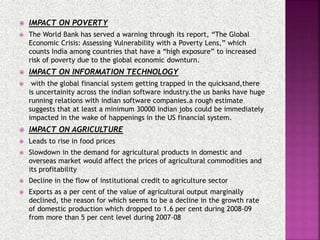
 IMPACT ON POVERTY
 The World Bank has served a warning through its report, “The Global
Economic Crisis: Assessing Vulnerability with a Poverty Lens,” which
counts India among countries that have a “high exposure” to increased
risk of poverty due to the global economic downturn.
 IMPACT ON INFORMATION TECHNOLOGY
 with the global financial system getting trapped in the quicksand,there
is uncertainity across the indian software industry.the us banks have huge
running relations with indian software companies.a rough estimate
suggests that at least a minimum 30000 indian jobs could be immediately
impacted in the wake of happenings in the US financial system.
 IMPACT ON AGRICULTURE
 Leads to rise in food prices
 Slowdown in the demand for agricultural products in domestic and
overseas market would affect the prices of agricultural commodities and
its profitability
 Decline in the flow of institutional credit to agriculture sector
 Exports as a per cent of the value of agricultural output marginally
declined, the reason for which seems to be a decline in the growth rate
of domestic production which dropped to 1.6 per cent during 2008-09
from more than 5 per cent level during 2007-08
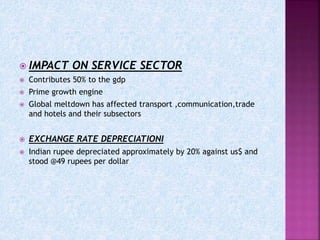
 IMPACT ON SERVICE SECTOR
 Contributes 50% to the gdp
 Prime growth engine
 Global meltdown has affected transport ,communication,trade
and hotels and their subsectors
 EXCHANGE RATE DEPRECIATIONI
 Indian rupee depreciated approximately by 20% against us$ and
stood @49 rupees per dollar
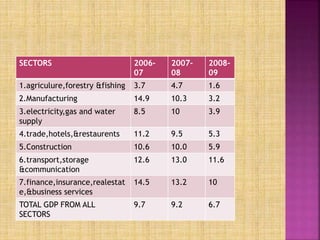
SECTORS 2006-
07
2007-
08
2008-
09
1.agriculure,forestry &fishing 3.7 4.7 1.6
2.Manufacturing 14.9 10.3 3.2
3.electricity,gas and water
supply
8.5 10 3.9
4.trade,hotels,&restaurents 11.2 9.5 5.3
5.Construction 10.6 10.0 5.9
6.transport,storage
&communication
12.6 13.0 11.6
7.finance,insurance,realestat
e,&business services
14.5 13.2 10
TOTAL GDP FROM ALL
SECTORS
9.7 9.2 6.7
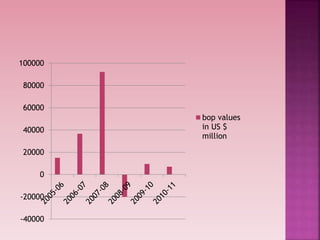
-40000
-20000
0
20000
40000
60000
80000
100000
bop values
in US $
million
 Global financial crisis has got a widspread
affect on indian economy
 it has got a far reaching negative impact on
all sectors of indian economy
 Resulted in loss of employment for lakhs of
people,reduction in export,forign exchange
depreciation etc
 the magnitude of the impact is low on our
country when we compare with the rest of
the world
 Rajyasabha.nic.in
 Global financial crisis,working paper
5,Nirupam vajbay
 Indian express.com
 Ageconsearch.umn.edu
 www.oecd.org/eco
 ijltet.org
 Mpra.ub.uni-muenchen.de

Global financial crisis

  • 1.
  • 2.
    INTRODUCTION  The currentglobal economic crisis is widely viewed as a glaring example of limitless pursuit of greed and overindulgence at the expense of caution,prudence, due diligence and regulation  Financial crises of some kind or the other occur sporadically virtually every decade and in various locations around the world.  Financial meltdowns have occurred in countries ranging from Sweden to Argentina, from Russia to Korea,from the United Kingdom to Indonesia, and from Japan to the United States.  Each financial crisis is unique, yet each bears some resemblance to others. Ingeneral, crises have been generated by factors such as overheating of markets, -excessive leveraging of debt -credit booms -miscalculations of risk -rapid outflows of capital from a country -unsustainable macroeconomic policies - off-balance sheet operations by banks -inexperience with new financial instruments -deregulation without sufficient market monitoring
  • 3.
     The financialcrisis of 2007–08, also known as the Global Financial Crisis and 2008 financial crisis, is considered by many economists to have been the worst financial crisis since the Great depression of the 1930s.  [It threatened the collapse of large financial institutions, which was prevented by the bailout of banks by national governments, but stock markets still dropped worldwide. In many areas, the housing market also suffered, resulting in evictions,foreclosures and prolonged unemployment.  The crisis played a significant role in the failure of key businesses, declines in consumer wealth estimated in trillions of U.S. dollars, and a downturn of economic activity leading to 2008-2012 global recession. and contributing to the European sovereign-debt crisis .  The active phase of the crisis, which manifested as a liquidity crisis, can be dated from August 9, 2007, when BNP Paribas terminated withdrawals from three hedge funds citing "a complete evaporation of liquidity".
  • 4.
     (i) Boomin World Economy and Thriving Asset Prices  Following the global slowdown of 2001, the world economy had recovered rather rapidly, posting record growth rates in 2004, 2005 and 2006.  The long period of abundant liquidity and lowinterest rates prior to the crisis led to a global search for yield and a general under-pricing of risk by investors.  Lending volumes increased substantially in many countries, due to a decline in lending standards and increasedleverage, contributing to bubbles in asset prices and commodities.  The strong performance in financial markets was fortified by the strength of asset prices.  Globally, property prices had been rising rapidly acting as a critical support for household spending. Their prolonged strength had been especially in evidence in several developed countries including the US.  Across a wide spectrum of asset classes, volatilities and risk premia looked exceptionally low compared with fixed income credit, equity and foreign exchange markets
  • 5.
    ( ii)Growth inus economy-interst rate cut and deregulation  According to one influential school of thought represented by among others, Paul Krugman, there was ‘global imbalances’, the phenomenon of huge current account surpluses in China and few other countries coexisting with the unsustainably large deficits in the US.  This imbalance was caused by the propensity of the countries with high saving rate to park their savings often at low yields, in the US.  The flood of money from these countries into the US kept interest rates low, fuelled the credit boom and inflated real estate and other asset prices to unsustainable levels.
  • 6.
    (iii) Rapid increasein credit  Against the backdrop of the historically low interest rates and booming asset prices, credit aggregates, along side monetary aggregates, had been expanding rapidly.  Despite the rapid increase in credit, however, the balance- sheets and repayment capacity of corporations as also the households did not appear to be under any strain.  The high level of asset prices kept the leverage ratios in check while the combination of strong income flows and low interest rates did the same with debt service ratios.  In fact, in the aggregatethe corporate sector enjoyed unusually strong profitability and a comfortable liquidity position, even though in some sectors leverage was elevated as aresult of very strong leverage buyout (LBO) and so-called “recapitalization”activity.  But debt-to-income ratios in the household sectors exhibited a markedupward trend, on the back of a major rise in mortgage debt.
  • 7.
    (iv) Failure ofthe US Leadership in Anticipating the Crisis  During the housing boom, most of the US authorities failed to comprehend the problem  . Alan Greenspan, the then head of Federal Reserve, in his book 'The Age of Turbulence', recalled what he used to say about the housing boom: "I would tell audiences that we were facing not a bubble but froth – lots of small local bubbles that never grew to a scale that could threaten the health of the overall economy.“  Even President Bush during his presidency never mentioned about the housing boom in public pronouncements while it was happening.  It is believed that the leaders in US were aware of the possibility of real estate bubbles but they did not anticipate its devastating consequences. As a result, the speculative housing market got considerable encouragement in terms of investment leading to tangible losses to all stakeholders in the event of the crisis
  • 8.
    GENESIS OF THECRISIS  The crisis was an outcome of the interplay between both micro economic and macro economic factors.  Macro economic perspective-crisis has been attributed to the persistence of the global imbalances,excessively accommodative monetary policy,lack of recognition of asset prices in policy formulation  Micro economic perspective-rapid financial innovations with adequate regulation ,credit boom and lowering of credit standards,inadequate corporate governance,inappropriate incentive system in the financial sector and overall lax oversight of the financial system • Main reasons • Monetary policy of the us and other western countries were eases aggressively • Policy rates of us reached 1% in june 2002 • Monetary excess during 2002-2006 leading to boom • Asset prices received strong gains-demand exceed supply • Global imbalance due to low interst & accommodative monetary policy • In 2006, following policy changes housig prices started to decline that lead to large scale foreclosures of housing loans resulting in bank losses and drastic fall in liquidity.this triggered the crisis.given the negative externalities and market failure in the financial sector and linkages across markets and countries, crisis became global • Global growth contracted to 1.3% and trade volume to 11%
  • 9.
    IMPACTS OF CRISISON INDIAN ECONOMY  Off shoot of globalized economy increasing integartion of indian economy and its fianancial markets increase its risks from these types of international developments.in india the adverse effect was on its equity markets,domestic forex market and liquidity  IMPACT ON CAPITAL FLOWS total net capital flows decline from us$17.3 billion in april-june2007 tous$13.2 in april-june 2008.  IMPACT ON STOCK AND FOREX MARKET the impact of financial turmoil was largely seen on equity market.indian stock prices have been severly effected.sensex down from 20,000 to less than 9000 in these years.stocks have even lost 90% of its value.  IMPACT ON INDIAN BANKING SECTOR The Indian banking system is not directly exposed to the sub-prime mortgage assets. It has very limited indirect exposure to the US mortgage market, or to the failed institutions or stressed asset. A detailed study undertaken by the RBI in September 2007 on the impact of the sub-prime episode on the Indian banks had revealed that none of the Indian banks or the foreign banks, with whom the discussions had been held,had any direct exposure to the sub-prime markets in the USA or other markets.However, a few Indian banks had invested in the collateralised debt obligations(CDOs)/ bonds which had a few underlying entities with sub-prime exposures.thus, no direct impact on account of direct exposure to the sub-prime market was in evidence
  • 10.
     IMPACT ONINDUSTRIAL SECTOR AND EXPORT  It has slowed down industrial sector, with industrial growth declined from 8.1 per cent from to 4.82 per cent .  In manufacturing sector, thegrowth has come down to 4.0 per cent in April-November, 2008 as compared to 9.8 per cent in the corresponding period last year.  exports have declined in absolute terms for five months in a row during October 2008-February 2009.  IMPACT ON EMPLOYMENT  A survey conducted by the Ministry of Labour and Employment states that in the last quarter of 2008, five lakh workers lost jobs.  The survey was based on a fairly large sample size across sectors such as Textiles, Automobiles, Gems & Jewellery, Metals, Mining,Construction, Transport and BPO/ IT sectors  Employment in these sectors went down from 16.2 million during September 2008 to 15.7 million during December 2008
  • 11.
     IMPACT ONPOVERTY  The World Bank has served a warning through its report, “The Global Economic Crisis: Assessing Vulnerability with a Poverty Lens,” which counts India among countries that have a “high exposure” to increased risk of poverty due to the global economic downturn.  IMPACT ON INFORMATION TECHNOLOGY  with the global financial system getting trapped in the quicksand,there is uncertainity across the indian software industry.the us banks have huge running relations with indian software companies.a rough estimate suggests that at least a minimum 30000 indian jobs could be immediately impacted in the wake of happenings in the US financial system.  IMPACT ON AGRICULTURE  Leads to rise in food prices  Slowdown in the demand for agricultural products in domestic and overseas market would affect the prices of agricultural commodities and its profitability  Decline in the flow of institutional credit to agriculture sector  Exports as a per cent of the value of agricultural output marginally declined, the reason for which seems to be a decline in the growth rate of domestic production which dropped to 1.6 per cent during 2008-09 from more than 5 per cent level during 2007-08
  • 12.
     IMPACT ONSERVICE SECTOR  Contributes 50% to the gdp  Prime growth engine  Global meltdown has affected transport ,communication,trade and hotels and their subsectors  EXCHANGE RATE DEPRECIATIONI  Indian rupee depreciated approximately by 20% against us$ and stood @49 rupees per dollar
  • 13.
    SECTORS 2006- 07 2007- 08 2008- 09 1.agriculure,forestry &fishing3.7 4.7 1.6 2.Manufacturing 14.9 10.3 3.2 3.electricity,gas and water supply 8.5 10 3.9 4.trade,hotels,&restaurents 11.2 9.5 5.3 5.Construction 10.6 10.0 5.9 6.transport,storage &communication 12.6 13.0 11.6 7.finance,insurance,realestat e,&business services 14.5 13.2 10 TOTAL GDP FROM ALL SECTORS 9.7 9.2 6.7
  • 14.
  • 15.
     Global financialcrisis has got a widspread affect on indian economy  it has got a far reaching negative impact on all sectors of indian economy  Resulted in loss of employment for lakhs of people,reduction in export,forign exchange depreciation etc  the magnitude of the impact is low on our country when we compare with the rest of the world
  • 16.
     Rajyasabha.nic.in  Globalfinancial crisis,working paper 5,Nirupam vajbay  Indian express.com  Ageconsearch.umn.edu  www.oecd.org/eco  ijltet.org  Mpra.ub.uni-muenchen.de