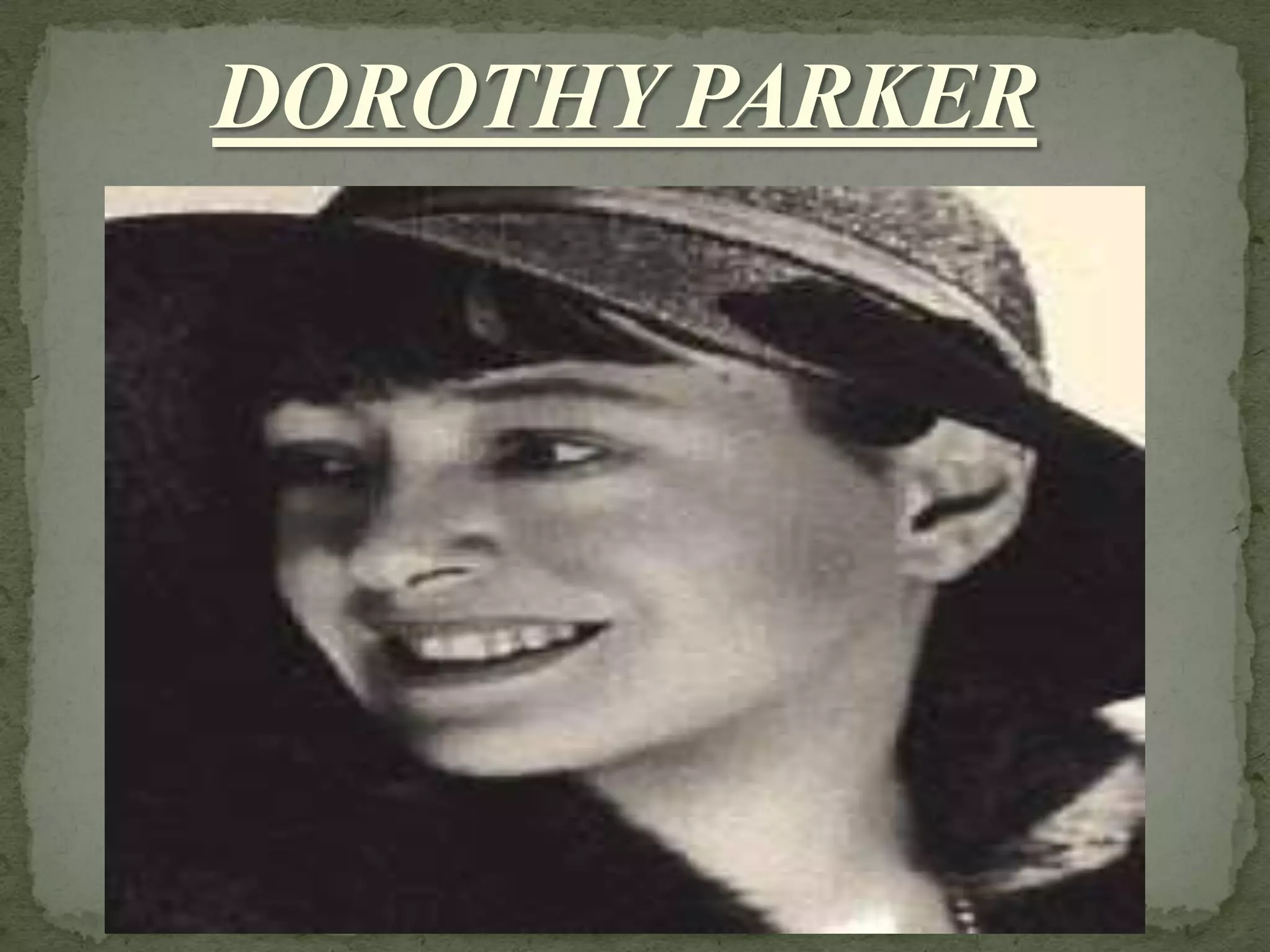
Dorothy Parker was an American poet, short story writer, critic and satirist, best
known for her wit, wisecracks, and eye for 20th century urban foibles.
From a conflicted and unhappy childhood, Parker rose to acclaim, both for her
literary output in such venues as The New Yorker and as a founding member of
the Algonquin Round Table. Following the breakup of the circle, Parker traveled
to Hollywood to pursue screenwriting. Her successes there, including two
Academy Award nominations, were curtailed as her involvement in left-wing
politics led to a place on the Hollywood blacklist.
Parker went through three marriages (two to the same man) and survived
several suicide attempts. Dismissive of her own talents, she deplored her
reputation as a "wisecracker." Nevertheless, her literary output and reputation
for her sharp wit have endured .parker died on june 7th 1967 in New York hotel
because of heart attack.
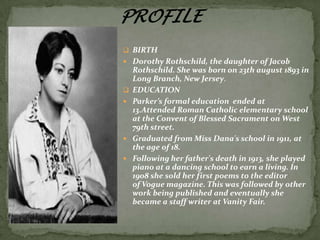
 BIRTH
 Dorothy Rothschild, the daughter of Jacob








Rothschild. She was born on 23th august 1893 in
Long Branch, New Jersey.
EDUCATION
Parker’s formal education ended at
13.Attended Roman Catholic elementary school
at the Convent of Blessed Sacrament on West
79th street.
Graduated from Miss Dana's school in 1911, at
the age of 18.
Following her father's death in 1913, she played
piano at a dancing school to earn a living. In
1908 she sold her first poems to the editor
of Vogue magazine. This was followed by other
work being published and eventually she
became a staff writer at Vanity Fair.
 LITERARY FEATURE

•

She was a short story writer , American poet
,Critic and Satirist.

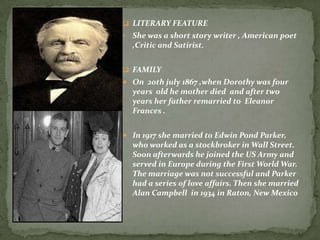
 FAMILY
 On 2oth july 1867 ,when Dorothy was four

years old he mother died and after two
years her father remarried to Eleanor
Frances .
 In 1917 she married to Edwin Pond Parker,

who worked as a stockbroker in Wall Street.
Soon afterwards he joined the US Army and
served in Europe during the First World War.
The marriage was not successful and Parker
had a series of love affairs. Then she married
Alan Campbell in 1934 in Raton, New Mexico
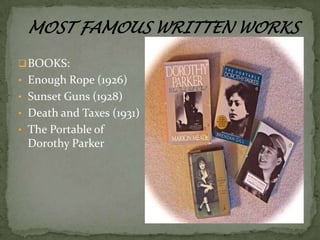
 BOOKS:
• Enough Rope (1926)
• Sunset Guns (1928)
• Death and Taxes (1931)
• The Portable of

Dorothy Parker
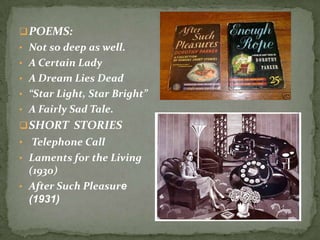
 POEMS:
• Not so deep as well.
• A Certain Lady
• A Dream Lies Dead
• “Star Light, Star Bright”
• A Fairly Sad Tale.

 SHORT STORIES
• Telephone Call
• Laments for the Living

(1930)
• After Such Pleasure
(1931)
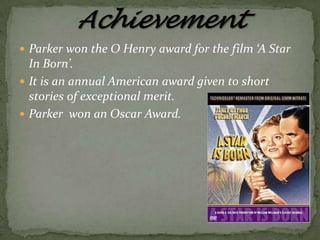
She worked there as a screenwriter, including on the film A Star
Is Born (1937), directed by William Wellman and starring Janet
Gaynor, Fredric March, and Adolphe Menjou. In Alfred
Hitchcock's film Saboteur (1940) Parker collaborated with Peter
Vertex and Joan Harrison. Her contribution is mainly visible in
some of the bizarre details of the circus the hero (Robert
Cummings) takes refuge in, with its squabbling Siamese twins,
its bearded lady in curlers and a malevolent dwarf who acts and
dresses a bit like Hitler.
With Lillian Hellman and Dashiell Hammett, Parker helped
found the Screen Writers' Guild. She also reported on the
Spanish Civil War, and collaborated on several plays.
Temptations of Hollywood did not make Parker any softer, which
a number of film stars had to face. When Joan Crawford was
married to Franchot Tone, she became obsessed with selfimprovement. Parker said: "You can take a whore to culture, but
you can't make her think." Parker had taken an early stand
against Fascism and Nazism and she declared herself a
Communist, for which she was blacklisted during the McCarthy
era. Her last major film project was The Fan (1949), directed by
Otto Preminger.
 Parker won the O Henry award for the film ‘A Star

In Born’.
 It is an annual American award given to short
stories of exceptional merit.
 Parker won an Oscar Award.
Wikipedia
2. Google
3. Dorothy Parker : What Fresh Hell is This?
1.
 Sr Francina
 Satakshi
 Rebecca
 Clarissa
 Prabhat

 Joanita
 Beril
 Sr Rita

Dorothy parker

  • 2.
    Dorothy Parker wasan American poet, short story writer, critic and satirist, best known for her wit, wisecracks, and eye for 20th century urban foibles. From a conflicted and unhappy childhood, Parker rose to acclaim, both for her literary output in such venues as The New Yorker and as a founding member of the Algonquin Round Table. Following the breakup of the circle, Parker traveled to Hollywood to pursue screenwriting. Her successes there, including two Academy Award nominations, were curtailed as her involvement in left-wing politics led to a place on the Hollywood blacklist. Parker went through three marriages (two to the same man) and survived several suicide attempts. Dismissive of her own talents, she deplored her reputation as a "wisecracker." Nevertheless, her literary output and reputation for her sharp wit have endured .parker died on june 7th 1967 in New York hotel because of heart attack.
  • 3.
     BIRTH  DorothyRothschild, the daughter of Jacob     Rothschild. She was born on 23th august 1893 in Long Branch, New Jersey. EDUCATION Parker’s formal education ended at 13.Attended Roman Catholic elementary school at the Convent of Blessed Sacrament on West 79th street. Graduated from Miss Dana's school in 1911, at the age of 18. Following her father's death in 1913, she played piano at a dancing school to earn a living. In 1908 she sold her first poems to the editor of Vogue magazine. This was followed by other work being published and eventually she became a staff writer at Vanity Fair.
  • 4.
     LITERARY FEATURE • Shewas a short story writer , American poet ,Critic and Satirist.  FAMILY  On 2oth july 1867 ,when Dorothy was four years old he mother died and after two years her father remarried to Eleanor Frances .  In 1917 she married to Edwin Pond Parker, who worked as a stockbroker in Wall Street. Soon afterwards he joined the US Army and served in Europe during the First World War. The marriage was not successful and Parker had a series of love affairs. Then she married Alan Campbell in 1934 in Raton, New Mexico
  • 5.
     BOOKS: • EnoughRope (1926) • Sunset Guns (1928) • Death and Taxes (1931) • The Portable of Dorothy Parker
  • 6.
     POEMS: • Notso deep as well. • A Certain Lady • A Dream Lies Dead • “Star Light, Star Bright” • A Fairly Sad Tale.  SHORT STORIES • Telephone Call • Laments for the Living (1930) • After Such Pleasure (1931)
  • 7.
    She worked thereas a screenwriter, including on the film A Star Is Born (1937), directed by William Wellman and starring Janet Gaynor, Fredric March, and Adolphe Menjou. In Alfred Hitchcock's film Saboteur (1940) Parker collaborated with Peter Vertex and Joan Harrison. Her contribution is mainly visible in some of the bizarre details of the circus the hero (Robert Cummings) takes refuge in, with its squabbling Siamese twins, its bearded lady in curlers and a malevolent dwarf who acts and dresses a bit like Hitler. With Lillian Hellman and Dashiell Hammett, Parker helped found the Screen Writers' Guild. She also reported on the Spanish Civil War, and collaborated on several plays. Temptations of Hollywood did not make Parker any softer, which a number of film stars had to face. When Joan Crawford was married to Franchot Tone, she became obsessed with selfimprovement. Parker said: "You can take a whore to culture, but you can't make her think." Parker had taken an early stand against Fascism and Nazism and she declared herself a Communist, for which she was blacklisted during the McCarthy era. Her last major film project was The Fan (1949), directed by Otto Preminger.
  • 8.
     Parker wonthe O Henry award for the film ‘A Star In Born’.  It is an annual American award given to short stories of exceptional merit.  Parker won an Oscar Award.
  • 9.
    Wikipedia 2. Google 3. DorothyParker : What Fresh Hell is This? 1.
  • 10.
     Sr Francina Satakshi  Rebecca  Clarissa  Prabhat  Joanita  Beril  Sr Rita