Subject, Predicate & Object
7th Grade Grammar Unit
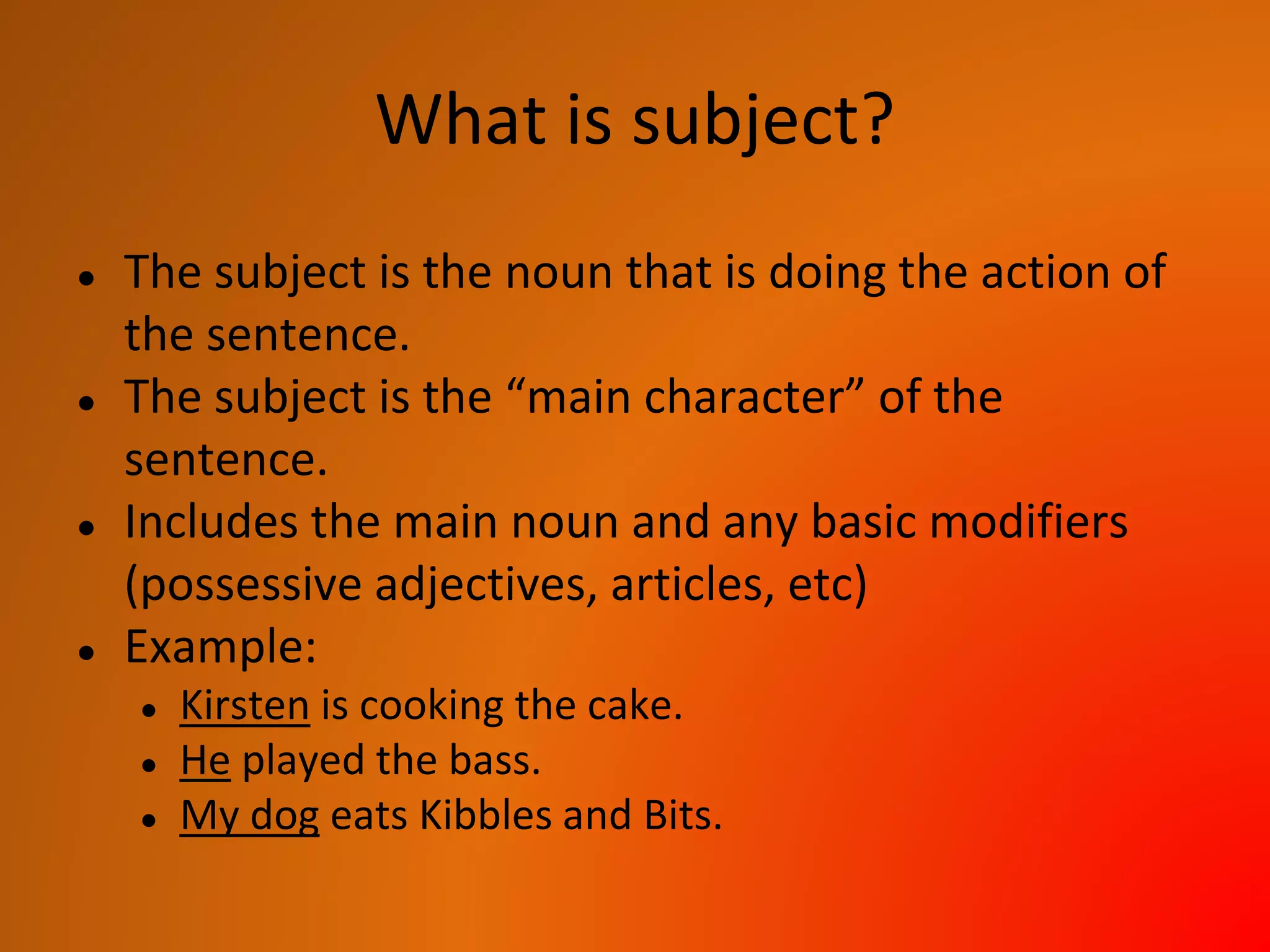
What is subject?
● The subject is the noun that is doing the action of
the sentence.
● The subject is the “main character” of the
sentence.
● Includes the main noun and any basic modifiers
(possessive adjectives, articles, etc)
● Example:
● Kirsten is cooking the cake.
● He played the bass.
● My dog eats Kibbles and Bits.
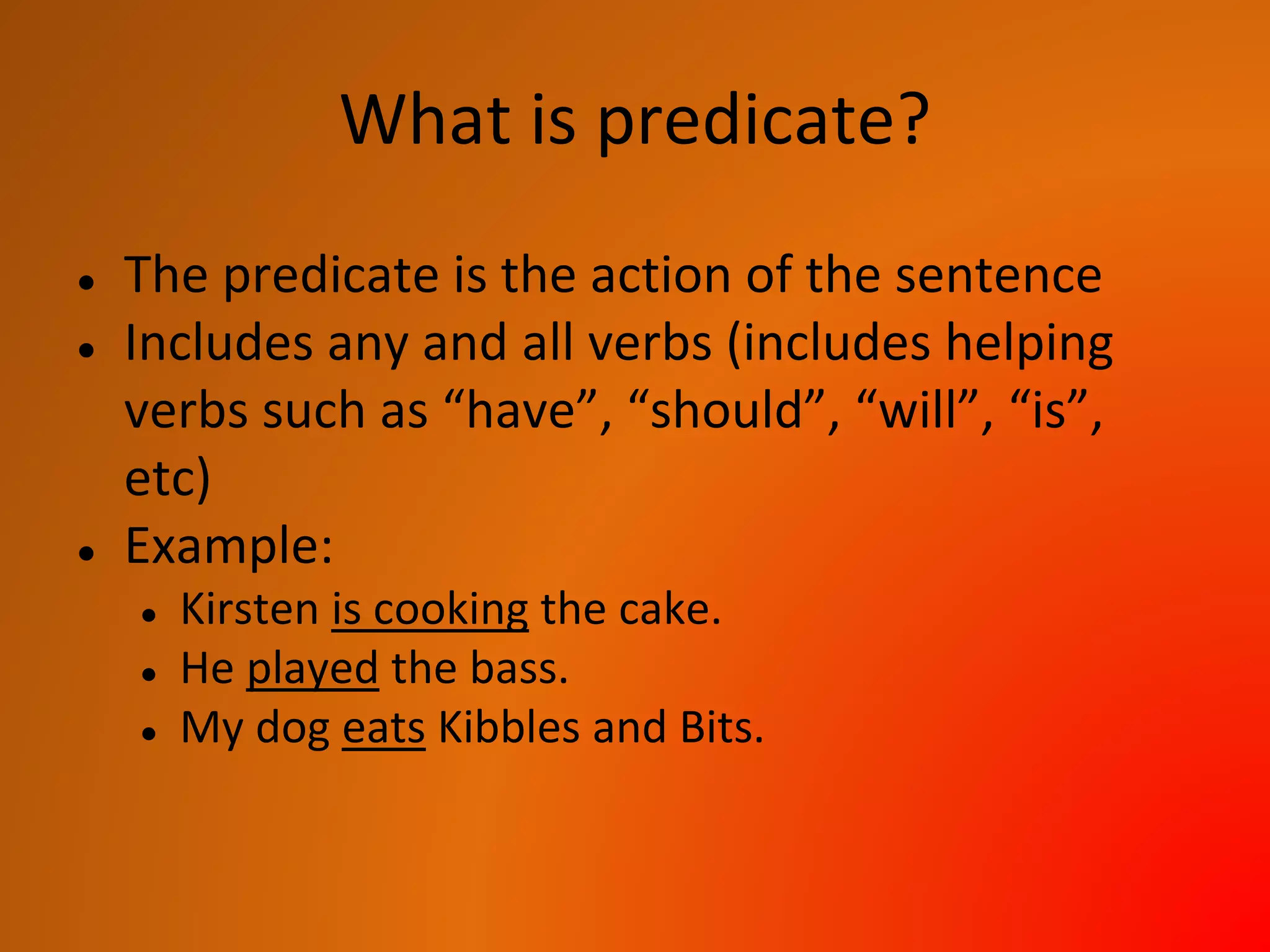
What is predicate?
● The predicate is the action of the sentence
● Includes any and all verbs (includes helping
verbs such as “have”, “should”, “will”, “is”,
etc)
● Example:
● Kirsten is cooking the cake.
● He played the bass.
● My dog eats Kibbles and Bits.
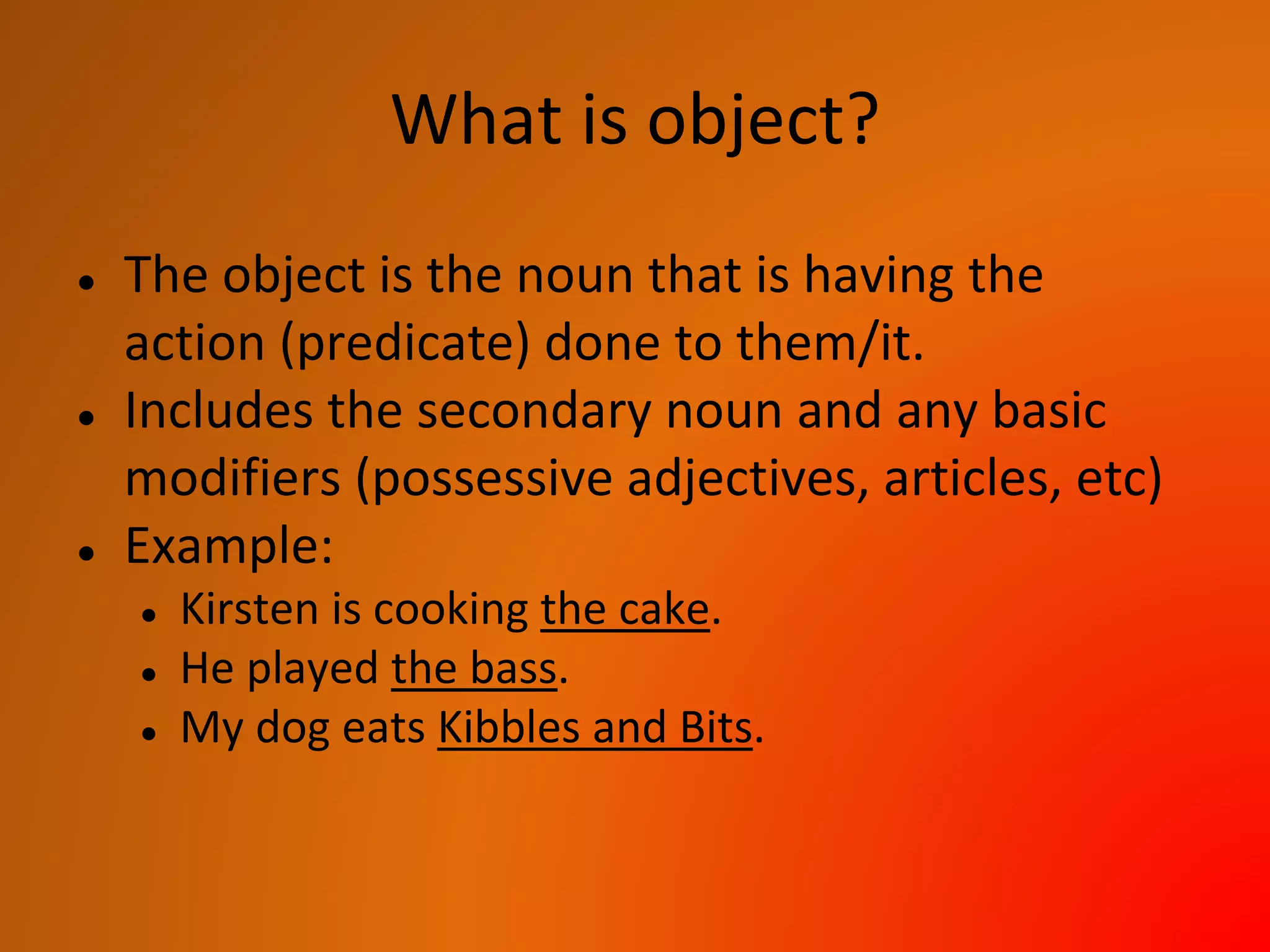
What is object?
● The object is the noun that is having the
action (predicate) done to them/it.
● Includes the secondary noun and any basic
modifiers (possessive adjectives, articles, etc)
● Example:
● Kirsten is cooking the cake.
● He played the bass.
● My dog eats Kibbles and Bits.
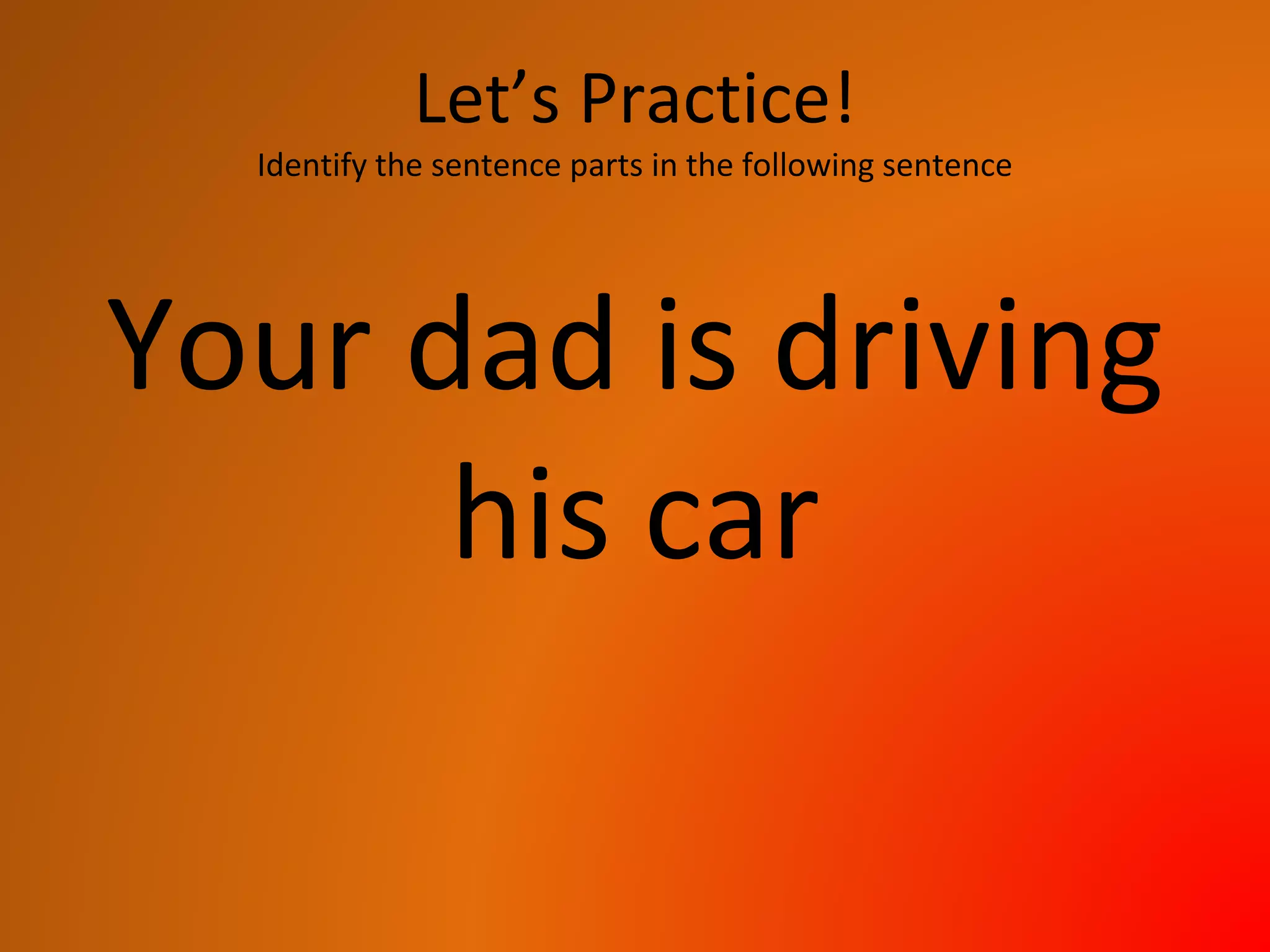
Let’s Practice!
Identify the sentence parts in the following sentence
Your dad is driving
his car
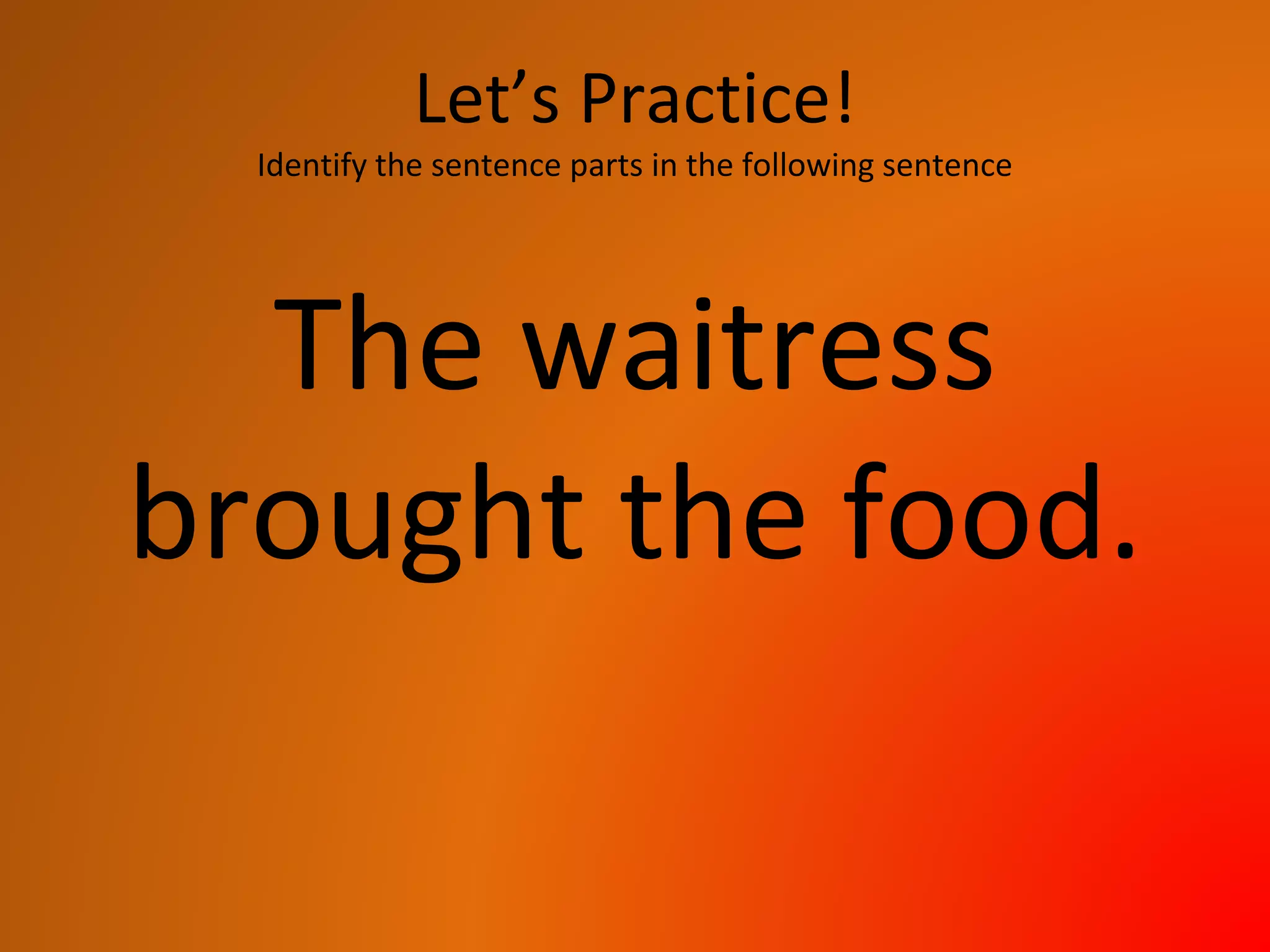
Let’s Practice!
Identify the sentence parts in the following sentence
The waitress
brought the food.
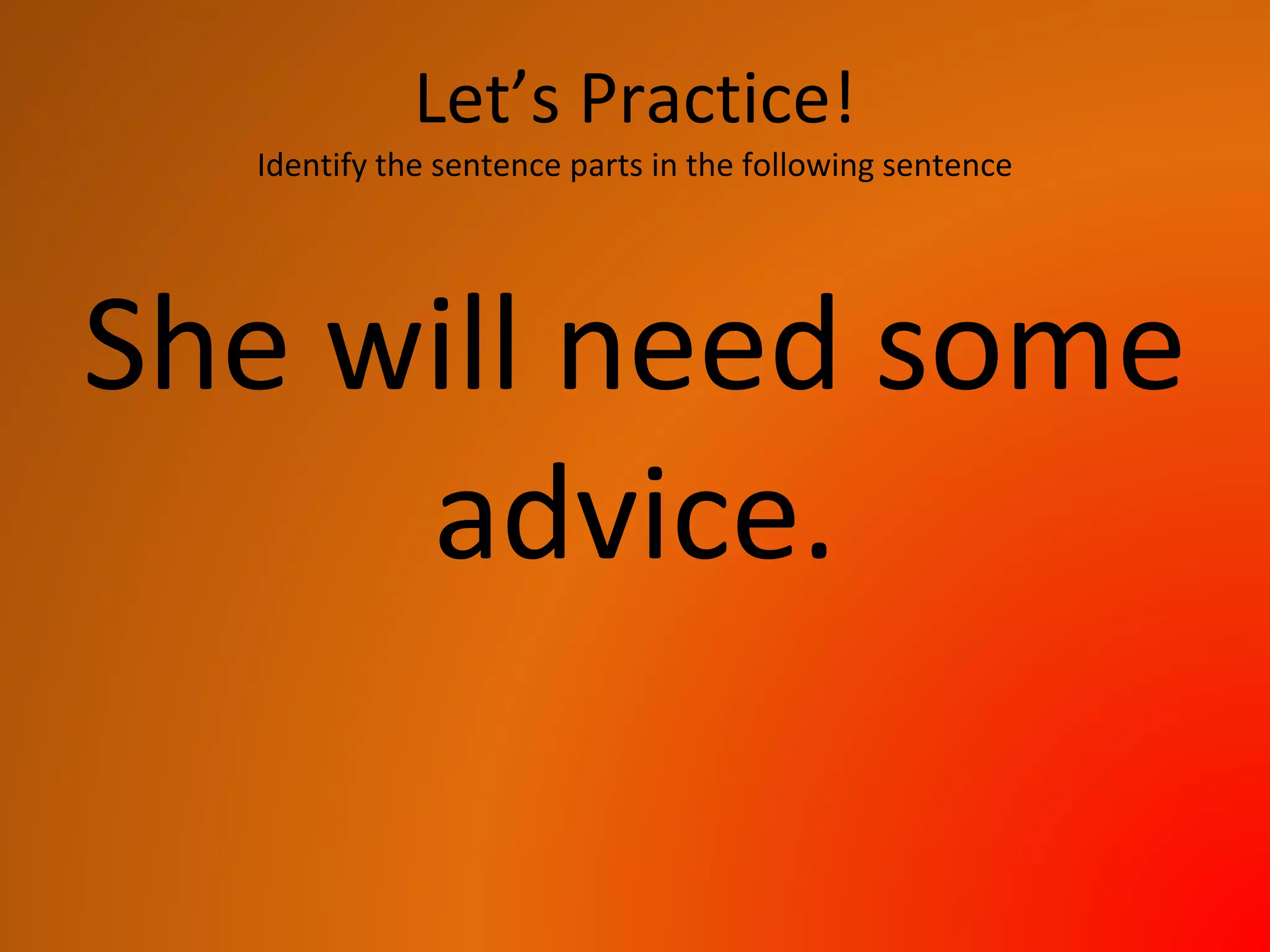
Let’s Practice!
Identify the sentence parts in the following sentence
She will need some
advice.
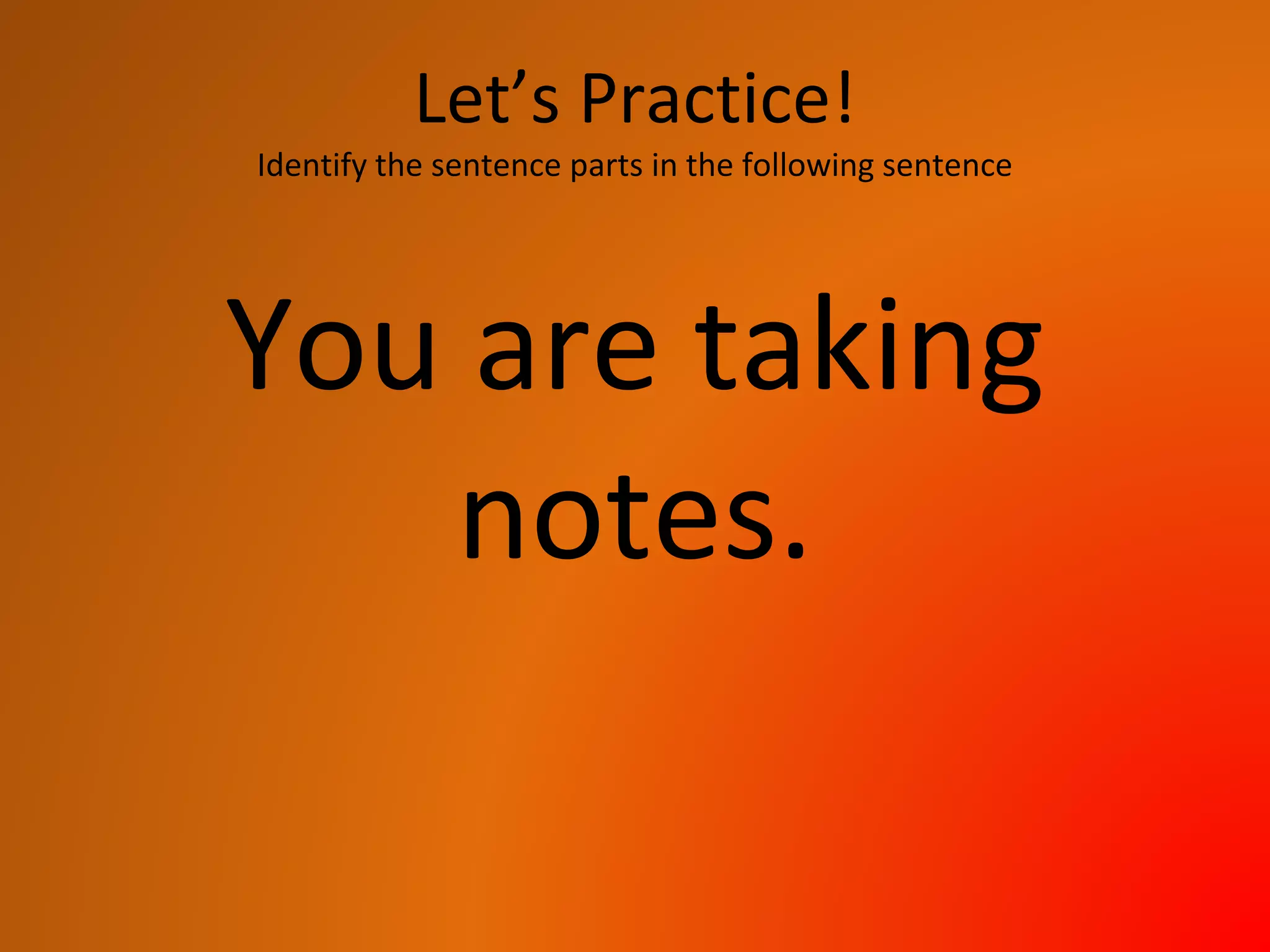
Let’s Practice!
Identify the sentence parts in the following sentence
You are taking
notes.
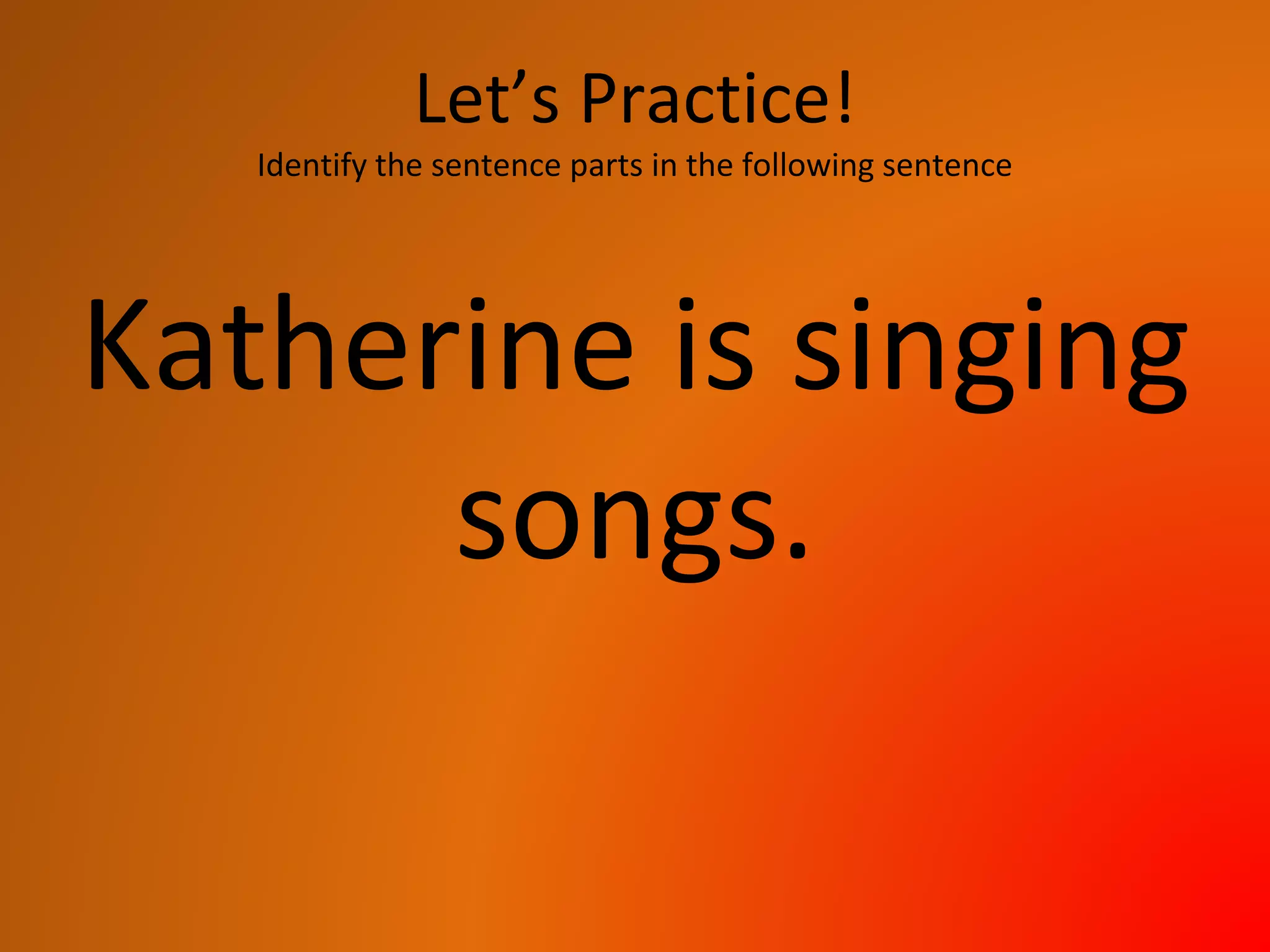
Let’s Practice!
Identify the sentence parts in the following sentence
Katherine is singing
songs.
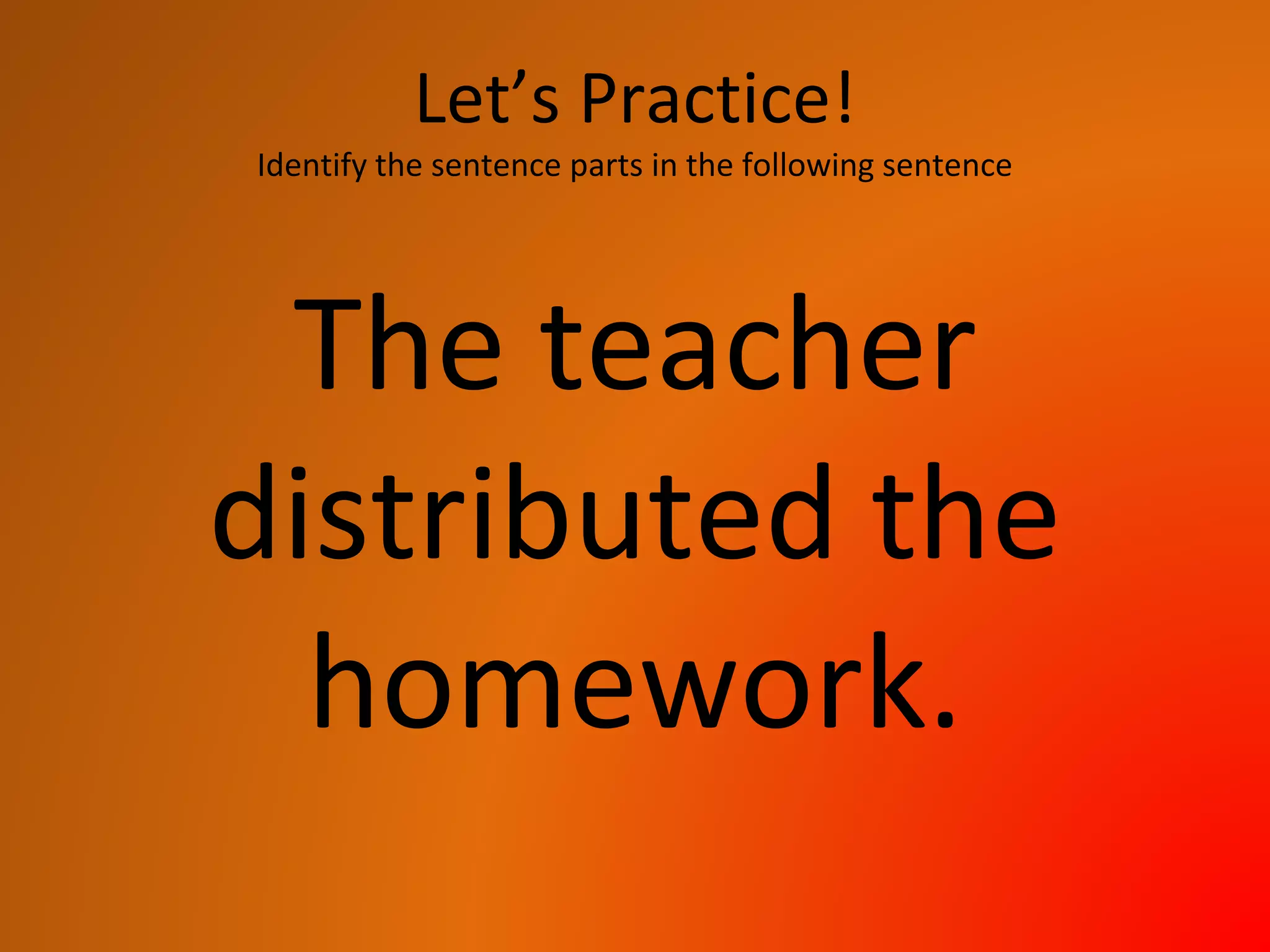
Let’s Practice!
Identify the sentence parts in the following sentence
The teacher
distributed the
homework.
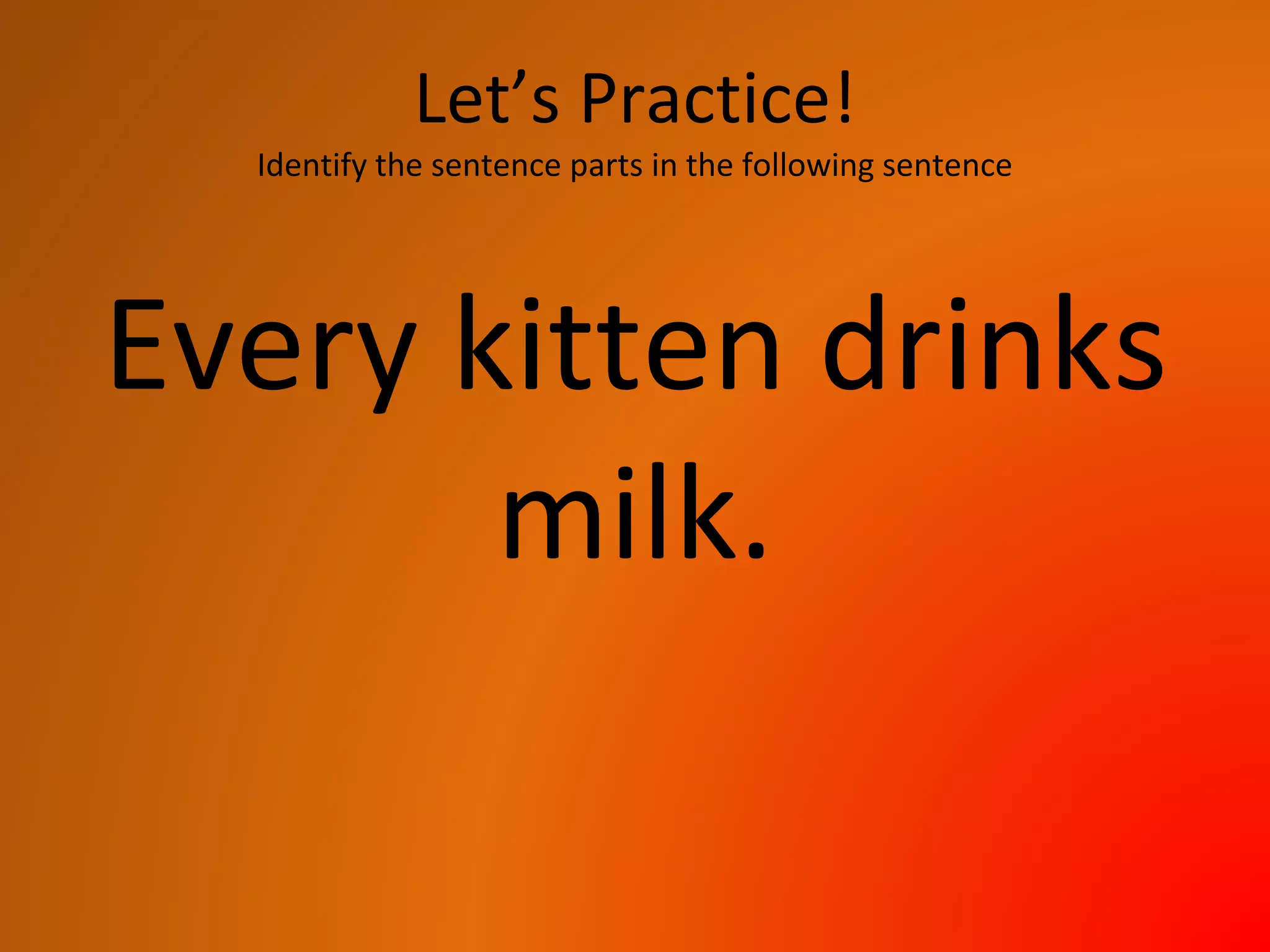
Let’s Practice!
Identify the sentence parts in the following sentence
Every kitten drinks
milk.
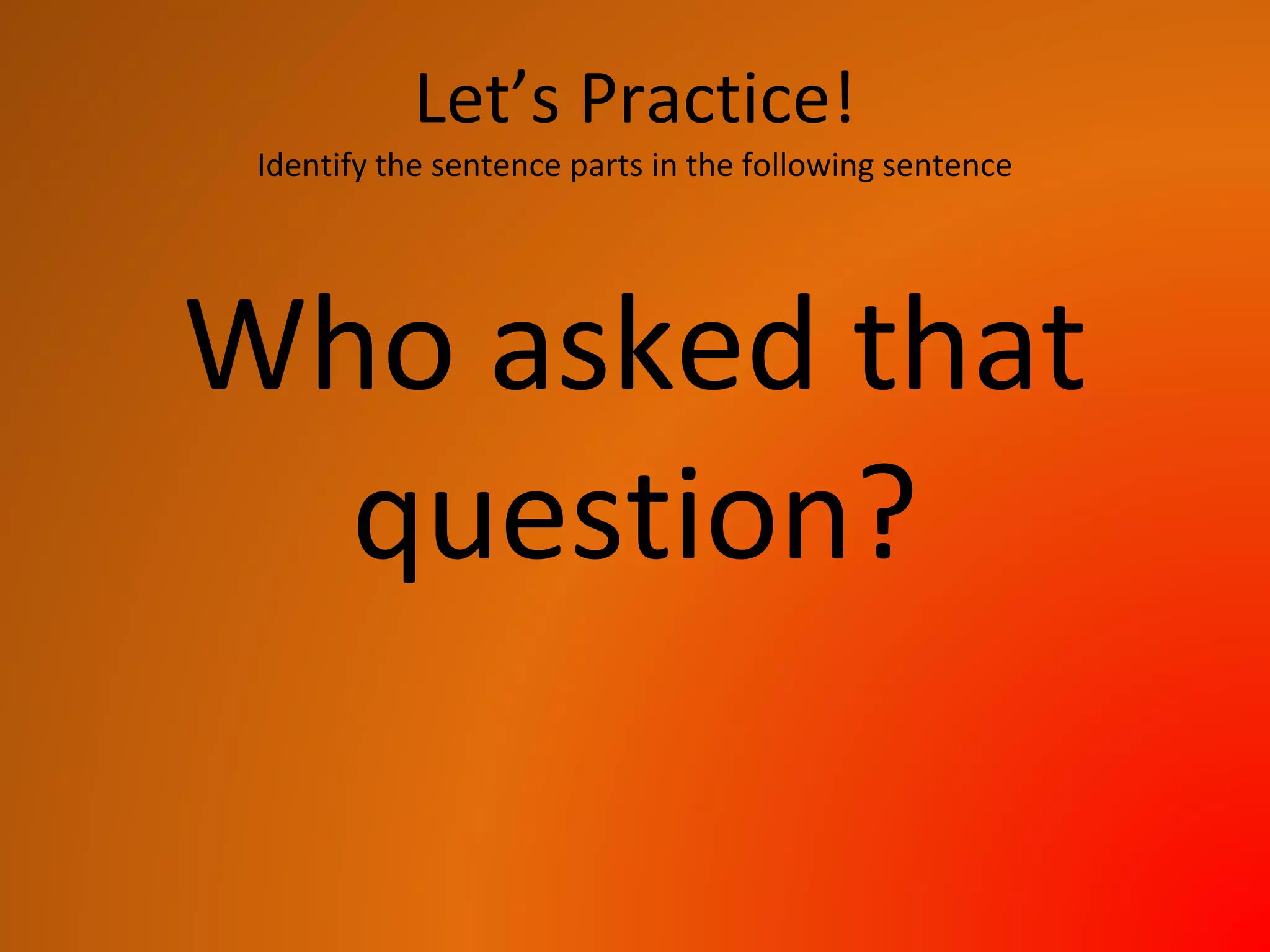
Let’s Practice!
Identify the sentence parts in the following sentence
Who asked that
question?
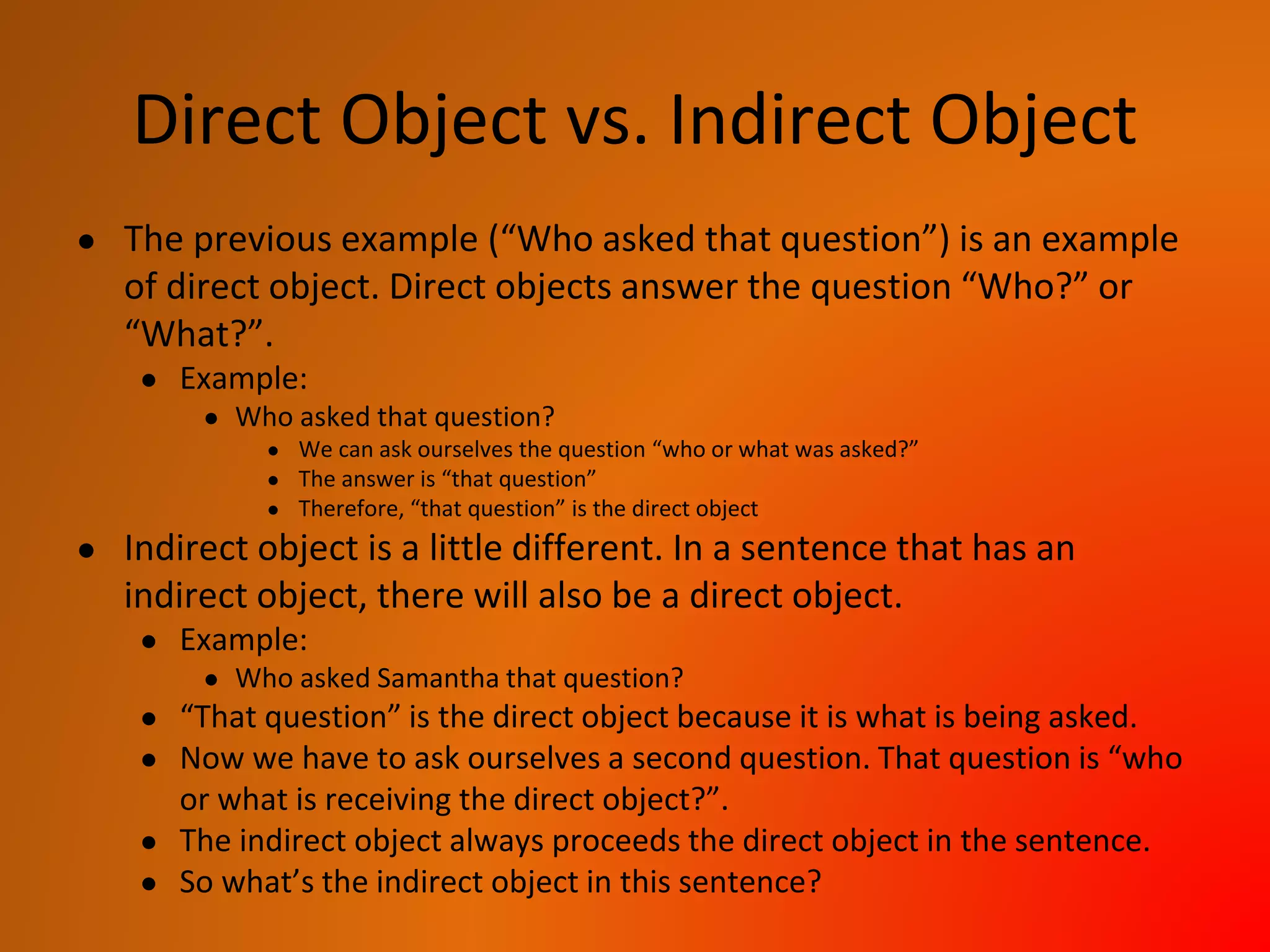
Direct Object vs. Indirect Object
● The previous example (“Who asked that question”) is an example
of direct object. Direct objects answer the question “Who?” or
“What?”.
● Example:
● Who asked that question?
● We can ask ourselves the question “who or what was asked?”
● The answer is “that question”
● Therefore, “that question” is the direct object
● Indirect object is a little different. In a sentence that has an
indirect object, there will also be a direct object.
● Example:
● Who asked Samantha that question?
● “That question” is the direct object because it is what is being asked.
● Now we have to ask ourselves a second question. That question is “who
or what is receiving the direct object?”.
● The indirect object always proceeds the direct object in the sentence.
● So what’s the indirect object in this sentence?
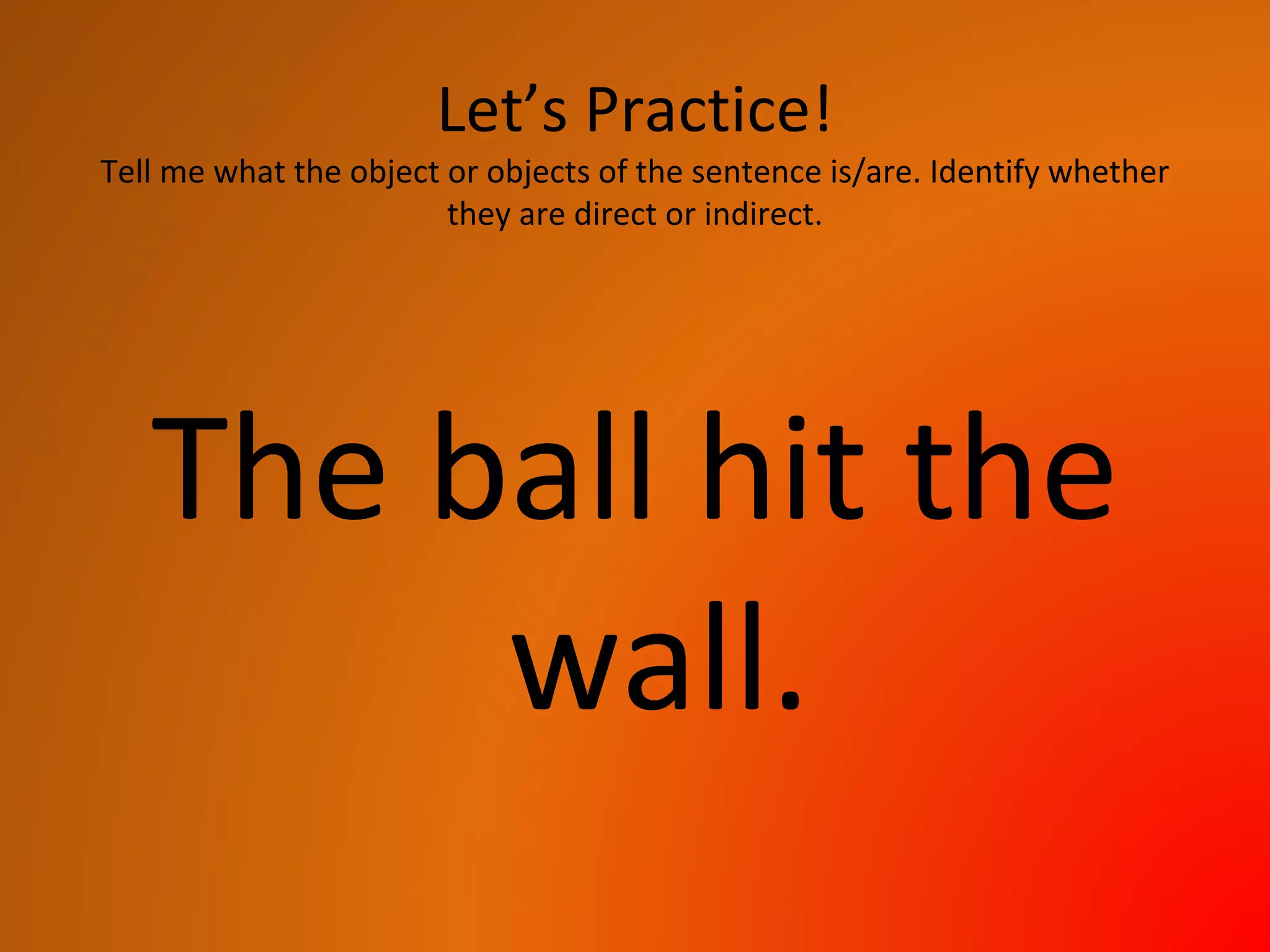
Let’s Practice!
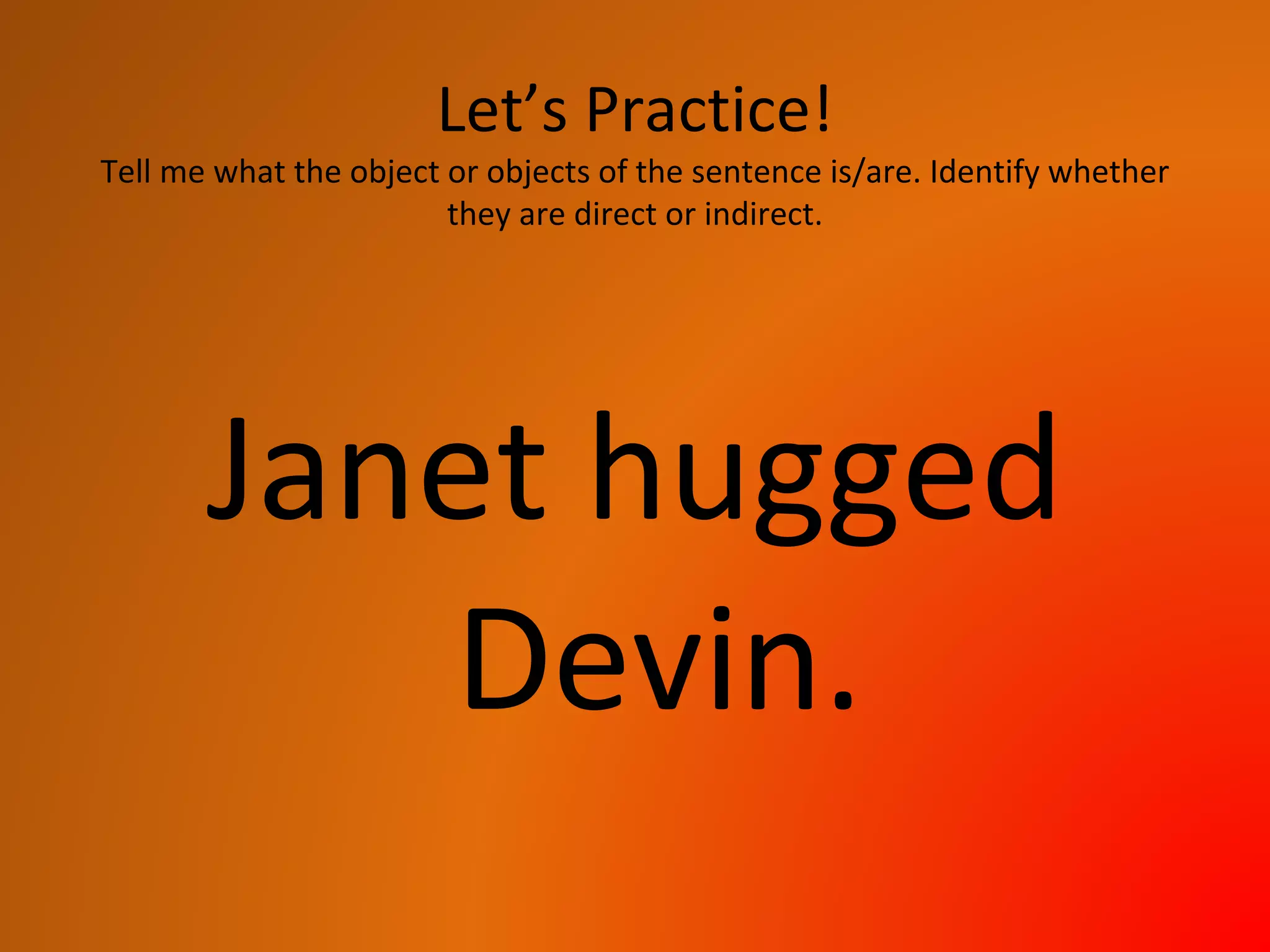
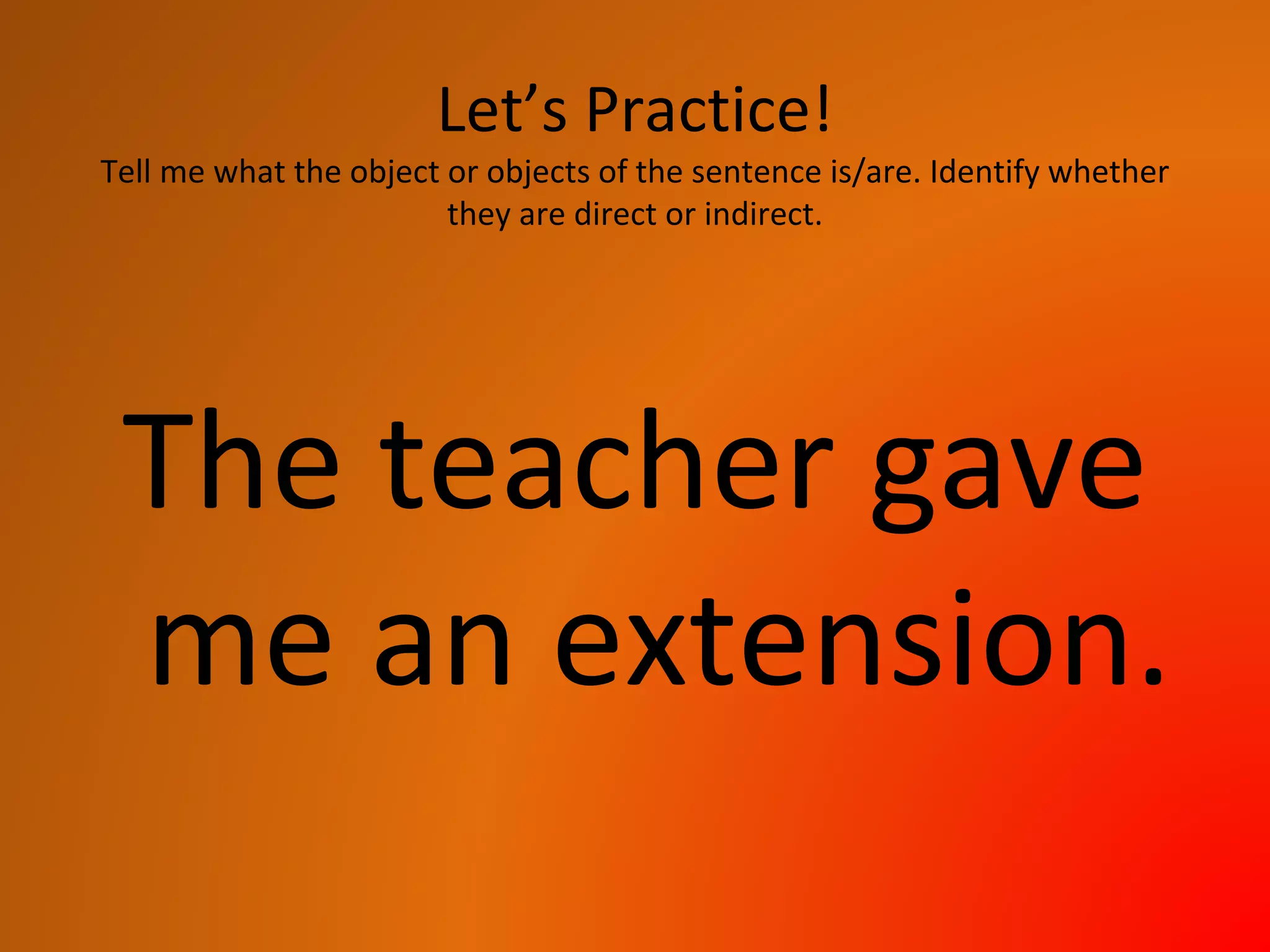
Tell me what the object or objects of the sentence is/are. Identify whether
they are direct or indirect.
The ball hit the
wall.
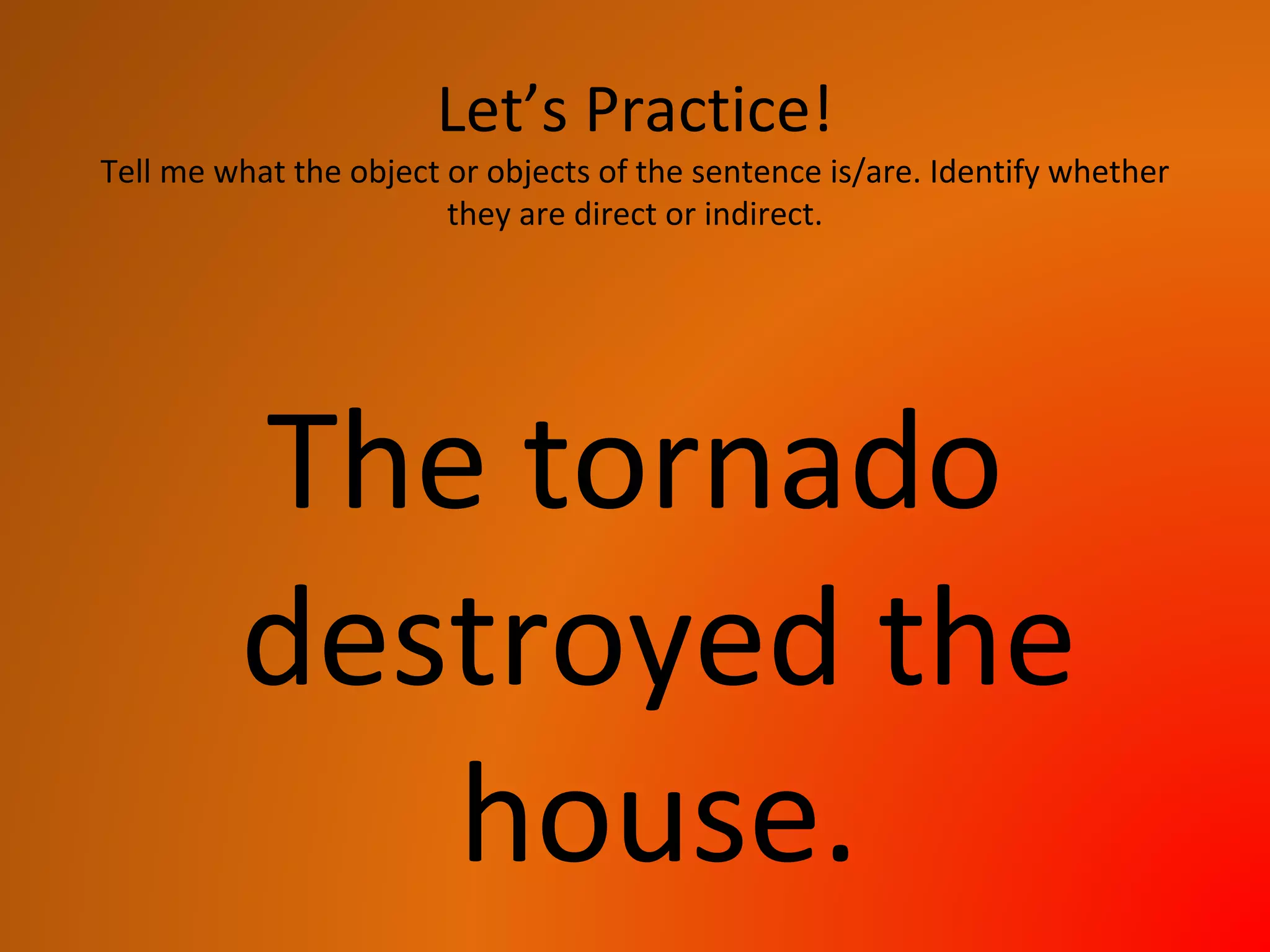
Let’s Practice!
Tell me what the object or objects of the sentence is/are. Identify whether
they are direct or indirect.
The tornado
destroyed the
house.
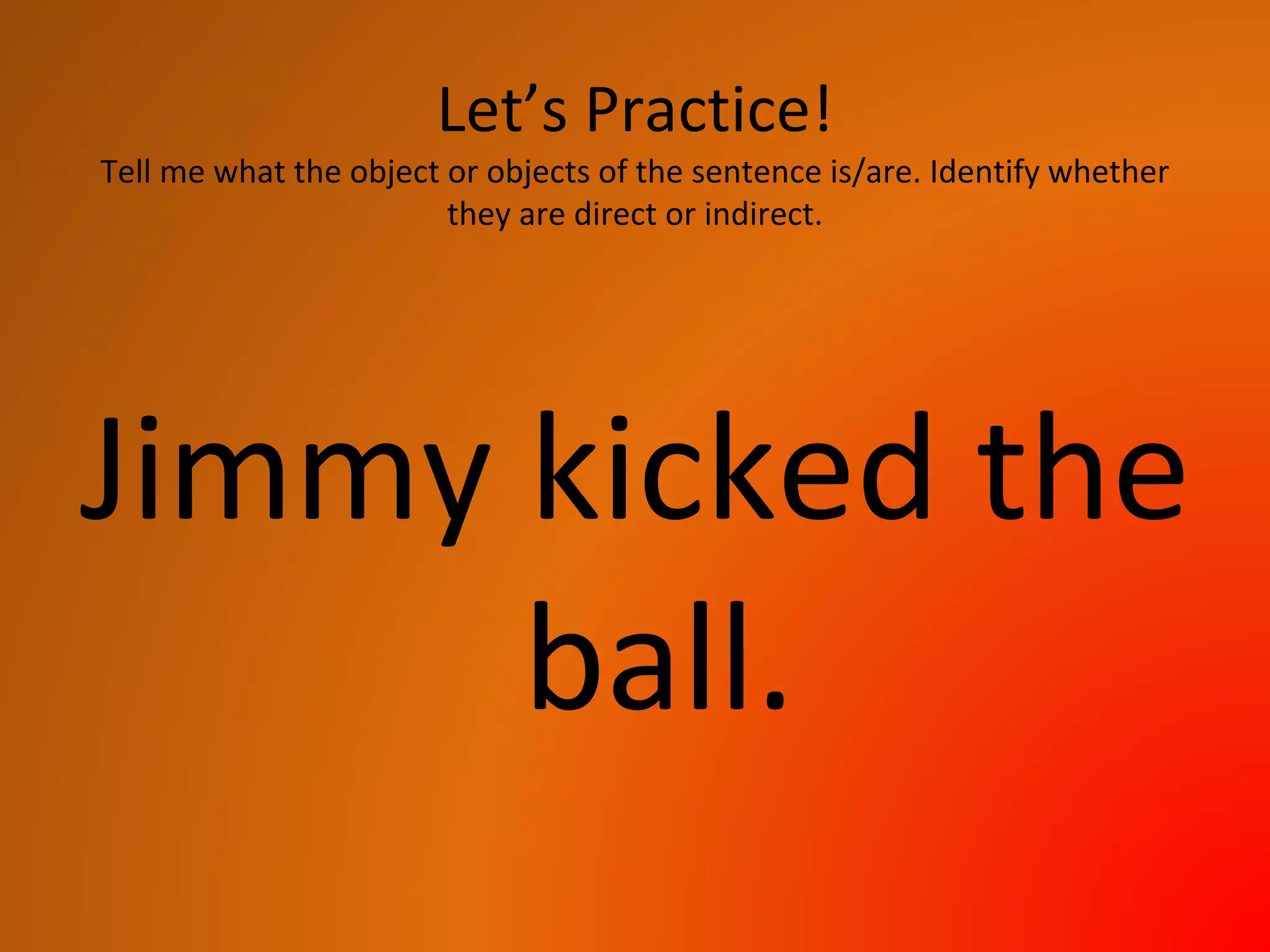
Let’s Practice!
Tell me what the object or objects of the sentence is/are. Identify whether
they are direct or indirect.
Jimmy kicked the
ball.
Let’s Practice!
Tell me what the object or objects of the sentence is/are. Identify whether
they are direct or indirect.
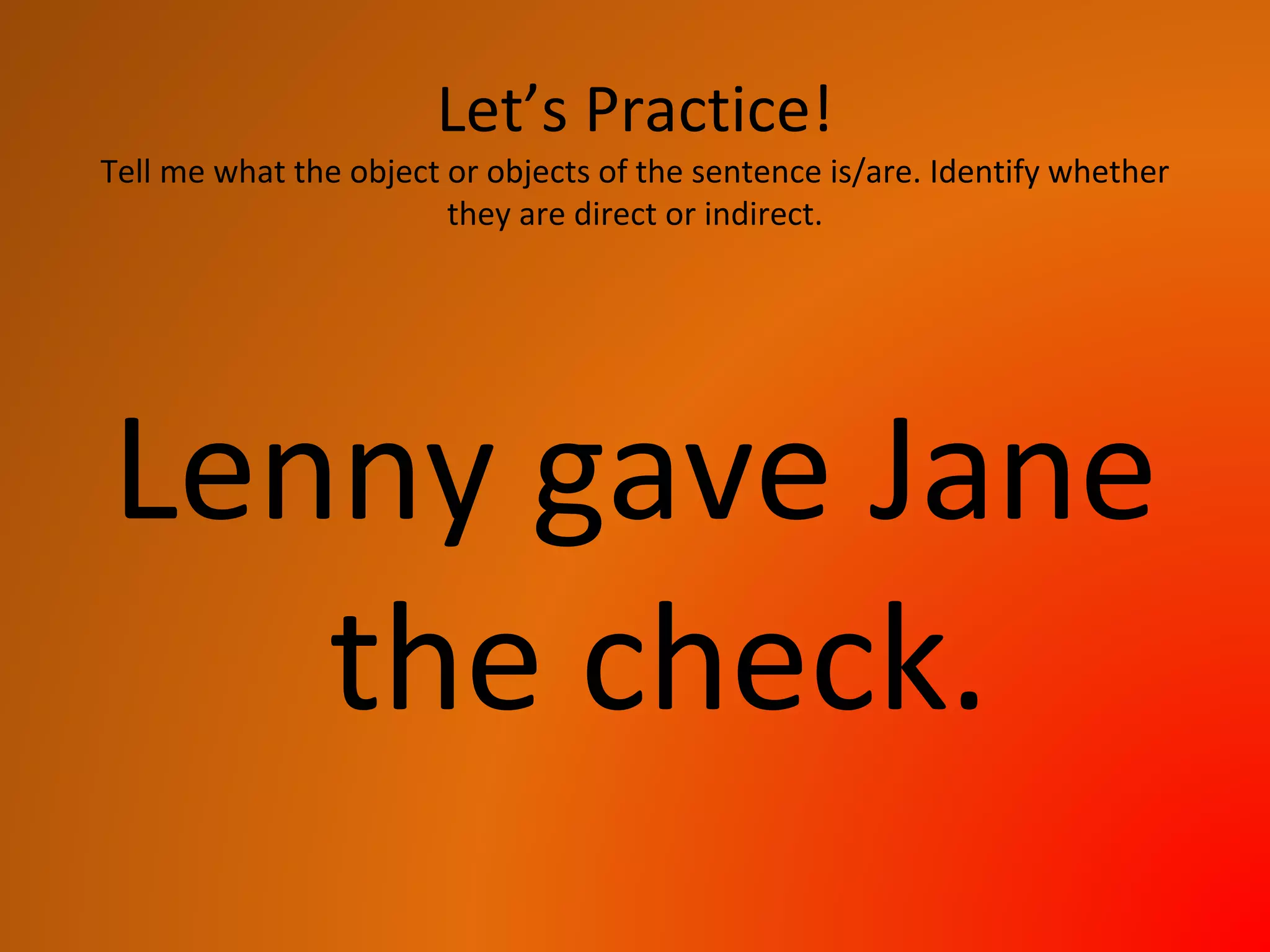
Lenny gave Jane
the check.
Let’s Practice!
Tell me what the object or objects of the sentence is/are. Identify whether
they are direct or indirect.
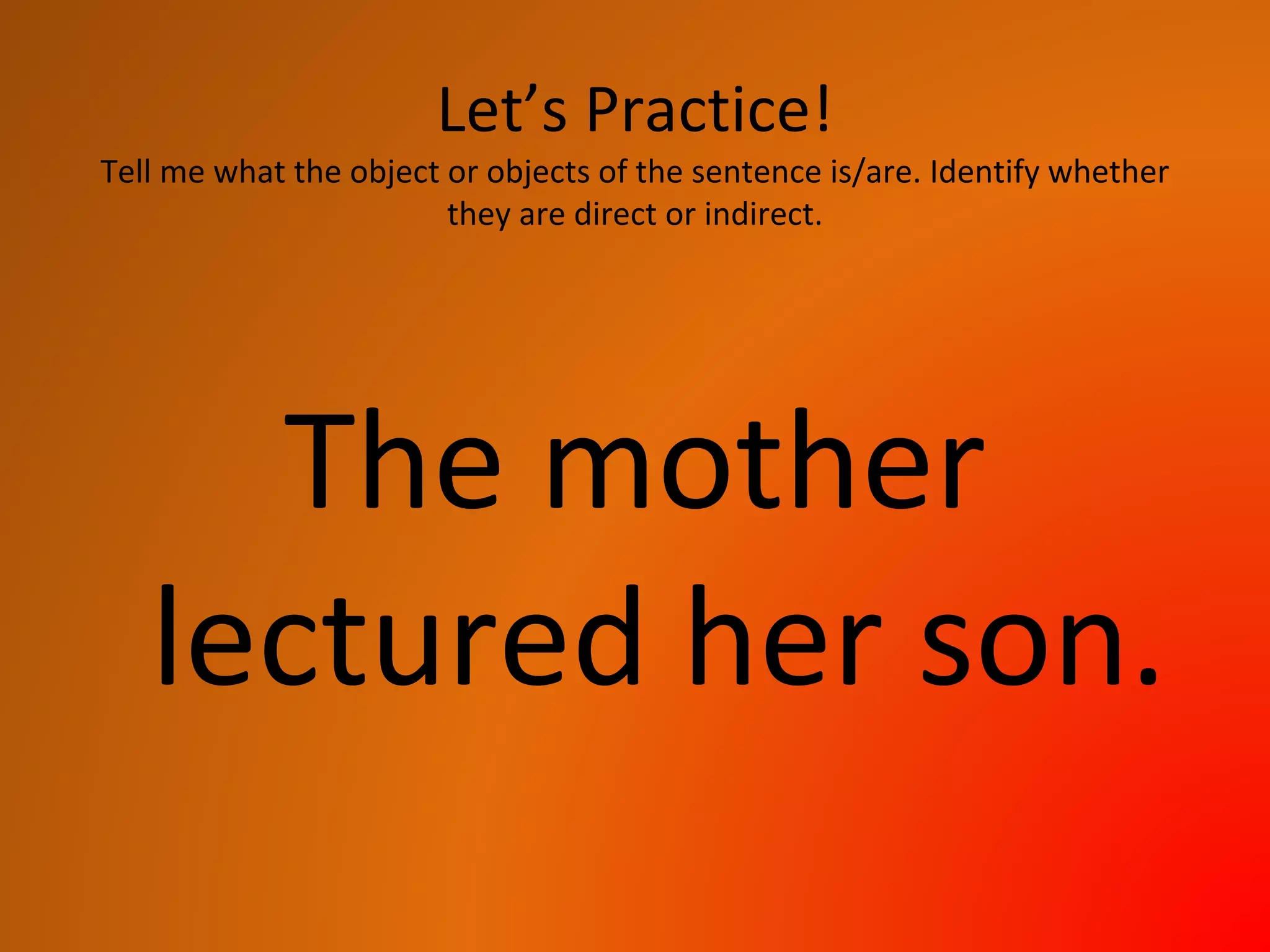
The mother
lectured her son.
Let’s Practice!
Tell me what the object or objects of the sentence is/are. Identify whether
they are direct or indirect.
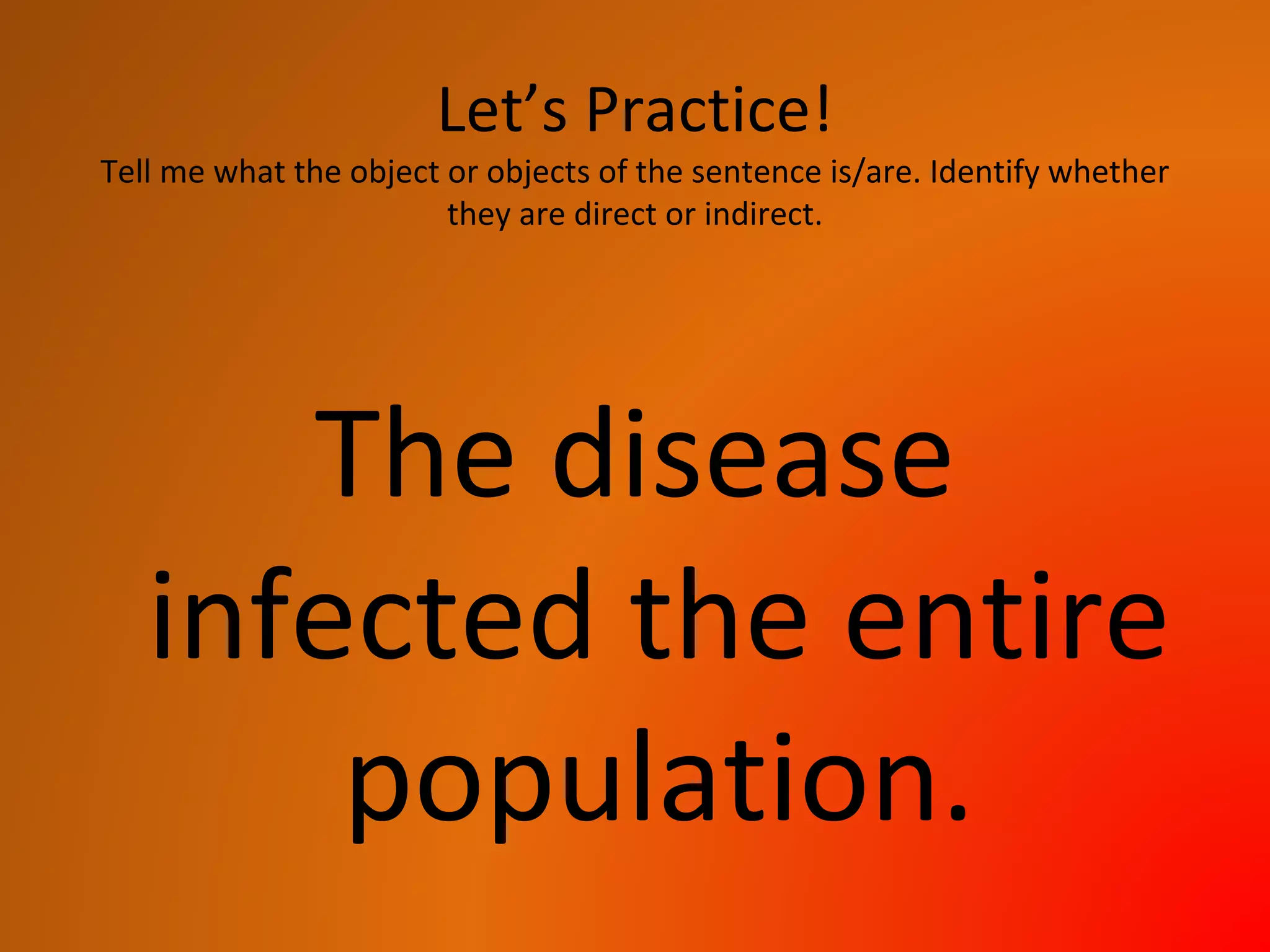
The disease
infected the entire
population.
Let’s Practice!
Tell me what the object or objects of the sentence is/are. Identify whether
they are direct or indirect.
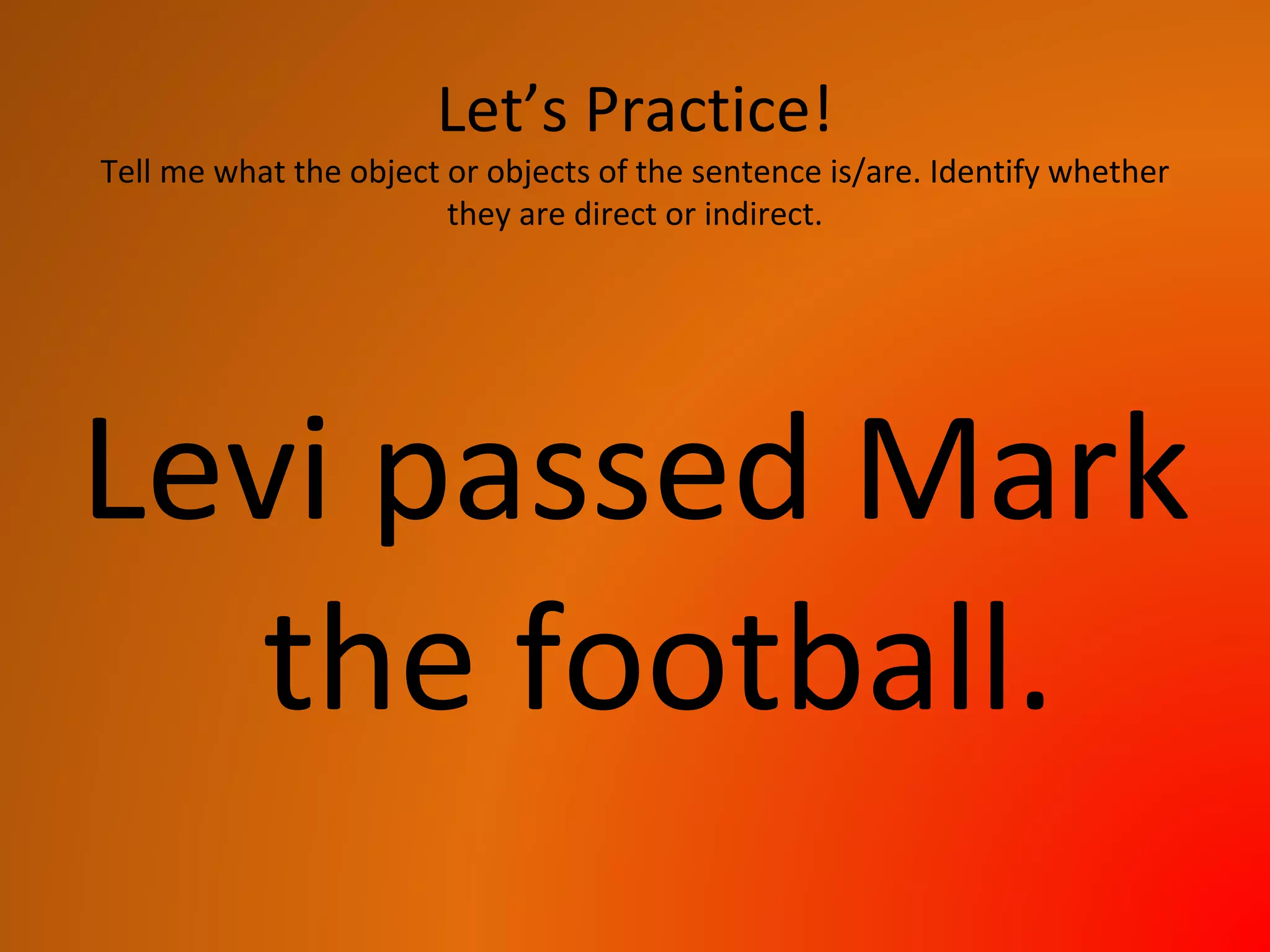
Levi passed Mark
the football.
Let’s Practice!
Tell me what the object or objects of the sentence is/are. Identify whether
they are direct or indirect.
Janet hugged
Devin.
Let’s Practice!
Tell me what the object or objects of the sentence is/are. Identify whether
they are direct or indirect.
The teacher gave
me an extension.
Let’s Practice!
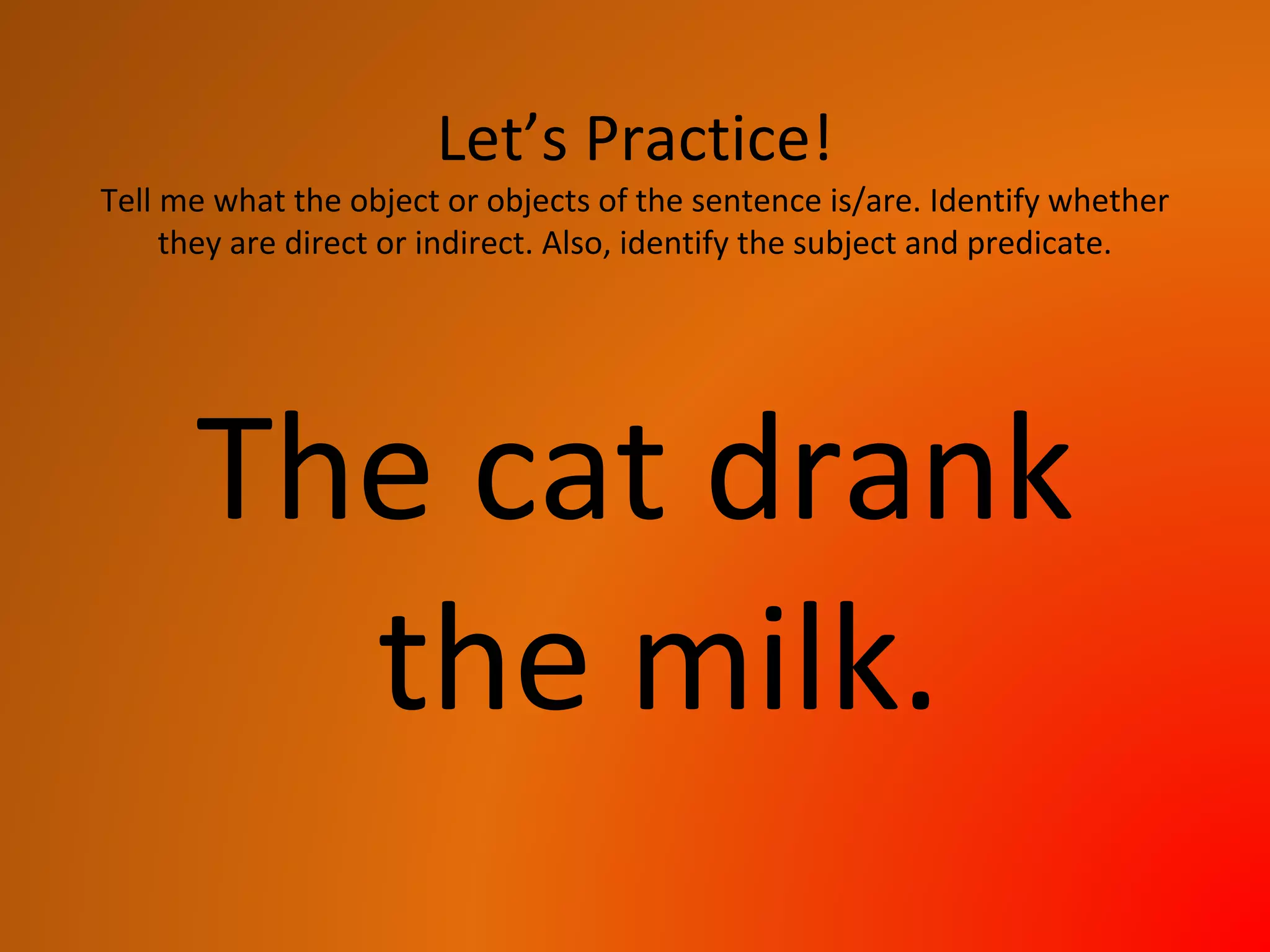
Tell me what the object or objects of the sentence is/are. Identify whether
they are direct or indirect. Also, identify the subject and predicate.
The cat drank
the milk.
Let’s Practice!
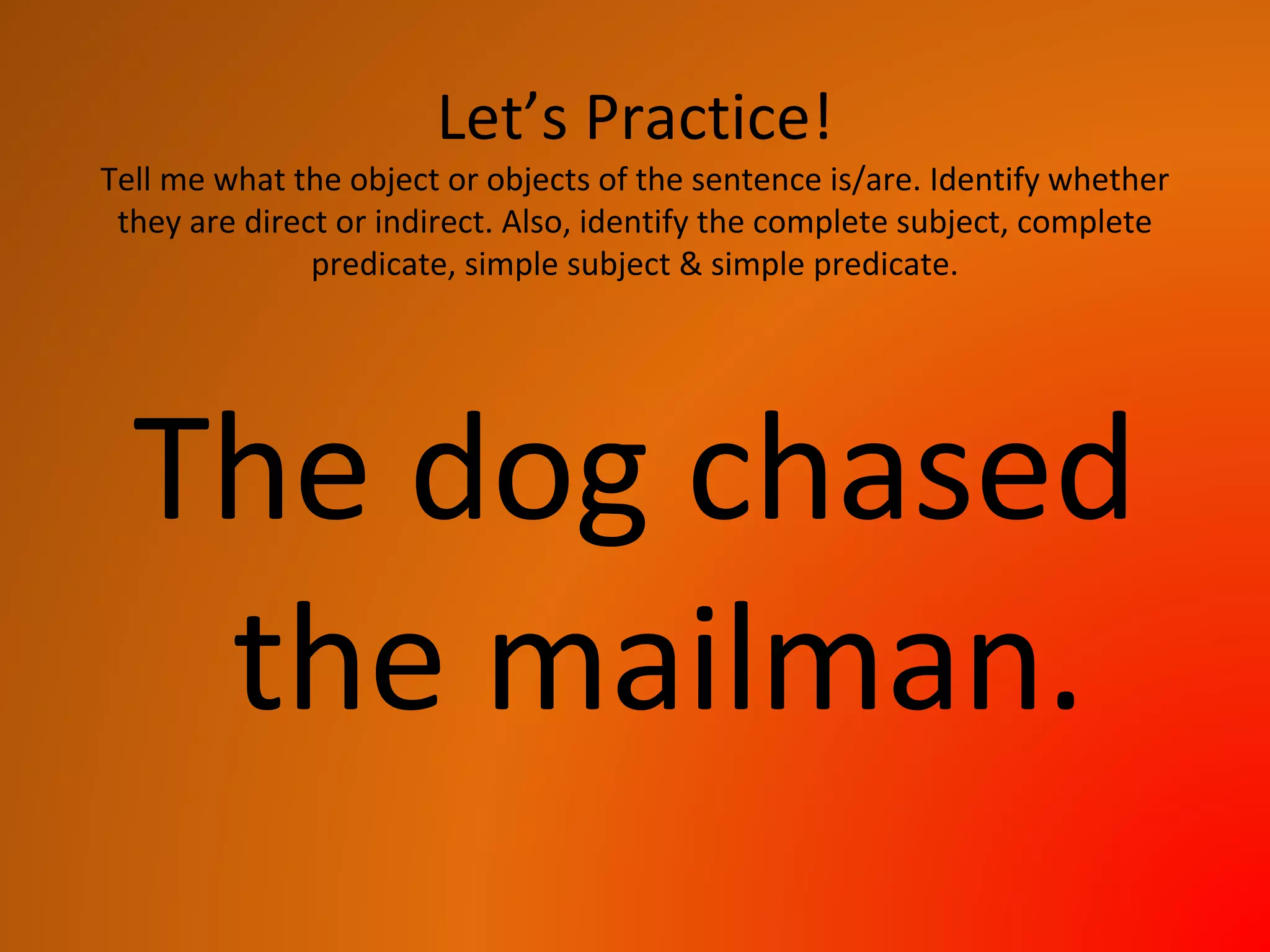
Tell me what the object or objects of the sentence is/are. Identify whether
they are direct or indirect. Also, identify the complete subject, complete
predicate, simple subject & simple predicate.
The dog chased
the mailman.
Let’s Practice!
Tell me what the object or objects of the sentence is/are. Identify whether
they are direct or indirect. Also, identify the complete subject, complete
predicate, simple subject & simple predicate.
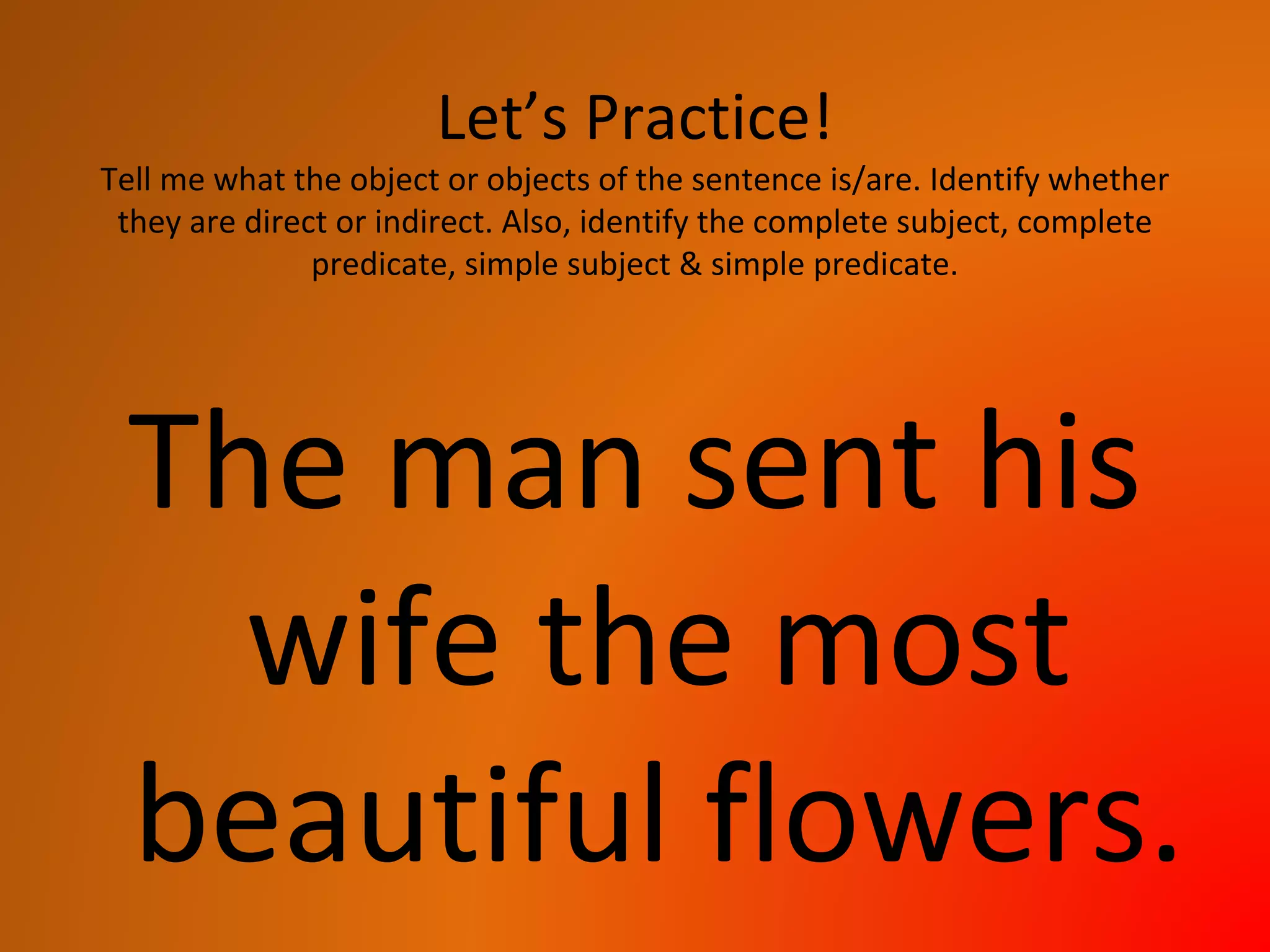
The man sent his
wife the most
beautiful flowers.
Let’s Practice!
Tell me what the object or objects of the sentence is/are. Identify whether
they are direct or indirect. Also, identify the complete subject, complete
predicate, simple subject & simple predicate.
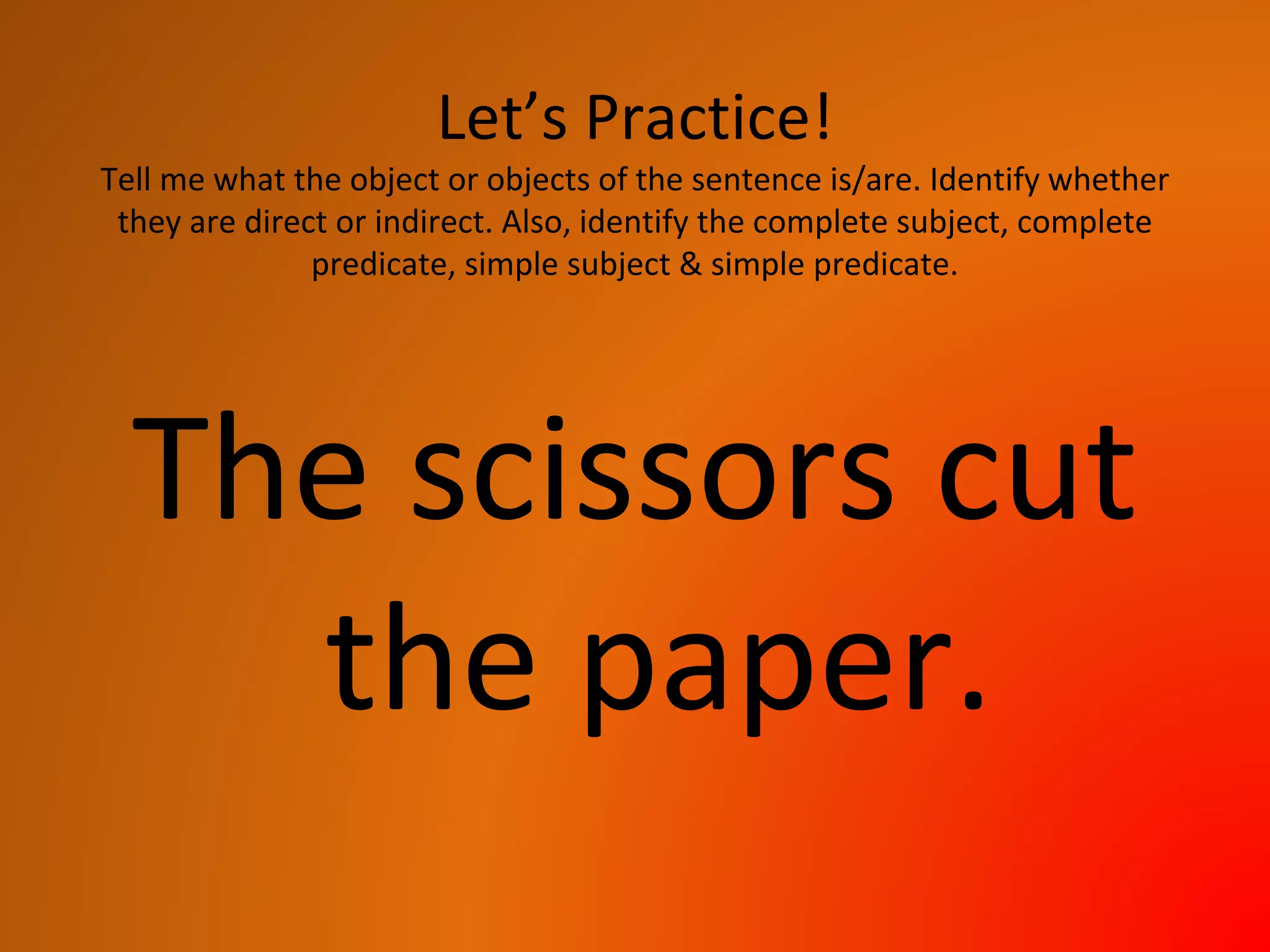
The scissors cut
the paper.
Let’s Practice!
Tell me what the object or objects of the sentence is/are. Identify whether
they are direct or indirect. Also, identify the complete subject, complete
predicate, simple subject & simple predicate.
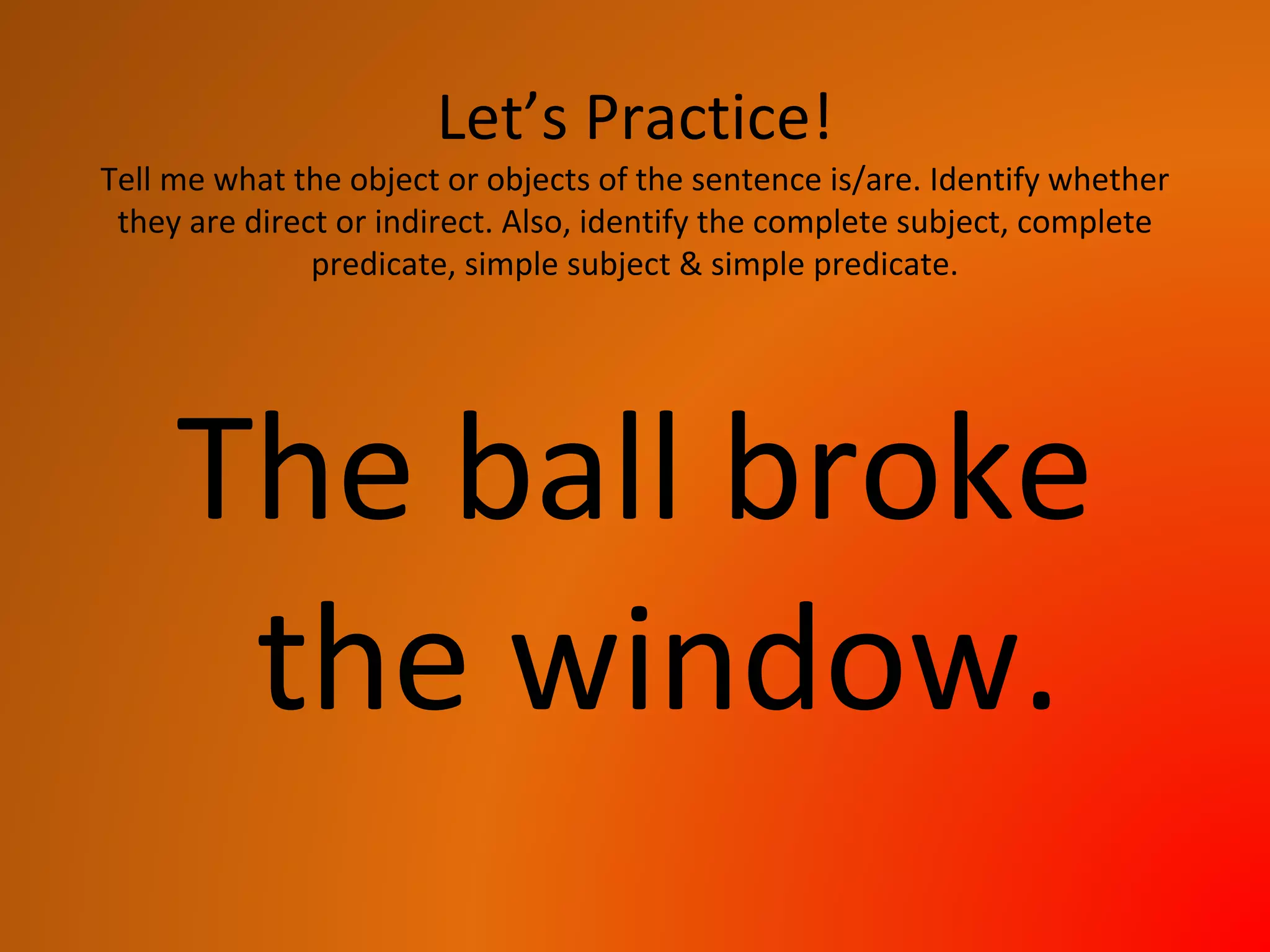
The ball broke
the window.
Let’s Practice!
Tell me what the object or objects of the sentence is/are. Identify whether
they are direct or indirect. Also, identify the complete subject, complete
predicate, simple subject & simple predicate.
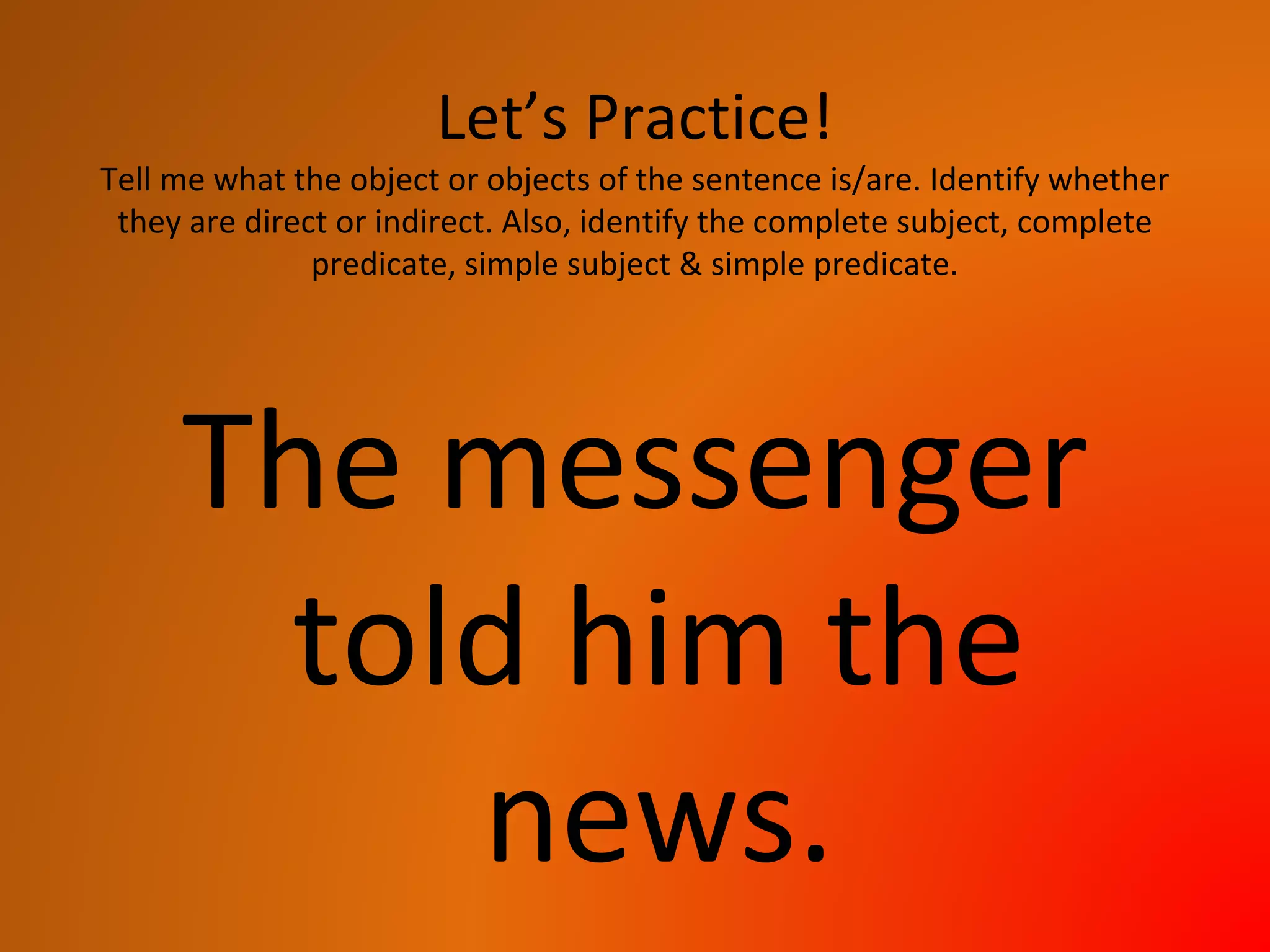
The messenger
told him the
news.
Let’s Practice!
Tell me what the object or objects of the sentence is/are. Identify whether
they are direct or indirect. Also, identify the complete subject, complete
predicate, simple subject & simple predicate.
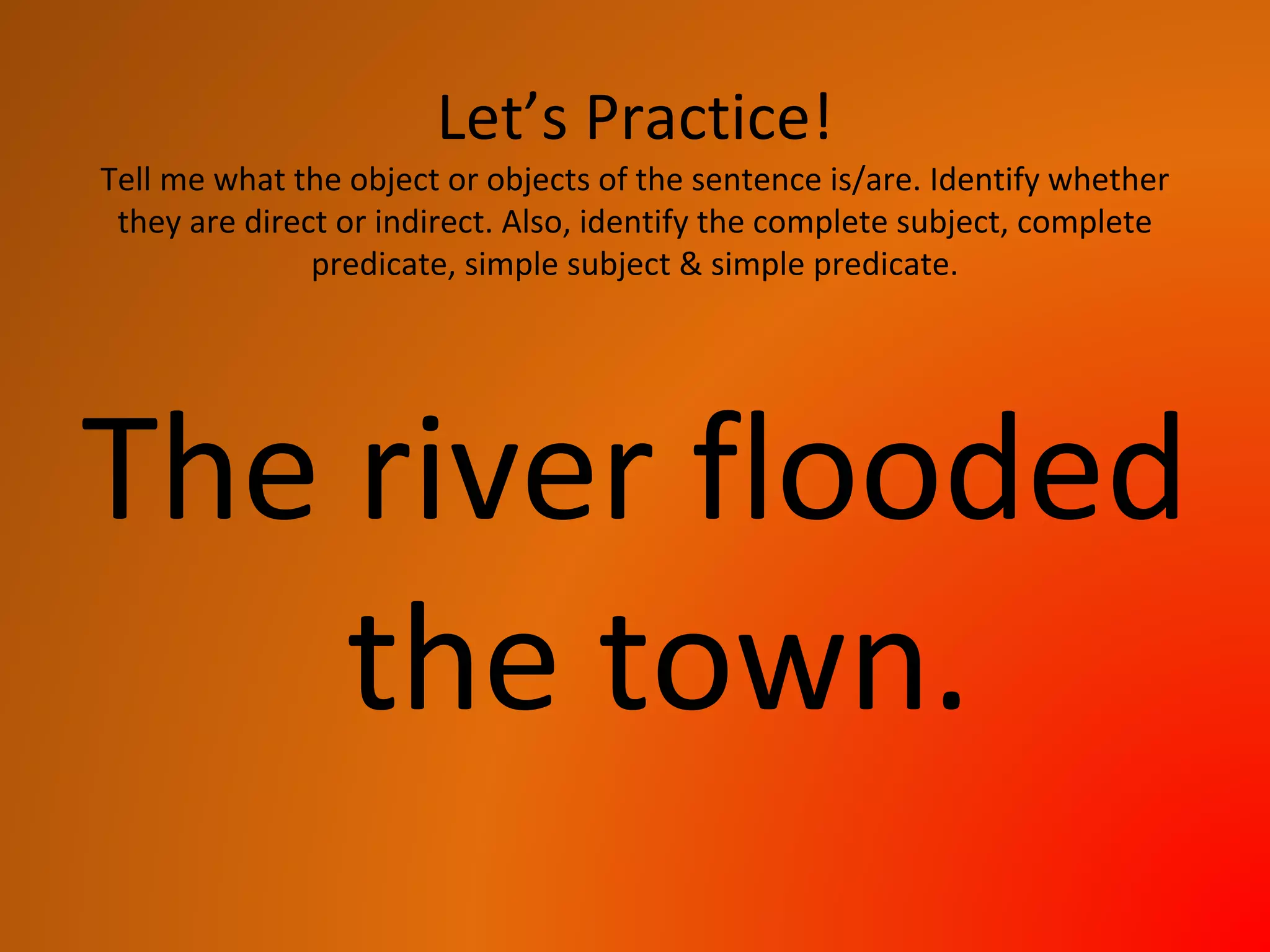
The river flooded
the town.
Let’s Practice!
Tell me what the object or objects of the sentence is/are. Identify whether
they are direct or indirect. Also, identify the complete subject, complete
predicate, simple subject & simple predicate.
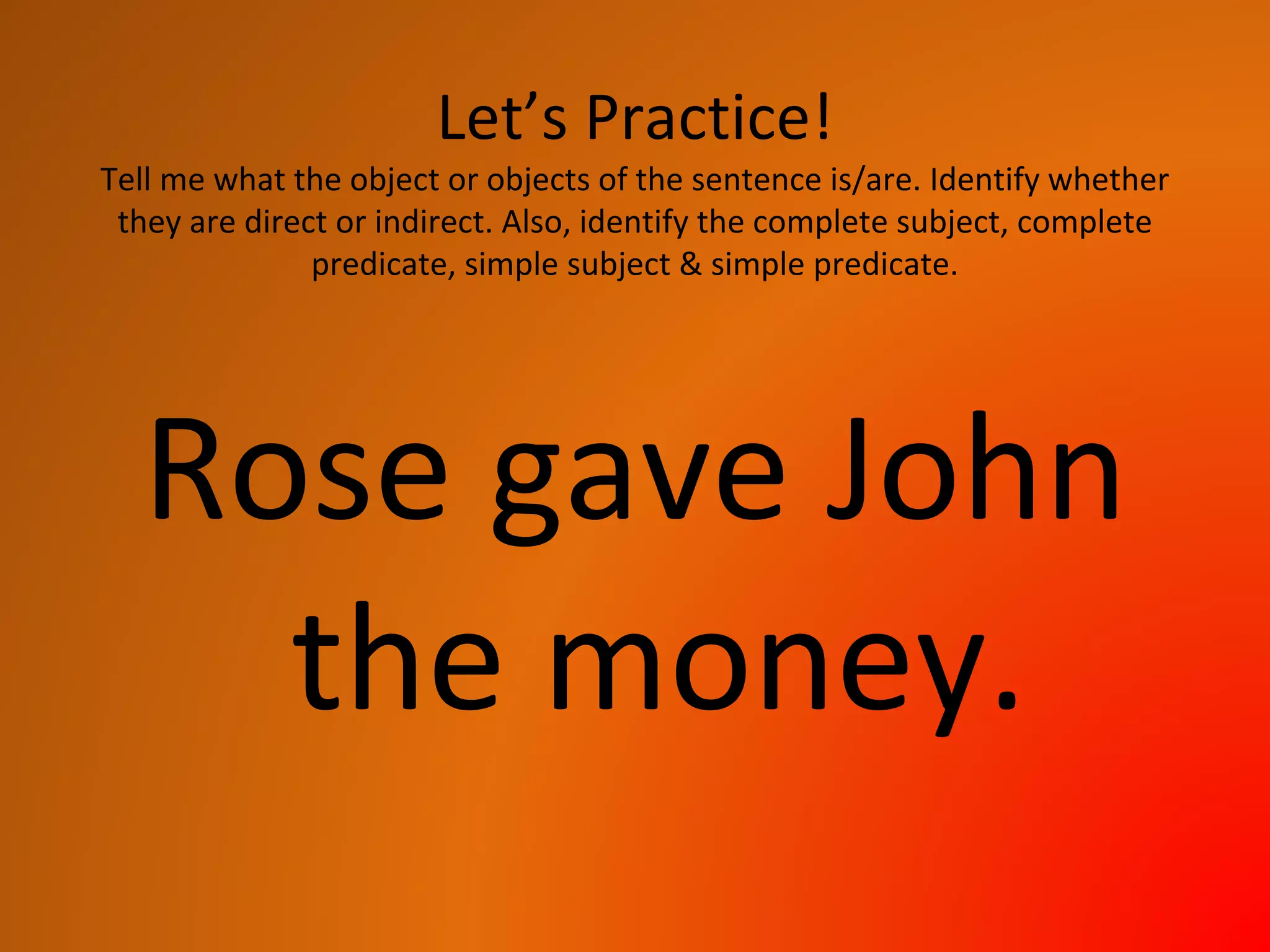
Rose gave John
the money.

Subject predicate object ppt

  • 1.
    Subject, Predicate &Object 7th Grade Grammar Unit
  • 2.
    What is subject? ●The subject is the noun that is doing the action of the sentence. ● The subject is the “main character” of the sentence. ● Includes the main noun and any basic modifiers (possessive adjectives, articles, etc) ● Example: ● Kirsten is cooking the cake. ● He played the bass. ● My dog eats Kibbles and Bits.
  • 3.
    What is predicate? ●The predicate is the action of the sentence ● Includes any and all verbs (includes helping verbs such as “have”, “should”, “will”, “is”, etc) ● Example: ● Kirsten is cooking the cake. ● He played the bass. ● My dog eats Kibbles and Bits.
  • 4.
    What is object? ●The object is the noun that is having the action (predicate) done to them/it. ● Includes the secondary noun and any basic modifiers (possessive adjectives, articles, etc) ● Example: ● Kirsten is cooking the cake. ● He played the bass. ● My dog eats Kibbles and Bits.
  • 5.
    Let’s Practice! Identify thesentence parts in the following sentence Your dad is driving his car
  • 6.
    Let’s Practice! Identify thesentence parts in the following sentence The waitress brought the food.
  • 7.
    Let’s Practice! Identify thesentence parts in the following sentence She will need some advice.
  • 8.
    Let’s Practice! Identify thesentence parts in the following sentence You are taking notes.
  • 9.
    Let’s Practice! Identify thesentence parts in the following sentence Katherine is singing songs.
  • 10.
    Let’s Practice! Identify thesentence parts in the following sentence The teacher distributed the homework.
  • 11.
    Let’s Practice! Identify thesentence parts in the following sentence Every kitten drinks milk.
  • 12.
    Let’s Practice! Identify thesentence parts in the following sentence Who asked that question?
  • 13.
    Direct Object vs.Indirect Object ● The previous example (“Who asked that question”) is an example of direct object. Direct objects answer the question “Who?” or “What?”. ● Example: ● Who asked that question? ● We can ask ourselves the question “who or what was asked?” ● The answer is “that question” ● Therefore, “that question” is the direct object ● Indirect object is a little different. In a sentence that has an indirect object, there will also be a direct object. ● Example: ● Who asked Samantha that question? ● “That question” is the direct object because it is what is being asked. ● Now we have to ask ourselves a second question. That question is “who or what is receiving the direct object?”. ● The indirect object always proceeds the direct object in the sentence. ● So what’s the indirect object in this sentence?
  • 14.
    Let’s Practice! Tell mewhat the object or objects of the sentence is/are. Identify whether they are direct or indirect. The ball hit the wall.
  • 15.
    Let’s Practice! Tell mewhat the object or objects of the sentence is/are. Identify whether they are direct or indirect. The tornado destroyed the house.
  • 16.
    Let’s Practice! Tell mewhat the object or objects of the sentence is/are. Identify whether they are direct or indirect. Jimmy kicked the ball.
  • 17.
    Let’s Practice! Tell mewhat the object or objects of the sentence is/are. Identify whether they are direct or indirect. Lenny gave Jane the check.
  • 18.
    Let’s Practice! Tell mewhat the object or objects of the sentence is/are. Identify whether they are direct or indirect. The mother lectured her son.
  • 19.
    Let’s Practice! Tell mewhat the object or objects of the sentence is/are. Identify whether they are direct or indirect. The disease infected the entire population.
  • 20.
    Let’s Practice! Tell mewhat the object or objects of the sentence is/are. Identify whether they are direct or indirect. Levi passed Mark the football.
  • 21.
    Let’s Practice! Tell mewhat the object or objects of the sentence is/are. Identify whether they are direct or indirect. Janet hugged Devin.
  • 22.
    Let’s Practice! Tell mewhat the object or objects of the sentence is/are. Identify whether they are direct or indirect. The teacher gave me an extension.
  • 23.
    Let’s Practice! Tell mewhat the object or objects of the sentence is/are. Identify whether they are direct or indirect. Also, identify the subject and predicate. The cat drank the milk.
  • 24.
    Let’s Practice! Tell mewhat the object or objects of the sentence is/are. Identify whether they are direct or indirect. Also, identify the complete subject, complete predicate, simple subject & simple predicate. The dog chased the mailman.
  • 25.
    Let’s Practice! Tell mewhat the object or objects of the sentence is/are. Identify whether they are direct or indirect. Also, identify the complete subject, complete predicate, simple subject & simple predicate. The man sent his wife the most beautiful flowers.
  • 26.
    Let’s Practice! Tell mewhat the object or objects of the sentence is/are. Identify whether they are direct or indirect. Also, identify the complete subject, complete predicate, simple subject & simple predicate. The scissors cut the paper.
  • 27.
    Let’s Practice! Tell mewhat the object or objects of the sentence is/are. Identify whether they are direct or indirect. Also, identify the complete subject, complete predicate, simple subject & simple predicate. The ball broke the window.
  • 28.
    Let’s Practice! Tell mewhat the object or objects of the sentence is/are. Identify whether they are direct or indirect. Also, identify the complete subject, complete predicate, simple subject & simple predicate. The messenger told him the news.
  • 29.
    Let’s Practice! Tell mewhat the object or objects of the sentence is/are. Identify whether they are direct or indirect. Also, identify the complete subject, complete predicate, simple subject & simple predicate. The river flooded the town.
  • 30.
    Let’s Practice! Tell mewhat the object or objects of the sentence is/are. Identify whether they are direct or indirect. Also, identify the complete subject, complete predicate, simple subject & simple predicate. Rose gave John the money.