A D E W I J A Y A , M D – O C T O B E R 2 0 2 0
Subdural Hygroma
Outline:
 History
 Definition
 Etiology
 Clinical Presentation
 Treatment
 Summary
History
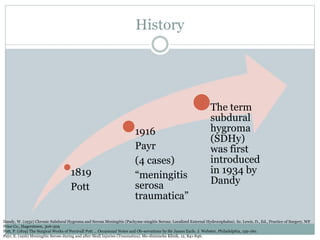
1819
Pott
1916
Payr
(4 cases)
“meningitis
serosa
traumatica”
The term
subdural
hygroma
(SDHy)
was first
introduced
in 1934 by
Dandy
Dandy, W. (1932) Chronic Subdural Hygroma and Serous Meningitis (Pachyme-ningitis Serosa: Localized External Hydrocephalus). In: Lewis, D., Ed., Practice of Surgery, WF
Prior Co., Hagerstown, 306-309
Pott, P. (1819) The Surgical Works of Percivall Pott ... Occasional Notes and Ob-servations by Sir James Earle. J. Webster, Philadelphia, 159-160.
Payr, E. (1916) Meningitis Serose during and after Skull Injuries (Traumatica). Me-dizinische Klinik, 12, 841-846.
Definition
A collection of cerebrospinal fluid (CSF), without
blood, located under the dural membrane.
Almenzalawy, M. A., Abd Elhakeem, A. E., & Ragab, M. H. (2019). Subdural Hygroma: Different Treatment Modalities and Clinical Outcome. Open Journal of Modern
Neurosurgery, 9(03), 208.
Etiology
 Trauma (in adults; most common)
 Infection (in children)
 Rupture of arachnoid cyst (spontaneous)
 Post operative (decompressive craniectomy,
cranioplasty or shunt installation)
Almenzalawy, M. A., Abd Elhakeem, A. E., & Ragab, M. H. (2019). Subdural Hygroma: Different Treatment Modalities and Clinical Outcome. Open Journal of Modern
Neurosurgery, 9(03), 208.
Clinical Presentation
 Mostly asymptomatic
 Headaches
 Changes in mental status
 Nausea and vomiting
 Focal Neurological deficits
 Seizures
 Sometimes, it may cause mass effect and become a
life-threatening condition
Diagnosis tool : brain CT scan
Lee, K.S. (1998) The Pathogenesis and Clinical Significance of Traumatic Subdural Hygroma. Brain Injury, 12, 595-603.
Ortiz-Prado, E., Acosta Castillo, T., Lopez, O.M., et al. (2016) Post-Traumatic Sub-dural Hygroma: A One Year Follow up Case Report and Literature Review. Global
Journal of Health Science, 8, 239-247.
Treatment
 Conservative
 Surgery (mass effect; unfavorable symptoms)
Summary
 A collection of cerebrospinal fluid (CSF), without
blood, located under the dural membrane
 Most common cause: traumatic
 Mostly asymptomatic
 Diagnostic tool : brain CT scan
 Management: conservative or surgery (mass effect,
loss of consciousness, unfavorable symptoms)
THANK YOU

Subdural Hygroma. An Overview

  • 1.
    A D EW I J A Y A , M D – O C T O B E R 2 0 2 0 Subdural Hygroma
  • 2.
    Outline:  History  Definition Etiology  Clinical Presentation  Treatment  Summary
  • 3.
    History 1819 Pott 1916 Payr (4 cases) “meningitis serosa traumatica” The term subdural hygroma (SDHy) wasfirst introduced in 1934 by Dandy Dandy, W. (1932) Chronic Subdural Hygroma and Serous Meningitis (Pachyme-ningitis Serosa: Localized External Hydrocephalus). In: Lewis, D., Ed., Practice of Surgery, WF Prior Co., Hagerstown, 306-309 Pott, P. (1819) The Surgical Works of Percivall Pott ... Occasional Notes and Ob-servations by Sir James Earle. J. Webster, Philadelphia, 159-160. Payr, E. (1916) Meningitis Serose during and after Skull Injuries (Traumatica). Me-dizinische Klinik, 12, 841-846.
  • 4.
    Definition A collection ofcerebrospinal fluid (CSF), without blood, located under the dural membrane. Almenzalawy, M. A., Abd Elhakeem, A. E., & Ragab, M. H. (2019). Subdural Hygroma: Different Treatment Modalities and Clinical Outcome. Open Journal of Modern Neurosurgery, 9(03), 208.
  • 5.
    Etiology  Trauma (inadults; most common)  Infection (in children)  Rupture of arachnoid cyst (spontaneous)  Post operative (decompressive craniectomy, cranioplasty or shunt installation) Almenzalawy, M. A., Abd Elhakeem, A. E., & Ragab, M. H. (2019). Subdural Hygroma: Different Treatment Modalities and Clinical Outcome. Open Journal of Modern Neurosurgery, 9(03), 208.
  • 6.
    Clinical Presentation  Mostlyasymptomatic  Headaches  Changes in mental status  Nausea and vomiting  Focal Neurological deficits  Seizures  Sometimes, it may cause mass effect and become a life-threatening condition Diagnosis tool : brain CT scan Lee, K.S. (1998) The Pathogenesis and Clinical Significance of Traumatic Subdural Hygroma. Brain Injury, 12, 595-603. Ortiz-Prado, E., Acosta Castillo, T., Lopez, O.M., et al. (2016) Post-Traumatic Sub-dural Hygroma: A One Year Follow up Case Report and Literature Review. Global Journal of Health Science, 8, 239-247.
  • 7.
    Treatment  Conservative  Surgery(mass effect; unfavorable symptoms)
  • 8.
    Summary  A collectionof cerebrospinal fluid (CSF), without blood, located under the dural membrane  Most common cause: traumatic  Mostly asymptomatic  Diagnostic tool : brain CT scan  Management: conservative or surgery (mass effect, loss of consciousness, unfavorable symptoms)
  • 9.