26/06/2024
BASIC CHEMISTRY
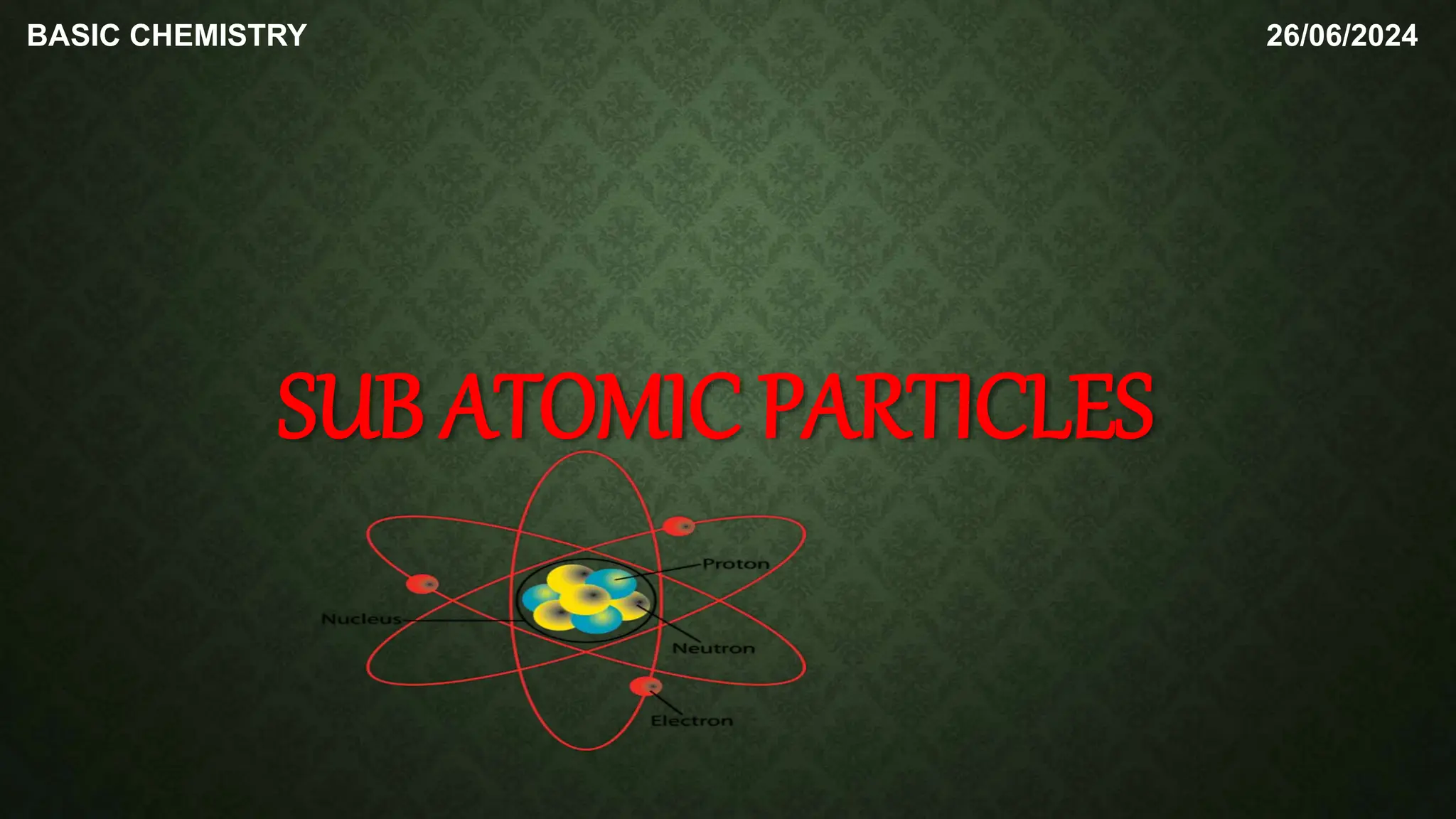
SUB ATOMIC PARTICLES
SUCCESS CRITERIA
I am successful in this lesson if I can;
•identify the sub-atomic particles.
•describe the structure of the atom.
•describe the locations, charges and masses of the
three main subatomic particles.
•describe the properties of the sub atomic particles.
26/06/2024
BASIC CHEMISTRY
According to Dalton’s Atomic Theory, atoms were indivisible solid
particles. This was not entirely accurate because contrary to what Dalton
believed, atoms can, in fact, be broken apart into smaller subunits or
subatomic particles. The particles present in an atom are :
• Proton
• Neutron
• Electron
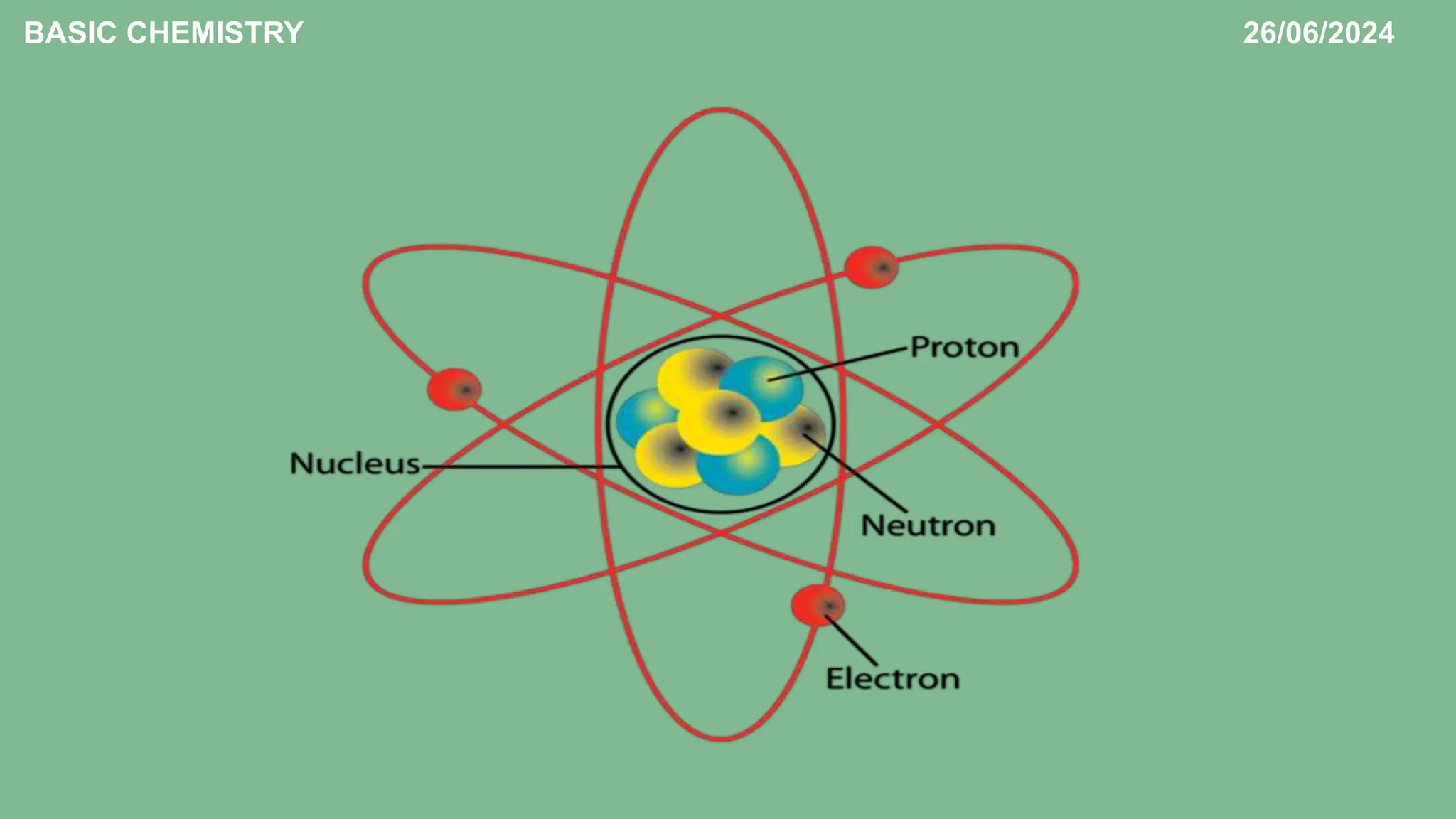
STRUCTURE OF AN ATOM
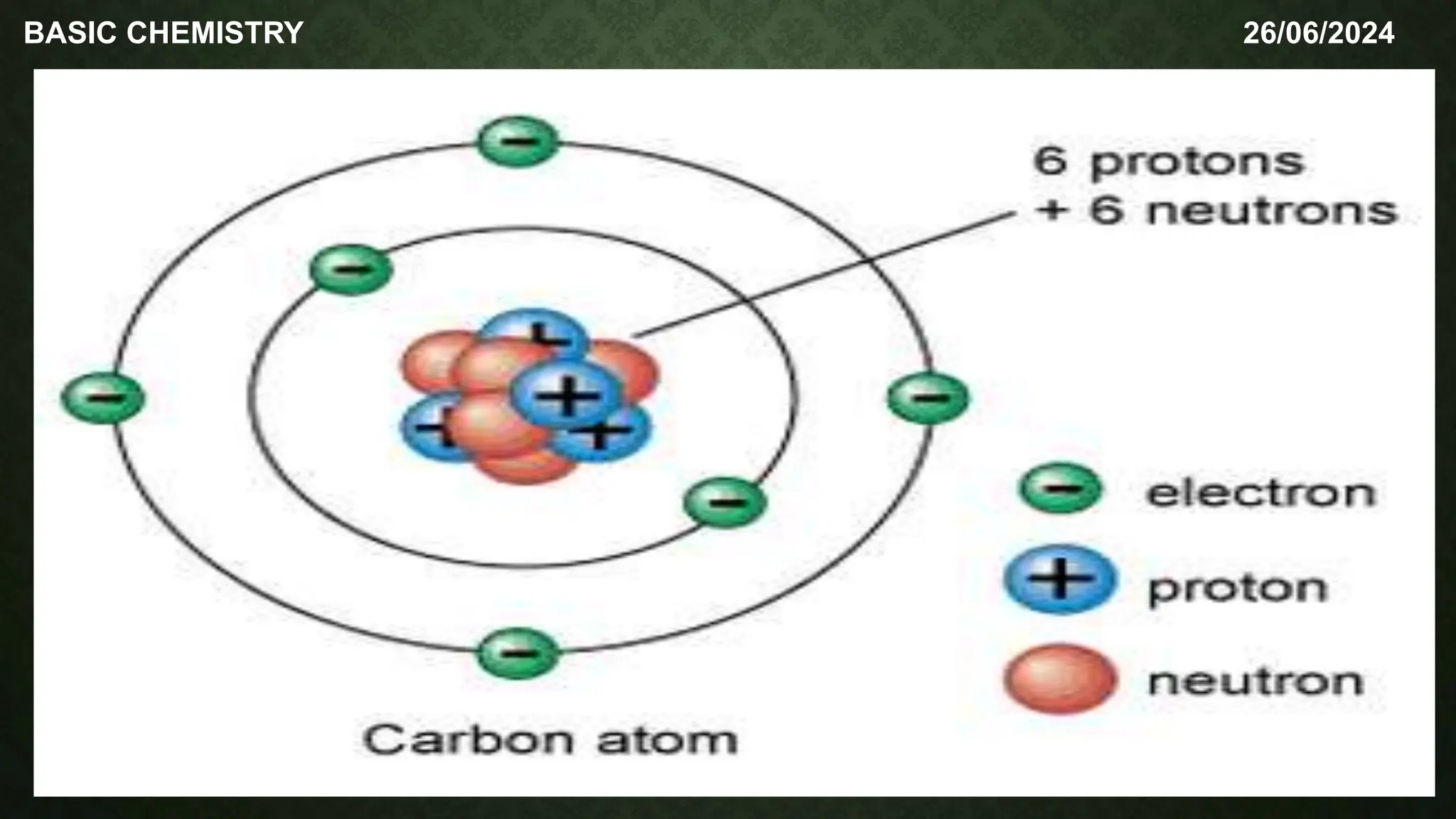
Every atom is composed of a nucleus and a region around the nucleus
called the orbital.
26/06/2024
BASIC CHEMISTRY
26/06/2024
BASIC CHEMISTRY
26/06/2024
BASIC CHEMISTRY
THE NUCLEUS
The nucleus is the central part of the atom composed of protons and
neutrons. It contains most of an atom’s mass.
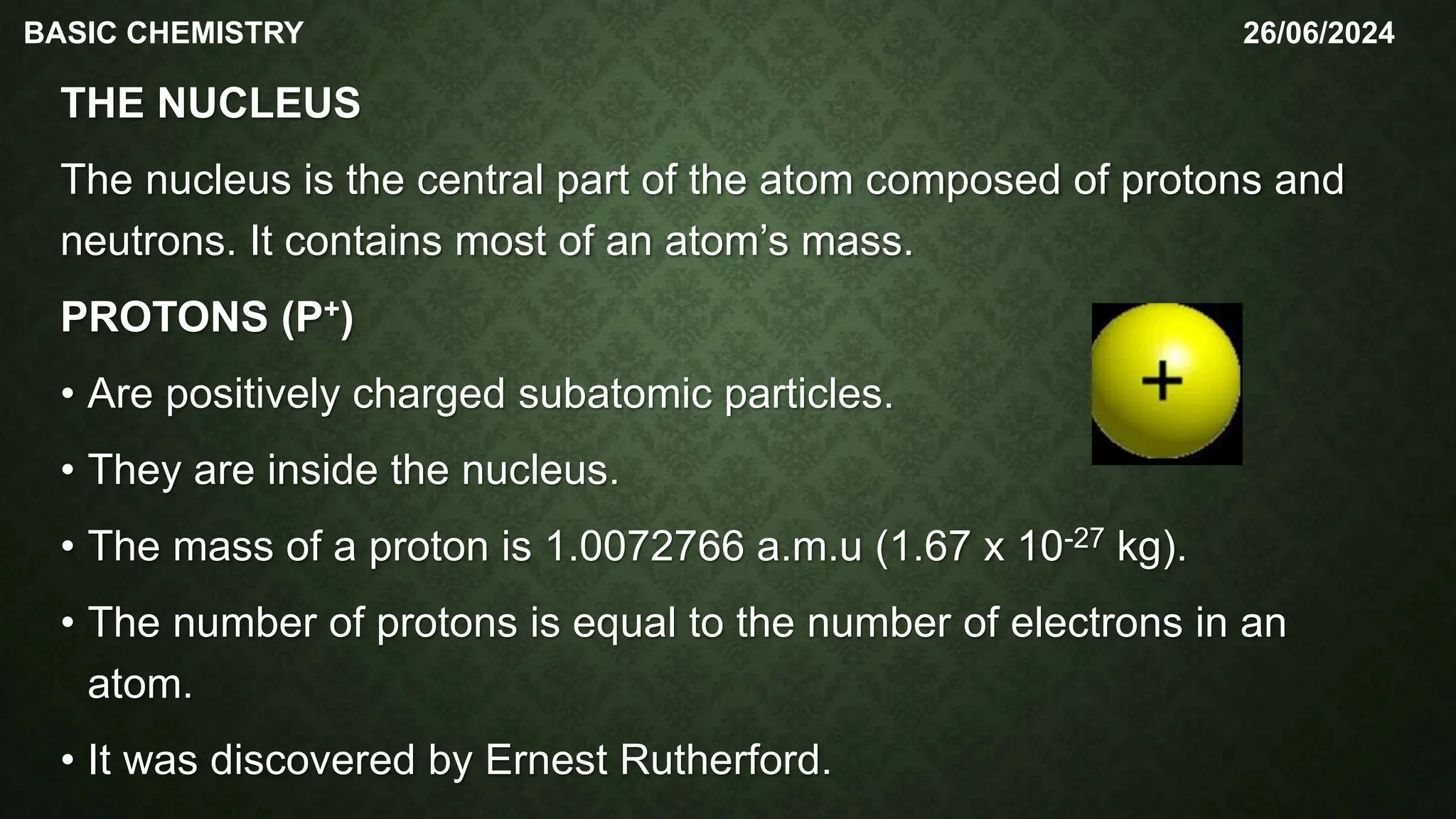
PROTONS (P+)
• Are positively charged subatomic particles.
• They are inside the nucleus.
• The mass of a proton is 1.0072766 a.m.u (1.67 x 10⁻²⁷ kg).
• The number of protons is equal to the number of electrons in an
atom.
• It was discovered by Ernest Rutherford.
26/06/2024
BASIC CHEMISTRY
26/06/2024
BASIC CHEMISTRY
NEUTRONS (no)
Neutrons, along with protons are found in the nucleus. Neutrons are
named for their neutral nature-unlike protons and electrons, they do not
carry any charge. Below are the general properties of the neutrons.
• Neutrons are neutral particles thus the have no charge.
• They are found inside the nucleus of an atom.
• The mass of a neutron is 1. 0086654 a.m.u (1.6 x 10⁻²⁴g).
• The neutron was discovered by James Chadwick in the year 1932.
• Both the proton and the neutron make the atomic mass of an atom.
• Protons and neutrons are together called nucleons.
26/06/2024
BASIC CHEMISTRY
ELECTRONS (e-)
Electrons are the subatomic particles that revolve around the nucleus of
an atom. These electrons may be removed from or gained by an atom to
form ions. The general properties of electrons are listed below.
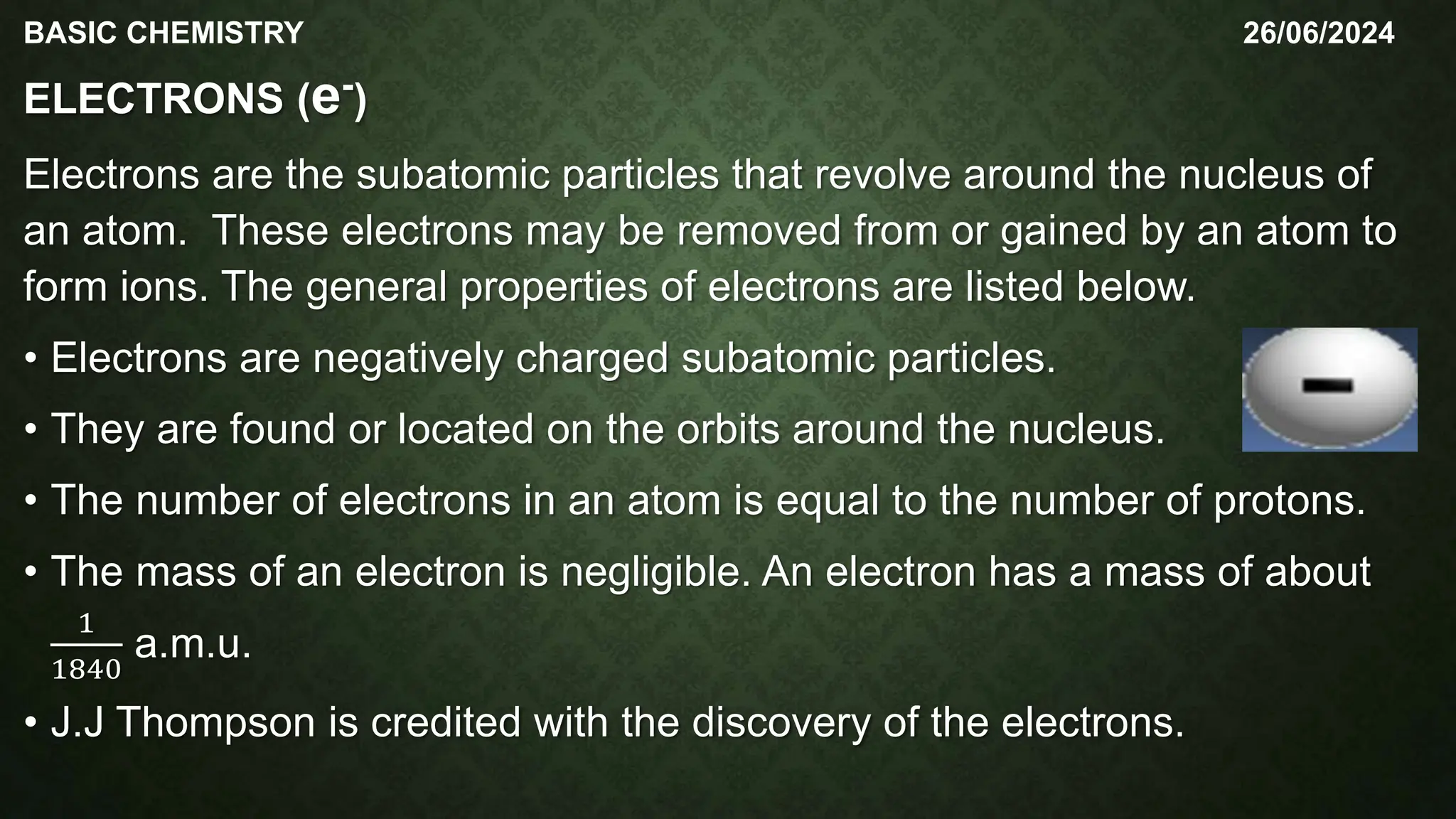
• Electrons are negatively charged subatomic particles.
• They are found or located on the orbits around the nucleus.
• The number of electrons in an atom is equal to the number of protons.
• The mass of an electron is negligible. An electron has a mass of about
1
1840
a.m.u.
• J.J Thompson is credited with the discovery of the electrons.
26/06/2024
BASIC CHEMISTRY
CHARACTERISTICS OF THE SUB ATOMIC
PARTICLES.
26/06/2024
BASIC CHEMISTRY
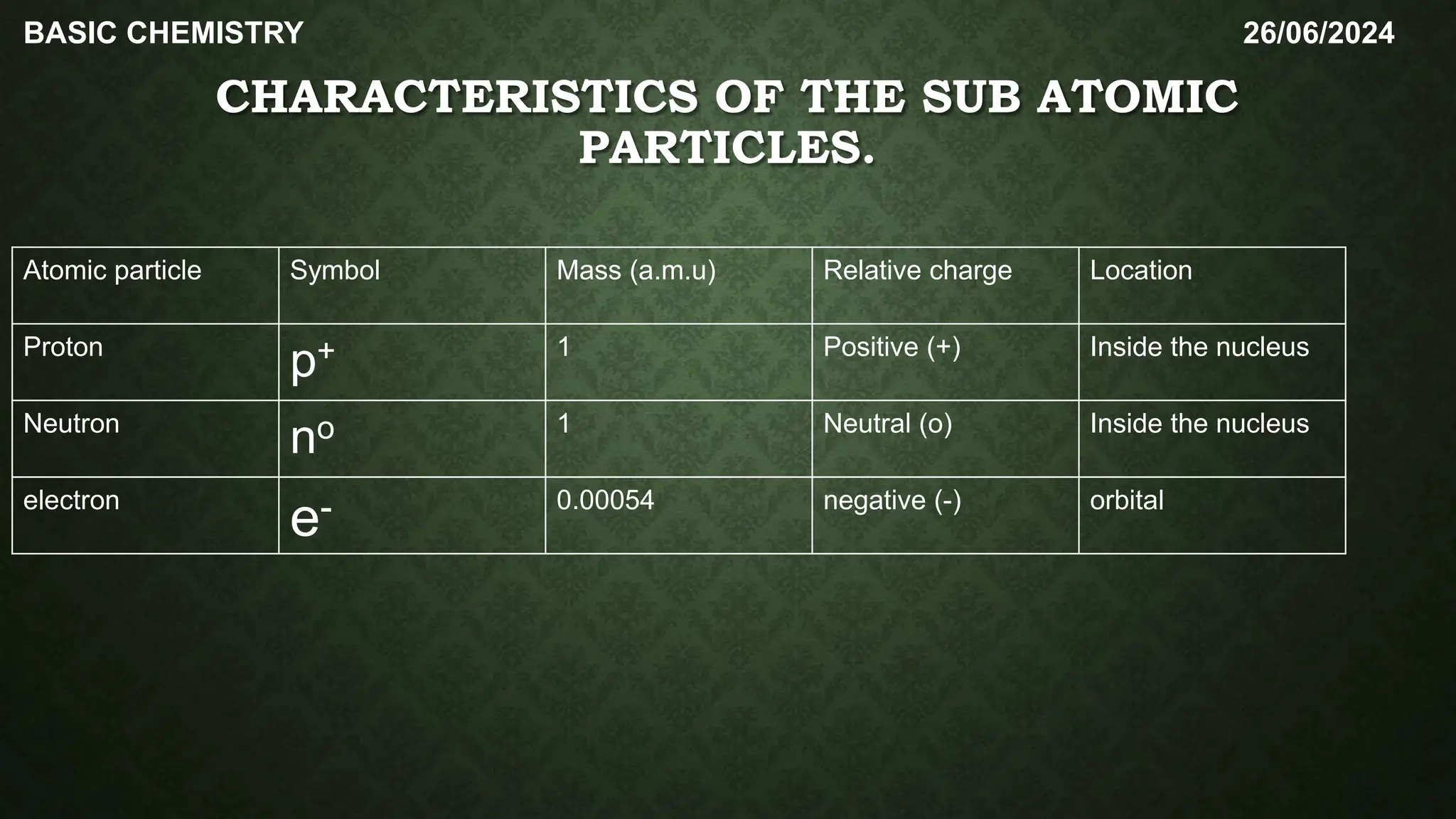
Atomic particle Symbol Mass (a.m.u) Relative charge Location
Proton
p+ 1 Positive (+) Inside the nucleus
Neutron
no 1 Neutral (o) Inside the nucleus
electron
e- 0.00054 negative (-) orbital
CLASS WORK
1. State two similarities and one difference between
(a)Proton and neutron
(b)Proton and Electron
2. Draw the structure of an atom showing all the sub-atomic
particles.
3. What is the name of the scientist who is credited with the
discovery of the electron.
26/06/2024
BASIC CHEMISTRY

SUB-ATOMIC PARTICLES PROTONS, NEUTRONS AND ELECTRONS..pptx

  • 1.
  • 2.
    SUCCESS CRITERIA I amsuccessful in this lesson if I can; •identify the sub-atomic particles. •describe the structure of the atom. •describe the locations, charges and masses of the three main subatomic particles. •describe the properties of the sub atomic particles. 26/06/2024 BASIC CHEMISTRY
  • 3.
    According to Dalton’sAtomic Theory, atoms were indivisible solid particles. This was not entirely accurate because contrary to what Dalton believed, atoms can, in fact, be broken apart into smaller subunits or subatomic particles. The particles present in an atom are : • Proton • Neutron • Electron STRUCTURE OF AN ATOM Every atom is composed of a nucleus and a region around the nucleus called the orbital. 26/06/2024 BASIC CHEMISTRY
  • 4.
  • 5.
  • 6.
    THE NUCLEUS The nucleusis the central part of the atom composed of protons and neutrons. It contains most of an atom’s mass. PROTONS (P+) • Are positively charged subatomic particles. • They are inside the nucleus. • The mass of a proton is 1.0072766 a.m.u (1.67 x 10⁻²⁷ kg). • The number of protons is equal to the number of electrons in an atom. • It was discovered by Ernest Rutherford. 26/06/2024 BASIC CHEMISTRY
  • 7.
  • 8.
    NEUTRONS (no) Neutrons, alongwith protons are found in the nucleus. Neutrons are named for their neutral nature-unlike protons and electrons, they do not carry any charge. Below are the general properties of the neutrons. • Neutrons are neutral particles thus the have no charge. • They are found inside the nucleus of an atom. • The mass of a neutron is 1. 0086654 a.m.u (1.6 x 10⁻²⁴g). • The neutron was discovered by James Chadwick in the year 1932. • Both the proton and the neutron make the atomic mass of an atom. • Protons and neutrons are together called nucleons. 26/06/2024 BASIC CHEMISTRY
  • 9.
    ELECTRONS (e-) Electrons arethe subatomic particles that revolve around the nucleus of an atom. These electrons may be removed from or gained by an atom to form ions. The general properties of electrons are listed below. • Electrons are negatively charged subatomic particles. • They are found or located on the orbits around the nucleus. • The number of electrons in an atom is equal to the number of protons. • The mass of an electron is negligible. An electron has a mass of about 1 1840 a.m.u. • J.J Thompson is credited with the discovery of the electrons. 26/06/2024 BASIC CHEMISTRY
  • 10.
    CHARACTERISTICS OF THESUB ATOMIC PARTICLES. 26/06/2024 BASIC CHEMISTRY Atomic particle Symbol Mass (a.m.u) Relative charge Location Proton p+ 1 Positive (+) Inside the nucleus Neutron no 1 Neutral (o) Inside the nucleus electron e- 0.00054 negative (-) orbital
  • 11.
    CLASS WORK 1. Statetwo similarities and one difference between (a)Proton and neutron (b)Proton and Electron 2. Draw the structure of an atom showing all the sub-atomic particles. 3. What is the name of the scientist who is credited with the discovery of the electron. 26/06/2024 BASIC CHEMISTRY