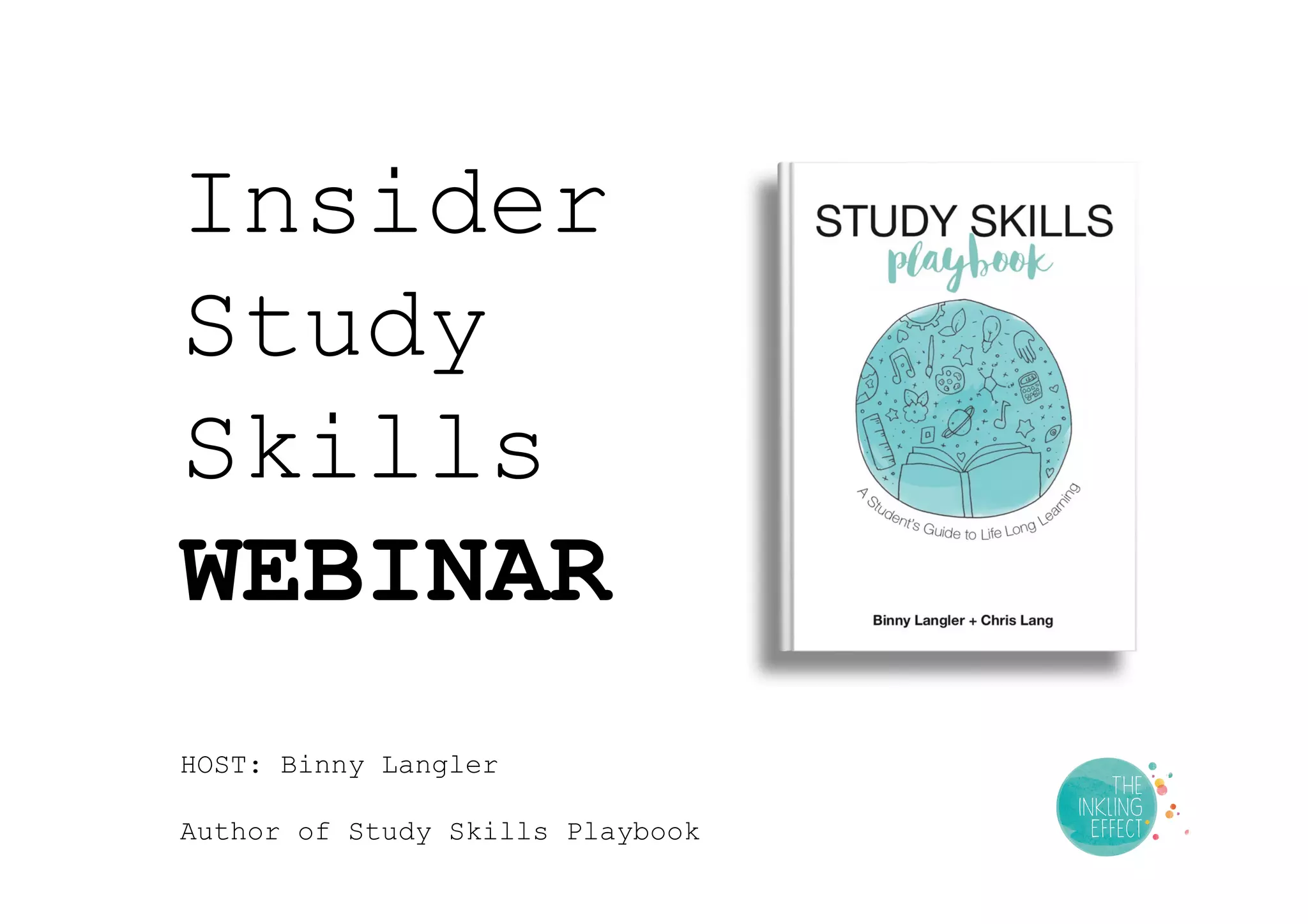
Insider
Study
Skills
WEBINAR
HOST: Binny Langler	


Author of Study Skills Playbook
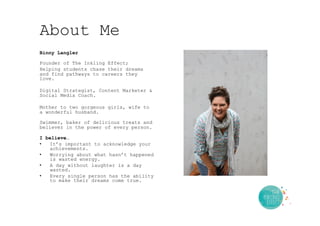
About Me
Binny Langler
Founder of The Inkling Effect;
Helping students chase their dreams
and find pathways to careers they
love.
Digital Strategist, Content Marketer &
Social Media Coach.
Mother to two gorgeous girls, wife to
a wonderful husband.
Swimmer, baker of delicious treats and
believer in the power of every person.
I believe…
•  It’s important to acknowledge your
achievements.
•  Worrying about what hasn’t happened
is wasted energy.
•  A day without laughter is a day
wasted.
•  Every single person has the ability
to make their dreams come true.
What we are going to cover
•  Goal setting
•  Planning your time +
space
•  Insider study tips
•  Essential study skills
•  Procrastination
•  Note Taking
•  Sleep and Wellbeing
•  Maths isn’t a monster
•  Preparation for exams
•  Secrets for passing
exams
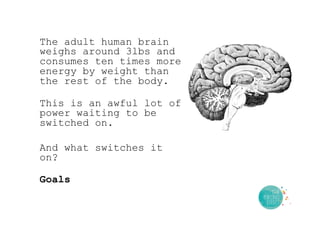
The adult human brain
weighs around 3lbs and
consumes ten times more
energy by weight than
the rest of the body.
This is an awful lot of
power waiting to be
switched on.
And what switches it
on?
Goals
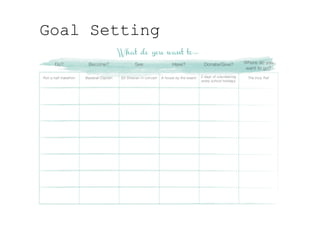
Goal Setting
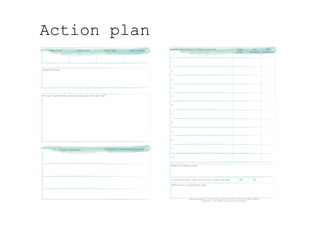
Action plan
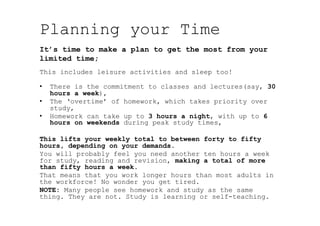
Planning your Time
This includes leisure activities and sleep too!
•  There is the commitment to classes and lectures(say, 30
hours a week),
•  The ‘overtime’ of homework, which takes priority over
study,
•  Homework can take up to 3 hours a night, with up to 6
hours on weekends during peak study times,
This lifts your weekly total to between forty to fifty
hours, depending on your demands.
You will probably feel you need another ten hours a week
for study, reading and revision, making a total of more
than fifty hours a week.
That means that you work longer hours than most adults in
the workforce! No wonder you get tired.
NOTE: Many people see homework and study as the same
thing. They are not. Study is learning or self-teaching.
It’s time to make a plan to get the most from your
limited time;
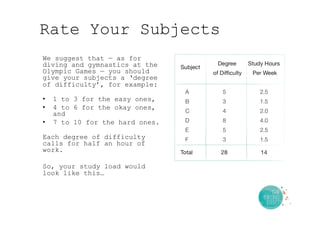
Rate Your Subjects
We suggest that — as for
diving and gymnastics at the
Olympic Games — you should
give your subjects a ‘degree
of difficulty’, for example:
•  1 to 3 for the easy ones,
•  4 to 6 for the okay ones,
and
•  7 to 10 for the hard ones.
Each degree of difficulty
calls for half an hour of
work.
So, your study load would
look like this…
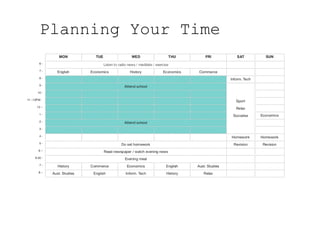
Planning Your Time
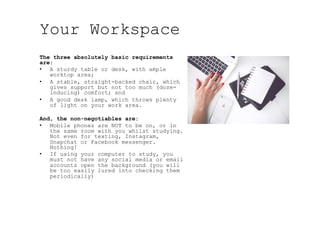
Your Workspace
The three absolutely basic requirements
are:
•  A sturdy table or desk, with ample
worktop area;
•  A stable, straight-backed chair, which
gives support but not too much (doze-
inducing) comfort; and
•  A good desk lamp, which throws plenty
of light on your work area.
And, the non-negotiables are:
•  Mobile phones are NOT to be on, or in
the same room with you whilst studying.
Not even for texting, Instagram,
Snapchat or Facebook messenger.
Nothing!
•  If using your computer to study, you
must not have any social media or email
accounts open the background (you will
be too easily lured into checking them
periodically)
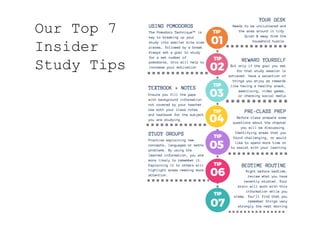
Our Top 7
Insider
Study Tips
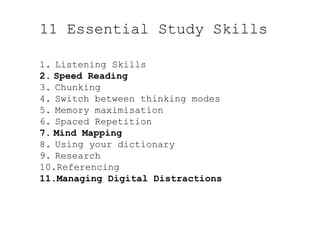
11 Essential Study Skills
1.  Listening Skills
2.  Speed Reading
3.  Chunking
4.  Switch between thinking modes
5.  Memory maximisation
6.  Spaced Repetition
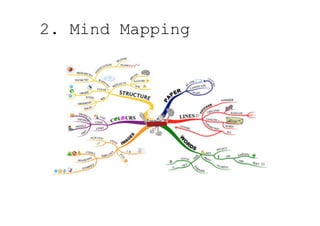
7.  Mind Mapping
8.  Using your dictionary
9.  Research
10. Referencing
11. Managing Digital Distractions
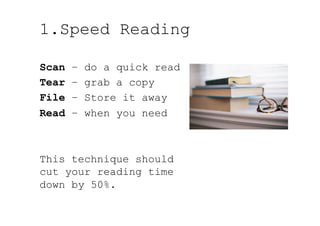
1.Speed Reading
Scan – do a quick read
Tear – grab a copy
File – Store it away
Read – when you need
This technique should
cut your reading time
down by 50%.
2. Mind Mapping
3. Digital Distractions
Procrastination
Tips to Overcome Procrastination:
•  Eat your Frog. Do the worst or hardest thing first when you sit
down to study, or when you are fresh in the morning.
•  Make yourself accountable. It’s easy not to stick to your plan, or
avoid the difficult tasks or subjects. Make yourself accountable to
a friend of family member.
•  Plan a no-procrastination day. Make a list of all the things you’ve
been avoiding or don’t want to do and tackle them all together.
•  Start your day again at midday. If you are studying all day make
sure you stop in the middle of the day and reassess how far you
have got on your to-do list.
•  Break your workload into bite size pieces. Rather than feeling
overwhelmed by your workload, use the Pomodoro Technique to create
manageable chunks of work you can systematically complete.
•  Avoid interruptions. Thanks to social media our attention span is
very short. Do not allow digital notifications, email alerts,
messenger, Snap Chat, calls or texts to pull you away from your
work (even if it’s only for 1 minute).
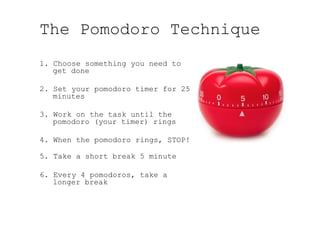
The Pomodoro Technique
1.  Choose something you need to
get done
2. Set your pomodoro timer for 25
minutes
3. Work on the task until the
pomodoro (your timer) rings
4. When the pomodoro rings, STOP!
5. Take a short break 5 minute
6. Every 4 pomodoros, take a
longer break
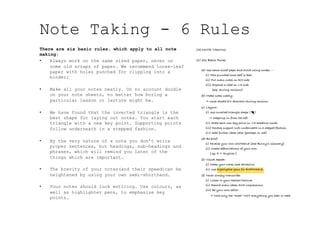
Note Taking - 6 Rules
There are six basic rules, which apply to all note
making:
•  Always work on the same sized paper, never on
some old scraps of paper. We recommend loose-leaf
paper with holes punched for clipping into a
binder;
•  Make all your notes neatly. On no account doodle
on your note sheets, no matter how boring a
particular lesson or lecture might be.
•  We have found that the inverted triangle is the
best shape for laying out notes. You start each
triangle with a new key point. Supporting points
follow underneath in a stepped fashion.
•  By the very nature of a note you don’t write
proper sentences, but headings, sub-headings and
phrases, which will remind you later of the
things which are important.
•  The brevity of your notes(and their speed)can be
heightened by using your own semi-shorthand.
•  Your notes should look enticing. Use colours, as
well as highlighter pens, to emphasize key
points.
Sleep & Well Being
The best asset we have for
making a contribution to the
world is ourselves.
If we underinvest in
ourselves, and by that I mean
our minds, bodies, and our
spirits, we damage the very
tool we need to make our
contribution.
Greg McKeown, Author,
Essentialism (2014)
Sleep - your secret weapon
A tired brain, while technically
awake, is barely functioning.
It is harder to think, plan,
prioritise, or see the bigger picture.
It is hard to make decisions or
choices and nearly impossible to
discern the essential from the
trivial.
Who wants to learn or study under
those circumstances?
The National Sleep Foundation (USA)
recommends:
-  teenagers 14-17 years need between
8-10 hour sleep each night,
-  young adults 18-25 years need
between 7-9 hours.
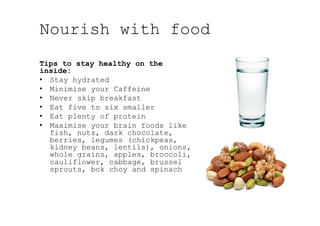
Nourish with food
Tips to stay healthy on the
inside:
•  Stay hydrated
•  Minimise your Caffeine
•  Never skip breakfast
•  Eat five to six smaller
•  Eat plenty of protein
•  Maximise your brain foods like
fish, nuts, dark chocolate,
berries, legumes (chickpeas,
kidney beans, lentils), onions,
whole grains, apples, broccoli,
cauliflower, cabbage, brussel
sprouts, bok choy and spinach
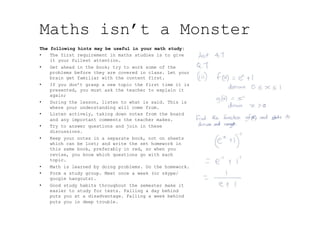
Maths isn’t a Monster
The following hints may be useful in your math study:
•  The first requirement in maths studies is to give
it your fullest attention.
•  Get ahead in the book; try to work some of the
problems before they are covered in class. Let your
brain get familiar with the content first.
•  If you don’t grasp a new topic the first time it is
presented, you must ask the teacher to explain it
again;
•  During the lesson, listen to what is said. This is
where your understanding will come from.
•  Listen actively, taking down notes from the board
and any important comments the teacher makes.
•  Try to answer questions and join in these
discussions.
•  Keep your notes in a separate book, not on sheets
which can be lost; and write the set homework in
this same book, preferably in red, so when you
revise, you know which questions go with each
topic.
•  Math is learned by doing problems. Do the homework.
•  Form a study group. Meet once a week (or skype/
google hangouts).
•  Good study habits throughout the semester make it
easier to study for tests. Falling a day behind
puts you at a disadvantage. Falling a week behind
puts you in deep trouble.
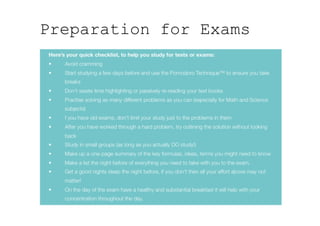
Preparation for Exams
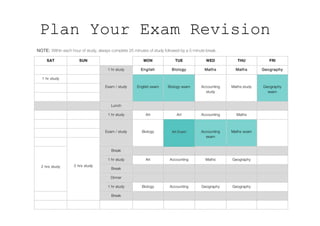
Plan Your Exam Revision
Art Exam
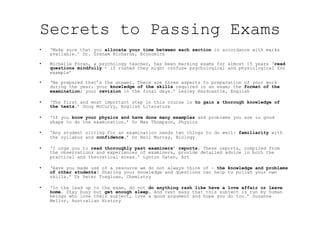
Secrets to Passing Exams
•  ‘Make sure that you allocate your time between each section in accordance with marks
available.’ Dr. Graham Richards, Economics
•  Michelle Foran, a psychology teacher, has been marking exams for almost 15 years ‘read
questions mindfully - if rushed they might confuse psychological and physiological for
example’
•  ‘Be prepared that’s the answer. There are three aspects to preparation of your work
during the year: your knowledge of the skills required in an exam; the format of the
examination; your revision in the final days.’ Lesley Hardcastle, English
•  ‘The first and most important step in this course is to gain a thorough knowledge of
the texts.’ Doug McCurry, English Literature
•  ‘If you know your physics and have done many examples and problems you are in good
shape to do the examination.’ Dr Max Thompson, Physics
•  ‘Any student sitting for an examination needs two things to do well: familiarity with
the syllabus and confidence.’ Dr Neil Murray, Biology
•  ‘I urge you to read thoroughly past examiners’ reports. These reports, compiled from
the observations and experiences of examiners, provide detailed advice in both the
practical and theoretical areas.’ Lynton Oaten, Art
•  ‘Have you made use of a resource we do not always think of — the knowledge and problems
of other students? Sharing your knowledge and questions can help to polish your own
skills.’ Dr Peter Tregloan, Chemistry
•  ‘In the lead up to the exam, do not do anything rash like have a love affair or leave
home. Stay busy but get enough sleep. And rest easy that this subject is run by human
beings who love their subject, love a good argument and hope you do too.’ Suzanne
Mellor, Australian History
Download
your
copy on
AMAZON
Thanks for joining me…
Tell your friends…
www.theinklingeffect.com.au

Study Skills Playbook Webinar Slides

  • 1.
    Insider Study Skills WEBINAR HOST: Binny Langler     Author of Study Skills Playbook
  • 2.
    About Me Binny Langler Founderof The Inkling Effect; Helping students chase their dreams and find pathways to careers they love. Digital Strategist, Content Marketer & Social Media Coach. Mother to two gorgeous girls, wife to a wonderful husband. Swimmer, baker of delicious treats and believer in the power of every person. I believe… •  It’s important to acknowledge your achievements. •  Worrying about what hasn’t happened is wasted energy. •  A day without laughter is a day wasted. •  Every single person has the ability to make their dreams come true.
  • 4.
    What we aregoing to cover •  Goal setting •  Planning your time + space •  Insider study tips •  Essential study skills •  Procrastination •  Note Taking •  Sleep and Wellbeing •  Maths isn’t a monster •  Preparation for exams •  Secrets for passing exams
  • 5.
    The adult humanbrain weighs around 3lbs and consumes ten times more energy by weight than the rest of the body. This is an awful lot of power waiting to be switched on. And what switches it on? Goals
  • 7.
  • 8.
  • 10.
    Planning your Time Thisincludes leisure activities and sleep too! •  There is the commitment to classes and lectures(say, 30 hours a week), •  The ‘overtime’ of homework, which takes priority over study, •  Homework can take up to 3 hours a night, with up to 6 hours on weekends during peak study times, This lifts your weekly total to between forty to fifty hours, depending on your demands. You will probably feel you need another ten hours a week for study, reading and revision, making a total of more than fifty hours a week. That means that you work longer hours than most adults in the workforce! No wonder you get tired. NOTE: Many people see homework and study as the same thing. They are not. Study is learning or self-teaching. It’s time to make a plan to get the most from your limited time;
  • 11.
    Rate Your Subjects Wesuggest that — as for diving and gymnastics at the Olympic Games — you should give your subjects a ‘degree of difficulty’, for example: •  1 to 3 for the easy ones, •  4 to 6 for the okay ones, and •  7 to 10 for the hard ones. Each degree of difficulty calls for half an hour of work. So, your study load would look like this…
  • 12.
  • 13.
    Your Workspace The threeabsolutely basic requirements are: •  A sturdy table or desk, with ample worktop area; •  A stable, straight-backed chair, which gives support but not too much (doze- inducing) comfort; and •  A good desk lamp, which throws plenty of light on your work area. And, the non-negotiables are: •  Mobile phones are NOT to be on, or in the same room with you whilst studying. Not even for texting, Instagram, Snapchat or Facebook messenger. Nothing! •  If using your computer to study, you must not have any social media or email accounts open the background (you will be too easily lured into checking them periodically)
  • 15.
  • 16.
    11 Essential StudySkills 1.  Listening Skills 2.  Speed Reading 3.  Chunking 4.  Switch between thinking modes 5.  Memory maximisation 6.  Spaced Repetition 7.  Mind Mapping 8.  Using your dictionary 9.  Research 10. Referencing 11. Managing Digital Distractions
  • 17.
    1.Speed Reading Scan –do a quick read Tear – grab a copy File – Store it away Read – when you need This technique should cut your reading time down by 50%.
  • 18.
  • 19.
  • 20.
    Procrastination Tips to OvercomeProcrastination: •  Eat your Frog. Do the worst or hardest thing first when you sit down to study, or when you are fresh in the morning. •  Make yourself accountable. It’s easy not to stick to your plan, or avoid the difficult tasks or subjects. Make yourself accountable to a friend of family member. •  Plan a no-procrastination day. Make a list of all the things you’ve been avoiding or don’t want to do and tackle them all together. •  Start your day again at midday. If you are studying all day make sure you stop in the middle of the day and reassess how far you have got on your to-do list. •  Break your workload into bite size pieces. Rather than feeling overwhelmed by your workload, use the Pomodoro Technique to create manageable chunks of work you can systematically complete. •  Avoid interruptions. Thanks to social media our attention span is very short. Do not allow digital notifications, email alerts, messenger, Snap Chat, calls or texts to pull you away from your work (even if it’s only for 1 minute).
  • 21.
    The Pomodoro Technique 1. Choose something you need to get done 2. Set your pomodoro timer for 25 minutes 3. Work on the task until the pomodoro (your timer) rings 4. When the pomodoro rings, STOP! 5. Take a short break 5 minute 6. Every 4 pomodoros, take a longer break
  • 22.
    Note Taking -6 Rules There are six basic rules, which apply to all note making: •  Always work on the same sized paper, never on some old scraps of paper. We recommend loose-leaf paper with holes punched for clipping into a binder; •  Make all your notes neatly. On no account doodle on your note sheets, no matter how boring a particular lesson or lecture might be. •  We have found that the inverted triangle is the best shape for laying out notes. You start each triangle with a new key point. Supporting points follow underneath in a stepped fashion. •  By the very nature of a note you don’t write proper sentences, but headings, sub-headings and phrases, which will remind you later of the things which are important. •  The brevity of your notes(and their speed)can be heightened by using your own semi-shorthand. •  Your notes should look enticing. Use colours, as well as highlighter pens, to emphasize key points.
  • 23.
    Sleep & WellBeing The best asset we have for making a contribution to the world is ourselves. If we underinvest in ourselves, and by that I mean our minds, bodies, and our spirits, we damage the very tool we need to make our contribution. Greg McKeown, Author, Essentialism (2014)
  • 24.
    Sleep - yoursecret weapon A tired brain, while technically awake, is barely functioning. It is harder to think, plan, prioritise, or see the bigger picture. It is hard to make decisions or choices and nearly impossible to discern the essential from the trivial. Who wants to learn or study under those circumstances? The National Sleep Foundation (USA) recommends: -  teenagers 14-17 years need between 8-10 hour sleep each night, -  young adults 18-25 years need between 7-9 hours.
  • 25.
    Nourish with food Tipsto stay healthy on the inside: •  Stay hydrated •  Minimise your Caffeine •  Never skip breakfast •  Eat five to six smaller •  Eat plenty of protein •  Maximise your brain foods like fish, nuts, dark chocolate, berries, legumes (chickpeas, kidney beans, lentils), onions, whole grains, apples, broccoli, cauliflower, cabbage, brussel sprouts, bok choy and spinach
  • 27.
    Maths isn’t aMonster The following hints may be useful in your math study: •  The first requirement in maths studies is to give it your fullest attention. •  Get ahead in the book; try to work some of the problems before they are covered in class. Let your brain get familiar with the content first. •  If you don’t grasp a new topic the first time it is presented, you must ask the teacher to explain it again; •  During the lesson, listen to what is said. This is where your understanding will come from. •  Listen actively, taking down notes from the board and any important comments the teacher makes. •  Try to answer questions and join in these discussions. •  Keep your notes in a separate book, not on sheets which can be lost; and write the set homework in this same book, preferably in red, so when you revise, you know which questions go with each topic. •  Math is learned by doing problems. Do the homework. •  Form a study group. Meet once a week (or skype/ google hangouts). •  Good study habits throughout the semester make it easier to study for tests. Falling a day behind puts you at a disadvantage. Falling a week behind puts you in deep trouble.
  • 28.
  • 29.
    Plan Your ExamRevision Art Exam
  • 30.
    Secrets to PassingExams •  ‘Make sure that you allocate your time between each section in accordance with marks available.’ Dr. Graham Richards, Economics •  Michelle Foran, a psychology teacher, has been marking exams for almost 15 years ‘read questions mindfully - if rushed they might confuse psychological and physiological for example’ •  ‘Be prepared that’s the answer. There are three aspects to preparation of your work during the year: your knowledge of the skills required in an exam; the format of the examination; your revision in the final days.’ Lesley Hardcastle, English •  ‘The first and most important step in this course is to gain a thorough knowledge of the texts.’ Doug McCurry, English Literature •  ‘If you know your physics and have done many examples and problems you are in good shape to do the examination.’ Dr Max Thompson, Physics •  ‘Any student sitting for an examination needs two things to do well: familiarity with the syllabus and confidence.’ Dr Neil Murray, Biology •  ‘I urge you to read thoroughly past examiners’ reports. These reports, compiled from the observations and experiences of examiners, provide detailed advice in both the practical and theoretical areas.’ Lynton Oaten, Art •  ‘Have you made use of a resource we do not always think of — the knowledge and problems of other students? Sharing your knowledge and questions can help to polish your own skills.’ Dr Peter Tregloan, Chemistry •  ‘In the lead up to the exam, do not do anything rash like have a love affair or leave home. Stay busy but get enough sleep. And rest easy that this subject is run by human beings who love their subject, love a good argument and hope you do too.’ Suzanne Mellor, Australian History
  • 31.
  • 32.
    Thanks for joiningme… Tell your friends…
  • 33.