Revision: “reread work done previously to
improve one's knowledge of a subject,
typically to prepare for an examination”
http://oxforddictionaries.com
To be effective, it should be more active
than simply re-reading your lecture notes or
trying to remember everything you’ve learned.
BUT...
re: again
vision: to see
Vary
your
study
plan
Get rid of
distractio
ns
Think of
your end
goal
Change your
environment
Try a
support
group
Comfort
(ergonomics)
Take
regular
breaks
Reward
yourself
If
listening &
speaking
are the
ways you
learn best
then you
are
probably an
auditory
learner
If you
learn best
by seeing
things
written
down, drawn
or in a
colour-code
you are
probably a
visual
learner
If you
learn best
by being
hands-on,
actively
participati
ng, then
you are
probably a
kinaestheti
c learner
Make sure
you are the
correct
distance
from the
screen and
keyboard
Try to study
when you are
feeling most
alert- give
yourself
plenty of
time to
study
effectively
Do you need
a mouse mat,
is the lead
long enough,
do you need
to change
sides?
Is your
chair at the
right height
and distance
for your
comfort?
Do you
have
enough
light? Is
it too
bright?
Is your
screen at
the right
angle? Is
your
keyboard
steady?
You work on things that
are urgent all the time
Your study has no
structure - you’re not
sure which work to
prioritise
You think you have lots of
time, when in fact the
assignment is due today: you
miss deadlines
Problems
Understand the difference
between urgent and important
Prioritise important and it
won’t become urgent
Design a study plan
around all of your
daily activities
Keep one diary or
calendar to record all
deadlines
Solutions
It’s easy to get bogged down with all the things you have
to do.
Try analysing your tasks – what is important? What is
urgent?
Urgent things are usually a result of poor planning – as
you get better at it, you should be able to focus on tasks
Time
Monday Tuesday Wednesday Thursday Friday Saturday Sunday
9-10 Practical
English
W
O
R
K10-11 Study Study Study Theory
11-12 Practical Unit 1
12-1 Lunch Lunch Lunch Lunch Lunch Lunch Lunch
1-2 Practica
l
English
W
O
R
K
2-3 Study Study Maths Study Study
3-4
History
Study
History
4-5 Study Study
5-6
Monday 10-11 Module1 2-3
Module2
Tuesday 10- 11 English 2-3
Homework
4-5 Maths
Wednesday 3- 4 Unit 3 4-5 Unit 4
Break your study time into manageable chunks.
Don’t do it all at once, and vary the topics you’re focusing on
Effective Revision Requires Good Notetaking
*Lorem ipsum dolor sit
amet, da libero, sit amet
commodo magna eros quis
urna.
*Lorem ipsum dolor sit
amet, da libero, sit amet
commodo magna eros quis
urna.
*Lorem ipsum dolor sit
amet, da libero, sit amet
commodo magna eros quis
urna.
*Lorem ipsum dolor sit
amet, da libero, sit amet
commodo magna eros quis
urna.
*Lorem ipsum dolor sit
amet, da libero, sit amet
commodo magna eros quis
urna.
English Lecture – 20/10/16
< Less than/smaller than
< More than/bigger
than↑ Decrease
⇒ or ∴Therefore
w/ With
↑ Increase
w/o Without
Think about other
abbreviations or symbols
you could use for your
course.
They make note taking
quicker but can also
challenge your brain to
focus on the information
represented.
Identify and explain
the reasons for the
popularity of One
Direction.
Process words – instruction words
telling you what to do
Content words – topics you should
focus on
Lists
Mind
Mapping
Audio Memory games
Notes
Study
groups
Testing /
Teaching
Practice
Papers
Coach – Not Force
Memory carries on
working after you
revise!
Revise – Sleep -
Review
Break Topics Into
‘Chunks’ No More Than
Five Chunks –
Relate Them
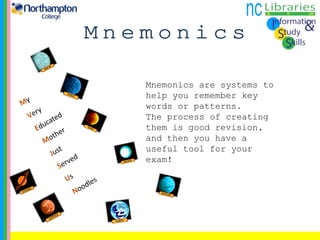
Mnemonics are systems to
help you remember key
words or patterns.
The process of creating
them is good revision,
and then you have a
useful tool for your
exam!
Whisk
Put these items into 3 groups so they will be easier to remember
Give each group a suitable name
•Find a soft ball or beanbag. In
pairs or small groups throw the
beanbag to each other
• Every time it is caught, that
person has to say a word related
to the subject and then
immediately throw it to the next
person
• If you take longer than five
seconds you have to do a
forfeit, such as kneeling down
• Makes you think quickly and
will hopefully show more than
you thought you knew
• Find some tiled letters
(Scrabble pieces, lettered dice,
or write and cut some out)
• Pick a letter out of a bag (or
roll the dice); for each letter
write one
keyword related to your study
subject (e.g: subject ‘Anatomy’
pick out ‘A’= adduction). Do
this 5 times• Write a related word beneath
each key word (e.g: adduction -
muscles)
• Write a related word beneath
the other two (e.g: adduction –
muscles - movement)
Top
tips
Keep track
of your
progress
Get enough
sleep
Eat
healthily
Do the
hard
topics
first
Take
regular
breaks
Have
relaxation
time
•Check through your notes, but do something relaxing
too
•Check the time & location of the exam
•Prepare any equipment you may need (calculators,
rulers, ID cards, etc)
•Try to get a good night’s sleep and eat a filling,
healthy breakfast before you set off in the morning.
•Leave with enough time to get to the venue and double-
check the exam details in case of any last minute
changes.
Please leave us some feedback about this
session!
Go to: goo.gl/7GUge7
Or follow the ‘session feedback’ link from
any of our moodle pages.
The library’s Information and Study Skills
moodle pages have lots of helpful leaflets,
games, videos and eResources to help you with
your revision.
From ‘All Courses’ on Moodle, go to ‘Cross-
College Student Courses’ and then ‘Information
and Study Skills’

Revision

  • 2.
    Revision: “reread workdone previously to improve one's knowledge of a subject, typically to prepare for an examination” http://oxforddictionaries.com To be effective, it should be more active than simply re-reading your lecture notes or trying to remember everything you’ve learned. BUT... re: again vision: to see
  • 3.
    Vary your study plan Get rid of distractio ns Thinkof your end goal Change your environment Try a support group Comfort (ergonomics) Take regular breaks Reward yourself
  • 4.
    If listening & speaking are the waysyou learn best then you are probably an auditory learner If you learn best by seeing things written down, drawn or in a colour-code you are probably a visual learner If you learn best by being hands-on, actively participati ng, then you are probably a kinaestheti c learner
  • 5.
    Make sure you arethe correct distance from the screen and keyboard Try to study when you are feeling most alert- give yourself plenty of time to study effectively Do you need a mouse mat, is the lead long enough, do you need to change sides? Is your chair at the right height and distance for your comfort? Do you have enough light? Is it too bright? Is your screen at the right angle? Is your keyboard steady?
  • 6.
    You work onthings that are urgent all the time Your study has no structure - you’re not sure which work to prioritise You think you have lots of time, when in fact the assignment is due today: you miss deadlines Problems Understand the difference between urgent and important Prioritise important and it won’t become urgent Design a study plan around all of your daily activities Keep one diary or calendar to record all deadlines Solutions
  • 7.
    It’s easy toget bogged down with all the things you have to do. Try analysing your tasks – what is important? What is urgent? Urgent things are usually a result of poor planning – as you get better at it, you should be able to focus on tasks
  • 8.
    Time Monday Tuesday WednesdayThursday Friday Saturday Sunday 9-10 Practical English W O R K10-11 Study Study Study Theory 11-12 Practical Unit 1 12-1 Lunch Lunch Lunch Lunch Lunch Lunch Lunch 1-2 Practica l English W O R K 2-3 Study Study Maths Study Study 3-4 History Study History 4-5 Study Study 5-6 Monday 10-11 Module1 2-3 Module2 Tuesday 10- 11 English 2-3 Homework 4-5 Maths Wednesday 3- 4 Unit 3 4-5 Unit 4 Break your study time into manageable chunks. Don’t do it all at once, and vary the topics you’re focusing on
  • 9.
  • 10.
    *Lorem ipsum dolorsit amet, da libero, sit amet commodo magna eros quis urna. *Lorem ipsum dolor sit amet, da libero, sit amet commodo magna eros quis urna. *Lorem ipsum dolor sit amet, da libero, sit amet commodo magna eros quis urna. *Lorem ipsum dolor sit amet, da libero, sit amet commodo magna eros quis urna. *Lorem ipsum dolor sit amet, da libero, sit amet commodo magna eros quis urna. English Lecture – 20/10/16
  • 11.
    < Less than/smallerthan < More than/bigger than↑ Decrease ⇒ or ∴Therefore w/ With ↑ Increase w/o Without Think about other abbreviations or symbols you could use for your course. They make note taking quicker but can also challenge your brain to focus on the information represented.
  • 12.
    Identify and explain thereasons for the popularity of One Direction. Process words – instruction words telling you what to do Content words – topics you should focus on
  • 13.
  • 14.
    Coach – NotForce Memory carries on working after you revise! Revise – Sleep - Review Break Topics Into ‘Chunks’ No More Than Five Chunks – Relate Them
  • 15.
    Mnemonics are systemsto help you remember key words or patterns. The process of creating them is good revision, and then you have a useful tool for your exam!
  • 16.
    Whisk Put these itemsinto 3 groups so they will be easier to remember Give each group a suitable name
  • 17.
    •Find a softball or beanbag. In pairs or small groups throw the beanbag to each other • Every time it is caught, that person has to say a word related to the subject and then immediately throw it to the next person • If you take longer than five seconds you have to do a forfeit, such as kneeling down • Makes you think quickly and will hopefully show more than you thought you knew
  • 18.
    • Find sometiled letters (Scrabble pieces, lettered dice, or write and cut some out) • Pick a letter out of a bag (or roll the dice); for each letter write one keyword related to your study subject (e.g: subject ‘Anatomy’ pick out ‘A’= adduction). Do this 5 times• Write a related word beneath each key word (e.g: adduction - muscles) • Write a related word beneath the other two (e.g: adduction – muscles - movement)
  • 19.
    Top tips Keep track of your progress Getenough sleep Eat healthily Do the hard topics first Take regular breaks Have relaxation time
  • 20.
    •Check through yournotes, but do something relaxing too •Check the time & location of the exam •Prepare any equipment you may need (calculators, rulers, ID cards, etc) •Try to get a good night’s sleep and eat a filling, healthy breakfast before you set off in the morning. •Leave with enough time to get to the venue and double- check the exam details in case of any last minute changes.
  • 21.
    Please leave ussome feedback about this session! Go to: goo.gl/7GUge7 Or follow the ‘session feedback’ link from any of our moodle pages. The library’s Information and Study Skills moodle pages have lots of helpful leaflets, games, videos and eResources to help you with your revision. From ‘All Courses’ on Moodle, go to ‘Cross- College Student Courses’ and then ‘Information and Study Skills’

Editor's Notes

  • #3 Again emphasise active revision. Explain we’ll go over some different active revision strategies in this PP and also ways to approach revision and exams. HAND OUT A5 ‘My revision guide’ sheets and suggest they add notes when they come across ideas useful to them.
  • #4 It’s important to keep yourself motivated and not give yourself a hard time. Discuss a few of these in detail explaining how they can be beneficial. We’ll do study plan, environment, and goals in detail
  • #5 Explain that whilst not totally scientific, doing an online test to establish learner type can be a useful starting point for ideas on how you might learn best / enjoy revising. Give a couple of examples e.g. Auditory – you understand when people give instructions verbally, you like audio books or the radio Visual – you like to draw or write when you’re learning, you visualise images in your head, you learn from videos Kinaesthetic – you like to try things out rather than just learning the theory, you enjoy physical activity, you doodle a lot when listening
  • #6 Explain that studying isn’t easy, but little things can put us off and make us more likely to find excuses – checking the ergonomics is a simple thing that can make a big difference to your concentration and success.
  • #8 https://www.developgoodhabits.com/eisenhower-matrix/
  • #9 Discuss different ways of doing this – calendars, planners etc. Moodle page – time calculator. Google charts etc.
  • #10 Explain that they can be helping themselves with revision when they first learn things by taking good notes – make reference to Cornell system, suggest they might like to find out more later – moodle etc. http://smg.photobucket.com/user/thebox24/media/Scan.jpg.html
  • #11 Many different ways of making notes both at the time and when revising – it’s good to rewrite in different ways – active – forces brain to process.
  • #13 Explain about unpicking exam questions. It’s important to revise in the context of the sort of things you will be asked to do, not just the content – but how to use the process words and respond to them.
  • #14 Emphasise that it’s important to vary activities and topics. The more active the better – we’ll go over a few suggestions now…
  • #17 Explain how to apply this to their subjects – good revision activity in itself; also a good way to split up topics