STUDY ON SCOPE OF PARAMETRIC SOFTWARES
IN ARCHITECTURE FOR THE FUTURE WORLD
DISSERTATION PRESENTATION
DGAREBC016 | ROHITH R NATH
GUIDED BY:AR.SHEFIN YOOSAF T
S9 B.ARCH
09|02|2022
Devaki Amma’s Guruvayurappan College of Architecture
Malappuram, Kerala
UNIVERSITY OF CALICUT
CONTENTS
• INTRODUCTION
• AIM & OBJECTIVES
• METHODOLOGY
• DEFINITION
• PARAMETRIC ARCHITECTURE THROUGH HISTORY
• EXISTING POSSIBILITIES OF PARAMETRIC ARCHITECTURE SOFTWARES
• PARAMETRIC URBANISM FOR THE FUTURE
• CASE STUDY
• DISTINCTIONS OF PARAMETRIC DESIGN SOFTWARE
• MERITS,DEMERITS AND COMPARITIVE ANALYSIS
• CONCLUSION
• REFERENCE
1
INTRODUCTION
Parametric Architecture is an innovative
expression of the computational support we
have received in the information age and the
advances in design engineering fabrication.
Parametric Architecture always adopt new
design agendas for every single attempts.
Maybe parametric Architecture have different
ways or options for a design problem as well.
Now a days Parametric softwares plays a
significant role in this Architecture world
2
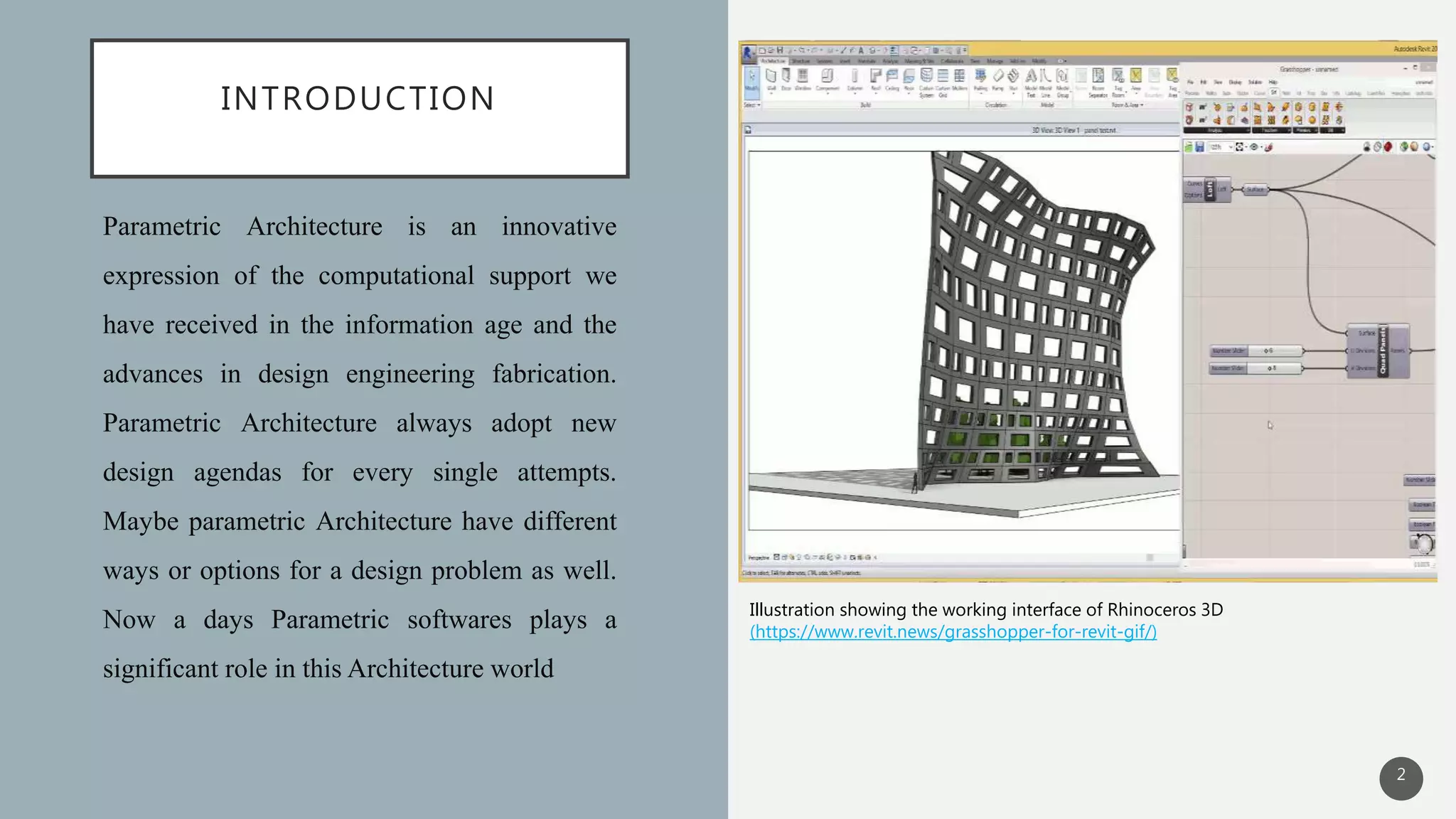
Illustration showing the working interface of Rhinoceros 3D
(https://www.revit.news/grasshopper-for-revit-gif/)
AIM & OBJECTIVES
The aim is to explore the position of parametric design in contemporary
architectural practices, identifying its advantages and disadvantages in
comparison with traditional computer-aided design (CAD) and the
Scope Of Parametric Architecture For The Future World.
The main Objectives are,
To study the evolution of Parametric Architecture
To study or examine the existing possibilities of Parametric
Architecture over CAD Softwares
To identify the merits and demerits of Parametric Architecture
To evaluate the applications of Parametric Architecture for the
future
3
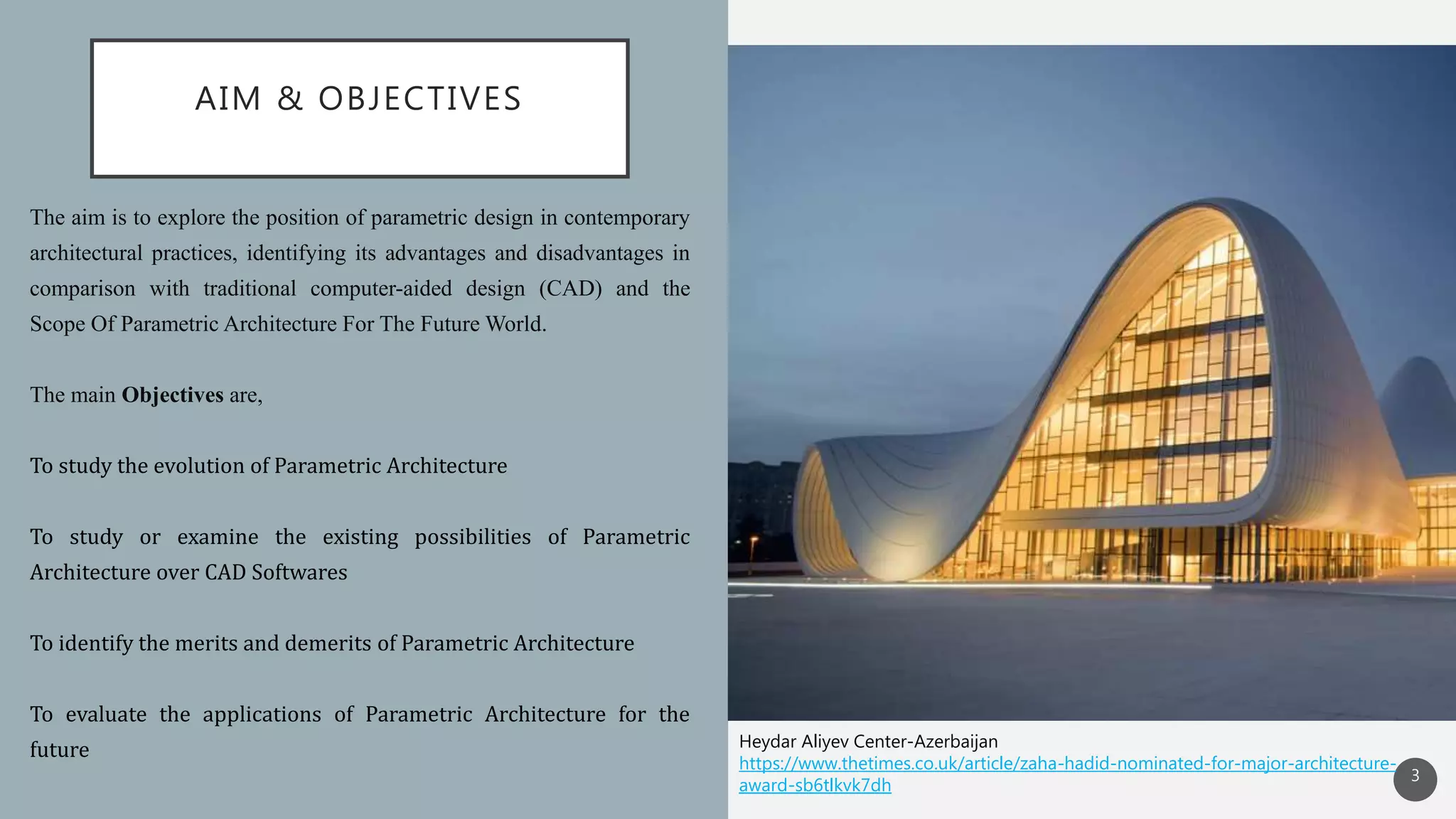
Heydar Aliyev Center-Azerbaijan
https://www.thetimes.co.uk/article/zaha-hadid-nominated-for-major-architecture-
award-sb6tlkvk7dh
METHODOLOGY
4
DEFINITION
The relations between the dimensions dependent upon
various parameters, The parameters and their
interrelationships become the code of the new
architectural language, the "structure" in the original
sense of the word. The setting of parameters and their
relation must be supported by the techniques and tools
offered by the most current sciences, in particular by
logics, mathematics and computers. Computers give the
possibility to express parameters and their relations
through a set of (self-correcting) routines".
- Luigi Moretti (Italian architect) in 1939
Figure showing Luigi Moretti working with Sketch Pad( Algorithm Aided
Design(AAD)-2014)
"Architectura Parametrica" 1960-Solution for a soccer stadium and diagram drawn
to generate the geometry (AAD)
5
PARAMETRIC
ARCHITECTURE
THROUGH
HISTORY
6
1939
• Definition By Luigi Moretti
1953
• Sketch Pad
• Most Influential computer programs ever written
• Based on a advanced associative logic called Constraints
196
6
• TEKLA
1980
• Rhino
1982
• Auto CAD
1987
• Pro Engineering Software
1994
• Blender
1997
• STAAD Pro
1998
• Autodesk MAYA.3DS MAX
2000
• Revit Architecture
EXISTING POSSIBILITIES
1.Digital Informing Creativity
7
2.Fractals
3.Digital Fabrication
4.Modeling Printable Objects
5.Modeling Objects for Cutting-based
Operations
6.Digital Form Finding
7.Digital Simulation(particle-spring
systems)
8.Computational Methodology and
Material Form Generation
9.Evaluative structures-Topology
Optimization
PARAMETRIC URBANISM
FOR THE FUTURE
8
Open street map analysis- Algorithms Aided Design (2014)
Parametric Urbanism allows us to understand and control
the behavior of complex systems, such as our cities or parts
of them. To describe this context, it is necessary to make a
selection of data; this inherently represents an important
design choice, because it deeply influences the final result.
In addition to data typologies, the source of them is in the
same way very important: data for example can be open-
data released by public administrations, freely available to
everyone; this data can be easily found on the Internet and
embody the social and economic aim of unlocking the
potential value of a huge quantity of information, usually
under-used.
CASE STUDY
LITERATURE CASE STUDY
Hangzhou Olympic Sports Center, Hangzhou, China.
9
Location and Context: Located around the
West Lake area, which is an area exposed to
an expansion and opportunities for industry
towards the Qian Tang riverfront - opposite the
city’s new Central Business District, the two
stadiums forms the centerpiece of the area as a
new urban landmark. Developed in partnership
with CCDI, the design is inspired by iconic lotus
flower found in the area, through its lotus-petal
design, the Hangzhou Olympic Sports Center
uses 67 percent less steel than Beijing’s
National Stadium (the Bird’s Nest).
https://www.dezeen.com/2020/03/05/hangzhou-olympic-sports-center-nbbj-
chinese-architecture/
NBBJ models Hangzhou Olympic Sports Center stadium on lotus flowers
“NBBJ: Naramore, Bain, Brady & Johanson (Seattle,
Washington Architectural & Planning Firm)”
CASE STUDY
LITERATURE CASE STUDY
10
Global multidisciplinary firm NBBJ has completed a new olympic sports center with a
smaller tennis stadium in the city of Hangzhou, China. The new sports center, named
Hangzhou Olympic Sports Center, covers a total of 40,000-square-metre and has the
80,000 seat capacity, with the 10,000-capacity tennis stadium.
https://www.dezeen.com/2020/03/05/hangzhou-olympic-sports-center-nbbj-
chinese-architecture/
NBBJ models Hangzhou Olympic Sports Center stadium on lotus flowers
CASE STUDY
LITERATURE CASE STUDY
11
NBBJ used parametric modeling to reduce steel in
two ways: firstly, by linking the steel shell and
concrete bowl together at each level so the two
systems work in unison; and secondly, by providing
additional structure at the top of the bowl to reduce
the roof cantilever.
Because the model was
parametric -computationally designed to respond to
different inputs like the number of rows of seats,
their distance from the field and sightline standards
-design changes could be made with an extremely
short turnaround, eliminating the “build-test-discard”
method commonly deployed in traditional modeling
The semi-transparent skin and exposed structure of the
stadium “petals” brings a sense of lightness to the internal
concourses.
CASE STUDY
LITERATURE CASE STUDY
12
NBBJ used 56 petals — 28 large and 28 small — entwine to create the steel framework. The
parametric model was used as the basis for cross-disciplinary collaboration with engineers and
material consultants, The engineers and consultants could use the design team’s output directly for
performing their specialized design and analysis operations. The close communication between
disciplines enabled the design team to ensure quality control and also find opportunities for further
optimization.
CASE STUDY
LITERATURE CASE STUDY
13
Design Process
• Circular arc • Point cloud constraints • Control surfaces
https://www.dezeen.com/2020/03/05/hangzhou-olympic-sports-center-nbbj-
chinese-architecture/
NBBJ models Hangzhou Olympic Sports Center stadium on lotus flowers
CASE STUDY
LITERATURE CASE STUDY
14
Design Process
• Geometry design: Parametrically
defining and controlling the exterior
geometry
• Form variations: Rapid refining the
building form and testing alternatives
• Structural collaboration: Systems for
producing analysis- ready structural
models.
• Conceptual simulation: Integrating
intuitive physics simulation for intuitive
understanding of complex structures
• Surface analysis and cladding:
Surface property visualization and detailed
paneling system
• Coordination: Organizing and exploring
parametrically generated models for use
in external documentation software.
• Documentation: 2D descriptive
geometry systems for elements which
The algorithm for defining the geometry of exterior shell. A point
cloud driven by circular arcs creates the control system for NURB
surfaces
-Grasshopper Algorithm interface-(AAD)
DISTINCTIONS OF PARAMETRIC
DESIGN SOFTWARE
15
A statistical comparison between traditional CAD and parametric design.-Based on
interviews and webinars
Questions one to five reflect concerns about the design
process. Question six inquires about production and
manufacturing. Finally, question seven asks whether there
are competitive advantages in parametric design in
comparison with CAD.
Distinctions between parametric packages and traditional
CAD and Building Information Modelling (BIM).
MERITS,DEMERITS AND COMPARITIVE
ANALYSIS
16
MERITS
• Optimization of the Design Process
• A Range of Solutions for the Design Problem
• Effective management of Engineering the Design
Process
• Seamless Integration
DE MERITS
• Unnecessary Complexity with too much
Information
• The Problem of Authorship
• Constraining Creativity with a Reactive Structure
• Learning and Training Difficulties
Python Coding for Blender interface
https://shophu.sajichhssa.ru/category?name=blender%20examples
CONCLUSION
17
https://www.generativedesign.org/
Generative design simulation
REFERENCE
18
Charleson, A. W. (2005). Structure As Architecture. Burlington MA 01803:
Elsevier.
Krystyna Januszkiewiz & Karl G Kowalski. (2017). Parametric Architecture In
Urban Space. Parametric Architecture In Urban Space, 11.
Miller, N. (2011). The Hangzhou Tennis Center: A Case Study in Integrated
Parametric Design. Chicago,: Quantum Group.
Schumacher, P. (2015). In Defense of Parametricism. London: Machine Books.
Tedeschi, A. (2014). Algorithms Aided Design . Italy: Le Penseur Publisher.
Zarei, Y. (2012). The Challenges of Parametric Design In Architecture
Today:Mapping
The Design Practice. The up and down sides of parametric design, 80-90.

STUDY ON SCOPE OF PARAMETRIC SOFTWARES IN ARCHITECTURE

  • 1.
    STUDY ON SCOPEOF PARAMETRIC SOFTWARES IN ARCHITECTURE FOR THE FUTURE WORLD DISSERTATION PRESENTATION DGAREBC016 | ROHITH R NATH GUIDED BY:AR.SHEFIN YOOSAF T S9 B.ARCH 09|02|2022 Devaki Amma’s Guruvayurappan College of Architecture Malappuram, Kerala UNIVERSITY OF CALICUT
  • 2.
    CONTENTS • INTRODUCTION • AIM& OBJECTIVES • METHODOLOGY • DEFINITION • PARAMETRIC ARCHITECTURE THROUGH HISTORY • EXISTING POSSIBILITIES OF PARAMETRIC ARCHITECTURE SOFTWARES • PARAMETRIC URBANISM FOR THE FUTURE • CASE STUDY • DISTINCTIONS OF PARAMETRIC DESIGN SOFTWARE • MERITS,DEMERITS AND COMPARITIVE ANALYSIS • CONCLUSION • REFERENCE 1
  • 3.
    INTRODUCTION Parametric Architecture isan innovative expression of the computational support we have received in the information age and the advances in design engineering fabrication. Parametric Architecture always adopt new design agendas for every single attempts. Maybe parametric Architecture have different ways or options for a design problem as well. Now a days Parametric softwares plays a significant role in this Architecture world 2 Illustration showing the working interface of Rhinoceros 3D (https://www.revit.news/grasshopper-for-revit-gif/)
  • 4.
    AIM & OBJECTIVES Theaim is to explore the position of parametric design in contemporary architectural practices, identifying its advantages and disadvantages in comparison with traditional computer-aided design (CAD) and the Scope Of Parametric Architecture For The Future World. The main Objectives are, To study the evolution of Parametric Architecture To study or examine the existing possibilities of Parametric Architecture over CAD Softwares To identify the merits and demerits of Parametric Architecture To evaluate the applications of Parametric Architecture for the future 3 Heydar Aliyev Center-Azerbaijan https://www.thetimes.co.uk/article/zaha-hadid-nominated-for-major-architecture- award-sb6tlkvk7dh
  • 5.
  • 6.
    DEFINITION The relations betweenthe dimensions dependent upon various parameters, The parameters and their interrelationships become the code of the new architectural language, the "structure" in the original sense of the word. The setting of parameters and their relation must be supported by the techniques and tools offered by the most current sciences, in particular by logics, mathematics and computers. Computers give the possibility to express parameters and their relations through a set of (self-correcting) routines". - Luigi Moretti (Italian architect) in 1939 Figure showing Luigi Moretti working with Sketch Pad( Algorithm Aided Design(AAD)-2014) "Architectura Parametrica" 1960-Solution for a soccer stadium and diagram drawn to generate the geometry (AAD) 5
  • 7.
    PARAMETRIC ARCHITECTURE THROUGH HISTORY 6 1939 • Definition ByLuigi Moretti 1953 • Sketch Pad • Most Influential computer programs ever written • Based on a advanced associative logic called Constraints 196 6 • TEKLA 1980 • Rhino 1982 • Auto CAD 1987 • Pro Engineering Software 1994 • Blender 1997 • STAAD Pro 1998 • Autodesk MAYA.3DS MAX 2000 • Revit Architecture
  • 8.
    EXISTING POSSIBILITIES 1.Digital InformingCreativity 7 2.Fractals 3.Digital Fabrication 4.Modeling Printable Objects 5.Modeling Objects for Cutting-based Operations 6.Digital Form Finding 7.Digital Simulation(particle-spring systems) 8.Computational Methodology and Material Form Generation 9.Evaluative structures-Topology Optimization
  • 9.
    PARAMETRIC URBANISM FOR THEFUTURE 8 Open street map analysis- Algorithms Aided Design (2014) Parametric Urbanism allows us to understand and control the behavior of complex systems, such as our cities or parts of them. To describe this context, it is necessary to make a selection of data; this inherently represents an important design choice, because it deeply influences the final result. In addition to data typologies, the source of them is in the same way very important: data for example can be open- data released by public administrations, freely available to everyone; this data can be easily found on the Internet and embody the social and economic aim of unlocking the potential value of a huge quantity of information, usually under-used.
  • 10.
    CASE STUDY LITERATURE CASESTUDY Hangzhou Olympic Sports Center, Hangzhou, China. 9 Location and Context: Located around the West Lake area, which is an area exposed to an expansion and opportunities for industry towards the Qian Tang riverfront - opposite the city’s new Central Business District, the two stadiums forms the centerpiece of the area as a new urban landmark. Developed in partnership with CCDI, the design is inspired by iconic lotus flower found in the area, through its lotus-petal design, the Hangzhou Olympic Sports Center uses 67 percent less steel than Beijing’s National Stadium (the Bird’s Nest). https://www.dezeen.com/2020/03/05/hangzhou-olympic-sports-center-nbbj- chinese-architecture/ NBBJ models Hangzhou Olympic Sports Center stadium on lotus flowers “NBBJ: Naramore, Bain, Brady & Johanson (Seattle, Washington Architectural & Planning Firm)”
  • 11.
    CASE STUDY LITERATURE CASESTUDY 10 Global multidisciplinary firm NBBJ has completed a new olympic sports center with a smaller tennis stadium in the city of Hangzhou, China. The new sports center, named Hangzhou Olympic Sports Center, covers a total of 40,000-square-metre and has the 80,000 seat capacity, with the 10,000-capacity tennis stadium. https://www.dezeen.com/2020/03/05/hangzhou-olympic-sports-center-nbbj- chinese-architecture/ NBBJ models Hangzhou Olympic Sports Center stadium on lotus flowers
  • 12.
    CASE STUDY LITERATURE CASESTUDY 11 NBBJ used parametric modeling to reduce steel in two ways: firstly, by linking the steel shell and concrete bowl together at each level so the two systems work in unison; and secondly, by providing additional structure at the top of the bowl to reduce the roof cantilever. Because the model was parametric -computationally designed to respond to different inputs like the number of rows of seats, their distance from the field and sightline standards -design changes could be made with an extremely short turnaround, eliminating the “build-test-discard” method commonly deployed in traditional modeling The semi-transparent skin and exposed structure of the stadium “petals” brings a sense of lightness to the internal concourses.
  • 13.
    CASE STUDY LITERATURE CASESTUDY 12 NBBJ used 56 petals — 28 large and 28 small — entwine to create the steel framework. The parametric model was used as the basis for cross-disciplinary collaboration with engineers and material consultants, The engineers and consultants could use the design team’s output directly for performing their specialized design and analysis operations. The close communication between disciplines enabled the design team to ensure quality control and also find opportunities for further optimization.
  • 14.
    CASE STUDY LITERATURE CASESTUDY 13 Design Process • Circular arc • Point cloud constraints • Control surfaces https://www.dezeen.com/2020/03/05/hangzhou-olympic-sports-center-nbbj- chinese-architecture/ NBBJ models Hangzhou Olympic Sports Center stadium on lotus flowers
  • 15.
    CASE STUDY LITERATURE CASESTUDY 14 Design Process • Geometry design: Parametrically defining and controlling the exterior geometry • Form variations: Rapid refining the building form and testing alternatives • Structural collaboration: Systems for producing analysis- ready structural models. • Conceptual simulation: Integrating intuitive physics simulation for intuitive understanding of complex structures • Surface analysis and cladding: Surface property visualization and detailed paneling system • Coordination: Organizing and exploring parametrically generated models for use in external documentation software. • Documentation: 2D descriptive geometry systems for elements which The algorithm for defining the geometry of exterior shell. A point cloud driven by circular arcs creates the control system for NURB surfaces -Grasshopper Algorithm interface-(AAD)
  • 16.
    DISTINCTIONS OF PARAMETRIC DESIGNSOFTWARE 15 A statistical comparison between traditional CAD and parametric design.-Based on interviews and webinars Questions one to five reflect concerns about the design process. Question six inquires about production and manufacturing. Finally, question seven asks whether there are competitive advantages in parametric design in comparison with CAD. Distinctions between parametric packages and traditional CAD and Building Information Modelling (BIM).
  • 17.
    MERITS,DEMERITS AND COMPARITIVE ANALYSIS 16 MERITS •Optimization of the Design Process • A Range of Solutions for the Design Problem • Effective management of Engineering the Design Process • Seamless Integration DE MERITS • Unnecessary Complexity with too much Information • The Problem of Authorship • Constraining Creativity with a Reactive Structure • Learning and Training Difficulties Python Coding for Blender interface https://shophu.sajichhssa.ru/category?name=blender%20examples
  • 18.
  • 19.
    REFERENCE 18 Charleson, A. W.(2005). Structure As Architecture. Burlington MA 01803: Elsevier. Krystyna Januszkiewiz & Karl G Kowalski. (2017). Parametric Architecture In Urban Space. Parametric Architecture In Urban Space, 11. Miller, N. (2011). The Hangzhou Tennis Center: A Case Study in Integrated Parametric Design. Chicago,: Quantum Group. Schumacher, P. (2015). In Defense of Parametricism. London: Machine Books. Tedeschi, A. (2014). Algorithms Aided Design . Italy: Le Penseur Publisher. Zarei, Y. (2012). The Challenges of Parametric Design In Architecture Today:Mapping The Design Practice. The up and down sides of parametric design, 80-90.