What is aninsulator?
Insulators are materials that inhibit the flow of electrical
current.
They are implemented in household items and electrical
circuits as protection and provide the required insulation
between the line conductor and earth.
Insulators possess high resistivity and low conductivity.
3.
Insulator properties
Insulators havesome specific properties that make them
different from other electrical devices.
High resistivity
Good mechanical strength for the conductor load
Good dielectric strength
Waterproof or non-porous
Types of insulator materials
Insulators consist of different types of insulator materials
like plastic, rubber, mica, wood, glass, etc.
4.
The importance ofinsulators
Help to protect from heat, noise, and electricity
Support the overhead conductor
Insulate the live parts of equipment or conductor from the
earth
Help to save switchgear, transformer, and other systems in
a substation
5.
Types of insulator
Insulatorsare classified into different types based on their
voltage rating.
Pin insulator
Suspension insulator
Shackle insulator
6.
1. Pin typeinsulator
An insulator that isolates a wire from physical support,
such as a pin on a utility pole or tower, is known as pin
type insulator.
It is the first developed insulators and being used for
overhead lines.
Pin type insulators find a use for transmission and
distribution of electric power at voltages up to 33 kV.
7.
Pin insulator specifications
It has high mechanical strength.
It requires less maintenance as compared to other insulator types.
Pin insulator pros
Simple in construction and cheap in cost
Easy maintenance
Can be used both vertically & horizontally
Applicable to a high voltage transmission line.
The mechanical strength of this insulator is high.
Pin insulator cons
It applies only to transmission lines.
It must be used by the spindle.
The insulator pin can damage the thread of an insulator.
8.
2. Suspension typeinsulator
A suspension type insulator protects an over headed
transmission line like a conductor.
It operates at above 33KV and overcomes the limitation of pin
type insulator.
Suspension insulator specifications
The voltage operating capacity of the insulator is from
11 kV to 765 kV.
Mostly used in the overhead transmission system or line.
It provides more flexibility to the overhead lines.
Generally placed with the steel tower.
9.
Suspension insulator pros
Ifanyone of the disc insulators in a suspension string is
damaged, it can be replaced easily.
Mechanical stresses on the suspension insulator are less
By using different numbers of discs, a suspension string
can be made suitable for any voltage level.
Suspension insulator cons
Suspension insulator string costlier than pin and post
type insulator.
It requires more height of supporting structure than pin
or post insulator.
10.
3. Shackle typeinsulator
An insulator that finds use in distribution networks that
works with low voltage is known as a shackle insulator.
It is also known as a spool insulator, is used on sharp
curves, end poles, and section poles.
It occurs in small size on the overhead distribution
system. At present, the usage of this insulator has
decreased because of the underground cable used for
distribution purposes.
11.
Shackle insulator specifications
It is used in a distribution system.
Can be used in overhead lines with low &
medium voltage
Can be used in both horizontal & vertical
position.
12.
Shackle insulator pros
Designed to meet up the demands of electricity
The best solution for maintaining protection in different
electrical appliances
Bears a high amount of current and temperature
Shackle insulator cons
These apply to low voltage distribution networks only
13.
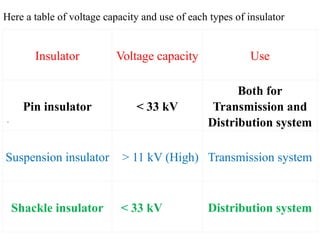
Insulator Voltage capacityUse
Pin insulator < 33 kV
Both for
Transmission and
Distribution system
Suspension insulator > 11 kV (High) Transmission system
Shackle insulator < 33 kV Distribution system
.
Here a table of voltage capacity and use of each types of insulator