Win/Mac CD
                               The CD contains a printable PDF of this entire book.
                               You can review and print pages from your computer.
                               The PDF (Portable Document Format) le requires
                               Acrobat Reader software.
                               If you have Acrobat Reader already installed on your
                               computer, open the le BRIEFCASE3.pdf from the CD.
                               To install Acrobat Reader:
                               Windows: Run ARINSTALL.EXE on the CD
                               Mac: Run Reader Installer on the CD
                               After installation, run Acrobat Reader and open the
                                le BRIEFCASE3.pdf from the CD.


Briefcase Three: Assessment Tools for Inclusion for Middle and High School
                       Author: June Stride, Ed. D.
                 Editors: Richard Wolfsdorf, Tom Kinney
   Graphic Design/Illustration: Michael Mastermaker and Beverly Potts
                          ISBN: 1-57861-611-5
   © 2007 Attainment Company, Inc. and Wolfpack Multimedia, Inc.
                           All rights reserved.
                 Printed in the United States of America


                          IEP
                    RESOURCES
               Attainment	Company,	Inc.
                    P.O.	Box	93010
                50	Commerce	Parkway
             Verona,	Wisconsin	53593-010
                    1-800-327-29
             www.AttainmentCompany.com


  WOLFPACK                                  MULTIMEDIA               INC.
Briefcase Three: Assessment Tools for Inclusion
                                for Middle and High School


                  Table of Contents

  . .Letter from the author. . . . . . . . . . . . . . . . . . . . . . . . . . . . . . . . . . . 4

1 . .Helping Students Prepare for
. . .Academic Success and Assessment. . . . . . . . . . . . . . . . . . . . . . . . . . 5

2 .TIPS for Teachers... About Assessment . . . . . . . . . . . . . . . . . . . . . 23
3 .Using Rubrics . . . . . . . . . . . . . . . . . . . . . . . . . . . . . . . . . . . . . . . . 29
4 . .Teacher and Coteacher Assessment . . . . . . . . . . . . . . . . . . . . . . . . 45
5 . .Alternate Assessment . . . . . . . . . . . . . . . . . . . . . . . . . . . . . . . . . . . 53
6 . .Testing in the Inclusion Classroom . . . . . . . . . . . . . . . . . . . . . . . . 67
7 . .Grading in the Inclusion Class . . . . . . . . . . . . . . . . . . . . . . . . . . . 79
8 . .Program Evaluation. . . . . . . . . . . . . . . . . . . . . . . . . . . . . . . . . . . . 91
Dear Fellow Teachers,

     Briefcase Three: Assessment Tools for Inclusion for Middle and
     High School was developed to reduce the burden of these important
     responsibilities for the inclusion teachers. Herein you will find hints to
     prepare for assessment of students, self, the collaboration effort, curriculum
     and your inclusion program. To my mind, inclusion teaching necessitates
     collaborative work to include collaborative assessment involving not only
     coteachers but also, importantly, students.

     For your convenience, Briefcase Three has a special feature: a ‘Student
     Brief.’ The ‘Student Brief ’ is designed as a stand-alone tool to encourage
     student involvement and responsibility for academic growth.

     Moreover, Briefcase Three has tools and strategies to help you take your
     students from where they are now to where they need to be when they
     leave your class. Acknowledging their talents and skills or deficits helps
     you as well as your students, to develop and effectively maximize academic
     programs and instructional strategies.

     Don’t let assessment frighten you! Help lies ahead! Briefcase Three will give
     you TIPS and pointers for student preparation for testing and for inclusion
     grading, for assessment and evaluation. Briefcase Three will help make your
     inclusion journey more worthwhile, pleasant and academically productive.

     Respectfully,
     June Stride Ed. D.


	                                                        Briefcase	Three:	Assessment	Tools	for	Inclusion
Helping students prepare
                         for academic success
                               and assessment
                                                               1
                             What’s The Score?


                    Str ength                      W eakness


                Tying it All Together


Briefcase	Three:	Assessment	Tools	for	Inclusion	               5
Dear Teachers,

     Why not take advantage of student energy and their growing desire
     for independence? Utilize ‘ free’ minutes at the beginning or end of
     the period, especially at the beginning of the year, to engage them in a
     growth challenge.

     The ‘Student Brief ’ that follows can be the vehicle to start them on the
     path. Use the forms to allow them to determine their own strengths
     and weaknesses. Invite them to collaborate with you on their path to
     personal academic and behavioral growth.

     When students feel involved and committed, discipline problems
     decline. As they channel their efforts in a directed positive manner,
     you’ ll be pleasantly surprised and pleased with the results!


     Sincerely,
     June


	                                                    Briefcase	Three:	Assessment	Tools	for	Inclusion
Helping Students Prepare for
                                Academic Success and Assessment


                   Academic Success
                    and Assessment


              Developing	a	study	spot.	Knowing	your	‘rights’
              The Right Spot + the Right Time + the Right Equipment + the Right Habits =
              The Right Attitude.


              Knowing	your	score…	
              personal	learning	strengths	and	weaknesses
              Athletes and scholars who are honest in their personal learning assessment can use
              their knowledge to overcome weaknesses.


              Succeeding	academically:	
              ‘The	Big	12	Rule	Book	for	Academic	Success’
              Positive performance develops from positive behaviors. Here are 12 TIPS for growth
              toward academic success.


              Check	It	Out!	
              Your	Personal	Student	Communication	Survey
              Many students are quite unaware of the quality of their communication skills with
              adults and peers as well as the relationship to success.


Briefcase	Three:	Assessment	Tools	for	Inclusion	                                                   7
Students who feel responsible for and are involved in their own academic growth and
     progress tend to work harder and want to work ‘smarter.’


      Making	the	grades:	12	study	skills	tips
      Learn to study for success. Grades can be improved. Scores on tests can go up.


      Reaching	the	top:	Taking	‘high	stakes’	tests
      Test day strategies help. You can reduce test-taking stress and improve test results by
      following these simple hints on test day.


      Your	choice:	Doing	better	on	multiple	choice	type	tests
      Multiple choice answering can be tricky. Here are tools to help you select the best
      answer from the choices given.


      Just	write	it:	Succeeding	on	tests	with	written	responses
      Pointers to help you make the maximum points on essay or written response tests.


8	                                                                Briefcase	Three:	Assessment	Tools	for	Inclusion
Student Brief


Briefcase	Three:	Assessment	Tools	for	Inclusion	        9
success in school


                                        YOUR	PLAYING	FIELD
                                                   (study	spot)
                               •	   Quiet
                               •	   Private	while	you	are	working
                               •	   Enough	space	to	keep	your	supplies
                               •	   Enough	space	to	spread	out	your	stuff	


Briefcase	Three:	Assessment	Tools	for	Inclusion	                            11
Student prep-Assessment


      Your	equipment:		
      •	 Flat	surface	of	a	desk	or	table: Large enough to spread out your stuff.
        (Computer tables usually are not big enough to do anything other than computer work.)
      • Lamp	or	light.
      • Comfortable	chair:	 Appropriate size for you and to reach the table.
      • Clock: To monitor study and homework time and your breaks.
      •	 Calculator: Plain or scientific, depending upon your teacher’s request.
      • Pencil	sharpener:	 Keep the pencils sharp.

                                   HINT:
                                   If you get stuck with a math problem,
                                   log on to www.webmath.com


      • Writing	and	drawing	tools: Pencils, pens, colored markers, highlighters, glue, rulers,
        notebooks, lined paper, scissors, ruler, protractor, folders. Smaller storage box for these
        items: Pick one to fit neatly into larger storage box for all supplies.


                                   HINT:
                                   Download your own graph paper at
                                   www.mathematicshelpcentral.com

      • Storage	box	large	enough	to	hold	all	supplies: A box on wheels is handy to roll
        your stuff away after use. Any kind of large shipping box will do!
      • Bonus: Computer. For word processing of homework and reports, an older and slower
        computer works well.


                                   HINT:
                                   Use the family computer or one at your
                                   local libarary for Internet access to do
                                   research.


12	                                                                 Briefcase	Three:	Assessment	Tools	for	Inclusion
What’s Your Score?

                          Athletes and scholars both need to know their learning strengths
                                          and weaknesses. What are yours?


           ck                                                        ck
        CheOff!                                                   CheOff!
         It                                                         It
 Easy    Difficult                                           Easy   Difficult

                   Speaking up in class, participating                      Working independently
                   in discussions                                           Staying on task, completing work
                   Volunteering answers                                     Working with a partner or
                   Reading out loud                                         in a small group
                                                                            Writing complete sentences
                   Finding the main ideas                                   or paragraphs
                   Outlining                                                Staying focused
                   Keeping an organized notebook                            Remembering material
                                                                            presented orally
                   Taking notes or copying notes
                   accurately                                               Recalling information you have read
                   Mathematical computation                                 Making an oral presentation

                   Graphing                                                 Learning from demonstrations

                   Studying for tests                                       Doing independent research

                   Remembering facts                                        Using appropriate language
                                                                            Reading and recalling subject
                   Taking tests                                             area vocabulary
                   Searching on the Internet                                Using computer software programs to
                                                                            enhance work

         Total	Easy	=	_______________									Total	Diffi
                                                      		cult	=	_______________

    Two important things I realize from completing this survey:

    1. ______________________________________________________________________________
        ______________________________________________________________________________
        ______________________________________________________________________________
    2. ______________________________________________________________________________
        ______________________________________________________________________________
        ______________________________________________________________________________

Briefcase	Three:	Assessment	Tools	for	Inclusion	                                                                  13
The Big 12: Rule Book for Academic Success


  1. Show interest. Listen carefully in class.

2. Take neat and accurate notes or arrange to get copies from
   someone who does!

3. Prepare daily. Reread your notes each
   evening; reread notes before class.

 4. Simplify study time. Keep neat,
    organized notebooks.

5. Copy homework assignments into an
   assignment pad or e-tablet.

6. Study daily at the same time in the
   same quiet location.

 7. Bring required supplies to class daily.

8. Hand in assignments on time.

9. Participate. Ask questions to clarify.

10. Volunteer. Ask questions and ask
    when you need help.

 11. Show motivation.
     Attend extra help sessions.

12. Use online homework assistance
    as needed.


1	                                              Briefcase	Three:	Assessment	Tools	for	Inclusion
YOUR PERSONAL COMMUNICATION SURVEY
           ck
        CheOff!
          It           1= Disagree 2 = Not sure 3 = Agree
   1      2       3
                       I respect people who talk to me by looking at and listening to them.
                       When someone talks to me, I stop what I’m doing to focus on what he/she is saying.
                       People listen to me and show me respect.
                       I can read and understand non-verbal/body language.
                       If someone is rude to me, I control my temper.
                       I do not make unkind remarks to or about people.
                       I do not get into fights.
                       I can express disagreement or anger without losing control.
                       I do not pick on people, hit them or provoke them.
                       If necessary, I ask an adult for help in handling a situation that is getting out of control.
                       I can find safe locations within my school and/or community.
                       I respect other peoples’ property.
                       I know a responsible person I can ask to help me stay out of trouble.
                       I am able to steer clear of involvement in violence and weapon use.
                       I stay on task and participate purposefully in group activities.
                       I show value for other peoples’ feelings and opinions.

I need to improve in the following communications areas:


Other strengths or difficulties that I have:


                                               How	Do	You	Rate?
                               3-8	Excellent	Skills         2-35	Fair
                               3-2	Good                     1-25	Danger	Zone


Briefcase	Three:	Assessment	Tools	for	Inclusion	                                                                       15
Making the Grades: Study Skills Tips
                        Strategies for Winning


           Study	TIPS	for	Before	or	During	Class
           Rules	of	the	Game
      1.   Organize your notebook into sections. Always date your notes and put them in order
           either in the front or back of the section.
      2.   Listen carefully during class. Ask questions any time you don’t understand something.
      3.   Take complete notes. Keep study guides or dittos handed out by your teachers. If you are
           absent, get and copy the notes from a good student or from the teacher.
      4.   Spend the first moments of each class reviewing previous notes. Develop a dailty habit of
           rereading your notes from class.
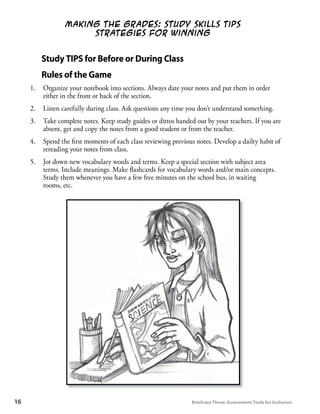
      5.   Jot down new vocabulary words and terms. Keep a special section with subject area
           terms. Include meanings. Make flashcards for vocabulary words and/or main concepts.
           Study them whenever you have a few free minutes on the school bus, in waiting
           rooms, etc.


1	                                                               Briefcase	Three:	Assessment	Tools	for	Inclusion

Student needs

  • 2.
    Win/Mac CD The CD contains a printable PDF of this entire book. You can review and print pages from your computer. The PDF (Portable Document Format) le requires Acrobat Reader software. If you have Acrobat Reader already installed on your computer, open the le BRIEFCASE3.pdf from the CD. To install Acrobat Reader: Windows: Run ARINSTALL.EXE on the CD Mac: Run Reader Installer on the CD After installation, run Acrobat Reader and open the le BRIEFCASE3.pdf from the CD. Briefcase Three: Assessment Tools for Inclusion for Middle and High School Author: June Stride, Ed. D. Editors: Richard Wolfsdorf, Tom Kinney Graphic Design/Illustration: Michael Mastermaker and Beverly Potts ISBN: 1-57861-611-5 © 2007 Attainment Company, Inc. and Wolfpack Multimedia, Inc. All rights reserved. Printed in the United States of America IEP RESOURCES Attainment Company, Inc. P.O. Box 93010 50 Commerce Parkway Verona, Wisconsin 53593-010 1-800-327-29 www.AttainmentCompany.com WOLFPACK MULTIMEDIA INC.
  • 3.
    Briefcase Three: AssessmentTools for Inclusion for Middle and High School Table of Contents . .Letter from the author. . . . . . . . . . . . . . . . . . . . . . . . . . . . . . . . . . . 4 1 . .Helping Students Prepare for . . .Academic Success and Assessment. . . . . . . . . . . . . . . . . . . . . . . . . . 5 2 .TIPS for Teachers... About Assessment . . . . . . . . . . . . . . . . . . . . . 23 3 .Using Rubrics . . . . . . . . . . . . . . . . . . . . . . . . . . . . . . . . . . . . . . . . 29 4 . .Teacher and Coteacher Assessment . . . . . . . . . . . . . . . . . . . . . . . . 45 5 . .Alternate Assessment . . . . . . . . . . . . . . . . . . . . . . . . . . . . . . . . . . . 53 6 . .Testing in the Inclusion Classroom . . . . . . . . . . . . . . . . . . . . . . . . 67 7 . .Grading in the Inclusion Class . . . . . . . . . . . . . . . . . . . . . . . . . . . 79 8 . .Program Evaluation. . . . . . . . . . . . . . . . . . . . . . . . . . . . . . . . . . . . 91
  • 4.
    Dear Fellow Teachers, Briefcase Three: Assessment Tools for Inclusion for Middle and High School was developed to reduce the burden of these important responsibilities for the inclusion teachers. Herein you will find hints to prepare for assessment of students, self, the collaboration effort, curriculum and your inclusion program. To my mind, inclusion teaching necessitates collaborative work to include collaborative assessment involving not only coteachers but also, importantly, students. For your convenience, Briefcase Three has a special feature: a ‘Student Brief.’ The ‘Student Brief ’ is designed as a stand-alone tool to encourage student involvement and responsibility for academic growth. Moreover, Briefcase Three has tools and strategies to help you take your students from where they are now to where they need to be when they leave your class. Acknowledging their talents and skills or deficits helps you as well as your students, to develop and effectively maximize academic programs and instructional strategies. Don’t let assessment frighten you! Help lies ahead! Briefcase Three will give you TIPS and pointers for student preparation for testing and for inclusion grading, for assessment and evaluation. Briefcase Three will help make your inclusion journey more worthwhile, pleasant and academically productive. Respectfully, June Stride Ed. D. Briefcase Three: Assessment Tools for Inclusion
  • 5.
    Helping students prepare for academic success and assessment 1 What’s The Score? Str ength W eakness Tying it All Together Briefcase Three: Assessment Tools for Inclusion 5
  • 6.
    Dear Teachers, Why not take advantage of student energy and their growing desire for independence? Utilize ‘ free’ minutes at the beginning or end of the period, especially at the beginning of the year, to engage them in a growth challenge. The ‘Student Brief ’ that follows can be the vehicle to start them on the path. Use the forms to allow them to determine their own strengths and weaknesses. Invite them to collaborate with you on their path to personal academic and behavioral growth. When students feel involved and committed, discipline problems decline. As they channel their efforts in a directed positive manner, you’ ll be pleasantly surprised and pleased with the results! Sincerely, June Briefcase Three: Assessment Tools for Inclusion
  • 7.
    Helping Students Preparefor Academic Success and Assessment Academic Success and Assessment Developing a study spot. Knowing your ‘rights’ The Right Spot + the Right Time + the Right Equipment + the Right Habits = The Right Attitude. Knowing your score… personal learning strengths and weaknesses Athletes and scholars who are honest in their personal learning assessment can use their knowledge to overcome weaknesses. Succeeding academically: ‘The Big 12 Rule Book for Academic Success’ Positive performance develops from positive behaviors. Here are 12 TIPS for growth toward academic success. Check It Out! Your Personal Student Communication Survey Many students are quite unaware of the quality of their communication skills with adults and peers as well as the relationship to success. Briefcase Three: Assessment Tools for Inclusion 7
  • 8.
    Students who feelresponsible for and are involved in their own academic growth and progress tend to work harder and want to work ‘smarter.’ Making the grades: 12 study skills tips Learn to study for success. Grades can be improved. Scores on tests can go up. Reaching the top: Taking ‘high stakes’ tests Test day strategies help. You can reduce test-taking stress and improve test results by following these simple hints on test day. Your choice: Doing better on multiple choice type tests Multiple choice answering can be tricky. Here are tools to help you select the best answer from the choices given. Just write it: Succeeding on tests with written responses Pointers to help you make the maximum points on essay or written response tests. 8 Briefcase Three: Assessment Tools for Inclusion
  • 9.
  • 11.
    success in school YOUR PLAYING FIELD (study spot) • Quiet • Private while you are working • Enough space to keep your supplies • Enough space to spread out your stuff Briefcase Three: Assessment Tools for Inclusion 11
  • 12.
    Student prep-Assessment Your equipment: • Flat surface of a desk or table: Large enough to spread out your stuff. (Computer tables usually are not big enough to do anything other than computer work.) • Lamp or light. • Comfortable chair: Appropriate size for you and to reach the table. • Clock: To monitor study and homework time and your breaks. • Calculator: Plain or scientific, depending upon your teacher’s request. • Pencil sharpener: Keep the pencils sharp. HINT: If you get stuck with a math problem, log on to www.webmath.com • Writing and drawing tools: Pencils, pens, colored markers, highlighters, glue, rulers, notebooks, lined paper, scissors, ruler, protractor, folders. Smaller storage box for these items: Pick one to fit neatly into larger storage box for all supplies. HINT: Download your own graph paper at www.mathematicshelpcentral.com • Storage box large enough to hold all supplies: A box on wheels is handy to roll your stuff away after use. Any kind of large shipping box will do! • Bonus: Computer. For word processing of homework and reports, an older and slower computer works well. HINT: Use the family computer or one at your local libarary for Internet access to do research. 12 Briefcase Three: Assessment Tools for Inclusion
  • 13.
    What’s Your Score? Athletes and scholars both need to know their learning strengths and weaknesses. What are yours? ck ck CheOff! CheOff! It It Easy Difficult Easy Difficult Speaking up in class, participating Working independently in discussions Staying on task, completing work Volunteering answers Working with a partner or Reading out loud in a small group Writing complete sentences Finding the main ideas or paragraphs Outlining Staying focused Keeping an organized notebook Remembering material presented orally Taking notes or copying notes accurately Recalling information you have read Mathematical computation Making an oral presentation Graphing Learning from demonstrations Studying for tests Doing independent research Remembering facts Using appropriate language Reading and recalling subject Taking tests area vocabulary Searching on the Internet Using computer software programs to enhance work Total Easy = _______________ Total Diffi cult = _______________ Two important things I realize from completing this survey: 1. ______________________________________________________________________________ ______________________________________________________________________________ ______________________________________________________________________________ 2. ______________________________________________________________________________ ______________________________________________________________________________ ______________________________________________________________________________ Briefcase Three: Assessment Tools for Inclusion 13
  • 14.
    The Big 12:Rule Book for Academic Success 1. Show interest. Listen carefully in class. 2. Take neat and accurate notes or arrange to get copies from someone who does! 3. Prepare daily. Reread your notes each evening; reread notes before class. 4. Simplify study time. Keep neat, organized notebooks. 5. Copy homework assignments into an assignment pad or e-tablet. 6. Study daily at the same time in the same quiet location. 7. Bring required supplies to class daily. 8. Hand in assignments on time. 9. Participate. Ask questions to clarify. 10. Volunteer. Ask questions and ask when you need help. 11. Show motivation. Attend extra help sessions. 12. Use online homework assistance as needed. 1 Briefcase Three: Assessment Tools for Inclusion
  • 15.
    YOUR PERSONAL COMMUNICATIONSURVEY ck CheOff! It 1= Disagree 2 = Not sure 3 = Agree 1 2 3 I respect people who talk to me by looking at and listening to them. When someone talks to me, I stop what I’m doing to focus on what he/she is saying. People listen to me and show me respect. I can read and understand non-verbal/body language. If someone is rude to me, I control my temper. I do not make unkind remarks to or about people. I do not get into fights. I can express disagreement or anger without losing control. I do not pick on people, hit them or provoke them. If necessary, I ask an adult for help in handling a situation that is getting out of control. I can find safe locations within my school and/or community. I respect other peoples’ property. I know a responsible person I can ask to help me stay out of trouble. I am able to steer clear of involvement in violence and weapon use. I stay on task and participate purposefully in group activities. I show value for other peoples’ feelings and opinions. I need to improve in the following communications areas: Other strengths or difficulties that I have: How Do You Rate? 3-8 Excellent Skills 2-35 Fair 3-2 Good 1-25 Danger Zone Briefcase Three: Assessment Tools for Inclusion 15
  • 16.
    Making the Grades:Study Skills Tips Strategies for Winning Study TIPS for Before or During Class Rules of the Game 1. Organize your notebook into sections. Always date your notes and put them in order either in the front or back of the section. 2. Listen carefully during class. Ask questions any time you don’t understand something. 3. Take complete notes. Keep study guides or dittos handed out by your teachers. If you are absent, get and copy the notes from a good student or from the teacher. 4. Spend the first moments of each class reviewing previous notes. Develop a dailty habit of rereading your notes from class. 5. Jot down new vocabulary words and terms. Keep a special section with subject area terms. Include meanings. Make flashcards for vocabulary words and/or main concepts. Study them whenever you have a few free minutes on the school bus, in waiting rooms, etc. 1 Briefcase Three: Assessment Tools for Inclusion