How to Use
Concrete Practice
When Training
This micro-course was created
for the South Carolina Center
for Child Care Career Development.
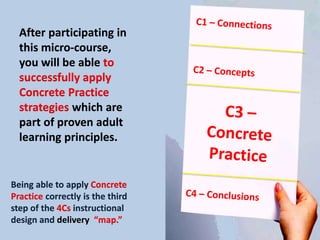
After participating in
this micro-course,
you will be able to
successfully apply
Concrete Practice
strategies which are
part of proven adult
learning principles.
Being able to apply Concrete
Practice correctly is the third
step of the 4Cs instructional
design and delivery “map.”
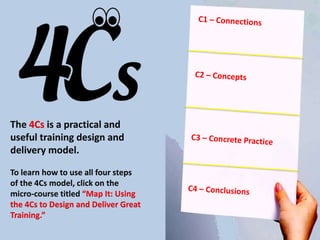
The 4Cs is a practical and
useful training design and
delivery model.
To learn how to use all four steps
of the 4Cs model, click on the
micro-course titled “Map It: Using
the 4Cs to Design and Deliver Great
Training.”
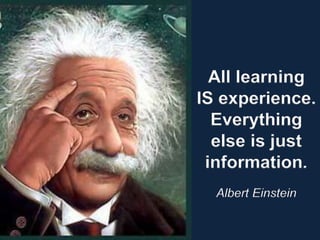
All learning
IS experience.
Everything
else is just
information.
Albert Einstein
You will need
something to
write on and
something to
write with.
What do YOU
already know about
Concrete Practice?
Take the
“Choose and Click”
quiz on the next slide.
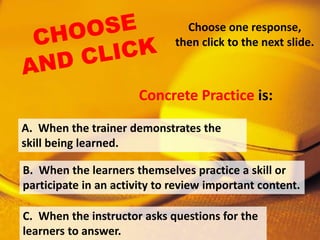
Choose one response,
then click to the next slide.
A. When the trainer demonstrates the
skill being learned.
B. When the learners themselves practice a skill or
participate in an activity to review important content.
C. When the instructor asks questions for the
learners to answer.
Concrete Practice is:
B. When the learners themselves practice a skill or
participate in an activity to review important content.
Did you choose
the correct answer?
Concrete Practice is:
Concrete practice
is when ALL learners
actively practice
a skill they have
just learned
AND/OR …
ALL learners
participate in an
active review of
important information
they just learned.
ALL learners, not some learners.
LEARNERS practice and participate, not the trainer.
The practice is done DURING the class, not just afterwards.
WHY is
Concrete Practice
so important?
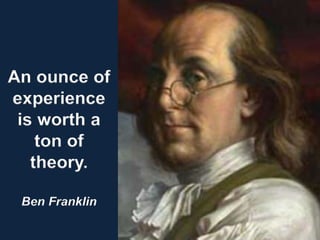
An ounce of
experience
is worth a
ton of
theory.
Ben Franklin
Concrete Practice
reinforces the skills
being learned or the
information that
has been taught.
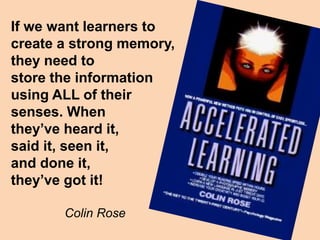
If we want learners to
create a strong memory,
they need to
store the information
using ALL of their
senses. When
they’ve heard it,
said it, seen it,
and done it,
they’ve got it!
Colin Rose
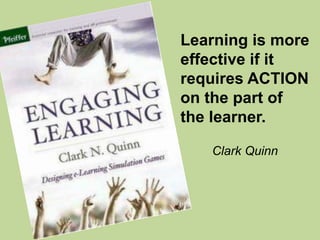
Learning is more
effective if it
requires ACTION
on the part of
the learner.
Clark Quinn
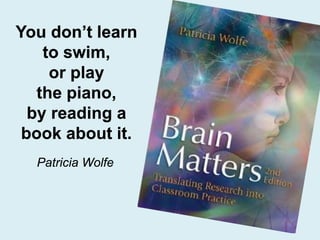
You don’t learn
to swim,
or play
the piano,
by reading a
book about it.
Patricia Wolfe
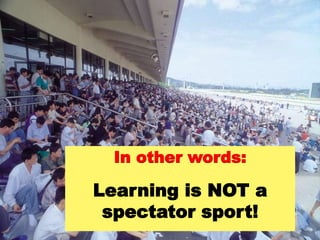
In other words:
Learning is NOT a
spectator sport!
In your own words, list at least two reasons
why Concrete Practice is important
for adult learning.
Here are three
elements of
effective
Concrete
Practice:
1.
Active
Participation
1.
Active
Participation
ALL learners – not just a few –
participate in practicing the skills
or actively reviewing the content.
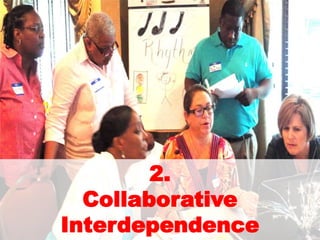
2.
Collaborative
Interdependence
2.
Collaborative
Interdependence
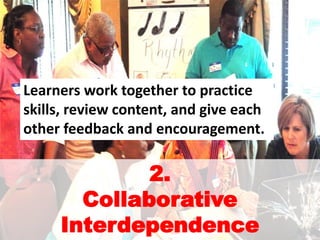
Learners work together to practice
skills, review content, and give each
other feedback and encouragement.
3.
Individual
Accountability
3.
Individual
Accountability
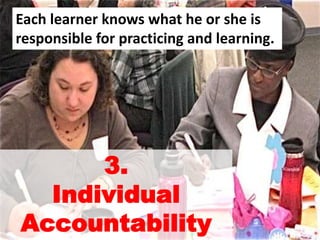
Each learner knows what he or she is
responsible for practicing and learning.
Choose the BEST example
of Concrete Practice that
includes all three elements.
C. The learners take a written test.
B. The learners watch a video of the skill they
are learning about.
A. With their table groups, each learner helps create a
content-related demonstration to present to the class.
Yes, Sentence A is the best
example of Concrete Practice
because it includes all three
elements.
A. With their table groups, each learner helps create a
content-related demonstration to present to the class.
Do one more: Which
Concrete Practice below
has all three elements?
C. Learners pair up at each computer and alternately
practice the procedure while giving each other
feedback and suggestions.
B. Learners watch a teacher-led demonstration of
the keyboarding procedure.
A. On their own, learners practice the computer
keyboarding procedure they are learning about.
Yes, Sentence C has all
three elements.
C. Learners pair up at each computer and alternately
practice the procedure while giving each other
feedback and suggestions.
Write down the three elements of
effective Concrete Practice.
Here are
six examples
of effective
Concrete Practice:
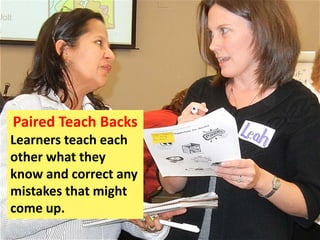
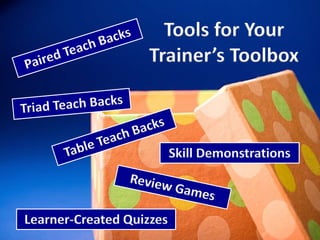
Paired Teach Backs
Learners teach each
other what they
know and correct any
mistakes that might
come up.
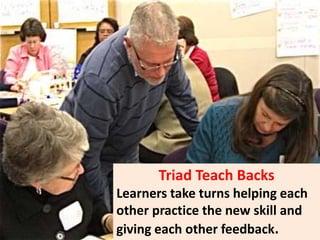
Triad Teach Backs
Learners take turns helping each
other practice the new skill and
giving each other feedback.
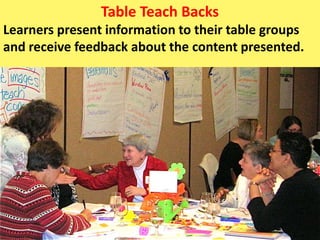
Table Teach Backs
Learners present information to their table groups
and receive feedback about the content presented.
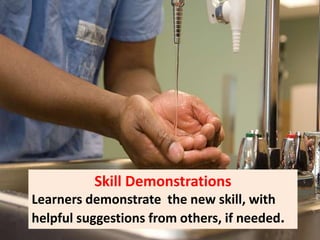
Skill Demonstrations
Learners demonstrate the new skill, with
helpful suggestions from others, if needed.
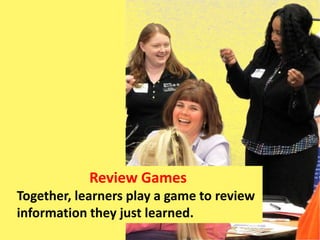
Review Games
Together, learners play a game to review
information they just learned.
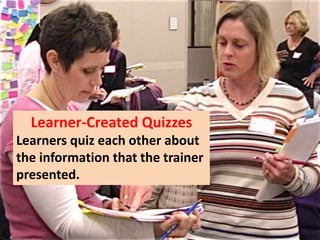
Learner-Created Quizzes
Learners quiz each other about
the information that the trainer
presented.
Tools for Your
Trainer’s Toolbox
Skill Demonstrations
Learner-Created Quizzes
Choose two tools you plan to use from
your Trainer’s Toolbox on the previous slide
and write them down.
After reading this slide, stand up, stretch,
and take a deep breath. More oxygen is
now flowing to your brain.
Think: What have you learned about
Concrete Practice so far?
Here are five
MORE examples
of effective
Concrete Practice:
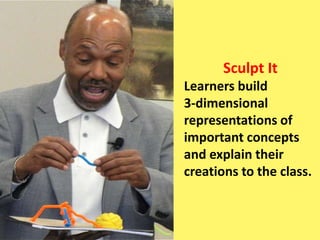
Sculpt It
Learners build
3-dimensional
representations of
important concepts
and explain their
creations to the class.
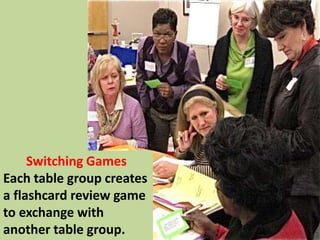
Switching Games
Each table group creates
a flashcard review game
to exchange with
another table group.
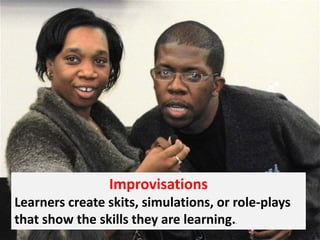
Improvisations
Learners create skits, simulations, or role-plays
that show the skills they are learning..
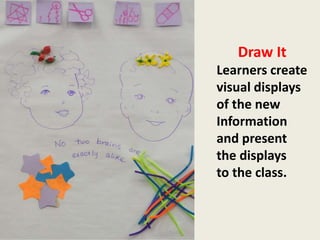
Draw It
Learners create
visual displays
of the new
Information
and present
the displays
to the class.
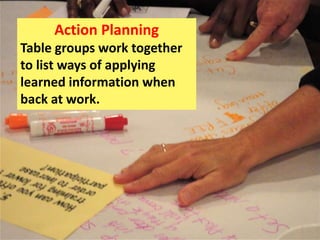
Action Planning
Table groups work together
to list ways of applying
learned information when
back at work.
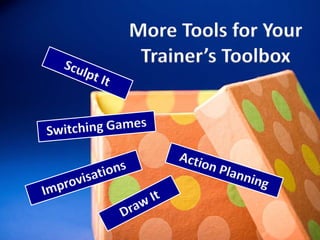
More Tools for Your
Trainer’s Toolbox
Choose two more tools that you plan to use
for Concrete Practice and write them down.
You are teaching a class on child care curriculum which
will help your adult students create a successful child
care learning environment, plan appropriate activities,
and facilitate children’s growth and development.
You present 6 key components of effective child care
curriculum while your students take notes.
What will you have them do next?
Choose the BEST Concrete Practice described below
that you will use to follow your presentation.
Then click to the next slide.
A. Learners work in pairs to complete a visual “web” display of
one of the 6 components. They hang their webs on the walls
and take turns explaining the displays to the class. The class
suggests details to add to the webs.
B. Learners watch a video about playground safety.
C. Learners read a handout about the 6 components and ask
questions afterwards.
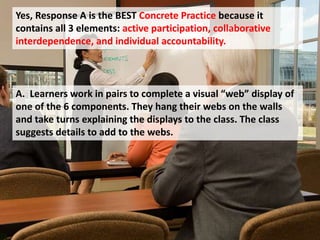
Yes, Response A is the BEST Concrete Practice because it
contains all 3 elements: active participation, collaborative
interdependence, and individual accountability.
A. Learners work in pairs to complete a visual “web” display of
one of the 6 components. They hang their webs on the walls
and take turns explaining the displays to the class. The class
suggests details to add to the webs.
You have just completed a short lecture on Dreikurs’ 4
mistaken goals of misbehavior: attention, power,
revenge and avoidance of failure. Your trainees took
notes on a fill-in-the-blanks graphic organizer.
What Concrete Practice should follow?
Again, choose the BEST Concrete Practice below to follow
your lecture, then click to the next slide.
A. Learners make signs with titles of the 4 mistaken
goals of behavior.
B. Learners take a test on Dreikur’s content.
C. Table groups work together to create descriptions of 5
children’s behaviors for a Jeopardy game. Then they play
the game with the other groups to practice matching
children’s behaviors to the mistaken goals.
Did you choose Response C?
It is the best Concrete Practice.
C. Table groups work together to create descriptions of 5
children’s behaviors for a Jeopardy game. Then they play
the game with the other groups to practice matching
children’s behaviors to the mistaken goals.
Now write down one fact about
Concrete Practice that you’ve learned from
this presentation that you didn’t know before.
Give yourself a
high five for your efforts!
A Note to All Trainers for the South Carolina
Center for Child Care Career Development
If you have completed this micro-course as part of your requirements for
Principles of Adult Learning, please photocopy your Quick Writes #3, #4, #5
and e-mail them to: melissa.starker@dss.sc.gov or fax them to
864-250-8690. Be sure to include your name and contact information (email or
phone number).
This slide set was created for the South Carolina
Center for Child Care Career Development.
Created by Sharon L. Bowman, M.A.
President, Bowperson Publishing & Training, Inc.
www.Bowperson.com; SBowperson@gmail.com
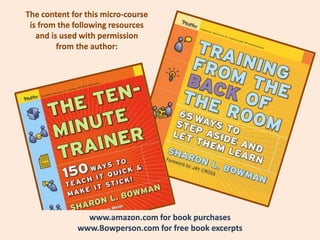
The content for this micro-course
is from the following resources
and is used with permission
from the author:
www.amazon.com for book purchases
www.Bowperson.com for free book excerpts
Concretepracticefinal

Concretepracticefinal

  • 1.
    How to Use ConcretePractice When Training
  • 2.
    This micro-course wascreated for the South Carolina Center for Child Care Career Development.
  • 3.
    After participating in thismicro-course, you will be able to successfully apply Concrete Practice strategies which are part of proven adult learning principles. Being able to apply Concrete Practice correctly is the third step of the 4Cs instructional design and delivery “map.”
  • 4.
    The 4Cs isa practical and useful training design and delivery model. To learn how to use all four steps of the 4Cs model, click on the micro-course titled “Map It: Using the 4Cs to Design and Deliver Great Training.”
  • 5.
    All learning IS experience. Everything elseis just information. Albert Einstein
  • 6.
    You will need somethingto write on and something to write with.
  • 7.
    What do YOU alreadyknow about Concrete Practice? Take the “Choose and Click” quiz on the next slide.
  • 8.
    Choose one response, thenclick to the next slide. A. When the trainer demonstrates the skill being learned. B. When the learners themselves practice a skill or participate in an activity to review important content. C. When the instructor asks questions for the learners to answer. Concrete Practice is:
  • 9.
    B. When thelearners themselves practice a skill or participate in an activity to review important content. Did you choose the correct answer? Concrete Practice is:
  • 10.
    Concrete practice is whenALL learners actively practice a skill they have just learned AND/OR …
  • 11.
    ALL learners participate inan active review of important information they just learned. ALL learners, not some learners. LEARNERS practice and participate, not the trainer. The practice is done DURING the class, not just afterwards.
  • 12.
  • 13.
    An ounce of experience isworth a ton of theory. Ben Franklin
  • 14.
    Concrete Practice reinforces theskills being learned or the information that has been taught.
  • 15.
    If we wantlearners to create a strong memory, they need to store the information using ALL of their senses. When they’ve heard it, said it, seen it, and done it, they’ve got it! Colin Rose
  • 16.
    Learning is more effectiveif it requires ACTION on the part of the learner. Clark Quinn
  • 17.
    You don’t learn toswim, or play the piano, by reading a book about it. Patricia Wolfe
  • 18.
    In other words: Learningis NOT a spectator sport!
  • 19.
    In your ownwords, list at least two reasons why Concrete Practice is important for adult learning.
  • 20.
    Here are three elementsof effective Concrete Practice:
  • 21.
  • 22.
    1. Active Participation ALL learners –not just a few – participate in practicing the skills or actively reviewing the content.
  • 23.
  • 24.
    2. Collaborative Interdependence Learners work togetherto practice skills, review content, and give each other feedback and encouragement.
  • 25.
  • 26.
    3. Individual Accountability Each learner knowswhat he or she is responsible for practicing and learning.
  • 27.
    Choose the BESTexample of Concrete Practice that includes all three elements. C. The learners take a written test. B. The learners watch a video of the skill they are learning about. A. With their table groups, each learner helps create a content-related demonstration to present to the class.
  • 28.
    Yes, Sentence Ais the best example of Concrete Practice because it includes all three elements. A. With their table groups, each learner helps create a content-related demonstration to present to the class.
  • 29.
    Do one more:Which Concrete Practice below has all three elements? C. Learners pair up at each computer and alternately practice the procedure while giving each other feedback and suggestions. B. Learners watch a teacher-led demonstration of the keyboarding procedure. A. On their own, learners practice the computer keyboarding procedure they are learning about.
  • 30.
    Yes, Sentence Chas all three elements. C. Learners pair up at each computer and alternately practice the procedure while giving each other feedback and suggestions.
  • 31.
    Write down thethree elements of effective Concrete Practice.
  • 32.
    Here are six examples ofeffective Concrete Practice:
  • 33.
    Paired Teach Backs Learnersteach each other what they know and correct any mistakes that might come up.
  • 34.
    Triad Teach Backs Learnerstake turns helping each other practice the new skill and giving each other feedback.
  • 35.
    Table Teach Backs Learnerspresent information to their table groups and receive feedback about the content presented.
  • 36.
    Skill Demonstrations Learners demonstratethe new skill, with helpful suggestions from others, if needed.
  • 37.
    Review Games Together, learnersplay a game to review information they just learned.
  • 38.
    Learner-Created Quizzes Learners quizeach other about the information that the trainer presented.
  • 39.
    Tools for Your Trainer’sToolbox Skill Demonstrations Learner-Created Quizzes
  • 40.
    Choose two toolsyou plan to use from your Trainer’s Toolbox on the previous slide and write them down.
  • 41.
    After reading thisslide, stand up, stretch, and take a deep breath. More oxygen is now flowing to your brain. Think: What have you learned about Concrete Practice so far?
  • 42.
    Here are five MOREexamples of effective Concrete Practice:
  • 43.
    Sculpt It Learners build 3-dimensional representationsof important concepts and explain their creations to the class.
  • 44.
    Switching Games Each tablegroup creates a flashcard review game to exchange with another table group.
  • 45.
    Improvisations Learners create skits,simulations, or role-plays that show the skills they are learning..
  • 46.
    Draw It Learners create visualdisplays of the new Information and present the displays to the class.
  • 47.
    Action Planning Table groupswork together to list ways of applying learned information when back at work.
  • 48.
    More Tools forYour Trainer’s Toolbox
  • 49.
    Choose two moretools that you plan to use for Concrete Practice and write them down.
  • 50.
    You are teachinga class on child care curriculum which will help your adult students create a successful child care learning environment, plan appropriate activities, and facilitate children’s growth and development. You present 6 key components of effective child care curriculum while your students take notes. What will you have them do next?
  • 51.
    Choose the BESTConcrete Practice described below that you will use to follow your presentation. Then click to the next slide. A. Learners work in pairs to complete a visual “web” display of one of the 6 components. They hang their webs on the walls and take turns explaining the displays to the class. The class suggests details to add to the webs. B. Learners watch a video about playground safety. C. Learners read a handout about the 6 components and ask questions afterwards.
  • 52.
    Yes, Response Ais the BEST Concrete Practice because it contains all 3 elements: active participation, collaborative interdependence, and individual accountability. A. Learners work in pairs to complete a visual “web” display of one of the 6 components. They hang their webs on the walls and take turns explaining the displays to the class. The class suggests details to add to the webs.
  • 53.
    You have justcompleted a short lecture on Dreikurs’ 4 mistaken goals of misbehavior: attention, power, revenge and avoidance of failure. Your trainees took notes on a fill-in-the-blanks graphic organizer. What Concrete Practice should follow?
  • 54.
    Again, choose theBEST Concrete Practice below to follow your lecture, then click to the next slide. A. Learners make signs with titles of the 4 mistaken goals of behavior. B. Learners take a test on Dreikur’s content. C. Table groups work together to create descriptions of 5 children’s behaviors for a Jeopardy game. Then they play the game with the other groups to practice matching children’s behaviors to the mistaken goals.
  • 55.
    Did you chooseResponse C? It is the best Concrete Practice. C. Table groups work together to create descriptions of 5 children’s behaviors for a Jeopardy game. Then they play the game with the other groups to practice matching children’s behaviors to the mistaken goals.
  • 56.
    Now write downone fact about Concrete Practice that you’ve learned from this presentation that you didn’t know before.
  • 57.
    Give yourself a highfive for your efforts!
  • 58.
    A Note toAll Trainers for the South Carolina Center for Child Care Career Development If you have completed this micro-course as part of your requirements for Principles of Adult Learning, please photocopy your Quick Writes #3, #4, #5 and e-mail them to: melissa.starker@dss.sc.gov or fax them to 864-250-8690. Be sure to include your name and contact information (email or phone number).
  • 59.
    This slide setwas created for the South Carolina Center for Child Care Career Development. Created by Sharon L. Bowman, M.A. President, Bowperson Publishing & Training, Inc. www.Bowperson.com; SBowperson@gmail.com
  • 60.
    The content forthis micro-course is from the following resources and is used with permission from the author: www.amazon.com for book purchases www.Bowperson.com for free book excerpts