Building Background
Knowledge
Beyond the Textbook
By Alicia Theadore
Instructor, UCI International Programs
ATHEADORE@gmail.com
ATHEADORE@gmail.com 1
Stay for this presentation if
you…
Teach reading, vocabulary, speaking, listening or
writing
Are frustrated with your students’ lack of
background knowledge
Want your students to be ready for academic
lectures and reading
ATHEADORE@gmail.com 2
Stay for this presentation if
you…
Want your students to be able to use critical
thinking
They cannot talk about what they don’t know
Want to build confidence in your students as
intelligent communicators
ATHEADORE@gmail.com 3
About me…
15 years of experience working with international
students
Full-time Instructor UCI Academic ESL Program
Reading Curriculum Coordinator
Lead Teacher for the ESL Commons Project
Emphasis on appealing to different learning styles,
strong emphasis on technology in the classroom
ATHEADORE@gmail.com 4
What do I mean by
“background knowledge”?
Not “schema” or prior knowledge = cursory
knowledge
Building contextual knowledge
Providing opportunities for “scaffolding”
Perfect for classroomsflipped
ATHEADORE@gmail.com 5
Why should students and
teachers develop BK?
ATHEADORE@gmail.com 6
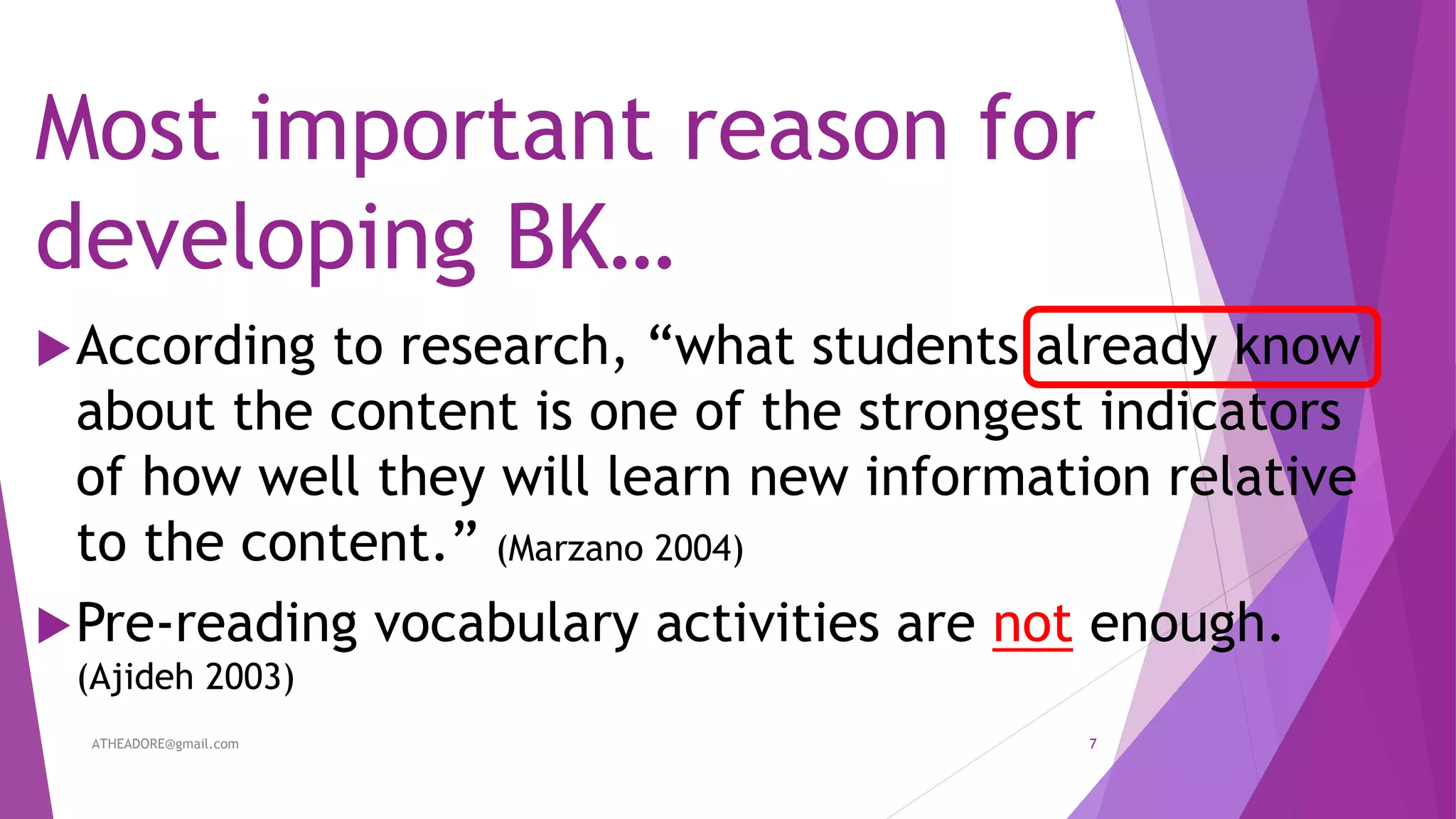
Most important reason for
developing BK…
According to research, “what students already know
about the content is one of the strongest indicators
of how well they will learn new information relative
to the content.” (Marzano 2004)
Pre-reading vocabulary activities are not enough.
(Ajideh 2003)
ATHEADORE@gmail.com 7
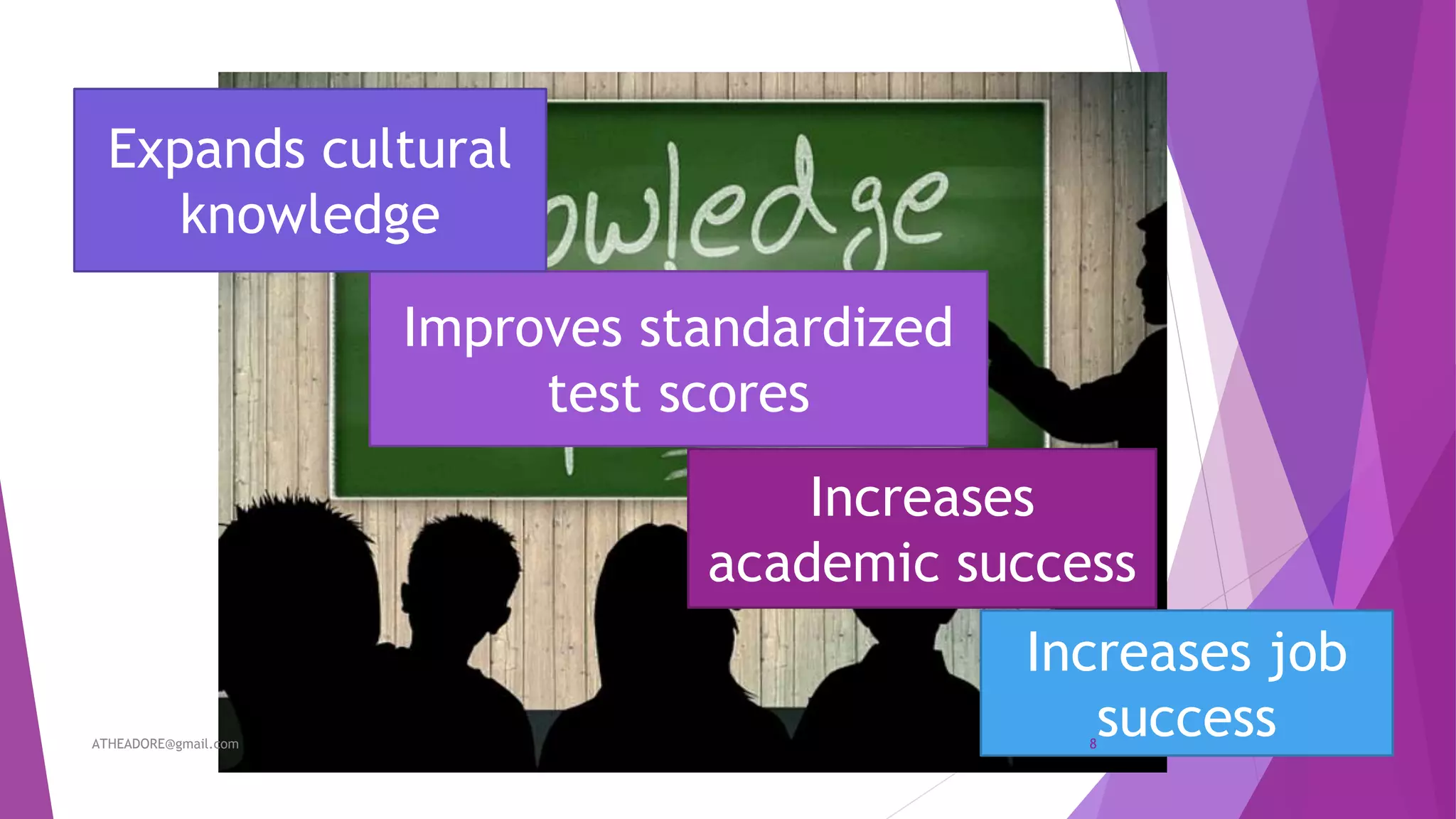
Increases
academic success
Improves standardized
test scores
Expands cultural
knowledge
Increases job
successATHEADORE@gmail.com 8
What methods can you use in
your classroom to build BK?
1. By yourself, make a list of at least 3 things
you can do to build context. (30 seconds)
ATHEADORE@gmail.com 9
30
seconds
What methods can you use in
your classroom to build BK?
2. With a partner, make a list of at least 6 things
you can do to build context. No repeats!
Underline them. (1 min.)
ATHEADORE@gmail.com 10
1 min.
What methods can you use in
your classroom to build BK?
3. Turn to a new partner, add to your list to
create at least 12 things you can do to build
context. No repeats! Underline them.
(1 min.)
ATHEADORE@gmail.com 11
1 min.
Ways to Enhance
Background Knowledge
ATHEADORE@gmail.com 12
General tips:
1. Use a variety of techniques for each unit.
2. Use multimodal techniques.
3. Provide (virtual) enrichment opportunities.
4. Make context relevant to what they already
know, every day life, or future goals.
ATHEADORE@gmail.com 13
General tips continued
5. Acknowledge overlapping knowledge areas.
6. Provide rewards for accuracy.
7. Be explicit about the activity and its benefit
to students’ learning.
ATHEADORE@gmail.com 14
1-2-3 Method
1. Start with students working by themselves.
Set a reasonable quantity and time limit to
brainstorm what they already know.
ATHEADORE@gmail.com 15
1-2-3 Method
2. After the time limit, put students in pairs
(or small groups).
 Acknowledge overlapping knowledge but encourage
expansion of ideas.
 Increase time limit.
ATHEADORE@gmail.com 16
1-2-3 Method
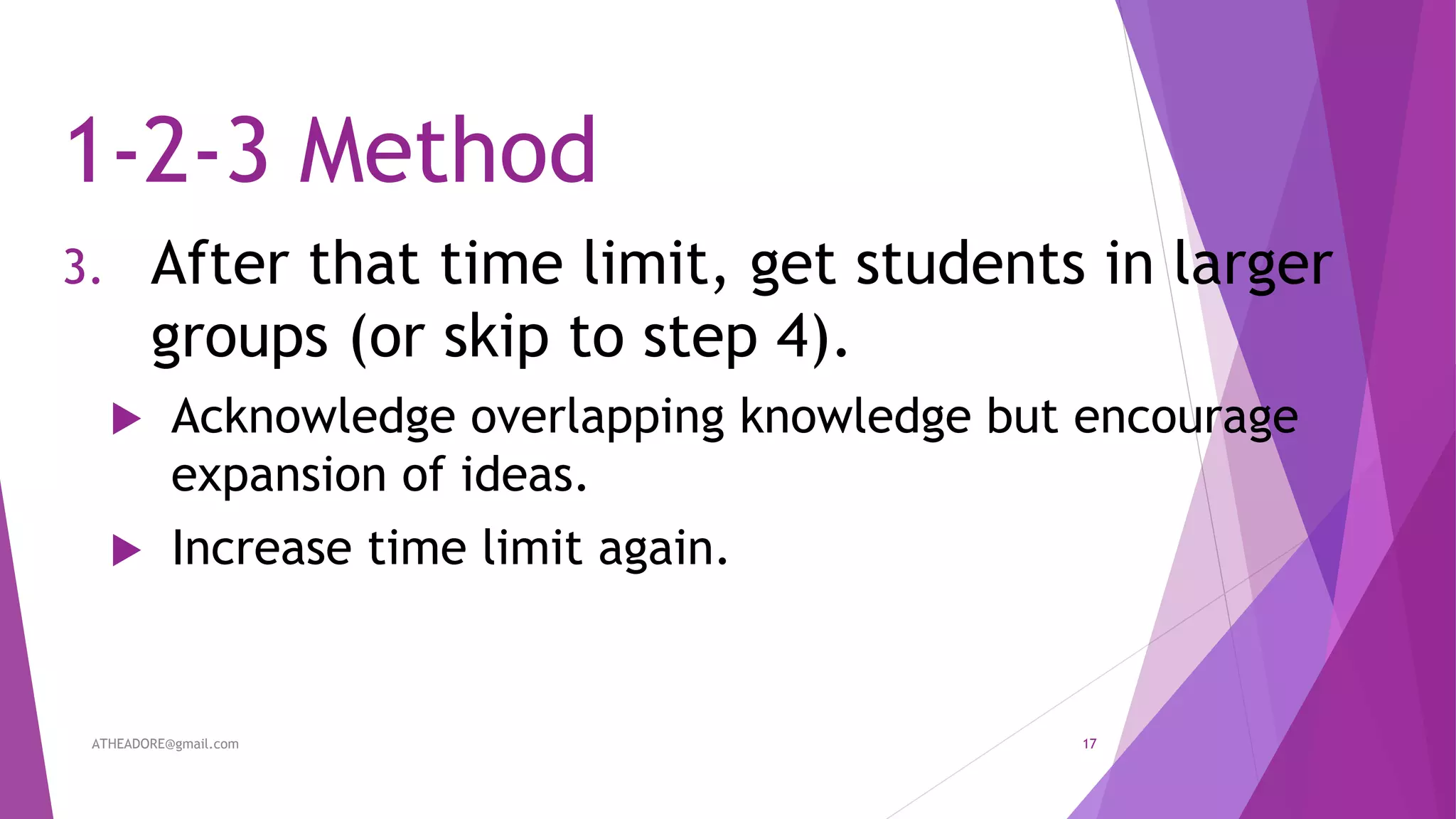
3. After that time limit, get students in larger
groups (or skip to step 4).
 Acknowledge overlapping knowledge but encourage
expansion of ideas.
 Increase time limit again.
ATHEADORE@gmail.com 17
1-2-3 Method continued
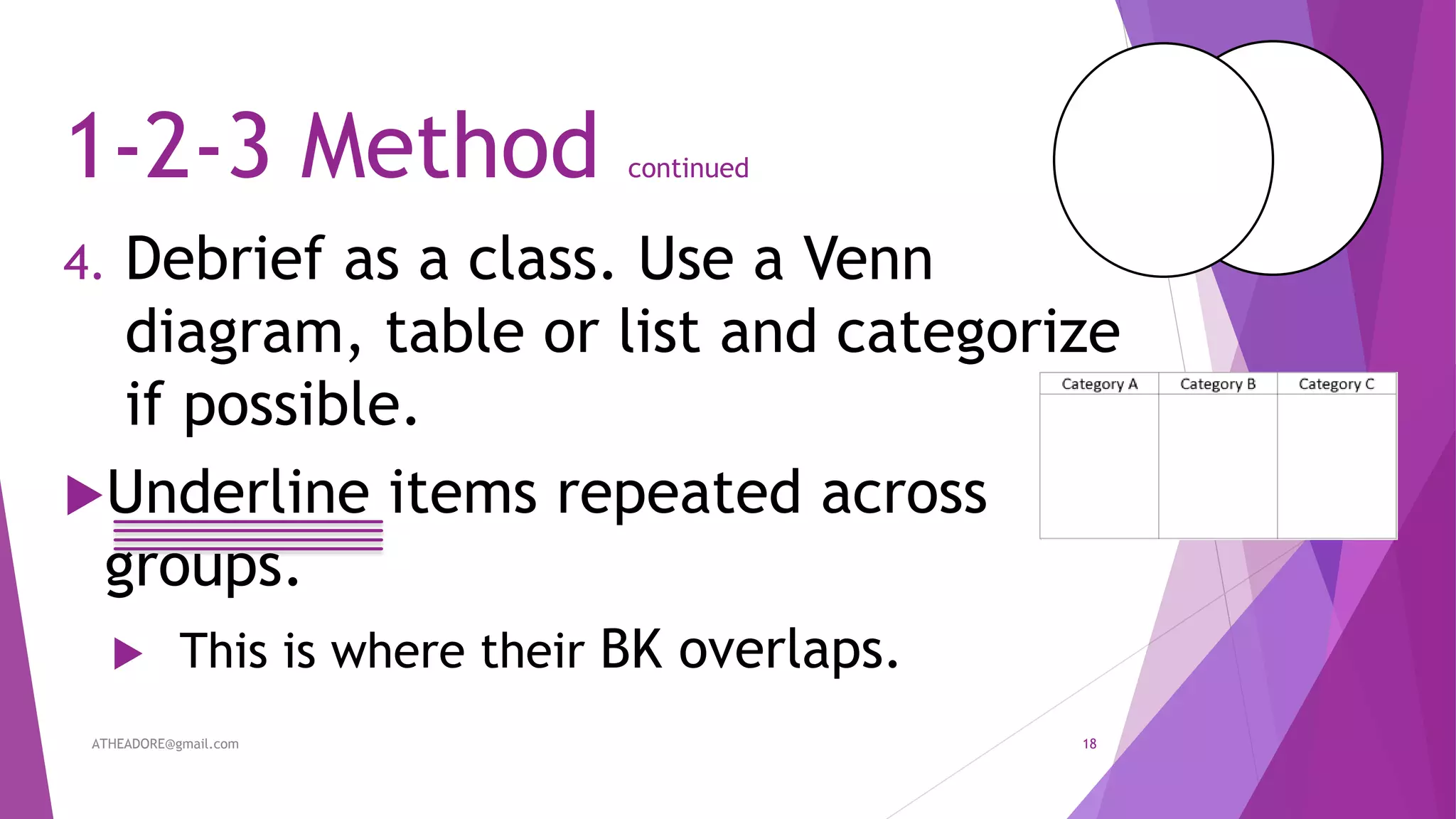
4. Debrief as a class. Use a Venn
diagram, table or list and categorize
if possible.
Underline items repeated across
groups.
 This is where their BK overlaps.

ATHEADORE@gmail.com 18
1-2-3 Method continued
5. Save the info!
 After the unit/lesson and before the test,
show the students what they knew, add what
they learned.
ATHEADORE@gmail.com 19
Your Turn!
By yourself, make a list of at least 3 inventions and
who invited them. (30 seconds)
With a partner, make a list of at least 6 inventions
and who invited them. (1 min.)
Turn to a new partner, make a list of at least 12
inventions and who invited them. (2 min.)
Your Topic: Inventions
Underline repeats but you must come up with
6-12 different inventions.ATHEADORE@gmail.com 20
Brainstorming Ball Toss
1. Have a small (soft) ball students can throw to
each other.
2. Get students in a circle (if possible).
3. Teacher stands at the board to act as recorder.
4. Collect as many of the words/phrases as you can
as students say them.
ATHEADORE@gmail.com 21
Brainstorming Ball Toss continued
5. Give the activity a time limit.
6. When finished, ask students to help
categorize ideas.
ATHEADORE@gmail.com 22
Brainstorming Ball Toss
Student Rules:
1. Students form a circle.
2. Toss the ball to a student at least 2 people away
from you.
3. Don’t need to use complete sentences
4. Don’t repeat ideas if possible
ATHEADORE@gmail.com 23
Brainstorming Ball Toss continued
Student Rules:
5. Ideas should be related – be ready to explain
6. Be positive and supportive!
In large classes, make two
circles with one student from
each acting as secretary.
ATHEADORE@gmail.com 24
Your Turn!
Student Rules:
1. Students form a circle.
2. Toss the ball to a student at least 2 people away from you.
3. Don’t need to use complete sentences
4. Don’t repeat ideas if possible
5. Ideas should be related – be ready to explain
6. Be positive and supportive!
Your Topic: space
and the galaxy
ATHEADORE@gmail.com 25
Photo Gallery
1. Find and print pictures about your topic (in
color preferably).
2. Number and place them around the room.
3. Give students a handout with questions
(individually or as a team).
4. Students move around the room to check
the pictures and find the answers to the
handout.
ATHEADORE@gmail.com 26
Photo Gallery
5. Debrief as a class,
 what was surprising or new?
 which answers did you already know?
 what is still true or used today?
Change it up! Make it a
jigsaw activity.
ATHEADORE@gmail.com 27
Photo Gallery – Your Turn!
1. Notice the small papers with numbers on them
around the room
2. You have 5 minutes to walk around the room and
find all 12 pictures.
3. Write down the answers to the 12 questions on the
handout.
GO!
ATHEADORE@gmail.com 28
The first 3 people who completely
and correctly answer the questions
see me to get a prize!
STOP
ATHEADORE@gmail.com 29
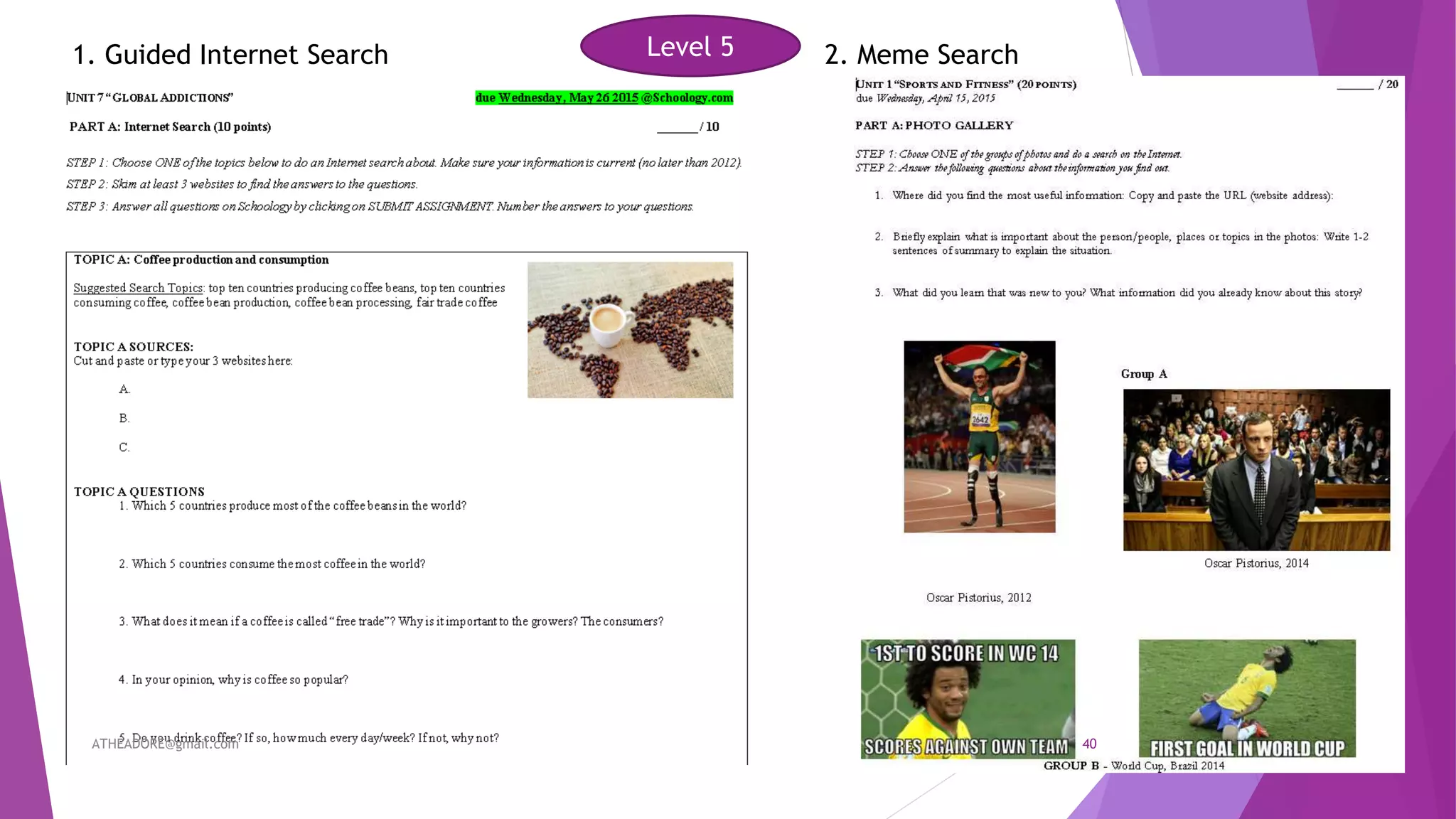
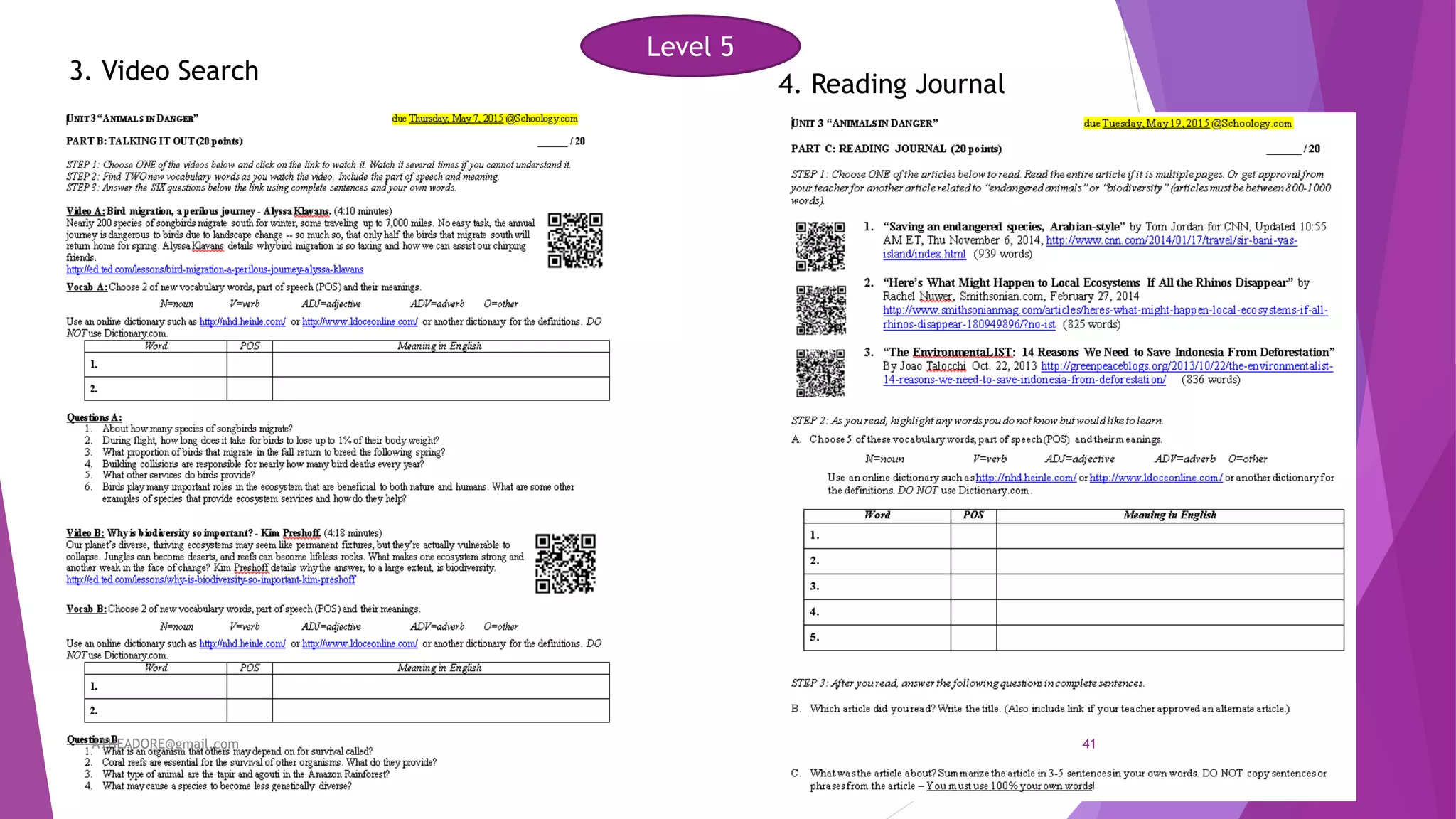
Sequential Internet Search
1. Find it – give students suggested search phrases.
2. Picture it – find a meme that reflects the topic.
What does the meme explain about it?
3. Watch it – send students to YouTube, TedEd,
Khan Academy, Teacher Tube, etc. to research a
topic.
4. Read it – supply news websites or actual links to
a news story about the topic.
For lower
level
students,
find kid-
friendly
sites.
ATHEADORE@gmail.com 30
Sequential Internet Search
Tips
Reflects what students do every day
Provide a handout for guidance
Provide 2-3 choices
Gives students a sense of control
Provides a shared learning opportunity when
debriefing
ATHEADORE@gmail.com 31
Sequential Internet Search –
Sample
FIND IT
1. Use Google, Bing or another search engine.
2. Try one of these search phrases. Focus on news
or informative sites (not movies, etc.)
 dinosaurs, sauropod, theropod, Jurassic Period
ATHEADORE@gmail.com 32
Sequential Internet Search –
Sample
FIND IT
3. Skim the first 3 articles you find to learn what
you can. You have 2 minutes.
4. Turn to a partner and discuss for 2 minutes
 What did you learn? Was anything new or surprising?
Was there any information you already knew?ATHEADORE@gmail.com 33
Sequential Internet Search –
Sample
PICTURE IT
1. Look carefully at the picture and text
2. Talk with your partner for 2 minutes:
 Can you guess the meaning of unknown words? What
do the words tell you about the animals?
ATHEADORE@gmail.com 34
ATHEADORE@gmail.com 35
Sequential Internet Search –
Sample
WATCH IT
1. Watch the short video and answer the questions
on your handout.
2. Talk with a partner for 2 minutes:
 What did you learn? Was anything new or surprising?
Was there any information you already knew?ATHEADORE@gmail.com 36
Sequential Internet Search –
Sample
WATCH IT
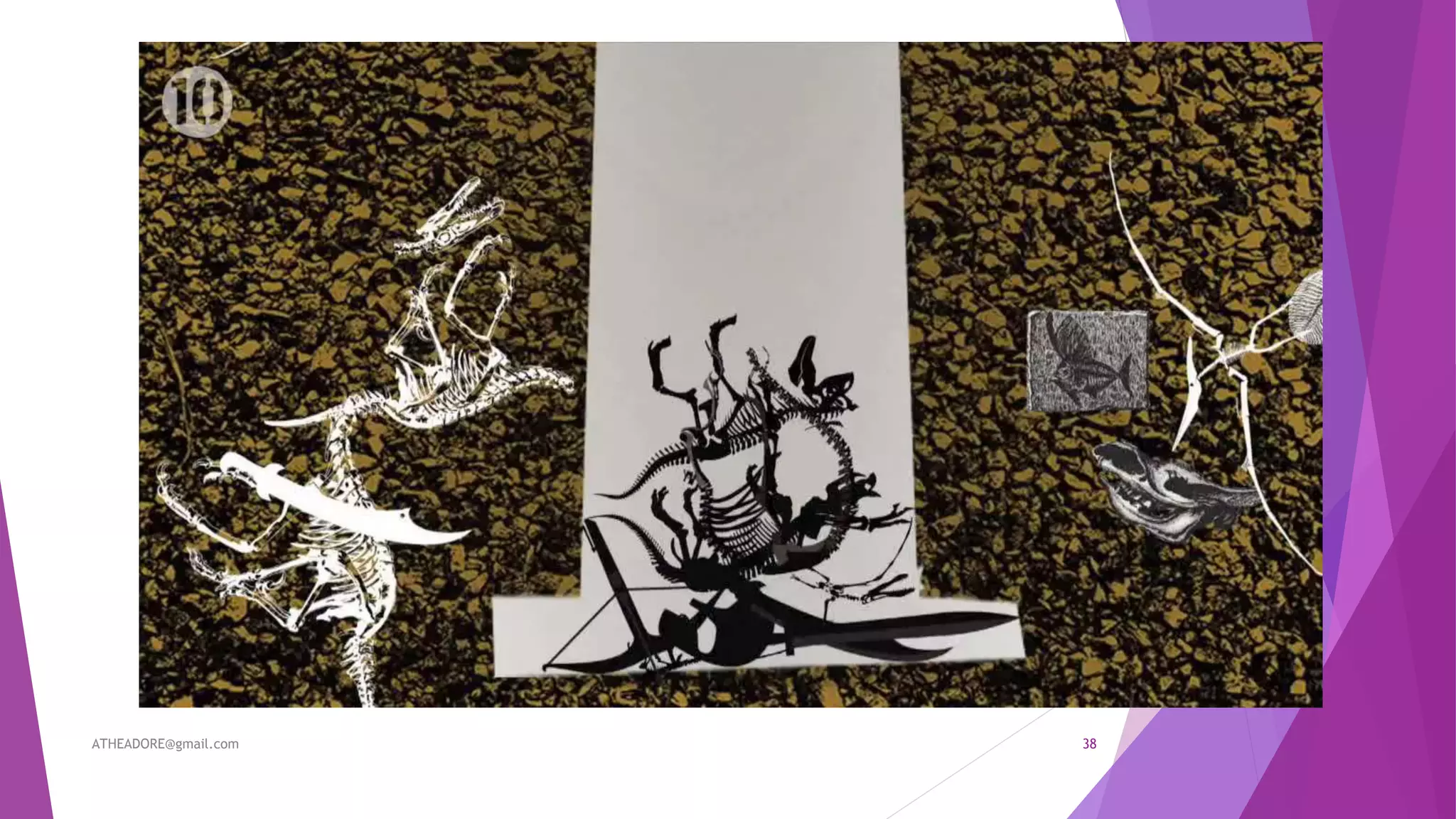
A. 10 Things About Dinosaurs You Did Know about
Dinosaurs (2:28, Top 10)
B. How Did Feathers Evolve? (3:26, Ted Ed)
ATHEADORE@gmail.com 37
ATHEADORE@gmail.com 38
ATHEADORE@gmail.com 39
1. Guided Internet Search 2. Meme SearchLevel 5
ATHEADORE@gmail.com 40
3. Video Search 4. Reading Journal
Level 5
ATHEADORE@gmail.com 41
Virtual Tours Tips:
There are hundreds of free virtual
tours
Google maps street view can serve
as virtual tours
Provide a handout for guidance.
ATHEADORE@gmail.com 42
Virtual tours – Your Turn
1. Go to Smithsonian NMNH Virtual Tour –
Dinosaurs
 http://paleobiology.si.edu/dinosaurs/interactives/tour
/main.html
2. Work with a partner to complete the
questions.
3. The first 3 pairs who completely and
correctly answer the questions see me to get
a prize!
ATHEADORE@gmail.com 43
Works Cited
 Ajideh, P. (2003). Schema Theory-based Pre-reading Tasks: A
neglected essential in the ESL reading class. The Reading
Matrix, 3, 1.
http://www.readingmatrix.com/articles/ajideh/article.pdf
 Marzano, R.J. (2004). Building Background Knowledge for
Academic Achievement: Research on What Works in Schools.
ASCD. Retrieved from Google books.
 Inventors’ images from
http://cdn.firstcry.com/brainbees/images/products/zoom/811
66a.jpgATHEADORE@gmail.com 44
Suggested Resources
Videos
 “Top 10” YouTube
Channel
 “SciShow” YouTube
Channel
 Animal Planet
 NatGeo.com
Reading
ATHEADORE@gmail.com 45

Building Background: Beyond the Textbook

  • 1.
    Building Background Knowledge Beyond theTextbook By Alicia Theadore Instructor, UCI International Programs ATHEADORE@gmail.com ATHEADORE@gmail.com 1
  • 2.
    Stay for thispresentation if you… Teach reading, vocabulary, speaking, listening or writing Are frustrated with your students’ lack of background knowledge Want your students to be ready for academic lectures and reading ATHEADORE@gmail.com 2
  • 3.
    Stay for thispresentation if you… Want your students to be able to use critical thinking They cannot talk about what they don’t know Want to build confidence in your students as intelligent communicators ATHEADORE@gmail.com 3
  • 4.
    About me… 15 yearsof experience working with international students Full-time Instructor UCI Academic ESL Program Reading Curriculum Coordinator Lead Teacher for the ESL Commons Project Emphasis on appealing to different learning styles, strong emphasis on technology in the classroom ATHEADORE@gmail.com 4
  • 5.
    What do Imean by “background knowledge”? Not “schema” or prior knowledge = cursory knowledge Building contextual knowledge Providing opportunities for “scaffolding” Perfect for classroomsflipped ATHEADORE@gmail.com 5
  • 6.
    Why should studentsand teachers develop BK? ATHEADORE@gmail.com 6
  • 7.
    Most important reasonfor developing BK… According to research, “what students already know about the content is one of the strongest indicators of how well they will learn new information relative to the content.” (Marzano 2004) Pre-reading vocabulary activities are not enough. (Ajideh 2003) ATHEADORE@gmail.com 7
  • 8.
    Increases academic success Improves standardized testscores Expands cultural knowledge Increases job successATHEADORE@gmail.com 8
  • 9.
    What methods canyou use in your classroom to build BK? 1. By yourself, make a list of at least 3 things you can do to build context. (30 seconds) ATHEADORE@gmail.com 9 30 seconds
  • 10.
    What methods canyou use in your classroom to build BK? 2. With a partner, make a list of at least 6 things you can do to build context. No repeats! Underline them. (1 min.) ATHEADORE@gmail.com 10 1 min.
  • 11.
    What methods canyou use in your classroom to build BK? 3. Turn to a new partner, add to your list to create at least 12 things you can do to build context. No repeats! Underline them. (1 min.) ATHEADORE@gmail.com 11 1 min.
  • 12.
    Ways to Enhance BackgroundKnowledge ATHEADORE@gmail.com 12
  • 13.
    General tips: 1. Usea variety of techniques for each unit. 2. Use multimodal techniques. 3. Provide (virtual) enrichment opportunities. 4. Make context relevant to what they already know, every day life, or future goals. ATHEADORE@gmail.com 13
  • 14.
    General tips continued 5.Acknowledge overlapping knowledge areas. 6. Provide rewards for accuracy. 7. Be explicit about the activity and its benefit to students’ learning. ATHEADORE@gmail.com 14
  • 15.
    1-2-3 Method 1. Startwith students working by themselves. Set a reasonable quantity and time limit to brainstorm what they already know. ATHEADORE@gmail.com 15
  • 16.
    1-2-3 Method 2. Afterthe time limit, put students in pairs (or small groups).  Acknowledge overlapping knowledge but encourage expansion of ideas.  Increase time limit. ATHEADORE@gmail.com 16
  • 17.
    1-2-3 Method 3. Afterthat time limit, get students in larger groups (or skip to step 4).  Acknowledge overlapping knowledge but encourage expansion of ideas.  Increase time limit again. ATHEADORE@gmail.com 17
  • 18.
    1-2-3 Method continued 4.Debrief as a class. Use a Venn diagram, table or list and categorize if possible. Underline items repeated across groups.  This is where their BK overlaps. ATHEADORE@gmail.com 18
  • 19.
    1-2-3 Method continued 5.Save the info!  After the unit/lesson and before the test, show the students what they knew, add what they learned. ATHEADORE@gmail.com 19
  • 20.
    Your Turn! By yourself,make a list of at least 3 inventions and who invited them. (30 seconds) With a partner, make a list of at least 6 inventions and who invited them. (1 min.) Turn to a new partner, make a list of at least 12 inventions and who invited them. (2 min.) Your Topic: Inventions Underline repeats but you must come up with 6-12 different inventions.ATHEADORE@gmail.com 20
  • 21.
    Brainstorming Ball Toss 1.Have a small (soft) ball students can throw to each other. 2. Get students in a circle (if possible). 3. Teacher stands at the board to act as recorder. 4. Collect as many of the words/phrases as you can as students say them. ATHEADORE@gmail.com 21
  • 22.
    Brainstorming Ball Tosscontinued 5. Give the activity a time limit. 6. When finished, ask students to help categorize ideas. ATHEADORE@gmail.com 22
  • 23.
    Brainstorming Ball Toss StudentRules: 1. Students form a circle. 2. Toss the ball to a student at least 2 people away from you. 3. Don’t need to use complete sentences 4. Don’t repeat ideas if possible ATHEADORE@gmail.com 23
  • 24.
    Brainstorming Ball Tosscontinued Student Rules: 5. Ideas should be related – be ready to explain 6. Be positive and supportive! In large classes, make two circles with one student from each acting as secretary. ATHEADORE@gmail.com 24
  • 25.
    Your Turn! Student Rules: 1.Students form a circle. 2. Toss the ball to a student at least 2 people away from you. 3. Don’t need to use complete sentences 4. Don’t repeat ideas if possible 5. Ideas should be related – be ready to explain 6. Be positive and supportive! Your Topic: space and the galaxy ATHEADORE@gmail.com 25
  • 26.
    Photo Gallery 1. Findand print pictures about your topic (in color preferably). 2. Number and place them around the room. 3. Give students a handout with questions (individually or as a team). 4. Students move around the room to check the pictures and find the answers to the handout. ATHEADORE@gmail.com 26
  • 27.
    Photo Gallery 5. Debriefas a class,  what was surprising or new?  which answers did you already know?  what is still true or used today? Change it up! Make it a jigsaw activity. ATHEADORE@gmail.com 27
  • 28.
    Photo Gallery –Your Turn! 1. Notice the small papers with numbers on them around the room 2. You have 5 minutes to walk around the room and find all 12 pictures. 3. Write down the answers to the 12 questions on the handout. GO! ATHEADORE@gmail.com 28 The first 3 people who completely and correctly answer the questions see me to get a prize!
  • 29.
  • 30.
    Sequential Internet Search 1.Find it – give students suggested search phrases. 2. Picture it – find a meme that reflects the topic. What does the meme explain about it? 3. Watch it – send students to YouTube, TedEd, Khan Academy, Teacher Tube, etc. to research a topic. 4. Read it – supply news websites or actual links to a news story about the topic. For lower level students, find kid- friendly sites. ATHEADORE@gmail.com 30
  • 31.
    Sequential Internet Search Tips Reflectswhat students do every day Provide a handout for guidance Provide 2-3 choices Gives students a sense of control Provides a shared learning opportunity when debriefing ATHEADORE@gmail.com 31
  • 32.
    Sequential Internet Search– Sample FIND IT 1. Use Google, Bing or another search engine. 2. Try one of these search phrases. Focus on news or informative sites (not movies, etc.)  dinosaurs, sauropod, theropod, Jurassic Period ATHEADORE@gmail.com 32
  • 33.
    Sequential Internet Search– Sample FIND IT 3. Skim the first 3 articles you find to learn what you can. You have 2 minutes. 4. Turn to a partner and discuss for 2 minutes  What did you learn? Was anything new or surprising? Was there any information you already knew?ATHEADORE@gmail.com 33
  • 34.
    Sequential Internet Search– Sample PICTURE IT 1. Look carefully at the picture and text 2. Talk with your partner for 2 minutes:  Can you guess the meaning of unknown words? What do the words tell you about the animals? ATHEADORE@gmail.com 34
  • 35.
  • 36.
    Sequential Internet Search– Sample WATCH IT 1. Watch the short video and answer the questions on your handout. 2. Talk with a partner for 2 minutes:  What did you learn? Was anything new or surprising? Was there any information you already knew?ATHEADORE@gmail.com 36
  • 37.
    Sequential Internet Search– Sample WATCH IT A. 10 Things About Dinosaurs You Did Know about Dinosaurs (2:28, Top 10) B. How Did Feathers Evolve? (3:26, Ted Ed) ATHEADORE@gmail.com 37
  • 38.
  • 39.
  • 40.
    1. Guided InternetSearch 2. Meme SearchLevel 5 ATHEADORE@gmail.com 40
  • 41.
    3. Video Search4. Reading Journal Level 5 ATHEADORE@gmail.com 41
  • 42.
    Virtual Tours Tips: Thereare hundreds of free virtual tours Google maps street view can serve as virtual tours Provide a handout for guidance. ATHEADORE@gmail.com 42
  • 43.
    Virtual tours –Your Turn 1. Go to Smithsonian NMNH Virtual Tour – Dinosaurs  http://paleobiology.si.edu/dinosaurs/interactives/tour /main.html 2. Work with a partner to complete the questions. 3. The first 3 pairs who completely and correctly answer the questions see me to get a prize! ATHEADORE@gmail.com 43
  • 44.
    Works Cited  Ajideh,P. (2003). Schema Theory-based Pre-reading Tasks: A neglected essential in the ESL reading class. The Reading Matrix, 3, 1. http://www.readingmatrix.com/articles/ajideh/article.pdf  Marzano, R.J. (2004). Building Background Knowledge for Academic Achievement: Research on What Works in Schools. ASCD. Retrieved from Google books.  Inventors’ images from http://cdn.firstcry.com/brainbees/images/products/zoom/811 66a.jpgATHEADORE@gmail.com 44
  • 45.
    Suggested Resources Videos  “Top10” YouTube Channel  “SciShow” YouTube Channel  Animal Planet  NatGeo.com Reading ATHEADORE@gmail.com 45

Editor's Notes

  • #7 Some ideas: enhance bottom up/top down reading, improve memory/vocab, helps with test prep, overall academic success