GLOBAL HEALTH  FIELD EDUCATION How can we teach, serve and learn? A case study: Schistosomiasis Control and Awareness Initiative  Eiman A. Mahmoud MD. MPH
The Global Health Program at Touro University  Summer internship Tropical medicine Emergency and trauma medicine Pediatric Global Health Elective rotations 3 rd  and 4 th  year medical students Complimentary MPH Global Health track degree Pharmacy students Physician assistants Medical students
International sites  Africa Ethiopia Tanzania Sudan Latin America Bolivia Asia Taiwan Israel
The importance of involvement and service in medical students overseas programs The challenges of including community based projects involving medical students  The role of Academia –NGO collaboration
Field education is a vital element for understanding our world through direct experience. The direct interaction of the student with the community serve as the best learning tool, and is optimized by the active involvement in addition to immersion.
Therefore it was essential for the program involved in Global Health to effectively organize field work to optimize its educational value through integration and application of its knowledge.
An essential element of academic skill building process in Global Health Education  is  “involvement and service”. Involvement and service will  Strengthen the learning process Provide a motivating force as well as self confidence Provide an opportunity in translating this force to action in the global field  Provide an early experience in breaking the “know-do” gap
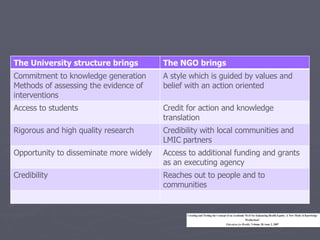
Several large institutions have collaborated with community based NGO s for enhancing health equity. Touro University Global Health program followed the Academic NGO conceptual framework created by ACANGO (Academic NGO initiative) in a small scale. Partnership with Global Physician Corps and other local NGOs at all of the international sites .
The University structure brings The NGO brings Commitment to knowledge generation Methods of assessing the evidence of interventions A style which is guided by values and belief with an action oriented Access to students Credit for action and knowledge translation Rigorous and high quality research Credibility with local communities and LMIC partners Opportunity to disseminate more widely Access to additional funding and grants as an executing agency Credibility Reaches out to people and to communities
The Case study of Schistosomiasis Control and Awareness Initiative , Shirati , Tarime district Tanzania (2004- present) is one of the several projects carried by the GHP and the GPC in collaboration with local NGO.
Challenges encountered in Global Health Field Education  THE SHISTO PROJECT Priority setting Reaching out to people  Sustainability
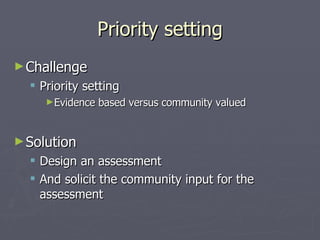
Priority setting Challenge Priority setting Evidence based versus community valued Solution Design an assessment And solicit the community input for the assessment
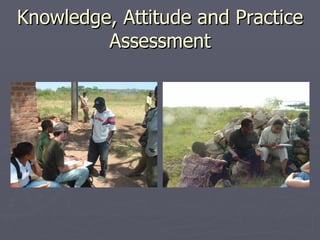
Initially the Touro-GHP , GPC and YFS a local NGO examined the knowledge , attitude and practice of fishermen  families in the Lake  community towards control and treatment of schistisomiasis.
Knowledge, Attitude and Practice Assessment
Most fishermen  (213, 82%) recognized  Schistosomiasis was the greatest health threat in their communities,  (160,61%) had adequate knowledge about the disease transmission,  but only 32% of them were willing to pay for screening, diagnosis and treatment of the infection  Rhode, Mahmoud and Kunin. J Am Osteopath Assoc. 2005 Jan;105(1):25.
Rather than stop at producing research results ,Touro-GHP and the GPC  endeavored to close the “research to action/policy” gap. Impact The Basket Fund of the Shiratti hospital was directed towards education and facilitating access to treatment.
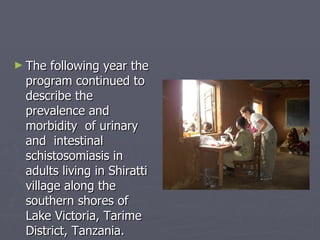
The following year the program continued to  describe the prevalence and morbidity  of urinary and  intestinal schistosomiasis in adults living in Shiratti village along the southern shores of Lake Victoria, Tarime  District, Tanzania.
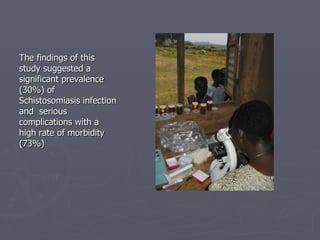
The findings of this study suggested a significant prevalence (30%) of Schistosomiasis infection and  serious complications with a high rate of morbidity (73%)
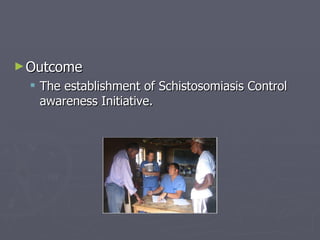
Outcome The establishment of Schistosomiasis Control awareness Initiative.
Impact The initiative provided annual screening for over 1200 residents over a period of 4 years  The initiative provided continuous health education within the community and in outpatient clinics The initiative also addressed the growing crisis of inadequate health human resources by providing training of health worker in Ultrasound diagnostic technique necessary for assessment of Shistosomiasis morbidity. The initiative provided access to praziquantil medications through sustainable resource funds.
Partnership and Reaching out  Host institutions Community
Host institutions seek partnership rather than simply defined as hosts. Projects and  their scholarly outcome are executed on the basis of collaboration Structural capacity building and training health care workers are crucial elements in any collaborative effort.
Faculty involvement  Public health program Medical program Pharmacy program Physician assistant program Project Share For structural capacity building
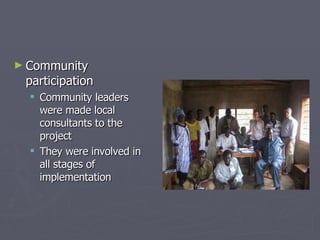
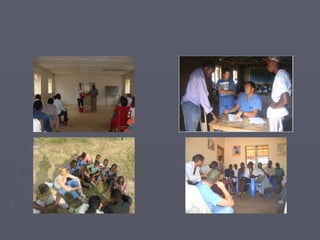
Community participation Community leaders were made local consultants to the project They were involved in all stages of implementation
The relationship of the community to Global Health projects Health related common culture Legitimate political authority Mechanism for priority setting Enhance the appropriateness of the research Help establish trust between the university, hospital staff and the program which last for years Grand Challenges in Global Health: Community Engagement in Research in Developing Countries Paulina O Tindana
 
Sustainability Sustainability Lasting benefit to the community. Maintenance of health over time Influenced by resources available to the project Financial Staff
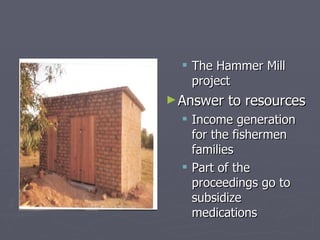
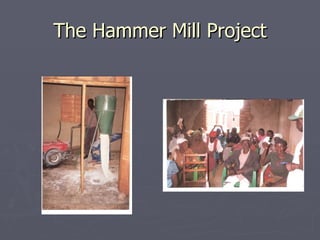
The Hammer Mill project Answer to resources Income generation for the fishermen families  Part of the proceedings go to subsidize medications
The Hammer Mill Project
Other projects carried by Touro GHP following the same model Diarrheal disease control “Assendabo Project” Ethiopia Access to antenatal care “The Bike Project” Tanzania Pediatric malaria , Tanzania. Maternal and Child Health “Min Sifr Project”  Post-conflict Southern Sudan

Student Electives in Low-resource Countries: Ethical Considerations: Eiman A. Mahmoud

  • 1.
    GLOBAL HEALTH FIELD EDUCATION How can we teach, serve and learn? A case study: Schistosomiasis Control and Awareness Initiative Eiman A. Mahmoud MD. MPH
  • 2.
    The Global HealthProgram at Touro University Summer internship Tropical medicine Emergency and trauma medicine Pediatric Global Health Elective rotations 3 rd and 4 th year medical students Complimentary MPH Global Health track degree Pharmacy students Physician assistants Medical students
  • 3.
    International sites Africa Ethiopia Tanzania Sudan Latin America Bolivia Asia Taiwan Israel
  • 4.
    The importance ofinvolvement and service in medical students overseas programs The challenges of including community based projects involving medical students The role of Academia –NGO collaboration
  • 5.
    Field education isa vital element for understanding our world through direct experience. The direct interaction of the student with the community serve as the best learning tool, and is optimized by the active involvement in addition to immersion.
  • 6.
    Therefore it wasessential for the program involved in Global Health to effectively organize field work to optimize its educational value through integration and application of its knowledge.
  • 7.
    An essential elementof academic skill building process in Global Health Education is “involvement and service”. Involvement and service will Strengthen the learning process Provide a motivating force as well as self confidence Provide an opportunity in translating this force to action in the global field Provide an early experience in breaking the “know-do” gap
  • 8.
    Several large institutionshave collaborated with community based NGO s for enhancing health equity. Touro University Global Health program followed the Academic NGO conceptual framework created by ACANGO (Academic NGO initiative) in a small scale. Partnership with Global Physician Corps and other local NGOs at all of the international sites .
  • 9.
    The University structurebrings The NGO brings Commitment to knowledge generation Methods of assessing the evidence of interventions A style which is guided by values and belief with an action oriented Access to students Credit for action and knowledge translation Rigorous and high quality research Credibility with local communities and LMIC partners Opportunity to disseminate more widely Access to additional funding and grants as an executing agency Credibility Reaches out to people and to communities
  • 10.
    The Case studyof Schistosomiasis Control and Awareness Initiative , Shirati , Tarime district Tanzania (2004- present) is one of the several projects carried by the GHP and the GPC in collaboration with local NGO.
  • 11.
    Challenges encountered inGlobal Health Field Education THE SHISTO PROJECT Priority setting Reaching out to people Sustainability
  • 12.
    Priority setting ChallengePriority setting Evidence based versus community valued Solution Design an assessment And solicit the community input for the assessment
  • 13.
    Initially the Touro-GHP, GPC and YFS a local NGO examined the knowledge , attitude and practice of fishermen families in the Lake community towards control and treatment of schistisomiasis.
  • 14.
    Knowledge, Attitude andPractice Assessment
  • 15.
    Most fishermen (213, 82%) recognized Schistosomiasis was the greatest health threat in their communities, (160,61%) had adequate knowledge about the disease transmission, but only 32% of them were willing to pay for screening, diagnosis and treatment of the infection Rhode, Mahmoud and Kunin. J Am Osteopath Assoc. 2005 Jan;105(1):25.
  • 16.
    Rather than stopat producing research results ,Touro-GHP and the GPC endeavored to close the “research to action/policy” gap. Impact The Basket Fund of the Shiratti hospital was directed towards education and facilitating access to treatment.
  • 17.
    The following yearthe program continued to describe the prevalence and morbidity of urinary and intestinal schistosomiasis in adults living in Shiratti village along the southern shores of Lake Victoria, Tarime District, Tanzania.
  • 18.
    The findings ofthis study suggested a significant prevalence (30%) of Schistosomiasis infection and serious complications with a high rate of morbidity (73%)
  • 19.
    Outcome The establishmentof Schistosomiasis Control awareness Initiative.
  • 20.
    Impact The initiativeprovided annual screening for over 1200 residents over a period of 4 years The initiative provided continuous health education within the community and in outpatient clinics The initiative also addressed the growing crisis of inadequate health human resources by providing training of health worker in Ultrasound diagnostic technique necessary for assessment of Shistosomiasis morbidity. The initiative provided access to praziquantil medications through sustainable resource funds.
  • 21.
    Partnership and Reachingout Host institutions Community
  • 22.
    Host institutions seekpartnership rather than simply defined as hosts. Projects and their scholarly outcome are executed on the basis of collaboration Structural capacity building and training health care workers are crucial elements in any collaborative effort.
  • 23.
    Faculty involvement Public health program Medical program Pharmacy program Physician assistant program Project Share For structural capacity building
  • 24.
    Community participation Communityleaders were made local consultants to the project They were involved in all stages of implementation
  • 25.
    The relationship ofthe community to Global Health projects Health related common culture Legitimate political authority Mechanism for priority setting Enhance the appropriateness of the research Help establish trust between the university, hospital staff and the program which last for years Grand Challenges in Global Health: Community Engagement in Research in Developing Countries Paulina O Tindana
  • 26.
  • 27.
    Sustainability Sustainability Lastingbenefit to the community. Maintenance of health over time Influenced by resources available to the project Financial Staff
  • 28.
    The Hammer Millproject Answer to resources Income generation for the fishermen families Part of the proceedings go to subsidize medications
  • 29.
  • 30.
    Other projects carriedby Touro GHP following the same model Diarrheal disease control “Assendabo Project” Ethiopia Access to antenatal care “The Bike Project” Tanzania Pediatric malaria , Tanzania. Maternal and Child Health “Min Sifr Project” Post-conflict Southern Sudan