Social media
and the role of technology in
improving health conversations;
21st April 2012
Rachel de Sain
Flaxworks
Why Health?
Why diabetes?
My mum
(the hot one in the
middle)
Type 1 diabetes at 30.
Almost dead at 40
after given the wrong
medication.
How can social media tools support health
conversations?
Industrial
Technology
Mobile
Connected
Revolutions and
Change
“the only thing
constant is
change”
The challenge
• Australia’s life expectancy is one of the
highest in the world, second only to Japan
• In 1996, chronic disease accounted for 80
per cent of the burden of disease,
measured in terms of loss of years and
quality of life
• Over three million Australians, or nearly
one in seven, suffer from chronic disease
• Health expenditure as a proportion of
Australian GDP has more than doubled
over the last four and a half decades from
3.8% to 9%
Using Microeconomic reform to deliver patient-centric Health Care
Technology holds the key
Nielsen: The Australian Online Consumer Report 2011
Slide care of Brandinfiltration.com
http://youtu.be/5mid8p4A6Eg
Technology has changed behaviors, attitudes
and activities – it will continue to do so…
Video Summary
• More people heading online to find answers
• Trusting word of mouth
• Wanting to feel connected and part of a
community
• Increasing amount of content coming from
people versus brands
• Growing use of social media to create
effective change in health outcomes
Social media is digital content created
by the people for the people.
Social media is a shift in how people discover,
read and share content;
Transforming broadcast media monologues (one
to many) into social media dialogues (many to
many).
Social Media
is
Conversation
SEARCHABLE
INTERACTIVE
ACCESSIBLE
TIMELESS
Social Media
Learning
• A great way
to find
information
Communicating
• A great way
to share
information
Connecting
• A great way
to be part of
the
community
Patient Practioner
Learning
• Learning from others
• Finding thought leaders
• Accessing the latest information
• http://www.youtube.com/watch?v=aUaInS6HI
Go
• 23 ½ hours video about how simply 30mins of
simple walking a day can make a huge
difference.
Diabetes portals
• http://www.youtube.com/watch?v=CQGF1Eo
XFPs
• http://www.diabetesmine.com/
• http://www.tudiabetes.org/
The PatientsLikeMe process is to help people share their health information in order to learn from
others like them and then use that information to discuss treatment options with their health care team
Step 1:
Create/update and
share your health
profile
Step 2:
Find support from
others like you and
compare experiences
Step 3:
Learn from aggregated
community Treatment
and Symptom Reports
Step 4:
Take profile to your doctor to have an
improved treatment conversation
Step 5:
Play an integral
part in your own
health care
With over 3,400 patients reporting Type II diabetes and 750 with Type I as a health condition in the US,
PatientsLikeMe is well-positioned to aggregate the real-world experience of people living with these challenges
35Proprietary & Confidential
Giving patients access to their own record is a crucial first step; the next evolution is to permit controlled
sharing between patients to help patients learn from one another’s experiences and conduct research
36Proprietary & Confidential
Can providing patients with the tools to connect with one another improve health outcomes for diabetes
patients struggling to manage their condition(s) despite good medical support?
37Proprietary & Confidential
23% - I have had fewer
visits to the ER
28% - PatientsLikeMe
gave me more and
better control over my
condition
59% -the site has given
me a better
understanding of my
seizures
49% - recording my
seizures helps me
manage my condition
50% - PatientsLikeMe
helped me understand
side effects
2010 Epilepsy User Survey: Those who connect with others on
PatientsLikeMe report a wider range of perceived benefits to their
epilepsy management and quality of life
30% - PatientsLikeMe
helped me be more
adherent
One-third of respondents had no one in “the real world” with whom to discuss their
epilepsy. After joining PatientsLikeMe, two-thirds reported a connection to at least one
other person with epilepsy.
Case Study: Patients Report Benefits of Connecting through a Data-Centric Sharing Platform
Health Information Seeking and Social Media
Use on the Internet among People with Diabetes
– Ryan J Shaw1, Constance M Johnson1 1Duke University School of Nursing, Durham, NC
Abstract
• Patients who are active and involved in their self-management and
care are more likely to manage chronic conditions effectively (6,
26).
• With a 5-fold increase in the incidence of chronic illness over the
past 20 years, access to information can provide patients the tools
and support to self-manage their chronic illness.
• New media technologies can serve as tools to engage and involve
patients in their health care.
• Thus, the Internet can serve as a mechanism of empowerment (4,
5). This is especially important for people with diabetes mellitus
where intensive self- management is critical.
Social media risks
• Growing ESL and CALD
community needs
• Americanisation of results
• Health literacy / tech literacy
– Understanding who and
what to trust
– How much to share
– Managing data when
cognitive functions decline
• Paranoia versus managing
privacy
Who can you trust?
BJ Fogg – behavior change guru
Gamification
A major factor for reduced
independence in older adults
1/3 community dwelling older adults fall
each year
10-20% multiple fallers
$18,454 per hospital admission
Total health cost to NSW alone in
2006/2007 $553M
Dr Stuart Smith, Neuroscience Research Centre
Our approach to balance
training and fall prevention
Videogames
Gaming
• Usability, consumer engagement and technology adoption.
– Make it fun and they will use it
– Great tool for education and change adoption
• eHealth needs a solitaire…
– Biggest educator of how to use a mouse and windows interface
• Movement based gaming platforms
– Rehabilitation, falls prevention
• Intergenerational gaming
– Bringing families together
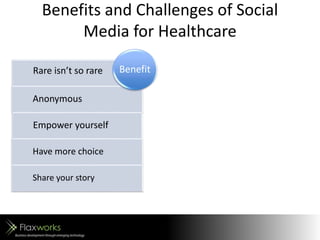
Benefits and Challenges of Social
Media for Healthcare
Rare isn’t so rare
Anonymous
Empower yourself
Have more choice
Share your story
Benefit
Benefits and Challenges of Social
Media for Healthcare
Rare isn’t so rare
Anonymous
Empower yourself
Have more choice
Share your story
Benefit Americanisation
Scaremongering
Accuracy of Info
Science / Art Balance
Everyone is Different
Challeng
e
Rachel de Sain
rdesain@flaxworks.com.au
skype: rdesain
twitter: rdesain
Thank you!
Final thought…

Keynote diabetes

  • 1.
    Social media and therole of technology in improving health conversations; 21st April 2012 Rachel de Sain Flaxworks
  • 3.
  • 4.
    Why diabetes? My mum (thehot one in the middle) Type 1 diabetes at 30. Almost dead at 40 after given the wrong medication.
  • 5.
    How can socialmedia tools support health conversations?
  • 6.
  • 7.
    The challenge • Australia’slife expectancy is one of the highest in the world, second only to Japan • In 1996, chronic disease accounted for 80 per cent of the burden of disease, measured in terms of loss of years and quality of life • Over three million Australians, or nearly one in seven, suffer from chronic disease • Health expenditure as a proportion of Australian GDP has more than doubled over the last four and a half decades from 3.8% to 9%
  • 8.
    Using Microeconomic reformto deliver patient-centric Health Care
  • 9.
  • 10.
    Nielsen: The AustralianOnline Consumer Report 2011
  • 14.
    Slide care ofBrandinfiltration.com
  • 16.
    http://youtu.be/5mid8p4A6Eg Technology has changedbehaviors, attitudes and activities – it will continue to do so…
  • 18.
    Video Summary • Morepeople heading online to find answers • Trusting word of mouth • Wanting to feel connected and part of a community • Increasing amount of content coming from people versus brands • Growing use of social media to create effective change in health outcomes
  • 20.
    Social media isdigital content created by the people for the people. Social media is a shift in how people discover, read and share content; Transforming broadcast media monologues (one to many) into social media dialogues (many to many).
  • 21.
  • 23.
  • 24.
    Social Media Learning • Agreat way to find information Communicating • A great way to share information Connecting • A great way to be part of the community Patient Practioner
  • 25.
    Learning • Learning fromothers • Finding thought leaders • Accessing the latest information
  • 30.
    • http://www.youtube.com/watch?v=aUaInS6HI Go • 23½ hours video about how simply 30mins of simple walking a day can make a huge difference.
  • 32.
    Diabetes portals • http://www.youtube.com/watch?v=CQGF1Eo XFPs •http://www.diabetesmine.com/ • http://www.tudiabetes.org/
  • 34.
    The PatientsLikeMe processis to help people share their health information in order to learn from others like them and then use that information to discuss treatment options with their health care team Step 1: Create/update and share your health profile Step 2: Find support from others like you and compare experiences Step 3: Learn from aggregated community Treatment and Symptom Reports Step 4: Take profile to your doctor to have an improved treatment conversation Step 5: Play an integral part in your own health care
  • 35.
    With over 3,400patients reporting Type II diabetes and 750 with Type I as a health condition in the US, PatientsLikeMe is well-positioned to aggregate the real-world experience of people living with these challenges 35Proprietary & Confidential
  • 36.
    Giving patients accessto their own record is a crucial first step; the next evolution is to permit controlled sharing between patients to help patients learn from one another’s experiences and conduct research 36Proprietary & Confidential
  • 37.
    Can providing patientswith the tools to connect with one another improve health outcomes for diabetes patients struggling to manage their condition(s) despite good medical support? 37Proprietary & Confidential
  • 38.
    23% - Ihave had fewer visits to the ER 28% - PatientsLikeMe gave me more and better control over my condition 59% -the site has given me a better understanding of my seizures 49% - recording my seizures helps me manage my condition 50% - PatientsLikeMe helped me understand side effects 2010 Epilepsy User Survey: Those who connect with others on PatientsLikeMe report a wider range of perceived benefits to their epilepsy management and quality of life 30% - PatientsLikeMe helped me be more adherent One-third of respondents had no one in “the real world” with whom to discuss their epilepsy. After joining PatientsLikeMe, two-thirds reported a connection to at least one other person with epilepsy. Case Study: Patients Report Benefits of Connecting through a Data-Centric Sharing Platform
  • 39.
    Health Information Seekingand Social Media Use on the Internet among People with Diabetes – Ryan J Shaw1, Constance M Johnson1 1Duke University School of Nursing, Durham, NC Abstract • Patients who are active and involved in their self-management and care are more likely to manage chronic conditions effectively (6, 26). • With a 5-fold increase in the incidence of chronic illness over the past 20 years, access to information can provide patients the tools and support to self-manage their chronic illness. • New media technologies can serve as tools to engage and involve patients in their health care. • Thus, the Internet can serve as a mechanism of empowerment (4, 5). This is especially important for people with diabetes mellitus where intensive self- management is critical.
  • 40.
    Social media risks •Growing ESL and CALD community needs • Americanisation of results • Health literacy / tech literacy – Understanding who and what to trust – How much to share – Managing data when cognitive functions decline • Paranoia versus managing privacy
  • 41.
  • 43.
    BJ Fogg –behavior change guru
  • 44.
  • 50.
    A major factorfor reduced independence in older adults 1/3 community dwelling older adults fall each year 10-20% multiple fallers $18,454 per hospital admission Total health cost to NSW alone in 2006/2007 $553M Dr Stuart Smith, Neuroscience Research Centre
  • 51.
    Our approach tobalance training and fall prevention Videogames
  • 55.
    Gaming • Usability, consumerengagement and technology adoption. – Make it fun and they will use it – Great tool for education and change adoption • eHealth needs a solitaire… – Biggest educator of how to use a mouse and windows interface • Movement based gaming platforms – Rehabilitation, falls prevention • Intergenerational gaming – Bringing families together
  • 56.
    Benefits and Challengesof Social Media for Healthcare Rare isn’t so rare Anonymous Empower yourself Have more choice Share your story Benefit
  • 57.
    Benefits and Challengesof Social Media for Healthcare Rare isn’t so rare Anonymous Empower yourself Have more choice Share your story Benefit Americanisation Scaremongering Accuracy of Info Science / Art Balance Everyone is Different Challeng e
  • 59.
    Rachel de Sain rdesain@flaxworks.com.au skype:rdesain twitter: rdesain Thank you! Final thought…