The student consumer and the rise of
e-textbook platforms
Digital Textbooks UCL 10th May 2018
Ken Chad
Ken Chad Consulting Ltd http://www.kenchadconsulting.com Tel: +44(0)7788727845
Twitter: @kenchad | Skype: kenchadconsulting |Linkedin: www.linkedin.com/in/kenchad
Researcher IDs:
• Orcid.org/0000-0001-5502-6898
• ResearchGate: https://www.researchgate.net/profile/Ken_Chad
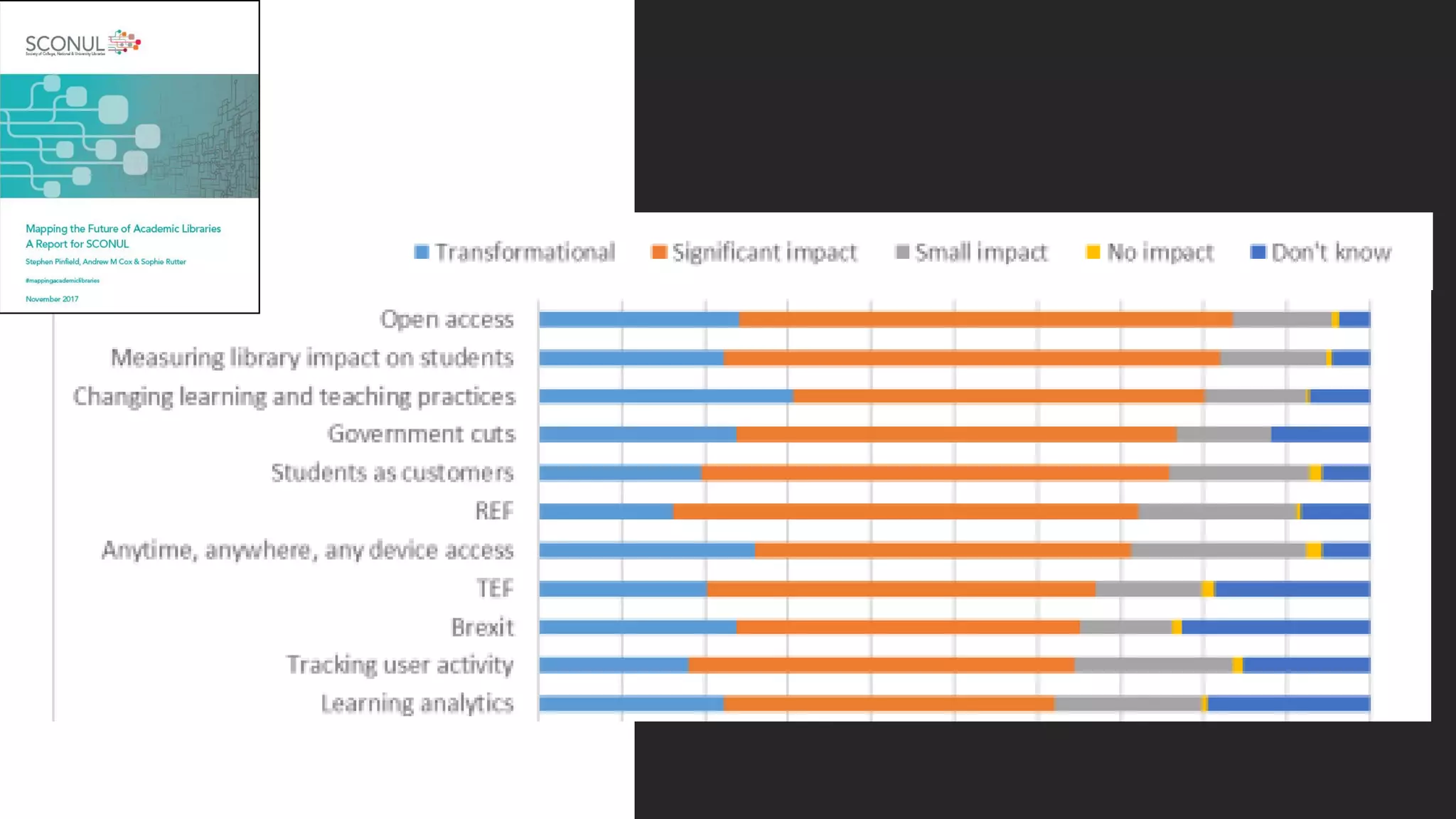
CONTEXT
Trends “
Trends “
Open
“Educators, institutions, and even
state legislators are turning their
attention toward Open Educational
Resources (OER)”
Bepress website: Open Educational Resources &
Books https://www.bepress.com/products/digital-
commons/features/open-educational-resources-
books/
Role of libraries
“Students tend to be more engaged
with learning on the whole if they
engage with library resources,
interact with library staff, and spend
time using libraries”.
Australasian Survey of Student Engagement [AUSSE] 2012
Institution Report (p. 40-41)
Excellence in
teaching
“The importance of ‘high quality teaching’
in Higher Education (HE) is becoming
increasingly emphasised both in the
United Kingdom (UK) and abroad
.....Excellence in teaching has become
entrenched in higher education policy and
in the educational strategies of academic
institutions, and increasingly linked to the
performance and assessment of these
institutions”
Higher Education Academy (HEA), 2016
Finances
Fees accounted for more than two-
thirds of total income at 42 per cent of
UK universities, while 22 institutions
depended on fees for more than
three-quarters of their income in
2015-16.
The risks of this are obvious: a sudden
drop in student demand, even spread
over a few years, could be catastrophic: a
peril highlighted by the strong correlation
that now exists between changes in real-
terms income for universities
University financial health check 2017: future prospects? Simon
Baker. Times Higher 17 August 2017
https://www.timeshighereducation.com/features/university-
financial-health-check-2017-future-prospects
Learning analytics
“Every time a student interacts with
their university – be that going to
the library, logging into their virtual
learning environment or submitting
assessments online – they leave
behind a digital footprint. Learning
analytics is the process of using this
data to improve learning and
teaching”
Learning analytics in higher education: A review of UK and
international practice. Read our updated briefing on learning
analytics and student success from January 2017. By Niall
Sclater, Alice Peasgood & Joel Mullen. Jisc. 2016.
https://www.jisc.ac.uk/reports/learning-analytics-in-higher-
education
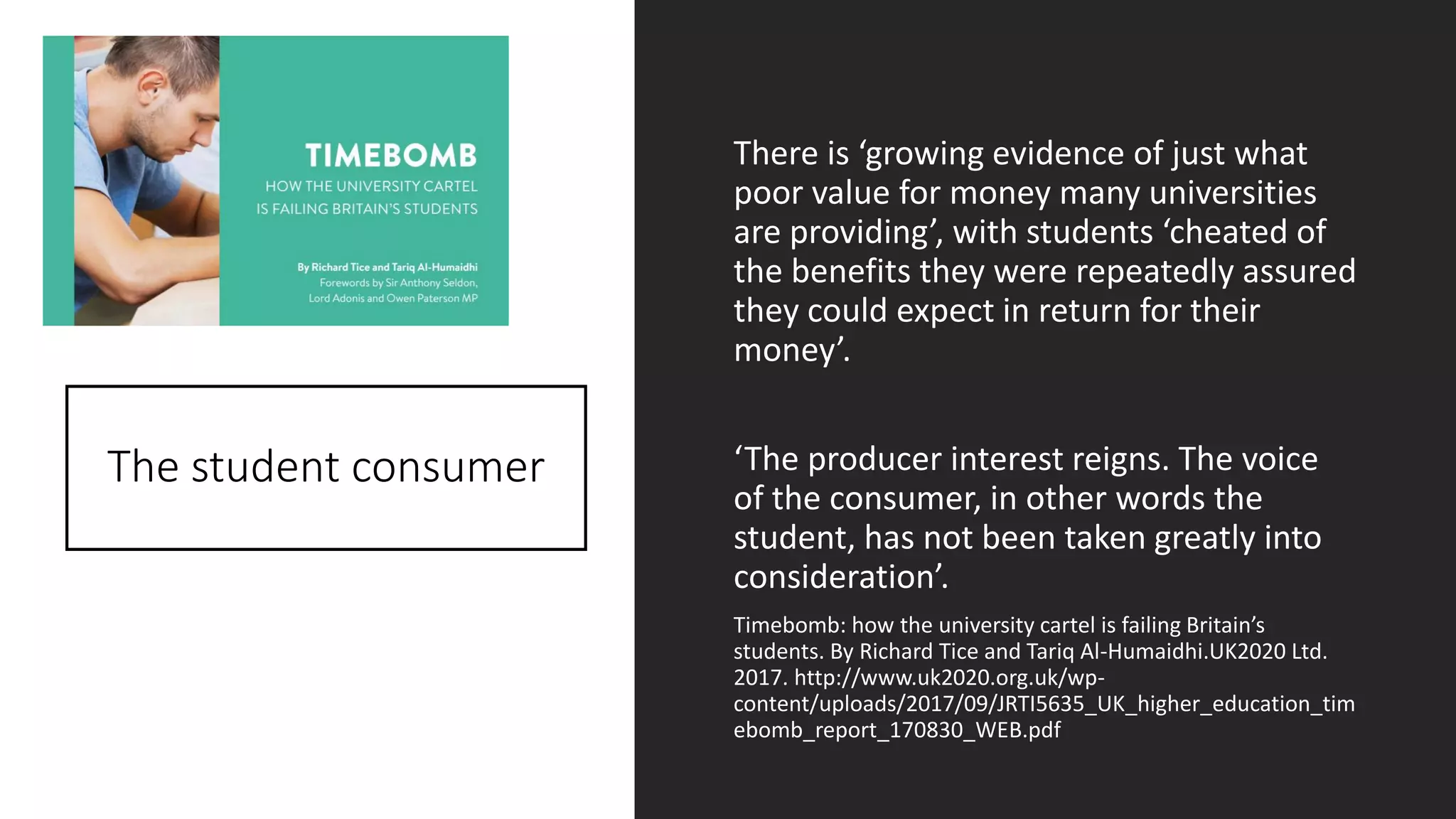
The student consumer
There is ‘growing evidence of just what
poor value for money many universities
are providing’, with students ‘cheated of
the benefits they were repeatedly assured
they could expect in return for their
money’.
‘The producer interest reigns. The voice
of the consumer, in other words the
student, has not been taken greatly into
consideration’.
Timebomb: how the university cartel is failing Britain’s
students. By Richard Tice and Tariq Al-Humaidhi.UK2020 Ltd.
2017. http://www.uk2020.org.uk/wp-
content/uploads/2017/09/JRTI5635_UK_higher_education_tim
ebomb_report_170830_WEB.pdf
consumerization
Consumerization is the reorientation of
product and service designs around
the individual end user. The
emergence of the individual
consumer as the primary driver of
product and service design
originated from and is most commonly
seen as a major IT industry shift
The primary impact of
consumerization is that it is forcing
businesses.. to rethink the way they
procure and manage IT equipment
and services.
consumerization
http://en.wikipedia.org/wiki/Consumerization
Platforms are Eating the
World
We are in the midst of a seismic
shift in business models,
powered by the Internet and a
generation of connected users.
Outlook 2014: Platforms are Eating
the World
https://www.wired.com/insights/2013/12/outlook-2014-
platforms-eating-world/
Thinking about
textbooks
Overcoming the
“textbook taboo”
“At a time when it is
increasingly necessary for
libraries to find new ways of
being mission-critical to their
sponsoring institutions, this
aversion to textbook
provision seems to me
increasingly self-defeating"
Academic Libraries and the Textbook Taboo: Time to
Get Over It? By Rick Anderson. The Scholarly Kitchen 7
July 2016
https://scholarlykitchen.sspnet.org/2016/07/07/acade
mic-libraries-and-the-textbook-taboo-time-to-get-over-
it
Value of library
provided e-textbooks
A library led e-textbook
service leads to ‘higher
engagement of learning
from students, their
increased satisfaction with
the University and Library,
plus addresses the issue of
reducing their direct costs’.
The direct library supply of individual textbooks to
students: examining the value proposition. By
Dominic Broadhurst. Information and Learning
Science, vol 118, no. 11/12, pp. 629-641. 2017
DOI: 10.1108/ILS-07-2017-0072
http://man.ac.uk/VEpn4p
Value for money?
Are institutional/library
e-textbook programmes
good value?
£2 million invested
Middlesex University free
books for everyone
“Money was allocated by the
University Executive. This was
new money which had not
previously been allocated
either to Schools or the
Library”
“The Library is responsible for
administering the project”
UKSG webinar Q and A
Where will the
money come from?
“Yes, we really, really,
haven't got any money”
Librarian messages to publishers.UKSG Presentation
2016https://docs.google.com/presentation/d/1suoalVA
srH5HQ_s8YZkA6YcBa5aKJ_klSXw-
debl_eU/edit#slide=id.p14
Where will the
money come from?
Substantial funding is available
in response to good value propositions
Value of library
resources?
“If there is a failure to demonstrate
[the] value [of library] resources there
is a risk of a lower institutional priority
being placed on them and a resulting
reduction in funding, with those core
users being disadvantaged over time”
TEF: what does it mean for academic libraries? By
Maxine Melling and Margaret Weaver. Insights – 30(3),
November 2017
Teaching Excellence
Framework
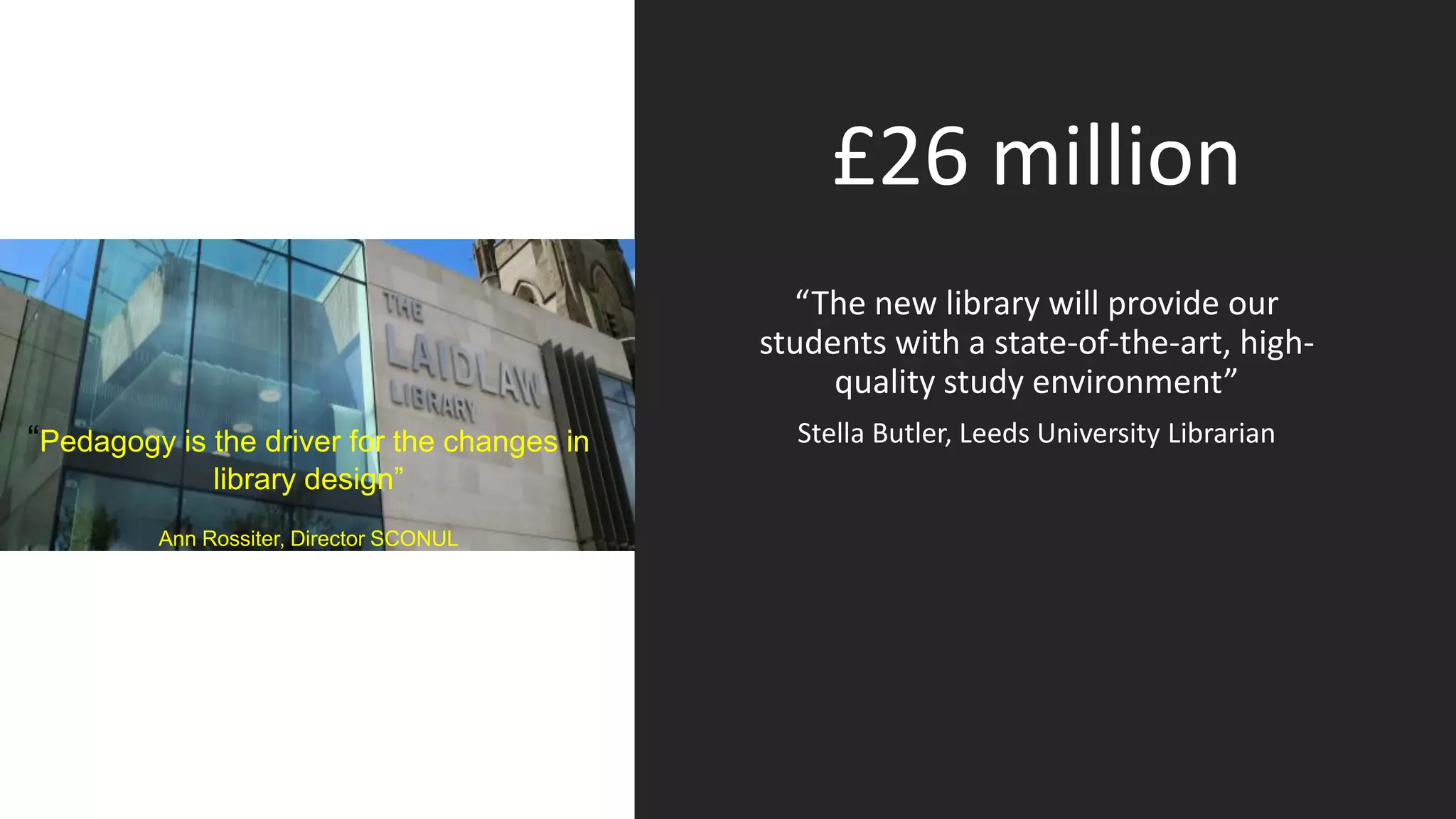
£26 million
“The new library will provide our
students with a state-of-the-art, high-
quality study environment”
Stella Butler, Leeds University Librarian“Pedagogy is the driver for the changes in
library design”
Ann Rossiter, Director SCONUL
Value Proposition
“Additional capital investment of £5.3m in
the last three years has been focused on a
complete refurbishment of the libraries ..
and a new replacement library ... .... As a
result, student use of library learning
resources and facilities has significantly
increased.”
Nottingham Trent University TEF
Submission
Value Proposition
“Our .....learning resources are
acknowledged within both the HE
sector and professional associations
are being amongst the best in class.”
Nottingham Trent University
TEF 2 Year Provider Submission
Open Textbooks have seen impressive
growth and impact in the North
American context, through providers
and initiatives such as OpenStax, the
Open Textbook Network, BC Campus,
and Lumen Learning.
The UK Open Textbooks project aims
to test the transferability of the
OpenStax and OpenTextbook Network
approaches to the UK context
http://ukopentextbooks.org/
New ways of making
textbooks
New ways of making
textbooks
“The advent of the TEF provides
another incentive...to raise the topic of
institutionally produced textbooks
higher on the agenda” Lara Speicher,
Publishing Manager, UCL Press
The Challenge of Open Access Textbooks. Jisc [Blog] 9
May 2017.
https://etextbook.jiscinvolve.org/wp/2017/05/09/the-
challenge-of-open-access-textbooks/
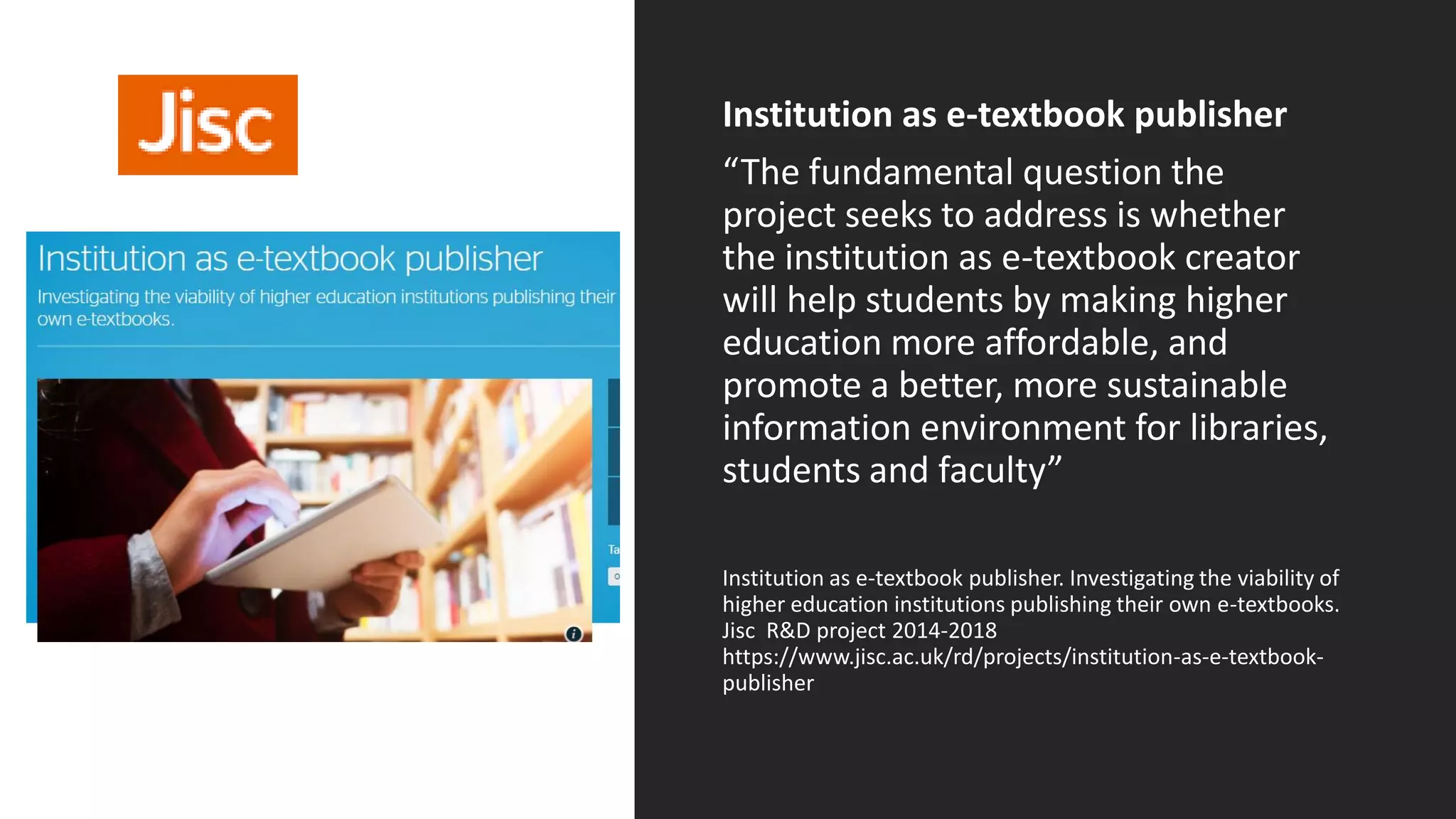
Institution as e-textbook publisher
“The fundamental question the
project seeks to address is whether
the institution as e-textbook creator
will help students by making higher
education more affordable, and
promote a better, more sustainable
information environment for libraries,
students and faculty”
Institution as e-textbook publisher. Investigating the viability of
higher education institutions publishing their own e-textbooks.
Jisc R&D project 2014-2018
https://www.jisc.ac.uk/rd/projects/institution-as-e-textbook-
publisher
Textbooks
Beyond the
e-book &
e-textbook
Library vs. learning
resources?
This was said back in 2001!
“There is a burgeoning area of overlap
between the ‘learning resources’
which academics wish to install in their
VLEs, and the digitised learning
resources which libraries are making
available" John McColl
Virtuous learning environments: the library and the VLE.
MacColl, J. Program: electronic library and information
systems, 35(3): 227-239. 2001. https://research-
repository.st-andrews.ac.uk/handle/10023/1825
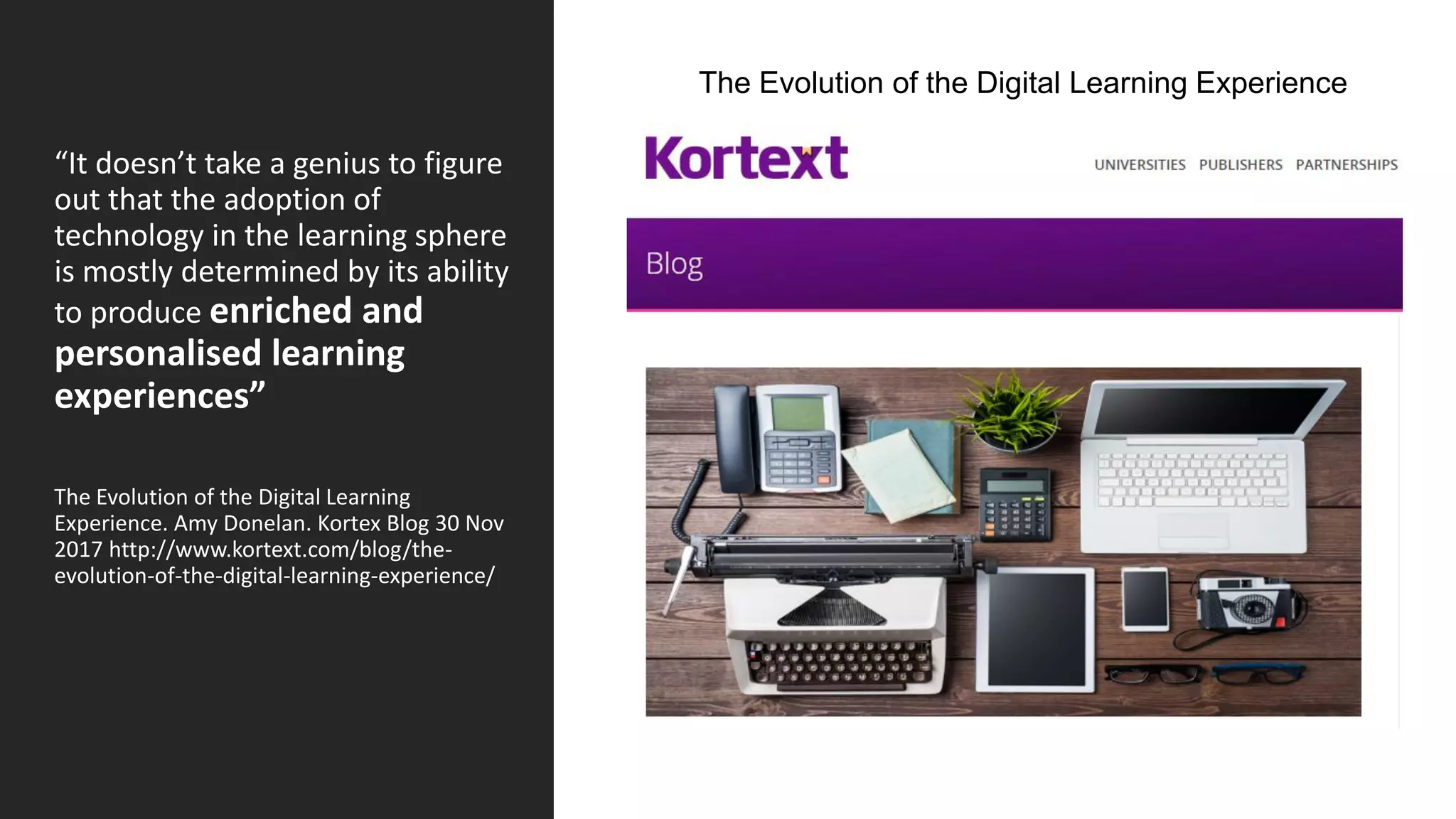
“It doesn’t take a genius to figure
out that the adoption of
technology in the learning sphere
is mostly determined by its ability
to produce enriched and
personalised learning
experiences”
The Evolution of the Digital Learning
Experience. Amy Donelan. Kortex Blog 30 Nov
2017 http://www.kortext.com/blog/the-
evolution-of-the-digital-learning-experience/
The Evolution of the Digital Learning Experience
Digital learning -
engaging with the
resources
“what these texts also offer students is the
opportunity to increase their engagement with
the material and work in a collaborative way
with their lecturers and peers. ..devices allow
students to be constantly connected to their
friends; sharing ideas and messages between
one another.
Digital learning resources allow students to
create working groups, in which they can share
notes between themselves and with their
lecturers.
By empowering students to access their
materials in a flexible, responsive way,
lecturers may get more out of the sessions
they provide with a classroom that is better
engaged with the course materials.”
Widening student participation through technology. John Donovan Research Information 20
November 2017
Lecture capture
Many universities now mandate or
strongly encourage the recording of all
lectures in rooms where this is enabled.
By September 2015, 42,000 lectures had
been recorded (80 per cent of the total
lectures taking place) at the University
of Manchester, and 95 per cent of
students surveyed wanted to see the
system used even more widely
Rebooting learning for the digital age: What next for
technology enhanced higher education?
Higher Education Policy Institute. HEPI Report 93 February 2017 ISBN
978-1-908240-24-8 http://www.hepi.ac.uk/wp-
content/uploads/2017/02/Hepi_Rebooting
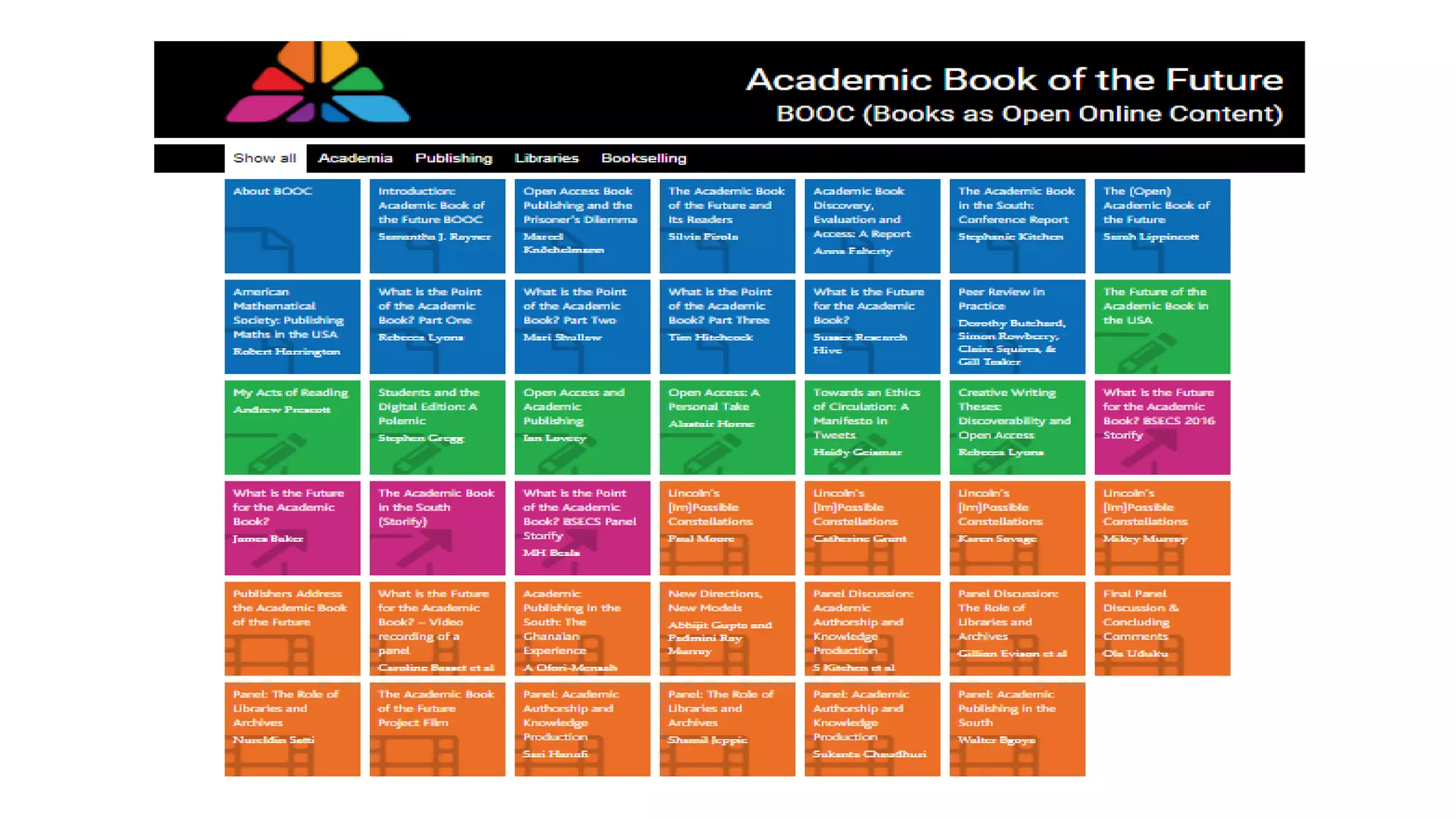
The BOOC
Books as Open Online Content (BOOC)
“These innovative ‘living books’ feature
articles of various types, in a non-linear
thematic presentation that offers
readers the option to select and sort
subjects they wish to read. With long
and short articles, blogs, videos, audio
and Storifys, these ‘books’ grow over a
period of time.” UCL Press
Focus on Ux
Students’ studies have become
inextricably linked to personal
technology, just like every other
aspect of their lives. They conduct
much of their research, and complete
their assignments, on computers,
tablets and smartphones, which
means there is value in
providing students with digital
materials that fully integrate
into the tools they already use
The Death of Textbook Publishing & the Future of College
Course Content. By Philip Preville Top Hat [White Paper].
2017? https://tophat.com/ebooks/death-textbook-publishing-
future-college-course-content
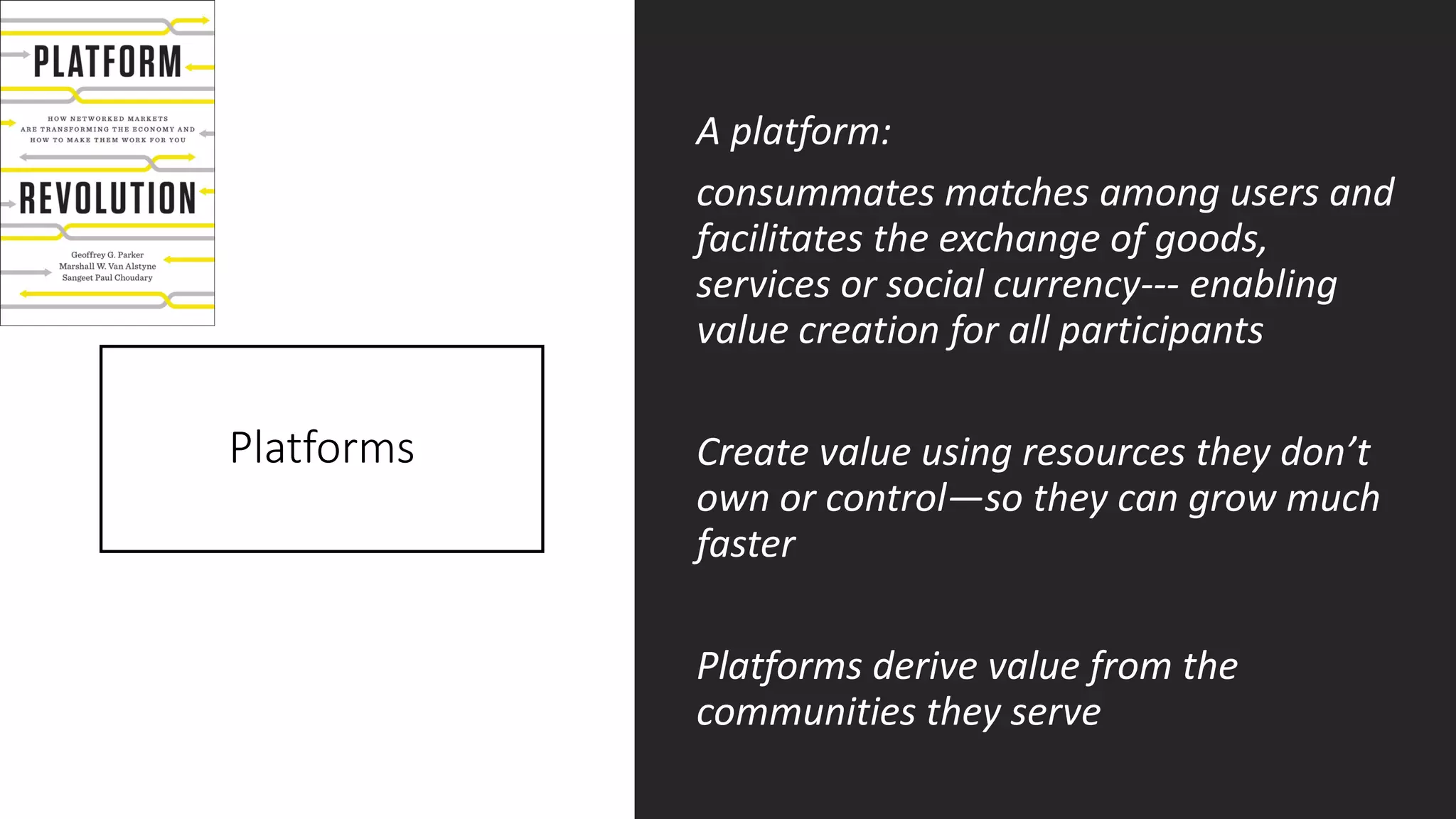
Platforms
A platform:
consummates matches among users and
facilitates the exchange of goods,
services or social currency--- enabling
value creation for all participants
Create value using resources they don’t
own or control—so they can grow much
faster
Platforms derive value from the
communities they serve
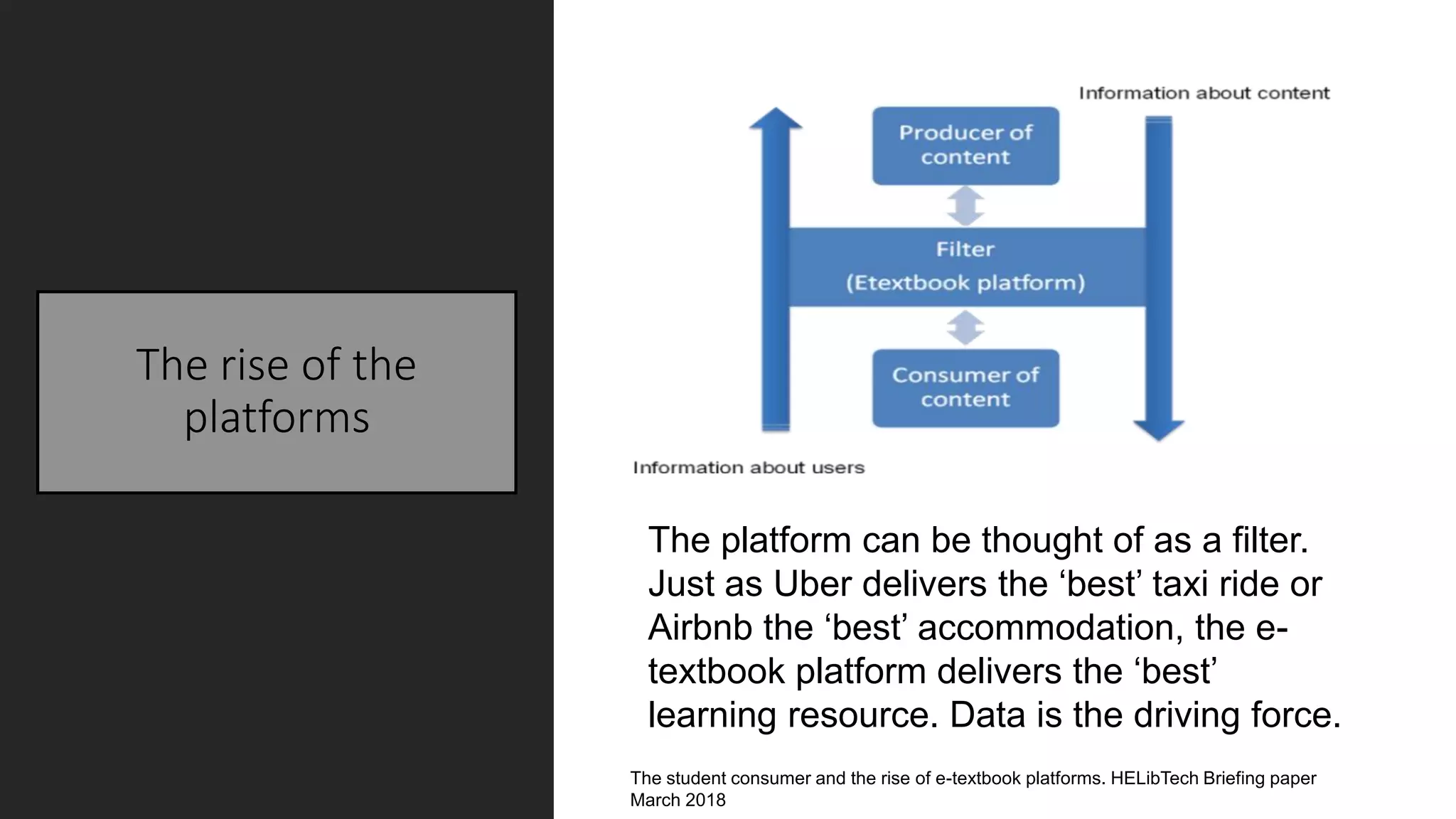
The rise of the
platforms
The platform can be thought of as a filter.
Just as Uber delivers the „best‟ taxi ride or
Airbnb the „best‟ accommodation, the e-
textbook platform delivers the „best‟
learning resource. Data is the driving force.
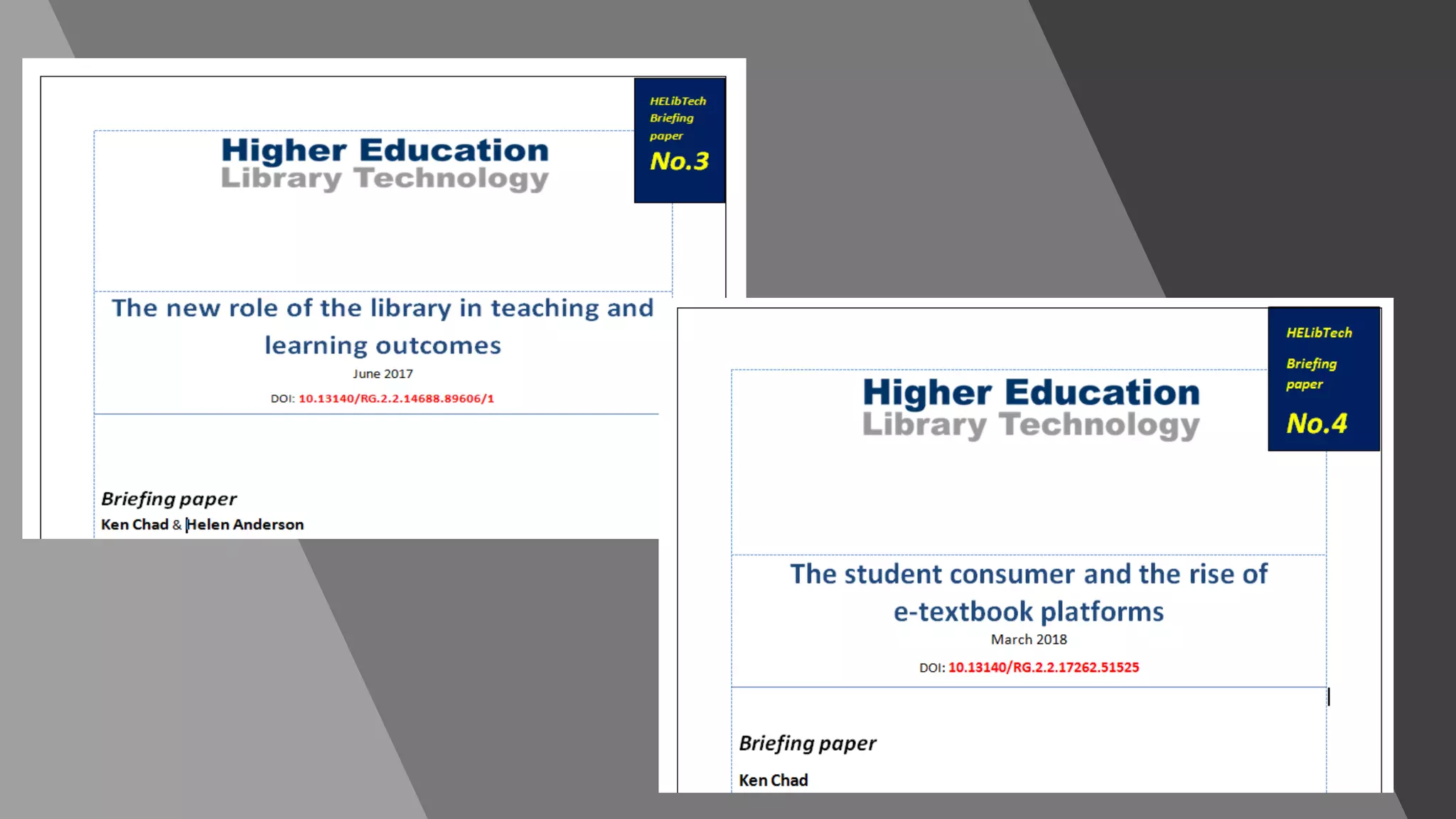
The student consumer and the rise of e-textbook platforms. HELibTech Briefing paper
March 2018
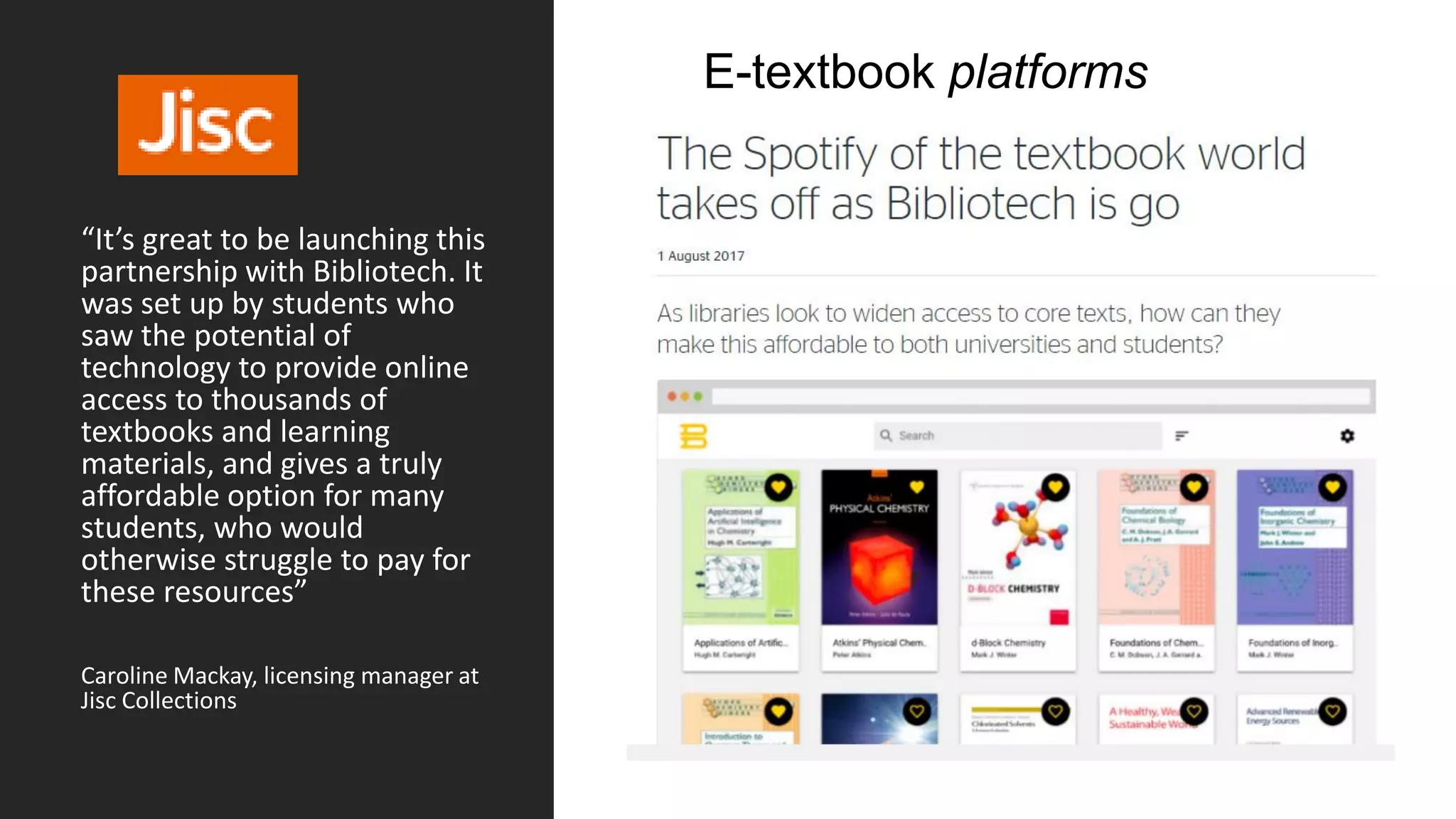
“It’s great to be launching this
partnership with Bibliotech. It
was set up by students who
saw the potential of
technology to provide online
access to thousands of
textbooks and learning
materials, and gives a truly
affordable option for many
students, who would
otherwise struggle to pay for
these resources”
Caroline Mackay, licensing manager at
Jisc Collections
E-textbook platforms
Final thoughts
Library vs. learning
resources?
As part of strengthening their value
proposition we expect to see more
libraries take a holistic view of the
management, discovery and
delivery of a wide range of learning
resources. At the moment many
valuable resources stand apart from
the conventional library collection
The new role of the library in teaching and learning outcomes. By Ken
Chad & Helen Anderson. Higher Education Library Technology
(HELibTech) briefing paper (No. 3). June 2017
Aligning resources to
courses
“our resource list management
service ensures that learning
resources are aligned with
academic courses”
Nottingham Trent University
TEF 2 Year Provider Submission
Reading/resource lists
By “investing our efforts into
developing a genuinely effective,
interactive and responsive reading
list system” librarians at the
University of Birmingham are
aiming to “transform the
teaching and learning
experience for students and
academics”.
Transforming student learning through ResourceLists@Bham.
Polly Harper & Ann-Marie James. SCONUL Focus. 2017
https://www.sconul.ac.uk/sites/default/files/documents/13_2
0.pdf
Reading/resource
lists-disaggregated
content
“By allowing digitised copies of
chapters...to be uploaded and
automatically copyright-checked –
academics are saved a lot of
administration time and can focus
their energies instead on choosing
the right resources for their list.
Most importantly, though, items
that would have ordinarily been
restricted to print-only access can
be made available. For distance
learners especially, this is
transformational”.
Transforming student learning through ResourceLists@Bham. Polly
Harper & Ann-Marie James. SCONUL Focus. 2017
https://www.sconul.ac.uk/sites/default/files/documents/13_20.pdf
LibTech & EdTech
‘All this suggests a trend for library
technology and educational
technology to merge. We will
certainly see reading list systems,
VLEs and digital textbook platforms
better integrated and perhaps even
subsumed into common learning
services platforms. ‘
The new role of the library in teaching and learning outcomes. By
Ken Chad & Helen Anderson. Higher Education Library
Technology (HELibTech) briefing paper (No. 3). June 2017
Data helps makes a
difference
Nottingham Trent University
Student Dashboard
Nottingham Trent’s learning analytics
initiative is designed to ‘increase retention,
improve attainment and increase belonging
within the course community’
Engagement scores for each student are
calculated from Virtual Learning
Environment (VLE) access, library usage,
card swipes and assignment submissions
Data to predictive
analytics
Such approaches aren’t just about
improving retention and graduation rates,
nor are they for those institutions that
suffer from low rates, but they represent an
opportunity to improve the overall
student experience.
Students deserve more personalised
learning in higher education. Predictive
analytics can help make learning and
support services more targeted, identifying
students according to their characteristics,
and understanding the risk of them
disengaging or dropping out
How analytics can support student success. Charles Prince
Wonkhe 26b April 2018 https://wonkhe.com/blogs/how-
analytics-can-support-student-success/
The battle for data
“We take in data from disparate
silos, unify and transform it to
derive new variables. Ninety-five
percent of the predictive power of
our Student Insights Engine and
action apps comes from derived
variables that inform more than
1,500 predictive models.”
https://www.civitaslearning.com/
The battle for data
The value of data analytics will surely
be a key driving force. Data from
reading lists and digital textbook
platforms combined with information
from other institutional systems on
student retention and academic
performance will produce powerful
insights. Such analytics will be
invaluable to institutions,
publishers and intermediaries
as they look at new ways to
deliver content.
The new role of the library in teaching and learning outcomes. By Ken
Chad & Helen Anderson. Higher Education Library Technology (HELibTech)
briefing paper (No. 3). June 2017
The revolution –will it
come?
“I think that it is past time for us to
take digital libraries to the next
level...But if this switch, from
individuals reading books and articles
one at a time in print to individuals
reading books and articles one at a
time on their own digital device is all
we get from the digital revolution,
then it won’t have been much of a
revolution”
Chris Bourg, Director of Libraries at
Massachusetts Institute of Technology
What happens to libraries and librarians when machines can read
all the books? Chris Bourg. Feral Librarian. [Blog] 16 March 2017
https://chrisbourg.wordpress.com/2017/03/16/what-happens-
to-libraries-and-librarians-when-machines-can-read-all-the-
books/
Focus on UX
Aside from affordability, neither
the UK Open Textbooks nor the
Jisc Institution as e-textbook
publisher initiatives has a strong
focus on the user experience.
Their stated goals are around
finding new business models for
e-book production.
The student consumer and the rise of e-textbook
platforms. Ken Chad Higher Education Library
Technology. March 2018
DOI: 10.13140/RG.2.2.17262.51525
Have we been trying to
solve the wrong
problem?
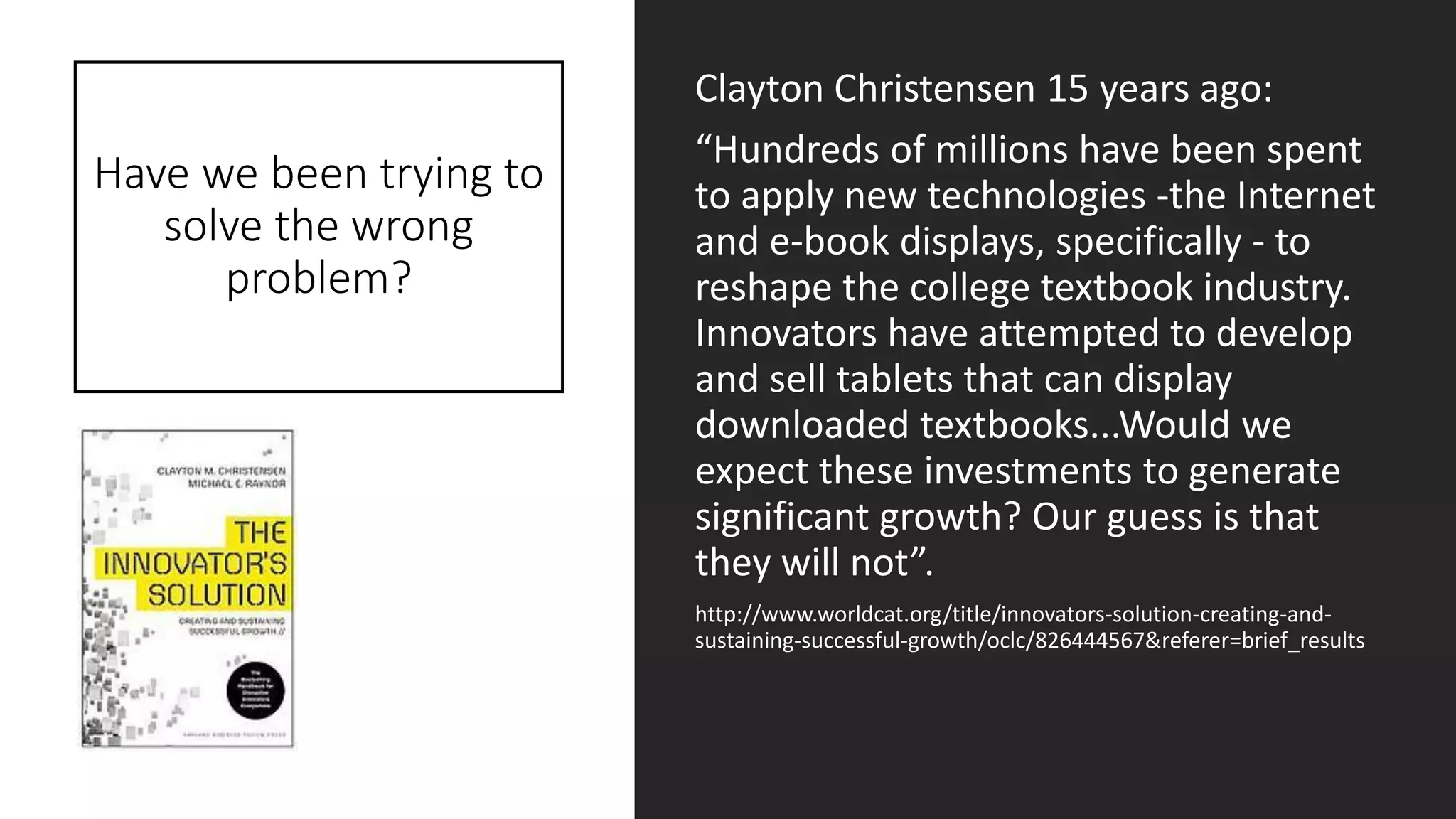
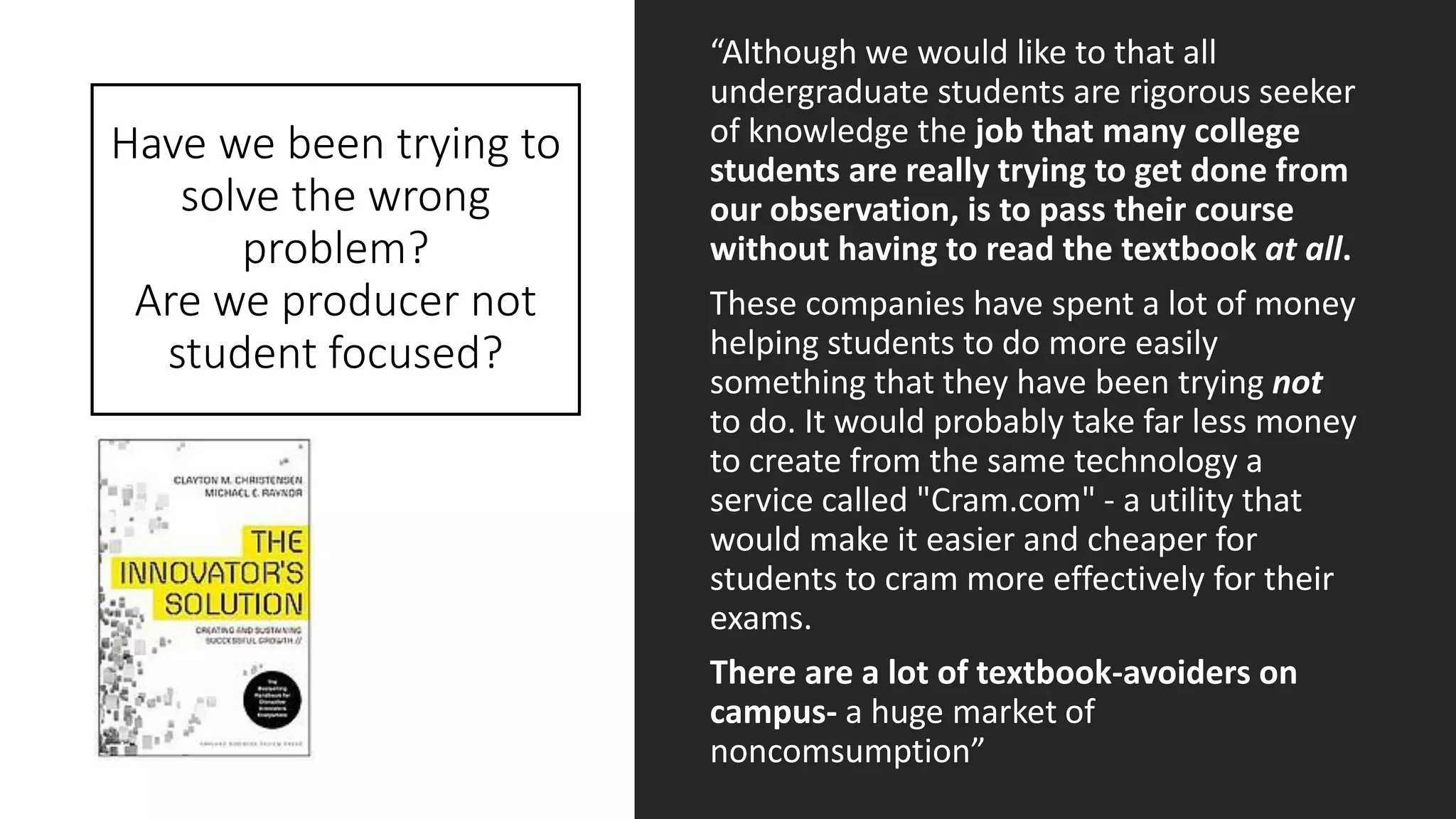
Clayton Christensen 15 years ago:
“Hundreds of millions have been spent
to apply new technologies -the Internet
and e-book displays, specifically - to
reshape the college textbook industry.
Innovators have attempted to develop
and sell tablets that can display
downloaded textbooks...Would we
expect these investments to generate
significant growth? Our guess is that
they will not”.
http://www.worldcat.org/title/innovators-solution-creating-and-
sustaining-successful-growth/oclc/826444567&referer=brief_results
Have we been trying to
solve the wrong
problem?
Are we producer not
student focused?
“Although we would like to that all
undergraduate students are rigorous seeker
of knowledge the job that many college
students are really trying to get done from
our observation, is to pass their course
without having to read the textbook at all.
These companies have spent a lot of money
helping students to do more easily
something that they have been trying not
to do. It would probably take far less money
to create from the same technology a
service called "Cram.com" - a utility that
would make it easier and cheaper for
students to cram more effectively for their
exams.
There are a lot of textbook-avoiders on
campus- a huge market of
noncomsumption”
Who will decide the
future?
[Publishers] are unlikely to be the
ones who decide what the future of
textbooks will look like. That
decision will get made by
students....and by faculty, who are
in the best position to know which
types of digital materials produce
the best learning outcomes
The Death of Textbook Publishing & the Future of College
Course Content. By Philip Preville Top Hat [White Paper]. 2017?
https://tophat.com/ebooks/death-textbook-publishing-future-
college-course-content
The student consumer and the rise of
e-textbook platforms
Digital Textbooks UCL 10th May 2018
Ken Chad
Ken Chad Consulting Ltd http://www.kenchadconsulting.com Tel: +44(0)7788727845
Twitter: @kenchad | Skype: kenchadconsulting |Linkedin: www.linkedin.com/in/kenchad
Researcher IDs:
• Orcid.org/0000-0001-5502-6898
• ResearchGate: https://www.researchgate.net/profile/Ken_Chad

Student consumer and the rsie of e-textbook platforms

  • 1.
    The student consumerand the rise of e-textbook platforms Digital Textbooks UCL 10th May 2018 Ken Chad Ken Chad Consulting Ltd http://www.kenchadconsulting.com Tel: +44(0)7788727845 Twitter: @kenchad | Skype: kenchadconsulting |Linkedin: www.linkedin.com/in/kenchad Researcher IDs: • Orcid.org/0000-0001-5502-6898 • ResearchGate: https://www.researchgate.net/profile/Ken_Chad
  • 2.
  • 4.
  • 5.
  • 6.
    Open “Educators, institutions, andeven state legislators are turning their attention toward Open Educational Resources (OER)” Bepress website: Open Educational Resources & Books https://www.bepress.com/products/digital- commons/features/open-educational-resources- books/
  • 7.
    Role of libraries “Studentstend to be more engaged with learning on the whole if they engage with library resources, interact with library staff, and spend time using libraries”. Australasian Survey of Student Engagement [AUSSE] 2012 Institution Report (p. 40-41)
  • 8.
    Excellence in teaching “The importanceof ‘high quality teaching’ in Higher Education (HE) is becoming increasingly emphasised both in the United Kingdom (UK) and abroad .....Excellence in teaching has become entrenched in higher education policy and in the educational strategies of academic institutions, and increasingly linked to the performance and assessment of these institutions” Higher Education Academy (HEA), 2016
  • 9.
    Finances Fees accounted formore than two- thirds of total income at 42 per cent of UK universities, while 22 institutions depended on fees for more than three-quarters of their income in 2015-16. The risks of this are obvious: a sudden drop in student demand, even spread over a few years, could be catastrophic: a peril highlighted by the strong correlation that now exists between changes in real- terms income for universities University financial health check 2017: future prospects? Simon Baker. Times Higher 17 August 2017 https://www.timeshighereducation.com/features/university- financial-health-check-2017-future-prospects
  • 10.
    Learning analytics “Every timea student interacts with their university – be that going to the library, logging into their virtual learning environment or submitting assessments online – they leave behind a digital footprint. Learning analytics is the process of using this data to improve learning and teaching” Learning analytics in higher education: A review of UK and international practice. Read our updated briefing on learning analytics and student success from January 2017. By Niall Sclater, Alice Peasgood & Joel Mullen. Jisc. 2016. https://www.jisc.ac.uk/reports/learning-analytics-in-higher- education
  • 11.
    The student consumer Thereis ‘growing evidence of just what poor value for money many universities are providing’, with students ‘cheated of the benefits they were repeatedly assured they could expect in return for their money’. ‘The producer interest reigns. The voice of the consumer, in other words the student, has not been taken greatly into consideration’. Timebomb: how the university cartel is failing Britain’s students. By Richard Tice and Tariq Al-Humaidhi.UK2020 Ltd. 2017. http://www.uk2020.org.uk/wp- content/uploads/2017/09/JRTI5635_UK_higher_education_tim ebomb_report_170830_WEB.pdf
  • 12.
    consumerization Consumerization is thereorientation of product and service designs around the individual end user. The emergence of the individual consumer as the primary driver of product and service design originated from and is most commonly seen as a major IT industry shift The primary impact of consumerization is that it is forcing businesses.. to rethink the way they procure and manage IT equipment and services. consumerization http://en.wikipedia.org/wiki/Consumerization
  • 13.
    Platforms are Eatingthe World We are in the midst of a seismic shift in business models, powered by the Internet and a generation of connected users. Outlook 2014: Platforms are Eating the World https://www.wired.com/insights/2013/12/outlook-2014- platforms-eating-world/
  • 14.
  • 15.
    Overcoming the “textbook taboo” “Ata time when it is increasingly necessary for libraries to find new ways of being mission-critical to their sponsoring institutions, this aversion to textbook provision seems to me increasingly self-defeating" Academic Libraries and the Textbook Taboo: Time to Get Over It? By Rick Anderson. The Scholarly Kitchen 7 July 2016 https://scholarlykitchen.sspnet.org/2016/07/07/acade mic-libraries-and-the-textbook-taboo-time-to-get-over- it
  • 16.
    Value of library providede-textbooks A library led e-textbook service leads to ‘higher engagement of learning from students, their increased satisfaction with the University and Library, plus addresses the issue of reducing their direct costs’. The direct library supply of individual textbooks to students: examining the value proposition. By Dominic Broadhurst. Information and Learning Science, vol 118, no. 11/12, pp. 629-641. 2017 DOI: 10.1108/ILS-07-2017-0072 http://man.ac.uk/VEpn4p
  • 17.
    Value for money? Areinstitutional/library e-textbook programmes good value?
  • 18.
    £2 million invested MiddlesexUniversity free books for everyone “Money was allocated by the University Executive. This was new money which had not previously been allocated either to Schools or the Library” “The Library is responsible for administering the project” UKSG webinar Q and A
  • 19.
    Where will the moneycome from? “Yes, we really, really, haven't got any money” Librarian messages to publishers.UKSG Presentation 2016https://docs.google.com/presentation/d/1suoalVA srH5HQ_s8YZkA6YcBa5aKJ_klSXw- debl_eU/edit#slide=id.p14
  • 20.
    Where will the moneycome from? Substantial funding is available in response to good value propositions
  • 21.
    Value of library resources? “Ifthere is a failure to demonstrate [the] value [of library] resources there is a risk of a lower institutional priority being placed on them and a resulting reduction in funding, with those core users being disadvantaged over time” TEF: what does it mean for academic libraries? By Maxine Melling and Margaret Weaver. Insights – 30(3), November 2017
  • 22.
    Teaching Excellence Framework £26 million “Thenew library will provide our students with a state-of-the-art, high- quality study environment” Stella Butler, Leeds University Librarian“Pedagogy is the driver for the changes in library design” Ann Rossiter, Director SCONUL
  • 23.
    Value Proposition “Additional capitalinvestment of £5.3m in the last three years has been focused on a complete refurbishment of the libraries .. and a new replacement library ... .... As a result, student use of library learning resources and facilities has significantly increased.” Nottingham Trent University TEF Submission
  • 24.
    Value Proposition “Our .....learningresources are acknowledged within both the HE sector and professional associations are being amongst the best in class.” Nottingham Trent University TEF 2 Year Provider Submission
  • 25.
    Open Textbooks haveseen impressive growth and impact in the North American context, through providers and initiatives such as OpenStax, the Open Textbook Network, BC Campus, and Lumen Learning. The UK Open Textbooks project aims to test the transferability of the OpenStax and OpenTextbook Network approaches to the UK context http://ukopentextbooks.org/ New ways of making textbooks
  • 26.
    New ways ofmaking textbooks “The advent of the TEF provides another incentive...to raise the topic of institutionally produced textbooks higher on the agenda” Lara Speicher, Publishing Manager, UCL Press The Challenge of Open Access Textbooks. Jisc [Blog] 9 May 2017. https://etextbook.jiscinvolve.org/wp/2017/05/09/the- challenge-of-open-access-textbooks/
  • 27.
    Institution as e-textbookpublisher “The fundamental question the project seeks to address is whether the institution as e-textbook creator will help students by making higher education more affordable, and promote a better, more sustainable information environment for libraries, students and faculty” Institution as e-textbook publisher. Investigating the viability of higher education institutions publishing their own e-textbooks. Jisc R&D project 2014-2018 https://www.jisc.ac.uk/rd/projects/institution-as-e-textbook- publisher Textbooks
  • 28.
  • 29.
    Library vs. learning resources? Thiswas said back in 2001! “There is a burgeoning area of overlap between the ‘learning resources’ which academics wish to install in their VLEs, and the digitised learning resources which libraries are making available" John McColl Virtuous learning environments: the library and the VLE. MacColl, J. Program: electronic library and information systems, 35(3): 227-239. 2001. https://research- repository.st-andrews.ac.uk/handle/10023/1825
  • 30.
    “It doesn’t takea genius to figure out that the adoption of technology in the learning sphere is mostly determined by its ability to produce enriched and personalised learning experiences” The Evolution of the Digital Learning Experience. Amy Donelan. Kortex Blog 30 Nov 2017 http://www.kortext.com/blog/the- evolution-of-the-digital-learning-experience/ The Evolution of the Digital Learning Experience
  • 31.
    Digital learning - engagingwith the resources “what these texts also offer students is the opportunity to increase their engagement with the material and work in a collaborative way with their lecturers and peers. ..devices allow students to be constantly connected to their friends; sharing ideas and messages between one another. Digital learning resources allow students to create working groups, in which they can share notes between themselves and with their lecturers. By empowering students to access their materials in a flexible, responsive way, lecturers may get more out of the sessions they provide with a classroom that is better engaged with the course materials.” Widening student participation through technology. John Donovan Research Information 20 November 2017
  • 32.
    Lecture capture Many universitiesnow mandate or strongly encourage the recording of all lectures in rooms where this is enabled. By September 2015, 42,000 lectures had been recorded (80 per cent of the total lectures taking place) at the University of Manchester, and 95 per cent of students surveyed wanted to see the system used even more widely Rebooting learning for the digital age: What next for technology enhanced higher education? Higher Education Policy Institute. HEPI Report 93 February 2017 ISBN 978-1-908240-24-8 http://www.hepi.ac.uk/wp- content/uploads/2017/02/Hepi_Rebooting
  • 33.
    The BOOC Books asOpen Online Content (BOOC) “These innovative ‘living books’ feature articles of various types, in a non-linear thematic presentation that offers readers the option to select and sort subjects they wish to read. With long and short articles, blogs, videos, audio and Storifys, these ‘books’ grow over a period of time.” UCL Press
  • 35.
    Focus on Ux Students’studies have become inextricably linked to personal technology, just like every other aspect of their lives. They conduct much of their research, and complete their assignments, on computers, tablets and smartphones, which means there is value in providing students with digital materials that fully integrate into the tools they already use The Death of Textbook Publishing & the Future of College Course Content. By Philip Preville Top Hat [White Paper]. 2017? https://tophat.com/ebooks/death-textbook-publishing- future-college-course-content
  • 36.
    Platforms A platform: consummates matchesamong users and facilitates the exchange of goods, services or social currency--- enabling value creation for all participants Create value using resources they don’t own or control—so they can grow much faster Platforms derive value from the communities they serve
  • 37.
    The rise ofthe platforms The platform can be thought of as a filter. Just as Uber delivers the „best‟ taxi ride or Airbnb the „best‟ accommodation, the e- textbook platform delivers the „best‟ learning resource. Data is the driving force. The student consumer and the rise of e-textbook platforms. HELibTech Briefing paper March 2018
  • 38.
    “It’s great tobe launching this partnership with Bibliotech. It was set up by students who saw the potential of technology to provide online access to thousands of textbooks and learning materials, and gives a truly affordable option for many students, who would otherwise struggle to pay for these resources” Caroline Mackay, licensing manager at Jisc Collections E-textbook platforms
  • 39.
  • 40.
    Library vs. learning resources? Aspart of strengthening their value proposition we expect to see more libraries take a holistic view of the management, discovery and delivery of a wide range of learning resources. At the moment many valuable resources stand apart from the conventional library collection The new role of the library in teaching and learning outcomes. By Ken Chad & Helen Anderson. Higher Education Library Technology (HELibTech) briefing paper (No. 3). June 2017
  • 41.
    Aligning resources to courses “ourresource list management service ensures that learning resources are aligned with academic courses” Nottingham Trent University TEF 2 Year Provider Submission
  • 42.
    Reading/resource lists By “investingour efforts into developing a genuinely effective, interactive and responsive reading list system” librarians at the University of Birmingham are aiming to “transform the teaching and learning experience for students and academics”. Transforming student learning through ResourceLists@Bham. Polly Harper & Ann-Marie James. SCONUL Focus. 2017 https://www.sconul.ac.uk/sites/default/files/documents/13_2 0.pdf
  • 43.
    Reading/resource lists-disaggregated content “By allowing digitisedcopies of chapters...to be uploaded and automatically copyright-checked – academics are saved a lot of administration time and can focus their energies instead on choosing the right resources for their list. Most importantly, though, items that would have ordinarily been restricted to print-only access can be made available. For distance learners especially, this is transformational”. Transforming student learning through ResourceLists@Bham. Polly Harper & Ann-Marie James. SCONUL Focus. 2017 https://www.sconul.ac.uk/sites/default/files/documents/13_20.pdf
  • 44.
    LibTech & EdTech ‘Allthis suggests a trend for library technology and educational technology to merge. We will certainly see reading list systems, VLEs and digital textbook platforms better integrated and perhaps even subsumed into common learning services platforms. ‘ The new role of the library in teaching and learning outcomes. By Ken Chad & Helen Anderson. Higher Education Library Technology (HELibTech) briefing paper (No. 3). June 2017
  • 45.
    Data helps makesa difference Nottingham Trent University Student Dashboard Nottingham Trent’s learning analytics initiative is designed to ‘increase retention, improve attainment and increase belonging within the course community’ Engagement scores for each student are calculated from Virtual Learning Environment (VLE) access, library usage, card swipes and assignment submissions
  • 46.
    Data to predictive analytics Suchapproaches aren’t just about improving retention and graduation rates, nor are they for those institutions that suffer from low rates, but they represent an opportunity to improve the overall student experience. Students deserve more personalised learning in higher education. Predictive analytics can help make learning and support services more targeted, identifying students according to their characteristics, and understanding the risk of them disengaging or dropping out How analytics can support student success. Charles Prince Wonkhe 26b April 2018 https://wonkhe.com/blogs/how- analytics-can-support-student-success/
  • 47.
    The battle fordata “We take in data from disparate silos, unify and transform it to derive new variables. Ninety-five percent of the predictive power of our Student Insights Engine and action apps comes from derived variables that inform more than 1,500 predictive models.” https://www.civitaslearning.com/
  • 48.
    The battle fordata The value of data analytics will surely be a key driving force. Data from reading lists and digital textbook platforms combined with information from other institutional systems on student retention and academic performance will produce powerful insights. Such analytics will be invaluable to institutions, publishers and intermediaries as they look at new ways to deliver content. The new role of the library in teaching and learning outcomes. By Ken Chad & Helen Anderson. Higher Education Library Technology (HELibTech) briefing paper (No. 3). June 2017
  • 49.
    The revolution –willit come? “I think that it is past time for us to take digital libraries to the next level...But if this switch, from individuals reading books and articles one at a time in print to individuals reading books and articles one at a time on their own digital device is all we get from the digital revolution, then it won’t have been much of a revolution” Chris Bourg, Director of Libraries at Massachusetts Institute of Technology What happens to libraries and librarians when machines can read all the books? Chris Bourg. Feral Librarian. [Blog] 16 March 2017 https://chrisbourg.wordpress.com/2017/03/16/what-happens- to-libraries-and-librarians-when-machines-can-read-all-the- books/
  • 50.
    Focus on UX Asidefrom affordability, neither the UK Open Textbooks nor the Jisc Institution as e-textbook publisher initiatives has a strong focus on the user experience. Their stated goals are around finding new business models for e-book production. The student consumer and the rise of e-textbook platforms. Ken Chad Higher Education Library Technology. March 2018 DOI: 10.13140/RG.2.2.17262.51525
  • 51.
    Have we beentrying to solve the wrong problem? Clayton Christensen 15 years ago: “Hundreds of millions have been spent to apply new technologies -the Internet and e-book displays, specifically - to reshape the college textbook industry. Innovators have attempted to develop and sell tablets that can display downloaded textbooks...Would we expect these investments to generate significant growth? Our guess is that they will not”. http://www.worldcat.org/title/innovators-solution-creating-and- sustaining-successful-growth/oclc/826444567&referer=brief_results
  • 52.
    Have we beentrying to solve the wrong problem? Are we producer not student focused? “Although we would like to that all undergraduate students are rigorous seeker of knowledge the job that many college students are really trying to get done from our observation, is to pass their course without having to read the textbook at all. These companies have spent a lot of money helping students to do more easily something that they have been trying not to do. It would probably take far less money to create from the same technology a service called "Cram.com" - a utility that would make it easier and cheaper for students to cram more effectively for their exams. There are a lot of textbook-avoiders on campus- a huge market of noncomsumption”
  • 53.
    Who will decidethe future? [Publishers] are unlikely to be the ones who decide what the future of textbooks will look like. That decision will get made by students....and by faculty, who are in the best position to know which types of digital materials produce the best learning outcomes The Death of Textbook Publishing & the Future of College Course Content. By Philip Preville Top Hat [White Paper]. 2017? https://tophat.com/ebooks/death-textbook-publishing-future- college-course-content
  • 54.
    The student consumerand the rise of e-textbook platforms Digital Textbooks UCL 10th May 2018 Ken Chad Ken Chad Consulting Ltd http://www.kenchadconsulting.com Tel: +44(0)7788727845 Twitter: @kenchad | Skype: kenchadconsulting |Linkedin: www.linkedin.com/in/kenchad Researcher IDs: • Orcid.org/0000-0001-5502-6898 • ResearchGate: https://www.researchgate.net/profile/Ken_Chad