Intellectual
Revolutions That
Defined Society
Science, Technology and Society
SCIENCE
• Science as an idea. It includes ideas, theories, and all available
systematic explanations and observations about the natural and
physical world.
• Science as an intellectual activity. It encompasses a systematic and
practical study of the natural and physical world. This process of study
involves systematic observation and experimentation.
• Science as a body of knowledge. It is a subject or a discipline, a field of
study, or about a body of knowledge that deals with the process of
learning about the natural and physical world. It is referred as the
school of science.
• Science as a personal and social activity. This explains that science is
both knowledge and activities done by human beings to develop better
understanding of the world, a way to improve and survive in life. It is
interwoven with people’s lives.
SCIENTIFIC REVOLUTION
• It took place during the 16th
and 17th
centuries
that started in Europe
• It refers to a period of significant transformation
in the way that people approached the
understanding of the natural world
• Characterized by a shift from traditional,
authority-based knowledge to empirical and
evidence-based scientific inquiry
• The change to the medieval idea of science occurred for four
reasons:
• Seventeenth century scientists and philosophers were able to
collaborate with members of the mathematical and astronomical
communities to effect advances in all fields.
• Scientists realized the inadequacy of medieval experimental
methods for their work and so felt the need to devise new methods
• Academics had access to a legacy of European, Greek, and
Middle Eastern scientific philosophy that they could use as a
starting point (either by disproving or building on the theorems).
• Institutions (for example, the British Royal Society) helped validate
science as a field by providing an outlet for the publication of
scientists’ work.
Nicolaus
Copernicus
Intellectual Revolutions That Defined Society
●Nicolaus Copernicus
●Polish astronomer
●Birth: February 19, 1473
●Death: May 24, 1543
●Place of Birth: Torun, Poland
Nicolaus Copernicus
Nicolaus Copernicus
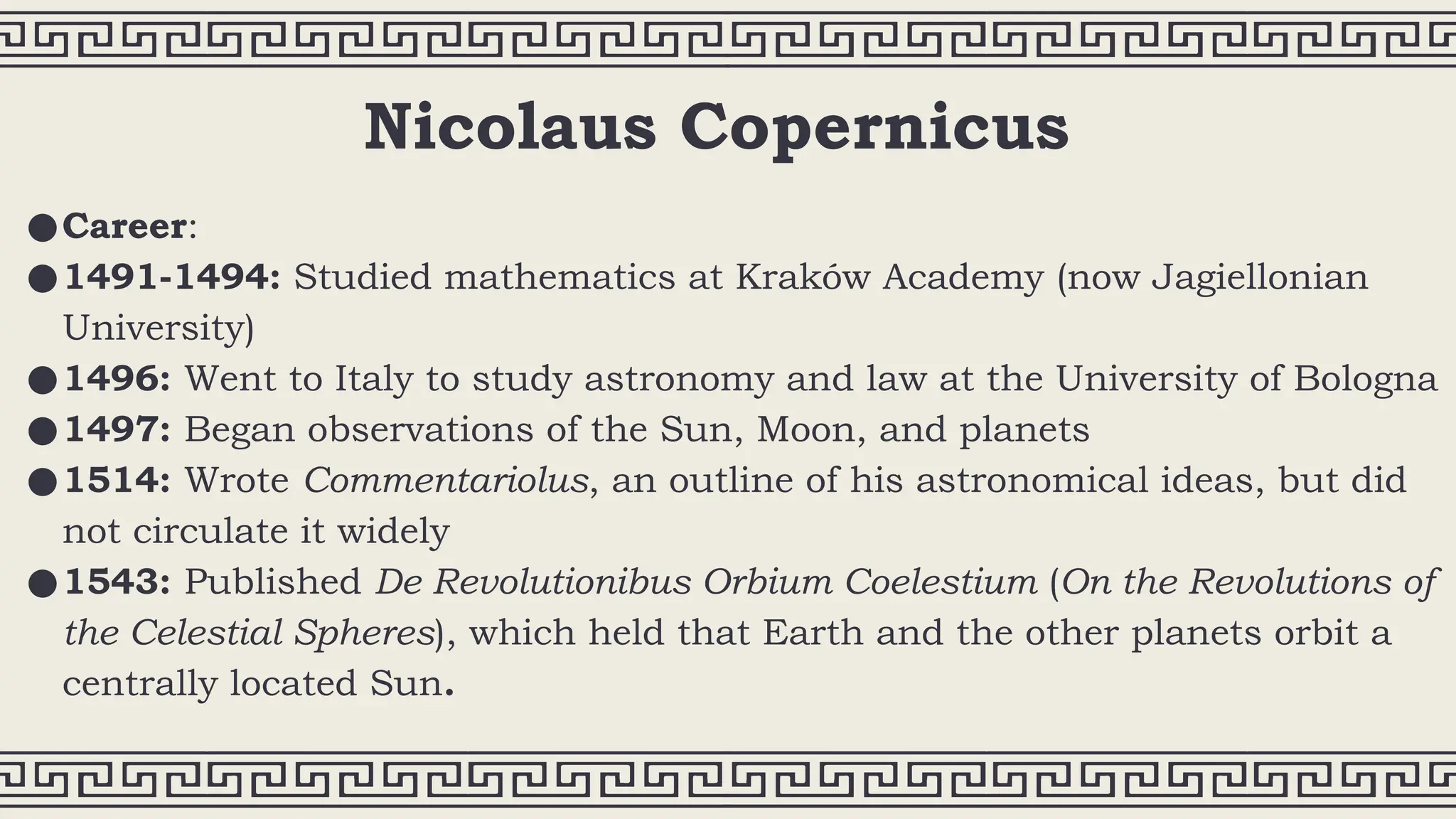
●Career:
●1491-1494: Studied mathematics at Kraków Academy (now Jagiellonian
University)
●1496: Went to Italy to study astronomy and law at the University of Bologna
●1497: Began observations of the Sun, Moon, and planets
●1514: Wrote Commentariolus, an outline of his astronomical ideas, but did
not circulate it widely
●1543: Published De Revolutionibus Orbium Coelestium (On the Revolutions of
the Celestial Spheres), which held that Earth and the other planets orbit a
centrally located Sun.
• Polish astronomer, renaissance polymath, and mathematician
known as the “Father of Modern Astronomy”
• Credited for laying the groundwork for the Scientific
Revolution
• In 1543 demonstrated that the earth was not the center of the
universe (Geocentric Model)
• Heliocentric Model, a theory that places the sun at the center of
the Solar System
Nicolaus Copernicus
The Copernican Model’s
stand against the
geocentric model includes:
a) the rotation of the
earth accounts for the
apparent daily rotation of
the stars, and;
The Copernican Model’s
stand against the
geocentric model
includes:
b) the apparent annual
cycle of the sun as
observed from earth is
due to the fact that
earth revolves around it.
Heliocentric plan of the Solar System
in the first edition of Copernicus’ De
Revolutionibus
1. Sun
2. Mercury
3. Venus
4. Earth
5. Mars
6. Jupiter
7. Saturn
8. Celestial sphere
Copernican System
● Before Copernican theory was accepted, astronomers believed that
Earth was stationary at the center of the solar system, and the Sun
and planets revolved around it.
● Copernicus was best known to his contemporaries as a doctor and
the Canon of Frauenburg Cathedral.
● Italian physicist and astronomer Galileo attempted to publicize
Copernican theory in the early 1600s, and was convicted of heresy
as a result.
● Copernican theory was not widely accepted until the late 17th
century—over 100 years after Copernicus's death.
● Copernicus's book, De Revolutionibus Orbium Coelestium, was
banned as heretical by the Catholic Church until 1835.
●Planetary Motions According to Copernicus
●A person moving at uniform speed is not necessarily aware of
his motion.
●Copernicus argued that the apparent annual motion of the
Sun about the Earth could be represented equally well by a
motion of the Earth about the Sun.
●The apparent rotation of the celestial sphere could also be
accounted for by assuming that the Earth rotates about a fix
axis while the celestial sphere is stationary.
●Planetary Motions According to Copernicus
●He deduced that the nearer a planet is to the Sun, the greater is its
orbital speed.
●The retrograde motions of the planets were easily understood
without the necessity for epicycles.
●He worked out the correct approximate scale of the Solar System.
●He resorted to using a number of epicycles in order to achieve the
accuracy he required in predicting the positions of the planets in the
sky.
●He maintained the concept of uniform circular motion in his theory.
●Planetary Motions According to Copernicus
●The heliocentric model did not prove that the
Earth revolves around the Sun.
●Ptolemaic model was clumsy, it lack the beauty
and symmetry of the Copernican model.
●In the Copernican model the Earth seems to be
no longer the central element of the universe.

STS_ Intellectual Revolution That Defined Society

  • 1.
  • 2.
    SCIENCE • Science asan idea. It includes ideas, theories, and all available systematic explanations and observations about the natural and physical world. • Science as an intellectual activity. It encompasses a systematic and practical study of the natural and physical world. This process of study involves systematic observation and experimentation. • Science as a body of knowledge. It is a subject or a discipline, a field of study, or about a body of knowledge that deals with the process of learning about the natural and physical world. It is referred as the school of science. • Science as a personal and social activity. This explains that science is both knowledge and activities done by human beings to develop better understanding of the world, a way to improve and survive in life. It is interwoven with people’s lives.
  • 3.
    SCIENTIFIC REVOLUTION • Ittook place during the 16th and 17th centuries that started in Europe • It refers to a period of significant transformation in the way that people approached the understanding of the natural world • Characterized by a shift from traditional, authority-based knowledge to empirical and evidence-based scientific inquiry
  • 4.
    • The changeto the medieval idea of science occurred for four reasons: • Seventeenth century scientists and philosophers were able to collaborate with members of the mathematical and astronomical communities to effect advances in all fields. • Scientists realized the inadequacy of medieval experimental methods for their work and so felt the need to devise new methods • Academics had access to a legacy of European, Greek, and Middle Eastern scientific philosophy that they could use as a starting point (either by disproving or building on the theorems). • Institutions (for example, the British Royal Society) helped validate science as a field by providing an outlet for the publication of scientists’ work.
  • 5.
  • 6.
    ●Nicolaus Copernicus ●Polish astronomer ●Birth:February 19, 1473 ●Death: May 24, 1543 ●Place of Birth: Torun, Poland Nicolaus Copernicus
  • 7.
    Nicolaus Copernicus ●Career: ●1491-1494: Studiedmathematics at Kraków Academy (now Jagiellonian University) ●1496: Went to Italy to study astronomy and law at the University of Bologna ●1497: Began observations of the Sun, Moon, and planets ●1514: Wrote Commentariolus, an outline of his astronomical ideas, but did not circulate it widely ●1543: Published De Revolutionibus Orbium Coelestium (On the Revolutions of the Celestial Spheres), which held that Earth and the other planets orbit a centrally located Sun.
  • 8.
    • Polish astronomer,renaissance polymath, and mathematician known as the “Father of Modern Astronomy” • Credited for laying the groundwork for the Scientific Revolution • In 1543 demonstrated that the earth was not the center of the universe (Geocentric Model) • Heliocentric Model, a theory that places the sun at the center of the Solar System Nicolaus Copernicus
  • 9.
    The Copernican Model’s standagainst the geocentric model includes: a) the rotation of the earth accounts for the apparent daily rotation of the stars, and;
  • 10.
    The Copernican Model’s standagainst the geocentric model includes: b) the apparent annual cycle of the sun as observed from earth is due to the fact that earth revolves around it.
  • 11.
    Heliocentric plan ofthe Solar System in the first edition of Copernicus’ De Revolutionibus 1. Sun 2. Mercury 3. Venus 4. Earth 5. Mars 6. Jupiter 7. Saturn 8. Celestial sphere
  • 12.
  • 13.
    ● Before Copernicantheory was accepted, astronomers believed that Earth was stationary at the center of the solar system, and the Sun and planets revolved around it. ● Copernicus was best known to his contemporaries as a doctor and the Canon of Frauenburg Cathedral. ● Italian physicist and astronomer Galileo attempted to publicize Copernican theory in the early 1600s, and was convicted of heresy as a result. ● Copernican theory was not widely accepted until the late 17th century—over 100 years after Copernicus's death. ● Copernicus's book, De Revolutionibus Orbium Coelestium, was banned as heretical by the Catholic Church until 1835.
  • 14.
    ●Planetary Motions Accordingto Copernicus ●A person moving at uniform speed is not necessarily aware of his motion. ●Copernicus argued that the apparent annual motion of the Sun about the Earth could be represented equally well by a motion of the Earth about the Sun. ●The apparent rotation of the celestial sphere could also be accounted for by assuming that the Earth rotates about a fix axis while the celestial sphere is stationary.
  • 15.
    ●Planetary Motions Accordingto Copernicus ●He deduced that the nearer a planet is to the Sun, the greater is its orbital speed. ●The retrograde motions of the planets were easily understood without the necessity for epicycles. ●He worked out the correct approximate scale of the Solar System. ●He resorted to using a number of epicycles in order to achieve the accuracy he required in predicting the positions of the planets in the sky. ●He maintained the concept of uniform circular motion in his theory.
  • 16.
    ●Planetary Motions Accordingto Copernicus ●The heliocentric model did not prove that the Earth revolves around the Sun. ●Ptolemaic model was clumsy, it lack the beauty and symmetry of the Copernican model. ●In the Copernican model the Earth seems to be no longer the central element of the universe.

Editor's Notes

  • #1 "Good [morning/afternoon], everyone. Today, we’ll dive into the life and contributions of Nicolaus Copernicus, a key figure in the intellectual revolutions that defined society. Through his groundbreaking work, he reshaped humanity’s understanding of the cosmos and set the stage for modern science. Let’s begin!"
  • #2 "Science plays a multifaceted role in our understanding of the world. Science can be understood in multiple dimensions, each highlighting a unique aspect of its nature and role in human life. First, science as an idea encompasses the theories, systematic explanations, and observations that aim to make sense of the natural and physical world. These ideas form the foundation of scientific understanding. Second, science as an intellectual activity involves the practical and systematic study of nature through observation and experimentation, emphasizing a methodical approach to discovery. Third, science as a body of knowledge refers to its role as a discipline or field of study, representing a comprehensive collection of information and learning processes about the natural and physical world, often associated with educational institutions. Finally, science as a personal and social activity reflects its integration into human life, both as knowledge and as actions taken to better understand the world. This aspect emphasizes its importance in addressing societal challenges, fostering innovation, and improving quality of life, demonstrating its interconnectedness with everyday human experiences.
  • #3 The Scientific Revolution was a pivotal period of transformation in how people understood and studied the natural world. Spanning the 16th and 17th centuries and originating in Europe, this era marked a departure from reliance on traditional, authority-based knowledge and a shift toward empirical observation and evidence-based scientific inquiry. It was characterized by groundbreaking advancements in various fields such as astronomy, physics, biology, and chemistry, as well as the development of new methods of experimentation and reasoning. This movement laid the foundation for modern science, emphasizing observation, experimentation, and the systematic questioning of established ideas.
  • #4 The transformation from the medieval understanding of science to a more modern approach in the seventeenth century can be attributed to several key factors. First, scientists and philosophers of the time collaborated closely with experts in mathematics and astronomy, which allowed for significant advances across various scientific disciplines. Second, they recognized the limitations of medieval experimental methods, which prompted the development of new, more rigorous methodologies better suited to their research. Third, scholars had access to an extensive intellectual heritage from European, Greek, and Middle Eastern scientific philosophy. This rich foundation provided material for scientists to refine, disprove, or expand upon existing theories. Finally, institutions like the British Royal Society played a crucial role in legitimizing science as a discipline by offering platforms for scientists to share and publish their work, fostering a culture of knowledge dissemination and peer review. Together, these factors marked a shift toward the systematic, empirical, and collaborative practices that define modern science.
  • #6 Nicolaus Copernicus, a renowned Polish astronomer, was born on February 19, 1473, in Torun, Poland, and passed away on May 24, 1543. He is best known for his revolutionary contributions to astronomy, particularly his heliocentric theory, which proposed that the Sun, rather than the Earth, is at the center of the solar system. This groundbreaking idea challenged the geocentric model that had dominated scientific thought for centuries and laid the foundation for modern astronomy. Copernicus's work profoundly influenced the Scientific Revolution, inspiring future scientists like Galileo and Kepler to explore and expand upon his theories.
  • #7 Nicolaus Copernicus had a distinguished career marked by significant contributions to the field of astronomy. Between 1491 and 1494, he studied mathematics at Kraków Academy, now known as Jagiellonian University, laying the groundwork for his future work in astronomy. In 1496, he traveled to Italy to study astronomy and law at the University of Bologna, where he deepened his understanding of the cosmos. By 1497, he had begun detailed observations of celestial bodies, including the Sun, Moon, and planets. Around 1514, he wrote Commentariolus, a preliminary outline of his revolutionary astronomical ideas, although he chose not to distribute it widely. His most significant work came in 1543 with the publication of De Revolutionibus Orbium Coelestium (On the Revolutions of the Celestial Spheres), which proposed a heliocentric model of the universe, asserting that the Earth and other planets revolve around the Sun. This work fundamentally transformed the field of astronomy and marked a turning point in the history of science.
  • #8 Nicolaus Copernicus, a Polish astronomer, Renaissance polymath, and mathematician, is often referred to as the "Father of Modern Astronomy." He is credited with laying the groundwork for the Scientific Revolution by challenging the long-held geocentric model, which placed Earth at the center of the universe. In 1543, Copernicus introduced his heliocentric model, which posited that the Sun is at the center of the Solar System and that Earth and other planets orbit around it. This revolutionary theory fundamentally altered humanity's understanding of the cosmos and set the stage for future scientific advancements. 4o
  • #9 Nicolaus Copernicus's heliocentric model directly challenged the geocentric model by offering a more accurate explanation of celestial phenomena. One of its key assertions was that the Earth's rotation on its axis accounts for the apparent daily rotation of the stars. This idea eliminated the need for complex mechanisms required by the geocentric model to explain the same observations, providing a simpler and more elegant explanation of the natural world. Copernicus's model marked a fundamental shift in understanding, emphasizing the dynamic nature of Earth and its position in the cosmos.
  • #10 The Copernican model challenged the geocentric model by explaining the apparent annual cycle of the Sun as observed from Earth. According to this heliocentric view, this phenomenon occurs because the Earth revolves around the Sun in its orbit. This explanation eliminated the need for complex epicycles and deferents that were central to the geocentric model, providing a simpler and more accurate account of the Sun's motion relative to Earth. This shift in perspective was a crucial element of the heliocentric theory, reinforcing the idea of Earth's dynamic role in the solar system.
  • #11 In the first edition of Copernicus' De Revolutionibus Orbium Coelestium, the heliocentric model of the Solar System is structured as follows: Sun – The central body around which all the planets orbit. Mercury – The planet closest to the Sun. Venus – The second planet from the Sun. Earth – The third planet from the Sun, where human life exists. Mars – The fourth planet from the Sun. Jupiter – The fifth planet from the Sun, significantly larger than Earth. Saturn – The sixth planet from the Sun, known for its prominent ring system. Celestial Sphere – The outermost boundary, representing the fixed stars, beyond which no known objects existed in Copernicus' model. This model was groundbreaking because it placed the Sun at the center of the Solar System, with the planets revolving around it, in contrast to the traditional geocentric model where Earth was at the center.
  • #13 Before the acceptance of Copernican theory, astronomers adhered to the geocentric model, which positioned Earth as a stationary body at the center of the universe, with the Sun and planets revolving around it. Copernicus, however, proposed a revolutionary heliocentric model, placing the Sun at the center of the solar system. Despite his groundbreaking ideas, Copernicus was better known during his lifetime as a doctor and as the Canon of Frauenburg Cathedral, rather than as a pioneering astronomer. In the early 1600s, Italian physicist and astronomer Galileo attempted to promote Copernican theory, using his telescope to gather supporting evidence, but he was convicted of heresy by the Catholic Church for advocating a model that contradicted religious teachings. Copernican theory did not gain widespread acceptance until the late 17th century, more than a century after Copernicus's death. Additionally, Copernicus's influential work, De Revolutionibus Orbium Coelestium, was banned by the Catholic Church as heretical and remained on the list of prohibited books until 1835, reflecting the resistance to his revolutionary ideas. 4o mini
  • #14 In his work, Copernicus proposed a new understanding of planetary motions that challenged the traditional geocentric model. He argued that a person moving at a uniform speed would not necessarily be aware of their motion, which helped him explain why the Earth’s motion around the Sun did not feel noticeable to observers. Copernicus suggested that the apparent annual motion of the Sun around the Earth could just as well be explained by the motion of the Earth orbiting the Sun, thus proposing a heliocentric model. Additionally, the apparent rotation of the celestial sphere, which was traditionally thought to be caused by the rotation of the heavens, could be explained by the Earth rotating on its own axis while the celestial sphere remained stationary. These ideas were revolutionary at the time, laying the foundation for the eventual acceptance of the heliocentric theory and fundamentally altering our understanding of the cosmos.
  • #15 Copernicus made several key observations about planetary motions that helped solidify his heliocentric theory. He deduced that the closer a planet is to the Sun, the faster it orbits, a principle now known as Kepler’s law of planetary motion. This understanding allowed him to explain the retrograde motions of planets—an apparent backward motion—without the need for the complicated system of epicycles used in the geocentric model. Copernicus also worked out a more accurate, though still approximate, scale of the Solar System, establishing the relative distances of the planets from the Sun. Despite his advances, Copernicus still used a number of epicycles in his model to achieve the required precision in predicting the positions of planets in the sky. Moreover, he maintained the concept of uniform circular motion, which was a deeply held belief in the astronomical traditions of the time, even though this assumption was later refined by scientists like Kepler. These contributions laid the groundwork for future developments in astronomy, even though Copernicus's model was not entirely free from the old paradigms.
  • #16 While the heliocentric model proposed by Copernicus did not directly prove that the Earth revolves around the Sun, it offered a more elegant and simpler explanation for the motions of the planets compared to the Ptolemaic geocentric model. The Ptolemaic system, with its complex network of epicycles and deferents to account for planetary motion, was seen as clumsy and overly complicated. In contrast, the Copernican model presented a more beautiful and symmetrical structure, where the Sun was placed at the center, with planets, including Earth, orbiting around it. One of the most profound implications of the Copernican model was the way it diminished Earth's perceived central importance in the universe. In the Ptolemaic system, Earth was the fixed center of all celestial motion, a concept deeply ingrained in human understanding. However, in Copernicus’s model, Earth was just one of several planets orbiting the Sun, leading to a more dynamic and less anthropocentric view of the cosmos. This shift was revolutionary, challenging both scientific thought and cultural beliefs of the time.