Famous scientists
STUDENT: HILOHI MIHAI-ADRIAN
OLARU CRISTINA-FLORENTINA
COORDINATING TEACHER: FRUMUȘELU MIHAI DANIEL
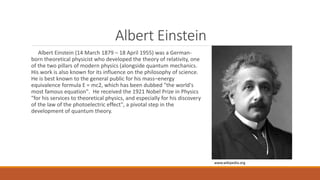
Albert Einstein
Albert Einstein (14 March 1879 – 18 April 1955) was a German-
born theoretical physicist who developed the theory of relativity, one
of the two pillars of modern physics (alongside quantum mechanics.
His work is also known for its influence on the philosophy of science.
He is best known to the general public for his mass–energy
equivalence formula E = mc2, which has been dubbed "the world's
most famous equation". He received the 1921 Nobel Prize in Physics
"for his services to theoretical physics, and especially for his discovery
of the law of the photoelectric effect", a pivotal step in the
development of quantum theory.
www.wikipedia.org
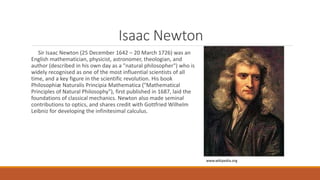
Isaac Newton
Sir Isaac Newton (25 December 1642 – 20 March 1726) was an
English mathematician, physicist, astronomer, theologian, and
author (described in his own day as a "natural philosopher") who is
widely recognised as one of the most influential scientists of all
time, and a key figure in the scientific revolution. His book
Philosophiæ Naturalis Principia Mathematica ("Mathematical
Principles of Natural Philosophy"), first published in 1687, laid the
foundations of classical mechanics. Newton also made seminal
contributions to optics, and shares credit with Gottfried Wilhelm
Leibniz for developing the infinitesimal calculus.
www.wikipedia.org
Galileo Galilei
Galileo Galilei (15 February 1564 – 8 January 1642) was
an Italian astronomer, physicist and engineer, sometimes
described as a polymath. Galileo has been called the "father
of observational astronomy", the "father of modern
physics", the "father of the scientific method", and the
"father of modern science".
Galileo studied speed and velocity, gravity and free fall,
the principle of relativity, inertia, projectile motion and also
worked in applied science and technology, describing the
properties of pendulums and "hydrostatic balances",
inventing the thermoscope and various military compasses,
and using the telescope for scientific observations of
celestial objects.
www.wikipedia.org
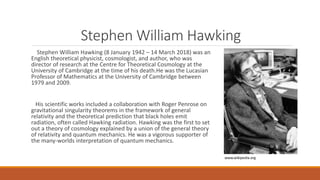
Stephen William Hawking
Stephen William Hawking (8 January 1942 – 14 March 2018) was an
English theoretical physicist, cosmologist, and author, who was
director of research at the Centre for Theoretical Cosmology at the
University of Cambridge at the time of his death.He was the Lucasian
Professor of Mathematics at the University of Cambridge between
1979 and 2009.
His scientific works included a collaboration with Roger Penrose on
gravitational singularity theorems in the framework of general
relativity and the theoretical prediction that black holes emit
radiation, often called Hawking radiation. Hawking was the first to set
out a theory of cosmology explained by a union of the general theory
of relativity and quantum mechanics. He was a vigorous supporter of
the many-worlds interpretation of quantum mechanics.
www.wikipedia.org
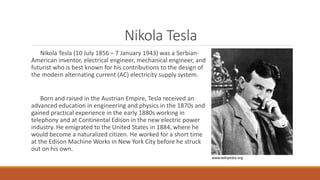
Nikola Tesla
Nikola Tesla (10 July 1856 – 7 January 1943) was a Serbian-
American inventor, electrical engineer, mechanical engineer, and
futurist who is best known for his contributions to the design of
the modern alternating current (AC) electricity supply system.
Born and raised in the Austrian Empire, Tesla received an
advanced education in engineering and physics in the 1870s and
gained practical experience in the early 1880s working in
telephony and at Continental Edison in the new electric power
industry. He emigrated to the United States in 1884, where he
would become a naturalized citizen. He worked for a short time
at the Edison Machine Works in New York City before he struck
out on his own.
www.wikipedia.org
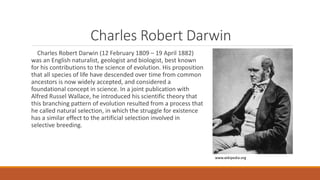
Charles Robert Darwin
Charles Robert Darwin (12 February 1809 – 19 April 1882)
was an English naturalist, geologist and biologist, best known
for his contributions to the science of evolution. His proposition
that all species of life have descended over time from common
ancestors is now widely accepted, and considered a
foundational concept in science. In a joint publication with
Alfred Russel Wallace, he introduced his scientific theory that
this branching pattern of evolution resulted from a process that
he called natural selection, in which the struggle for existence
has a similar effect to the artificial selection involved in
selective breeding.
www.wikipedia.org
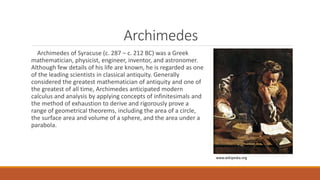
Archimedes
Archimedes of Syracuse (c. 287 – c. 212 BC) was a Greek
mathematician, physicist, engineer, inventor, and astronomer.
Although few details of his life are known, he is regarded as one
of the leading scientists in classical antiquity. Generally
considered the greatest mathematician of antiquity and one of
the greatest of all time, Archimedes anticipated modern
calculus and analysis by applying concepts of infinitesimals and
the method of exhaustion to derive and rigorously prove a
range of geometrical theorems, including the area of a circle,
the surface area and volume of a sphere, and the area under a
parabola.
www.wikipedia.org
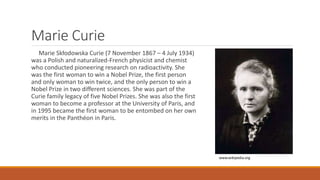
Marie Curie
Marie Skłodowska Curie (7 November 1867 – 4 July 1934)
was a Polish and naturalized-French physicist and chemist
who conducted pioneering research on radioactivity. She
was the first woman to win a Nobel Prize, the first person
and only woman to win twice, and the only person to win a
Nobel Prize in two different sciences. She was part of the
Curie family legacy of five Nobel Prizes. She was also the first
woman to become a professor at the University of Paris, and
in 1995 became the first woman to be entombed on her own
merits in the Panthéon in Paris.
www.wikipedia.org
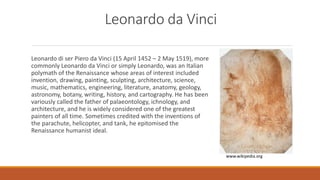
Leonardo da Vinci
Leonardo di ser Piero da Vinci (15 April 1452 – 2 May 1519), more
commonly Leonardo da Vinci or simply Leonardo, was an Italian
polymath of the Renaissance whose areas of interest included
invention, drawing, painting, sculpting, architecture, science,
music, mathematics, engineering, literature, anatomy, geology,
astronomy, botany, writing, history, and cartography. He has been
variously called the father of palaeontology, ichnology, and
architecture, and he is widely considered one of the greatest
painters of all time. Sometimes credited with the inventions of
the parachute, helicopter, and tank, he epitomised the
Renaissance humanist ideal.
www.wikipedia.org
Bibliografie:
https://en.wikipedia.org/wiki/Leonardo_da_Vinci
https://en.wikipedia.org/wiki/Stephen_Hawking
https://en.wikipedia.org/wiki/Isaac_Newton
https://en.wikipedia.org/wiki/Marie_Curie
https://en.wikipedia.org/wiki/Galileo_Galilei
https://en.wikipedia.org/wiki/Charles_Darwin
https://en.wikipedia.org/wiki/Nikola_Tesla
https://en.wikipedia.org/wiki/Albert_Einstein
https://en.wikipedia.org/wiki/Archimedes

Famous scientists

  • 1.
    Famous scientists STUDENT: HILOHIMIHAI-ADRIAN OLARU CRISTINA-FLORENTINA COORDINATING TEACHER: FRUMUȘELU MIHAI DANIEL
  • 2.
    Albert Einstein Albert Einstein(14 March 1879 – 18 April 1955) was a German- born theoretical physicist who developed the theory of relativity, one of the two pillars of modern physics (alongside quantum mechanics. His work is also known for its influence on the philosophy of science. He is best known to the general public for his mass–energy equivalence formula E = mc2, which has been dubbed "the world's most famous equation". He received the 1921 Nobel Prize in Physics "for his services to theoretical physics, and especially for his discovery of the law of the photoelectric effect", a pivotal step in the development of quantum theory. www.wikipedia.org
  • 3.
    Isaac Newton Sir IsaacNewton (25 December 1642 – 20 March 1726) was an English mathematician, physicist, astronomer, theologian, and author (described in his own day as a "natural philosopher") who is widely recognised as one of the most influential scientists of all time, and a key figure in the scientific revolution. His book Philosophiæ Naturalis Principia Mathematica ("Mathematical Principles of Natural Philosophy"), first published in 1687, laid the foundations of classical mechanics. Newton also made seminal contributions to optics, and shares credit with Gottfried Wilhelm Leibniz for developing the infinitesimal calculus. www.wikipedia.org
  • 4.
    Galileo Galilei Galileo Galilei(15 February 1564 – 8 January 1642) was an Italian astronomer, physicist and engineer, sometimes described as a polymath. Galileo has been called the "father of observational astronomy", the "father of modern physics", the "father of the scientific method", and the "father of modern science". Galileo studied speed and velocity, gravity and free fall, the principle of relativity, inertia, projectile motion and also worked in applied science and technology, describing the properties of pendulums and "hydrostatic balances", inventing the thermoscope and various military compasses, and using the telescope for scientific observations of celestial objects. www.wikipedia.org
  • 5.
    Stephen William Hawking StephenWilliam Hawking (8 January 1942 – 14 March 2018) was an English theoretical physicist, cosmologist, and author, who was director of research at the Centre for Theoretical Cosmology at the University of Cambridge at the time of his death.He was the Lucasian Professor of Mathematics at the University of Cambridge between 1979 and 2009. His scientific works included a collaboration with Roger Penrose on gravitational singularity theorems in the framework of general relativity and the theoretical prediction that black holes emit radiation, often called Hawking radiation. Hawking was the first to set out a theory of cosmology explained by a union of the general theory of relativity and quantum mechanics. He was a vigorous supporter of the many-worlds interpretation of quantum mechanics. www.wikipedia.org
  • 6.
    Nikola Tesla Nikola Tesla(10 July 1856 – 7 January 1943) was a Serbian- American inventor, electrical engineer, mechanical engineer, and futurist who is best known for his contributions to the design of the modern alternating current (AC) electricity supply system. Born and raised in the Austrian Empire, Tesla received an advanced education in engineering and physics in the 1870s and gained practical experience in the early 1880s working in telephony and at Continental Edison in the new electric power industry. He emigrated to the United States in 1884, where he would become a naturalized citizen. He worked for a short time at the Edison Machine Works in New York City before he struck out on his own. www.wikipedia.org
  • 7.
    Charles Robert Darwin CharlesRobert Darwin (12 February 1809 – 19 April 1882) was an English naturalist, geologist and biologist, best known for his contributions to the science of evolution. His proposition that all species of life have descended over time from common ancestors is now widely accepted, and considered a foundational concept in science. In a joint publication with Alfred Russel Wallace, he introduced his scientific theory that this branching pattern of evolution resulted from a process that he called natural selection, in which the struggle for existence has a similar effect to the artificial selection involved in selective breeding. www.wikipedia.org
  • 8.
    Archimedes Archimedes of Syracuse(c. 287 – c. 212 BC) was a Greek mathematician, physicist, engineer, inventor, and astronomer. Although few details of his life are known, he is regarded as one of the leading scientists in classical antiquity. Generally considered the greatest mathematician of antiquity and one of the greatest of all time, Archimedes anticipated modern calculus and analysis by applying concepts of infinitesimals and the method of exhaustion to derive and rigorously prove a range of geometrical theorems, including the area of a circle, the surface area and volume of a sphere, and the area under a parabola. www.wikipedia.org
  • 9.
    Marie Curie Marie SkłodowskaCurie (7 November 1867 – 4 July 1934) was a Polish and naturalized-French physicist and chemist who conducted pioneering research on radioactivity. She was the first woman to win a Nobel Prize, the first person and only woman to win twice, and the only person to win a Nobel Prize in two different sciences. She was part of the Curie family legacy of five Nobel Prizes. She was also the first woman to become a professor at the University of Paris, and in 1995 became the first woman to be entombed on her own merits in the Panthéon in Paris. www.wikipedia.org
  • 10.
    Leonardo da Vinci Leonardodi ser Piero da Vinci (15 April 1452 – 2 May 1519), more commonly Leonardo da Vinci or simply Leonardo, was an Italian polymath of the Renaissance whose areas of interest included invention, drawing, painting, sculpting, architecture, science, music, mathematics, engineering, literature, anatomy, geology, astronomy, botany, writing, history, and cartography. He has been variously called the father of palaeontology, ichnology, and architecture, and he is widely considered one of the greatest painters of all time. Sometimes credited with the inventions of the parachute, helicopter, and tank, he epitomised the Renaissance humanist ideal. www.wikipedia.org
  • 11.