SEd 325 - The Teaching of
Science (Teaching the
Specialized Field)
Dr. ERMA D. MAALIHAN
Comprehensive Exam Review
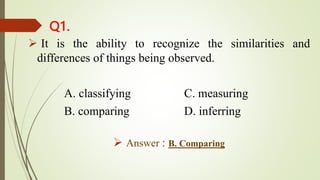
Q1.
 It is the ability to recognize the similarities and
differences of things being observed.
A. classifying C. measuring
B. comparing D. inferring
 Answer : B. Comparing
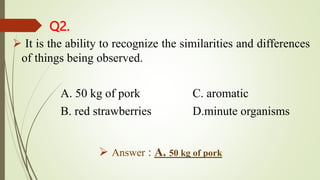
Q2.
 It is the ability to recognize the similarities and differences
of things being observed.
A. 50 kg of pork C. aromatic
B. red strawberries D.minute organisms
 Answer : A. 50 kg of pork
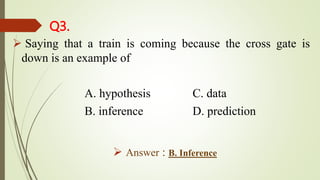
Q3.
 Saying that a train is coming because the cross gate is
down is an example of
A. hypothesis C. data
B. inference D. prediction
 Answer : B. Inference
Q4.
 You were assigned to demonstrate in a Science class for the division level training.
All the instructional materials were prepared to enhance classroom discussion.
Unfortunately, the power point presentation couldn’t be used since there was a
power shortage. What must you do?
A. Re-schedule the demo at another time.
B. Teach using the other resources in the school.
C. Request another teacher to take your place.
D. Tell your supervisor that you cannot teach without the said materials.
 Answer : B. Teach using the other resources in the school.
Q5.
 Each learner approaches the world in many ways” implies that the learner has different
ways of what he/she learns. It implies varied learning styles as well as teaching styles.
As a teacher, how would you apply this statement?
A. Review the contents of the lesson.
B. Master one strategy in teaching.
C. Make one standard lesson plan.
D. Provide various activities of learning.
 Answer : D. Provide various activities of learning.
Q6.
 Which of these are crucial skills for effective teaching?
I. Creation of new instructional materials
II. Classroom management
III. Higher order thinking skill
IV.Art of questioning
A. I, II, III, IV C. I and III
B. II and IV D. I and IV
 Answer : A. I, II, III, IV
Q7.
 A classroom strategy to help students to easily learn science
vocabulary.
A. science text cards C. graphic organizers
B. word games D.instructional conversations
 Answer : D.instructional conversations
Q8.
 In the light of the modern concept of teaching, which is a
characteristic of effective teaching?
A. Pouring information to the learners.
B. Allowing learners to learn on their own.
C. Developing abilities to address the future.
D. Removing the physical presence of the teacher.
 Answer : B. Allowing learners to learn on their own.
Q9.
 It is known as the best teaching method invented so far that
involves the active participation of students to experience
scientific concepts than to just have an audience view.
A. role play C. hands on learning
B.sports based learning D. science stations
 Answer : C. hands on learning
Q10.
 It is known as the best teaching method invented so far that involves the
active participation of students to experience scientific concepts than to just
have an audience view.
A. Allow sufficient “think time” at least 7- 10 seconds.
B. Extend wait-time until the student responds.
c. Immediately call another student in case one cannot answer.
D. You may answer your own question if no one can.
 Answer : A. Allow sufficient “think time” at least 7- 10 seconds.
Q11.
 You want your better students to overlearn what they have learned
and at the same time help others to master the lesson. Which
activity is best?
A. game C. peer tutoring
B. simulation D. practice
 Answer : C. peer tutoring
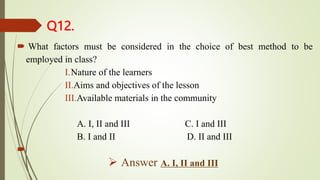
Q12.
 What factors must be considered in the choice of best method to be
employed in class?
I.Nature of the learners
II.Aims and objectives of the lesson
III.Available materials in the community
A. I, II and III C. I and III
B. I and II D. II and III

 Answer A. I, II and III
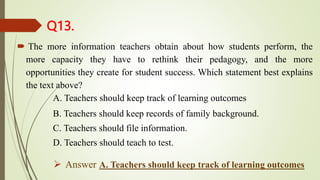
Q13.
 The more information teachers obtain about how students perform, the
more capacity they have to rethink their pedagogy, and the more
opportunities they create for student success. Which statement best explains
the text above?
A. Teachers should keep track of learning outcomes
B. Teachers should keep records of family background.
C. Teachers should file information.
D. Teachers should teach to test.
 Answer A. Teachers should keep track of learning outcomes
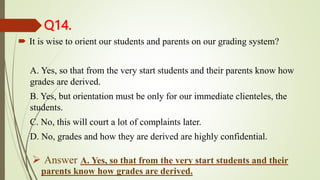
Q14.
 It is wise to orient our students and parents on our grading system?
A. Yes, so that from the very start students and their parents know how
grades are derived.
B. Yes, but orientation must be only for our immediate clienteles, the
students.
C. No, this will court a lot of complaints later.
D. No, grades and how they are derived are highly confidential.
 Answer A. Yes, so that from the very start students and their
parents know how grades are derived.
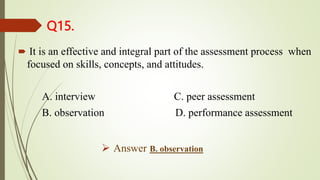
Q15.
 It is an effective and integral part of the assessment process when
focused on skills, concepts, and attitudes.
A. interview C. peer assessment
B. observation D. performance assessment
 Answer B. observation
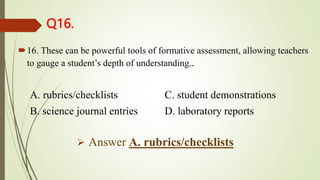
Q16.
16. These can be powerful tools of formative assessment, allowing teachers
to gauge a student’s depth of understanding..
A. rubrics/checklists C. student demonstrations
B. science journal entries D. laboratory reports
 Answer A. rubrics/checklists
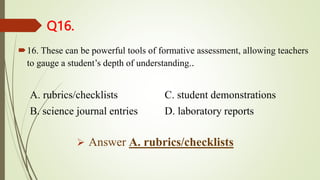
Q16.
16. These can be powerful tools of formative assessment, allowing teachers
to gauge a student’s depth of understanding..
A. rubrics/checklists C. student demonstrations
B. science journal entries D. laboratory reports
 Answer A. rubrics/checklists
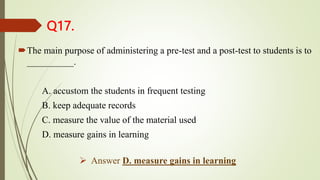
Q17.
The main purpose of administering a pre-test and a post-test to students is to
__________.
A. accustom the students in frequent testing
B. keep adequate records
C. measure the value of the material used
D. measure gains in learning
 Answer D. measure gains in learning
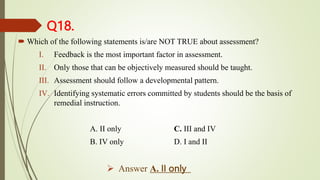
Q18.
 Which of the following statements is/are NOT TRUE about assessment?
I. Feedback is the most important factor in assessment.
II. Only those that can be objectively measured should be taught.
III. Assessment should follow a developmental pattern.
IV. Identifying systematic errors committed by students should be the basis of
remedial instruction.
A. II only C. III and IV
B. IV only D. I and II
 Answer A. II only
Q19.
Prof. Santos wants to determine students’ strengths and weaknesses in the use of
laboratory equipment. Which assessment procedure will be the most appropriate
and authentic?
A. Observation of students’ use of laboratory equipment while they conduct
experiments.
B. Paper-and-pencil test that requires students to enumerate the do’s and don't
s in the use of laboratory equipment.
C. Practicum test on the use of laboratory equipment.
D. Requiring students to draw and label the laboratory equipment.
 Answer A. Observation of students’ use of laboratory equipment
while they conduct experiments.
Q20.
To make the students get focused in the discussion, what must you do
especially if your students are unruly and noisy?
A. Employ innovative strategies.
B. Explore various means of giving sanctions.
C. Ignore the students who are misbehaving.
D. Refer the unruly and noisy pupils to the Guidance Office.
 Answer A. Employ innovative strategies.
Q21.
Which practice helps the teacher maximize time for instruction?
A. Employ a reactive approach to discipline.
B. Maximize discipline time.
C. Avoid classroom routine. They make your students robots
D. Minimize discipline time.
 Answer D. Minimize discipline time
Q22.
Suppose two of your students fought in class while the lesson was going on,
what would be your immediate response?
A. Take the two students immediately to the principal’s office.
B. Settle the issues immediately even if you have to stop the lesson.
C. Stop the fight and place the two boys in a corner.
D. Refer to the class who is the winner in the fight.
 Answer B. Settle the issues immediately even if you have to
stop the lesson.
Q23.
Which seating arrangement has been proven to be effective for learning?
A. Flexible to suit varied activities.
B. Fixed arrangement to maximize instructional time.
C. A combination of fixed and flexible arrangement.
D. Any seat arrangement to suit varied learning styles.
 Answer A . Flexible to suit varied activities.
Q24.
 As a teacher, one has to be properly dressed at all times in all occasions. This is part of
the personal classroom management of teachers. Why is this important?
I. Teachers must be role models.
II. Teachers must always be presentable
III. Teachers must look dignified at all times.
IV. Teachers are also models in observing proper dress code.
 A. I and II C. I, II, and III
B. I, II, III, and IV D. II and IV
 Answer B. I, II, III, and IV
Q25.
To create order and discipline in the class, various classroom management
techniques are employed by teachers. Which is a proactive technique?
A. Giving sanctions commensurate to the offense.
B. Reinforcing good work by giving praiseworthy comments.
C. Referring unruly behaviour only when necessary.
D. Writing reports/referrals only when all the possible means have been
explored.
 Answer B. Reinforcing good work by giving praiseworthy
comments.
Q26.
Science differs from other disciplines, such as history and the arts,
because science relies on ________.
A. facts C. observations
B. testing explanations D. theories
 Answer B. testing explanations
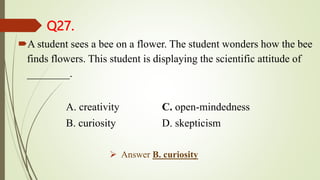
Q27.
A student sees a bee on a flower. The student wonders how the bee
finds flowers. This student is displaying the scientific attitude of
________.
A. creativity C. open-mindedness
B. curiosity D. skepticism
 Answer B. curiosity
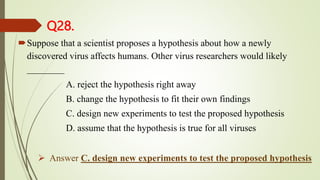
Q28.
Suppose that a scientist proposes a hypothesis about how a newly
discovered virus affects humans. Other virus researchers would likely
________
A. reject the hypothesis right away
B. change the hypothesis to fit their own findings
C. design new experiments to test the proposed hypothesis
D. assume that the hypothesis is true for all viruses
 Answer C. design new experiments to test the proposed hypothesis
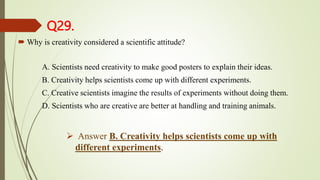
Q29.
 Why is creativity considered a scientific attitude?
A. Scientists need creativity to make good posters to explain their ideas.
B. Creativity helps scientists come up with different experiments.
C. Creative scientists imagine the results of experiments without doing them.
D. Scientists who are creative are better at handling and training animals.
 Answer B. Creativity helps scientists come up with
different experiments.
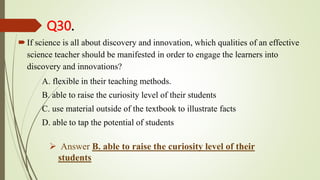
Q30.
If science is all about discovery and innovation, which qualities of an effective
science teacher should be manifested in order to engage the learners into
discovery and innovations?
A. flexible in their teaching methods.
B. able to raise the curiosity level of their students
C. use material outside of the textbook to illustrate facts
D. able to tap the potential of students
 Answer B. able to raise the curiosity level of their
students
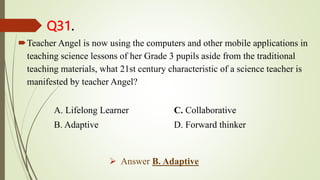
Q31.
Teacher Angel is now using the computers and other mobile applications in
teaching science lessons of her Grade 3 pupils aside from the traditional
teaching materials, what 21st century characteristic of a science teacher is
manifested by teacher Angel?
A. Lifelong Learner C. Collaborative
B. Adaptive D. Forward thinker
 Answer B. Adaptive
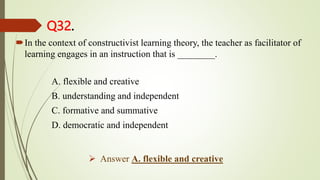
Q32.
In the context of constructivist learning theory, the teacher as facilitator of
learning engages in an instruction that is ________.
A. flexible and creative
B. understanding and independent
C. formative and summative
D. democratic and independent
 Answer A. flexible and creative
Q33.
Learning styles refer to the preferred way an individual processes
information. Classify a student who learns best through verbal lectures,
discussions, talking things through and listening to what others have to say.
He is a/an _________.
A. visual learner C. analytic learner
B. auditory learner D. global learner
 Answer B. auditory learner
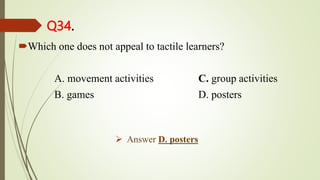
Q34.
Which one does not appeal to tactile learners?
A. movement activities C. group activities
B. games D. posters
 Answer D. posters
Q35.
Giving rewards is one way to motivate students to behave properly at all times.
What is the best positive reinforcement which can be employed?
A. Acknowledging the potential of each student
B. Giving medals for every good work done
C. Praising them for good work
D. Distributing tokens/materials for every best work
 Answer A. Acknowledging the potential of each student
Q36.
If you are a constructivist, what assumptions about learning and learner govern
your thinking?
A. For learners to learn, knowledge should be transmitted directly from
teachers to learners.
B. Learners are capable of constructing meaning of what is taught to them
C. Learners are empty receptacles waiting to be filled.
D. Teachers are the only source of knowledge.
 Answer A. For learners to learn, knowledge should be
transmitted directly from teachers to learners.
Q37.
According to research, persons learn best with what they
________.
A. smell and taste C. hear and touch
B. see and hear D. touch and taste
 Answer B. see and hear
Q38.
Studies in the area of neuroscience disclosed that the human brain has limitless
capacity. What does this imply?
A. Students can possibly reach a point where they have learned everything.
B. Every child is a potential genius.
C. Some students are admittedly not capable of learning.
D. Every pupil has his own native ability and his learning is limited to this
native ability.

 Answer B. Every child is a potential genius
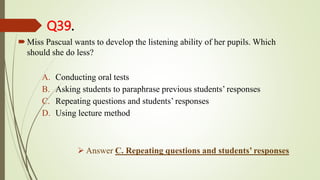
Q39.
Miss Pascual wants to develop the listening ability of her pupils. Which
should she do less?
A. Conducting oral tests
B. Asking students to paraphrase previous students’ responses
C. Repeating questions and students’ responses
D. Using lecture method
 Answer C. Repeating questions and students’ responses
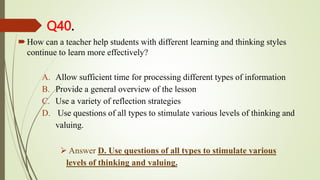
Q40.
How can a teacher help students with different learning and thinking styles
continue to learn more effectively?
A. Allow sufficient time for processing different types of information
B. Provide a general overview of the lesson
C. Use a variety of reflection strategies
D. Use questions of all types to stimulate various levels of thinking and
valuing.
 Answer D. Use questions of all types to stimulate various
levels of thinking and valuing.
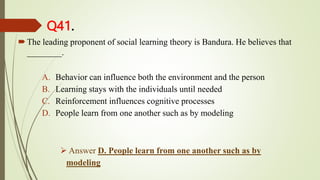
Q41.
The leading proponent of social learning theory is Bandura. He believes that
________.
A. Behavior can influence both the environment and the person
B. Learning stays with the individuals until needed
C. Reinforcement influences cognitive processes
D. People learn from one another such as by modeling
 Answer D. People learn from one another such as by
modeling
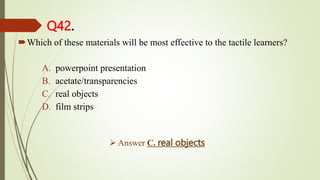
Q42.
Which of these materials will be most effective to the tactile learners?
A. powerpoint presentation
B. acetate/transparencies
C. real objects
D. film strips
 Answer C. real objects
Q43.
 Which appropriate teaching practice flows from this research finding on the brain:
The brain’s emotional center is tied into its ability to learn.
A. Create a learning environment that encourages students to explore their
feelings and ideas freely.
B. Come up with highly competitive games where winners will feel happy.
C. Tell students to participate in class activities or else they won’t receive
plus points in class recitation
D. To establish discipline be judgmental in attitude.

 Answer A .Create a learning environment that encourages
students to explore their feelings and ideas freely.
Q44.
 Which violates this brain-based principle of teaching-learning : “Each child’s brain
is unique and vastly different from one another”.
A. Giving ample opportunity for a student to explore even if the class creates
“noise”
B. Making a left-handed pupil write with his right hand as this is better
C. Allowing open dialogue among students
D. Employing MI teaching approaches
 Answer B . Making a left-handed pupil write with his right hand
as this is better
Q45.
What science learning theory sees learners that develop an
understanding of the importance of the problem, comprehend the
relevance of the topic, and construct knowledge through their
experiences?
A. Cognitivism
B. Constructivism
C. Behaviorism
D. Cognitive constructivism
 Answer D . Cognitive constructivism
Q46.
Its emphasis is on the process of learning and not on the product
A. social learning
B. experiential learning
C. discovery learning
D. reflective learning
 Answer B. experiential learning
Q47.
Audio-visual materials are given much importance in instruction as
support for teaching. In the use of these devices and instructional
materials the teacher should remember first that ________
A. illustrative materials are expensive
B. Devices should be colored and entertaining
C. Audio-visual devices are ends in themselves
D. No single device is effective in all types of learning
 Answer D . No single device is effective in all types of
learning
Q48.
In preparing instructional materials, what is the primary factor to be
considered?
A. the objectives of the lesson
B. the diversity of the learners
C. the methods and techniques
D. the technology available in the classroom
 Answer A. the objectives of the lesson
Q49.
Based on the contributions of the five senses to learning, which
instructional material will be most effective?
A. multisensory aid
B. Audio aid
C. Visual aid
D. audio visual aid
 Answer C. Visual aid
Q50.
Which should be used if you want to teach the human digestive system
in such a way that the pupils can manipulate the organs?
A. model of the digestive system
B. realia from medical schools
C. drawing of an artist
D. picture from medical references
 Answer D. picture from medical references
Thank You and God Bless!

SEd-325.pptx

  • 1.
    SEd 325 -The Teaching of Science (Teaching the Specialized Field) Dr. ERMA D. MAALIHAN Comprehensive Exam Review
  • 2.
    Q1.  It isthe ability to recognize the similarities and differences of things being observed. A. classifying C. measuring B. comparing D. inferring  Answer : B. Comparing
  • 3.
    Q2.  It isthe ability to recognize the similarities and differences of things being observed. A. 50 kg of pork C. aromatic B. red strawberries D.minute organisms  Answer : A. 50 kg of pork
  • 4.
    Q3.  Saying thata train is coming because the cross gate is down is an example of A. hypothesis C. data B. inference D. prediction  Answer : B. Inference
  • 5.
    Q4.  You wereassigned to demonstrate in a Science class for the division level training. All the instructional materials were prepared to enhance classroom discussion. Unfortunately, the power point presentation couldn’t be used since there was a power shortage. What must you do? A. Re-schedule the demo at another time. B. Teach using the other resources in the school. C. Request another teacher to take your place. D. Tell your supervisor that you cannot teach without the said materials.  Answer : B. Teach using the other resources in the school.
  • 6.
    Q5.  Each learnerapproaches the world in many ways” implies that the learner has different ways of what he/she learns. It implies varied learning styles as well as teaching styles. As a teacher, how would you apply this statement? A. Review the contents of the lesson. B. Master one strategy in teaching. C. Make one standard lesson plan. D. Provide various activities of learning.  Answer : D. Provide various activities of learning.
  • 7.
    Q6.  Which ofthese are crucial skills for effective teaching? I. Creation of new instructional materials II. Classroom management III. Higher order thinking skill IV.Art of questioning A. I, II, III, IV C. I and III B. II and IV D. I and IV  Answer : A. I, II, III, IV
  • 8.
    Q7.  A classroomstrategy to help students to easily learn science vocabulary. A. science text cards C. graphic organizers B. word games D.instructional conversations  Answer : D.instructional conversations
  • 9.
    Q8.  In thelight of the modern concept of teaching, which is a characteristic of effective teaching? A. Pouring information to the learners. B. Allowing learners to learn on their own. C. Developing abilities to address the future. D. Removing the physical presence of the teacher.  Answer : B. Allowing learners to learn on their own.
  • 10.
    Q9.  It isknown as the best teaching method invented so far that involves the active participation of students to experience scientific concepts than to just have an audience view. A. role play C. hands on learning B.sports based learning D. science stations  Answer : C. hands on learning
  • 11.
    Q10.  It isknown as the best teaching method invented so far that involves the active participation of students to experience scientific concepts than to just have an audience view. A. Allow sufficient “think time” at least 7- 10 seconds. B. Extend wait-time until the student responds. c. Immediately call another student in case one cannot answer. D. You may answer your own question if no one can.  Answer : A. Allow sufficient “think time” at least 7- 10 seconds.
  • 12.
    Q11.  You wantyour better students to overlearn what they have learned and at the same time help others to master the lesson. Which activity is best? A. game C. peer tutoring B. simulation D. practice  Answer : C. peer tutoring
  • 13.
    Q12.  What factorsmust be considered in the choice of best method to be employed in class? I.Nature of the learners II.Aims and objectives of the lesson III.Available materials in the community A. I, II and III C. I and III B. I and II D. II and III   Answer A. I, II and III
  • 14.
    Q13.  The moreinformation teachers obtain about how students perform, the more capacity they have to rethink their pedagogy, and the more opportunities they create for student success. Which statement best explains the text above? A. Teachers should keep track of learning outcomes B. Teachers should keep records of family background. C. Teachers should file information. D. Teachers should teach to test.  Answer A. Teachers should keep track of learning outcomes
  • 15.
    Q14.  It iswise to orient our students and parents on our grading system? A. Yes, so that from the very start students and their parents know how grades are derived. B. Yes, but orientation must be only for our immediate clienteles, the students. C. No, this will court a lot of complaints later. D. No, grades and how they are derived are highly confidential.  Answer A. Yes, so that from the very start students and their parents know how grades are derived.
  • 16.
    Q15.  It isan effective and integral part of the assessment process when focused on skills, concepts, and attitudes. A. interview C. peer assessment B. observation D. performance assessment  Answer B. observation
  • 17.
    Q16. 16. These canbe powerful tools of formative assessment, allowing teachers to gauge a student’s depth of understanding.. A. rubrics/checklists C. student demonstrations B. science journal entries D. laboratory reports  Answer A. rubrics/checklists
  • 18.
    Q16. 16. These canbe powerful tools of formative assessment, allowing teachers to gauge a student’s depth of understanding.. A. rubrics/checklists C. student demonstrations B. science journal entries D. laboratory reports  Answer A. rubrics/checklists
  • 19.
    Q17. The main purposeof administering a pre-test and a post-test to students is to __________. A. accustom the students in frequent testing B. keep adequate records C. measure the value of the material used D. measure gains in learning  Answer D. measure gains in learning
  • 20.
    Q18.  Which ofthe following statements is/are NOT TRUE about assessment? I. Feedback is the most important factor in assessment. II. Only those that can be objectively measured should be taught. III. Assessment should follow a developmental pattern. IV. Identifying systematic errors committed by students should be the basis of remedial instruction. A. II only C. III and IV B. IV only D. I and II  Answer A. II only
  • 21.
    Q19. Prof. Santos wantsto determine students’ strengths and weaknesses in the use of laboratory equipment. Which assessment procedure will be the most appropriate and authentic? A. Observation of students’ use of laboratory equipment while they conduct experiments. B. Paper-and-pencil test that requires students to enumerate the do’s and don't s in the use of laboratory equipment. C. Practicum test on the use of laboratory equipment. D. Requiring students to draw and label the laboratory equipment.  Answer A. Observation of students’ use of laboratory equipment while they conduct experiments.
  • 22.
    Q20. To make thestudents get focused in the discussion, what must you do especially if your students are unruly and noisy? A. Employ innovative strategies. B. Explore various means of giving sanctions. C. Ignore the students who are misbehaving. D. Refer the unruly and noisy pupils to the Guidance Office.  Answer A. Employ innovative strategies.
  • 23.
    Q21. Which practice helpsthe teacher maximize time for instruction? A. Employ a reactive approach to discipline. B. Maximize discipline time. C. Avoid classroom routine. They make your students robots D. Minimize discipline time.  Answer D. Minimize discipline time
  • 24.
    Q22. Suppose two ofyour students fought in class while the lesson was going on, what would be your immediate response? A. Take the two students immediately to the principal’s office. B. Settle the issues immediately even if you have to stop the lesson. C. Stop the fight and place the two boys in a corner. D. Refer to the class who is the winner in the fight.  Answer B. Settle the issues immediately even if you have to stop the lesson.
  • 25.
    Q23. Which seating arrangementhas been proven to be effective for learning? A. Flexible to suit varied activities. B. Fixed arrangement to maximize instructional time. C. A combination of fixed and flexible arrangement. D. Any seat arrangement to suit varied learning styles.  Answer A . Flexible to suit varied activities.
  • 26.
    Q24.  As ateacher, one has to be properly dressed at all times in all occasions. This is part of the personal classroom management of teachers. Why is this important? I. Teachers must be role models. II. Teachers must always be presentable III. Teachers must look dignified at all times. IV. Teachers are also models in observing proper dress code.  A. I and II C. I, II, and III B. I, II, III, and IV D. II and IV  Answer B. I, II, III, and IV
  • 27.
    Q25. To create orderand discipline in the class, various classroom management techniques are employed by teachers. Which is a proactive technique? A. Giving sanctions commensurate to the offense. B. Reinforcing good work by giving praiseworthy comments. C. Referring unruly behaviour only when necessary. D. Writing reports/referrals only when all the possible means have been explored.  Answer B. Reinforcing good work by giving praiseworthy comments.
  • 28.
    Q26. Science differs fromother disciplines, such as history and the arts, because science relies on ________. A. facts C. observations B. testing explanations D. theories  Answer B. testing explanations
  • 29.
    Q27. A student seesa bee on a flower. The student wonders how the bee finds flowers. This student is displaying the scientific attitude of ________. A. creativity C. open-mindedness B. curiosity D. skepticism  Answer B. curiosity
  • 30.
    Q28. Suppose that ascientist proposes a hypothesis about how a newly discovered virus affects humans. Other virus researchers would likely ________ A. reject the hypothesis right away B. change the hypothesis to fit their own findings C. design new experiments to test the proposed hypothesis D. assume that the hypothesis is true for all viruses  Answer C. design new experiments to test the proposed hypothesis
  • 31.
    Q29.  Why iscreativity considered a scientific attitude? A. Scientists need creativity to make good posters to explain their ideas. B. Creativity helps scientists come up with different experiments. C. Creative scientists imagine the results of experiments without doing them. D. Scientists who are creative are better at handling and training animals.  Answer B. Creativity helps scientists come up with different experiments.
  • 32.
    Q30. If science isall about discovery and innovation, which qualities of an effective science teacher should be manifested in order to engage the learners into discovery and innovations? A. flexible in their teaching methods. B. able to raise the curiosity level of their students C. use material outside of the textbook to illustrate facts D. able to tap the potential of students  Answer B. able to raise the curiosity level of their students
  • 33.
    Q31. Teacher Angel isnow using the computers and other mobile applications in teaching science lessons of her Grade 3 pupils aside from the traditional teaching materials, what 21st century characteristic of a science teacher is manifested by teacher Angel? A. Lifelong Learner C. Collaborative B. Adaptive D. Forward thinker  Answer B. Adaptive
  • 34.
    Q32. In the contextof constructivist learning theory, the teacher as facilitator of learning engages in an instruction that is ________. A. flexible and creative B. understanding and independent C. formative and summative D. democratic and independent  Answer A. flexible and creative
  • 35.
    Q33. Learning styles referto the preferred way an individual processes information. Classify a student who learns best through verbal lectures, discussions, talking things through and listening to what others have to say. He is a/an _________. A. visual learner C. analytic learner B. auditory learner D. global learner  Answer B. auditory learner
  • 36.
    Q34. Which one doesnot appeal to tactile learners? A. movement activities C. group activities B. games D. posters  Answer D. posters
  • 37.
    Q35. Giving rewards isone way to motivate students to behave properly at all times. What is the best positive reinforcement which can be employed? A. Acknowledging the potential of each student B. Giving medals for every good work done C. Praising them for good work D. Distributing tokens/materials for every best work  Answer A. Acknowledging the potential of each student
  • 38.
    Q36. If you area constructivist, what assumptions about learning and learner govern your thinking? A. For learners to learn, knowledge should be transmitted directly from teachers to learners. B. Learners are capable of constructing meaning of what is taught to them C. Learners are empty receptacles waiting to be filled. D. Teachers are the only source of knowledge.  Answer A. For learners to learn, knowledge should be transmitted directly from teachers to learners.
  • 39.
    Q37. According to research,persons learn best with what they ________. A. smell and taste C. hear and touch B. see and hear D. touch and taste  Answer B. see and hear
  • 40.
    Q38. Studies in thearea of neuroscience disclosed that the human brain has limitless capacity. What does this imply? A. Students can possibly reach a point where they have learned everything. B. Every child is a potential genius. C. Some students are admittedly not capable of learning. D. Every pupil has his own native ability and his learning is limited to this native ability.   Answer B. Every child is a potential genius
  • 41.
    Q39. Miss Pascual wantsto develop the listening ability of her pupils. Which should she do less? A. Conducting oral tests B. Asking students to paraphrase previous students’ responses C. Repeating questions and students’ responses D. Using lecture method  Answer C. Repeating questions and students’ responses
  • 42.
    Q40. How can ateacher help students with different learning and thinking styles continue to learn more effectively? A. Allow sufficient time for processing different types of information B. Provide a general overview of the lesson C. Use a variety of reflection strategies D. Use questions of all types to stimulate various levels of thinking and valuing.  Answer D. Use questions of all types to stimulate various levels of thinking and valuing.
  • 43.
    Q41. The leading proponentof social learning theory is Bandura. He believes that ________. A. Behavior can influence both the environment and the person B. Learning stays with the individuals until needed C. Reinforcement influences cognitive processes D. People learn from one another such as by modeling  Answer D. People learn from one another such as by modeling
  • 44.
    Q42. Which of thesematerials will be most effective to the tactile learners? A. powerpoint presentation B. acetate/transparencies C. real objects D. film strips  Answer C. real objects
  • 45.
    Q43.  Which appropriateteaching practice flows from this research finding on the brain: The brain’s emotional center is tied into its ability to learn. A. Create a learning environment that encourages students to explore their feelings and ideas freely. B. Come up with highly competitive games where winners will feel happy. C. Tell students to participate in class activities or else they won’t receive plus points in class recitation D. To establish discipline be judgmental in attitude.   Answer A .Create a learning environment that encourages students to explore their feelings and ideas freely.
  • 46.
    Q44.  Which violatesthis brain-based principle of teaching-learning : “Each child’s brain is unique and vastly different from one another”. A. Giving ample opportunity for a student to explore even if the class creates “noise” B. Making a left-handed pupil write with his right hand as this is better C. Allowing open dialogue among students D. Employing MI teaching approaches  Answer B . Making a left-handed pupil write with his right hand as this is better
  • 47.
    Q45. What science learningtheory sees learners that develop an understanding of the importance of the problem, comprehend the relevance of the topic, and construct knowledge through their experiences? A. Cognitivism B. Constructivism C. Behaviorism D. Cognitive constructivism  Answer D . Cognitive constructivism
  • 48.
    Q46. Its emphasis ison the process of learning and not on the product A. social learning B. experiential learning C. discovery learning D. reflective learning  Answer B. experiential learning
  • 49.
    Q47. Audio-visual materials aregiven much importance in instruction as support for teaching. In the use of these devices and instructional materials the teacher should remember first that ________ A. illustrative materials are expensive B. Devices should be colored and entertaining C. Audio-visual devices are ends in themselves D. No single device is effective in all types of learning  Answer D . No single device is effective in all types of learning
  • 50.
    Q48. In preparing instructionalmaterials, what is the primary factor to be considered? A. the objectives of the lesson B. the diversity of the learners C. the methods and techniques D. the technology available in the classroom  Answer A. the objectives of the lesson
  • 51.
    Q49. Based on thecontributions of the five senses to learning, which instructional material will be most effective? A. multisensory aid B. Audio aid C. Visual aid D. audio visual aid  Answer C. Visual aid
  • 52.
    Q50. Which should beused if you want to teach the human digestive system in such a way that the pupils can manipulate the organs? A. model of the digestive system B. realia from medical schools C. drawing of an artist D. picture from medical references  Answer D. picture from medical references
  • 53.
    Thank You andGod Bless!