Strikes S.2 (q)
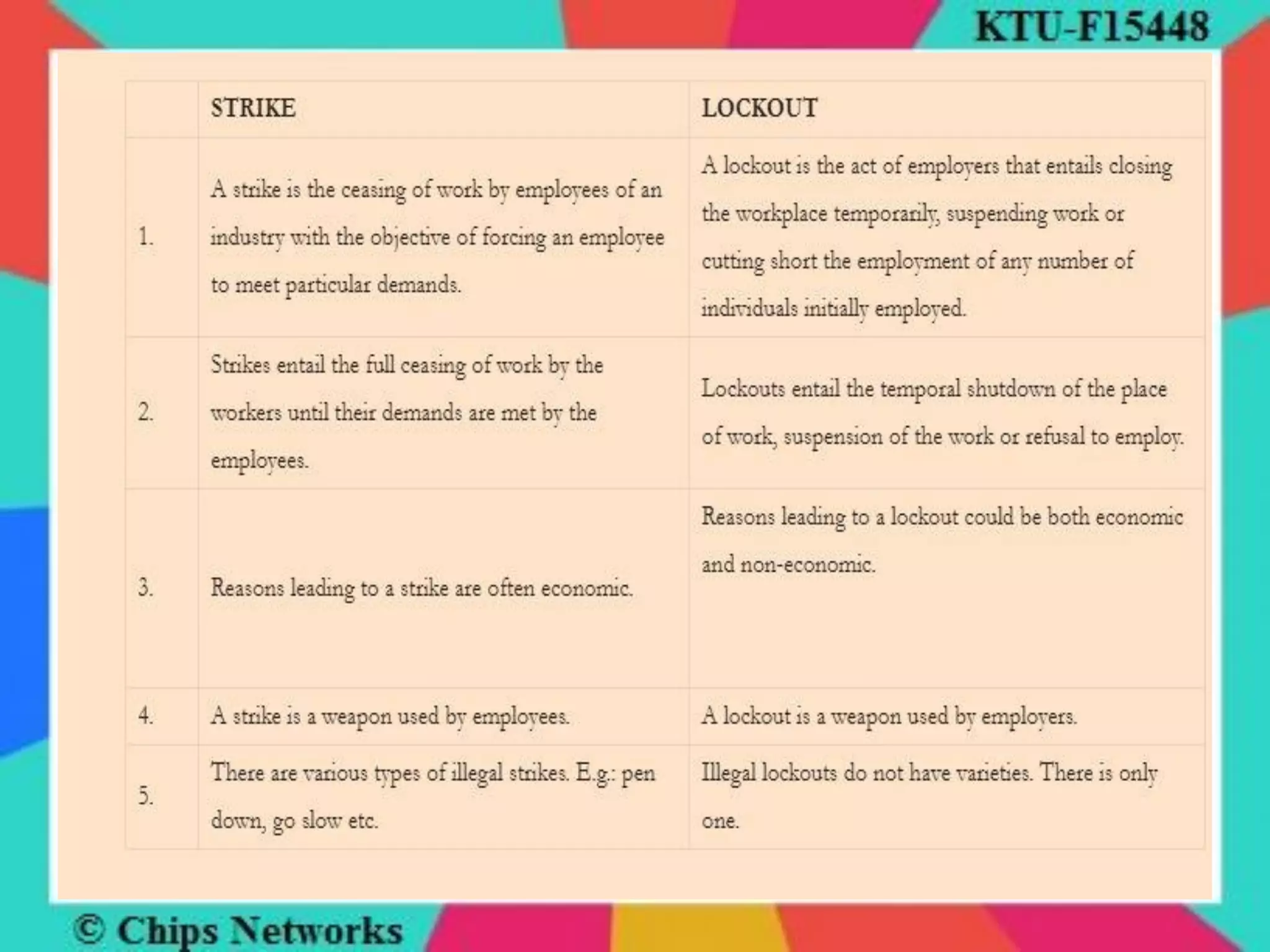
A strike is the ceasing of work by employees of an industry with an
objective of forcing an employee to meet particular demands. It is a
mutual understanding between workers to cease work or even
employment all with the motive of drawing the attention of the
management concerning their various demands.
In order for a strike to take place, the following components should
be in place according to the Act:
There has to be an industry.
Work must stop.
It must be a combined action of individuals..
A relationship between the parties must be strictly of
employment
It should be a planned refusal of work.
Lockouts S.2 (1)
A lockout is the act of employers that entails closing the
workplace temporarily, suspending work or cutting short
the employment of any number of individuals initially
employed. A lockout is a strategic weapon that
employers hold when in lock heads with the
employees.
.
A lockout has to have the following in order to be counted as a
lockout:
There has to be a temporal shut down of the area of
employment. It could also be a temporary suspension of
workers or holding back of work from the workers.
The employer has to have a demand that leads him to initiate
the lockout.
The lockout touches any number of workers employed with in
the industry.
On the- other hand, there are some actions that do not count as
lockouts. For instance:
When an employer stops late-comers from working on that day.
Preventing employees whose services have been ceased from
going to the place of work.
Types of strikes
Workers in the industrial world have resolved to
various types of strikes. The strikes differ in their mode
of actions they come along with. Some strikes produce
different impacts on the industry , though they all aim at
the same results
The various types of strikes include:
General Strike
Sit down Strike
Pen/Tool down Strike
Go-slow Strike
Go-speed Strike
General Strike
A General Strike is said to be a legal strike since it follows all the
protocols as stated in the Act of Industrial Disputes.,
Employees begin by giving a strike notice to the management of
the industry they work for. If the management fails to settle the
dispute within the given time in the strike notice, the strike will
be launched after the expiry of the notice. All trade unions linked
to the demand at hand participate in the General Strike.
Sit-down Strike
This kind of strike involves employees reporting for duty in their
workplaces normally; take their positions in their various areas
of work but here comes the game changer; they simply sit and do
nothing.
They might also choose to just hang around the industry's
premises. The objective of this strike is to cripple production.
The industry ends up incurring huge losses due to no work being
done at all.
It is also of great pain and shame to the employers, since the rate
of production is going down in the presence of workers who have
reported for duty to work which they eventually end up not
doing.
Pen/Tool down Strike
This type of strike shares some similarities with the sit down
strike.
For the pen down, it mostly takes place among people with white
collar jobs or rather people who work in offices. Tool down is for
workers in production industries like factories to be specific. This
type of strike qualifies to be a strike since the members drop down
their items of work in unison and refuse to work.
Go-slow Strike
The Go-slow Strike aimed at showing the employers how
offended the employees are. The employees report for duty as
usual and could even get to work but with only one distinction;
they don't actually do any thing productive. The delay in all that
they do and the outcome tums into little or no production at all.
"The unique thing about this strike is that at the end of the day, the
employees demand for their wages. This aspect makes the Go-slow
Strike the most harmful strike compared to the total dissertation
of work like in the General Strike. No production has been made
but the workers have to be paid because they are demanding for it
Go-speed Strike
It is not a common type of strike but it has also proven
to bear results. Unlike the Go-slow strike, the workers
of the industry give notice to the employers in advance
stating various demands that they have. They go ahead
to give a duration of time to the management to look
into those demands. By any chance; if the management
fails to meet the stated demands in the time given, the
workers resolve to a strike.
A kind of a strike that sees them work harder hence making a
greater level of production in the industry. The increase in
production is meant to channel their discontentment with the
management The unique strike sees the workers working on
overtime which in turn causes the employer to feel humiliated.
The overproduction brings about a problem in the distribution of
raw materials, storing and keeping stock of the finished and
unfinished products and so forth — generally causing an
economic collision. The employer is then forced to meet the
demands of the workers.
Boundaries of strikes:
Strikes are not allowed to take place when:
1. The employer has not given notice of the strike within six
weeks before commencing the strike; or
2. Before the end 14 days after giving the notice.
3. The duration of time stated in the notice has not expired.
4. The conciliation process before a Conciliation Officer is still
pending.
5. A duration of 7 days passes after the settling of the conciliation
proceedings.
Boundaries of lockouts:
Lockouts are not allowed to take place when:
1. The employer has not given prior notice about the lockout within six weeks
before the lockout; or
2. Before the end of 14 days after giving the notice.
3. The duration of time stated in the notice has not expired.
4. The conciliation process before a Conciliation Officer is still pending
5. A duration of 7 days passes after the settling of the conciliation
proceedings.
The notice of a lockout, however, shall not be necessary when
there is a strike already in progress.
Circumstances making strikes and lockouts illegal in an
industrial establishment (S. 23)
An employee working in an industrial establishment shall not go in
strike contrary to the agreements made in the contracts and no
employer of any such employee shall initiate a lockout when:
The conciliation process before the Board of Conciliation is still
pending and after 7 days since the settlement of the conciliation.
The conciliation before a Board is what is considered in this case
and not the conciliation before an Officer
The case before a Labour Court, National Tribunal or Industrial
Tribunal is pending and after 2 months since the settlement of such
a case.
The case of arbitration before an arbitrator is still pending and after
2 months since the closing of the case. A notification has to have
been issued.
A settlement or award is still operational in reference to any of the
issues under the settlement or award.
Circumstances under which strike or lockouts are not
illegal
When the strike or lockout in pursuit of an industrial dispute has
already begun and exist at the reference time of the conflict to a
Board, an arbitrator, a Labour Court and an Industrial or National
Tribunal. The strike or lockout shall therefore not be termed as
illegal given that they have not contravened the given statement of
this Act.
When a lockout has been initiated as a result of an
illegal strike or a strike initiated as a result of an
illegal lockout shall not be termed as illegal.
Consequences of illegal strikes and lockouts
Individuals who continue to run a strike or lockout contrary to the
law are subject to punishments and penalties in accordance to the
Act.
The consequences touch on both employers and employees.
An employee who initiates or continues to run a strike which has
been deemed as illegal by the Act is subject to the extent of one-
month imprisonment or a fine that may reaches up to fifty rupees or
both.
An employer who initiates or continues to run a strike
which has been deemed as illegal by the Act is subject to
the extent of one-month imprisonment or a fine that may
reaches up to one thousand rupees or both.
Public utility services
Section 2(n) declares certain types of industries to be permanently public
utility services
permanent public utility services [sn.2(n) (I TO v)]
I) Any rail/transport/air services/services in major ports or docks
II) Any section of an industry the working of which is essential for ensuring
safety of workmen employed.
III) Post/telegraph/telephone services
IV) Industries supplying power/light or water to public
V) Any system of public conservancy sanitation.
Public utility services
section 2n(vi) empowers the central/state governments to declare
any industry listed in schedule -i of the ID act as public utility
services
Such declarations by the appropriate government is valid for six
months from date of notification in gazette.
Government can extend the validity by renewing the declaration
at the end of each six month.
If the declarations are not renewed such notified industries
would come out of the definition of public utility.
as per schedule-i, the following categories of industries could be
cleared as public utility for six monthly spells through a gazette
notifications:
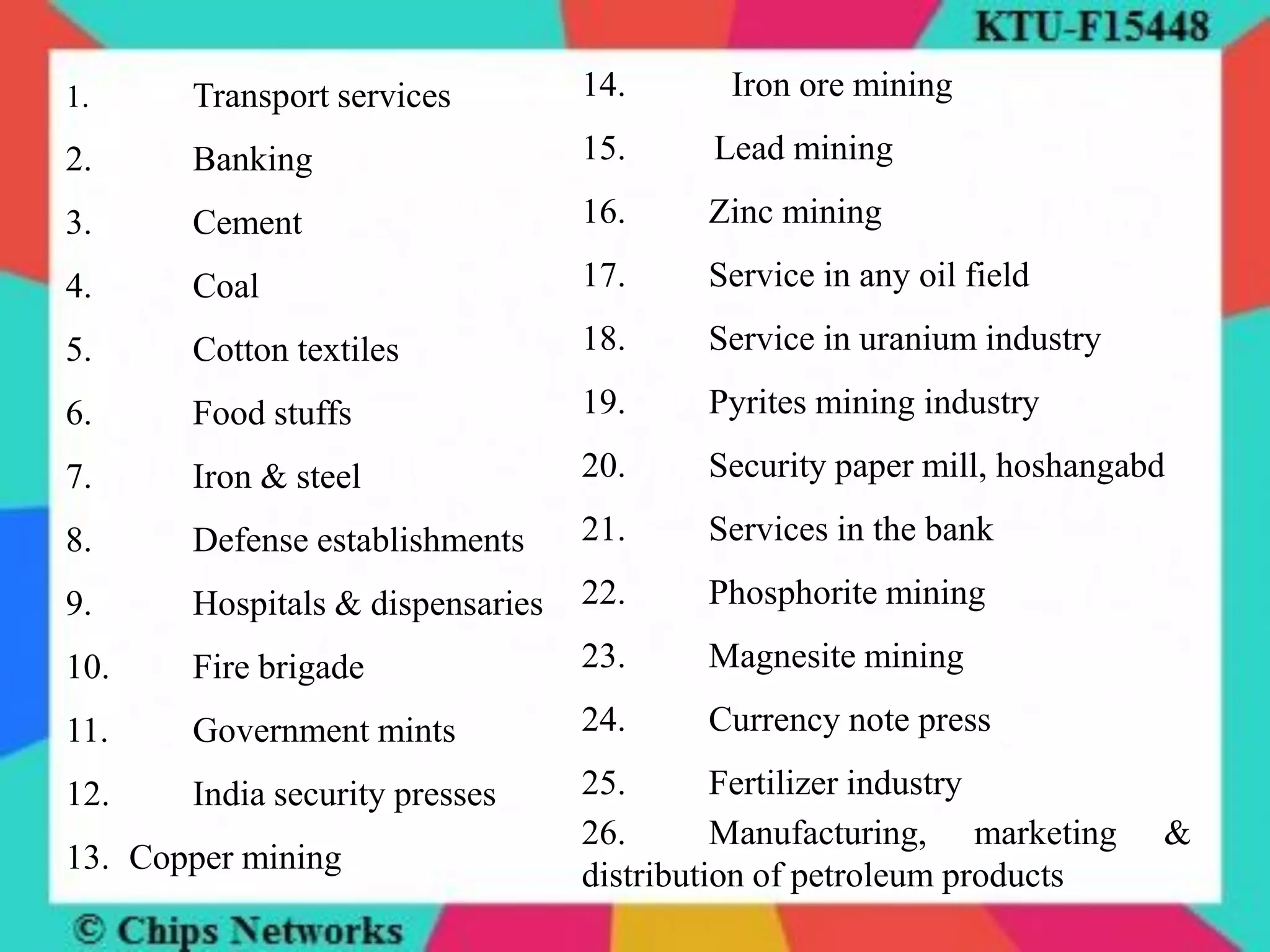
1. Transport services
2. Banking
3. Cement
4. Coal
5. Cotton textiles
6. Food stuffs
7. Iron & steel
8. Defense establishments
9. Hospitals & dispensaries
10. Fire brigade
11. Government mints
12. India security presses
13. Copper mining
14. Iron ore mining
15. Lead mining
16. Zinc mining
17. Service in any oil field
18. Service in uranium industry
19. Pyrites mining industry
20. Security paper mill, hoshangabd
21. Services in the bank
22. Phosphorite mining
23. Magnesite mining
24. Currency note press
25. Fertilizer industry
26. Manufacturing, marketing &
distribution of petroleum products
No strike in public utility:
a) Without giving to the employer notice of strike, within 6 weeks before
striking i.e. from the date of the notice to the date of strike, a period of 6 weeks
should not have elapsed;
b) Within 14 days of giving such notice i.e. a period of 14 days must have
elapsed from the date of notice to the date of strike
c) Before the expiring of the date of strike specified in any such notice as
aforesaid i.e., the date specified in the notice must have expired on the day of
striking;
d) During the pendency of any conciliation proceeding before a conciliation
officer and 7 days after the conclusion of such proceedings.
No lock-out in public utility
a) Without notice of lock-out within 6 weeks before lock-out
b) Within 14 days of giving such notice.
c) Before the expiring of the date of lock-out specified in notice.
d) During the pendency of any conciliation proceeding before a
conciliation officer and 7 days after the conclusion of proceeding.
Penalty for illegal lock-outs
An illegal lock-out is punishable for a term extending to 1 month
or with fine up to Rs.1000 or with both.
Penalty for instigation of illegal lock-outs
An illegal lock-out is punishable with imprisonment for a term
which may extend to 6 months or a fine up to Rs.1000 or both.
Consequences of Illegal Strikes / Lockouts on Workmen
all workmen no wages
instigators could be punished/imprisoned under sections 26, 27,
28. on employer
will have to pay wages and can be punished/imprisoned under
sections 26, 27, 28. on any person
any person extending financial assistance to further an illegal
strike or lockout would be violating section 25.
Strike & lock outs

Strike & lock outs

  • 2.
    Strikes S.2 (q) Astrike is the ceasing of work by employees of an industry with an objective of forcing an employee to meet particular demands. It is a mutual understanding between workers to cease work or even employment all with the motive of drawing the attention of the management concerning their various demands.
  • 3.
    In order fora strike to take place, the following components should be in place according to the Act: There has to be an industry. Work must stop. It must be a combined action of individuals.. A relationship between the parties must be strictly of employment It should be a planned refusal of work.
  • 4.
    Lockouts S.2 (1) Alockout is the act of employers that entails closing the workplace temporarily, suspending work or cutting short the employment of any number of individuals initially employed. A lockout is a strategic weapon that employers hold when in lock heads with the employees. .
  • 5.
    A lockout hasto have the following in order to be counted as a lockout: There has to be a temporal shut down of the area of employment. It could also be a temporary suspension of workers or holding back of work from the workers. The employer has to have a demand that leads him to initiate the lockout. The lockout touches any number of workers employed with in the industry.
  • 6.
    On the- otherhand, there are some actions that do not count as lockouts. For instance: When an employer stops late-comers from working on that day. Preventing employees whose services have been ceased from going to the place of work.
  • 7.
    Types of strikes Workersin the industrial world have resolved to various types of strikes. The strikes differ in their mode of actions they come along with. Some strikes produce different impacts on the industry , though they all aim at the same results
  • 8.
    The various typesof strikes include: General Strike Sit down Strike Pen/Tool down Strike Go-slow Strike Go-speed Strike
  • 9.
    General Strike A GeneralStrike is said to be a legal strike since it follows all the protocols as stated in the Act of Industrial Disputes., Employees begin by giving a strike notice to the management of the industry they work for. If the management fails to settle the dispute within the given time in the strike notice, the strike will be launched after the expiry of the notice. All trade unions linked to the demand at hand participate in the General Strike.
  • 10.
    Sit-down Strike This kindof strike involves employees reporting for duty in their workplaces normally; take their positions in their various areas of work but here comes the game changer; they simply sit and do nothing. They might also choose to just hang around the industry's premises. The objective of this strike is to cripple production. The industry ends up incurring huge losses due to no work being done at all. It is also of great pain and shame to the employers, since the rate of production is going down in the presence of workers who have reported for duty to work which they eventually end up not doing.
  • 11.
    Pen/Tool down Strike Thistype of strike shares some similarities with the sit down strike. For the pen down, it mostly takes place among people with white collar jobs or rather people who work in offices. Tool down is for workers in production industries like factories to be specific. This type of strike qualifies to be a strike since the members drop down their items of work in unison and refuse to work.
  • 12.
    Go-slow Strike The Go-slowStrike aimed at showing the employers how offended the employees are. The employees report for duty as usual and could even get to work but with only one distinction; they don't actually do any thing productive. The delay in all that they do and the outcome tums into little or no production at all. "The unique thing about this strike is that at the end of the day, the employees demand for their wages. This aspect makes the Go-slow Strike the most harmful strike compared to the total dissertation of work like in the General Strike. No production has been made but the workers have to be paid because they are demanding for it
  • 13.
    Go-speed Strike It isnot a common type of strike but it has also proven to bear results. Unlike the Go-slow strike, the workers of the industry give notice to the employers in advance stating various demands that they have. They go ahead to give a duration of time to the management to look into those demands. By any chance; if the management fails to meet the stated demands in the time given, the workers resolve to a strike.
  • 14.
    A kind ofa strike that sees them work harder hence making a greater level of production in the industry. The increase in production is meant to channel their discontentment with the management The unique strike sees the workers working on overtime which in turn causes the employer to feel humiliated. The overproduction brings about a problem in the distribution of raw materials, storing and keeping stock of the finished and unfinished products and so forth — generally causing an economic collision. The employer is then forced to meet the demands of the workers.
  • 15.
    Boundaries of strikes: Strikesare not allowed to take place when: 1. The employer has not given notice of the strike within six weeks before commencing the strike; or 2. Before the end 14 days after giving the notice. 3. The duration of time stated in the notice has not expired. 4. The conciliation process before a Conciliation Officer is still pending. 5. A duration of 7 days passes after the settling of the conciliation proceedings.
  • 16.
    Boundaries of lockouts: Lockoutsare not allowed to take place when: 1. The employer has not given prior notice about the lockout within six weeks before the lockout; or 2. Before the end of 14 days after giving the notice. 3. The duration of time stated in the notice has not expired. 4. The conciliation process before a Conciliation Officer is still pending 5. A duration of 7 days passes after the settling of the conciliation proceedings. The notice of a lockout, however, shall not be necessary when there is a strike already in progress.
  • 17.
    Circumstances making strikesand lockouts illegal in an industrial establishment (S. 23) An employee working in an industrial establishment shall not go in strike contrary to the agreements made in the contracts and no employer of any such employee shall initiate a lockout when: The conciliation process before the Board of Conciliation is still pending and after 7 days since the settlement of the conciliation. The conciliation before a Board is what is considered in this case and not the conciliation before an Officer
  • 18.
    The case beforea Labour Court, National Tribunal or Industrial Tribunal is pending and after 2 months since the settlement of such a case. The case of arbitration before an arbitrator is still pending and after 2 months since the closing of the case. A notification has to have been issued. A settlement or award is still operational in reference to any of the issues under the settlement or award.
  • 19.
    Circumstances under whichstrike or lockouts are not illegal When the strike or lockout in pursuit of an industrial dispute has already begun and exist at the reference time of the conflict to a Board, an arbitrator, a Labour Court and an Industrial or National Tribunal. The strike or lockout shall therefore not be termed as illegal given that they have not contravened the given statement of this Act.
  • 20.
    When a lockouthas been initiated as a result of an illegal strike or a strike initiated as a result of an illegal lockout shall not be termed as illegal.
  • 21.
    Consequences of illegalstrikes and lockouts Individuals who continue to run a strike or lockout contrary to the law are subject to punishments and penalties in accordance to the Act. The consequences touch on both employers and employees. An employee who initiates or continues to run a strike which has been deemed as illegal by the Act is subject to the extent of one- month imprisonment or a fine that may reaches up to fifty rupees or both.
  • 22.
    An employer whoinitiates or continues to run a strike which has been deemed as illegal by the Act is subject to the extent of one-month imprisonment or a fine that may reaches up to one thousand rupees or both.
  • 25.
    Public utility services Section2(n) declares certain types of industries to be permanently public utility services permanent public utility services [sn.2(n) (I TO v)] I) Any rail/transport/air services/services in major ports or docks II) Any section of an industry the working of which is essential for ensuring safety of workmen employed. III) Post/telegraph/telephone services IV) Industries supplying power/light or water to public V) Any system of public conservancy sanitation.
  • 26.
    Public utility services section2n(vi) empowers the central/state governments to declare any industry listed in schedule -i of the ID act as public utility services Such declarations by the appropriate government is valid for six months from date of notification in gazette. Government can extend the validity by renewing the declaration at the end of each six month. If the declarations are not renewed such notified industries would come out of the definition of public utility. as per schedule-i, the following categories of industries could be cleared as public utility for six monthly spells through a gazette notifications:
  • 27.
    1. Transport services 2.Banking 3. Cement 4. Coal 5. Cotton textiles 6. Food stuffs 7. Iron & steel 8. Defense establishments 9. Hospitals & dispensaries 10. Fire brigade 11. Government mints 12. India security presses 13. Copper mining 14. Iron ore mining 15. Lead mining 16. Zinc mining 17. Service in any oil field 18. Service in uranium industry 19. Pyrites mining industry 20. Security paper mill, hoshangabd 21. Services in the bank 22. Phosphorite mining 23. Magnesite mining 24. Currency note press 25. Fertilizer industry 26. Manufacturing, marketing & distribution of petroleum products
  • 28.
    No strike inpublic utility: a) Without giving to the employer notice of strike, within 6 weeks before striking i.e. from the date of the notice to the date of strike, a period of 6 weeks should not have elapsed; b) Within 14 days of giving such notice i.e. a period of 14 days must have elapsed from the date of notice to the date of strike c) Before the expiring of the date of strike specified in any such notice as aforesaid i.e., the date specified in the notice must have expired on the day of striking; d) During the pendency of any conciliation proceeding before a conciliation officer and 7 days after the conclusion of such proceedings.
  • 29.
    No lock-out inpublic utility a) Without notice of lock-out within 6 weeks before lock-out b) Within 14 days of giving such notice. c) Before the expiring of the date of lock-out specified in notice. d) During the pendency of any conciliation proceeding before a conciliation officer and 7 days after the conclusion of proceeding.
  • 30.
    Penalty for illegallock-outs An illegal lock-out is punishable for a term extending to 1 month or with fine up to Rs.1000 or with both. Penalty for instigation of illegal lock-outs An illegal lock-out is punishable with imprisonment for a term which may extend to 6 months or a fine up to Rs.1000 or both.
  • 31.
    Consequences of IllegalStrikes / Lockouts on Workmen all workmen no wages instigators could be punished/imprisoned under sections 26, 27, 28. on employer will have to pay wages and can be punished/imprisoned under sections 26, 27, 28. on any person any person extending financial assistance to further an illegal strike or lockout would be violating section 25.