Stress
Management
SUBMITTED TO:
Prof. B.B Goyal
SUBMITTED BY:
Shivam Verma (MBA )
UBS Panjab University
Stress
 Stress has been defined as a physical, mental
or emotional response to events which cause
mental or bodily tension.
Stress Reduction Strategies
Individual
Strategies
Muscle Relaxation
Biofeedback
Meditation
Cognitive restructuring
Time Management
Physical Fitness
Sound Sleep
Laughter Yoga
Organisational
Strategies
Limited & Flexible Work
Job Sharing
Telecommuting
Employee assistance programmes
Wellness Programmes
Social Support System
Job Redesigning
Selection & Placement
Individual Strategies
Muscle Relaxation:
This involves slow and deep
breathing, a conscious effort to
relieve muscle tension and an
altered state of consciousness.
This technique is inexpensive
and may require a trained
professional to implement
initially.
Individual Strategies
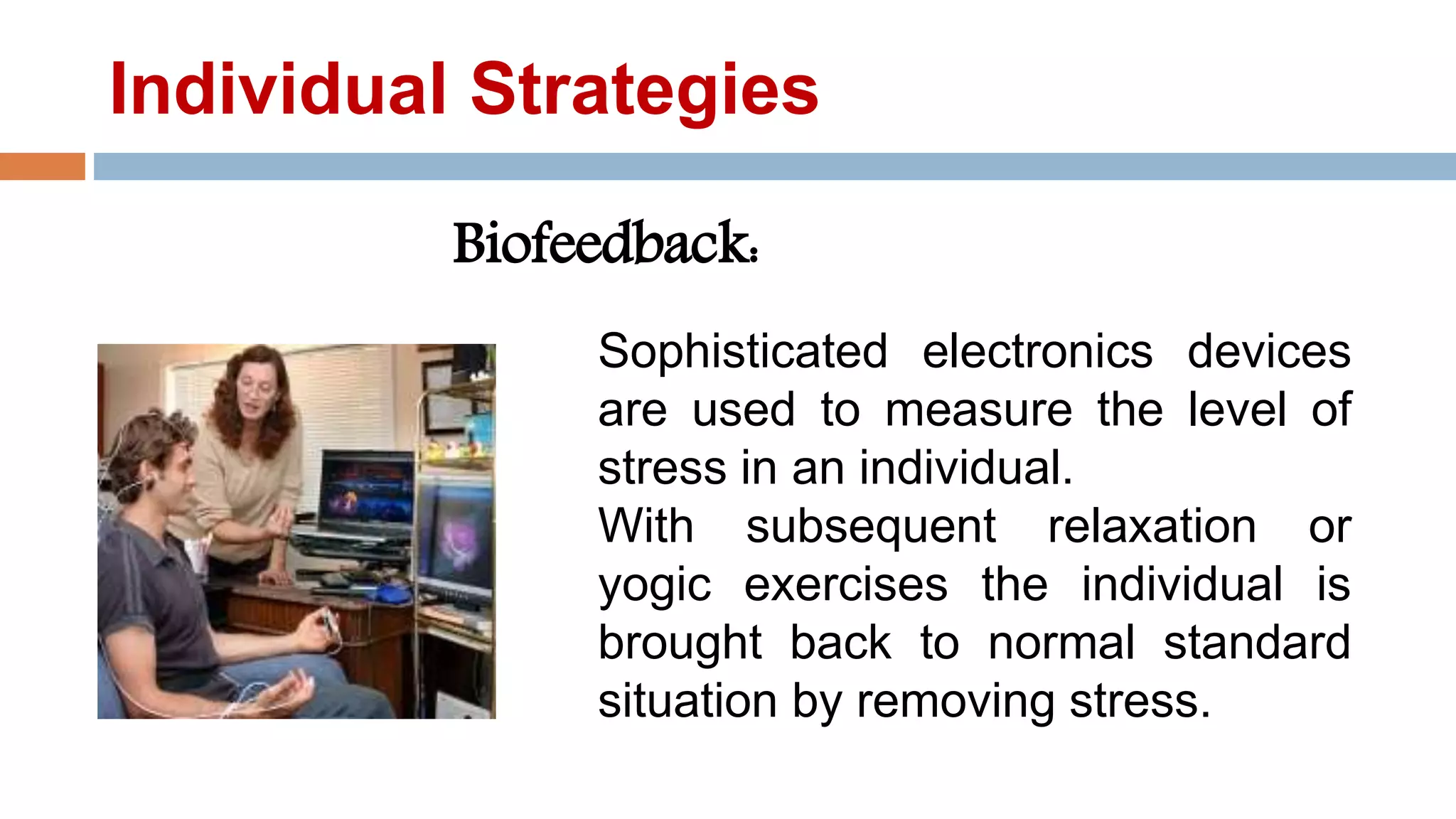
Biofeedback:
Sophisticated electronics devices
are used to measure the level of
stress in an individual.
With subsequent relaxation or
yogic exercises the individual is
brought back to normal standard
situation by removing stress.
Individual Strategies
Meditation:
Meditation involves sitting at quite
place, closing eyes and
concentrating on some symbol
with uttering of simple word like
‘OM’.
It is aimed at total concentration
thus forgetting routine situations
Individual Strategies
Cognitive Restructuring:
Cognitive restructuring (CR) is
a psychotherapeutic process of learning
to identify irrational thoughts known
as cognitive distortions, such as all-or-
nothing thinking, magical thinking, over-
generalization, magnification, and emoti
onal reasoning, which are commonly
associated with many mental health
disorders.
Individual Strategies
Time Management:
Everybody has to play various roles in life.
All the roles have to be performed in a
given span of time. It is therefore
necessary to plan time adequately. Every
individual must maintain a diary in which
work schedule and progress should be
reflected when more than one job is
required to be done at a particular time,
priority should be given to the important
Individual Strategies
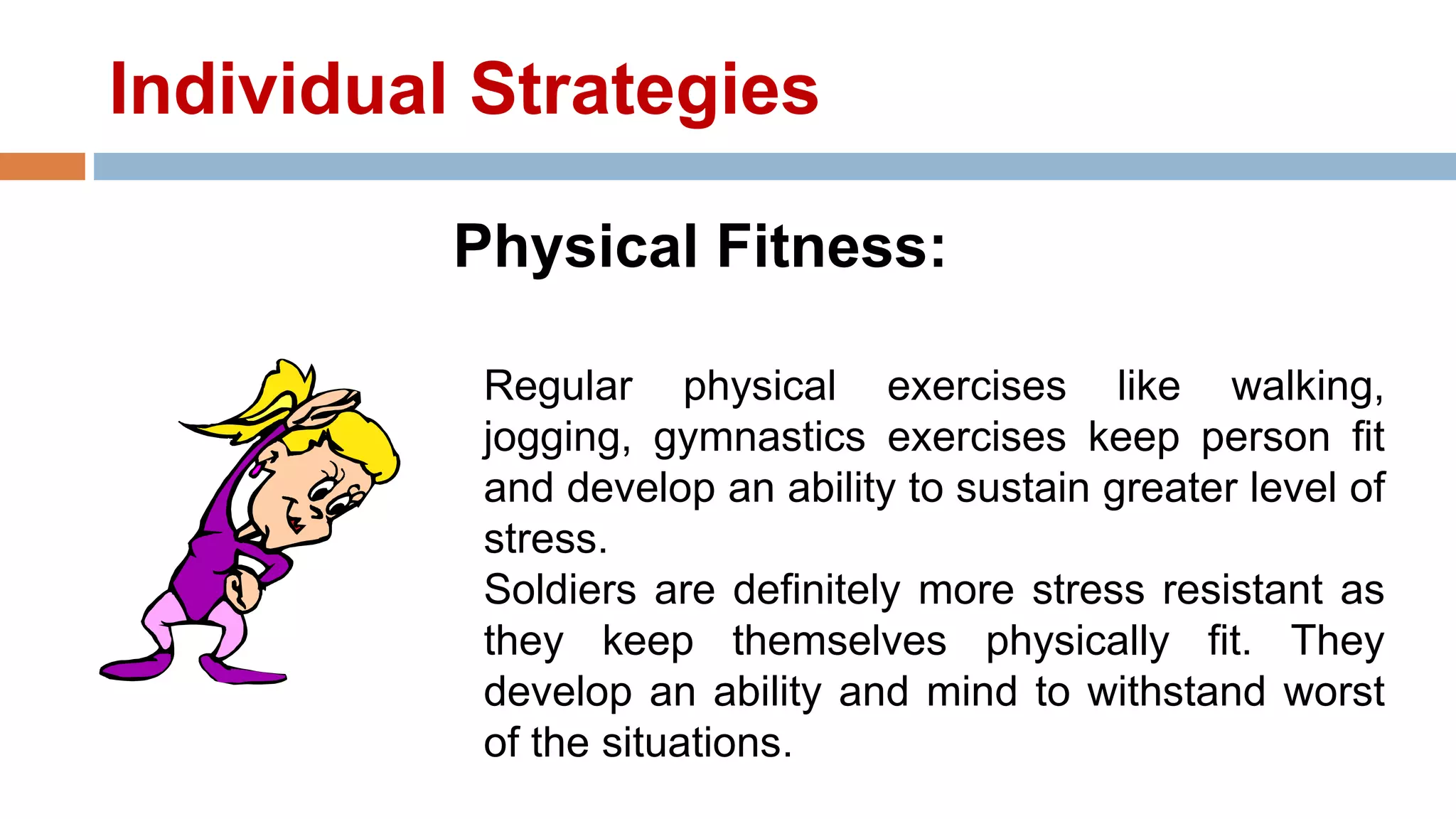
Physical Fitness:
Regular physical exercises like walking,
jogging, gymnastics exercises keep person fit
and develop an ability to sustain greater level of
stress.
Soldiers are definitely more stress resistant as
they keep themselves physically fit. They
develop an ability and mind to withstand worst
of the situations.
Individual Strategies
Sound Sleep:
The simplest way of managing stress
is sound sleep every night. But that
itself is luxury for many, particularly
management students. As stated
above, management students are
known to sleep only 3 to 4 hours a
day. Some sleep 8 hours a day,
though 5 to 6 hours of sound sleep is
adequate enough.
Individual Strategies
Laughter Yoga:
This is one therapy which does not
cost anything to you- no fee, no body
stretching, no bending, no leg twisting,
no running and no holding breaths. All
you have to do is to laugh as much
and loudly as you can. Laughter acts
as stress buffer. Happiness which
laughter brings adds to better quality
of life.
Organisational Strategies
Job Redesigning:
Higher demands and absence of
worker control make a job stressful. A
major concern In Job redesign is to
enhance worker control. Job
redesigning can be carried out in
more than one way. First is to shift
workers from individuals to team
based roles. Second is telecommute
jobs in which employees perform part
of their works at home.
Organisational Strategies
Social Support System
:
Social support is a highly effective
organisational strategy to cope with
the stress. Social support refers to
friendship, marriage, cultural norms,
or membership of an organisation.
Given social support, an individual’s
capacity to resist stress enhances.
Organisational Strategies
Job Sharing :
Job sharing involves two or more
employees assume duties of a
single job, splitting its
responsibilities, salary and
benefits. Sharing of benefits is
done on the basis of time spent
on the job.
Organisational Strategies
Telecommuting :
Telecommuting involves working from
home or a site close to home rather
than commuting a longer distance to
the office every day. Telecommuting
frees an employee from commuting
long distance. This is a great relief for
employees working in city like
Bengaluru which is known for it’s
traffic jams.
Organisational Strategies
Limited Work :
This involves limiting the number
of hours that employees are
expected to work and giving them
flexibility in scheduling those
hours. This arrangement enables
balance work and life better.
Organisational Strategies
Employee Selection and
Training:
This is the starting point in
coping with stress. Management
can avoid hiring stress-prone
individuals and those with high
external focus of control.
Similarly, training can increase
an Individual’s self-efficiency and
thus lesson stress.
Organisational Strategies
Employee Assistance
Programmes(EAP) :
EAP are designed to deal with a wide
range of stress-related problems both
work and non-work related. EAPs tend
to be based on the typical medical
approach which involve diagnosis,
treatment , screening & prevention. HUL
has a programme called ’Vitality Index’
which is conducted on an annual basis
to keep employees aware of their health.
Organisational Strategies
Wellness Programmes :
Wellness programmes, often called
Health Promotion Programmes, focus
on employee’s overall physical and
mental health. Simply stated, any
activity an organisation engages in that
is designed to identify and assist in
preventing or correcting specific health
problems, health hazards, or negative
health habits falls under wellness
THANKS

Stress Management OB

  • 1.
    Stress Management SUBMITTED TO: Prof. B.BGoyal SUBMITTED BY: Shivam Verma (MBA ) UBS Panjab University
  • 2.
    Stress  Stress hasbeen defined as a physical, mental or emotional response to events which cause mental or bodily tension.
  • 3.
    Stress Reduction Strategies Individual Strategies MuscleRelaxation Biofeedback Meditation Cognitive restructuring Time Management Physical Fitness Sound Sleep Laughter Yoga Organisational Strategies Limited & Flexible Work Job Sharing Telecommuting Employee assistance programmes Wellness Programmes Social Support System Job Redesigning Selection & Placement
  • 4.
    Individual Strategies Muscle Relaxation: Thisinvolves slow and deep breathing, a conscious effort to relieve muscle tension and an altered state of consciousness. This technique is inexpensive and may require a trained professional to implement initially.
  • 5.
    Individual Strategies Biofeedback: Sophisticated electronicsdevices are used to measure the level of stress in an individual. With subsequent relaxation or yogic exercises the individual is brought back to normal standard situation by removing stress.
  • 6.
    Individual Strategies Meditation: Meditation involvessitting at quite place, closing eyes and concentrating on some symbol with uttering of simple word like ‘OM’. It is aimed at total concentration thus forgetting routine situations
  • 7.
    Individual Strategies Cognitive Restructuring: Cognitiverestructuring (CR) is a psychotherapeutic process of learning to identify irrational thoughts known as cognitive distortions, such as all-or- nothing thinking, magical thinking, over- generalization, magnification, and emoti onal reasoning, which are commonly associated with many mental health disorders.
  • 8.
    Individual Strategies Time Management: Everybodyhas to play various roles in life. All the roles have to be performed in a given span of time. It is therefore necessary to plan time adequately. Every individual must maintain a diary in which work schedule and progress should be reflected when more than one job is required to be done at a particular time, priority should be given to the important
  • 9.
    Individual Strategies Physical Fitness: Regularphysical exercises like walking, jogging, gymnastics exercises keep person fit and develop an ability to sustain greater level of stress. Soldiers are definitely more stress resistant as they keep themselves physically fit. They develop an ability and mind to withstand worst of the situations.
  • 10.
    Individual Strategies Sound Sleep: Thesimplest way of managing stress is sound sleep every night. But that itself is luxury for many, particularly management students. As stated above, management students are known to sleep only 3 to 4 hours a day. Some sleep 8 hours a day, though 5 to 6 hours of sound sleep is adequate enough.
  • 11.
    Individual Strategies Laughter Yoga: Thisis one therapy which does not cost anything to you- no fee, no body stretching, no bending, no leg twisting, no running and no holding breaths. All you have to do is to laugh as much and loudly as you can. Laughter acts as stress buffer. Happiness which laughter brings adds to better quality of life.
  • 12.
    Organisational Strategies Job Redesigning: Higherdemands and absence of worker control make a job stressful. A major concern In Job redesign is to enhance worker control. Job redesigning can be carried out in more than one way. First is to shift workers from individuals to team based roles. Second is telecommute jobs in which employees perform part of their works at home.
  • 13.
    Organisational Strategies Social SupportSystem : Social support is a highly effective organisational strategy to cope with the stress. Social support refers to friendship, marriage, cultural norms, or membership of an organisation. Given social support, an individual’s capacity to resist stress enhances.
  • 14.
    Organisational Strategies Job Sharing: Job sharing involves two or more employees assume duties of a single job, splitting its responsibilities, salary and benefits. Sharing of benefits is done on the basis of time spent on the job.
  • 15.
    Organisational Strategies Telecommuting : Telecommutinginvolves working from home or a site close to home rather than commuting a longer distance to the office every day. Telecommuting frees an employee from commuting long distance. This is a great relief for employees working in city like Bengaluru which is known for it’s traffic jams.
  • 16.
    Organisational Strategies Limited Work: This involves limiting the number of hours that employees are expected to work and giving them flexibility in scheduling those hours. This arrangement enables balance work and life better.
  • 17.
    Organisational Strategies Employee Selectionand Training: This is the starting point in coping with stress. Management can avoid hiring stress-prone individuals and those with high external focus of control. Similarly, training can increase an Individual’s self-efficiency and thus lesson stress.
  • 18.
    Organisational Strategies Employee Assistance Programmes(EAP): EAP are designed to deal with a wide range of stress-related problems both work and non-work related. EAPs tend to be based on the typical medical approach which involve diagnosis, treatment , screening & prevention. HUL has a programme called ’Vitality Index’ which is conducted on an annual basis to keep employees aware of their health.
  • 19.
    Organisational Strategies Wellness Programmes: Wellness programmes, often called Health Promotion Programmes, focus on employee’s overall physical and mental health. Simply stated, any activity an organisation engages in that is designed to identify and assist in preventing or correcting specific health problems, health hazards, or negative health habits falls under wellness
  • 20.