DEPARTMENT OF MICROBIOLOGY
VIVEKANANDHA ARTS AND SCIENCE COLLEGE FOR WOMEN
SANGAKIRI
SUBJECT: MEDICAL BACTERIOLOGY
TITLE:STREPOCOCCUS PYOGENES
SUBJECT INCHARGE: SUBMITTED BY:
Dr.R.MYTHILI, POOJA MURUGAN,
HEAD OF THE DEPARTMENT, III B.sc. Microbiology ,
assistant professor, Department of Microbiology,
Department of Microbiology, Sankagiri,
Sankagiri,
D
CONTENT
INTRODUCTION
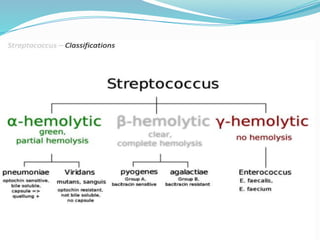
CLASSIFICATION
MORPHOLOGY
CULTURE CHARACTERS
BOICHEMICAL REACTION
PATHOGENICITY
RESPIRATORY INFECTION
SYMPTOMS
LAB DIAGNOSIS
TREATMENT
INTRODUTION
 Streptococci [or] Gram positive cocci arranged in
chains or pairs ,they are normal flora of humans and
animals .
 Some of them are human pathogens.
 The most important one are streptococcus pyogenes
causing pyogenic infection ,which are spread as
opposed to staphylococcal lesions,which are
typically , are localized.
 Cocci in Billroth [1874] ,who called them
streptococci.
classfication
MORPHOLOGY
 The individual cocci are spherical ,oval in shape [0.5µm]
 The size may be variated from cultural conditions
 E,g. Anaerobically growing streptococcus are some what
smaller
 They are arranged in chains (i-e) chains being longer in
liquid media than in solid media
 Streptococci are non motile, non-spore formers
CULTURAL CHARACTERS
 It is an aerobe & facultative anaerobe, growing
best at temperature of 37°C [range 22 - 42°C].
 It is exacting in nutritive requirements ,growth
occurring only in media containing fermented
carbohydrads [or ] enriched whith blood
[or]serum.
 In blood agar at 24 hrs the organisms product
small [0.5-1µm ],circular ,semi transparent,
clearheamolysis with low convex disc.
 The growth & hemolysis only promoted by
10%CO 2
BIOCHEMICAL REACTION
 Catalase negative
 Bile insoluble
 Fements sugars producing acid but no gas
 PYR test positive
 Hydrolyse pyrrolidonyl-beta-napthylamide (PYR)
due to presence of peptidase, the resulting
napthylamide produces a red colour upon the
addition of 0.01% cinnamaldehyde reagent
 Failure to ferment ribose
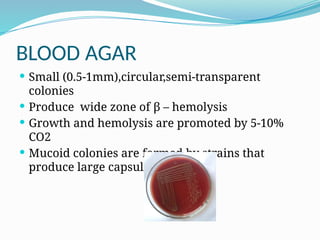
BLOOD AGAR
 Small (0.5-1mm),circular,semi-transparent
colonies
 Produce wide zone of β – hemolysis
 Growth and hemolysis are promoted by 5-10%
CO2
 Mucoid colonies are formed by strains that
produce large capsules
PATHOGENICITY
 Produces pyrogenic infection with a tendency to
spread locally, along lymphatics and through
blood stream
 Disease caused can be:
 Suppurative
 Non suppurative
SUPPURATIVE
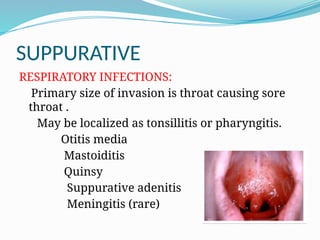
RESPIRATORY INFECTIONS:
Primary size of invasion is throat causing sore
throat .
May be localized as tonsillitis or pharyngitis.
Otitis media
Mastoiditis
Quinsy
Suppurative adenitis
Meningitis (rare)
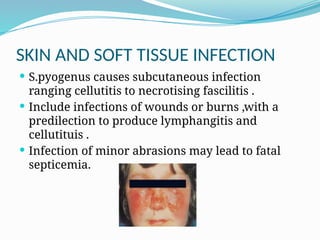
SKIN AND SOFT TISSUE INFECTION
 S.pyogenus causes subcutaneous infection
ranging cellutitis to necrotising fascilitis .
 Include infections of wounds or burns ,with a
predilection to produce lymphangitis and
cellutituis .
 Infection of minor abrasions may lead to fatal
septicemia.
a) Impetigo [pyoderma]
 Pyo-purulent and derma-skin
 Caused by higher numeberd M types S. pyrogen.
 Superficial discrete crused spot of less than one
inch in diameter seen in children .
 Lasts for 1-2 weeks and heals spontaneously
wihtout any scars .
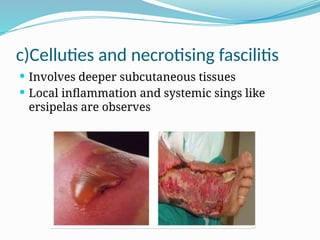
b)Erysipelas
Erysipelas and ; red pella; skin
Hypersensitivity reactioen to streptococcal
antigen
Causes acute spreading lesions involving
superficial lymphatics.
Affected skin is red ,swollen ,indurared and
sharply demarcated from surrounding
healthy skin.
Rare and seen only in order patiens.
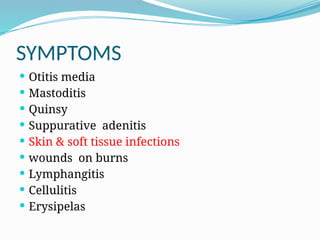
c)Celluties and necrotising fascilitis
 Involves deeper subcutaneous tissues
 Local inflammation and systemic sings like
ersipelas are observes
NON SUPPERATIVE
 After a latent period of 1-4 weeks
 Followed by rheumatic fever and acute
glomerulonephritis
 A) Rheumatic fever
 complication of S.pyogenus pharyngitis due to
specific 1M protein tyoes,
 characterized by aschoff nodules [sub
cutaneous nodule] degeneration of haert valves
 Mimics epidemiologic character of
streptococcalpharygitis.
SYMPTOMS
 Otitis media
 Mastoditis
 Quinsy
 Suppurative adenitis
 Skin & soft tissue infections
 wounds on burns
 Lymphangitis
 Cellulitis
 Erysipelas
LAB DIAGNOSIS
 Throat swab culture ;detectin of group a antigen .
 Specific nucleic acid based test.
 Elevation of anti hyalurinidase antibodies [strong
evidence]
 Specimen;
 Throat swab , pus swab or exudates are collected .
 Microscopy ;
 Gram –staining of pus can be examinated
 Presence of gram positive cocci in chain can be
indication.
TREATMENT
 For group A streptococcal infection is pencillinG
 The patients who are allergic to penicilin, the
drug of choice was Erthromycin , cephalexin.
 The antimicrobial drugs have no effects on
established glomerulus nephritis and Rheumatic
fever.
Streptococcus pyogenes  ,Introduction,classification

Streptococcus pyogenes ,Introduction,classification

  • 1.
    DEPARTMENT OF MICROBIOLOGY VIVEKANANDHAARTS AND SCIENCE COLLEGE FOR WOMEN SANGAKIRI SUBJECT: MEDICAL BACTERIOLOGY TITLE:STREPOCOCCUS PYOGENES SUBJECT INCHARGE: SUBMITTED BY: Dr.R.MYTHILI, POOJA MURUGAN, HEAD OF THE DEPARTMENT, III B.sc. Microbiology , assistant professor, Department of Microbiology, Department of Microbiology, Sankagiri, Sankagiri, D
  • 2.
  • 3.
    INTRODUTION  Streptococci [or]Gram positive cocci arranged in chains or pairs ,they are normal flora of humans and animals .  Some of them are human pathogens.  The most important one are streptococcus pyogenes causing pyogenic infection ,which are spread as opposed to staphylococcal lesions,which are typically , are localized.  Cocci in Billroth [1874] ,who called them streptococci.
  • 4.
  • 5.
    MORPHOLOGY  The individualcocci are spherical ,oval in shape [0.5µm]  The size may be variated from cultural conditions  E,g. Anaerobically growing streptococcus are some what smaller  They are arranged in chains (i-e) chains being longer in liquid media than in solid media  Streptococci are non motile, non-spore formers
  • 6.
    CULTURAL CHARACTERS  Itis an aerobe & facultative anaerobe, growing best at temperature of 37°C [range 22 - 42°C].  It is exacting in nutritive requirements ,growth occurring only in media containing fermented carbohydrads [or ] enriched whith blood [or]serum.  In blood agar at 24 hrs the organisms product small [0.5-1µm ],circular ,semi transparent, clearheamolysis with low convex disc.  The growth & hemolysis only promoted by 10%CO 2
  • 7.
    BIOCHEMICAL REACTION  Catalasenegative  Bile insoluble  Fements sugars producing acid but no gas  PYR test positive  Hydrolyse pyrrolidonyl-beta-napthylamide (PYR) due to presence of peptidase, the resulting napthylamide produces a red colour upon the addition of 0.01% cinnamaldehyde reagent  Failure to ferment ribose
  • 8.
    BLOOD AGAR  Small(0.5-1mm),circular,semi-transparent colonies  Produce wide zone of β – hemolysis  Growth and hemolysis are promoted by 5-10% CO2  Mucoid colonies are formed by strains that produce large capsules
  • 9.
    PATHOGENICITY  Produces pyrogenicinfection with a tendency to spread locally, along lymphatics and through blood stream  Disease caused can be:  Suppurative  Non suppurative
  • 10.
    SUPPURATIVE RESPIRATORY INFECTIONS: Primary sizeof invasion is throat causing sore throat . May be localized as tonsillitis or pharyngitis. Otitis media Mastoiditis Quinsy Suppurative adenitis Meningitis (rare)
  • 11.
    SKIN AND SOFTTISSUE INFECTION  S.pyogenus causes subcutaneous infection ranging cellutitis to necrotising fascilitis .  Include infections of wounds or burns ,with a predilection to produce lymphangitis and cellutituis .  Infection of minor abrasions may lead to fatal septicemia.
  • 12.
    a) Impetigo [pyoderma] Pyo-purulent and derma-skin  Caused by higher numeberd M types S. pyrogen.  Superficial discrete crused spot of less than one inch in diameter seen in children .  Lasts for 1-2 weeks and heals spontaneously wihtout any scars .
  • 13.
    b)Erysipelas Erysipelas and ;red pella; skin Hypersensitivity reactioen to streptococcal antigen Causes acute spreading lesions involving superficial lymphatics. Affected skin is red ,swollen ,indurared and sharply demarcated from surrounding healthy skin. Rare and seen only in order patiens.
  • 14.
    c)Celluties and necrotisingfascilitis  Involves deeper subcutaneous tissues  Local inflammation and systemic sings like ersipelas are observes
  • 15.
    NON SUPPERATIVE  Aftera latent period of 1-4 weeks  Followed by rheumatic fever and acute glomerulonephritis  A) Rheumatic fever  complication of S.pyogenus pharyngitis due to specific 1M protein tyoes,  characterized by aschoff nodules [sub cutaneous nodule] degeneration of haert valves  Mimics epidemiologic character of streptococcalpharygitis.
  • 16.
    SYMPTOMS  Otitis media Mastoditis  Quinsy  Suppurative adenitis  Skin & soft tissue infections  wounds on burns  Lymphangitis  Cellulitis  Erysipelas
  • 17.
    LAB DIAGNOSIS  Throatswab culture ;detectin of group a antigen .  Specific nucleic acid based test.  Elevation of anti hyalurinidase antibodies [strong evidence]  Specimen;  Throat swab , pus swab or exudates are collected .  Microscopy ;  Gram –staining of pus can be examinated  Presence of gram positive cocci in chain can be indication.
  • 18.
    TREATMENT  For groupA streptococcal infection is pencillinG  The patients who are allergic to penicilin, the drug of choice was Erthromycin , cephalexin.  The antimicrobial drugs have no effects on established glomerulus nephritis and Rheumatic fever.