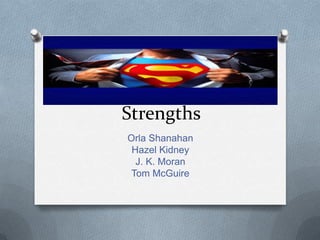
Strengths
Orla Shanahan
 Hazel Kidney
  J. K. Moran
 Tom McGuire
Brainstorm


Take a moment to write down what do we
know about Strengths already?
Overview of seminar
O Definitions              O Education and
O Theories                     strengths
O History                  O   Children and
O Character Strengths
                               strengths
                           O   Sport and Strengths
O Criteria for strengths
                           O   Activity
O Difference between
  strengths and talents    O   Politics and strengths
O 6 Virtues, 24            O   Activity
  Strengths                O   Summary
O Everyday Strengths       O   Suggested Readings
Learning Outcomes
O Understand strengths in positive
    psychology
O   Know your own strengths
O   Knowledge of strengths in everyday
    occurrence
O   Be able to use them in a positive useful
    manner
O   Cite main theorists and their theories
Definition
O Character strengths:
    positive traits reflected in thoughts, feelings and
    behaviors. They exist in degrees and can be
    measured as individual differences.
                                    (Chung, 2008)

O “The truth is that all of us attain the greatest
  success and happiness possible in this life
  whenever we use our native capacities to their
  greatest extent.” Dr. Smiley
  Blanton, psychiatrist and psychoanalyst
  (1882-1966)
Main Theorists
O Jonathan Haidt


O Christopher Peterson


O Martin Seligman
History
O World War II psychological mission:
    O Cure mental disease
    O Help people live more productive lives
    O Identifying and nurturing high talents


O Used APA presidency shift focus from curing
   mental illness to fulfilment

O Out of 17,000 articles, 61% about negative
   issues
                (Czapinksi, 1985, cited in Chung, 2008)
Improvement
O Higher gain in life satisfaction when
  strengths and weaknesses worked on
  rather than strengths alone
                              (Rust, Diessner & Reade, 2009)

O Excess in one strength does not cause a
  drop in life satisfaction
                     (Park, Peterson & Seligman, 2004)
What are your character
        strengths?
O http://www.youtube.com/watch?v=K-
 3IjNr1gCg&feature=related- Character
 strengths


O Take a minute to write down your
 character strengths.
List of strengths


O http://www.youtube.com/watch?v=xNEu2j
 p_go8
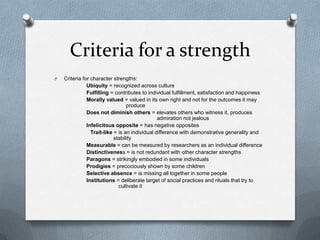
Criteria for a strength
O   Criteria for character strengths:
               Ubiquity = recognized across culture
               Fulfilling = contributes to individual fulfillment, satisfaction and happiness
               Morally valued = valued in its own right and not for the outcomes it may
                                  produce
               Does not diminish others = elevates others who witness it, produces
                                                admiration not jealous
               Infelicitous opposite = has negative opposites
                 Trait-like = is an individual difference with demonstrative generality and
                            stability
               Measurable = can be measured by researchers as an individual difference
               Distinctiveness = is not redundant with other character strengths
               Paragons = strikingly embodied in some individuals
               Prodigies = precociously shown by some children
               Selective absence = is missing all together in some people
               Institutions = deliberate target of social practices and rituals that try to
                              cultivate it
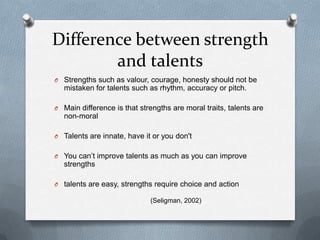
Difference between strength
        and talents
O Strengths such as valour, courage, honesty should not be
  mistaken for talents such as rhythm, accuracy or pitch.

O Main difference is that strengths are moral traits, talents are
  non-moral

O Talents are innate, have it or you don't


O You can‟t improve talents as much as you can improve
  strengths

O talents are easy, strengths require choice and action

                             (Seligman, 2002)
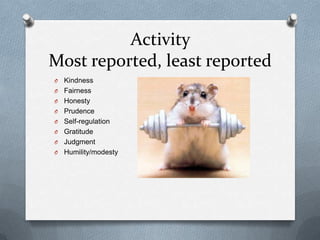
Activity
Most reported, least reported
O   Kindness
O   Fairness
O   Honesty
O   Prudence
O   Self-regulation
O   Gratitude
O   Judgment
O   Humility/modesty
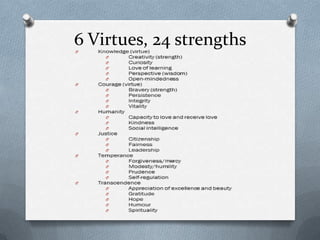
Peterson & Seligman (2005):

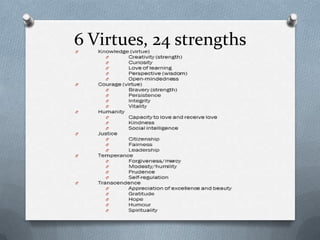
O 6 Virtues
O 24 strengths

O Take the survey
O The VIA-IS can be taken for free at
  http://www.viasurvey.org/, a site run by the VIA
  institute. You need to register and then the site will
  save your results so you can always revisit and
  check your strengths.

O http://www.youtube.com/watch?v=N-Lo-
  hofLGc&feature=related?
6 Virtues, 24 strengths
Everyday strengths
We use our strengths in our day to day life.

O Education


O Sport


O Politics
Strengths In education
O Incorporating a focus on strengths in the school mission.
Focusing on character strengths offers a step towards
1. greater engagement
2. greater achievement
3. greater well-being
Just naming the strengths of a teacher or a student is an
uplifting experience.
O When we are able to use our strengths, we are
   satisfying our natural urges.
O We feel good about ourselves, we thrive and we feel
   energized.
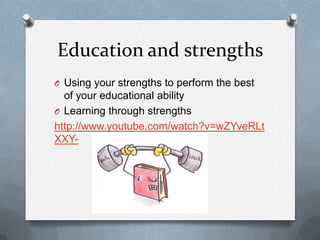
Education and strengths
O Using your strengths to perform the best
  of your educational ability
O Learning through strengths
http://www.youtube.com/watch?v=wZYveRLt
XXY-
Strengths In Education
O We perform better, we are more productive. We
  have greater contentment and satisfaction. There
  is a sense of accomplishment and meaning in our
  work and personal life.

O In contrast, a continual focus on trying to fix
  weaknesses leaves us frustrated, suppressing our
  natural tendencies. This can lead to anger and
  becoming psychologically and physically drained.

O Overtime, these negative kinds of emotions can
  lead to depression.
Strengths In Education
O Elizabeth Hurlock‟s (1925) creative work
  highlighted how praise of students‟ work has a
  more powerful effect on math performance
  than criticism of students‟ efforts.

O Don‟t focus on the weaknesses.

O Good character is what parents want to
  encourage in their children, what teachers
  attempt to communicate with their pupils, and
  what friends look for in each other.
Education and strengths
O Teachers have found that storytelling, festival-
  type celebrations, and character strengths
  have a particular interaction in schools.

O It brings them together to create a program
  that helps students and teachers notice
  strengths in themselves and others.

O It also brings celebration and strengths into
  the life of the whole school as well as the
  classroom.
Educational strengths
O Comics are used as the most frequently
  mentioned strength as an educational tool
  along with the ability for comics to motivate
  students.

O Haugaard (1973) shares that comics were the
  only way to motivate her son to read.

O Versaci (2001) finds that comics can quite
  literally put a human face on a given subject
  resulting in an intimate, emotional connection
  between his students and characters of a
  comics story.
Activity
O Write your name in the middle of a piece
  of paper and leave it on the desk.

O Write down what you feel the main
  strength(s) of each person in the class are
  on their piece of paper.

O Everyone should feel great after this, take
  this piece of paper home and treasure it
  !!
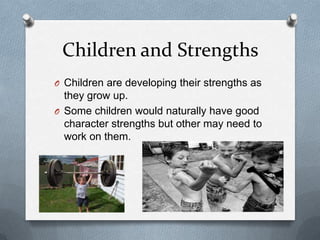
Children and Strengths
O Children are developing their strengths as
  they grow up.
O Some children would naturally have good
  character strengths but other may need to
  work on them.
Marshmallow Experiment


O http://www.youtube.com/watch?v=QX_oy9
 614HQ
Take a Break
Sport and Strengths
O Sport got there first, of course, and got there many
    decades earlier.

O    Even before Freud and Kraepelin had begun
    constructing their contrasting disease models of
    mental illness, athletes and footballers had come
    to a basic conception of positive psychology.

O   Meaning, significance and life satisfaction could
    be found in a context of team, in the refusal to give
    up, and in the deliberate exercise of courage.
A Window in Stirling, Scotland 1929
O The APA defines exercise and sport
  psychology as the study of psychological
  influences on performance and
  participation in sports, exercise and other
  forms of athletic activity.

O It is divided into three sections:
  O (i) sport psychology
  O (ii) exercise psychology
  O (iii) human performance.
                      (Salama-Younes, 2011)
Sport Psychology
O Addresses the interactions between
  psychology and sport performance

O Optimal athletic performance


O Well-being of coaches, referees, and athletes


O The connection between physical and
  psychological functioning
Exercise Psychology
O The behavioral, social cognitive and
  psychobiological antecedents

O The consequences of physical activity


O Focus on adoption and maintenance of
  physical activity and its effects on
  psychological well-being
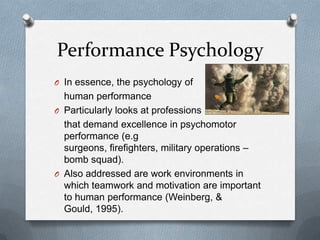
Performance Psychology
O In essence, the psychology of
  human performance
O Particularly looks at professions
  that demand excellence in psychomotor
  performance (e.g
  surgeons, firefighters, military operations –
  bomb squad).
O Also addressed are work environments in
  which teamwork and motivation are important
  to human performance (Weinberg, &
  Gould, 1995).
Prodigies in Sport
O The term, „child prodigy‟, is generally used
  to describe children under the age of 13
  who show exceptional ability, comparable
  to that of the most skilled adults, in a
  particular field of human endeavor.
O There exist prodigies with respect to a
  strength: children who show a strength at
  a much earlier age than typical or at a
  much more sophisticated level than
  typical.
O Usually categorized in math or music
Examples
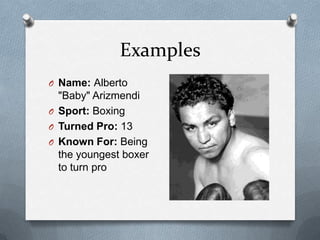
O Name: Alberto
  "Baby" Arizmendi
O Sport: Boxing
O Turned Pro: 13
O Known For: Being
  the youngest boxer
  to turn pro
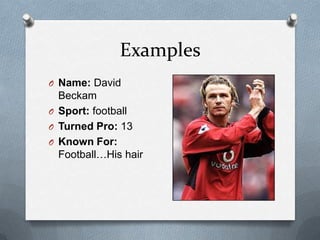
Examples
O Name: David
  Beckam
O Sport: football
O Turned Pro: 13
O Known For:
  Football…His hair
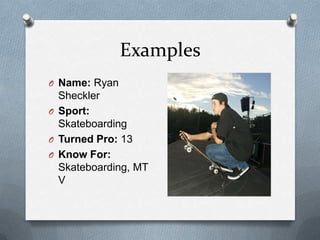
Examples
O Name: Ryan
  Sheckler
O Sport:
  Skateboarding
O Turned Pro: 13
O Know For:
  Skateboarding, MT
  V
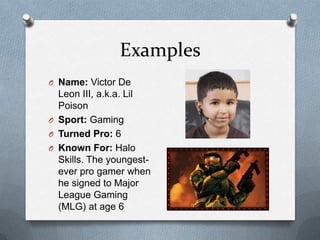
Examples
O Name: Victor De
  Leon III, a.k.a. Lil
  Poison
O Sport: Gaming
O Turned Pro: 6
O Known For: Halo
  Skills. The youngest-
  ever pro gamer when
  he signed to Major
  League Gaming
  (MLG) at age 6
Examples
O Name: Tiger Woods
O Sport: Golf
O Turned Pro: 8
O Known For: Formerly
  the World no.1 he is the
  highest-paid
  professional athlete in
  the world, having
  earned an estimated
  US$90.5 million from
  winnings and
  endorsements in
  2010.[6][7]
Examples
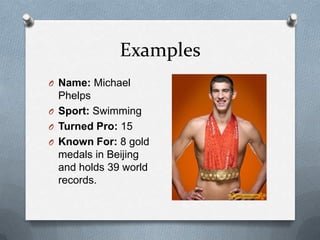
O Name: Michael
  Phelps
O Sport: Swimming
O Turned Pro: 15
O Known For: 8 gold
  medals in Beijing
  and holds 39 world
  records.
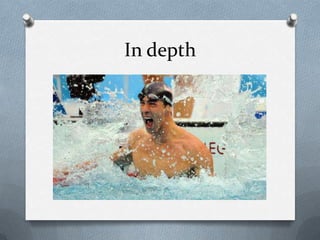
In depth
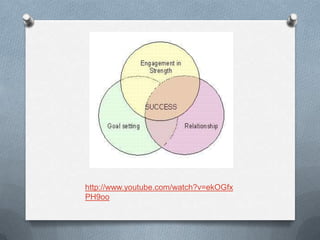
How did he do it?
O It is not difficult to trace the anatomy of
  Phelps‟ unprecedented success. It came
  from three concepts that are well-
  discussed in positive psychology:

   O 1) engagement in his own strength
   O 2) goal-setting
   O 3) positive relationships with significant
     others
Engagement in Strength
O Not many people are able to find their own
  strength and talents, and even fewer are able to
  engage in and develop them like Phelps has

O Diagnosed with ADHD


O “When I was in high school, one of my teachers
  said I am never going to be successful,”

O His passion and commitment also demonstrates
  that utilizing our strengths in the main areas of our
  lives will bring us gratification and authentic
  happiness, as proposed by Martin E.P. Seligman
  (2002).
Goal Setting
O Keeps a list of his swimming goals on top of
  his nightstand, near the alarm clock

O “The greatest thing is this proves that nothing
  is impossible and goals are what it takes, this
  is what I have learnt.” Michael Phelps

O Charles Noble – “You must have long range
  goals to keep you from being frustrated by
  short range failures”.
Positive Relationships
O Gross (2001), social support fosters
  positive emotions and can serve as buffer
  against stress.
O Just after winning his eighth
  medal, Phelps said, “There‟s so much
  emotions going through my head, so
  much excitement. I guess I just want to
  see my mom.”
http://www.youtube.com/watch?v=ekOGfx
PH9oo
Activity
Divide into groups and answer the following questions. Each group is
given one of five different sports teams.
Questions:
1.   What are the group strengths needed to be a good team?
2.   What individual strengths do you need to be a part of this
     team?
3.   How does this build on your own character strengths??
4.   What group team would best suit you as an individual based
     on your character strengths?

The Five teams:
O Rugby
O Hockey
O Football
O Basketball
O Hurling
6 Virtues, 24 strengths
Politics and strengths
O Positivity important in gaining voters
O survey of voters in Virginia, 75% of the people
  indicated that negative campaigns were likely to
  discourage people from voting (Freedman, 1999)
O Rudd and Julia Gillard – promoted a positive vision


O People with head strengths such as innovation and
  creativity voted for Obama and people with
  strengths related to the heart, such as humanity
  and courage, voted for McCain (Park & Peterson,
  2010).
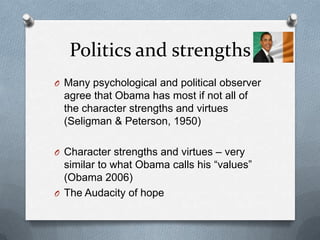
Politics and strengths
O Many psychological and political observer
  agree that Obama has most if not all of
  the character strengths and virtues
  (Seligman & Peterson, 1950)

O Character strengths and virtues – very
  similar to what Obama calls his “values”
  (Obama 2006)
O The Audacity of hope
Politics and strengths
O Primarily thanks to character strengths
  and virtues that he became president
  (Ripley, 2008)
O empathy, compassion, fairness, emotional
  and social
O intelligence, generosity, and kindness
O He also has great self-confidence
Politics and strengths
O incredible perseverance, and “fierce
  ambitions” (Obama, 2006a, p. 243)
O Humour very important part of Obama
  make up
O http://www.youtube.com/watch?v=xVnk89
  1ChPc
Activity
Divide into groups
O Each person gives an example of when
  they achieved a goal or accomplished
  something good in their life.
O Take it in turns discuss the strengths that
  would have been required to achieve
  these goals.
Summary
O Know and identify your character
  strengths.
O Use your strengths to help you achieve
  better results in your everyday life.
O Don‟t focus on weaknesses.
O Working in areas that requires your
  character strengths to increase life
  satisfaction.
Any Questions ?
Suggested Readings
O Positive psychology: the science of
  happiness and human strengths, By Dr.
  Alan Carr (2004)
O Authentic Happiness: using the new
  positive psychology to realize your
  potential lasting fulfillment. Martin E. P.
  Seligman ( 2002)
O Seilgman character strengths and virtues
References
O   Chung, H. (2008). Resiliency and character         strengths among
    college students.

O   Linley, P. A., Joseph, S., Harrington, S. &          Wood, A. M.
    (2006). Positive psychology: Past, present, and (possible) future.
    The     Journal of Positive Psychology; 1, (1), 3-16.

O   Rust, T., Diessnar, R. & Reade, L. (2009). Strengths only or
    strengths and relative weaknesses? A Preliminary Study. The
    Journal of Psychology; 143, (5), 465–476

O   Seligman, M. E. P. (2002). Authentic    Happiness. The Free
    Press; New York.

O   Nansook Park, Christopher Peterson, and Martin E. P. Seligman
    (2004). Strengths of Character and Well-Being. Journal of Social
    and Clinical Psychology: Vol. 23, No. 5, pp. 603-619.
Strengths presentation

Strengths presentation

  • 1.
    Strengths Orla Shanahan HazelKidney J. K. Moran Tom McGuire
  • 2.
    Brainstorm Take a momentto write down what do we know about Strengths already?
  • 3.
    Overview of seminar ODefinitions O Education and O Theories strengths O History O Children and O Character Strengths strengths O Sport and Strengths O Criteria for strengths O Activity O Difference between strengths and talents O Politics and strengths O 6 Virtues, 24 O Activity Strengths O Summary O Everyday Strengths O Suggested Readings
  • 4.
    Learning Outcomes O Understandstrengths in positive psychology O Know your own strengths O Knowledge of strengths in everyday occurrence O Be able to use them in a positive useful manner O Cite main theorists and their theories
  • 5.
    Definition O Character strengths: positive traits reflected in thoughts, feelings and behaviors. They exist in degrees and can be measured as individual differences. (Chung, 2008) O “The truth is that all of us attain the greatest success and happiness possible in this life whenever we use our native capacities to their greatest extent.” Dr. Smiley Blanton, psychiatrist and psychoanalyst (1882-1966)
  • 6.
    Main Theorists O JonathanHaidt O Christopher Peterson O Martin Seligman
  • 7.
    History O World WarII psychological mission: O Cure mental disease O Help people live more productive lives O Identifying and nurturing high talents O Used APA presidency shift focus from curing mental illness to fulfilment O Out of 17,000 articles, 61% about negative issues (Czapinksi, 1985, cited in Chung, 2008)
  • 8.
    Improvement O Higher gainin life satisfaction when strengths and weaknesses worked on rather than strengths alone (Rust, Diessner & Reade, 2009) O Excess in one strength does not cause a drop in life satisfaction (Park, Peterson & Seligman, 2004)
  • 9.
    What are yourcharacter strengths? O http://www.youtube.com/watch?v=K- 3IjNr1gCg&feature=related- Character strengths O Take a minute to write down your character strengths.
  • 10.
    List of strengths Ohttp://www.youtube.com/watch?v=xNEu2j p_go8
  • 11.
    Criteria for astrength O Criteria for character strengths: Ubiquity = recognized across culture Fulfilling = contributes to individual fulfillment, satisfaction and happiness Morally valued = valued in its own right and not for the outcomes it may produce Does not diminish others = elevates others who witness it, produces admiration not jealous Infelicitous opposite = has negative opposites Trait-like = is an individual difference with demonstrative generality and stability Measurable = can be measured by researchers as an individual difference Distinctiveness = is not redundant with other character strengths Paragons = strikingly embodied in some individuals Prodigies = precociously shown by some children Selective absence = is missing all together in some people Institutions = deliberate target of social practices and rituals that try to cultivate it
  • 12.
    Difference between strength and talents O Strengths such as valour, courage, honesty should not be mistaken for talents such as rhythm, accuracy or pitch. O Main difference is that strengths are moral traits, talents are non-moral O Talents are innate, have it or you don't O You can‟t improve talents as much as you can improve strengths O talents are easy, strengths require choice and action (Seligman, 2002)
  • 13.
    Activity Most reported, leastreported O Kindness O Fairness O Honesty O Prudence O Self-regulation O Gratitude O Judgment O Humility/modesty
  • 14.
    Peterson & Seligman(2005): O 6 Virtues O 24 strengths O Take the survey O The VIA-IS can be taken for free at http://www.viasurvey.org/, a site run by the VIA institute. You need to register and then the site will save your results so you can always revisit and check your strengths. O http://www.youtube.com/watch?v=N-Lo- hofLGc&feature=related?
  • 15.
    6 Virtues, 24strengths
  • 16.
    Everyday strengths We useour strengths in our day to day life. O Education O Sport O Politics
  • 17.
    Strengths In education OIncorporating a focus on strengths in the school mission. Focusing on character strengths offers a step towards 1. greater engagement 2. greater achievement 3. greater well-being Just naming the strengths of a teacher or a student is an uplifting experience. O When we are able to use our strengths, we are satisfying our natural urges. O We feel good about ourselves, we thrive and we feel energized.
  • 18.
    Education and strengths OUsing your strengths to perform the best of your educational ability O Learning through strengths http://www.youtube.com/watch?v=wZYveRLt XXY-
  • 19.
    Strengths In Education OWe perform better, we are more productive. We have greater contentment and satisfaction. There is a sense of accomplishment and meaning in our work and personal life. O In contrast, a continual focus on trying to fix weaknesses leaves us frustrated, suppressing our natural tendencies. This can lead to anger and becoming psychologically and physically drained. O Overtime, these negative kinds of emotions can lead to depression.
  • 20.
    Strengths In Education OElizabeth Hurlock‟s (1925) creative work highlighted how praise of students‟ work has a more powerful effect on math performance than criticism of students‟ efforts. O Don‟t focus on the weaknesses. O Good character is what parents want to encourage in their children, what teachers attempt to communicate with their pupils, and what friends look for in each other.
  • 21.
    Education and strengths OTeachers have found that storytelling, festival- type celebrations, and character strengths have a particular interaction in schools. O It brings them together to create a program that helps students and teachers notice strengths in themselves and others. O It also brings celebration and strengths into the life of the whole school as well as the classroom.
  • 22.
    Educational strengths O Comicsare used as the most frequently mentioned strength as an educational tool along with the ability for comics to motivate students. O Haugaard (1973) shares that comics were the only way to motivate her son to read. O Versaci (2001) finds that comics can quite literally put a human face on a given subject resulting in an intimate, emotional connection between his students and characters of a comics story.
  • 23.
    Activity O Write yourname in the middle of a piece of paper and leave it on the desk. O Write down what you feel the main strength(s) of each person in the class are on their piece of paper. O Everyone should feel great after this, take this piece of paper home and treasure it !!
  • 24.
    Children and Strengths OChildren are developing their strengths as they grow up. O Some children would naturally have good character strengths but other may need to work on them.
  • 25.
  • 26.
  • 27.
    Sport and Strengths OSport got there first, of course, and got there many decades earlier. O Even before Freud and Kraepelin had begun constructing their contrasting disease models of mental illness, athletes and footballers had come to a basic conception of positive psychology. O Meaning, significance and life satisfaction could be found in a context of team, in the refusal to give up, and in the deliberate exercise of courage.
  • 28.
    A Window inStirling, Scotland 1929
  • 29.
    O The APAdefines exercise and sport psychology as the study of psychological influences on performance and participation in sports, exercise and other forms of athletic activity. O It is divided into three sections: O (i) sport psychology O (ii) exercise psychology O (iii) human performance. (Salama-Younes, 2011)
  • 30.
    Sport Psychology O Addressesthe interactions between psychology and sport performance O Optimal athletic performance O Well-being of coaches, referees, and athletes O The connection between physical and psychological functioning
  • 31.
    Exercise Psychology O Thebehavioral, social cognitive and psychobiological antecedents O The consequences of physical activity O Focus on adoption and maintenance of physical activity and its effects on psychological well-being
  • 32.
    Performance Psychology O Inessence, the psychology of human performance O Particularly looks at professions that demand excellence in psychomotor performance (e.g surgeons, firefighters, military operations – bomb squad). O Also addressed are work environments in which teamwork and motivation are important to human performance (Weinberg, & Gould, 1995).
  • 33.
    Prodigies in Sport OThe term, „child prodigy‟, is generally used to describe children under the age of 13 who show exceptional ability, comparable to that of the most skilled adults, in a particular field of human endeavor. O There exist prodigies with respect to a strength: children who show a strength at a much earlier age than typical or at a much more sophisticated level than typical. O Usually categorized in math or music
  • 34.
    Examples O Name: Alberto "Baby" Arizmendi O Sport: Boxing O Turned Pro: 13 O Known For: Being the youngest boxer to turn pro
  • 35.
    Examples O Name: David Beckam O Sport: football O Turned Pro: 13 O Known For: Football…His hair
  • 36.
    Examples O Name: Ryan Sheckler O Sport: Skateboarding O Turned Pro: 13 O Know For: Skateboarding, MT V
  • 37.
    Examples O Name: VictorDe Leon III, a.k.a. Lil Poison O Sport: Gaming O Turned Pro: 6 O Known For: Halo Skills. The youngest- ever pro gamer when he signed to Major League Gaming (MLG) at age 6
  • 38.
    Examples O Name: TigerWoods O Sport: Golf O Turned Pro: 8 O Known For: Formerly the World no.1 he is the highest-paid professional athlete in the world, having earned an estimated US$90.5 million from winnings and endorsements in 2010.[6][7]
  • 39.
    Examples O Name: Michael Phelps O Sport: Swimming O Turned Pro: 15 O Known For: 8 gold medals in Beijing and holds 39 world records.
  • 40.
  • 41.
    How did hedo it? O It is not difficult to trace the anatomy of Phelps‟ unprecedented success. It came from three concepts that are well- discussed in positive psychology: O 1) engagement in his own strength O 2) goal-setting O 3) positive relationships with significant others
  • 42.
    Engagement in Strength ONot many people are able to find their own strength and talents, and even fewer are able to engage in and develop them like Phelps has O Diagnosed with ADHD O “When I was in high school, one of my teachers said I am never going to be successful,” O His passion and commitment also demonstrates that utilizing our strengths in the main areas of our lives will bring us gratification and authentic happiness, as proposed by Martin E.P. Seligman (2002).
  • 43.
    Goal Setting O Keepsa list of his swimming goals on top of his nightstand, near the alarm clock O “The greatest thing is this proves that nothing is impossible and goals are what it takes, this is what I have learnt.” Michael Phelps O Charles Noble – “You must have long range goals to keep you from being frustrated by short range failures”.
  • 44.
    Positive Relationships O Gross(2001), social support fosters positive emotions and can serve as buffer against stress. O Just after winning his eighth medal, Phelps said, “There‟s so much emotions going through my head, so much excitement. I guess I just want to see my mom.”
  • 45.
  • 46.
    Activity Divide into groupsand answer the following questions. Each group is given one of five different sports teams. Questions: 1. What are the group strengths needed to be a good team? 2. What individual strengths do you need to be a part of this team? 3. How does this build on your own character strengths?? 4. What group team would best suit you as an individual based on your character strengths? The Five teams: O Rugby O Hockey O Football O Basketball O Hurling
  • 47.
    6 Virtues, 24strengths
  • 48.
  • 49.
    Politics and strengths OPositivity important in gaining voters O survey of voters in Virginia, 75% of the people indicated that negative campaigns were likely to discourage people from voting (Freedman, 1999) O Rudd and Julia Gillard – promoted a positive vision O People with head strengths such as innovation and creativity voted for Obama and people with strengths related to the heart, such as humanity and courage, voted for McCain (Park & Peterson, 2010).
  • 50.
    Politics and strengths OMany psychological and political observer agree that Obama has most if not all of the character strengths and virtues (Seligman & Peterson, 1950) O Character strengths and virtues – very similar to what Obama calls his “values” (Obama 2006) O The Audacity of hope
  • 51.
    Politics and strengths OPrimarily thanks to character strengths and virtues that he became president (Ripley, 2008) O empathy, compassion, fairness, emotional and social O intelligence, generosity, and kindness O He also has great self-confidence
  • 52.
    Politics and strengths Oincredible perseverance, and “fierce ambitions” (Obama, 2006a, p. 243) O Humour very important part of Obama make up O http://www.youtube.com/watch?v=xVnk89 1ChPc
  • 53.
    Activity Divide into groups OEach person gives an example of when they achieved a goal or accomplished something good in their life. O Take it in turns discuss the strengths that would have been required to achieve these goals.
  • 54.
    Summary O Know andidentify your character strengths. O Use your strengths to help you achieve better results in your everyday life. O Don‟t focus on weaknesses. O Working in areas that requires your character strengths to increase life satisfaction.
  • 55.
  • 56.
    Suggested Readings O Positivepsychology: the science of happiness and human strengths, By Dr. Alan Carr (2004) O Authentic Happiness: using the new positive psychology to realize your potential lasting fulfillment. Martin E. P. Seligman ( 2002) O Seilgman character strengths and virtues
  • 57.
    References O Chung, H. (2008). Resiliency and character strengths among college students. O Linley, P. A., Joseph, S., Harrington, S. & Wood, A. M. (2006). Positive psychology: Past, present, and (possible) future. The Journal of Positive Psychology; 1, (1), 3-16. O Rust, T., Diessnar, R. & Reade, L. (2009). Strengths only or strengths and relative weaknesses? A Preliminary Study. The Journal of Psychology; 143, (5), 465–476 O Seligman, M. E. P. (2002). Authentic Happiness. The Free Press; New York. O Nansook Park, Christopher Peterson, and Martin E. P. Seligman (2004). Strengths of Character and Well-Being. Journal of Social and Clinical Psychology: Vol. 23, No. 5, pp. 603-619.