Strengthening the Innovation Process Dr. Roman Götter Managing Director, Fraunhofer Academy v7
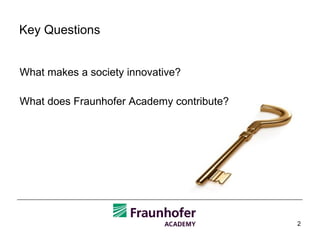
Key Questions  What makes a society innovative? What does Fraunhofer Academy contribute?
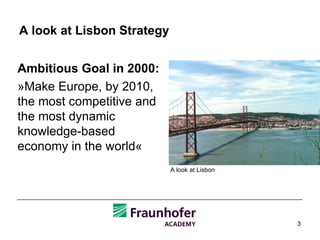
A look at Lisbon Strategy  Ambitious Goal in 2000:   »Make Europe, by 2010, the most competitive and the most dynamic knowledge-based economy in the world« A look at Lisbon
Updated goals of Lisbon Strategy   (2005)   Investments in research, education and Innovation should reach 3% gross domestic product (GDP) Boost innovation for environmental protection  Liberalized markets for services in Europe Reduced bureaucracy for companies Transition to flexible labor markets Still a long way to go!
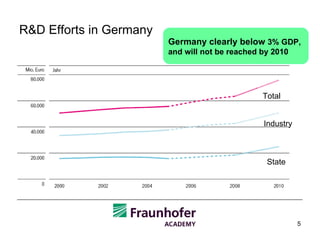
R&D Efforts in Germany Industry State Total Germany clearly below  3% GDP, and will not be reached by 2010
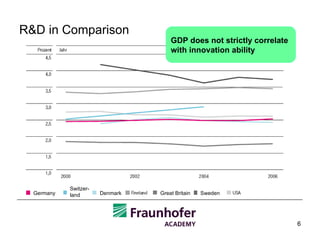
R&D in Comparison Germany Switzer- land Denmark Great Britain Sweden GDP does not strictly correlate with innovation ability
Most innovative Country is: What do you think?
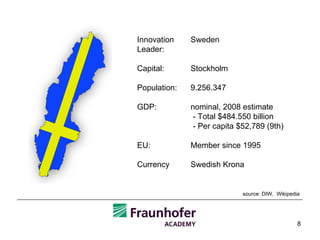
Innovation  Sweden Leader: Capital:  Stockholm Population:  9.256.347 GDP: nominal, 2008 estimate   - Total $484.550 billion    - Per capita $52,789 (9th) EU: Member since 1995  Currency Swedish Krona source: DIW,  Wikipedia
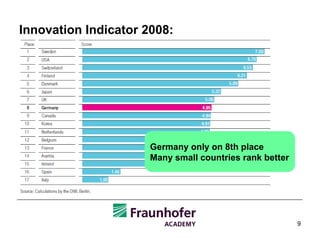
Innovation Indicator 2008: Germany only on 8th place Many small countries rank better
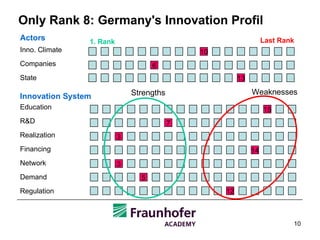
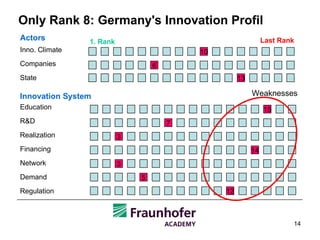
Only Rank 8: Germany's Innovation Profil Innovation System Education R&D Realization Financing Network Demand Regulation Inno. Climate Companies State Actors 1. Rank  Last Rank 3 14 5 12 10 6 13 15 7 3 Strengths Weaknesses
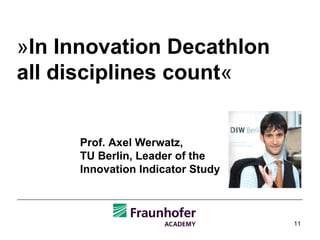
» In Innovation Decathlon all disciplines count « Prof. Axel Werwatz, TU Berlin, Leader of the  Innovation Indicator Study
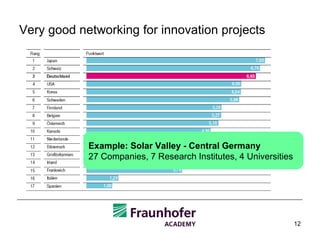
Very good networking for innovation projects Example: Solar Valley - Central Germany 27 Companies, 7 Research Institutes, 4 Universities
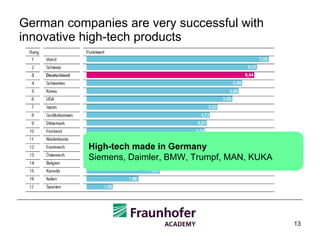
German companies are very successful with innovative high-tech products High-tech made in Germany Siemens, Daimler, BMW, Trumpf, MAN, KUKA
Only Rank 8: Germany's Innovation Profil Innovation System Education R&D Realization Financing Network Demand Regulation Inno. Climate Companies State Actors 1. Rank  Last Rank 3 14 5 12 10 6 13 15 7 3 Weaknesses
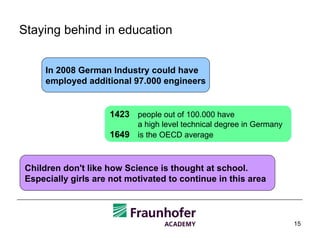
Staying behind in education 1423   people out of 100.000 have  a high level technical degree in Germany 1649   is the OECD average Children don't like how Science is thought at school. Especially girls are not motivated to continue in this area In 2008 German Industry could have  employed additional 97.000 engineers
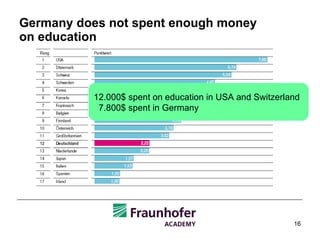
Germany does not spent enough money on education 12.000$ spent on education in USA and Switzerland 7.800$ spent in Germany
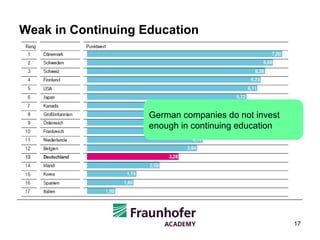
Weak in Continuing Education German companies do not invest  enough in continuing education
Key aspects for improvements  Science must be  inspiring for boys and girls  already in school Academic studies must become  modular and stay in step with industrial practice Continuing education must  teach current research knowhow directly and quickly
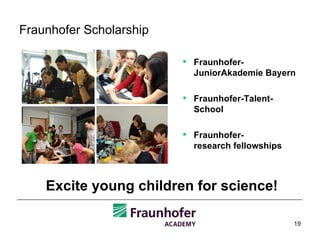
Fraunhofer Scholarship Excite young children for science!  Fraunhofer- JuniorAkademie Bayern Fraunhofer-Talent-School Fraunhofer- research fellowships
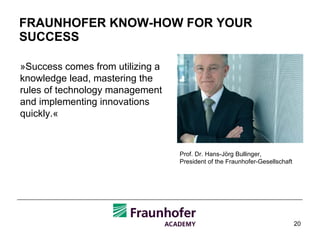
FRAUNHOFER KNOW-HOW FOR YOUR SUCCESS »Success comes from utilizing a knowledge lead, mastering the rules of technology management and implementing innovations quickly.« Prof. Dr. Hans-Jörg Bullinger,  President of the Fraunhofer-Gesellschaft
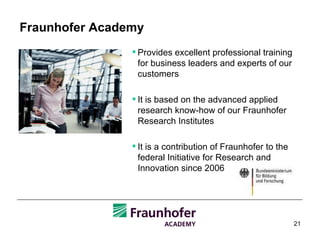
Fraunhofer Academy Provides excellent professional training for business leaders and experts of our customers It is based on the advanced applied research know-how of our Fraunhofer Research Institutes It is a contribution of Fraunhofer to the federal Initiative for Research and Innovation since 2006
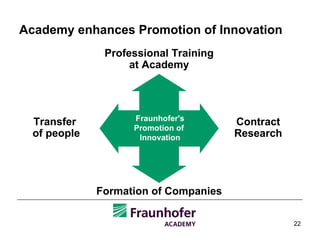
Academy enhances Promotion of Innovation Professional Training at Academy Formation of Companies Contract Research Transfer  of people Fraunhofer's Promotion of  Innovation
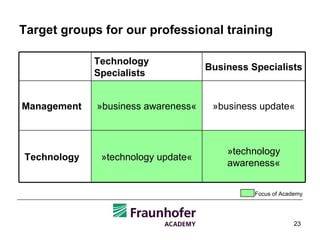
Target groups for our professional training Focus of Academy »technology awareness« »technology update« Technology »business update« »business awareness« Management Business Specialists Technology Specialists
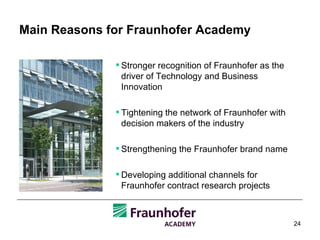
Main Reasons for Fraunhofer Academy Stronger recognition of Fraunhofer as the driver of Technology and Business Innovation Tightening the network of Fraunhofer with decision makers of the industry Strengthening the Fraunhofer brand name Developing additional channels for Fraunhofer contract research projects
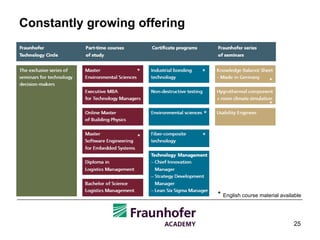
Constantly growing offering * * * * * * *  English course material available *
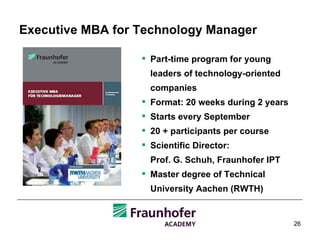
Executive MBA for Technology Manager Part-time program for young leaders of technology-oriented companies Format: 20 weeks during 2 years Starts every September 20 + participants per course Scientific Director:  Prof. G. Schuh, Fraunhofer IPT  Master degree of Technical University Aachen (RWTH )
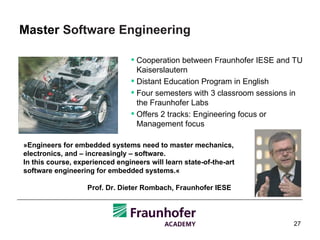
Master  Software Engineering Cooperation between Fraunhofer IESE and TU Kaiserslautern Distant Education Program in English Four semesters with 3 classroom sessions in the Fraunhofer Labs Offers 2 tracks: Engineering focus or Management focus »Engineers for embedded systems need to master mechanics, electronics, and – increasingly – software. In this course, experienced engineers will learn state-of-the-art software engineering for embedded systems.« Prof.  Dr. Dieter Rombach, Fraunhofer IESE
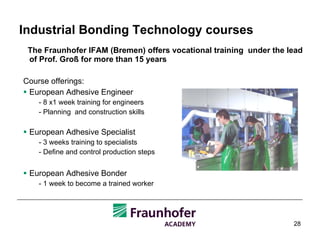
Industrial Bonding Technology courses The Fraunhofer IFAM (Bremen) offers vocational training  under the lead of Prof. Groß for more than 15 years Course offerings: European Adhesive Engineer  - 8 x1 week training for engineers - Planning  and construction skills European Adhesive Specialist  - 3 weeks training to specialists - Define and control production steps European Adhesive Bonder  - 1 week to become a trained worker
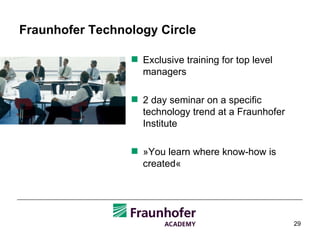
Fraunhofer Technology Circle Exclusive training for top level managers  2 day seminar on a specific technology trend at a Fraunhofer Institute »You learn where know-how is created«
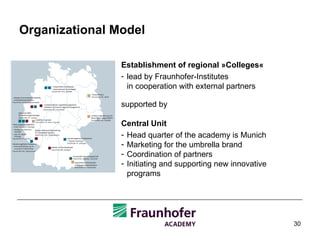
Organizational Model Establishment of regional »Colleges« lead by Fraunhofer-Institutes  in cooperation with external partners supported by Central Unit Head quarter of the academy is Munich Marketing for the umbrella brand Coordination of partners Initiating and supporting new innovative programs
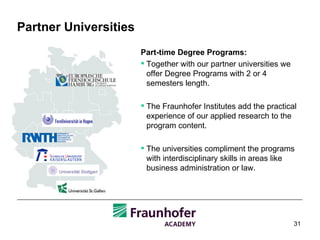
Partner Universities Part-time  Degree Programs : Together with our partner universities we offer Degree Programs with 2 or 4 semesters length.  The Fraunhofer Institutes add the practical experience of our applied research to the program content. The universities compliment the programs with interdisciplinary skills in areas like business administration or law.
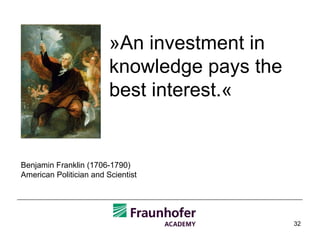
»An investment in knowledge pays the best interest.« Benjamin Franklin (1706-1790) American Politician and Scientist
Contact and further information Dr. Roman Götter Managing Director Fraunhofer Academy Hansastraße 27c 80686 München Fon:  +49 89 1205 1515 Fax: +49 89 1205 77 1515 [email_address] www.academy.fraunhofer.de Ingrid Breitenberger Marketing Coordination Fon: +49 89 1205 1516 Fax: +49 89 1205 77 1516 [email_address] Martin Fischer Education Officer Fon: +49 89 1205 1511 Fax: +49 89 1205 77 1511 [email_address]
Sources Data for GDP and Innovation Indicator: http://ww2.bdi.eu/messenews/SiteCollectionDocuments/Innovationsindikator_08_English.pdf http://ww2.bdi.eu/initiativen/innovationsindikator/Seiten/downloads.aspx pictures: © Fraunhofer: pages 1, 19-28 Technology circle key visual: Getty Images: page 29 key question: http://allthingsnu.files.wordpress.com/2008/10/key_question1.jpg Long Road: http://www.geo.de/img/userinhalte/picture_contest/60/438/43874_disp.jpg Sweden: http://openclipart.org/people/mystica/mystica_Sweden_Flag_In_Sweden_Map.png Franklin: http://www.thechemistrynerd.com/benfranklin/

Strengthening the Innovation Process

  • 1.
    Strengthening the InnovationProcess Dr. Roman Götter Managing Director, Fraunhofer Academy v7
  • 2.
    Key Questions What makes a society innovative? What does Fraunhofer Academy contribute?
  • 3.
    A look atLisbon Strategy Ambitious Goal in 2000: »Make Europe, by 2010, the most competitive and the most dynamic knowledge-based economy in the world« A look at Lisbon
  • 4.
    Updated goals ofLisbon Strategy (2005) Investments in research, education and Innovation should reach 3% gross domestic product (GDP) Boost innovation for environmental protection Liberalized markets for services in Europe Reduced bureaucracy for companies Transition to flexible labor markets Still a long way to go!
  • 5.
    R&D Efforts inGermany Industry State Total Germany clearly below 3% GDP, and will not be reached by 2010
  • 6.
    R&D in ComparisonGermany Switzer- land Denmark Great Britain Sweden GDP does not strictly correlate with innovation ability
  • 7.
    Most innovative Countryis: What do you think?
  • 8.
    Innovation SwedenLeader: Capital: Stockholm Population: 9.256.347 GDP: nominal, 2008 estimate - Total $484.550 billion - Per capita $52,789 (9th) EU: Member since 1995 Currency Swedish Krona source: DIW, Wikipedia
  • 9.
    Innovation Indicator 2008:Germany only on 8th place Many small countries rank better
  • 10.
    Only Rank 8:Germany's Innovation Profil Innovation System Education R&D Realization Financing Network Demand Regulation Inno. Climate Companies State Actors 1. Rank Last Rank 3 14 5 12 10 6 13 15 7 3 Strengths Weaknesses
  • 11.
    » In InnovationDecathlon all disciplines count « Prof. Axel Werwatz, TU Berlin, Leader of the Innovation Indicator Study
  • 12.
    Very good networkingfor innovation projects Example: Solar Valley - Central Germany 27 Companies, 7 Research Institutes, 4 Universities
  • 13.
    German companies arevery successful with innovative high-tech products High-tech made in Germany Siemens, Daimler, BMW, Trumpf, MAN, KUKA
  • 14.
    Only Rank 8:Germany's Innovation Profil Innovation System Education R&D Realization Financing Network Demand Regulation Inno. Climate Companies State Actors 1. Rank Last Rank 3 14 5 12 10 6 13 15 7 3 Weaknesses
  • 15.
    Staying behind ineducation 1423 people out of 100.000 have a high level technical degree in Germany 1649 is the OECD average Children don't like how Science is thought at school. Especially girls are not motivated to continue in this area In 2008 German Industry could have employed additional 97.000 engineers
  • 16.
    Germany does notspent enough money on education 12.000$ spent on education in USA and Switzerland 7.800$ spent in Germany
  • 17.
    Weak in ContinuingEducation German companies do not invest enough in continuing education
  • 18.
    Key aspects forimprovements Science must be inspiring for boys and girls already in school Academic studies must become modular and stay in step with industrial practice Continuing education must teach current research knowhow directly and quickly
  • 19.
    Fraunhofer Scholarship Exciteyoung children for science! Fraunhofer- JuniorAkademie Bayern Fraunhofer-Talent-School Fraunhofer- research fellowships
  • 20.
    FRAUNHOFER KNOW-HOW FORYOUR SUCCESS »Success comes from utilizing a knowledge lead, mastering the rules of technology management and implementing innovations quickly.« Prof. Dr. Hans-Jörg Bullinger, President of the Fraunhofer-Gesellschaft
  • 21.
    Fraunhofer Academy Providesexcellent professional training for business leaders and experts of our customers It is based on the advanced applied research know-how of our Fraunhofer Research Institutes It is a contribution of Fraunhofer to the federal Initiative for Research and Innovation since 2006
  • 22.
    Academy enhances Promotionof Innovation Professional Training at Academy Formation of Companies Contract Research Transfer of people Fraunhofer's Promotion of Innovation
  • 23.
    Target groups forour professional training Focus of Academy »technology awareness« »technology update« Technology »business update« »business awareness« Management Business Specialists Technology Specialists
  • 24.
    Main Reasons forFraunhofer Academy Stronger recognition of Fraunhofer as the driver of Technology and Business Innovation Tightening the network of Fraunhofer with decision makers of the industry Strengthening the Fraunhofer brand name Developing additional channels for Fraunhofer contract research projects
  • 25.
    Constantly growing offering* * * * * * * English course material available *
  • 26.
    Executive MBA forTechnology Manager Part-time program for young leaders of technology-oriented companies Format: 20 weeks during 2 years Starts every September 20 + participants per course Scientific Director: Prof. G. Schuh, Fraunhofer IPT Master degree of Technical University Aachen (RWTH )
  • 27.
    Master SoftwareEngineering Cooperation between Fraunhofer IESE and TU Kaiserslautern Distant Education Program in English Four semesters with 3 classroom sessions in the Fraunhofer Labs Offers 2 tracks: Engineering focus or Management focus »Engineers for embedded systems need to master mechanics, electronics, and – increasingly – software. In this course, experienced engineers will learn state-of-the-art software engineering for embedded systems.« Prof. Dr. Dieter Rombach, Fraunhofer IESE
  • 28.
    Industrial Bonding Technologycourses The Fraunhofer IFAM (Bremen) offers vocational training under the lead of Prof. Groß for more than 15 years Course offerings: European Adhesive Engineer - 8 x1 week training for engineers - Planning and construction skills European Adhesive Specialist - 3 weeks training to specialists - Define and control production steps European Adhesive Bonder - 1 week to become a trained worker
  • 29.
    Fraunhofer Technology CircleExclusive training for top level managers 2 day seminar on a specific technology trend at a Fraunhofer Institute »You learn where know-how is created«
  • 30.
    Organizational Model Establishmentof regional »Colleges« lead by Fraunhofer-Institutes in cooperation with external partners supported by Central Unit Head quarter of the academy is Munich Marketing for the umbrella brand Coordination of partners Initiating and supporting new innovative programs
  • 31.
    Partner Universities Part-time Degree Programs : Together with our partner universities we offer Degree Programs with 2 or 4 semesters length. The Fraunhofer Institutes add the practical experience of our applied research to the program content. The universities compliment the programs with interdisciplinary skills in areas like business administration or law.
  • 32.
    »An investment inknowledge pays the best interest.« Benjamin Franklin (1706-1790) American Politician and Scientist
  • 33.
    Contact and furtherinformation Dr. Roman Götter Managing Director Fraunhofer Academy Hansastraße 27c 80686 München Fon: +49 89 1205 1515 Fax: +49 89 1205 77 1515 [email_address] www.academy.fraunhofer.de Ingrid Breitenberger Marketing Coordination Fon: +49 89 1205 1516 Fax: +49 89 1205 77 1516 [email_address] Martin Fischer Education Officer Fon: +49 89 1205 1511 Fax: +49 89 1205 77 1511 [email_address]
  • 34.
    Sources Data forGDP and Innovation Indicator: http://ww2.bdi.eu/messenews/SiteCollectionDocuments/Innovationsindikator_08_English.pdf http://ww2.bdi.eu/initiativen/innovationsindikator/Seiten/downloads.aspx pictures: © Fraunhofer: pages 1, 19-28 Technology circle key visual: Getty Images: page 29 key question: http://allthingsnu.files.wordpress.com/2008/10/key_question1.jpg Long Road: http://www.geo.de/img/userinhalte/picture_contest/60/438/43874_disp.jpg Sweden: http://openclipart.org/people/mystica/mystica_Sweden_Flag_In_Sweden_Map.png Franklin: http://www.thechemistrynerd.com/benfranklin/

Editor's Notes

  • #11 Gesellschaft: Der Deutschen Gesellschaft fehlt leider es an Risikobereitschaft und Gründergeist. Unternehmen: Eigentlich ein Aktivposten. Aber bei der betrieblichen Innovationskultur weisen die deutschen Firmen im internationalen Vergleich dagegen Mängel auf – Unternehmen anderer Länder nutzen die Fähigkeiten und Potenziale ihrer Mitarbeiter besser. Staat: Ein Übermaß an Regulierungen hemmt die Entwicklung und Durchsetzung von Innovationen in der Bundesrepublik. Bildung: Nur mit qualifizierten Arbeitnehmern, findigen Ingenieuren und kreativen Wissenschaftlern kann eine Gesellschaft innovativ sein. Deutschlands Bildungssystem weist gravierende Mängel auf. Finanzierung: Nach dem Zusammenbruch des 'Neuen Marktes' fehlt es in Deutschland an Risikokapital. Wettbewerb: Ein Übermaß an Regulierungen hemmt die Entwicklung und Durchsetzung von Innovationen in der Bundesrepublik.
  • #15 Gesellschaft: Der Deutschen Gesellschaft fehlt leider es an Risikobereitschaft und Gründergeist. Unternehmen: Eigentlich ein Aktivposten. Aber bei der betrieblichen Innovationskultur weisen die deutschen Firmen im internationalen Vergleich dagegen Mängel auf – Unternehmen anderer Länder nutzen die Fähigkeiten und Potenziale ihrer Mitarbeiter besser. Staat: Ein Übermaß an Regulierungen hemmt die Entwicklung und Durchsetzung von Innovationen in der Bundesrepublik. Bildung: Nur mit qualifizierten Arbeitnehmern, findigen Ingenieuren und kreativen Wissenschaftlern kann eine Gesellschaft innovativ sein. Deutschlands Bildungssystem weist gravierende Mängel auf. Finanzierung: Nach dem Zusammenbruch des 'Neuen Marktes' fehlt es in Deutschland an Risikokapital. Wettbewerb: Ein Übermaß an Regulierungen hemmt die Entwicklung und Durchsetzung von Innovationen in der Bundesrepublik.
  • #22 Motivation Außensicht
  • #23 Förderung der Weiterbildung ist Satzungsziel der Fraunhofer-Gesellschaft. Sie verstärkt den Kundenbeziehung und unterstützt damit auch die Auftragsforschung.
  • #24 Fokus der FTA: ergibt sich daraus, dass die Zielgruppe und/oder die Inhalte der Weiterbildung einen Technikbezug aufweisen müssen. Daher werden an Führungskräfte mit technischem Hintergrund sowohl Management- als auch Technologieinhalte vermittelt, an Führungskräfte mit nicht-technischem Hintergrund Technologieinhalte. Nicht im Fokus sind Business-Inhalte für nicht-Techniker (keine Business School).
  • #25 Motivation Innensicht
  • #26 Herbst 2005 Start mit 5 Programmen (grau) 2007 Ausbau auf 11 Angebote (Grün sind neue Angebote) 2008 6 weitere Programme in Planung
  • #27 »Entscheidung für einen der besten Executive MBA im deutschsprachigen Raum, dabei der Einzige, der speziell auf die Zielgruppe der Ingenieure und Naturwissenschaftler ausgerichtet ist.« Ranking capital 24/2005: »Erste Adressen mit anerkanntem Gütesiegel«
  • #30 Start 28. Februar 2008 in Stuttgart
  • #32 Fraunhofer IML aus Dortmund: Diplomstudiengang Logistik (2 Semester) in Kooperation mit Universität St. Gallen. Fraunhofer IUSE aus Oberhausen: Masterstudiengang Umweltwissenschaften (4 Semester) in Kooperation mit der FernUniversität in Hagen. Fraunhofer IPT aus Aachen: Executive MBA für Technologiemanager (4 Semester) in Kooperation mit RWTH Aachen und der Universität St. Gallen. Fraunhofer IESE aus Kaiserslautern: Masterstudiengang Software Engineering (4 Semester) in Kooperation mit der TU Kaiserslautern. Fraunhofer IBP aus Stuttgart: Masterstudiengang Bauphysik (4 Semester) in Kooperation mit der Universität Stuttgart
  • #33 Schon vor 250 Jahren richtig