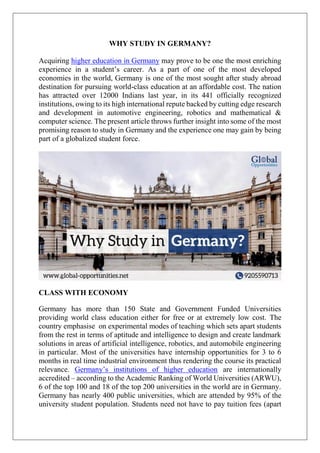
WHY STUDY IN GERMANY?
Acquiring higher education in Germany may prove to be one the most enriching
experience in a student’s career. As a part of one of the most developed
economies in the world, Germany is one of the most sought after study abroad
destination for pursuing world-class education at an affordable cost. The nation
has attracted over 12000 Indians last year, in its 441 officially recognized
institutions, owing to its high international repute backed by cutting edge research
and development in automotive engineering, robotics and mathematical &
computer science. The present article throws further insight into some of the most
promising reason to study in Germany and the experience one may gain by being
part of a globalized student force.
CLASS WITH ECONOMY
Germany has more than 150 State and Government Funded Universities
providing world class education either for free or at extremely low cost. The
country emphasise on experimental modes of teaching which sets apart students
from the rest in terms of aptitude and intelligence to design and create landmark
solutions in areas of artificial intelligence, robotics, and automobile engineering
in particular. Most of the universities have internship opportunities for 3 to 6
months in real time industrial environment thus rendering the course its practical
relevance. Germany’s institutions of higher education are internationally
accredited – according to the Academic Ranking of World Universities (ARWU),
6 of the top 100 and 18 of the top 200 universities in the world are in Germany.
Germany has nearly 400 public universities, which are attended by 95% of the
university student population. Students need not have to pay tuition fees (apart
from a small administrative cost at the start of each semester). In addition there
are also around 120 private institutions. Germany is for serious learners who don’t
have to worry much about tuition fee. Higher education in Germany is funded by
the states and a student has thus to manage only his/her living expense. More than
95% of the entire higher education system in 150 universities is funded by the
state. The learning is cutting edge with a very high promise of a lucrative career.
TEST FOR ACADEMIC STUDIES AND PROPAEDEUTIC COURSES
Germany offers guidance on selection of courses through one of its unique test
viz. the Test for Academic Studies (TestAS, www.testas.de for further details).
After taking the test, students can more realistically assess the likelihood of
completing a degree program. Passing the test also escalate the chance of gaining
admission into university of one’s choice. Additionally, propaedeutic courses are
also offered by few universities to provide students preparatory courses in
language and academics. The course typically includes an introduction to the
Germany university system and scientific working methods.
DUAL EDUCATION BENEFITS
One of the most striking features of German education system is its dual
education system of learning. It combines the best features of theory and practice
in a single course. Most of the universities have Internship Opportunities from 3
to 6 months inside the course curriculum thereby making the program practical
oriented. Under this arrangement, candidates are trained in a company for three
to five days a week according to the specified standards. The practical training is
combined with the technical know-how and practical sessions at industry
workshops thus providing hands on experience of the actual way of carrying
operations in a company setting. On completion of the program students gets a
degree as well as an experience certificate.
AFFORDABLE LIVING
The cost of living is around €700 - €800 per year including rent, food, transport,
health insurance, internet, stationery, and recreational activities. Apart from that,
international students are also allowed to work for 90 days (full working day) or
180 days (half working day) in a year. The average wage rate is around €15 per
hour.
SPECTRUM OF COURSES
Germany offers more than 16000 courses of study under all levels. Germany leads
world innovation in areas as diverse as automobile, aerospace, modern warfare
systems, and mathematical sciences. It has the second highest number of Nobel
laureates in the world after USA. This speaks volumes about its educational
system and the focus that the nation pays on research and innovation.
LEADERSHIP AT THE HIGHEST LEVEL
Germany is the largest economic power in Europe and the third largest in the
world. This makes it a place to be for young learners and researchers. It leads the
world automobile market in terms of engineering and superior quality. Artificial
intelligence is also another area in which Germany undisputedly holds an edge in
research and development. So saying that Germany offers a great learning
experience is grossly an understatement. This is rightly the place where the
biggest, brightest and the most futuristic designs are taking shape.

WHY STUDY IN GERMANY?

  • 1.
    WHY STUDY INGERMANY? Acquiring higher education in Germany may prove to be one the most enriching experience in a student’s career. As a part of one of the most developed economies in the world, Germany is one of the most sought after study abroad destination for pursuing world-class education at an affordable cost. The nation has attracted over 12000 Indians last year, in its 441 officially recognized institutions, owing to its high international repute backed by cutting edge research and development in automotive engineering, robotics and mathematical & computer science. The present article throws further insight into some of the most promising reason to study in Germany and the experience one may gain by being part of a globalized student force. CLASS WITH ECONOMY Germany has more than 150 State and Government Funded Universities providing world class education either for free or at extremely low cost. The country emphasise on experimental modes of teaching which sets apart students from the rest in terms of aptitude and intelligence to design and create landmark solutions in areas of artificial intelligence, robotics, and automobile engineering in particular. Most of the universities have internship opportunities for 3 to 6 months in real time industrial environment thus rendering the course its practical relevance. Germany’s institutions of higher education are internationally accredited – according to the Academic Ranking of World Universities (ARWU), 6 of the top 100 and 18 of the top 200 universities in the world are in Germany. Germany has nearly 400 public universities, which are attended by 95% of the university student population. Students need not have to pay tuition fees (apart
  • 2.
    from a smalladministrative cost at the start of each semester). In addition there are also around 120 private institutions. Germany is for serious learners who don’t have to worry much about tuition fee. Higher education in Germany is funded by the states and a student has thus to manage only his/her living expense. More than 95% of the entire higher education system in 150 universities is funded by the state. The learning is cutting edge with a very high promise of a lucrative career. TEST FOR ACADEMIC STUDIES AND PROPAEDEUTIC COURSES Germany offers guidance on selection of courses through one of its unique test viz. the Test for Academic Studies (TestAS, www.testas.de for further details). After taking the test, students can more realistically assess the likelihood of completing a degree program. Passing the test also escalate the chance of gaining admission into university of one’s choice. Additionally, propaedeutic courses are also offered by few universities to provide students preparatory courses in language and academics. The course typically includes an introduction to the Germany university system and scientific working methods. DUAL EDUCATION BENEFITS One of the most striking features of German education system is its dual education system of learning. It combines the best features of theory and practice in a single course. Most of the universities have Internship Opportunities from 3 to 6 months inside the course curriculum thereby making the program practical oriented. Under this arrangement, candidates are trained in a company for three to five days a week according to the specified standards. The practical training is combined with the technical know-how and practical sessions at industry workshops thus providing hands on experience of the actual way of carrying operations in a company setting. On completion of the program students gets a degree as well as an experience certificate. AFFORDABLE LIVING The cost of living is around €700 - €800 per year including rent, food, transport, health insurance, internet, stationery, and recreational activities. Apart from that, international students are also allowed to work for 90 days (full working day) or 180 days (half working day) in a year. The average wage rate is around €15 per hour. SPECTRUM OF COURSES Germany offers more than 16000 courses of study under all levels. Germany leads world innovation in areas as diverse as automobile, aerospace, modern warfare
  • 3.
    systems, and mathematicalsciences. It has the second highest number of Nobel laureates in the world after USA. This speaks volumes about its educational system and the focus that the nation pays on research and innovation. LEADERSHIP AT THE HIGHEST LEVEL Germany is the largest economic power in Europe and the third largest in the world. This makes it a place to be for young learners and researchers. It leads the world automobile market in terms of engineering and superior quality. Artificial intelligence is also another area in which Germany undisputedly holds an edge in research and development. So saying that Germany offers a great learning experience is grossly an understatement. This is rightly the place where the biggest, brightest and the most futuristic designs are taking shape.