CHW AIM Toolkit Changes &  Applications  DONNA BJERREGAARD INITIATIVES INC. FOR USAID HEALTH CARE IMPROVEMENT PROJECT CORE GROUP MEETING 5-11-2011
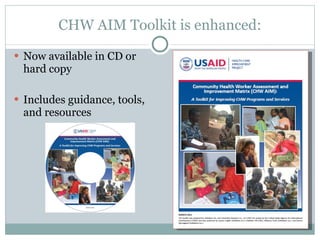
CHW AIM Toolkit is enhanced: Now available in CD or hard copy Includes guidance, tools, and resources
CHW AIM Toolkit Contents Introduction CHW Program Functionality Matrix  Intervention Matrices MNCH, HIV/AIDS, and TB Soon to include WASH & FP Facilitator’s Guide Training Guide Appendices Participant Selection Form for Workshop Comprehensive Document Review Guide and Checklist for CHW Programs  CHW AIM Validation Questionnaire Score and Score Rationale Documentation Worksheet CHW AIM Program Functionality Score Sheet CHW AIM Action Planning Framework Resources and Field Examples
The CHW AIM Field Applications  Field tests in Nepal and Benin Salvation Army in Zambia assessed the Chikankata Child Survival Project WHO GHWA 8 country case studies on CHW Programs Save the Children in Ethiopia assessed CHWs and HEWs CHW AIM OR: comparative study in Zambia to assess impact of applying CHW AIM as an improvement framework Quick Facts: Donor – USAID Timeframe: 2008 – present Country applications: 11 Quantitative data sets generated: 19 Workshops: 9 with 146 participants Qualitative data sets generated: 12 (interviews)
WHO Results  Country Case Studies  NOTE:  For a minimally functional program    a score of at least  2  is required in each of the 12 components CHW-AIM Pakistan Bangladesh Thailand Brazil Haiti Ethiopia Uganda Mozambique Recruitment 3 3 3 3 3 3 3 3 CHW Role 3 2 3 2 3 3 2 2 Initial Training 3 2 3 3 3 3 3 3 Ongoing Training 2 3 2 3 2 2 1 1 Equipment and Supplies 2 3 2 3 2 2 1 2 Supervision 3 3 0 3 3 3 2 2 Performance Evaluation 3 2 0 3 2 2 2 1 Incentives 2 2 2 3 3 2 1 0 Community Involvement 2 3 3 3 2 2 2 2 Referral System 1 1 1 3 3 2 1 1 Professional Advancement 2 0 1 2 2 2 0 2 Documentation, Information System 2 1 0 3 3 3 2 0 Average Score  2.1 1.6 2.1 2.8 2.6 2.4 1.6 1.6
CHW AIM Results from 19 programs
CHW AIM OR: Does it improve performance To test the effectiveness of the CHW AIM toolkit as a capacity building and performance improvement tool. To test the theory that strengthening CHW program functionality leads to improved CHW engagement and performance.  To assess the costs associated with implementing the CHW AIM tool and the incremental cost effectiveness associated with its use.
CHW AIM OR Timeline:  2 years – July 2010 to June 2012 Partners: 3 I/FBO/I/NGO; 2 local and one regional program Sample: 5 CHW programs and 130 CHWs, one control (30 CHWs) Tools: CHW AIM, CHW engagement survey, CHW engagement interview, program management interview, performance assessments (against stds)
CHW AIM OR Baseline Results
Performance Against National Service Delivery Standards
Self-Ranked Engagement
CHW AIM Facilitating Factors Both quantitative (scoring and counting) and qualitative (interviews and discussion) Can be applied at a country level to assess multiple programs or at the individual level Provides clear criteria across programs for multiple partners/implementers Can be complemented with other tools  Matrix can be applied without the workshop through interviews and document discovery (e.g., GHWA 8 country case studies, Ethiopia)
www.CHWCentral.org : An Online Community of Practice
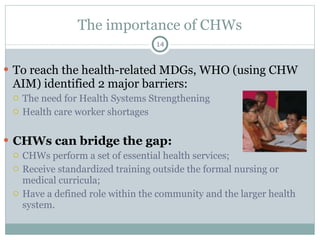
The importance of CHWs To reach the health-related MDGs, WHO (using CHW AIM) identified 2 major barriers:  The need for Health Systems Strengthening  Health care worker shortages  CHWs can bridge the gap:  CHWs perform a set of essential health services; Receive standardized training outside the formal nursing or medical curricula; Have a defined role within the community and the larger health system.
Birth of the Community of Practice CHW AIM process presented 15 components  & raised questions about how to  improve CHW program functionality .  Questions about resources: What information exists?  What best practices can be shared?  What questions need to be answered?  How can these gaps be addressed?  www.CHWCentral.org was conceived to provide  one-stop shopping  for collective learning, problem solving and sharing information and ideas
Situational Analysis & Results Building on lessons learned:  Literature  Websites  User Surveys and Key Informants Identified priority topics:  Training Program performance evaluation  Incentives  Community involvement  Methodology:   Downloadable documents  Email & Discussion forums Virtual learning sessions  Initiatives Inc. Annual Retreat 2008
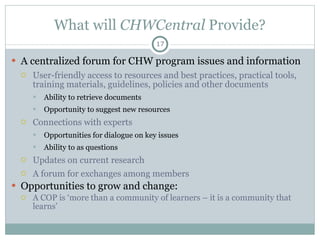
What will  CHWCentral  Provide? A centralized forum for CHW program issues and information User-friendly access to resources and best practices, practical tools, training materials, guidelines, policies and other documents Ability to retrieve documents  Opportunity to suggest new resources  Connections with experts Opportunities for dialogue on key issues Ability to as questions Updates on current research A forum for exchanges among members  Opportunities to grow and change:  A COP is ‘more than a community of learners – it is a community that learns’
The Website: www.chwcentral.org
Current Status Launch: June 14 th  at the Global Health Council meeting Join us: 6:30 pm at the Omni Shoreham Resources ready to post First experts in place and discussion topic prepared  Additional experts lined up  Technical Advisory Group being created
How Will We Know if the Site Works? Using metrics and qualitative surveys to determine:  Is the number of members increasing over time? Does the content match user expectations? How easy is the site to access and use globally? Is the number of online resources growing?  Does the material aid implementation?
Challenges and Next Steps Maintaining a vibrant, dynamic and unique site  Encouraging membership Getting and responding to feedback Monitoring and improving site Launch TAG meeting  Engage field & HQ members  Moderate site activity Test technology/content and incorporate feedback  Gather new/or update resources
What can you do? Visit  www.chwcentral.org   (June 2011) Promote the site to programs and projects using CHWs Recommend resource materials Provide feedback using our survey  Sign Up at URC/HCI booth

CHWs on the Move_Bjerregaard_5.10.11

  • 1.
    CHW AIM ToolkitChanges & Applications DONNA BJERREGAARD INITIATIVES INC. FOR USAID HEALTH CARE IMPROVEMENT PROJECT CORE GROUP MEETING 5-11-2011
  • 2.
    CHW AIM Toolkitis enhanced: Now available in CD or hard copy Includes guidance, tools, and resources
  • 3.
    CHW AIM ToolkitContents Introduction CHW Program Functionality Matrix Intervention Matrices MNCH, HIV/AIDS, and TB Soon to include WASH & FP Facilitator’s Guide Training Guide Appendices Participant Selection Form for Workshop Comprehensive Document Review Guide and Checklist for CHW Programs CHW AIM Validation Questionnaire Score and Score Rationale Documentation Worksheet CHW AIM Program Functionality Score Sheet CHW AIM Action Planning Framework Resources and Field Examples
  • 4.
    The CHW AIMField Applications Field tests in Nepal and Benin Salvation Army in Zambia assessed the Chikankata Child Survival Project WHO GHWA 8 country case studies on CHW Programs Save the Children in Ethiopia assessed CHWs and HEWs CHW AIM OR: comparative study in Zambia to assess impact of applying CHW AIM as an improvement framework Quick Facts: Donor – USAID Timeframe: 2008 – present Country applications: 11 Quantitative data sets generated: 19 Workshops: 9 with 146 participants Qualitative data sets generated: 12 (interviews)
  • 5.
    WHO Results Country Case Studies NOTE: For a minimally functional program  a score of at least 2 is required in each of the 12 components CHW-AIM Pakistan Bangladesh Thailand Brazil Haiti Ethiopia Uganda Mozambique Recruitment 3 3 3 3 3 3 3 3 CHW Role 3 2 3 2 3 3 2 2 Initial Training 3 2 3 3 3 3 3 3 Ongoing Training 2 3 2 3 2 2 1 1 Equipment and Supplies 2 3 2 3 2 2 1 2 Supervision 3 3 0 3 3 3 2 2 Performance Evaluation 3 2 0 3 2 2 2 1 Incentives 2 2 2 3 3 2 1 0 Community Involvement 2 3 3 3 2 2 2 2 Referral System 1 1 1 3 3 2 1 1 Professional Advancement 2 0 1 2 2 2 0 2 Documentation, Information System 2 1 0 3 3 3 2 0 Average Score 2.1 1.6 2.1 2.8 2.6 2.4 1.6 1.6
  • 6.
    CHW AIM Resultsfrom 19 programs
  • 7.
    CHW AIM OR:Does it improve performance To test the effectiveness of the CHW AIM toolkit as a capacity building and performance improvement tool. To test the theory that strengthening CHW program functionality leads to improved CHW engagement and performance. To assess the costs associated with implementing the CHW AIM tool and the incremental cost effectiveness associated with its use.
  • 8.
    CHW AIM ORTimeline: 2 years – July 2010 to June 2012 Partners: 3 I/FBO/I/NGO; 2 local and one regional program Sample: 5 CHW programs and 130 CHWs, one control (30 CHWs) Tools: CHW AIM, CHW engagement survey, CHW engagement interview, program management interview, performance assessments (against stds)
  • 9.
    CHW AIM ORBaseline Results
  • 10.
    Performance Against NationalService Delivery Standards
  • 11.
  • 12.
    CHW AIM FacilitatingFactors Both quantitative (scoring and counting) and qualitative (interviews and discussion) Can be applied at a country level to assess multiple programs or at the individual level Provides clear criteria across programs for multiple partners/implementers Can be complemented with other tools Matrix can be applied without the workshop through interviews and document discovery (e.g., GHWA 8 country case studies, Ethiopia)
  • 13.
    www.CHWCentral.org : AnOnline Community of Practice
  • 14.
    The importance ofCHWs To reach the health-related MDGs, WHO (using CHW AIM) identified 2 major barriers: The need for Health Systems Strengthening Health care worker shortages CHWs can bridge the gap: CHWs perform a set of essential health services; Receive standardized training outside the formal nursing or medical curricula; Have a defined role within the community and the larger health system.
  • 15.
    Birth of theCommunity of Practice CHW AIM process presented 15 components & raised questions about how to improve CHW program functionality . Questions about resources: What information exists? What best practices can be shared? What questions need to be answered? How can these gaps be addressed? www.CHWCentral.org was conceived to provide one-stop shopping for collective learning, problem solving and sharing information and ideas
  • 16.
    Situational Analysis &Results Building on lessons learned: Literature Websites User Surveys and Key Informants Identified priority topics: Training Program performance evaluation Incentives Community involvement Methodology: Downloadable documents Email & Discussion forums Virtual learning sessions Initiatives Inc. Annual Retreat 2008
  • 17.
    What will CHWCentral Provide? A centralized forum for CHW program issues and information User-friendly access to resources and best practices, practical tools, training materials, guidelines, policies and other documents Ability to retrieve documents Opportunity to suggest new resources Connections with experts Opportunities for dialogue on key issues Ability to as questions Updates on current research A forum for exchanges among members Opportunities to grow and change: A COP is ‘more than a community of learners – it is a community that learns’
  • 18.
  • 19.
    Current Status Launch:June 14 th at the Global Health Council meeting Join us: 6:30 pm at the Omni Shoreham Resources ready to post First experts in place and discussion topic prepared Additional experts lined up Technical Advisory Group being created
  • 20.
    How Will WeKnow if the Site Works? Using metrics and qualitative surveys to determine: Is the number of members increasing over time? Does the content match user expectations? How easy is the site to access and use globally? Is the number of online resources growing? Does the material aid implementation?
  • 21.
    Challenges and NextSteps Maintaining a vibrant, dynamic and unique site Encouraging membership Getting and responding to feedback Monitoring and improving site Launch TAG meeting Engage field & HQ members Moderate site activity Test technology/content and incorporate feedback Gather new/or update resources
  • 22.
    What can youdo? Visit www.chwcentral.org (June 2011) Promote the site to programs and projects using CHWs Recommend resource materials Provide feedback using our survey Sign Up at URC/HCI booth

Editor's Notes

  • #3 Context and reason for request to develop tool: FY2008 USAID MCH Priority Increase functional CHWs by 100,000 (original request) PEPFAR II Health systems strengthening Specific target to increase health workers by 140,000 Global Health Initiative Health systems strengthening Although original request was to measure and count functional community health workers, objectives changed when tool was seen as an effective way to strengthen CHW programs and to develop common and crosscutting criteria for functional programs.
  • #6 WHO and Global Health Workforce Alliance (GHWA) used the CHW AIM as a benchmark for assessing 8 country programs. At this point in the tool development there were 12 components. The tool was not applied in a workshop but rather through review of documentation and interviews. For each of the 12 components listed above, four levels of functionality are described that range from non-functional (Level 0) to highly functional as defined by suggested best practices (Level 3).
  • #10 WHO and Global Health Workforce Alliance (GHWA) used the CHW AIM as a benchmark for assessing 8 country programs. At this point in the tool development there were 12 components. The tool was not applied in a workshop but rather through review of documentation and interviews. For each of the 12 components listed above, four levels of functionality are described that range from non-functional (Level 0) to highly functional as defined by suggested best practices (Level 3).