Apache Flink in action –
stream processing of mobile
networks
Future of Data: Real Time Stream Processing with Apache Flink
Who we are
We are a company that deals with the
processing of data, its storage, distribution
and analysis. We combine advanced
technology with expert services in order to
obtain value for our customers.
Main focus is on the big data technologies,
like Hadoop, Kafka, NiFi, Flink.
Web: http://triviadata.com/
What we‘re going to talk about
• Why mobile network operators need stream processing
• Architecture
• Business Challenges
• Operating Flink in Hadoop environment
• Stream processing challenges in our use case
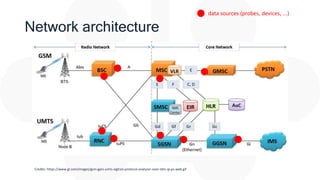
Network architecture
Credits: https://www.gl.com/images/gsm-gprs-umts-sigtran-protocol-analyzer-over-tdm-ip-ps-web.gif
data sources (probes, devices, ...)
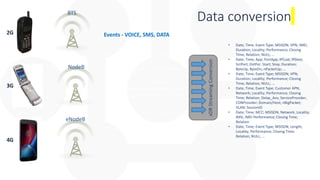
xDRStreamingConversion
2G
BTS
3G
NodeB
4G
eNodeB
00101101001111100010101000100110111001000010
00101101000101010001001101110010000111110010
01101001101110010111000101010001001100010
10101101000101010001001101110010000111110010
0010111001001011010000111110101000100000010
0011101001101110010111000101010001001100010
101101001101110010111000101010001001100010
Events - VOICE, SMS, DATA
• Date; Time; Event Type; MSISDN; VPN; IMEI;
Duration; Locality; Performance; Closing
Time; Relation; NULL; ...
• Date; Time; App; PortApp; IPCust; IPDest;
SrcPort; DstPor; Start; Stop; Duration;
ByteUp; ByteDn; nPacketUp; ...
• Date; Time; Event Type; MSISDN; VPN;
Duration; Locality; Performance; Closing
Time; Relation; NULL; ...
• Date; Time; Event Type; Customer APN;
Network; Locality; Performance; Closing
Time; Relation; Delay_Ans; ServiceProvider;
CDNProvider; Domain/Host; nBigPacket;
VLAN; SessionID
• Date; Time; MCC; MSISDN; Network; Locality;
IMSI, IMEI Performance; Closing Time;
Relation
• Date; Time; Event Type; MSISDN; Lenght;
Locality; Performance; Closing Time;
Relation; NULL; ...
Data conversion
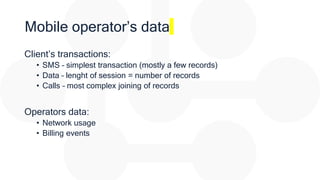
Mobile operator’s data
Client’s transactions:
• SMS – simplest transaction (mostly a few records)
• Data – lenght of session = number of records
• Calls – most complex joining of records
Operators data:
• Network usage
• Billing events
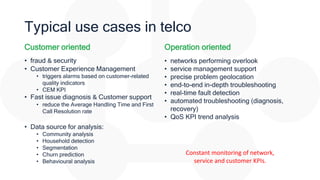
Typical use cases in telco
Customer oriented
• fraud & security
• Customer Experience Management
• triggers alarms based on customer-related
quality indicators
• CEM KPI
• Fast issue diagnosis & Customer support
• reduce the Average Handling Time and First
Call Resolution rate
• Data source for analysis:
• Community analysis
• Household detection
• Segmentation
• Churn prediction
• Behavioural analysis
Operation oriented
• networks performing overlook
• service management support
• precise problem geolocation
• end-to-end in-depth troubleshooting
• real-time fault detection
• automated troubleshooting (diagnosis,
recovery)
• QoS KPI trend analysis
Constant monitoring of network,
service and customer KPIs.
Use cases in action
• Network Analytics (web application)
• Cell
• User
• Device
• Getting raw data into HDFS for analysts – SQL queries via
Impala
They already do it
• DWH style
• Batch processing
Challenges
• Conversion from binary format (e.g. ASN.1)
• Tightening the feedback loop
• Have solution ready for future use cases
• Anomaly detection
• Predictive maintenance
• Still allow people to run analytical queries on data
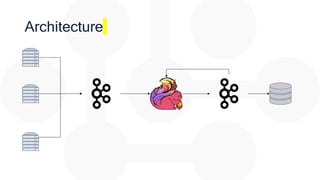
Architecture
Apache Kafka
• De facto standard for stream processing
• Fault tolerant
• Highly scalable
• We use it with
• Avro (schema evolution)
• Schema registry
Apache Flink
• Very flexible window definitions
• Event time semantics
• Many deployment options
• Can handle large state
Challenges
• Running Flink on YARN
• Secured Hadoop & Kafka cluster
• Data onboarding
• Side inputs/data enrichment
• Storing data in Hadoop
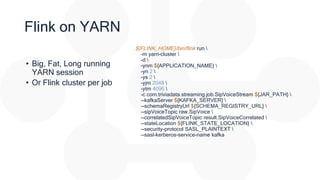
Flink on YARN
• Big, Fat, Long running
YARN session
• Or Flink cluster per job
${FLINK_HOME}/bin/flink run 
-m yarn-cluster 
-d 
-ynm ${APPLICATION_NAME} 
-yn 2 
-ys 2 
-yjm 2048 
-ytm 4096 
-c com.triviadata.streaming.job.SipVoiceStream ${JAR_PATH} 
--kafkaServer ${KAFKA_SERVER} 
--schemaRegistryUrl ${SCHEMA_REGISTRY_URL} 
--sipVoiceTopic raw.SipVoice 
--correlatedSipVoiceTopic result.SipVoiceCorrelated 
--stateLocation ${FLINK_STATE_LOCATION} 
--security-protocol SASL_PLAINTEXT 
--sasl-kerberos-service-name kafka
Kerberized Hadoop & Kafka
• Easy & Straightforward Flink setup
• Hbase/Phoenix privileges
• Hassle with Kafka ACLs
• ACL to read from the topic
• ACL to write to the topic
• ACL to join consumer group
security.kerberos.login.use-ticket-cache: false
security.kerberos.login.keytab: /home/appuser/appuser.keytab
security.kerberos.login.principal: appuser
security.kerberos.login.contexts: Client,KafkaClient
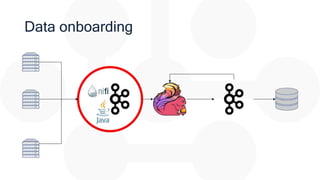
Data onboarding
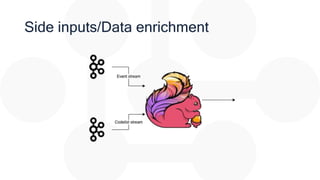
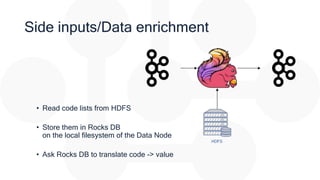
Side inputs/Data enrichment
• Read code lists from HDFS
• Store them in Rocks DB
on the local filesystem of the Data Node
• Ask Rocks DB to translate code -> value
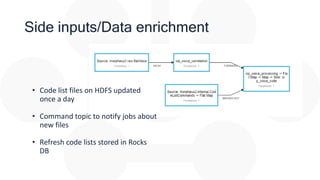
Side inputs/Data enrichment
• Code list files on HDFS updated
once a day
• Command topic to notify jobs about
new files
• Refresh code lists stored in Rocks
DB
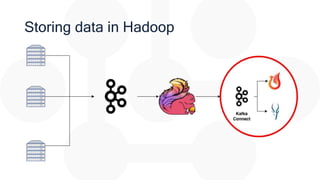
Storing data in Hadoop
Apache Phoenix
• OLTP DB on top of HBase
• JDBC API
• ACID transactions
• Secondary indexes
• Joins
Cloudera Impala
• Analytic database for Hadoop
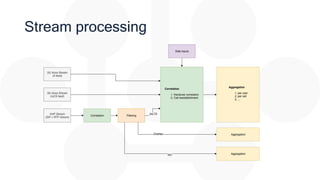
Stream processing
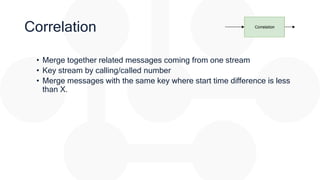
Correlation
• Merge together related messages coming from one stream
• Key stream by calling/called number
• Merge messages with the same key where start time difference is less
than X.
Correlation
override def processElement(
value: SipVoice,
ctx: KeyedProcessFunction[String, SipVoice,
SipVoices]#Context,
out: Collector[SipVoices]): Unit = {
val startTime = parseTime(value.startTime)
val (key, values) =
sipVoiceState
.keys
.asScala
.find(s => math.abs(s - startTime) <= waitingTime)
.map(k => (k, value :: sipVoiceState.get(k)))
.getOrElse {
val triggerTimeStamp =
ctx.timerService().currentProcessingTime() + delayPeriod
ctx
.timerService
.registerProcessingTimeTimer(triggerTimeStamp)
sipVoiceTimers
.put(triggerTimeStamp, startTime)
(startTime, List(value))
}
sipVoiceState.put(key, values)
}
override def onTimer(
timestamp: Long,
ctx: KeyedProcessFunction[String, SipVoice,
SipVoices]#OnTimerContext,
out: Collector[SipVoices]): Unit = {
if (sipVoiceTimers.contains(timestamp)) {
val sipVoiceKey = sipVoiceTimers.get(timestamp)
val correlationId = UUID.randomUUID().toString
val correlatedSipVoices =
sipVoiceState
.get(sipVoiceKey)
.map(_.toCorrelated(correlationId))
.sortBy(_.startTime)
out.collect(SipVoices(correlatedSipVoices))
correlatedSipVoice.inc()
inStateSipVoice.dec(correlatedSipVoices.size)
sipVoiceTimers.remove(timestamp)
sipVoiceState.remove(sipVoiceKey)
}
}
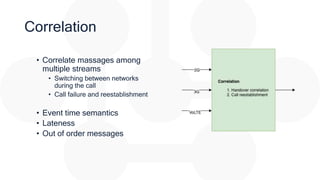
Correlation
• Correlate massages among
multiple streams
• Switching between networks
during the call
• Call failure and reestablishment
• Event time semantics
• Lateness
• Out of order messages
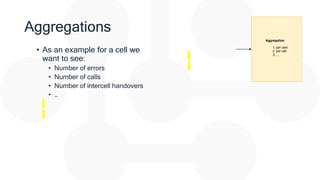
Aggregations
• As an example for a cell we
want to see:
• Number of errors
• Number of calls
• Number of intercell handovers
• …
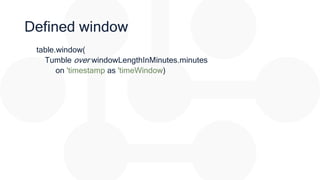
Defined window
table.window(
Tumble over windowLengthInMinutes.minutes
on 'timestamp as 'timeWindow)
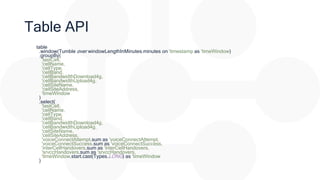
Table API
table
.window(Tumble over windowLengthInMinutes.minutes on 'timestamp as 'timeWindow)
.groupBy(
'lastCell,
'cellName,
'cellType,
'cellBand,
'cellBandwidthDownload4g,
'cellBandwidthUpload4g,
'cellSiteName,
'cellSiteAddress,
'timeWindow
)
.select(
'lastCell,
'cellName,
'cellType,
'cellBand,
'cellBandwidthDownload4g,
'cellBandwidthUpload4g,
'cellSiteName,
'cellSiteAddress,
'voiceConnectAttempt.sum as 'voiceConnectAttempt,
'voiceConnectSuccess.sum as 'voiceConnectSuccess,
'interCellHandovers.sum as 'interCellHandovers,
'srvccHandovers.sum as 'srvccHandovers,
'timeWindow.start.cast(Types.LONG) as 'timeWindow
)

Stream processing on mobile networks

  • 1.
    Apache Flink inaction – stream processing of mobile networks Future of Data: Real Time Stream Processing with Apache Flink
  • 2.
    Who we are Weare a company that deals with the processing of data, its storage, distribution and analysis. We combine advanced technology with expert services in order to obtain value for our customers. Main focus is on the big data technologies, like Hadoop, Kafka, NiFi, Flink. Web: http://triviadata.com/
  • 3.
    What we‘re goingto talk about • Why mobile network operators need stream processing • Architecture • Business Challenges • Operating Flink in Hadoop environment • Stream processing challenges in our use case
  • 4.
  • 5.
    xDRStreamingConversion 2G BTS 3G NodeB 4G eNodeB 00101101001111100010101000100110111001000010 00101101000101010001001101110010000111110010 01101001101110010111000101010001001100010 10101101000101010001001101110010000111110010 0010111001001011010000111110101000100000010 0011101001101110010111000101010001001100010 101101001101110010111000101010001001100010 Events - VOICE,SMS, DATA • Date; Time; Event Type; MSISDN; VPN; IMEI; Duration; Locality; Performance; Closing Time; Relation; NULL; ... • Date; Time; App; PortApp; IPCust; IPDest; SrcPort; DstPor; Start; Stop; Duration; ByteUp; ByteDn; nPacketUp; ... • Date; Time; Event Type; MSISDN; VPN; Duration; Locality; Performance; Closing Time; Relation; NULL; ... • Date; Time; Event Type; Customer APN; Network; Locality; Performance; Closing Time; Relation; Delay_Ans; ServiceProvider; CDNProvider; Domain/Host; nBigPacket; VLAN; SessionID • Date; Time; MCC; MSISDN; Network; Locality; IMSI, IMEI Performance; Closing Time; Relation • Date; Time; Event Type; MSISDN; Lenght; Locality; Performance; Closing Time; Relation; NULL; ... Data conversion
  • 6.
    Mobile operator’s data Client’stransactions: • SMS – simplest transaction (mostly a few records) • Data – lenght of session = number of records • Calls – most complex joining of records Operators data: • Network usage • Billing events
  • 7.
    Typical use casesin telco Customer oriented • fraud & security • Customer Experience Management • triggers alarms based on customer-related quality indicators • CEM KPI • Fast issue diagnosis & Customer support • reduce the Average Handling Time and First Call Resolution rate • Data source for analysis: • Community analysis • Household detection • Segmentation • Churn prediction • Behavioural analysis Operation oriented • networks performing overlook • service management support • precise problem geolocation • end-to-end in-depth troubleshooting • real-time fault detection • automated troubleshooting (diagnosis, recovery) • QoS KPI trend analysis Constant monitoring of network, service and customer KPIs.
  • 8.
    Use cases inaction • Network Analytics (web application) • Cell • User • Device • Getting raw data into HDFS for analysts – SQL queries via Impala
  • 9.
    They already doit • DWH style • Batch processing
  • 10.
    Challenges • Conversion frombinary format (e.g. ASN.1) • Tightening the feedback loop • Have solution ready for future use cases • Anomaly detection • Predictive maintenance • Still allow people to run analytical queries on data
  • 11.
  • 12.
    Apache Kafka • Defacto standard for stream processing • Fault tolerant • Highly scalable • We use it with • Avro (schema evolution) • Schema registry
  • 13.
    Apache Flink • Veryflexible window definitions • Event time semantics • Many deployment options • Can handle large state
  • 14.
    Challenges • Running Flinkon YARN • Secured Hadoop & Kafka cluster • Data onboarding • Side inputs/data enrichment • Storing data in Hadoop
  • 15.
    Flink on YARN •Big, Fat, Long running YARN session • Or Flink cluster per job ${FLINK_HOME}/bin/flink run -m yarn-cluster -d -ynm ${APPLICATION_NAME} -yn 2 -ys 2 -yjm 2048 -ytm 4096 -c com.triviadata.streaming.job.SipVoiceStream ${JAR_PATH} --kafkaServer ${KAFKA_SERVER} --schemaRegistryUrl ${SCHEMA_REGISTRY_URL} --sipVoiceTopic raw.SipVoice --correlatedSipVoiceTopic result.SipVoiceCorrelated --stateLocation ${FLINK_STATE_LOCATION} --security-protocol SASL_PLAINTEXT --sasl-kerberos-service-name kafka
  • 16.
    Kerberized Hadoop &Kafka • Easy & Straightforward Flink setup • Hbase/Phoenix privileges • Hassle with Kafka ACLs • ACL to read from the topic • ACL to write to the topic • ACL to join consumer group security.kerberos.login.use-ticket-cache: false security.kerberos.login.keytab: /home/appuser/appuser.keytab security.kerberos.login.principal: appuser security.kerberos.login.contexts: Client,KafkaClient
  • 17.
  • 18.
  • 19.
    Side inputs/Data enrichment •Read code lists from HDFS • Store them in Rocks DB on the local filesystem of the Data Node • Ask Rocks DB to translate code -> value
  • 20.
    Side inputs/Data enrichment •Code list files on HDFS updated once a day • Command topic to notify jobs about new files • Refresh code lists stored in Rocks DB
  • 21.
  • 22.
    Apache Phoenix • OLTPDB on top of HBase • JDBC API • ACID transactions • Secondary indexes • Joins
  • 23.
    Cloudera Impala • Analyticdatabase for Hadoop
  • 24.
  • 25.
    Correlation • Merge togetherrelated messages coming from one stream • Key stream by calling/called number • Merge messages with the same key where start time difference is less than X.
  • 26.
    Correlation override def processElement( value:SipVoice, ctx: KeyedProcessFunction[String, SipVoice, SipVoices]#Context, out: Collector[SipVoices]): Unit = { val startTime = parseTime(value.startTime) val (key, values) = sipVoiceState .keys .asScala .find(s => math.abs(s - startTime) <= waitingTime) .map(k => (k, value :: sipVoiceState.get(k))) .getOrElse { val triggerTimeStamp = ctx.timerService().currentProcessingTime() + delayPeriod ctx .timerService .registerProcessingTimeTimer(triggerTimeStamp) sipVoiceTimers .put(triggerTimeStamp, startTime) (startTime, List(value)) } sipVoiceState.put(key, values) } override def onTimer( timestamp: Long, ctx: KeyedProcessFunction[String, SipVoice, SipVoices]#OnTimerContext, out: Collector[SipVoices]): Unit = { if (sipVoiceTimers.contains(timestamp)) { val sipVoiceKey = sipVoiceTimers.get(timestamp) val correlationId = UUID.randomUUID().toString val correlatedSipVoices = sipVoiceState .get(sipVoiceKey) .map(_.toCorrelated(correlationId)) .sortBy(_.startTime) out.collect(SipVoices(correlatedSipVoices)) correlatedSipVoice.inc() inStateSipVoice.dec(correlatedSipVoices.size) sipVoiceTimers.remove(timestamp) sipVoiceState.remove(sipVoiceKey) } }
  • 27.
    Correlation • Correlate massagesamong multiple streams • Switching between networks during the call • Call failure and reestablishment • Event time semantics • Lateness • Out of order messages
  • 28.
    Aggregations • As anexample for a cell we want to see: • Number of errors • Number of calls • Number of intercell handovers • …
  • 29.
    Defined window table.window( Tumble overwindowLengthInMinutes.minutes on 'timestamp as 'timeWindow)
  • 30.
    Table API table .window(Tumble overwindowLengthInMinutes.minutes on 'timestamp as 'timeWindow) .groupBy( 'lastCell, 'cellName, 'cellType, 'cellBand, 'cellBandwidthDownload4g, 'cellBandwidthUpload4g, 'cellSiteName, 'cellSiteAddress, 'timeWindow ) .select( 'lastCell, 'cellName, 'cellType, 'cellBand, 'cellBandwidthDownload4g, 'cellBandwidthUpload4g, 'cellSiteName, 'cellSiteAddress, 'voiceConnectAttempt.sum as 'voiceConnectAttempt, 'voiceConnectSuccess.sum as 'voiceConnectSuccess, 'interCellHandovers.sum as 'interCellHandovers, 'srvccHandovers.sum as 'srvccHandovers, 'timeWindow.start.cast(Types.LONG) as 'timeWindow )

Editor's Notes

  • #5 Picture is just 2G and 3G 4G is simmilar – NodeB is changed to eNodeB + some new boxes Acronyms: base station controller (BSC) Radio Network Controller (or RNC) mobile switching center (MSC) Short Message Service Center (SMSC) Serving GPRS Support Node (SGSN)
  • #9 Network Analytics portal Network operation & Development to detect and troubleshoot problems in the network. Customer technical support – track Quality of service of a specific customer
  • #10 Based on batch jobs, Transforming and moving data between different layers (pre-stage, stage, datamarts,...), Cons: - Data stored multiple times. Heavy to calculate correlations and aggregations About one hour latency.
  • #13 Avro allows us to generate Java/Scala classes for our projects. There are Maven/SBT plugins, DDL scripts
  • #14  At the time we were choosing stream processing framework this was the only one which met our needs. We were considering Flink, Spark, Kafka Streams Spark (1.6) -> did not handle large state well Kafka Steams -> not so rich API. Too new at that time
  • #18 We have different setup for different clients. Why? Separation of concerns More processors in case of nifi. Copy from sFTP, parse, push to kafka, copy raw data to hdfs,…. In case of ASN.1 parsing -> has been already done for batch processing, generating CSV files. Now changed to also produce messages to Kafka
  • #19 AVOID NEW DB/CACHE – there is already whole Hadoop ensemble to maintain. PROBLEM: we don’t get updates, we get new version of each codelist every day Took too long while new values were reflected in the data stream
  • #21 Receive command to refresh codelist, Broadcast command to all parallel instances of next component check timestamp weather your codelists aren’t newer. -> It can be either refresh all, refresh one, refresh from different location… So far it works. There is possible problem if our codelists grow too big – e.g. whole user profile with history for streaming machine learning algorithms etc.
  • #29 Quite simple aggregations – usually SUM or COUNT We have different jobs calculating different aggregations – differently keyed stream
  • #30  We use tumble windows of length 5 minutes – which is our finest granularity. Coarser granularities we calctulate on with SQL on query time – 15 minutes/1 hour/1 day But it‘s possible to have defined multiple windows with different length
  • #31 Very natural way to write SQL like syntax in Scala. STREAMING API – reduce, aggregate, fold TABLE API SQL API – sql, window defined in group by