Copyright © 2016 by McGraw-Hill Education. This is proprietary material solely for authorized instructor use. Not authorized for sale or distribution in any manner.
This document may not be copied, scanned, duplicated, forwarded, distributed, or posted on a website, in whole or part.
Strategic
Management:
Creating
Competitive
Advantages
chapter 1
Copyright © 2016 by McGraw-Hill Education. This is proprietary material solely for authorized instructor use. Not authorized for sale or distribution in any manner.
This document may not be copied, scanned, duplicated, forwarded, distributed, or posted on a website, in whole or part.
The Importance of Leadership
Consider…
Maintaining competitive success or even
surviving over long periods of time is difficult
for companies of any size.
SO how much credit (or blame) does a leader
deserve?
1-2
Copyright © 2016 by McGraw-Hill Education. This is proprietary material solely for authorized instructor use. Not authorized for sale or distribution in any manner.
This document may not be copied, scanned, duplicated, forwarded, distributed, or posted on a website, in whole or part.
1-3
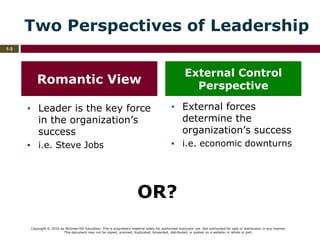
Two Perspectives of Leadership
Romantic View
▪ Leader is the key force
in the organization’s
success
▪ i.e. Steve Jobs
External Control
Perspective
▪ External forces
determine the
organization’s success
▪ i.e. economic downturns
OR?
External Control
Perspective
Romantic View
Copyright © 2016 by McGraw-Hill Education. This is proprietary material solely for authorized instructor use. Not authorized for sale or distribution in any manner.
This document may not be copied, scanned, duplicated, forwarded, distributed, or posted on a website, in whole or part.
1-4
Leaders can make a difference
▪ Must be proactive - anticipate change
▪ Continually refine strategies
▪ Be aware of external opportunities and threats
▪ Thoroughly understand their firm’s resources and
capabilities
▪ Make strategic management both a process
and a way of thinking throughout the
organization
Copyright © 2016 by McGraw-Hill Education. This is proprietary material solely for authorized instructor use. Not authorized for sale or distribution in any manner.
This document may not be copied, scanned, duplicated, forwarded, distributed, or posted on a website, in whole or part.
Insights from Executives:
Leaders can make a difference
▪ Major anticipated developments can often have
very negative consequences for businesses
regardless of how well formulated their strategies
are. HOWEVER:
▪ Successful executives are often able to navigate
around the difficult circumstances that they face
by:
▪ Anticipating structural changes in the industry
▪ Staying aware of changes in the external environment
▪ Acknowledging the need to make tough strategic
choices
1-7
Copyright © 2016 by McGraw-Hill Education. This is proprietary material solely for authorized instructor use. Not authorized for sale or distribution in any manner.
This document may not be copied, scanned, duplicated, forwarded, distributed, or posted on a website, in whole or part.
1-6
Insights from Executives:
Leaders can make a difference cont.
▪ How does Melvin Alexander, CPA, executive
director of Principled Solutions Enterprise suggest
health care executive handle these challenges as
they deal with the implications of the Affordable
Care Act?
▪ Health care industry structural changes?
▪ Prepare for acquisitions, standardization of practices
▪ Need to address resource limitations
▪ Effect of the external environment on strategy?
▪ Need to anticipate economic, regulatory, socio-
cultural/behavioral expectations & technology needs
Copyright © 2016 by McGraw-Hill Education. This is proprietary material solely for authorized instructor use. Not authorized for sale or distribution in any manner.
This document may not be copied, scanned, duplicated, forwarded, distributed, or posted on a website, in whole or part.
1-7
Defining Strategic Management
Strategic Management involves
▪ Analysis
▪ Strategic goals (vision, mission, strategic objectives)
▪ Internal and external environment
▪ Decisions - Formulation
▪ What industries should we compete in?
▪ How should we compete in those industries?
▪ Actions - Implementation
▪ Allocate necessary resources
▪ Design the organization to bring intended strategies to
reality
Copyright © 2016 by McGraw-Hill Education. This is proprietary material solely for authorized instructor use. Not authorized for sale or distribution in any manner.
This document may not be copied, scanned, duplicated, forwarded, distributed, or posted on a website, in whole or part.
1-8
Two Fundamental Questions
1. How should we compete in order to create
competitive advantages in the marketplace?
2. How can we create competitive advantages
in the marketplace that are unique, valuable,
and difficult for rivals to copy or substitute?
NOTE: Operational effectiveness is not enough to
sustain a competitive advantage.
Copyright © 2016 by McGraw-Hill Education. This is proprietary material solely for authorized instructor use. Not authorized for sale or distribution in any manner.
This document may not be copied, scanned, duplicated, forwarded, distributed, or posted on a website, in whole or part.
1-9
Strategic Management
Key Attributes of strategic management
▪ Directs the organization toward overall goals and
objectives.
▪ Includes multiple stakeholders in decision
making.
▪ Needs to incorporate short-term and long-term
perspectives.
▪ Recognizes trade-offs between efficiency and
effectiveness.
Copyright © 2016 by McGraw-Hill Education. This is proprietary material solely for authorized instructor use. Not authorized for sale or distribution in any manner.
This document may not be copied, scanned, duplicated, forwarded, distributed, or posted on a website, in whole or part.
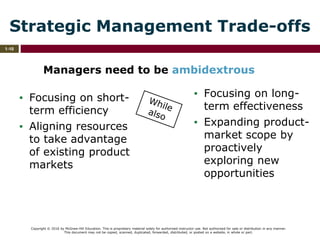
While also
▪ Focusing on long-
term effectiveness
▪ Expanding product-
market scope by
proactively
exploring new
opportunities
Managers need to be
ambidextrous
▪ Focusing on short-
term efficiency
▪ Aligning resources
to take advantage
of existing product
markets
1-10
Strategic Management Trade-offs
Managers need to be ambidextrous
Copyright © 2016 by McGraw-Hill Education. This is proprietary material solely for authorized instructor use. Not authorized for sale or distribution in any manner.
This document may not be copied, scanned, duplicated, forwarded, distributed, or posted on a website, in whole or part.
1-11
Question?
According to Henry Mintzberg, the realized
strategies of a firm
A. are a combination of deliberate and emergent
strategies.
B. are a combination of deliberate and differentiation
strategies.
C. must be based on a company’s strategic plan.
D. must be kept confidential for competitive reasons.
Copyright © 2016 by McGraw-Hill Education. This is proprietary material solely for authorized instructor use. Not authorized for sale or distribution in any manner.
This document may not be copied, scanned, duplicated, forwarded, distributed, or posted on a website, in whole or part.
1-12
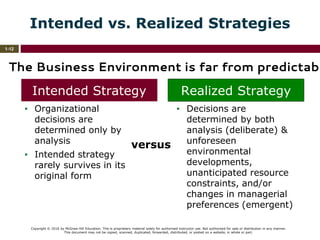
Intended vs. Realized Strategies
The Business Environment is far from predictable.
Intended Strategy
▪ Organizational
decisions are
determined only by
analysis
▪ Intended strategy
rarely survives in its
original form
Realized Strategy
▪ Decisions are
determined by both
analysis (deliberate) &
unforeseen
environmental
developments,
unanticipated resource
constraints, and/or
changes in managerial
preferences (emergent)
Intended Strategy Realized Strategy
The Business Environment is far from predictabl
versus
Copyright © 2016 by McGraw-Hill Education. This is proprietary material solely for authorized instructor use. Not authorized for sale or distribution in any manner.
This document may not be copied, scanned, duplicated, forwarded, distributed, or posted on a website, in whole or part.
1-13
Strategic Management Process
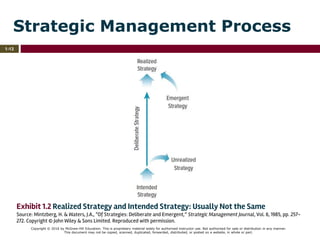
Exhibit 1.2 Realized Strategy and Intended Strategy: Usually Not the Same
Source: Mintzberg, H. & Waters, J.A., “Of Strategies: Deliberate and Emergent,” Strategic Management Journal, Vol. 6, 1985, pp. 257-
272. Copyright © John Wiley & Sons Limited. Reproduced with permission.
Copyright © 2016 by McGraw-Hill Education. This is proprietary material solely for authorized instructor use. Not authorized for sale or distribution in any manner.
This document may not be copied, scanned, duplicated, forwarded, distributed, or posted on a website, in whole or part.
1-14
Strategic Management Process
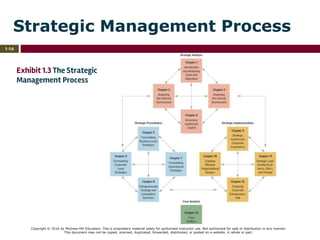
Exhibit 1.3 The Strategic
Management Process
Copyright © 2016 by McGraw-Hill Education. This is proprietary material solely for authorized instructor use. Not authorized for sale or distribution in any manner.
This document may not be copied, scanned, duplicated, forwarded, distributed, or posted on a website, in whole or part.
1-15
Example:
Leaders’ Use of the Strategic Management Process
▪ Groupon’s leadership focused on initial strategic
goals
– a global e-commerce marketplace connecting subscribers with
local merchants for “deals-of-the day.” HOWEVER:
▪ Growth expectations can be unrealistically optimistic in
an industry where the business model is easily imitated.
▪ Leadership needs to continually assess resource needs
against environmental realities - balancing growth goals
against profitability, guarding against overconfidence.
▪ Poorly anticipated developments can often have very
negative consequences for businesses regardless of how
initially attractive their strategies were - have daily group
deals turned out to be a fad?
Copyright © 2016 by McGraw-Hill Education. This is proprietary material solely for authorized instructor use. Not authorized for sale or distribution in any manner.
This document may not be copied, scanned, duplicated, forwarded, distributed, or posted on a website, in whole or part.
1-16
Strategy Analysis
▪ Starting point in the strategic management
process.
▪ Precedes effective formulation and
implementation of strategies.
▪ Involves careful analysis of the overarching goals
of the organization.
▪ Requires a thorough analysis of the
organization’s external and internal environment.
Copyright © 2016 by McGraw-Hill Education. This is proprietary material solely for authorized instructor use. Not authorized for sale or distribution in any manner.
This document may not be copied, scanned, duplicated, forwarded, distributed, or posted on a website, in whole or part.
1-17
Strategy Analysis cont.
Analyzing Organizational Goals & Objectives
▪ Establish a hierarchy of goals
▪ Vision
▪ Mission
▪ Strategic Objectives
Analyzing the External Environment of the Firm
▪ Managers must monitor & scan the environment as
well as analyze competitors
▪ The General Environment
▪ The Industry Environment
Copyright © 2016 by McGraw-Hill Education. This is proprietary material solely for authorized instructor use. Not authorized for sale or distribution in any manner.
This document may not be copied, scanned, duplicated, forwarded, distributed, or posted on a website, in whole or part.
1-18
Strategy Analysis cont.
Assessing the Internal Environment of the Firm
▪ Analyzing strengths & relationships among activities
that constitute a firm’s value chain
▪ Can uncover potential sources of competitive
advantage
Assessing a Firm’s Intellectual Assets
▪ Knowledge workers & other intellectual assets drive
competitive advantage & wealth creation
▪ Networks & relationships plus technology enhances
collaboration, accumulates & stores knowledge
Copyright © 2016 by McGraw-Hill Education. This is proprietary material solely for authorized instructor use. Not authorized for sale or distribution in any manner.
This document may not be copied, scanned, duplicated, forwarded, distributed, or posted on a website, in whole or part.
1-19
Strategy Formulation
▪ Based on strategy analysis
▪ Developed at several levels
▪ Involves decisions that can create and sustain
competitive advantage
▪ Investment decisions
▪ Commitment of resources
▪ Operational synergies
▪ Recognizing viable opportunities
Copyright © 2016 by McGraw-Hill Education. This is proprietary material solely for authorized instructor use. Not authorized for sale or distribution in any manner.
This document may not be copied, scanned, duplicated, forwarded, distributed, or posted on a website, in whole or part.
1-20
Strategy Formulation cont.
Formulating Business-Level Strategy
▪ Successful firms develop bases for sustainable
competitive advantage through
▪ Cost leadership and/or
▪ Differentiation, as well as
▪ Focusing on a narrow or industrywide market segment
Formulating Corporate-Level Strategy
▪ Addresses a firm’s portfolio (or group) of businesses
▪ What business(es) should we compete in?
▪ How can we manage this portfolio of businesses to
create synergies?
Copyright © 2016 by McGraw-Hill Education. This is proprietary material solely for authorized instructor use. Not authorized for sale or distribution in any manner.
This document may not be copied, scanned, duplicated, forwarded, distributed, or posted on a website, in whole or part.
1-21
Strategy Formulation cont.
Formulating International Strategy
▪ What is the appropriate entry strategy?
▪ How do we go about attaining competitive
advantage in international markets?
Entrepreneurial Strategy and Competitive
Dynamics
▪ How do we recognize viable opportunities?
▪ How do we formulate effective strategies?
Copyright © 2016 by McGraw-Hill Education. This is proprietary material solely for authorized instructor use. Not authorized for sale or distribution in any manner.
This document may not be copied, scanned, duplicated, forwarded, distributed, or posted on a website, in whole or part.
1-22
Strategy Implementation
Implements the formulated strategy
▪ Ensures proper strategic control systems
▪ Establishes an appropriate organizational design -
coordinates & integrates activities within the firm
▪ Coordinates activities with suppliers, customers,
alliance partners
▪ Leadership ensures organizational commitment to
excellence & ethical behavior
▪ Promotes learning & continuous improvement
▪ Acts entrepreneurially in creating new opportunities
Copyright © 2016 by McGraw-Hill Education. This is proprietary material solely for authorized instructor use. Not authorized for sale or distribution in any manner.
This document may not be copied, scanned, duplicated, forwarded, distributed, or posted on a website, in whole or part.
1-23
Strategy Implementation cont.
Strategic Control & Corporate Governance
▪ Informational control
▪ Monitor & scan the environment
▪ Respond effectively to threats & opportunities
▪ Behavioral control
▪ Proper balance of rewards & incentives
▪ Appropriate cultures & boundaries (or constraints)
▪ Effective corporate governance
Copyright © 2016 by McGraw-Hill Education. This is proprietary material solely for authorized instructor use. Not authorized for sale or distribution in any manner.
This document may not be copied, scanned, duplicated, forwarded, distributed, or posted on a website, in whole or part.
1-24
Strategy Implementation cont.
Creating Effective Organizational Designs
▪ Organizational structures must be consistent with
strategy
▪ Organizational boundaries must be flexible &
permeable
▪ Strategic alliances must capitalize on capabilities of
other organizations
Copyright © 2016 by McGraw-Hill Education. This is proprietary material solely for authorized instructor use. Not authorized for sale or distribution in any manner.
This document may not be copied, scanned, duplicated, forwarded, distributed, or posted on a website, in whole or part.
1-25
Strategy Implementation cont.
Creating a Learning Organization & an Ethical
Organization
▪ Effective leaders
▪ Set a direction
▪ Design the organization
▪ Develop an organization committed to excellence &
ethical behavior
▪ Create a “learning organization”
▪ Benefit from individual & collective talents
Copyright © 2016 by McGraw-Hill Education. This is proprietary material solely for authorized instructor use. Not authorized for sale or distribution in any manner.
This document may not be copied, scanned, duplicated, forwarded, distributed, or posted on a website, in whole or part.
1-26
Strategy Implementation cont.
Fostering Corporate Entrepreneurship
▪ Firms must continually improve & grow
▪ Firms must find new ways to renew themselves
▪ Entrepreneurship & innovation provide for new
opportunities
▪ Enhance a firm’s innovative capacity
Copyright © 2016 by McGraw-Hill Education. This is proprietary material solely for authorized instructor use. Not authorized for sale or distribution in any manner.
This document may not be copied, scanned, duplicated, forwarded, distributed, or posted on a website, in whole or part.
1-27
Corporate Governance & Stakeholder
Management
▪ Appropriate Strategic Management requires an
effective & appropriate corporate structure
▪ Corporate Governance: the relationship among
various participants in determining the direction and
performance of corporations.
▪ Primary participants:
▪ The shareholders
▪ The management (led by the Chief Executive Officer)
▪ The Board of Directors (BOD)
Copyright © 2016 by McGraw-Hill Education. This is proprietary material solely for authorized instructor use. Not authorized for sale or distribution in any manner.
This document may not be copied, scanned, duplicated, forwarded, distributed, or posted on a website, in whole or part.
Corporate Governance cont.
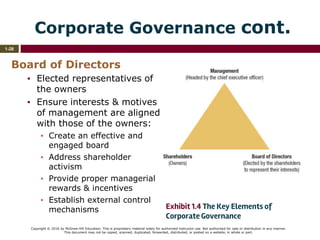
Board of Directors
▪ Elected representatives of
the owners
▪ Ensure interests & motives
of management are aligned
with those of the owners:
▪ Create an effective and
engaged board
▪ Address shareholder
activism
▪ Provide proper managerial
rewards & incentives
▪ Establish external control
mechanisms
1-28
Exhibit 1.4 The Key Elements of
Corporate Governance
Copyright © 2016 by McGraw-Hill Education. This is proprietary material solely for authorized instructor use. Not authorized for sale or distribution in any manner.
This document may not be copied, scanned, duplicated, forwarded, distributed, or posted on a website, in whole or part.
1-29
Stakeholder Management
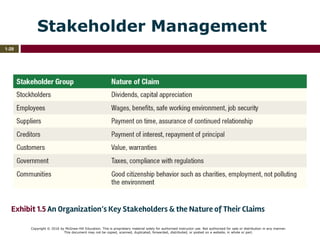
Exhibit 1.5 An Organization’s Key Stakeholders & the Nature of Their Claims
Copyright © 2016 by McGraw-Hill Education. This is proprietary material solely for authorized instructor use. Not authorized for sale or distribution in any manner.
This document may not be copied, scanned, duplicated, forwarded, distributed, or posted on a website, in whole or part.
1-30
Stakeholder Management
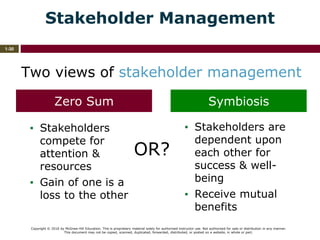
Two views of stakeholder management
Zero Sum
▪ Stakeholders
compete for
attention &
resources
▪ Gain of one is a
loss to the other
Or?
Symbiosis
▪ Stakeholders are
dependent upon
each other for
success & well-
being
▪ Receive mutual
benefits
OR?
Zero Sum Symbiosis
Two views of stakeholder management
Copyright © 2016 by McGraw-Hill Education. This is proprietary material solely for authorized instructor use. Not authorized for sale or distribution in any manner.
This document may not be copied, scanned, duplicated, forwarded, distributed, or posted on a website, in whole or part.
1-31
Question?
▪ P&G created a cleaning product that led to a
change in consumer shopping habits and also a
revolution in industry supply chain economics.
According to the text, this is an example of
___________.
A. zero-sum relationship among stakeholders
B. stakeholder symbiosis
C. rewarding stakeholders
D. emphasizing financial returns
Copyright © 2016 by McGraw-Hill Education. This is proprietary material solely for authorized instructor use. Not authorized for sale or distribution in any manner.
This document may not be copied, scanned, duplicated, forwarded, distributed, or posted on a website, in whole or part.
1-32
Social Responsibility
▪ Social responsibility: the expectation that
businesses or individuals will strive to improve the
overall welfare of society.
▪ Firms have multiple stakeholders and must go
beyond a focus solely on financial results
▪ Firms must create shared value – and share this
value with society in a mutually beneficial
relationship
▪ Firms can measure a triple bottom line
▪ Assessing financial, social, AND environmental
performance
▪ Embracing a sustainable global economy.
Copyright © 2016 by McGraw-Hill Education. This is proprietary material solely for authorized instructor use. Not authorized for sale or distribution in any manner.
This document may not be copied, scanned, duplicated, forwarded, distributed, or posted on a website, in whole or part.
1-33
Example:
Making Sustainability Profitable
▪ Rapidly developing economies are often seen as sustainability
laggards, due to weak regulatory bodies, resource shortages,
competition from more industrialized countries & firms.
▪ Yet Sekem’s leadership had a vision: as Egypt’s first organic
farm, of growing organic cotton.
▪ Sekem’s farming techniques reclaimed arable land from the
Sahara and decreased greenhouse gases. It also meant cotton
needed 20%-40% less water.
▪ Responding to worldwide demand, from 2006 until the Arab
Spring of 2011, Sekem improved cotton yields by 30%, &
increased revenues by 14%.
▪ Sekem subsidiaries now include medicinal products & schools.
▪ Sekem took the long-term view of strategy & it paid off.
Copyright © 2016 by McGraw-Hill Education. This is proprietary material solely for authorized instructor use. Not authorized for sale or distribution in any manner.
This document may not be copied, scanned, duplicated, forwarded, distributed, or posted on a website, in whole or part.
1-34
Empowered Strategic
Management
▪ Strategic management requires an integrative
view of the organization
▪ ALL functional areas & activities must fit together
to achieve goals & objectives
▪ Leaders are needed throughout:
▪ Local line leaders – have profit & loss
responsibility
▪ Executive leaders – champion & guide ideas
▪ Internal networkers – hold little positional
power, but have conviction & clarity of ideas
Copyright © 2016 by McGraw-Hill Education. This is proprietary material solely for authorized instructor use. Not authorized for sale or distribution in any manner.
This document may not be copied, scanned, duplicated, forwarded, distributed, or posted on a website, in whole or part.
1-35
Coherence in Strategic Direction
▪ Organizations express priorities best through
stated goals & objectives that form a hierarchy
of goals
▪ Vision – evokes powerful & compelling mental
images of a shared future
▪ Mission – encompasses the organization’s current
purpose, basis of competition, & competitive
advantage
▪ Strategic Objectives – operationalize the mission
statement with specific yardsticks
Copyright © 2016 by McGraw-Hill Education. This is proprietary material solely for authorized instructor use. Not authorized for sale or distribution in any manner.
This document may not be copied, scanned, duplicated, forwarded, distributed, or posted on a website, in whole or part.
1-36
Coherence in Strategic Direction
Exhibit 1.6 A Hierarchy of Goals
Copyright © 2016 by McGraw-Hill Education. This is proprietary material solely for authorized instructor use. Not authorized for sale or distribution in any manner.
This document may not be copied, scanned, duplicated, forwarded, distributed, or posted on a website, in whole or part.
1-37
Coherence in Strategic Direction
Organizational Vision
▪ A “massively inspiring” goal
▪ Overarching, long term
▪ A destination driven by & evoking passion
▪ Developed & implemented by leadership
▪ A fundamental statement of an organization’s
values, aspirations, and goals
▪ Captures both the minds & hearts of employees
Copyright © 2016 by McGraw-Hill Education. This is proprietary material solely for authorized instructor use. Not authorized for sale or distribution in any manner.
This document may not be copied, scanned, duplicated, forwarded, distributed, or posted on a website, in whole or part.
1-38
Coherence in Strategic Direction
Organizational Visions can backfire
▪ The Walk Doesn’t Match the Talk
▪ Irrelevance
▪ Not the Holy Grail
▪ Too Much Focus Leads to Missed Opportunities
▪ An Ideal Future Irreconciled with the Present
Copyright © 2016 by McGraw-Hill Education. This is proprietary material solely for authorized instructor use. Not authorized for sale or distribution in any manner.
This document may not be copied, scanned, duplicated, forwarded, distributed, or posted on a website, in whole or part.
1-39
Coherence in Strategic Direction
Mission Statement
▪ Encompasses both the purpose of the company and
the basis of competition and competitive advantage
▪ Is more specific than the vision
▪ Focuses on the means by which the firm will
compete
▪ Incorporates stakeholder management
▪ Communicates why an organization is special &
different
▪ Can & should change when competitive conditions
change
Copyright © 2016 by McGraw-Hill Education. This is proprietary material solely for authorized instructor use. Not authorized for sale or distribution in any manner.
This document may not be copied, scanned, duplicated, forwarded, distributed, or posted on a website, in whole or part.
1-40
Coherence in Strategic Direction
Strategic Objectives
▪ Are used to operationalize the mission statement
▪ Provide guidance on how to fulfill mission & vision
▪ Are measurable, specific, appropriate, realistic &
timely
▪ Channel all employees’ efforts toward common goals
▪ Can be both financial and nonfinancial
▪ Should be challenging, yet help resolve conflicts
▪ Provide a yardstick for rewards & incentives

MGMT 488 Ch 1

  • 1.
    Copyright © 2016by McGraw-Hill Education. This is proprietary material solely for authorized instructor use. Not authorized for sale or distribution in any manner. This document may not be copied, scanned, duplicated, forwarded, distributed, or posted on a website, in whole or part. Strategic Management: Creating Competitive Advantages chapter 1
  • 2.
    Copyright © 2016by McGraw-Hill Education. This is proprietary material solely for authorized instructor use. Not authorized for sale or distribution in any manner. This document may not be copied, scanned, duplicated, forwarded, distributed, or posted on a website, in whole or part. The Importance of Leadership Consider… Maintaining competitive success or even surviving over long periods of time is difficult for companies of any size. SO how much credit (or blame) does a leader deserve? 1-2
  • 3.
    Copyright © 2016by McGraw-Hill Education. This is proprietary material solely for authorized instructor use. Not authorized for sale or distribution in any manner. This document may not be copied, scanned, duplicated, forwarded, distributed, or posted on a website, in whole or part. 1-3 Two Perspectives of Leadership Romantic View ▪ Leader is the key force in the organization’s success ▪ i.e. Steve Jobs External Control Perspective ▪ External forces determine the organization’s success ▪ i.e. economic downturns OR? External Control Perspective Romantic View
  • 4.
    Copyright © 2016by McGraw-Hill Education. This is proprietary material solely for authorized instructor use. Not authorized for sale or distribution in any manner. This document may not be copied, scanned, duplicated, forwarded, distributed, or posted on a website, in whole or part. 1-4 Leaders can make a difference ▪ Must be proactive - anticipate change ▪ Continually refine strategies ▪ Be aware of external opportunities and threats ▪ Thoroughly understand their firm’s resources and capabilities ▪ Make strategic management both a process and a way of thinking throughout the organization
  • 5.
    Copyright © 2016by McGraw-Hill Education. This is proprietary material solely for authorized instructor use. Not authorized for sale or distribution in any manner. This document may not be copied, scanned, duplicated, forwarded, distributed, or posted on a website, in whole or part. Insights from Executives: Leaders can make a difference ▪ Major anticipated developments can often have very negative consequences for businesses regardless of how well formulated their strategies are. HOWEVER: ▪ Successful executives are often able to navigate around the difficult circumstances that they face by: ▪ Anticipating structural changes in the industry ▪ Staying aware of changes in the external environment ▪ Acknowledging the need to make tough strategic choices 1-7
  • 6.
    Copyright © 2016by McGraw-Hill Education. This is proprietary material solely for authorized instructor use. Not authorized for sale or distribution in any manner. This document may not be copied, scanned, duplicated, forwarded, distributed, or posted on a website, in whole or part. 1-6 Insights from Executives: Leaders can make a difference cont. ▪ How does Melvin Alexander, CPA, executive director of Principled Solutions Enterprise suggest health care executive handle these challenges as they deal with the implications of the Affordable Care Act? ▪ Health care industry structural changes? ▪ Prepare for acquisitions, standardization of practices ▪ Need to address resource limitations ▪ Effect of the external environment on strategy? ▪ Need to anticipate economic, regulatory, socio- cultural/behavioral expectations & technology needs
  • 7.
    Copyright © 2016by McGraw-Hill Education. This is proprietary material solely for authorized instructor use. Not authorized for sale or distribution in any manner. This document may not be copied, scanned, duplicated, forwarded, distributed, or posted on a website, in whole or part. 1-7 Defining Strategic Management Strategic Management involves ▪ Analysis ▪ Strategic goals (vision, mission, strategic objectives) ▪ Internal and external environment ▪ Decisions - Formulation ▪ What industries should we compete in? ▪ How should we compete in those industries? ▪ Actions - Implementation ▪ Allocate necessary resources ▪ Design the organization to bring intended strategies to reality
  • 8.
    Copyright © 2016by McGraw-Hill Education. This is proprietary material solely for authorized instructor use. Not authorized for sale or distribution in any manner. This document may not be copied, scanned, duplicated, forwarded, distributed, or posted on a website, in whole or part. 1-8 Two Fundamental Questions 1. How should we compete in order to create competitive advantages in the marketplace? 2. How can we create competitive advantages in the marketplace that are unique, valuable, and difficult for rivals to copy or substitute? NOTE: Operational effectiveness is not enough to sustain a competitive advantage.
  • 9.
    Copyright © 2016by McGraw-Hill Education. This is proprietary material solely for authorized instructor use. Not authorized for sale or distribution in any manner. This document may not be copied, scanned, duplicated, forwarded, distributed, or posted on a website, in whole or part. 1-9 Strategic Management Key Attributes of strategic management ▪ Directs the organization toward overall goals and objectives. ▪ Includes multiple stakeholders in decision making. ▪ Needs to incorporate short-term and long-term perspectives. ▪ Recognizes trade-offs between efficiency and effectiveness.
  • 10.
    Copyright © 2016by McGraw-Hill Education. This is proprietary material solely for authorized instructor use. Not authorized for sale or distribution in any manner. This document may not be copied, scanned, duplicated, forwarded, distributed, or posted on a website, in whole or part. While also ▪ Focusing on long- term effectiveness ▪ Expanding product- market scope by proactively exploring new opportunities Managers need to be ambidextrous ▪ Focusing on short- term efficiency ▪ Aligning resources to take advantage of existing product markets 1-10 Strategic Management Trade-offs Managers need to be ambidextrous
  • 11.
    Copyright © 2016by McGraw-Hill Education. This is proprietary material solely for authorized instructor use. Not authorized for sale or distribution in any manner. This document may not be copied, scanned, duplicated, forwarded, distributed, or posted on a website, in whole or part. 1-11 Question? According to Henry Mintzberg, the realized strategies of a firm A. are a combination of deliberate and emergent strategies. B. are a combination of deliberate and differentiation strategies. C. must be based on a company’s strategic plan. D. must be kept confidential for competitive reasons.
  • 12.
    Copyright © 2016by McGraw-Hill Education. This is proprietary material solely for authorized instructor use. Not authorized for sale or distribution in any manner. This document may not be copied, scanned, duplicated, forwarded, distributed, or posted on a website, in whole or part. 1-12 Intended vs. Realized Strategies The Business Environment is far from predictable. Intended Strategy ▪ Organizational decisions are determined only by analysis ▪ Intended strategy rarely survives in its original form Realized Strategy ▪ Decisions are determined by both analysis (deliberate) & unforeseen environmental developments, unanticipated resource constraints, and/or changes in managerial preferences (emergent) Intended Strategy Realized Strategy The Business Environment is far from predictabl versus
  • 13.
    Copyright © 2016by McGraw-Hill Education. This is proprietary material solely for authorized instructor use. Not authorized for sale or distribution in any manner. This document may not be copied, scanned, duplicated, forwarded, distributed, or posted on a website, in whole or part. 1-13 Strategic Management Process Exhibit 1.2 Realized Strategy and Intended Strategy: Usually Not the Same Source: Mintzberg, H. & Waters, J.A., “Of Strategies: Deliberate and Emergent,” Strategic Management Journal, Vol. 6, 1985, pp. 257- 272. Copyright © John Wiley & Sons Limited. Reproduced with permission.
  • 14.
    Copyright © 2016by McGraw-Hill Education. This is proprietary material solely for authorized instructor use. Not authorized for sale or distribution in any manner. This document may not be copied, scanned, duplicated, forwarded, distributed, or posted on a website, in whole or part. 1-14 Strategic Management Process Exhibit 1.3 The Strategic Management Process
  • 15.
    Copyright © 2016by McGraw-Hill Education. This is proprietary material solely for authorized instructor use. Not authorized for sale or distribution in any manner. This document may not be copied, scanned, duplicated, forwarded, distributed, or posted on a website, in whole or part. 1-15 Example: Leaders’ Use of the Strategic Management Process ▪ Groupon’s leadership focused on initial strategic goals – a global e-commerce marketplace connecting subscribers with local merchants for “deals-of-the day.” HOWEVER: ▪ Growth expectations can be unrealistically optimistic in an industry where the business model is easily imitated. ▪ Leadership needs to continually assess resource needs against environmental realities - balancing growth goals against profitability, guarding against overconfidence. ▪ Poorly anticipated developments can often have very negative consequences for businesses regardless of how initially attractive their strategies were - have daily group deals turned out to be a fad?
  • 16.
    Copyright © 2016by McGraw-Hill Education. This is proprietary material solely for authorized instructor use. Not authorized for sale or distribution in any manner. This document may not be copied, scanned, duplicated, forwarded, distributed, or posted on a website, in whole or part. 1-16 Strategy Analysis ▪ Starting point in the strategic management process. ▪ Precedes effective formulation and implementation of strategies. ▪ Involves careful analysis of the overarching goals of the organization. ▪ Requires a thorough analysis of the organization’s external and internal environment.
  • 17.
    Copyright © 2016by McGraw-Hill Education. This is proprietary material solely for authorized instructor use. Not authorized for sale or distribution in any manner. This document may not be copied, scanned, duplicated, forwarded, distributed, or posted on a website, in whole or part. 1-17 Strategy Analysis cont. Analyzing Organizational Goals & Objectives ▪ Establish a hierarchy of goals ▪ Vision ▪ Mission ▪ Strategic Objectives Analyzing the External Environment of the Firm ▪ Managers must monitor & scan the environment as well as analyze competitors ▪ The General Environment ▪ The Industry Environment
  • 18.
    Copyright © 2016by McGraw-Hill Education. This is proprietary material solely for authorized instructor use. Not authorized for sale or distribution in any manner. This document may not be copied, scanned, duplicated, forwarded, distributed, or posted on a website, in whole or part. 1-18 Strategy Analysis cont. Assessing the Internal Environment of the Firm ▪ Analyzing strengths & relationships among activities that constitute a firm’s value chain ▪ Can uncover potential sources of competitive advantage Assessing a Firm’s Intellectual Assets ▪ Knowledge workers & other intellectual assets drive competitive advantage & wealth creation ▪ Networks & relationships plus technology enhances collaboration, accumulates & stores knowledge
  • 19.
    Copyright © 2016by McGraw-Hill Education. This is proprietary material solely for authorized instructor use. Not authorized for sale or distribution in any manner. This document may not be copied, scanned, duplicated, forwarded, distributed, or posted on a website, in whole or part. 1-19 Strategy Formulation ▪ Based on strategy analysis ▪ Developed at several levels ▪ Involves decisions that can create and sustain competitive advantage ▪ Investment decisions ▪ Commitment of resources ▪ Operational synergies ▪ Recognizing viable opportunities
  • 20.
    Copyright © 2016by McGraw-Hill Education. This is proprietary material solely for authorized instructor use. Not authorized for sale or distribution in any manner. This document may not be copied, scanned, duplicated, forwarded, distributed, or posted on a website, in whole or part. 1-20 Strategy Formulation cont. Formulating Business-Level Strategy ▪ Successful firms develop bases for sustainable competitive advantage through ▪ Cost leadership and/or ▪ Differentiation, as well as ▪ Focusing on a narrow or industrywide market segment Formulating Corporate-Level Strategy ▪ Addresses a firm’s portfolio (or group) of businesses ▪ What business(es) should we compete in? ▪ How can we manage this portfolio of businesses to create synergies?
  • 21.
    Copyright © 2016by McGraw-Hill Education. This is proprietary material solely for authorized instructor use. Not authorized for sale or distribution in any manner. This document may not be copied, scanned, duplicated, forwarded, distributed, or posted on a website, in whole or part. 1-21 Strategy Formulation cont. Formulating International Strategy ▪ What is the appropriate entry strategy? ▪ How do we go about attaining competitive advantage in international markets? Entrepreneurial Strategy and Competitive Dynamics ▪ How do we recognize viable opportunities? ▪ How do we formulate effective strategies?
  • 22.
    Copyright © 2016by McGraw-Hill Education. This is proprietary material solely for authorized instructor use. Not authorized for sale or distribution in any manner. This document may not be copied, scanned, duplicated, forwarded, distributed, or posted on a website, in whole or part. 1-22 Strategy Implementation Implements the formulated strategy ▪ Ensures proper strategic control systems ▪ Establishes an appropriate organizational design - coordinates & integrates activities within the firm ▪ Coordinates activities with suppliers, customers, alliance partners ▪ Leadership ensures organizational commitment to excellence & ethical behavior ▪ Promotes learning & continuous improvement ▪ Acts entrepreneurially in creating new opportunities
  • 23.
    Copyright © 2016by McGraw-Hill Education. This is proprietary material solely for authorized instructor use. Not authorized for sale or distribution in any manner. This document may not be copied, scanned, duplicated, forwarded, distributed, or posted on a website, in whole or part. 1-23 Strategy Implementation cont. Strategic Control & Corporate Governance ▪ Informational control ▪ Monitor & scan the environment ▪ Respond effectively to threats & opportunities ▪ Behavioral control ▪ Proper balance of rewards & incentives ▪ Appropriate cultures & boundaries (or constraints) ▪ Effective corporate governance
  • 24.
    Copyright © 2016by McGraw-Hill Education. This is proprietary material solely for authorized instructor use. Not authorized for sale or distribution in any manner. This document may not be copied, scanned, duplicated, forwarded, distributed, or posted on a website, in whole or part. 1-24 Strategy Implementation cont. Creating Effective Organizational Designs ▪ Organizational structures must be consistent with strategy ▪ Organizational boundaries must be flexible & permeable ▪ Strategic alliances must capitalize on capabilities of other organizations
  • 25.
    Copyright © 2016by McGraw-Hill Education. This is proprietary material solely for authorized instructor use. Not authorized for sale or distribution in any manner. This document may not be copied, scanned, duplicated, forwarded, distributed, or posted on a website, in whole or part. 1-25 Strategy Implementation cont. Creating a Learning Organization & an Ethical Organization ▪ Effective leaders ▪ Set a direction ▪ Design the organization ▪ Develop an organization committed to excellence & ethical behavior ▪ Create a “learning organization” ▪ Benefit from individual & collective talents
  • 26.
    Copyright © 2016by McGraw-Hill Education. This is proprietary material solely for authorized instructor use. Not authorized for sale or distribution in any manner. This document may not be copied, scanned, duplicated, forwarded, distributed, or posted on a website, in whole or part. 1-26 Strategy Implementation cont. Fostering Corporate Entrepreneurship ▪ Firms must continually improve & grow ▪ Firms must find new ways to renew themselves ▪ Entrepreneurship & innovation provide for new opportunities ▪ Enhance a firm’s innovative capacity
  • 27.
    Copyright © 2016by McGraw-Hill Education. This is proprietary material solely for authorized instructor use. Not authorized for sale or distribution in any manner. This document may not be copied, scanned, duplicated, forwarded, distributed, or posted on a website, in whole or part. 1-27 Corporate Governance & Stakeholder Management ▪ Appropriate Strategic Management requires an effective & appropriate corporate structure ▪ Corporate Governance: the relationship among various participants in determining the direction and performance of corporations. ▪ Primary participants: ▪ The shareholders ▪ The management (led by the Chief Executive Officer) ▪ The Board of Directors (BOD)
  • 28.
    Copyright © 2016by McGraw-Hill Education. This is proprietary material solely for authorized instructor use. Not authorized for sale or distribution in any manner. This document may not be copied, scanned, duplicated, forwarded, distributed, or posted on a website, in whole or part. Corporate Governance cont. Board of Directors ▪ Elected representatives of the owners ▪ Ensure interests & motives of management are aligned with those of the owners: ▪ Create an effective and engaged board ▪ Address shareholder activism ▪ Provide proper managerial rewards & incentives ▪ Establish external control mechanisms 1-28 Exhibit 1.4 The Key Elements of Corporate Governance
  • 29.
    Copyright © 2016by McGraw-Hill Education. This is proprietary material solely for authorized instructor use. Not authorized for sale or distribution in any manner. This document may not be copied, scanned, duplicated, forwarded, distributed, or posted on a website, in whole or part. 1-29 Stakeholder Management Exhibit 1.5 An Organization’s Key Stakeholders & the Nature of Their Claims
  • 30.
    Copyright © 2016by McGraw-Hill Education. This is proprietary material solely for authorized instructor use. Not authorized for sale or distribution in any manner. This document may not be copied, scanned, duplicated, forwarded, distributed, or posted on a website, in whole or part. 1-30 Stakeholder Management Two views of stakeholder management Zero Sum ▪ Stakeholders compete for attention & resources ▪ Gain of one is a loss to the other Or? Symbiosis ▪ Stakeholders are dependent upon each other for success & well- being ▪ Receive mutual benefits OR? Zero Sum Symbiosis Two views of stakeholder management
  • 31.
    Copyright © 2016by McGraw-Hill Education. This is proprietary material solely for authorized instructor use. Not authorized for sale or distribution in any manner. This document may not be copied, scanned, duplicated, forwarded, distributed, or posted on a website, in whole or part. 1-31 Question? ▪ P&G created a cleaning product that led to a change in consumer shopping habits and also a revolution in industry supply chain economics. According to the text, this is an example of ___________. A. zero-sum relationship among stakeholders B. stakeholder symbiosis C. rewarding stakeholders D. emphasizing financial returns
  • 32.
    Copyright © 2016by McGraw-Hill Education. This is proprietary material solely for authorized instructor use. Not authorized for sale or distribution in any manner. This document may not be copied, scanned, duplicated, forwarded, distributed, or posted on a website, in whole or part. 1-32 Social Responsibility ▪ Social responsibility: the expectation that businesses or individuals will strive to improve the overall welfare of society. ▪ Firms have multiple stakeholders and must go beyond a focus solely on financial results ▪ Firms must create shared value – and share this value with society in a mutually beneficial relationship ▪ Firms can measure a triple bottom line ▪ Assessing financial, social, AND environmental performance ▪ Embracing a sustainable global economy.
  • 33.
    Copyright © 2016by McGraw-Hill Education. This is proprietary material solely for authorized instructor use. Not authorized for sale or distribution in any manner. This document may not be copied, scanned, duplicated, forwarded, distributed, or posted on a website, in whole or part. 1-33 Example: Making Sustainability Profitable ▪ Rapidly developing economies are often seen as sustainability laggards, due to weak regulatory bodies, resource shortages, competition from more industrialized countries & firms. ▪ Yet Sekem’s leadership had a vision: as Egypt’s first organic farm, of growing organic cotton. ▪ Sekem’s farming techniques reclaimed arable land from the Sahara and decreased greenhouse gases. It also meant cotton needed 20%-40% less water. ▪ Responding to worldwide demand, from 2006 until the Arab Spring of 2011, Sekem improved cotton yields by 30%, & increased revenues by 14%. ▪ Sekem subsidiaries now include medicinal products & schools. ▪ Sekem took the long-term view of strategy & it paid off.
  • 34.
    Copyright © 2016by McGraw-Hill Education. This is proprietary material solely for authorized instructor use. Not authorized for sale or distribution in any manner. This document may not be copied, scanned, duplicated, forwarded, distributed, or posted on a website, in whole or part. 1-34 Empowered Strategic Management ▪ Strategic management requires an integrative view of the organization ▪ ALL functional areas & activities must fit together to achieve goals & objectives ▪ Leaders are needed throughout: ▪ Local line leaders – have profit & loss responsibility ▪ Executive leaders – champion & guide ideas ▪ Internal networkers – hold little positional power, but have conviction & clarity of ideas
  • 35.
    Copyright © 2016by McGraw-Hill Education. This is proprietary material solely for authorized instructor use. Not authorized for sale or distribution in any manner. This document may not be copied, scanned, duplicated, forwarded, distributed, or posted on a website, in whole or part. 1-35 Coherence in Strategic Direction ▪ Organizations express priorities best through stated goals & objectives that form a hierarchy of goals ▪ Vision – evokes powerful & compelling mental images of a shared future ▪ Mission – encompasses the organization’s current purpose, basis of competition, & competitive advantage ▪ Strategic Objectives – operationalize the mission statement with specific yardsticks
  • 36.
    Copyright © 2016by McGraw-Hill Education. This is proprietary material solely for authorized instructor use. Not authorized for sale or distribution in any manner. This document may not be copied, scanned, duplicated, forwarded, distributed, or posted on a website, in whole or part. 1-36 Coherence in Strategic Direction Exhibit 1.6 A Hierarchy of Goals
  • 37.
    Copyright © 2016by McGraw-Hill Education. This is proprietary material solely for authorized instructor use. Not authorized for sale or distribution in any manner. This document may not be copied, scanned, duplicated, forwarded, distributed, or posted on a website, in whole or part. 1-37 Coherence in Strategic Direction Organizational Vision ▪ A “massively inspiring” goal ▪ Overarching, long term ▪ A destination driven by & evoking passion ▪ Developed & implemented by leadership ▪ A fundamental statement of an organization’s values, aspirations, and goals ▪ Captures both the minds & hearts of employees
  • 38.
    Copyright © 2016by McGraw-Hill Education. This is proprietary material solely for authorized instructor use. Not authorized for sale or distribution in any manner. This document may not be copied, scanned, duplicated, forwarded, distributed, or posted on a website, in whole or part. 1-38 Coherence in Strategic Direction Organizational Visions can backfire ▪ The Walk Doesn’t Match the Talk ▪ Irrelevance ▪ Not the Holy Grail ▪ Too Much Focus Leads to Missed Opportunities ▪ An Ideal Future Irreconciled with the Present
  • 39.
    Copyright © 2016by McGraw-Hill Education. This is proprietary material solely for authorized instructor use. Not authorized for sale or distribution in any manner. This document may not be copied, scanned, duplicated, forwarded, distributed, or posted on a website, in whole or part. 1-39 Coherence in Strategic Direction Mission Statement ▪ Encompasses both the purpose of the company and the basis of competition and competitive advantage ▪ Is more specific than the vision ▪ Focuses on the means by which the firm will compete ▪ Incorporates stakeholder management ▪ Communicates why an organization is special & different ▪ Can & should change when competitive conditions change
  • 40.
    Copyright © 2016by McGraw-Hill Education. This is proprietary material solely for authorized instructor use. Not authorized for sale or distribution in any manner. This document may not be copied, scanned, duplicated, forwarded, distributed, or posted on a website, in whole or part. 1-40 Coherence in Strategic Direction Strategic Objectives ▪ Are used to operationalize the mission statement ▪ Provide guidance on how to fulfill mission & vision ▪ Are measurable, specific, appropriate, realistic & timely ▪ Channel all employees’ efforts toward common goals ▪ Can be both financial and nonfinancial ▪ Should be challenging, yet help resolve conflicts ▪ Provide a yardstick for rewards & incentives

Editor's Notes

  • #3 See the chapter opener “learning from mistakes.” Introduces the concepts of romantic leadership versus the resource perspective. Even innovative firms struggle in the marketplace if they do not anticipate and respond proactively to changes in the environment. Today’s leaders face a large number of complex challenges in the global marketplace. In considering how much credit (or blame) they deserve, two perspectives of leadership immediately come to mind: the “romantic” and “external control” perspectives.
  • #4 Romantic view of leadership = situations in which the leader is the key force determining the organization’s success – or lack thereof. External control view of leadership = situations in which external forces – where the leader has limited influence – determine the organization’s success.
  • #5 BUT leaders CAN make a difference.
  • #6 Although many might think that the leader is the most important factor in determining organizational outcomes, external factors may positively (or negatively) affect a firm’s success. For instance, developments in the general environment, such as economic downturns, new technologies, government legislation, or an outbreak of major internal conflict or war, can greatly restrict the strategic choices that are available to a firm’s executives.
  • #7 The Affordable Care Act is a major piece of legislation with far-reaching consequences for businesses in the United States. The healthcare industry has seen structural changes such as consolidations of hospitals, increases in physicians employed by hospitals, and expanded service lines (e.g., hospitals offering health insurance). Large hospital systems have responded by acquiring other hospitals, improving quality by standardizing processes, and taking steps to become Accountable Care Organizations (ACO) in order to optimize the changes in Medicare. Smaller organizations are faced with constraints due to resource limitations and local environmental issues (e.g., location). If an organization can become an ACO, this will reduce the financial risk, but requires a good understanding of assigned patients’ healthcare status, effective preventive care programs, and information technology systems that monitor patient activities. In addition, new strategies are necessary to ensure success of the new law and achieve projected returns on the large investments made. Executives must acknowledge external environmental forces such as understanding the behavior of healthcare consumers, appreciating the vested interest of health insurers and pharmaceutical companies, investing in information technology to create centers of excellence that can address point of care and delivery site changes for major health care procedures. Obviously, the Affordable Care Act has both positive and negative implications, in both the long- and short-term, for organizations, and leaders, in multiple industries. (See the Extra Example in the Instructor’s Manual of a surgeon’s perspective on this Act.)
  • #8 Strategic management = the analyses, decisions, and actions an organization undertakes in order to create and sustain competitive advantages. Strategic management is the study of why some firms outperform others. Strategy = the ideas, decisions, and actions that enable a firm to succeed.
  • #9 Competitive advantage = a firm’s resources and capabilities that enable it to overcome the competitive forces in its industry(ies). Operational effectiveness = performing similar activities better than rivals; sustainable competitive advantage is possible only by performing different activities from rivals, or performing similar activities in different ways.
  • #10 Stakeholders = individuals, groups, and organizations who have a stake in the success of the organization, including owners (shareholders in a publicly held corporation), employees, customers, suppliers, and the community at large. Efficiency = performing actions at a low cost relative to a benchmark, or “doing things right.” Effectiveness = tailoring actions to the needs of an organization rather than wasting effort, or “doing the right thing.”
  • #11 Ambidexterity = the challenge managers face of both aligning resources to take advantage of existing product markets and proactively exploring new opportunities.
  • #12 Answer: A. See pg. 10-11. Henry Mintzberg, a management scholar at McGill University, argues that viewing the strategic management process as one in which analysis is followed by optimal decisions and their subsequent meticulous implementation neither describes the strategic management process accurately nor prescribes ideal practice. He sees the business environment as far from predictable, thus limiting our ability for analysis. For a variety of reasons, the intended strategy rarely survives in its original form. Unforeseen environmental developments, unanticipated resource constraints, or changes in managerial preferences may result in at least some parts of the intended strategy remaining unrealized. Thus, the final realized strategy of any firm is a combination of deliberate and emergent strategies.
  • #13 Intended strategy = strategy in which organizational decisions are determined only by analysis. Realized strategy = strategy in which organizational decisions are determined by both analysis and unforeseen environmental developments, unanticipated resource constraints, and/or changes in managerial preferences.
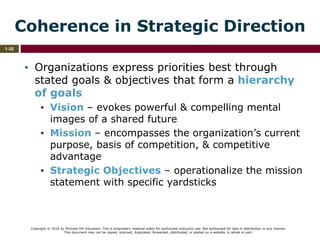
  • #14 The final realized strategy of any firm is a combination of deliberate and emergent strategies.
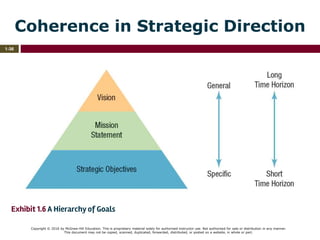
  • #15 The Strategic Management Process involves strategy analysis, strategy formulation, and strategy implementation.
  • #16 See the Sidebar – Learning from Mistakes, at the beginning of the chapter. Might some of Groupon’s performance issues have been avoided if leadership had paid careful attention to the strategic management process, specifically analysis, formulation, and implementation of its initial strategy? Groupon failed to recognize how easy it was for rivals to imitate their business, because of the extremely low entry barriers. In addition to guarding against unrealistic growth expectations, leaders must also make sure appropriate controls are in place; at Groupon that meant establishing accounting practices that would monitor marketing costs against revenue adjusted for refunds. In addition, the business model must be adjusted for industry realities: Groupon’s business was very difficult to scale, given the need to hire extensively in order to solicit new business. Also see http://www.theverge.com/2013/3/13/4079280/greed-is-groupon-can-anyone-save-the-company-from-itself and http://www.usatoday.com/story/tech/columnist/shinal/2015/05/06/groupon-ipo-shares-growth-shinal/70892740/ For an interesting comparison story, see Case 15: Zynga, where CEO mis-steps and a questionable business model face extensive competition in a volatile industry.
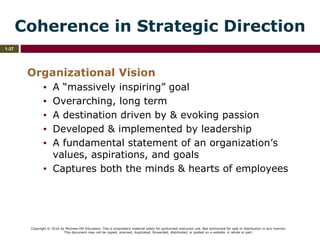
  • #17 Strategy Analysis = study of firms’ external and internal environments, and their fit with organizational vision and goals. Consider using Case 1: Robin Hood, or Case 23: QVC to illustrate how the whole strategic management process works, starting with strategy analysis. Case 19: The Casino Industry gives a good overview of the importance of external environmental analysis (addressing concepts covered in Chapter 2.)
  • #18 Chapter 1 = Analyzing Organizational Goals and Objectives Chapter 2 = Analyzing the External Environment of the Firm
  • #19 Chapter 3 = Assessing the Internal Environment of the Firm Chapter 4 = Assessing a Firm’s Intellectual Assets
  • #20 Strategy Formulation = decisions made by firms regarding investments, commitments, and other aspects of operations that create and sustain competitive advantage. Involves questions about what businesses to compete in, and how to manage these businesses in order to achieve synergy – how they can create more value by working together than by operating as stand-alone businesses. Requires international strategies and entrepreneurial initiatives that can recognize viable opportunities.
  • #21 Chapter 5 = Formulating Business-Level Strategy Chapter 6 = Formulating Corporate-level Strategy
  • #22 Chapter 7 = Formulating International Strategy Chapter 8 = Entrepreneurial Strategy and Competitive Dynamics
  • #23 Strategy Implementation = actions made by firms that carry out the formulated strategy, including strategic controls, organizational design, and leadership.
  • #24 Chapter 9 = Strategic Control and Corporate Governance
  • #25 Chapter 10 = Creating Effective Organizational Designs
  • #26 Chapter 11 = Creating a Learning Organization and an Ethical Organization
  • #27 Chapter 12 = Fostering Corporate Entrepreneurship
  • #28 Strategic management – the analysis, formulation & implementation of strategy – requires an effective & appropriate organizational design – a STRUCTURE that can allow for these strategic activities to take place. According to economist Milton Friedman, the overall purpose of a public corporation is to maximize the long-term return to the owners (shareholders). But who is really responsible for fulfilling this purpose?
  • #29 The board of directors (BOD) provides detailed procedures for formal evaluation of directors and the firm’s top officers. Such guidelines serve to ensure that management is acting in the best interests of shareholders. Chapter 9 highlights important internal and external control mechanisms to ensure effective corporate governance.
  • #30 In addition to shareholders, there are other stakeholders (e.g. suppliers, customers) who must be taken into account in the strategic management process. A stakeholder can be defined as an individual or group, inside or outside the company, that has a stake in and can influence an organization’s performance. Each stakeholder group makes various claims on the company. Stakeholder management = a firm’s strategy for recognizing and responding to the interests of all its salient stakeholders.
  • #31 Zero-sum view of stakeholder management is rooted, in part, in the traditional conflict between workers and management, leading to the formation of unions and sometimes ending in adversarial union – management negotiations and long bitter strikes. The stakeholder challenges facing Walmart is an example of this. However, organizations can achieve mutual benefit through stakeholder symbiosis. The example given is how P&G considered the needs of consumers, shippers, wholesalers, and environmentalists when developing a liquid concentration for cleaning powder. This product breakthrough led not only to a change in consumer shopping habits, but also a revolution in industry supply chain economics. Leading companies are increasingly realizing that learning to partner with governments and communities, suppliers and customers, and even long-term rivals, is essential for dealing with big, complex problems. Stakeholder groups do not have to be in conflict with each other.
  • #32 Answer: B. There will always be conflicting demands on organizations. However, organizations can achieve mutual benefit through stakeholder symbiosis, which recognizes that stakeholders are dependent upon each other for their success and well-being.
  • #33 Social responsibility recognizes that businesses must respond to society’s expectations regarding their obligations to society. Shared value = policies and operating practices that enhance the competitiveness of a company while simultaneously advancing the economic and social conditions in which it operates. Social responsibility is not just an added cost to business. Instead businesses are creators of value that they then share with society in a mutually beneficial relationship. Triple bottom line = assessment of a firm’s financial, social, and environmental performance – accounting for the environmental and social costs of doing business. A sustainable global economy implies an economy that the planet is capable of supporting indefinitely.
  • #34 Although sustainability projects are often very difficult to quantify, the story of SEKEM illustrates how visionary leadership plus an awareness of the triple bottom line – economic, environmental and social goals – can pay off in the long term. From “Making Sustainability Profitable,” by Knut Haanaes, David Michael, Jeremy Jurgens, & Subramanian Rangan, Harvard Business Review, March 2013. Executive Summary available at http://hbr.org/2013/03/making-sustainability-profitable/ar/1 “Organic products were a luxury with little market to speak of when Ibrahim Abouleish founded Sekem, Egypt’s first organic farm, in Cairo in 1977. The years Sekem spent honing sustainable cultivation practices paid off, though, in 1990, when it moved into growing organic cotton. Organic produce was entering mainstream Western stores then, and worldwide demand for all things organic began to surge. There were other advantages to the organic approach as well: Sekem’s farming techniques helped reclaim arable land from the Sahara, which had been spreading into the Nile delta. With them, the soil absorbed more carbon dioxide from the atmosphere, decreasing greenhouse gases, and cotton crops needed 20% to 40% less water. In the bargain, organic techniques lowered the farm’s costs, improved average yields by almost 30%, and produced a raw cotton that was more elastic than its conventionally grown counterpart. So, far from being an expensive indulgence, organic cotton offered Sekem a business model that was more sustainable—not just environmentally but financially. In recent years that model has generated healthy revenue growth: From 2006 until the disruptions of the Arab Spring in 2011, the business posted 14% annual increases, and Sekem is now one of Egypt’s largest organic food producers.” “Rapidly developing economies are often portrayed as sustainability laggards—focused more on raising their citizens out of poverty than on protecting the environment. It’s true that their regulatory bodies can be weak, hesitant to impose restrictions on newly liberalized markets, or resentful of pressure from industrialized nations. But the developed world has never had a monopoly on visionaries, as Sekem’s story illustrates. And in markets where the pressures of resource depletion are felt most keenly, corporate sustainability efforts have become a wellspring of innovation…. many, like Sekem, took a long view, investing in initially more-expensive methods of sustainable operation that eventually led to dramatically lower costs and higher yields…. Collectively, these companies vividly demonstrate that trade-offs between economic development and environmentalism aren’t necessary. Rather, the pursuit of sustainability can be a powerful path to reinvention for all businesses facing limits on their resources and their customers’ buying power.” SEKEM's goals are to "restore and maintain the vitality of the soil and food as well as the biodiversity of nature" through sustainable, organic agriculture and to support social and cultural development in Egypt. See more at www.sekem.com.
  • #35 An organization can’t succeed if only the top managers in the organization take an integrative, strategic perspective of issues facing the firm and everyone else “fends for themselves” in their independent, isolated functional areas. Instead, people throughout the organization must strive toward overall goals. No longer can organizations be effective if the top “does the thinking” and the rest of the organization “does the work.” Everyone must be involved in the strategic management process.
  • #36 Hierarchy of goals = organizational goals ranging from, at the top, those that are less specific yet able to evoke powerful and compelling mental images, to, at the bottom, those that are more specific and measurable. A hierarchy of strategic goals can help an organization achieve coherence in its strategic direction. Vision = organizational goal(s) that evoke(s) powerful and compelling mental images, i.e. “Connecting the world through games” (Zynga), or “To be the happiest place on earth” (Disney) Mission statement = a set of organizational goals that include both the purpose of the organization, its scope of operations, and the basis of its competitive advantage. Strategic Objectives = a set of organizational goals that are used to operationalize the mission statement and that are specific and cover a well-defined time frame.
  • #37 The hierarchy of goals has a relationship to two attributes: general versus specific (from vision to objectives), and time horizon (long-term to short-term).
  • #38 Vision = organizational goal(s) that evoke(s) powerful and compelling mental images, i.e. “Connecting the world through games” (Zynga), or “To be the happiest place on earth” (Disney)
  • #39 Walk doesn’t match the talk = idealistic vision can arouse employee enthusiasm but can be quickly dashed if employees find senior management’s behavior is not consistent with the vision. Irrelevance = vision created in a vacuum unrelated to environmental threats or opportunities, or not a match for organization’s resources & capabilities. Not the holy grail = managers continually search for the ONE elusive solution that will solve their firm’s problems. Too much focus = by directing people & resources toward a grandiose vision, losses can be devastating. Ideal future irreconciled with the present = visions should be anchored in current reality, need to account for the often hostile environment in which the firm competes.
  • #40 Mission statement = a set of organizational goals that include both the purpose of the organization, its scope of operations, and the basis of its competitive advantage.
  • #41 Strategic Objectives = a set of organizational goals that are used to operationalize the mission statement and that are specific and cover a well-defined time frame. Short-term objectives can become essential components of a firm’s “action plan,” and therefore can be critical in implementing the firm’s chosen strategy. See Chapter 9 for more details. Also see Case 1: Robin Hood for an example!