Slide 1


Java Design Pattern
Strategy Pattern


                   Swapnal Agrawal
                   Module Lead

                   Ganesh Kolhe
                   Senior Team Lead
Slide 2


Outline
 Overview
 Analysis and Design
 Module and Client Implementation
 Strategy
 Variation in the Implementation
 Java API Usage
 Consequences
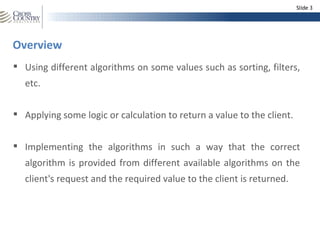
Slide 3


Overview
 Using different algorithms on some values such as sorting, filters,
  etc.


 Applying some logic or calculation to return a value to the client.


 Implementing the algorithms in such a way that the correct
  algorithm is provided from different available algorithms on the
  client's request and the required value to the client is returned.
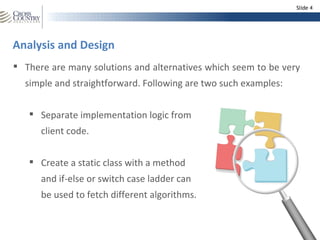
Slide 4


Analysis and Design
 There are many solutions and alternatives which seem to be very
  simple and straightforward. Following are two such examples:


    Separate implementation logic from
      client code.


    Create a static class with a method
      and if-else or switch case ladder can
      be used to fetch different algorithms.
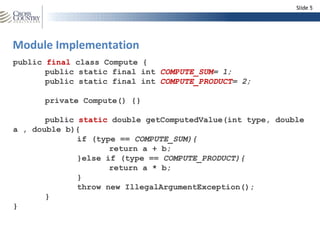
Slide 5


Module Implementation
public final class Compute {
       public static final int COMPUTE_SUM= 1;
       public static final int COMPUTE_PRODUCT= 2;

      private Compute() {}

       public static double getComputedValue(int type, double
a , double b){
              if (type == COMPUTE_SUM){
                     return a + b;
              }else if (type == COMPUTE_PRODUCT){
                     return a * b;
              }
              throw new IllegalArgumentException();
       }
}
Slide 6


Client Implementation
public class ApplicationClient {
      public static void main(String[] args) {
             System.out.println("Sum = "+
                   Compute.getComputedValue(
                   Compute.COMPUTE_SUM, 20, 25));


             System.out.println("Product = "+
                   Compute.getComputedValue(
                   Compute.COMPUTE_PRODUCT, 7, 3));
      }
}
Slide 7


The Design


             Easy Testing

                                       Code Reuse
                            Easy
                         Maintenance

               Easy
             Expansion
Slide 8


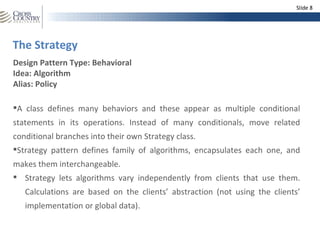
The Strategy
Design Pattern Type: Behavioral
Idea: Algorithm
Alias: Policy

A class defines many behaviors and these appear as multiple conditional
statements in its operations. Instead of many conditionals, move related
conditional branches into their own Strategy class.
Strategy pattern defines family of algorithms, encapsulates each one, and
makes them interchangeable.
 Strategy lets algorithms vary independently from clients that use them.
   Calculations are based on the clients’ abstraction (not using the clients’
   implementation or global data).
Slide 9


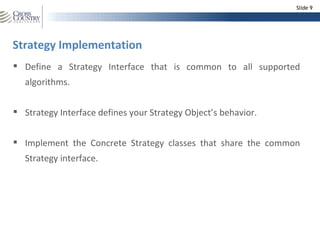
Strategy Implementation
 Define a Strategy Interface that is common to all supported
   algorithms.


 Strategy Interface defines your Strategy Object’s behavior.


 Implement the Concrete Strategy classes that share the common
   Strategy interface.
Slide 10


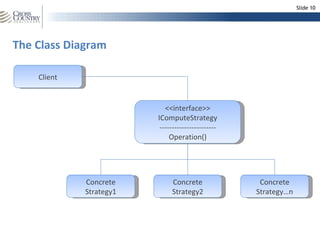
The Class Diagram

    Client


                            <<interface>>
                         IComputeStrategy
                          -----------------------
                              Operation()


             Concrete         Concrete               Concrete
             Strategy1        Strategy2             Strategy…n
Slide 11


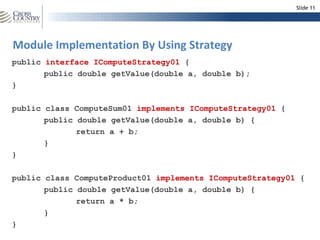
Module Implementation By Using Strategy
public interface IComputeStrategy01 {
       public double getValue(double a, double b);
}

public class ComputeSum01 implements IComputeStrategy01 {
       public double getValue(double a, double b) {
              return a + b;
       }
}

public class ComputeProduct01 implements IComputeStrategy01 {
       public double getValue(double a, double b) {
              return a * b;
       }
}
Slide 12


Client Code Using the Implementation
public class StrategyApplicationClient01 {
       public static void main(String[] args) {

      IComputeStrategy01 compute1 = new ComputeSum01();
      System.out.println("Sum = "+
             compute1.getValue(20, 25));

      IComputeStrategy01 compute2 = new ComputeProduct02();
      System.out.println("Product = "+
             compute2.getValue(7, 3));
      }
}
Slide 13


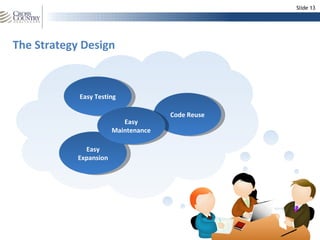
The Strategy Design


            Easy Testing

                                      Code Reuse
                           Easy
                        Maintenance

              Easy
            Expansion
Slide 14


Variation In The Implementation
 Singleton:

    Concrete classes as singleton objects.


    Define a static method to get a singleton instance.
Slide 15


Strategy Implementation By Using Singleton
//singleton implementation
public final class ComputeSum02 implements IComputeStrategy02
{

private static ComputeSum02 computeSum = new ComputeSum02();

private ComputeSum02(){}

public static IComputeStrategy02 getOnlyOneInstance(){
return computeSum;
}

public double getValue(double a, double b) {
return a + b;
}
}
Slide 16


Client - Strategy Implementation By Using Singleton
public class StrategyApplicationClient02 {
       public static void main(String[] args) {

             IComputeStrategy02 compute1 =
                    ComputeSum02.getOnlyOneInstance();
             System.out.println("Sum = "+
                    compute1.getValue(20, 25));

             IComputeStrategy02 compute2 =
                     ComputeProduct02.getOnlyOneInstance();
             System.out.println(“Product= "+
                    compute2.getValue(7, 3));
      }
}
Slide 17


Another Variation In the Implementation
Context:
   is configured with a Concrete Strategy object.
   maintains a private reference to a Strategy object.

   may define an interface that lets Strategy access its data.


  By changing the Context's Strategy, different behaviors can be
     obtained.
Slide 18


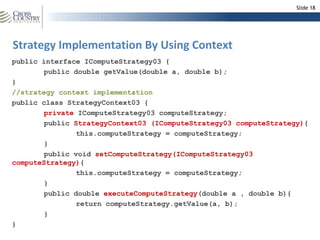
Strategy Implementation By Using Context
public interface IComputeStrategy03 {
        public double getValue(double a, double b);
}
//strategy context implementation
public class StrategyContext03 {
        private IComputeStrategy03 computeStrategy;
        public StrategyContext03 (IComputeStrategy03 computeStrategy){
                this.computeStrategy = computeStrategy;
        }
        public void setComputeStrategy(IComputeStrategy03
computeStrategy){
                this.computeStrategy = computeStrategy;
        }
        public double executeComputeStrategy(double a , double b){
                return computeStrategy.getValue(a, b);
        }
}
Slide 19


Client - Strategy Implementation By Using Context
public class StrategyApplicationClient03 {
 public static void main(String[] args) {

      StrategyContext03 ctx = new StrategyContext03(
             ComputeSum03.getOnlyOneInstance());
      System.out.println("Sum = "+
             ctx.executeComputeStrategy(20, 25));

      ctx.setComputeStratey(
             ComputeProduct03.getOnlyOneInstance());
      System.out.println("Product = "+
      ctx.executeComputeStrategy(7, 3));
      }
}
Slide 20


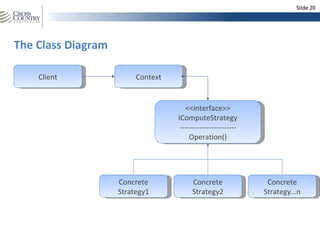
The Class Diagram

    Client               Context


                                      <<interface>>
                                   IComputeStrategy
                                    -----------------------
                                        Operation()


                    Concrete            Concrete               Concrete
                    Strategy1           Strategy2             Strategy…n
Slide 21


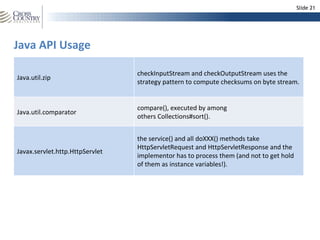
Java API Usage

                                 checkInputStream and checkOutputStream uses the
Java.util.zip
                                 strategy pattern to compute checksums on byte stream.


                                 compare(), executed by among
Java.util.comparator
                                 others Collections#sort().


                                 the service() and all doXXX() methods take
                                 HttpServletRequest and HttpServletResponse and the
Javax.servlet.http.HttpServlet
                                 implementor has to process them (and not to get hold
                                 of them as instance variables!).
Slide 22


Consequences
 Benefits
   Provides an alternative to sub classing the Context class to get a variety
    of algorithms or behaviors.
   Eliminates large conditional statements.

   Provides a choice of implementations for the same behavior.


 Shortcomings
   Increases the number of objects.

   All algorithms must use the same Strategy interface.


  Think twice before implementing the Strategy pattern or any other design
     pattern to match your requirements.
Slide 23


About Cross Country Infotech
Cross Country Infotech (CCI) Pvt. Ltd. is a part of the Cross Country Healthcare (NYSE:
CCRN) group of companies. CCI specializes in providing a gamut of IT/ITES services and
is well equipped with technical expertise to provide smarter solutions to its customers.
Some of our cutting-edge technology offerings include Mobile, Web and BI Application
Development; ECM and Informix 4GL Solutions; and Technical Documentation, UI
Design and Testing services.
Slide 24


References
  http://paginas.fe.up.pt/~aaguiar/as/gof/hires/pat5i.htm

  http://www.oodesign.com/strategy-pattern.html
Slide 25


Thank You!

Strategy Design Pattern

  • 1.
    Slide 1 Java DesignPattern Strategy Pattern Swapnal Agrawal Module Lead Ganesh Kolhe Senior Team Lead
  • 2.
    Slide 2 Outline  Overview Analysis and Design  Module and Client Implementation  Strategy  Variation in the Implementation  Java API Usage  Consequences
  • 3.
    Slide 3 Overview  Usingdifferent algorithms on some values such as sorting, filters, etc.  Applying some logic or calculation to return a value to the client.  Implementing the algorithms in such a way that the correct algorithm is provided from different available algorithms on the client's request and the required value to the client is returned.
  • 4.
    Slide 4 Analysis andDesign  There are many solutions and alternatives which seem to be very simple and straightforward. Following are two such examples:  Separate implementation logic from client code.  Create a static class with a method and if-else or switch case ladder can be used to fetch different algorithms.
  • 5.
    Slide 5 Module Implementation publicfinal class Compute { public static final int COMPUTE_SUM= 1; public static final int COMPUTE_PRODUCT= 2; private Compute() {} public static double getComputedValue(int type, double a , double b){ if (type == COMPUTE_SUM){ return a + b; }else if (type == COMPUTE_PRODUCT){ return a * b; } throw new IllegalArgumentException(); } }
  • 6.
    Slide 6 Client Implementation publicclass ApplicationClient { public static void main(String[] args) { System.out.println("Sum = "+ Compute.getComputedValue( Compute.COMPUTE_SUM, 20, 25)); System.out.println("Product = "+ Compute.getComputedValue( Compute.COMPUTE_PRODUCT, 7, 3)); } }
  • 7.
    Slide 7 The Design Easy Testing Code Reuse Easy Maintenance Easy Expansion
  • 8.
    Slide 8 The Strategy DesignPattern Type: Behavioral Idea: Algorithm Alias: Policy A class defines many behaviors and these appear as multiple conditional statements in its operations. Instead of many conditionals, move related conditional branches into their own Strategy class. Strategy pattern defines family of algorithms, encapsulates each one, and makes them interchangeable.  Strategy lets algorithms vary independently from clients that use them. Calculations are based on the clients’ abstraction (not using the clients’ implementation or global data).
  • 9.
    Slide 9 Strategy Implementation Define a Strategy Interface that is common to all supported algorithms.  Strategy Interface defines your Strategy Object’s behavior.  Implement the Concrete Strategy classes that share the common Strategy interface.
  • 10.
    Slide 10 The ClassDiagram Client <<interface>> IComputeStrategy ----------------------- Operation() Concrete Concrete Concrete Strategy1 Strategy2 Strategy…n
  • 11.
    Slide 11 Module ImplementationBy Using Strategy public interface IComputeStrategy01 { public double getValue(double a, double b); } public class ComputeSum01 implements IComputeStrategy01 { public double getValue(double a, double b) { return a + b; } } public class ComputeProduct01 implements IComputeStrategy01 { public double getValue(double a, double b) { return a * b; } }
  • 12.
    Slide 12 Client CodeUsing the Implementation public class StrategyApplicationClient01 { public static void main(String[] args) { IComputeStrategy01 compute1 = new ComputeSum01(); System.out.println("Sum = "+ compute1.getValue(20, 25)); IComputeStrategy01 compute2 = new ComputeProduct02(); System.out.println("Product = "+ compute2.getValue(7, 3)); } }
  • 13.
    Slide 13 The StrategyDesign Easy Testing Code Reuse Easy Maintenance Easy Expansion
  • 14.
    Slide 14 Variation InThe Implementation  Singleton:  Concrete classes as singleton objects.  Define a static method to get a singleton instance.
  • 15.
    Slide 15 Strategy ImplementationBy Using Singleton //singleton implementation public final class ComputeSum02 implements IComputeStrategy02 { private static ComputeSum02 computeSum = new ComputeSum02(); private ComputeSum02(){} public static IComputeStrategy02 getOnlyOneInstance(){ return computeSum; } public double getValue(double a, double b) { return a + b; } }
  • 16.
    Slide 16 Client -Strategy Implementation By Using Singleton public class StrategyApplicationClient02 { public static void main(String[] args) { IComputeStrategy02 compute1 = ComputeSum02.getOnlyOneInstance(); System.out.println("Sum = "+ compute1.getValue(20, 25)); IComputeStrategy02 compute2 = ComputeProduct02.getOnlyOneInstance(); System.out.println(“Product= "+ compute2.getValue(7, 3)); } }
  • 17.
    Slide 17 Another VariationIn the Implementation Context:  is configured with a Concrete Strategy object.  maintains a private reference to a Strategy object.  may define an interface that lets Strategy access its data. By changing the Context's Strategy, different behaviors can be obtained.
  • 18.
    Slide 18 Strategy ImplementationBy Using Context public interface IComputeStrategy03 { public double getValue(double a, double b); } //strategy context implementation public class StrategyContext03 { private IComputeStrategy03 computeStrategy; public StrategyContext03 (IComputeStrategy03 computeStrategy){ this.computeStrategy = computeStrategy; } public void setComputeStrategy(IComputeStrategy03 computeStrategy){ this.computeStrategy = computeStrategy; } public double executeComputeStrategy(double a , double b){ return computeStrategy.getValue(a, b); } }
  • 19.
    Slide 19 Client -Strategy Implementation By Using Context public class StrategyApplicationClient03 { public static void main(String[] args) { StrategyContext03 ctx = new StrategyContext03( ComputeSum03.getOnlyOneInstance()); System.out.println("Sum = "+ ctx.executeComputeStrategy(20, 25)); ctx.setComputeStratey( ComputeProduct03.getOnlyOneInstance()); System.out.println("Product = "+ ctx.executeComputeStrategy(7, 3)); } }
  • 20.
    Slide 20 The ClassDiagram Client Context <<interface>> IComputeStrategy ----------------------- Operation() Concrete Concrete Concrete Strategy1 Strategy2 Strategy…n
  • 21.
    Slide 21 Java APIUsage checkInputStream and checkOutputStream uses the Java.util.zip strategy pattern to compute checksums on byte stream. compare(), executed by among Java.util.comparator others Collections#sort(). the service() and all doXXX() methods take HttpServletRequest and HttpServletResponse and the Javax.servlet.http.HttpServlet implementor has to process them (and not to get hold of them as instance variables!).
  • 22.
    Slide 22 Consequences  Benefits  Provides an alternative to sub classing the Context class to get a variety of algorithms or behaviors.  Eliminates large conditional statements.  Provides a choice of implementations for the same behavior.  Shortcomings  Increases the number of objects.  All algorithms must use the same Strategy interface. Think twice before implementing the Strategy pattern or any other design pattern to match your requirements.
  • 23.
    Slide 23 About CrossCountry Infotech Cross Country Infotech (CCI) Pvt. Ltd. is a part of the Cross Country Healthcare (NYSE: CCRN) group of companies. CCI specializes in providing a gamut of IT/ITES services and is well equipped with technical expertise to provide smarter solutions to its customers. Some of our cutting-edge technology offerings include Mobile, Web and BI Application Development; ECM and Informix 4GL Solutions; and Technical Documentation, UI Design and Testing services.
  • 24.
    Slide 24 References http://paginas.fe.up.pt/~aaguiar/as/gof/hires/pat5i.htm  http://www.oodesign.com/strategy-pattern.html
  • 25.

Editor's Notes