Strategies for
Building a Hybrid
Workplace
Business Consultant Roberto Lico
licoreis@licoreis.com.br
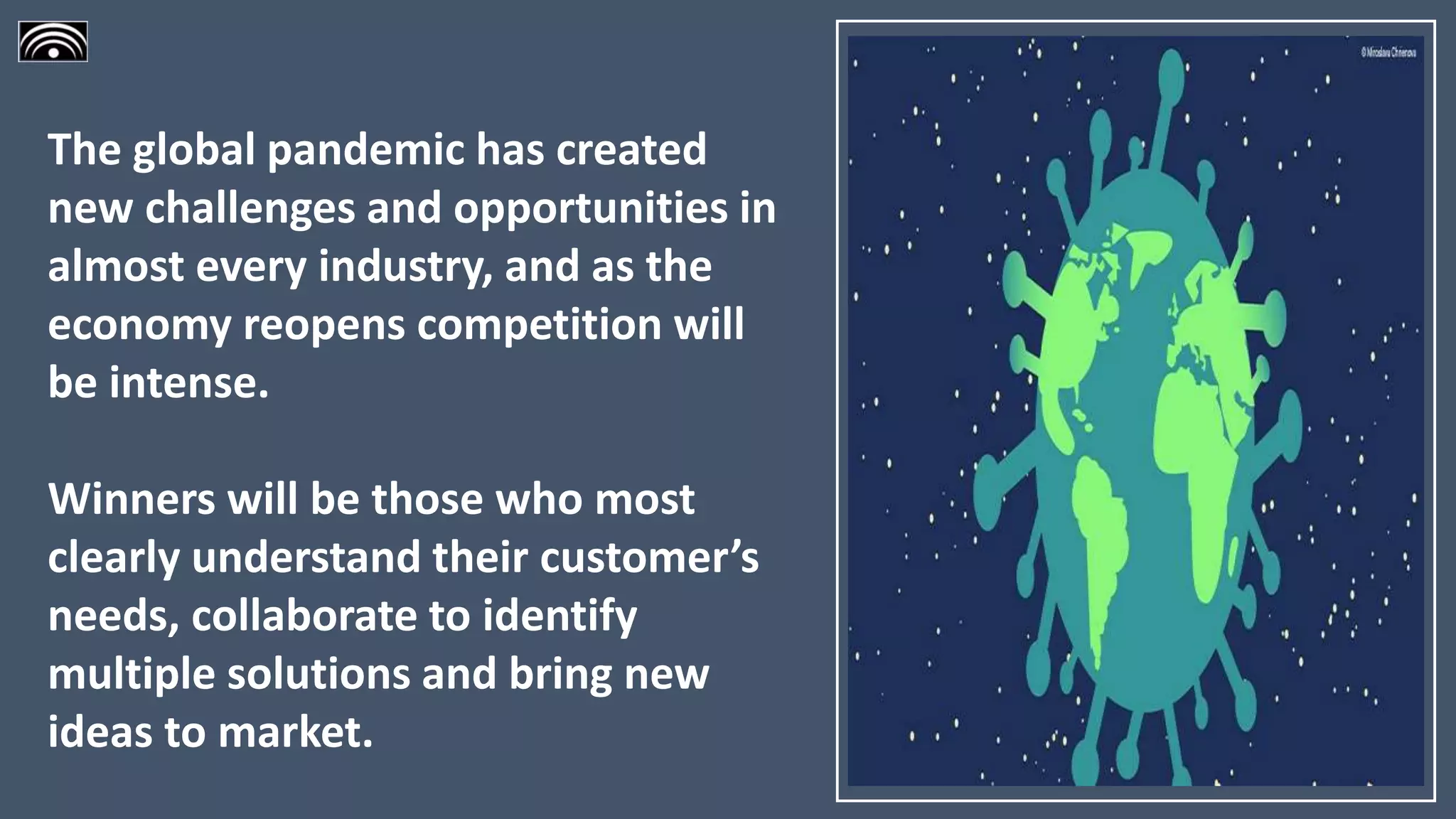
The global pandemic has created
new challenges and opportunities in
almost every industry, and as the
economy reopens competition will
be intense.
Winners will be those who most
clearly understand their customer’s
needs, collaborate to identify
multiple solutions and bring new
ideas to market.
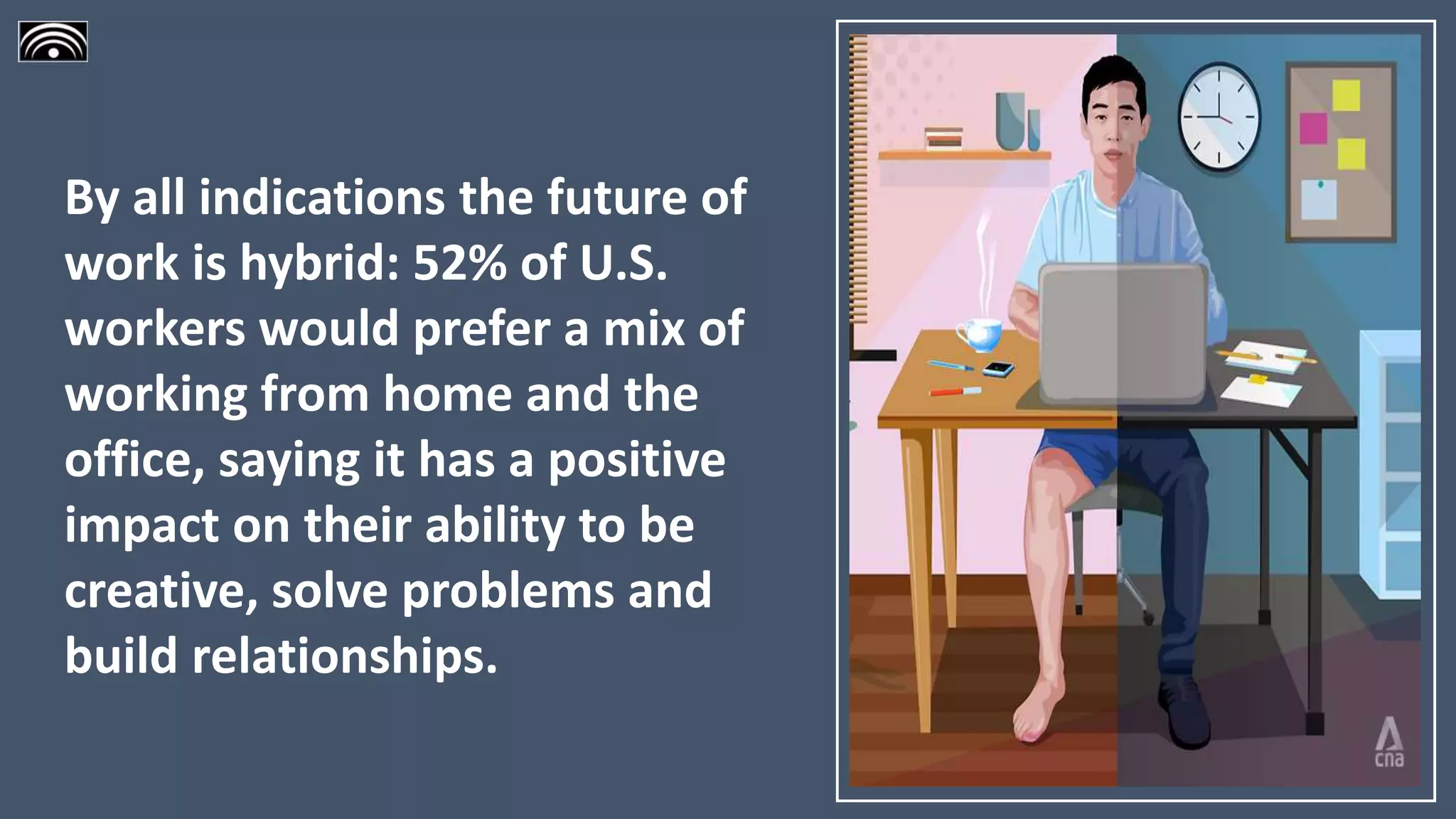
By all indications the future of
work is hybrid: 52% of U.S.
workers would prefer a mix of
working from home and the
office, saying it has a positive
impact on their ability to be
creative, solve problems and
build relationships.
Global research tells us 72% of
corporate leaders plan to offer a
hybrid model, and only 13% say
they expect to decrease their
real estate footprint in the next
year, suggesting that
organizations will continue to
leverage their workplaces
within a hybrid work future.
But getting hybrid right will be
hard. Deciding who works from
the office and how often is a
complex issue, and it will be
different for every organization.
If not done well it could
threaten culture, collaboration,
and innovation.
Conversely, a well-executed
hybrid workplace can be a
magnet that brings people
together and helps us work
better than ever before.
Organizations who will win know
that workplaces designed for people
and the resiliency of their
organizations will help them move
forward, learn, and remain
competitive. supports new hybrid
work patterns.
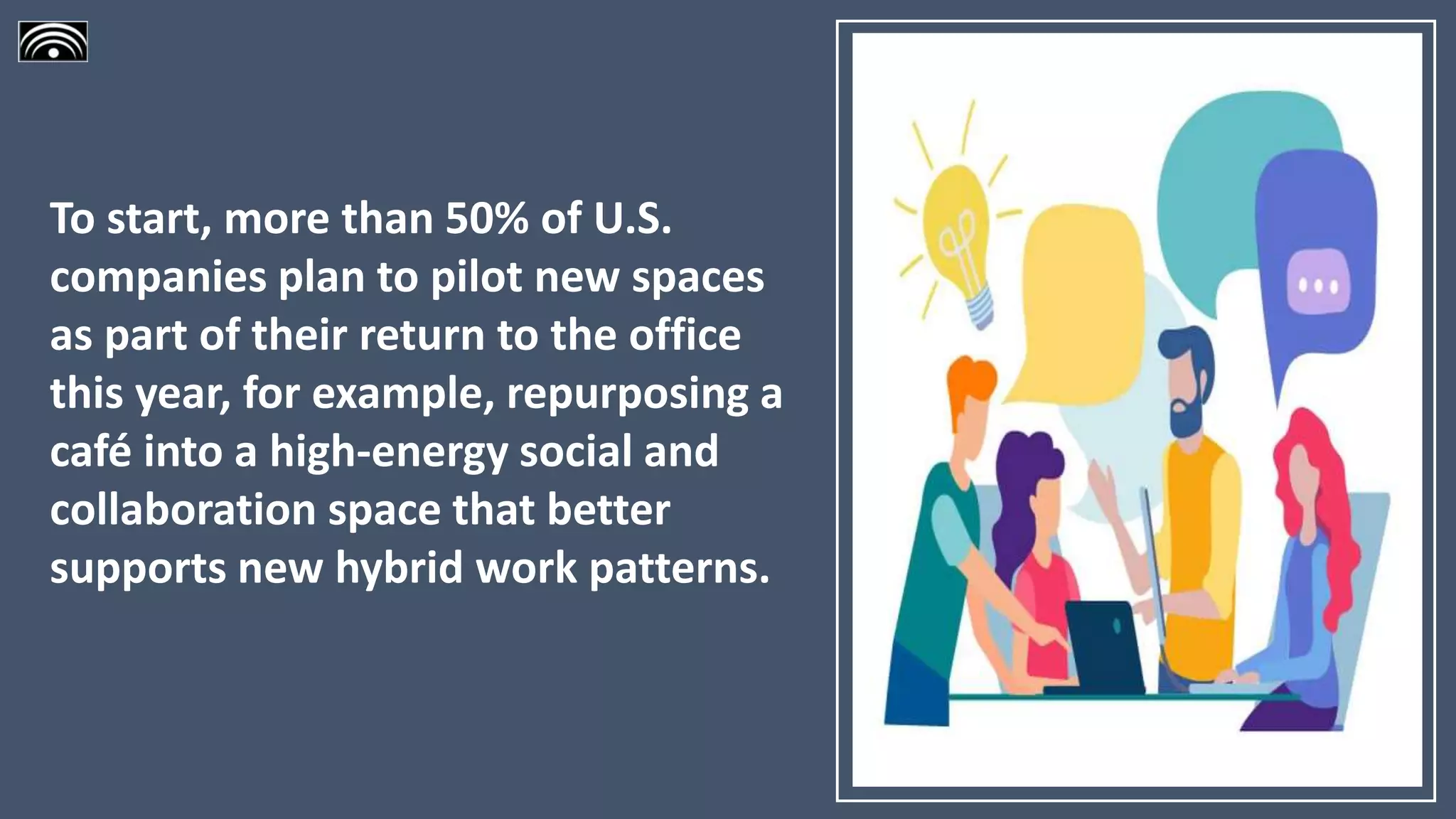
To start, more than 50% of U.S.
companies plan to pilot new spaces
as part of their return to the office
this year, for example, repurposing a
café into a high-energy social and
collaboration space that better
supports new hybrid work patterns.
Braid the Digital and Physical
Experience
We know that bridging the gap between in-
person and remote participants is hard and
remote colleagues can feel frustrated and
unable to participate equally, becoming
less engaged.
The solution is to integrate physical spaces
and technology, providing your team the
opportunity to communicate well.
Flip Enclosed and Open Spaces
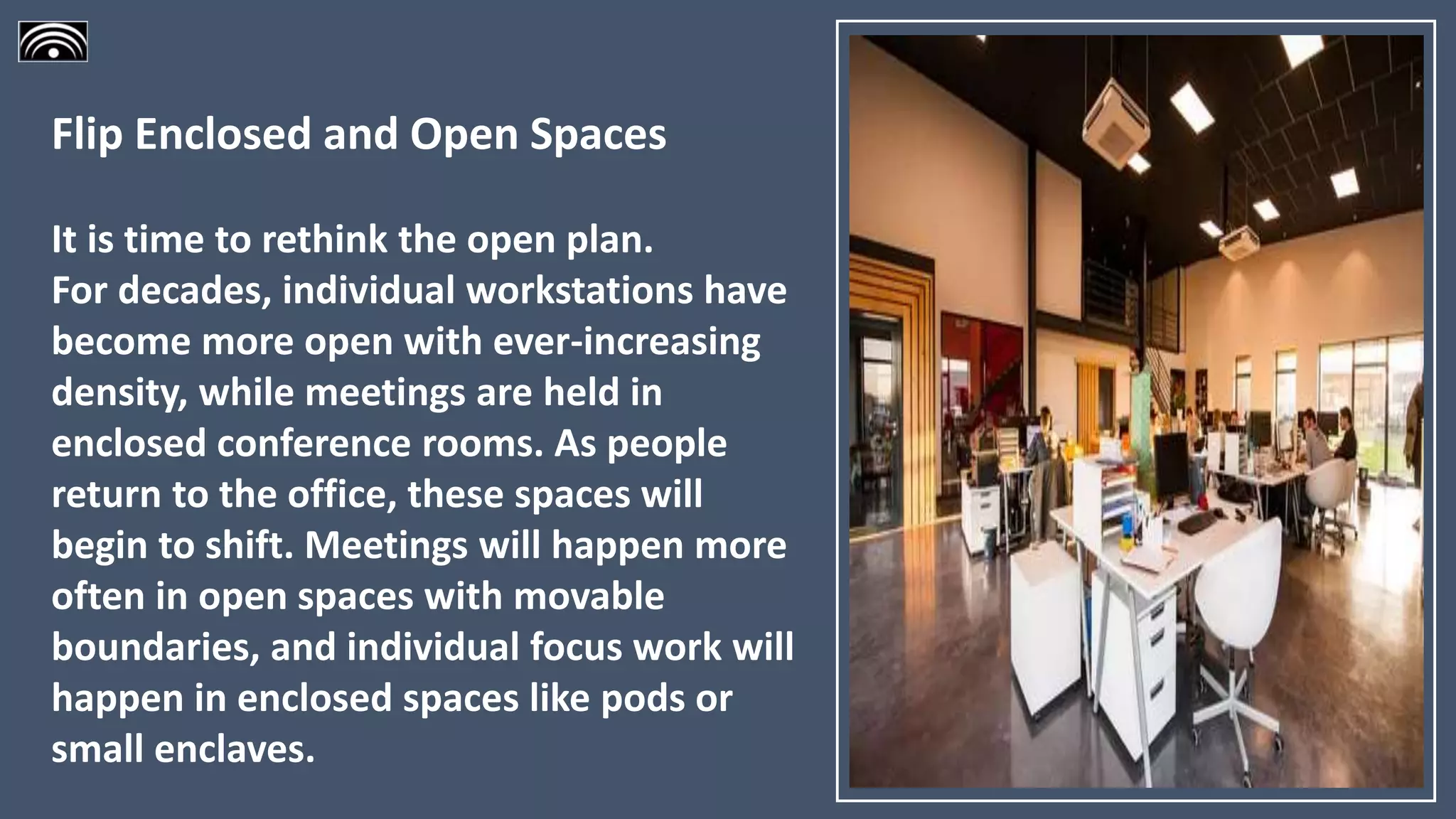
It is time to rethink the open plan.
For decades, individual workstations have
become more open with ever-increasing
density, while meetings are held in
enclosed conference rooms. As people
return to the office, these spaces will
begin to shift. Meetings will happen more
often in open spaces with movable
boundaries, and individual focus work will
happen in enclosed spaces like pods or
small enclaves.
Shift from Fixed to Fluid
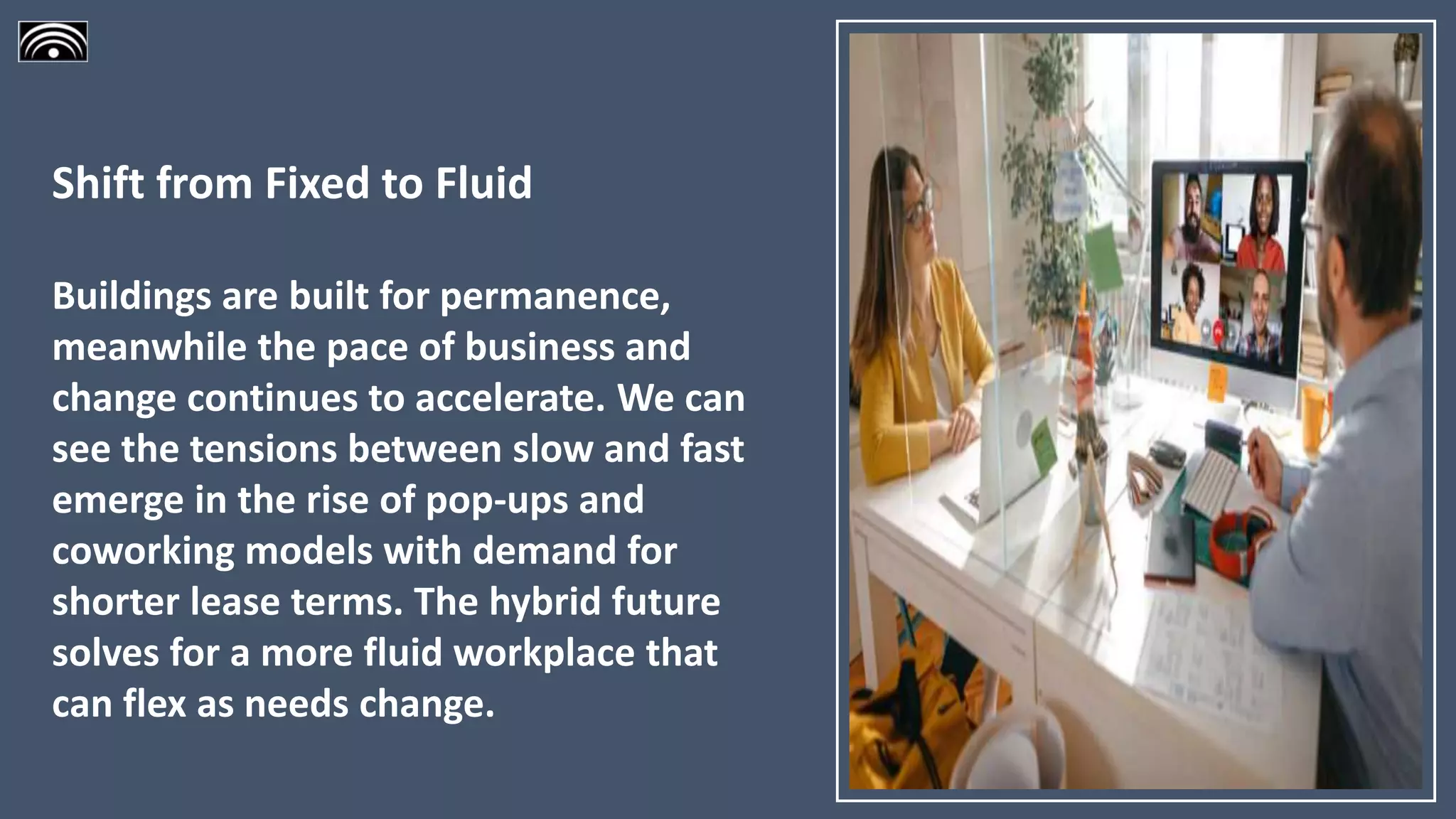
Buildings are built for permanence,
meanwhile the pace of business and
change continues to accelerate. We can
see the tensions between slow and fast
emerge in the rise of pop-ups and
coworking models with demand for
shorter lease terms. The hybrid future
solves for a more fluid workplace that
can flex as needs change.
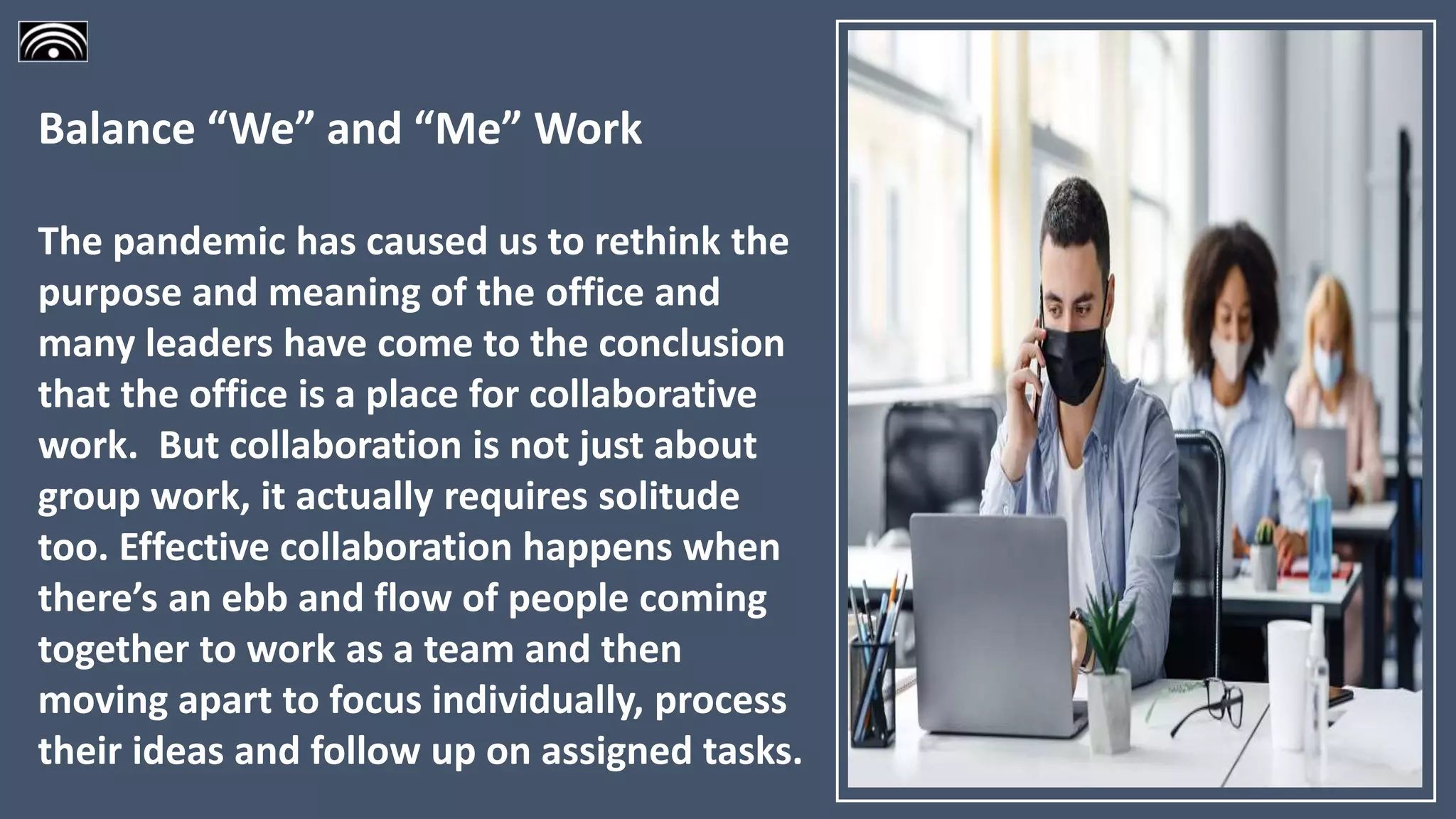
Balance “We” and “Me” Work
The pandemic has caused us to rethink the
purpose and meaning of the office and
many leaders have come to the conclusion
that the office is a place for collaborative
work. But collaboration is not just about
group work, it actually requires solitude
too. Effective collaboration happens when
there’s an ebb and flow of people coming
together to work as a team and then
moving apart to focus individually, process
their ideas and follow up on assigned tasks.
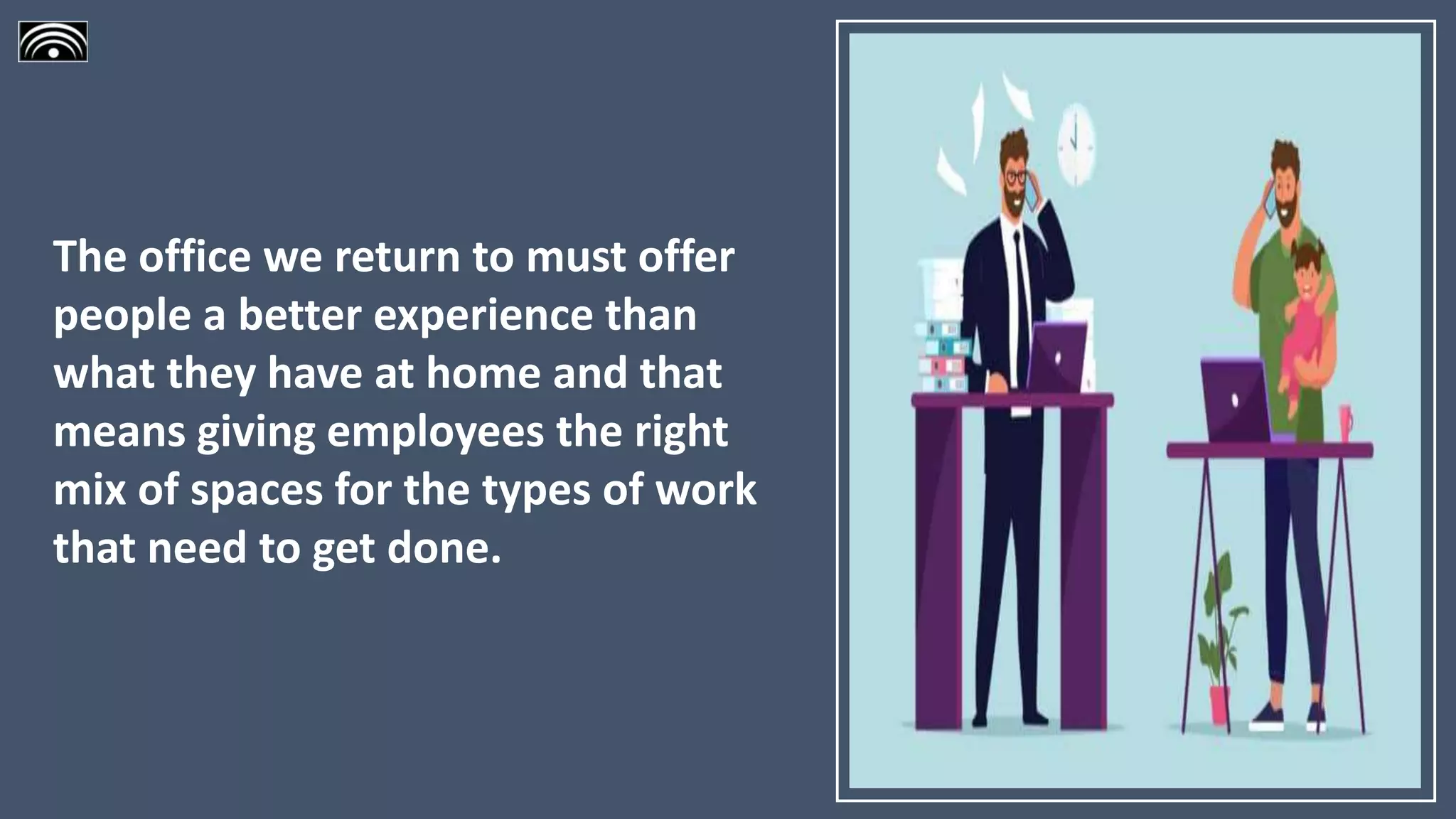
The office we return to must offer
people a better experience than
what they have at home and that
means giving employees the right
mix of spaces for the types of work
that need to get done.
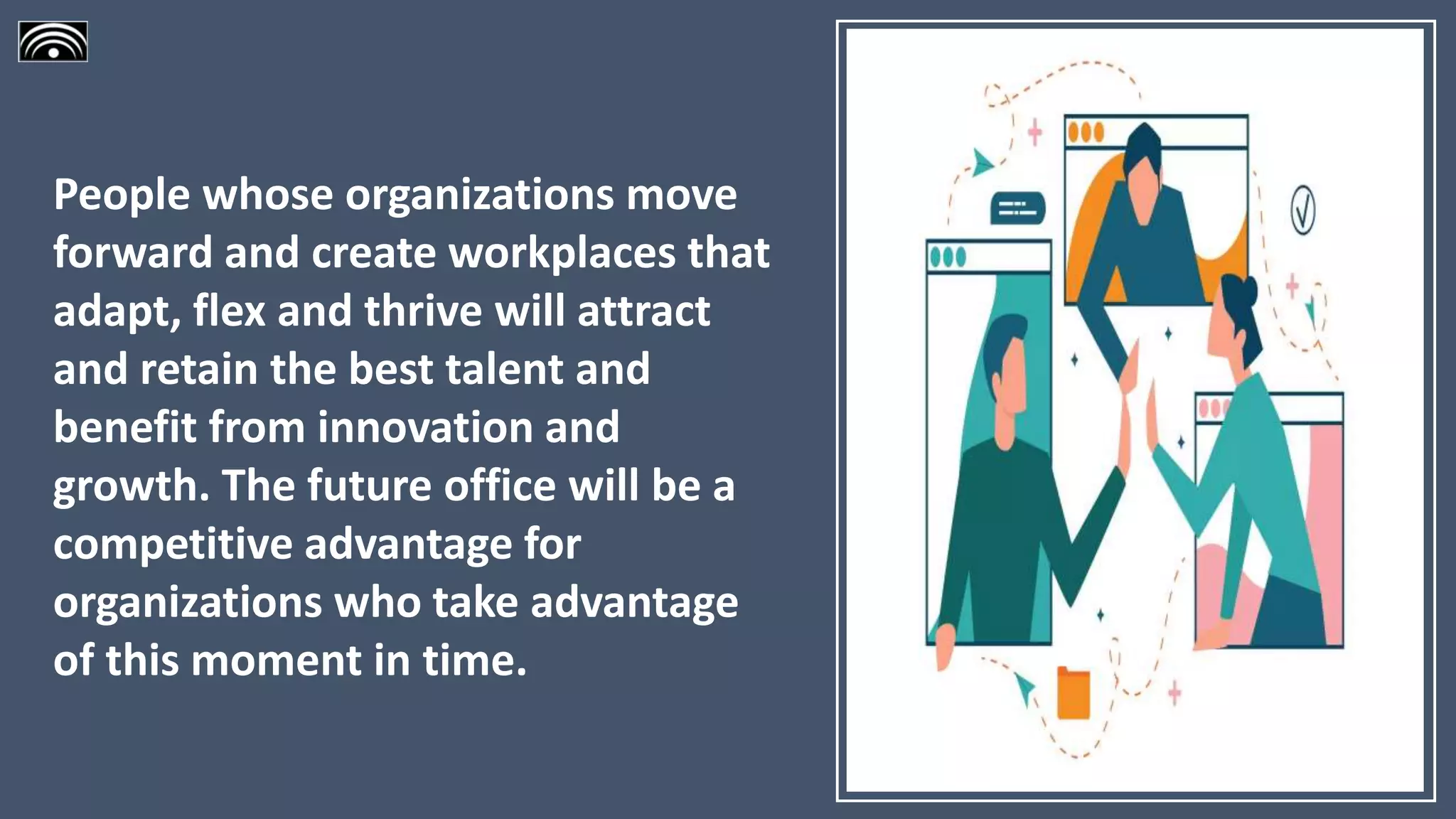
People whose organizations move
forward and create workplaces that
adapt, flex and thrive will attract
and retain the best talent and
benefit from innovation and
growth. The future office will be a
competitive advantage for
organizations who take advantage
of this moment in time.
LRCL – Lico Reis Consultoria & Línguas
Roberto Lico – licoreis@licoreis.com.br
WhatsApp: 12 9 9195 2474
LRCL – Business Services Consulting
Information – licoreis@licoreis.com.br
We provide a whole range of
Business and Legal Online
Support about Brazil:
 Management and Business Strategy
 English Business Classes and Support
 Technical Translations
 On-line Lectures
 On-line Business Consulting
 Country Business Profile
LRCL – Lico Reis Consultoria & Línguas
Informações – licoreis@licoreis.com.br
Nossas Atividades Profissionais:
 Estratégias de Negócios – Desenvolvimento e Follow-up
 Treinamentos e Workshops para Empresas Nacionais e
Multinacionais (Português e Inglês)
 Aulas de Inglês Empresarial
 Traduções Técnicas
 Consultoria de Negócios
 Exportação e Importação

strategies for building a hybrid workplace that works

  • 1.
    Strategies for Building aHybrid Workplace Business Consultant Roberto Lico licoreis@licoreis.com.br
  • 3.
    The global pandemichas created new challenges and opportunities in almost every industry, and as the economy reopens competition will be intense. Winners will be those who most clearly understand their customer’s needs, collaborate to identify multiple solutions and bring new ideas to market.
  • 4.
    By all indicationsthe future of work is hybrid: 52% of U.S. workers would prefer a mix of working from home and the office, saying it has a positive impact on their ability to be creative, solve problems and build relationships.
  • 5.
    Global research tellsus 72% of corporate leaders plan to offer a hybrid model, and only 13% say they expect to decrease their real estate footprint in the next year, suggesting that organizations will continue to leverage their workplaces within a hybrid work future.
  • 6.
    But getting hybridright will be hard. Deciding who works from the office and how often is a complex issue, and it will be different for every organization.
  • 7.
    If not donewell it could threaten culture, collaboration, and innovation. Conversely, a well-executed hybrid workplace can be a magnet that brings people together and helps us work better than ever before.
  • 8.
    Organizations who willwin know that workplaces designed for people and the resiliency of their organizations will help them move forward, learn, and remain competitive. supports new hybrid work patterns.
  • 9.
    To start, morethan 50% of U.S. companies plan to pilot new spaces as part of their return to the office this year, for example, repurposing a café into a high-energy social and collaboration space that better supports new hybrid work patterns.
  • 10.
    Braid the Digitaland Physical Experience We know that bridging the gap between in- person and remote participants is hard and remote colleagues can feel frustrated and unable to participate equally, becoming less engaged. The solution is to integrate physical spaces and technology, providing your team the opportunity to communicate well.
  • 11.
    Flip Enclosed andOpen Spaces It is time to rethink the open plan. For decades, individual workstations have become more open with ever-increasing density, while meetings are held in enclosed conference rooms. As people return to the office, these spaces will begin to shift. Meetings will happen more often in open spaces with movable boundaries, and individual focus work will happen in enclosed spaces like pods or small enclaves.
  • 12.
    Shift from Fixedto Fluid Buildings are built for permanence, meanwhile the pace of business and change continues to accelerate. We can see the tensions between slow and fast emerge in the rise of pop-ups and coworking models with demand for shorter lease terms. The hybrid future solves for a more fluid workplace that can flex as needs change.
  • 13.
    Balance “We” and“Me” Work The pandemic has caused us to rethink the purpose and meaning of the office and many leaders have come to the conclusion that the office is a place for collaborative work. But collaboration is not just about group work, it actually requires solitude too. Effective collaboration happens when there’s an ebb and flow of people coming together to work as a team and then moving apart to focus individually, process their ideas and follow up on assigned tasks.
  • 14.
    The office wereturn to must offer people a better experience than what they have at home and that means giving employees the right mix of spaces for the types of work that need to get done.
  • 15.
    People whose organizationsmove forward and create workplaces that adapt, flex and thrive will attract and retain the best talent and benefit from innovation and growth. The future office will be a competitive advantage for organizations who take advantage of this moment in time.
  • 17.
    LRCL – LicoReis Consultoria & Línguas Roberto Lico – licoreis@licoreis.com.br WhatsApp: 12 9 9195 2474
  • 18.
    LRCL – BusinessServices Consulting Information – licoreis@licoreis.com.br We provide a whole range of Business and Legal Online Support about Brazil:  Management and Business Strategy  English Business Classes and Support  Technical Translations  On-line Lectures  On-line Business Consulting  Country Business Profile
  • 19.
    LRCL – LicoReis Consultoria & Línguas Informações – licoreis@licoreis.com.br Nossas Atividades Profissionais:  Estratégias de Negócios – Desenvolvimento e Follow-up  Treinamentos e Workshops para Empresas Nacionais e Multinacionais (Português e Inglês)  Aulas de Inglês Empresarial  Traduções Técnicas  Consultoria de Negócios  Exportação e Importação