Success in the hybrid workplace
Using people-first strategies
to drive business growth
The modern workplace.
Putting people before place.
The landscape of the modern workplace has undergone a
significant transformation with the rise of the hybrid workforce.
As businesses adapt to this new paradigm — operationally and
culturally — they’re navigating a range of complexities, while
simultaneously seeking to capitalize on the potential advantages
it offers. In this eBook, we explore how business leaders are
putting their people first to drive enhanced collaboration,
culture, performance, security, compliance, and sustainable
business practices.
We know that hybrid work is here to stay. We also know that
managing that workforce effectively is critical to success.
According to Gartner®, human-centric design is “a model that
puts people at the center of work.”1
Their research has shown
that organizations with a human-centric model in place are
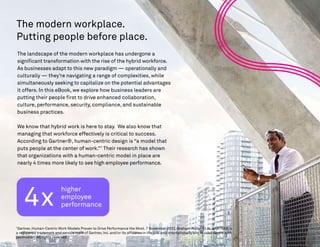
nearly 4 times more likely to see high employee performance.
4x
higher
employee
performance
1
Gartner, Human-Centric Work Models Proven to Drive Performance the Most. 7 November 2022, Graham Waller Et Al. GARTNER is
a registered trademark and service mark of Gartner, Inc. and/or its affiliates in the U.S. and internationally and is used herein with
permission. All rights reserved.
The challenges mount.
C-suite leaders are navigating a rapidly evolving, increasingly
competitive market while contending with an entirely new
kind of workforce characterized by:
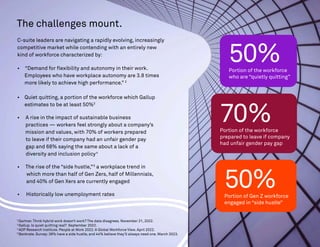
50%
Portion of the workforce
who are “quietly quitting”
70%
Portion of the workforce
prepared to leave if company
had unfair gender pay gap
50%
Portion of Gen Z workforce
engaged in “side hustle”
2
Gartner. Think hybrid work doesn’t work? The data disagrees. November 21, 2022.
3
Gallup. Is quiet quitting real? September 2022.
4
ADP Research Institute. People at Work 2022: A Global Workforce View. April 2022.
5
Bankrate. Survey: 39% have a side hustle, and 44% believe they’ll always need one. March 2023.
• “Demand for flexibility and autonomy in their work.
Employees who have workplace autonomy are 3.8 times
more likely to achieve high performance.” 2
• Quiet quitting, a portion of the workforce which Gallup
estimates to be at least 50%3
• A rise in the impact of sustainable business
practices — workers feel strongly about a company’s
mission and values, with 70% of workers prepared
to leave if their company had an unfair gender pay
gap and 68% saying the same about a lack of a
diversity and inclusion policy4
• The rise of the “side hustle,”5
a workplace trend in
which more than half of Gen Zers, half of Millennials,
and 40% of Gen Xers are currently engaged
• Historically low unemployment rates
The response? A people first workplace.
Forward-thinking leaders are taking a people-first, human-centric approach
to managing their hybrid employees. How? By creating and reinforcing a
culture that prioritizes a balanced working/personal life for each employee
through empathy, flexibility and collaboration.
They understand that maintaining employee connections and creating a
sense of inclusivity, collaboration, and teamwork are critical, whether it’s
peer-to-peer, manager-to-peer, manager-to-manager, or in group dynamics.
First and foremost, however, they understand that a people-first
model requires commitment to empowerment, training, technolo-
gies and tools. It also takes a higher-level commitment to building
a culture that encompasses and fosters the principles of CSR, ESG
and DEIB.These principles demonstrate an organization’s focus on
making people and planet a priority.
Now,let’s explore how a people-centric model drives satisfaction,
performance and revenue, backed by findings from Ricoh’s
2023 Global Customer Discovery Report.
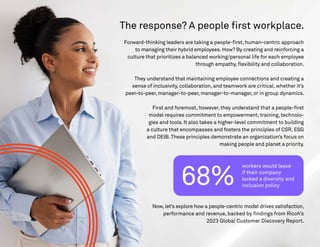
68%
workers would leave
if their company
lacked a diversity and
inclusion policy
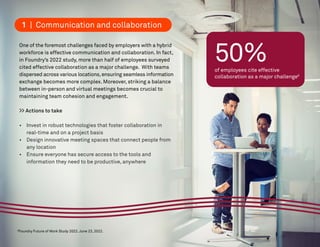
50%
of employees cite effective
collaboration as a major challenge6
One of the foremost challenges faced by employers with a hybrid
workforce is effective communication and collaboration. In fact,
in Foundry’s 2022 study, more than half of employees surveyed
cited effective collaboration as a major challenge. With teams
dispersed across various locations,ensuring seamless information
exchange becomes more complex. Moreover, striking a balance
between in-person and virtual meetings becomes crucial to
maintaining team cohesion and engagement.
>> Actions to take
• Invest in robust technologies that foster collaboration in
real-time and on a project basis
• Design innovative meeting spaces that connect people from
any location
• Ensure everyone has secure access to the tools and
information they need to be productive, anywhere
6
Foundry Future of Work Study 2022. June 23, 2022.
1 | Communication and collaboration
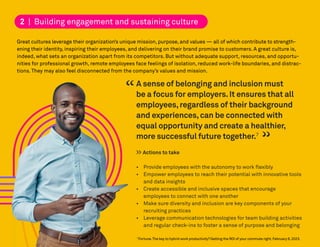
Great cultures leverage their organization’s unique mission, purpose, and values — all of which contribute to strength-
ening their identity, inspiring their employees, and delivering on their brand promise to customers. A great culture is,
indeed, what sets an organization apart from its competitors. But without adequate support, resources, and opportu-
nities for professional growth, remote employees face feelings of isolation, reduced work-life boundaries, and distrac-
tions. They may also feel disconnected from the company’s values and mission.
7
Fortune.The key to hybrid work productivity? Getting the ROI of your commute right.February 8,2023.
2 | Building engagement and sustaining culture
A sense of belonging and inclusion must
be a focus for employers.It ensures that all
employees,regardless of their background
and experiences,can be connected with
equal opportunity and create a healthier,
more successful future together.7
>> Actions to take
• Provide employees with the autonomy to work flexibly
• Empower employees to reach their potential with innovative tools
and data insights
• Create accessible and inclusive spaces that encourage
employees to connect with one another
• Make sure diversity and inclusion are key components of your
recruiting practices
• Leverage communication technologies for team building activities
and regular check-ins to foster a sense of purpose and belonging
“
“
About three-quarters of all U.S.companies are in the process
of adopting a hybrid work model.7
Now, managers need to
learn how to maximize hybrid work productivity by
determining what employees can most effectively work on
at home, and what to focus on when they come to the office.
While matching workers with tasks might seem simple, it
isn’t. Without proper guidance in this area, middle
managers will often shoehorn traditional office-centric
methods of working into hybrid settings. Leaders must
recognize and address the reality that misaligning remote
workers with activities can result in lower productivity,
engagement, and morale, which hurts the company’s bottom
line,as well as employees’well-being and career success.
So, given the obstacles, can workers truly be more
productive when working from a location of their choosing?
Studies have shown that working in an environment that
suits individual preferences, reduces commute time, and
presents fewer distractions can enhance a worker’s focus
and efficiency — and with them, productivity.
8
Forbes, S., Birkett, H., Evans, L., & Chung, H. (2022). Flexible Working and the Future of Work. Retrieved from Equal Parenting Project.
3 | Increased productivity and performance
>> Actions to take
• Design a flexible, seamless work experience that enables
employees to access tools from any location
• Automate processes to empower workers, drive
efficiency and optimize outcomes
• Manage and leverage information to enable data-driven
strategies that drive growth and minimize risk
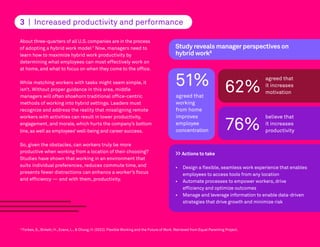
51%
agreed that
working
from home
improves
employee
concentration
Study reveals manager perspectives on
hybrid work8
62%
agreed that
it increases
motivation
76%
believe that
it increases
productivity
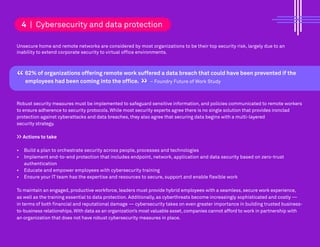
Unsecure home and remote networks are considered by most organizations to be their top security risk, largely due to an
inability to extend corporate security to virtual office environments.
62% of organizations offering remote work suffered a data breach that could have been prevented if the
employees had been coming into the office. – Foundry Future of Work Study
Robust security measures must be implemented to safeguard sensitive information, and policies communicated to remote workers
to ensure adherence to security protocols. While most security experts agree there is no single solution that provides ironclad
protection against cyberattacks and data breaches, they also agree that securing data begins with a multi-layered
security strategy.
>> Actions to take
• Build a plan to orchestrate security across people, processes and technologies
• Implement end-to-end protection that includes endpoint, network, application and data security based on zero-trust
authentication
• Educate and empower employees with cybersecurity training
• Ensure your IT team has the expertise and resources to secure, support and enable flexible work
To maintain an engaged, productive workforce, leaders must provide hybrid employees with a seamless, secure work experience,
as well as the training essential to data protection. Additionally, as cyberthreats become increasingly sophisticated and costly —
in terms of both financial and reputational damage — cybersecurity takes on even greater importance in building trusted business-
to-business relationships.With data as an organization’s most valuable asset,companies cannot afford to work in partnership with
an organization that does not have robust cybersecurity measures in place.
4 | Cybersecurity and data protection
“ “
9
Deloitte. Global Remote Work Survey. 2022.
5. Compliance
Compliance is a challenge even in the best of circumstances, and a hybrid workforce adds an
entirely new layer of regulatory hoops for an organization to jump through. A recent survey by
Deloitte reveals that regulatory issues are often cited among the top three challenges employers
face when implementing remote or hybrid work strategies.9
Further complicating compliance is the increased scrutiny that third-party vendors and partners
continue to face from customers and regulators monitoring their handling of proprietary data.
For starters, a chief consideration, among many, is how to maintain a culture of compliance across
a borderless workplace when, historically, this has been done with employees working together,
side by side.Then, organizations must consider the numerous types of remote work, with each type
potentially involving its own regulatory considerations.
>> Actions to take
• Cultivate a compliance mindset that lives across the entire organization
• Identify, classify, structure and clean up data to eliminate risk
• Adhere to an information governance framework to improve operational data efficiency, ensure
compliance and gain valuable insights
• Prepare a disaster response plan that supports compliance and mitigates impact
5 | Compliance
Another shift associated with hybrid work is the growing importance of sustainable business practices.
Business frameworks such as CSR (Corporate Social Responsibility),ESG (Environmental,Social,and Governance),and DEIB (Diversity,
Equity, Inclusion, and Belonging) are becoming increasingly important across the entire commerce ecosystem as shareholders,
investors,clients,customers,and workers demand greater accountability from companies and organizations.Those demands include,
but are not limited to:
10
Ricoh Customer Discovery Report 2023.
11
ICIMS. 3 sustainability initiatives to help attract and retain talent. April 22, 2022.
12
Bain & Company. Do ESG efforts create value? April 17, 2023.
6 | Sustainable business practices
Employee well-being:Offering employees the opportunity to avoid commutes and work in a location of their choosing can lead to reduced
stress levels and improved work-life balance. This, in turn, can lead to an increase in job satisfaction, productivity, and retention.
Environment: By adopting sustainable practices, such as eliminating the need for daily commuting, a hybrid employee is contributing to a
reduced environmental footprint. An employer may contribute to reducing the carbon footprint created by its office space.
Cost savings:Remote work reduces expenses. For the employee, the costs associated with travel to an office, and, for the employer, the
costs associated with maintaining office space.
Social responsibility:A commitment to social causes and frameworks, such as CSR and DEIB, fosters a positive company image, strength-
ens relationships with stakeholders, and attracts socially conscious employees and customers.
Global talent pool: A company’s position on sustainable business practices enhances its ability to attract talent. In fact, 66% of respon-
dents in one study noted that a company’s mission and core values must align with their own when applying for a job11
“Although environmental impact has been a focus area for many years,there is a rise in activity around diversity and inclusion,
with organizations looking to see how they can improve digital accessibility and enhance the diversity of thought and culture.10
“
>> Actions to take: Sustainable practices give meaning to work and build a positive perception in the marketplace. In recent years,
sustainability has become an essential component of doing business,from attracting top talent to attracting new customers.Beyond
benefiting the planet and society,sustainability measures correlate with financial performance,according to a Bain &
Company study.12
•
•
•
•
•
How can leaders optimize operations for long-term results?
Implementing processes and practices to build a hybrid workforce is no simple task. It requires aligning workers not
only with tasks, but with each other — not only through technologies, but through an engaging and inclusive culture.
Doing all this successfully may require a C-suite mindset shift.
After all, yesterday’s workplace is gone forever, and today’s is still taking shape. One thing is certain, however. Your
organization’s success hinges on your ability to manage a hybrid workforce, challenge your own expectations and
assumptions, and keep evolving your business … so you’re prepared for whatever the future holds.
Strategic investment in
your people — and the
right technology, tools
and processes to support
them — is key to
optimizing your operations
for long-term success.
In addition, choosing
partners that can advise
and support you on the
journey will accelerate
your results.
Your partner in building connections
Ricoh works with organizations of all sizes and across industries to drive modernization and create efficiencies that
support collaboration, teamwork, technology integration, and results-based process improvement.
Our people are customer obsessed, and we thrive on making meaningful connections among data, systems, and people,
and partnering with our clients to uncover and make strategic use of their information.
Our agnostic approach means we don’t favor one technology, solution, or team for service delivery. Instead, we take a
human-centered, custom approach to bring the best people, technologies, and partners together to solve our clients’
challenges. If you’d like more information or to explore solutions for your business, we’re ready to talk.
About Ricoh
At Ricoh, we are unlocking the power of our customers’ information, processes, and abilities so they can respond to
change and provide the best possible experiences for their employees and customers. By unleashing the full power
of trapped information, organizations can unlock the full potential of their people, respond to change with actionable
insights, and create more meaningful human experiences.
For further information, please visit www.ricoh-usa.com
Ricoh USA, Inc. 300 Eagleview Boulevard, Exton, PA 19341 | 1-800-63-RICOH
©2023 Ricoh USA, Inc. All rights reserved. Ricoh® and the Ricoh logo are registered trademarks of Ricoh Company, Ltd. All other trademarks are the property of their respective owners.The
content of this document, and the appearance, features and specifications of Ricoh products and services are subject to change from time to time without notice. Products are shown with optional
features. While care has been taken to ensure the accuracy of this information, Ricoh makes no representation or warranties about the accuracy, completeness or adequacy of the information
contained herein, and shall not be liable for any errors or omissions in these materials. Actual results will vary depending upon use of the products and services, and the conditions and factors
affecting performance.The only warranties for Ricoh products and services are as set forth in the express warranty statements accompanying them.

Digital Workplace Management: Transforming the Modern Workforce.pdf

  • 1.
    Success in thehybrid workplace Using people-first strategies to drive business growth
  • 2.
    The modern workplace. Puttingpeople before place. The landscape of the modern workplace has undergone a significant transformation with the rise of the hybrid workforce. As businesses adapt to this new paradigm — operationally and culturally — they’re navigating a range of complexities, while simultaneously seeking to capitalize on the potential advantages it offers. In this eBook, we explore how business leaders are putting their people first to drive enhanced collaboration, culture, performance, security, compliance, and sustainable business practices. We know that hybrid work is here to stay. We also know that managing that workforce effectively is critical to success. According to Gartner®, human-centric design is “a model that puts people at the center of work.”1 Their research has shown that organizations with a human-centric model in place are nearly 4 times more likely to see high employee performance. 4x higher employee performance 1 Gartner, Human-Centric Work Models Proven to Drive Performance the Most. 7 November 2022, Graham Waller Et Al. GARTNER is a registered trademark and service mark of Gartner, Inc. and/or its affiliates in the U.S. and internationally and is used herein with permission. All rights reserved.
  • 3.
    The challenges mount. C-suiteleaders are navigating a rapidly evolving, increasingly competitive market while contending with an entirely new kind of workforce characterized by: 50% Portion of the workforce who are “quietly quitting” 70% Portion of the workforce prepared to leave if company had unfair gender pay gap 50% Portion of Gen Z workforce engaged in “side hustle” 2 Gartner. Think hybrid work doesn’t work? The data disagrees. November 21, 2022. 3 Gallup. Is quiet quitting real? September 2022. 4 ADP Research Institute. People at Work 2022: A Global Workforce View. April 2022. 5 Bankrate. Survey: 39% have a side hustle, and 44% believe they’ll always need one. March 2023. • “Demand for flexibility and autonomy in their work. Employees who have workplace autonomy are 3.8 times more likely to achieve high performance.” 2 • Quiet quitting, a portion of the workforce which Gallup estimates to be at least 50%3 • A rise in the impact of sustainable business practices — workers feel strongly about a company’s mission and values, with 70% of workers prepared to leave if their company had an unfair gender pay gap and 68% saying the same about a lack of a diversity and inclusion policy4 • The rise of the “side hustle,”5 a workplace trend in which more than half of Gen Zers, half of Millennials, and 40% of Gen Xers are currently engaged • Historically low unemployment rates
  • 4.
    The response? Apeople first workplace. Forward-thinking leaders are taking a people-first, human-centric approach to managing their hybrid employees. How? By creating and reinforcing a culture that prioritizes a balanced working/personal life for each employee through empathy, flexibility and collaboration. They understand that maintaining employee connections and creating a sense of inclusivity, collaboration, and teamwork are critical, whether it’s peer-to-peer, manager-to-peer, manager-to-manager, or in group dynamics. First and foremost, however, they understand that a people-first model requires commitment to empowerment, training, technolo- gies and tools. It also takes a higher-level commitment to building a culture that encompasses and fosters the principles of CSR, ESG and DEIB.These principles demonstrate an organization’s focus on making people and planet a priority. Now,let’s explore how a people-centric model drives satisfaction, performance and revenue, backed by findings from Ricoh’s 2023 Global Customer Discovery Report. 68% workers would leave if their company lacked a diversity and inclusion policy
  • 5.
    50% of employees citeeffective collaboration as a major challenge6 One of the foremost challenges faced by employers with a hybrid workforce is effective communication and collaboration. In fact, in Foundry’s 2022 study, more than half of employees surveyed cited effective collaboration as a major challenge. With teams dispersed across various locations,ensuring seamless information exchange becomes more complex. Moreover, striking a balance between in-person and virtual meetings becomes crucial to maintaining team cohesion and engagement. >> Actions to take • Invest in robust technologies that foster collaboration in real-time and on a project basis • Design innovative meeting spaces that connect people from any location • Ensure everyone has secure access to the tools and information they need to be productive, anywhere 6 Foundry Future of Work Study 2022. June 23, 2022. 1 | Communication and collaboration
  • 6.
    Great cultures leveragetheir organization’s unique mission, purpose, and values — all of which contribute to strength- ening their identity, inspiring their employees, and delivering on their brand promise to customers. A great culture is, indeed, what sets an organization apart from its competitors. But without adequate support, resources, and opportu- nities for professional growth, remote employees face feelings of isolation, reduced work-life boundaries, and distrac- tions. They may also feel disconnected from the company’s values and mission. 7 Fortune.The key to hybrid work productivity? Getting the ROI of your commute right.February 8,2023. 2 | Building engagement and sustaining culture A sense of belonging and inclusion must be a focus for employers.It ensures that all employees,regardless of their background and experiences,can be connected with equal opportunity and create a healthier, more successful future together.7 >> Actions to take • Provide employees with the autonomy to work flexibly • Empower employees to reach their potential with innovative tools and data insights • Create accessible and inclusive spaces that encourage employees to connect with one another • Make sure diversity and inclusion are key components of your recruiting practices • Leverage communication technologies for team building activities and regular check-ins to foster a sense of purpose and belonging “ “
  • 7.
    About three-quarters ofall U.S.companies are in the process of adopting a hybrid work model.7 Now, managers need to learn how to maximize hybrid work productivity by determining what employees can most effectively work on at home, and what to focus on when they come to the office. While matching workers with tasks might seem simple, it isn’t. Without proper guidance in this area, middle managers will often shoehorn traditional office-centric methods of working into hybrid settings. Leaders must recognize and address the reality that misaligning remote workers with activities can result in lower productivity, engagement, and morale, which hurts the company’s bottom line,as well as employees’well-being and career success. So, given the obstacles, can workers truly be more productive when working from a location of their choosing? Studies have shown that working in an environment that suits individual preferences, reduces commute time, and presents fewer distractions can enhance a worker’s focus and efficiency — and with them, productivity. 8 Forbes, S., Birkett, H., Evans, L., & Chung, H. (2022). Flexible Working and the Future of Work. Retrieved from Equal Parenting Project. 3 | Increased productivity and performance >> Actions to take • Design a flexible, seamless work experience that enables employees to access tools from any location • Automate processes to empower workers, drive efficiency and optimize outcomes • Manage and leverage information to enable data-driven strategies that drive growth and minimize risk 51% agreed that working from home improves employee concentration Study reveals manager perspectives on hybrid work8 62% agreed that it increases motivation 76% believe that it increases productivity
  • 8.
    Unsecure home andremote networks are considered by most organizations to be their top security risk, largely due to an inability to extend corporate security to virtual office environments. 62% of organizations offering remote work suffered a data breach that could have been prevented if the employees had been coming into the office. – Foundry Future of Work Study Robust security measures must be implemented to safeguard sensitive information, and policies communicated to remote workers to ensure adherence to security protocols. While most security experts agree there is no single solution that provides ironclad protection against cyberattacks and data breaches, they also agree that securing data begins with a multi-layered security strategy. >> Actions to take • Build a plan to orchestrate security across people, processes and technologies • Implement end-to-end protection that includes endpoint, network, application and data security based on zero-trust authentication • Educate and empower employees with cybersecurity training • Ensure your IT team has the expertise and resources to secure, support and enable flexible work To maintain an engaged, productive workforce, leaders must provide hybrid employees with a seamless, secure work experience, as well as the training essential to data protection. Additionally, as cyberthreats become increasingly sophisticated and costly — in terms of both financial and reputational damage — cybersecurity takes on even greater importance in building trusted business- to-business relationships.With data as an organization’s most valuable asset,companies cannot afford to work in partnership with an organization that does not have robust cybersecurity measures in place. 4 | Cybersecurity and data protection “ “
  • 9.
    9 Deloitte. Global RemoteWork Survey. 2022. 5. Compliance Compliance is a challenge even in the best of circumstances, and a hybrid workforce adds an entirely new layer of regulatory hoops for an organization to jump through. A recent survey by Deloitte reveals that regulatory issues are often cited among the top three challenges employers face when implementing remote or hybrid work strategies.9 Further complicating compliance is the increased scrutiny that third-party vendors and partners continue to face from customers and regulators monitoring their handling of proprietary data. For starters, a chief consideration, among many, is how to maintain a culture of compliance across a borderless workplace when, historically, this has been done with employees working together, side by side.Then, organizations must consider the numerous types of remote work, with each type potentially involving its own regulatory considerations. >> Actions to take • Cultivate a compliance mindset that lives across the entire organization • Identify, classify, structure and clean up data to eliminate risk • Adhere to an information governance framework to improve operational data efficiency, ensure compliance and gain valuable insights • Prepare a disaster response plan that supports compliance and mitigates impact 5 | Compliance
  • 10.
    Another shift associatedwith hybrid work is the growing importance of sustainable business practices. Business frameworks such as CSR (Corporate Social Responsibility),ESG (Environmental,Social,and Governance),and DEIB (Diversity, Equity, Inclusion, and Belonging) are becoming increasingly important across the entire commerce ecosystem as shareholders, investors,clients,customers,and workers demand greater accountability from companies and organizations.Those demands include, but are not limited to: 10 Ricoh Customer Discovery Report 2023. 11 ICIMS. 3 sustainability initiatives to help attract and retain talent. April 22, 2022. 12 Bain & Company. Do ESG efforts create value? April 17, 2023. 6 | Sustainable business practices Employee well-being:Offering employees the opportunity to avoid commutes and work in a location of their choosing can lead to reduced stress levels and improved work-life balance. This, in turn, can lead to an increase in job satisfaction, productivity, and retention. Environment: By adopting sustainable practices, such as eliminating the need for daily commuting, a hybrid employee is contributing to a reduced environmental footprint. An employer may contribute to reducing the carbon footprint created by its office space. Cost savings:Remote work reduces expenses. For the employee, the costs associated with travel to an office, and, for the employer, the costs associated with maintaining office space. Social responsibility:A commitment to social causes and frameworks, such as CSR and DEIB, fosters a positive company image, strength- ens relationships with stakeholders, and attracts socially conscious employees and customers. Global talent pool: A company’s position on sustainable business practices enhances its ability to attract talent. In fact, 66% of respon- dents in one study noted that a company’s mission and core values must align with their own when applying for a job11 “Although environmental impact has been a focus area for many years,there is a rise in activity around diversity and inclusion, with organizations looking to see how they can improve digital accessibility and enhance the diversity of thought and culture.10 “ >> Actions to take: Sustainable practices give meaning to work and build a positive perception in the marketplace. In recent years, sustainability has become an essential component of doing business,from attracting top talent to attracting new customers.Beyond benefiting the planet and society,sustainability measures correlate with financial performance,according to a Bain & Company study.12 • • • • •
  • 11.
    How can leadersoptimize operations for long-term results? Implementing processes and practices to build a hybrid workforce is no simple task. It requires aligning workers not only with tasks, but with each other — not only through technologies, but through an engaging and inclusive culture. Doing all this successfully may require a C-suite mindset shift. After all, yesterday’s workplace is gone forever, and today’s is still taking shape. One thing is certain, however. Your organization’s success hinges on your ability to manage a hybrid workforce, challenge your own expectations and assumptions, and keep evolving your business … so you’re prepared for whatever the future holds. Strategic investment in your people — and the right technology, tools and processes to support them — is key to optimizing your operations for long-term success. In addition, choosing partners that can advise and support you on the journey will accelerate your results.
  • 12.
    Your partner inbuilding connections Ricoh works with organizations of all sizes and across industries to drive modernization and create efficiencies that support collaboration, teamwork, technology integration, and results-based process improvement. Our people are customer obsessed, and we thrive on making meaningful connections among data, systems, and people, and partnering with our clients to uncover and make strategic use of their information. Our agnostic approach means we don’t favor one technology, solution, or team for service delivery. Instead, we take a human-centered, custom approach to bring the best people, technologies, and partners together to solve our clients’ challenges. If you’d like more information or to explore solutions for your business, we’re ready to talk.
  • 13.
    About Ricoh At Ricoh,we are unlocking the power of our customers’ information, processes, and abilities so they can respond to change and provide the best possible experiences for their employees and customers. By unleashing the full power of trapped information, organizations can unlock the full potential of their people, respond to change with actionable insights, and create more meaningful human experiences. For further information, please visit www.ricoh-usa.com Ricoh USA, Inc. 300 Eagleview Boulevard, Exton, PA 19341 | 1-800-63-RICOH ©2023 Ricoh USA, Inc. All rights reserved. Ricoh® and the Ricoh logo are registered trademarks of Ricoh Company, Ltd. All other trademarks are the property of their respective owners.The content of this document, and the appearance, features and specifications of Ricoh products and services are subject to change from time to time without notice. Products are shown with optional features. While care has been taken to ensure the accuracy of this information, Ricoh makes no representation or warranties about the accuracy, completeness or adequacy of the information contained herein, and shall not be liable for any errors or omissions in these materials. Actual results will vary depending upon use of the products and services, and the conditions and factors affecting performance.The only warranties for Ricoh products and services are as set forth in the express warranty statements accompanying them.