Environment & PEST Analysis:
An Approach to External Business
Environment
 Author -Abhishek Gupta- Administrative-cum-Accounts Officer &
Head of Office, Sardar Swaran Singh National Institute of Renewable
Energy (Ministry of New & Renewable Energy, Govt. of India)-
(Punjab)
 Journal Name-International Journal of Modern Social Sciences.
 Journal homepage:
www.ModernScientificPress.com/Journals/IJMSS.aspx
 Article history: Received 8 April 2013, Received in revised form 28
May, Accepted 29 May 2013, Published 30 May 2013.
ISSN: 2169-9917
STRATEGIC MANAGEMENT
 Environmental management-environmental planning, protection, monitoring,
assessment, research, education, conservation and sustainable use of resources.
 Environmental factors must be considered in the long-term goal of making
industrial development .
 Discussion of Environmental Analysis in the strategic management process of
organization.
 Strategic planning – feasibility –Impacts of factors.
 The strategic planning of business includes -functional subdivisions –
-Strategic Planning
-Human Resource Management
-Strategic Human Resource Planning
 In strategic planning, it can use different analytical methods and techniques that
one of them is PEST analysis. This paper introduces how to apply it in a new
manner.
STRATEGIC MANAGEMENT
INTRODUCTION
 External environment-
-components of all outside factors
-influences the impacts of operations of business.
-Consists ~Micro and Macro.
 There are various factors need to be considered under approaches of
external environment.
>Environment Analysis: Threats & Opportunities.
>Environmental Forecasting .
>PEST Analysis
>Industries: Global Competition.
>Environmental Uncertainty.
>The General Environment .
FACTORS
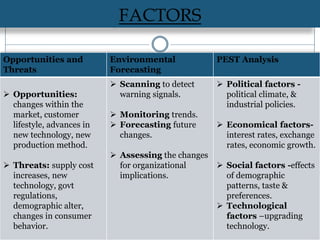
Opportunities and
Threats
Environmental
Forecasting
PEST Analysis
 Opportunities:
changes within the
market, customer
lifestyle, advances in
new technology, new
production method.
 Threats: supply cost
increases, new
technology, govt
regulations,
demographic alter,
changes in consumer
behavior.
 Scanning to detect
warning signals.
 Monitoring trends.
 Forecasting future
changes.
 Assessing the changes
for organizational
implications.
 Political factors -
political climate, &
industrial policies.
 Economical factors-
interest rates, exchange
rates, economic growth.
 Social factors -effects
of demographic
patterns, taste &
preferences.
 Technological
factors –upgrading
technology.
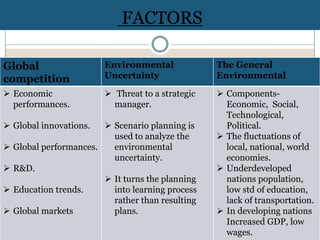
FACTORS
Global
competition
Environmental
Uncertainty
The General
Environmental
 Economic
performances.
 Global innovations.
 Global performances.
 R&D.
 Education trends.
 Global markets
 Threat to a strategic
manager.
 Scenario planning is
used to analyze the
environmental
uncertainty.
 It turns the planning
into learning process
rather than resulting
plans.
 Components-
Economic, Social,
Technological,
Political.
 The fluctuations of
local, national, world
economies.
 Underdeveloped
nations population,
low std of education,
lack of transportation.
 In developing nations
Increased GDP, low
wages.
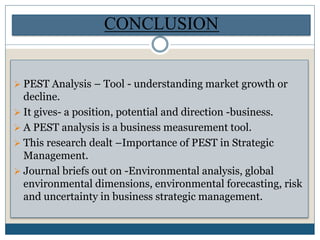
 PEST Analysis – Tool - understanding market growth or
decline.
 It gives- a position, potential and direction -business.
 A PEST analysis is a business measurement tool.
 This research dealt –Importance of PEST in Strategic
Management.
 Journal briefs out on -Environmental analysis, global
environmental dimensions, environmental forecasting, risk
and uncertainty in business strategic management.
CONCLUSION
REFERENCE
 Frederic P Miller, Agnes F Vandome, John McBrewster, (2011). Pest Analysis, VDM
Publishing.
 Babette E. Bensoussan, Craig S. Fleisher, (2008). Analysis Without Paralysis:10 Tools to
Make Better Strategic Decisions, 1st edition, FT Press.
 Michel Robert, (2006). The New Strategic Thinking: Pure & Simple, McGraw-Hill.
 Kenichi Ohmae, (2002). The Mind of the Strategist, Tata McGraw-Hill Education.
 Kenichi Ohmae, Nicholas Brealey, (2000). The Invisible Continent: Four Strategic
Imperatives of the New Economy, 1st edition, HarperBusiness.
 Edmund B. Fitzgerald, (2000). Globalizing Customer Solutions: the Enlightened
Confluence of Technology, Innovation, Trade, and Investment, Greenwood Publishing
Group.
 Robert C. Megantz, (2002). Technology Management: Developing and Implementing
Effective Licensing Programs, 2nd Edition, Wiley.
 W. Teignmouth Shore, (2010). The Pest, BiblioBazaar, USA.
 Markus Slamanig, (2012). PEST Analysis Hungary: Country Evaluation and Selection of
Hungary, 1st edition, GRIN Verlag.
BY
PRIYA.H
PRIYANKA.K
(1ST MCOM-2016)
THANK YOU

strategic Management

  • 1.
    Environment & PESTAnalysis: An Approach to External Business Environment  Author -Abhishek Gupta- Administrative-cum-Accounts Officer & Head of Office, Sardar Swaran Singh National Institute of Renewable Energy (Ministry of New & Renewable Energy, Govt. of India)- (Punjab)  Journal Name-International Journal of Modern Social Sciences.  Journal homepage: www.ModernScientificPress.com/Journals/IJMSS.aspx  Article history: Received 8 April 2013, Received in revised form 28 May, Accepted 29 May 2013, Published 30 May 2013. ISSN: 2169-9917 STRATEGIC MANAGEMENT
  • 2.
     Environmental management-environmentalplanning, protection, monitoring, assessment, research, education, conservation and sustainable use of resources.  Environmental factors must be considered in the long-term goal of making industrial development .  Discussion of Environmental Analysis in the strategic management process of organization.  Strategic planning – feasibility –Impacts of factors.  The strategic planning of business includes -functional subdivisions – -Strategic Planning -Human Resource Management -Strategic Human Resource Planning  In strategic planning, it can use different analytical methods and techniques that one of them is PEST analysis. This paper introduces how to apply it in a new manner. STRATEGIC MANAGEMENT
  • 3.
    INTRODUCTION  External environment- -componentsof all outside factors -influences the impacts of operations of business. -Consists ~Micro and Macro.  There are various factors need to be considered under approaches of external environment. >Environment Analysis: Threats & Opportunities. >Environmental Forecasting . >PEST Analysis >Industries: Global Competition. >Environmental Uncertainty. >The General Environment .
  • 4.
    FACTORS Opportunities and Threats Environmental Forecasting PEST Analysis Opportunities: changes within the market, customer lifestyle, advances in new technology, new production method.  Threats: supply cost increases, new technology, govt regulations, demographic alter, changes in consumer behavior.  Scanning to detect warning signals.  Monitoring trends.  Forecasting future changes.  Assessing the changes for organizational implications.  Political factors - political climate, & industrial policies.  Economical factors- interest rates, exchange rates, economic growth.  Social factors -effects of demographic patterns, taste & preferences.  Technological factors –upgrading technology.
  • 5.
    FACTORS Global competition Environmental Uncertainty The General Environmental  Economic performances. Global innovations.  Global performances.  R&D.  Education trends.  Global markets  Threat to a strategic manager.  Scenario planning is used to analyze the environmental uncertainty.  It turns the planning into learning process rather than resulting plans.  Components- Economic, Social, Technological, Political.  The fluctuations of local, national, world economies.  Underdeveloped nations population, low std of education, lack of transportation.  In developing nations Increased GDP, low wages.
  • 6.
     PEST Analysis– Tool - understanding market growth or decline.  It gives- a position, potential and direction -business.  A PEST analysis is a business measurement tool.  This research dealt –Importance of PEST in Strategic Management.  Journal briefs out on -Environmental analysis, global environmental dimensions, environmental forecasting, risk and uncertainty in business strategic management. CONCLUSION
  • 7.
    REFERENCE  Frederic PMiller, Agnes F Vandome, John McBrewster, (2011). Pest Analysis, VDM Publishing.  Babette E. Bensoussan, Craig S. Fleisher, (2008). Analysis Without Paralysis:10 Tools to Make Better Strategic Decisions, 1st edition, FT Press.  Michel Robert, (2006). The New Strategic Thinking: Pure & Simple, McGraw-Hill.  Kenichi Ohmae, (2002). The Mind of the Strategist, Tata McGraw-Hill Education.  Kenichi Ohmae, Nicholas Brealey, (2000). The Invisible Continent: Four Strategic Imperatives of the New Economy, 1st edition, HarperBusiness.  Edmund B. Fitzgerald, (2000). Globalizing Customer Solutions: the Enlightened Confluence of Technology, Innovation, Trade, and Investment, Greenwood Publishing Group.  Robert C. Megantz, (2002). Technology Management: Developing and Implementing Effective Licensing Programs, 2nd Edition, Wiley.  W. Teignmouth Shore, (2010). The Pest, BiblioBazaar, USA.  Markus Slamanig, (2012). PEST Analysis Hungary: Country Evaluation and Selection of Hungary, 1st edition, GRIN Verlag.
  • 8.