Module 02: External Environmental Analysis
➢ Classification of Firm’s environment
➢ Constituents of Firm’s macro,micro and relevant environment
➢ PESTLE analysis
➢ Framework for assessing impact of opportunities and threats
Concepts Covered
2
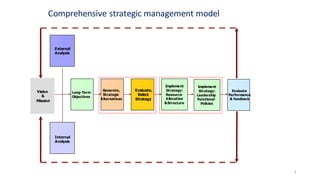
External
Analysis
Internal
Analysis
Long-Term
Objectives
Generate,
Strategic
Alternatives
Evaluate,
Select
Strategy
Implement
Strategy:
Resource
Allocation
&Structure
Evaluate
Performance
& feedback
Vision
&
Mission
Comprehensive strategic management model
Implement
Strategy:
Leadership
Functional
Policies
3
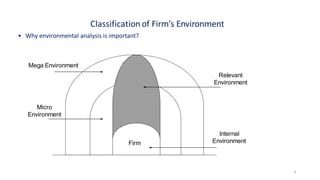
Classification of Firm’s Environment
Mega Environment
Micro
Environment
Relevant
Environment
Internal
Environment
Firm
• Why environmental analysis is important?
4
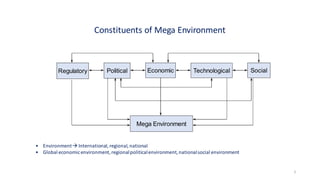
Constituents of Mega Environment
Political Economic Technological Social
Regulatory
Mega Environment
• Environment→ International,regional,national
• Global economicenvironment,regionalpoliticalenvironment,nationalsocial environment
5
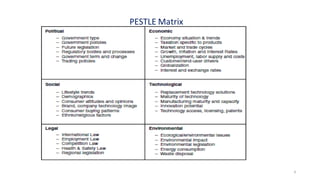
PESTLE Matrix
6
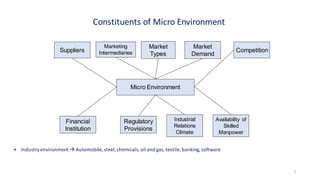
Marketing
Intermediaries
Market
Types
Market
Demand
Competition
Suppliers
Micro Environment
Availability of
Skilled
Manpower
Industrial
Relations
Climate
Regulatory
Provisions
Financial
Institution
Constituents of Micro Environment
• Industryenvironment → Automobile, steel,chemicals,oil and gas,textile, banking,software
7
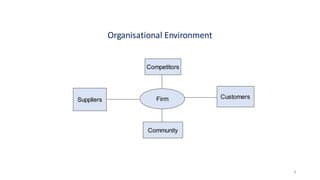
Organisational Environment
Firm
Competitors
Community
Suppliers Customers
8
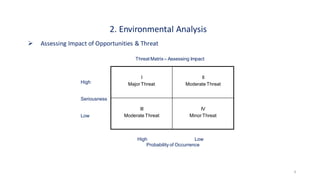
I
Major Threat
II
Moderate Threat
III
Moderate Threat
IV
Minor Threat
High
Seriousness
Low
High Low
Probability of Occurrence
Threat Matrix– Assessing Impact
➢ Assessing Impact of Opportunities & Threat
2. Environmental Analysis
9
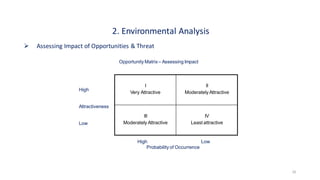
I
Very Attractive
II
Moderately Attractive
III
Moderately Attractive
IV
Least attractive
High
Attractiveness
Low
High Low
Probability of Occurrence
Opportunity Matrix– Assessing Impact
➢ Assessing Impact of Opportunities & Threat
2. Environmental Analysis
10
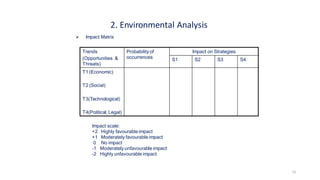
➢ Impact Matrix
2. Environmental Analysis
Trends
(Opportunities &
Threats)
Probability of
occurrences
Impact on Strategies
S1 S2 S3 S4
T1 (Economic)
T2 (Social)
T3(Technological)
T4(Political, Legal)
Impact scale:
+2 Highly favourable impact
+1 Moderately favourable impact
0 No impact
-1 Moderately unfavourable impact
-2 Highly unfavourable impact
11
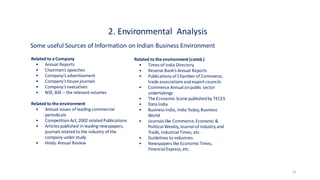
Related to a Company
• Annual Reports
• Chairman’s speeches
• Company’s advertisement
• Company’s house journals
• Company’s executives
• NSE,BSE – the relevant volumes
Related to the environment
• Annual issues of leadingcommercial
periodicals
• CompetitionAct,2002 relatedPublications
• Articles published in leading newspapers,
journals relatedto the industry of the
company under study
• Hindu Annual Review
2. Environmental Analysis
Some useful Sources of Information on Indian Business Environment
Related to the environment (contd.)
• Times of India Directory
• Reserve Bank’s Annual Reports
• Publications of Chamber of Commerce,
trade associations andexport councils
• Commerce Annual onpublic sector
undertakings
• The Economic Scene publishedby TECES
• Data India
• Business India, India Today,Business
World
• Journals like Commerce,Economic &
Political Weekly,Journal of Industry and
Trade,Industrial Times, etc.
• Guidelines to industries
• Newspapers like EconomicTimes,
Financial Express,etc.
12
Conclusion
• The business environment is ever-changing and dynamic in nature. An organization needs to
scan the external environment for new opportunities and threats in a systematic and
continuous manner. This would help the organization to sustain and gain competitive
advantage.
• The various components and framework for external environmental analysis have been
discussed in this chapter including classification of firm’s environment such as mega-, micro-,
and relevant environment; PESTLE matrix and other frameworks for assessment of
environmental opportunities and threats for an organization.
13
References
1. Crafting and Executing Strategy – The Quest for Competitive Advantage, Concepts and Cases,
Thomson & Strickland,McGraw-HillEducation.
2. Exploring Strategy – Text and Cases, Gerry Johnson, Richard Whittington, Kevan Scholes, Duncan
Angwin, and PatrickRegner, Pearson,10th edition.
3. Strategic Management – Planning for Domestic and Global Competition, John Pearce, R.Robinson
and Amita Mital,McGraw-HillEducation,14th edition.
4. Strategic Management – An Integrated Approach, Charles Hill & Gareth Jones, Cengage Learning,
9th edition.
14

Chap2_External Env analysis Strategic Management

  • 1.
    Module 02: ExternalEnvironmental Analysis
  • 2.
    ➢ Classification ofFirm’s environment ➢ Constituents of Firm’s macro,micro and relevant environment ➢ PESTLE analysis ➢ Framework for assessing impact of opportunities and threats Concepts Covered 2
  • 3.
  • 4.
    Classification of Firm’sEnvironment Mega Environment Micro Environment Relevant Environment Internal Environment Firm • Why environmental analysis is important? 4
  • 5.
    Constituents of MegaEnvironment Political Economic Technological Social Regulatory Mega Environment • Environment→ International,regional,national • Global economicenvironment,regionalpoliticalenvironment,nationalsocial environment 5
  • 6.
  • 7.
  • 8.
  • 9.
    I Major Threat II Moderate Threat III ModerateThreat IV Minor Threat High Seriousness Low High Low Probability of Occurrence Threat Matrix– Assessing Impact ➢ Assessing Impact of Opportunities & Threat 2. Environmental Analysis 9
  • 10.
    I Very Attractive II Moderately Attractive III ModeratelyAttractive IV Least attractive High Attractiveness Low High Low Probability of Occurrence Opportunity Matrix– Assessing Impact ➢ Assessing Impact of Opportunities & Threat 2. Environmental Analysis 10
  • 11.
    ➢ Impact Matrix 2.Environmental Analysis Trends (Opportunities & Threats) Probability of occurrences Impact on Strategies S1 S2 S3 S4 T1 (Economic) T2 (Social) T3(Technological) T4(Political, Legal) Impact scale: +2 Highly favourable impact +1 Moderately favourable impact 0 No impact -1 Moderately unfavourable impact -2 Highly unfavourable impact 11
  • 12.
    Related to aCompany • Annual Reports • Chairman’s speeches • Company’s advertisement • Company’s house journals • Company’s executives • NSE,BSE – the relevant volumes Related to the environment • Annual issues of leadingcommercial periodicals • CompetitionAct,2002 relatedPublications • Articles published in leading newspapers, journals relatedto the industry of the company under study • Hindu Annual Review 2. Environmental Analysis Some useful Sources of Information on Indian Business Environment Related to the environment (contd.) • Times of India Directory • Reserve Bank’s Annual Reports • Publications of Chamber of Commerce, trade associations andexport councils • Commerce Annual onpublic sector undertakings • The Economic Scene publishedby TECES • Data India • Business India, India Today,Business World • Journals like Commerce,Economic & Political Weekly,Journal of Industry and Trade,Industrial Times, etc. • Guidelines to industries • Newspapers like EconomicTimes, Financial Express,etc. 12
  • 13.
    Conclusion • The businessenvironment is ever-changing and dynamic in nature. An organization needs to scan the external environment for new opportunities and threats in a systematic and continuous manner. This would help the organization to sustain and gain competitive advantage. • The various components and framework for external environmental analysis have been discussed in this chapter including classification of firm’s environment such as mega-, micro-, and relevant environment; PESTLE matrix and other frameworks for assessment of environmental opportunities and threats for an organization. 13
  • 14.
    References 1. Crafting andExecuting Strategy – The Quest for Competitive Advantage, Concepts and Cases, Thomson & Strickland,McGraw-HillEducation. 2. Exploring Strategy – Text and Cases, Gerry Johnson, Richard Whittington, Kevan Scholes, Duncan Angwin, and PatrickRegner, Pearson,10th edition. 3. Strategic Management – Planning for Domestic and Global Competition, John Pearce, R.Robinson and Amita Mital,McGraw-HillEducation,14th edition. 4. Strategic Management – An Integrated Approach, Charles Hill & Gareth Jones, Cengage Learning, 9th edition. 14