Strategic Management-
Overview
Defining Strategic Management
❖Strategic management
 the art and science of formulating,
implementing, and evaluating cross-
functional decisions that enable an
organization to achieve its objectives
1-2
Defining Strategic Management
❖Strategic management is used
synonymously with the term strategic
planning.
❖Sometimes the term strategic
management is used to refer to strategy
formulation, implementation, and
evaluation, with strategic planning
referring only to strategy formulation.
1-3
Defining Strategic Management
❖A strategic plan is a company’s game
plan.
❖A strategic plan results from tough
managerial choices among numerous
good alternatives, and it signals
commitment to specific markets, policies,
procedures, and operations.
1-4
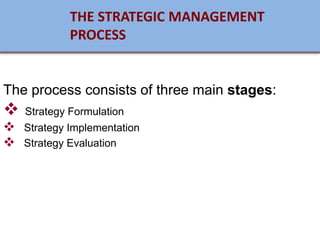
The process consists of three main stages:
❖ Strategy Formulation
❖ Strategy Implementation
❖ Strategy Evaluation
THE STRATEGIC MANAGEMENT
PROCESS
THE STRATEGIC MANAGEMENT
PROCESS (cont.)
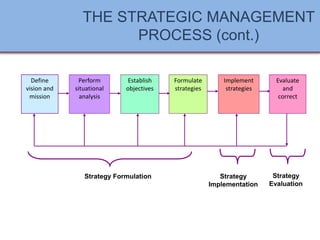
Define
vision and
mission
Perform
situational
analysis
Establish
objectives
Formulate
strategies
Implement
strategies
Evaluate
and
correct
Strategy Formulation Strategy
Implementation
Strategy
Evaluation
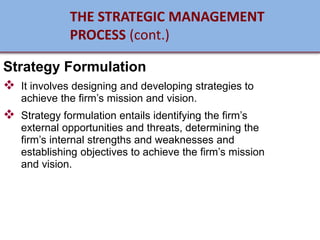
Strategy Formulation
❖ It involves designing and developing strategies to
achieve the firm’s mission and vision.
❖ Strategy formulation entails identifying the firm’s
external opportunities and threats, determining the
firm’s internal strengths and weaknesses and
establishing objectives to achieve the firm’s mission
and vision.
THE STRATEGIC MANAGEMENT
PROCESS (cont.)
THE STRATEGIC MANAGEMENT
PROCESS (cont.)
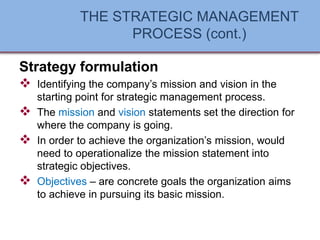
Strategy formulation
❖ Identifying the company’s mission and vision in the
starting point for strategic management process.
❖ The mission and vision statements set the direction for
where the company is going.
❖ In order to achieve the organization’s mission, would
need to operationalize the mission statement into
strategic objectives.
❖ Objectives – are concrete goals the organization aims
to achieve in pursuing its basic mission.
THE STRATEGIC MANAGEMENT
PROCESS (cont.)
Strategy formulation
❖ Before organization establish its objectives, it
must perform situation analysis.
❖ Situation Analysis
 Scanning and evaluating the organization’s internal
and external environment – this provides the critical
information to establish the organization’s objectives.
 Also use to identify the organization’s opportunities
and threats.
THE STRATEGIC MANAGEMENT
PROCESS (cont.)
Strategy formulation
❖An organization can develop alternative
strategies once the organization had a
clear picture of its environment.
❖Strategy formulation involves designing
and developing the company strategies.
Strategy Implementation
❖ Strategy implementation means executing the
strategies or when business strategies are translated
into action.
❖ It includes allocating resources to execute the
formulated strategies, preparing budgets, and
developing and utilizing information systems and
employees.
THE STRATEGIC MANAGEMENT
PROCESS (cont.)
Strategy Evaluation
❖ The final stage in the strategic management process
❖ The firm’s managers seek to determine which strategies
worked and which were not successful.
❖ Involves:
 Reviewing external and internal factors that form the basis
of the current strategies
 Measuring performance against objectives
 Taking corrective action – if the strategies formulated did
not results in the objectives being met or not in line with the
actual goals, → the strategy should be modified or
reformulated.
THE STRATEGIC MANAGEMENT
PROCESS (cont.)
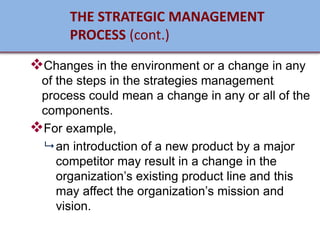
❖Changes in the environment or a change in any
of the steps in the strategies management
process could mean a change in any or all of the
components.
❖For example,
 an introduction of a new product by a major
competitor may result in a change in the
organization’s existing product line and this
may affect the organization’s mission and
vision.
THE STRATEGIC MANAGEMENT
PROCESS (cont.)
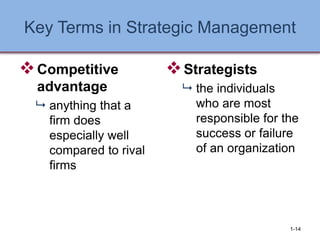
Key Terms in Strategic Management
❖Competitive
advantage
 anything that a
firm does
especially well
compared to rival
firms
❖Strategists
 the individuals
who are most
responsible for the
success or failure
of an organization
1-14
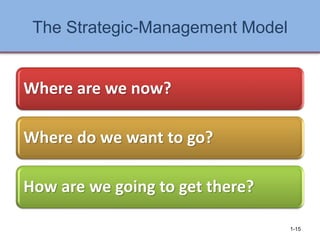
The Strategic-Management Model
Where are we now?
Where do we want to go?
How are we going to get there?
1-15
Benefits of Strategic Management
❖Historically, the principal benefit of
strategic management has been to help
organizations formulate better strategies
through the use of a more systematic,
logical, and rational approach to strategic
choice
1-16
Benefits of Strategic Management
❖Communication is a key to successful
strategic management
❖Through dialogue and participation,
managers and employees become
committed to supporting the organization
1-17
Financial Benefits
❖ Businesses using strategic-management
concepts show significant improvement in
sales, profitability, and productivity
compared to firms without systematic
planning activities
❖ High-performing firms seem to make more
informed decisions with good anticipation of
both short- and long-term consequences
1-18
Nonfinancial Benefits
❖It allows for identification, prioritization,
and exploitation of opportunities.
❖It provides an objective view of
management problems.
❖It represents a framework for improved
coordination and control of activities.
❖It minimizes the effects of adverse
conditions and changes.
1-19
Nonfinancial Benefits
❖ It allows major decisions to better support
established objectives.
❖ It allows more effective allocation of time
and resources to identified opportunities.
❖ It allows fewer resources and less time to be
devoted to correcting erroneous or ad hoc
decisions.
❖ It creates a framework for internal
communication among personnel.
1-20
Why Some Firms Do No
Strategic Planning
❖Lack of knowledge in strategic planning
❖Poor reward structures
❖Waste of time
❖Too expensive
❖Laziness
1-21
Why Some Firms Do No
Strategic Planning
❖Fear of failure
❖Overconfidence
❖Prior bad experience
❖Self-interest
❖Fear of the unknown
1-22
Pitfalls in Strategic Planning
❖ Using strategic planning to gain control over
decisions and resources
❖ Doing strategic planning only to satisfy
accreditation or regulatory requirements
❖ Too hastily moving from mission development
to strategy formulation
❖ Failing to communicate the plan to employees,
who continue working in the dark
❖ Top managers making many intuitive decisions
that conflict with the formal plan
1-23
Pitfalls in Strategic Planning
❖ Top managers not actively supporting the
strategic-planning process
❖ Failing to use plans as a standard for
measuring performance
❖ Delegating planning to a “planner” rather than
involving all managers
❖ Failing to involve key employees in all phases
of planning
❖ Failing to create a collaborative climate
supportive of change
1-24
Thank You
1-25

Strategic Mgt_Introduction explained .pdf

  • 1.
  • 2.
    Defining Strategic Management ❖Strategicmanagement  the art and science of formulating, implementing, and evaluating cross- functional decisions that enable an organization to achieve its objectives 1-2
  • 3.
    Defining Strategic Management ❖Strategicmanagement is used synonymously with the term strategic planning. ❖Sometimes the term strategic management is used to refer to strategy formulation, implementation, and evaluation, with strategic planning referring only to strategy formulation. 1-3
  • 4.
    Defining Strategic Management ❖Astrategic plan is a company’s game plan. ❖A strategic plan results from tough managerial choices among numerous good alternatives, and it signals commitment to specific markets, policies, procedures, and operations. 1-4
  • 5.
    The process consistsof three main stages: ❖ Strategy Formulation ❖ Strategy Implementation ❖ Strategy Evaluation THE STRATEGIC MANAGEMENT PROCESS
  • 6.
    THE STRATEGIC MANAGEMENT PROCESS(cont.) Define vision and mission Perform situational analysis Establish objectives Formulate strategies Implement strategies Evaluate and correct Strategy Formulation Strategy Implementation Strategy Evaluation
  • 7.
    Strategy Formulation ❖ Itinvolves designing and developing strategies to achieve the firm’s mission and vision. ❖ Strategy formulation entails identifying the firm’s external opportunities and threats, determining the firm’s internal strengths and weaknesses and establishing objectives to achieve the firm’s mission and vision. THE STRATEGIC MANAGEMENT PROCESS (cont.)
  • 8.
    THE STRATEGIC MANAGEMENT PROCESS(cont.) Strategy formulation ❖ Identifying the company’s mission and vision in the starting point for strategic management process. ❖ The mission and vision statements set the direction for where the company is going. ❖ In order to achieve the organization’s mission, would need to operationalize the mission statement into strategic objectives. ❖ Objectives – are concrete goals the organization aims to achieve in pursuing its basic mission.
  • 9.
    THE STRATEGIC MANAGEMENT PROCESS(cont.) Strategy formulation ❖ Before organization establish its objectives, it must perform situation analysis. ❖ Situation Analysis  Scanning and evaluating the organization’s internal and external environment – this provides the critical information to establish the organization’s objectives.  Also use to identify the organization’s opportunities and threats.
  • 10.
    THE STRATEGIC MANAGEMENT PROCESS(cont.) Strategy formulation ❖An organization can develop alternative strategies once the organization had a clear picture of its environment. ❖Strategy formulation involves designing and developing the company strategies.
  • 11.
    Strategy Implementation ❖ Strategyimplementation means executing the strategies or when business strategies are translated into action. ❖ It includes allocating resources to execute the formulated strategies, preparing budgets, and developing and utilizing information systems and employees. THE STRATEGIC MANAGEMENT PROCESS (cont.)
  • 12.
    Strategy Evaluation ❖ Thefinal stage in the strategic management process ❖ The firm’s managers seek to determine which strategies worked and which were not successful. ❖ Involves:  Reviewing external and internal factors that form the basis of the current strategies  Measuring performance against objectives  Taking corrective action – if the strategies formulated did not results in the objectives being met or not in line with the actual goals, → the strategy should be modified or reformulated. THE STRATEGIC MANAGEMENT PROCESS (cont.)
  • 13.
    ❖Changes in theenvironment or a change in any of the steps in the strategies management process could mean a change in any or all of the components. ❖For example,  an introduction of a new product by a major competitor may result in a change in the organization’s existing product line and this may affect the organization’s mission and vision. THE STRATEGIC MANAGEMENT PROCESS (cont.)
  • 14.
    Key Terms inStrategic Management ❖Competitive advantage  anything that a firm does especially well compared to rival firms ❖Strategists  the individuals who are most responsible for the success or failure of an organization 1-14
  • 15.
    The Strategic-Management Model Whereare we now? Where do we want to go? How are we going to get there? 1-15
  • 16.
    Benefits of StrategicManagement ❖Historically, the principal benefit of strategic management has been to help organizations formulate better strategies through the use of a more systematic, logical, and rational approach to strategic choice 1-16
  • 17.
    Benefits of StrategicManagement ❖Communication is a key to successful strategic management ❖Through dialogue and participation, managers and employees become committed to supporting the organization 1-17
  • 18.
    Financial Benefits ❖ Businessesusing strategic-management concepts show significant improvement in sales, profitability, and productivity compared to firms without systematic planning activities ❖ High-performing firms seem to make more informed decisions with good anticipation of both short- and long-term consequences 1-18
  • 19.
    Nonfinancial Benefits ❖It allowsfor identification, prioritization, and exploitation of opportunities. ❖It provides an objective view of management problems. ❖It represents a framework for improved coordination and control of activities. ❖It minimizes the effects of adverse conditions and changes. 1-19
  • 20.
    Nonfinancial Benefits ❖ Itallows major decisions to better support established objectives. ❖ It allows more effective allocation of time and resources to identified opportunities. ❖ It allows fewer resources and less time to be devoted to correcting erroneous or ad hoc decisions. ❖ It creates a framework for internal communication among personnel. 1-20
  • 21.
    Why Some FirmsDo No Strategic Planning ❖Lack of knowledge in strategic planning ❖Poor reward structures ❖Waste of time ❖Too expensive ❖Laziness 1-21
  • 22.
    Why Some FirmsDo No Strategic Planning ❖Fear of failure ❖Overconfidence ❖Prior bad experience ❖Self-interest ❖Fear of the unknown 1-22
  • 23.
    Pitfalls in StrategicPlanning ❖ Using strategic planning to gain control over decisions and resources ❖ Doing strategic planning only to satisfy accreditation or regulatory requirements ❖ Too hastily moving from mission development to strategy formulation ❖ Failing to communicate the plan to employees, who continue working in the dark ❖ Top managers making many intuitive decisions that conflict with the formal plan 1-23
  • 24.
    Pitfalls in StrategicPlanning ❖ Top managers not actively supporting the strategic-planning process ❖ Failing to use plans as a standard for measuring performance ❖ Delegating planning to a “planner” rather than involving all managers ❖ Failing to involve key employees in all phases of planning ❖ Failing to create a collaborative climate supportive of change 1-24
  • 25.