Strain Diagrams
By
T. Santhi (15MST1024)
What is strain??
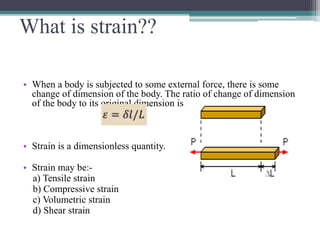
• When a body is subjected to some external force, there is some
change of dimension of the body. The ratio of change of dimension
of the body to its original dimension is known as strain.
• Strain is a dimensionless quantity.
• Strain may be:-
a) Tensile strain
b) Compressive strain
c) Volumetric strain
d) Shear strain
Types of strain
• Tensile strain- Ratio of increase in length to original
length of the body when it is subjected to a pull force.
• Compressive strain- Ratio of decrease in length to
original length of the body when it is subjected to a
push force
• Volumetric strain- Ratio of change of volume of the
body to the original volume.
• Shear strain-Strain due to shear stress
Types of Materials
1. Rigid material
2. Perfectly linear elastic material
3. Rigid-perfectly plastic
4. Rigid with strain hardening
5. Elastic perfectly plastic
6. Elasto-plastic with strain hardening
7. Visco-elastic materials
Rigid Material
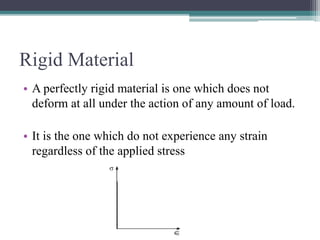
• A perfectly rigid material is one which does not
deform at all under the action of any amount of load.
• It is the one which do not experience any strain
regardless of the applied stress
Perfectly Linear Elastic Material
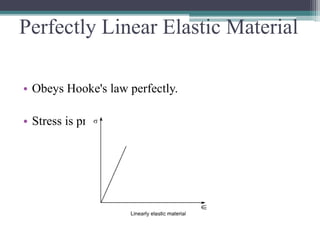
• Obeys Hooke's law perfectly.
• Stress is proportional to strain.
Rigid-Perfectly Plastic
• The material is rigid up to the yield point and then
deforms plastically at constant stress.
Rigid With Strain Hardening
• The material is up to yield point and deforms
plastically with strain hardening characteristics.
Elastic Perfectly Plastic
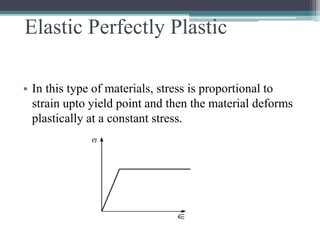
• In this type of materials, stress is proportional to
strain upto yield point and then the material deforms
plastically at a constant stress.
Elasto-Plastic With Strain
Hardening
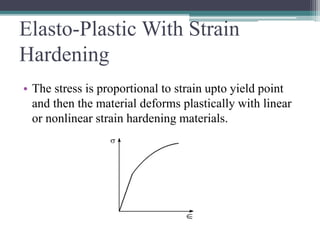
• The stress is proportional to strain upto yield point
and then the material deforms plastically with linear
or nonlinear strain hardening materials.
Visco-Elastic Materials
(a) Maxwell body: In this method the visco elastic
material is represented by a spring and dashpot in
series.
• Kelvin- voigt body: In this method the visco elastic
material is represented by a spring and dashpot in
parallel series.
(c) Linear standard body: It is nothing but the
combination of Maxwell and Kelvin-Voigt bodies
Thank You

strain diagrams

  • 1.
  • 2.
    What is strain?? •When a body is subjected to some external force, there is some change of dimension of the body. The ratio of change of dimension of the body to its original dimension is known as strain. • Strain is a dimensionless quantity. • Strain may be:- a) Tensile strain b) Compressive strain c) Volumetric strain d) Shear strain
  • 3.
    Types of strain •Tensile strain- Ratio of increase in length to original length of the body when it is subjected to a pull force. • Compressive strain- Ratio of decrease in length to original length of the body when it is subjected to a push force • Volumetric strain- Ratio of change of volume of the body to the original volume. • Shear strain-Strain due to shear stress
  • 4.
    Types of Materials 1.Rigid material 2. Perfectly linear elastic material 3. Rigid-perfectly plastic 4. Rigid with strain hardening 5. Elastic perfectly plastic 6. Elasto-plastic with strain hardening 7. Visco-elastic materials
  • 5.
    Rigid Material • Aperfectly rigid material is one which does not deform at all under the action of any amount of load. • It is the one which do not experience any strain regardless of the applied stress
  • 6.
    Perfectly Linear ElasticMaterial • Obeys Hooke's law perfectly. • Stress is proportional to strain.
  • 7.
    Rigid-Perfectly Plastic • Thematerial is rigid up to the yield point and then deforms plastically at constant stress.
  • 8.
    Rigid With StrainHardening • The material is up to yield point and deforms plastically with strain hardening characteristics.
  • 9.
    Elastic Perfectly Plastic •In this type of materials, stress is proportional to strain upto yield point and then the material deforms plastically at a constant stress.
  • 10.
    Elasto-Plastic With Strain Hardening •The stress is proportional to strain upto yield point and then the material deforms plastically with linear or nonlinear strain hardening materials.
  • 11.
    Visco-Elastic Materials (a) Maxwellbody: In this method the visco elastic material is represented by a spring and dashpot in series.
  • 12.
    • Kelvin- voigtbody: In this method the visco elastic material is represented by a spring and dashpot in parallel series.
  • 13.
    (c) Linear standardbody: It is nothing but the combination of Maxwell and Kelvin-Voigt bodies
  • 14.