Structural Analysis - II
FLEXIBILITY METHOD
• Equilibrium and compatibility – Determinate
vs Indeterminate structures – Indeterminacy –
Primary structure – Compatibility conditions –
Analysis of indeterminate pin-jointed plane
frames, continuous beams, rigid jointed plane
frames (with redundancy restricted to two).
Flexibility Method
• The flexibility method, also known as the force method or
compatibility method, is a technique for analyzing statically
indeterminate structures.
• It involves determining the redundant forces by
establishing force-displacement relationships for structural
members and combining them to produce a relationship
for the entire structure.
• This method is suitable when kinematic indeterminacy is
greater than static indeterminacy.
• Determining Static Indeterminacy: Identify the degree
of static indeterminacy (DSI) of the structure.
• Choosing Redundant Forces: Select the redundant
forces to be analyzed.
• Creating a Basic Determinate Structure: Remove the
redundant restraints, creating a basic determinate
structure.
• Establishing Force-Displacement
Relationships: Determine the displacements caused
by a unit load at each redundant force location.
• Compatibility Equation: Apply compatibility
equations to ensure displacement compatibility at
the redundant force locations.
• Solving for Redundant Forces: Solve the
compatibility equations to find the values of the
redundant forces.
• Calculating Member Forces: Determine member
forces by combining the forces in the basic
determinate structure and those caused by the
redundant forces.
• Flexibility Matrix:
• The flexibility matrix is a square matrix that
represents the displacement at coordinate i
due to a unit force at coordinate j in a
structure.
• It's also known as the "flexibility coefficient".
• The matrix elements are displacements, and
it's always a symmetric matrix.
• Advantages and Limitations:
• Advantages:
• Suitable for structures with a high degree of
static indeterminacy and can provide an
understanding of the structure's behavior.
• Limitations:
• Can be more computationally intensive for
complex structures compared to stiffness
methods.
•
• Applications:
• Beams, Frames, and Indeterminate structures
with single or double degrees of indeterminacy.
• In essence, the flexibility method provides a
systematic approach to analyzing statically
indeterminate structures by focusing on the
relationship between forces and displacements,
ultimately determining the redundant forces
and internal forces in the structure.
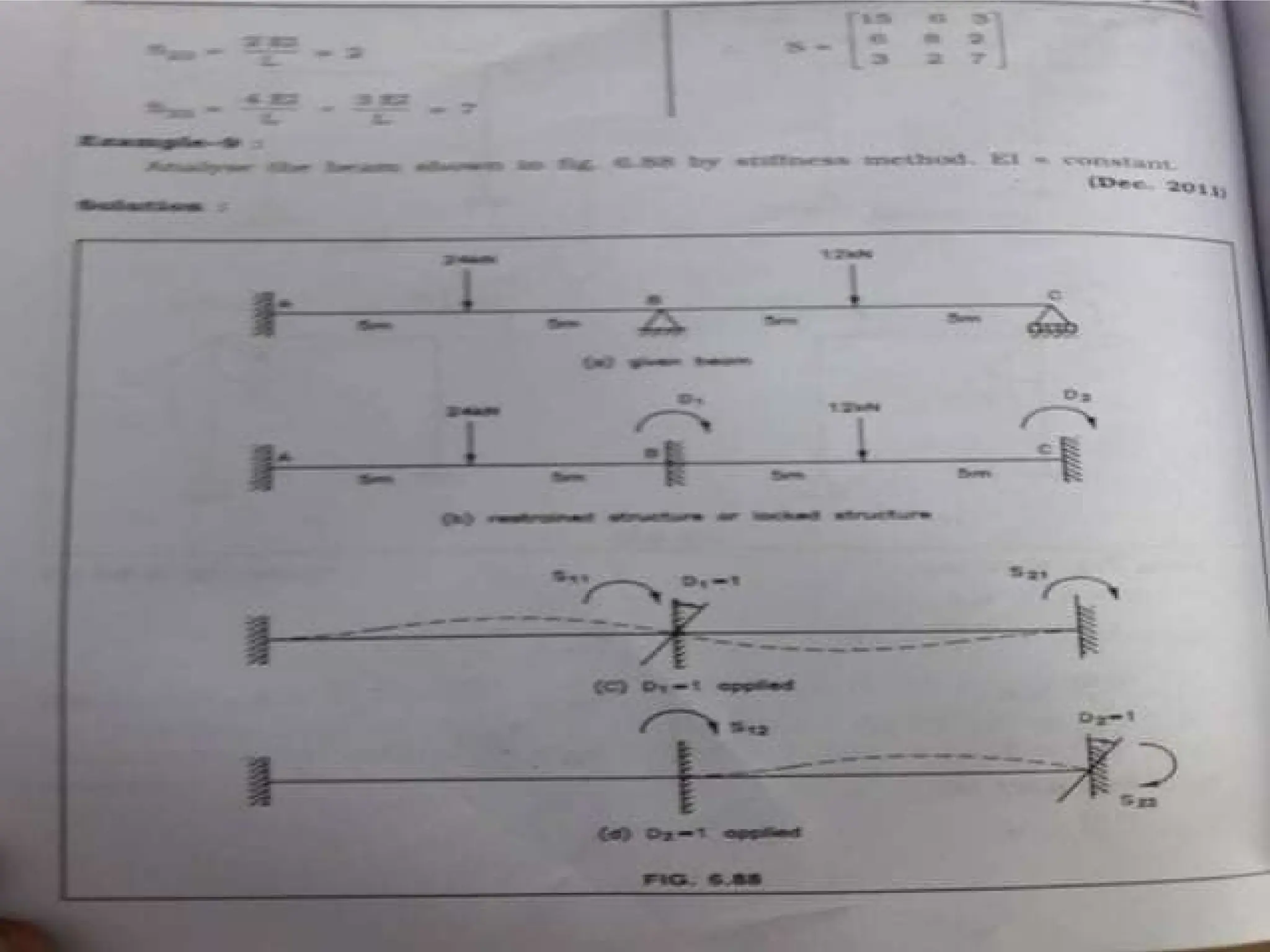
STIFFNESS METHOD
• Element and global stiffness matrices –
Analysis of continuous beams – Co-ordinate
transformations – Rotation matrix –
Transformations of stiffness matrices, load
vectors and displacements vectors – Analysis
of pin-jointed plane frames and rigid frames
(with redundancy limited to two).
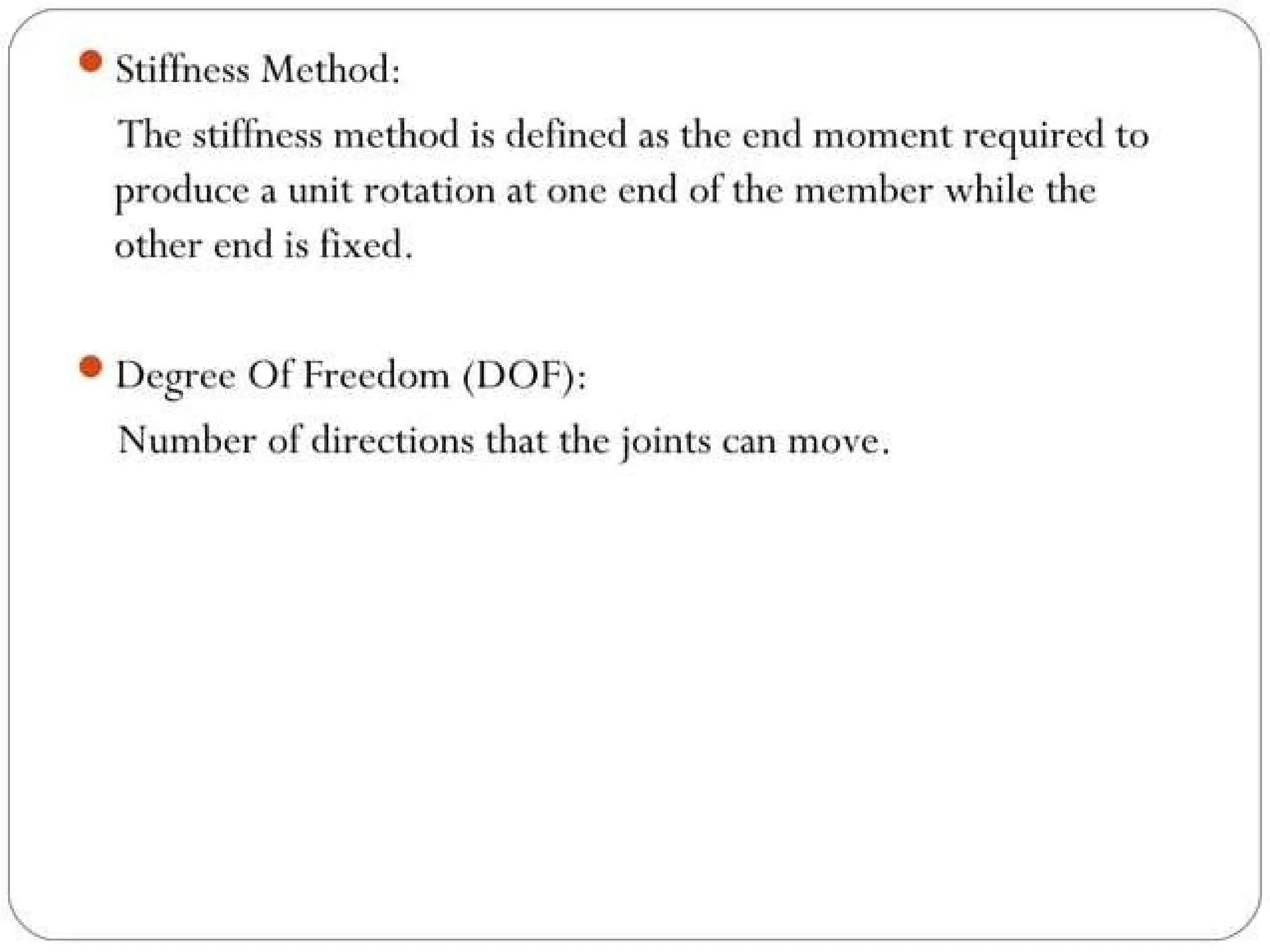
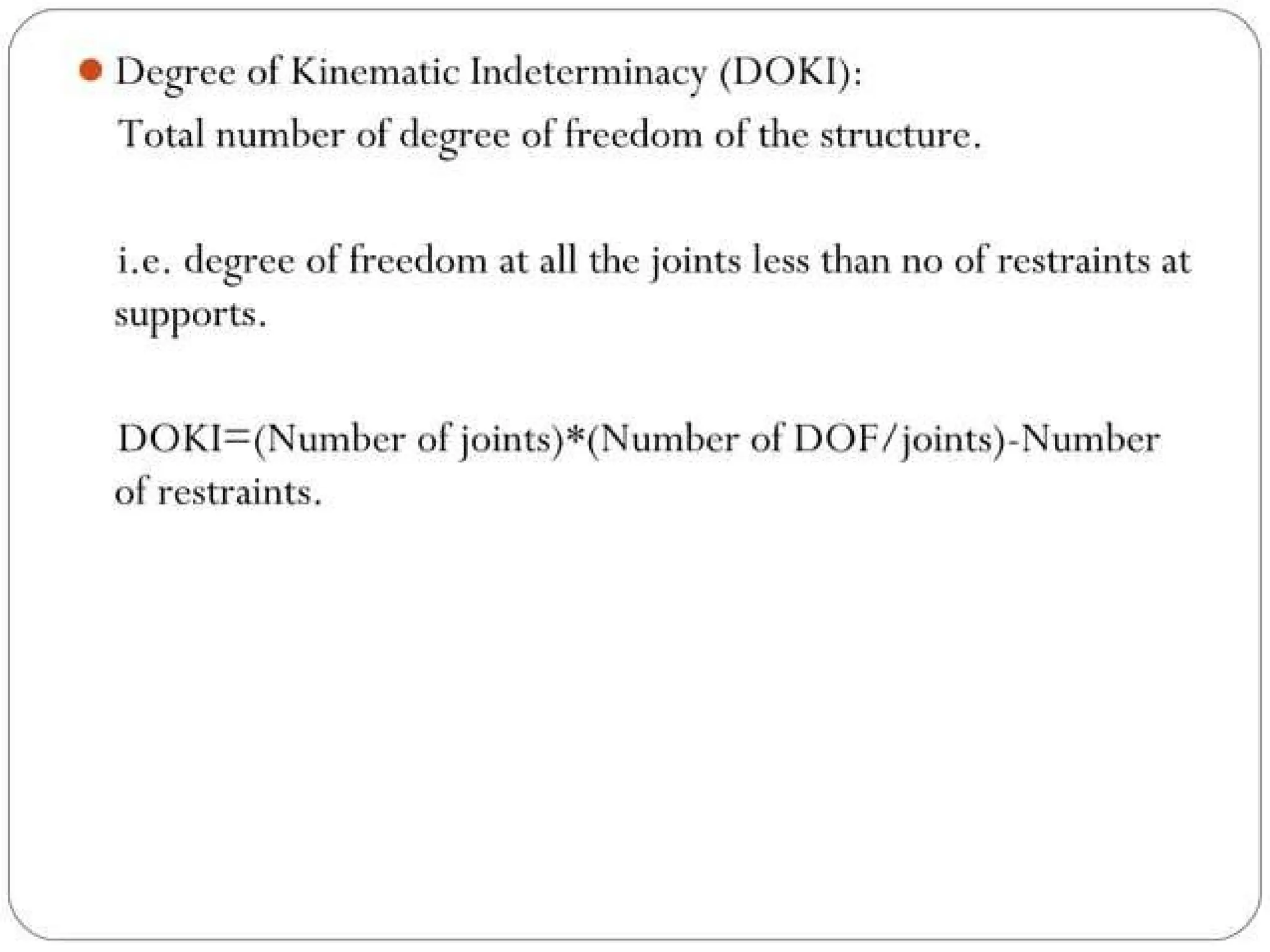
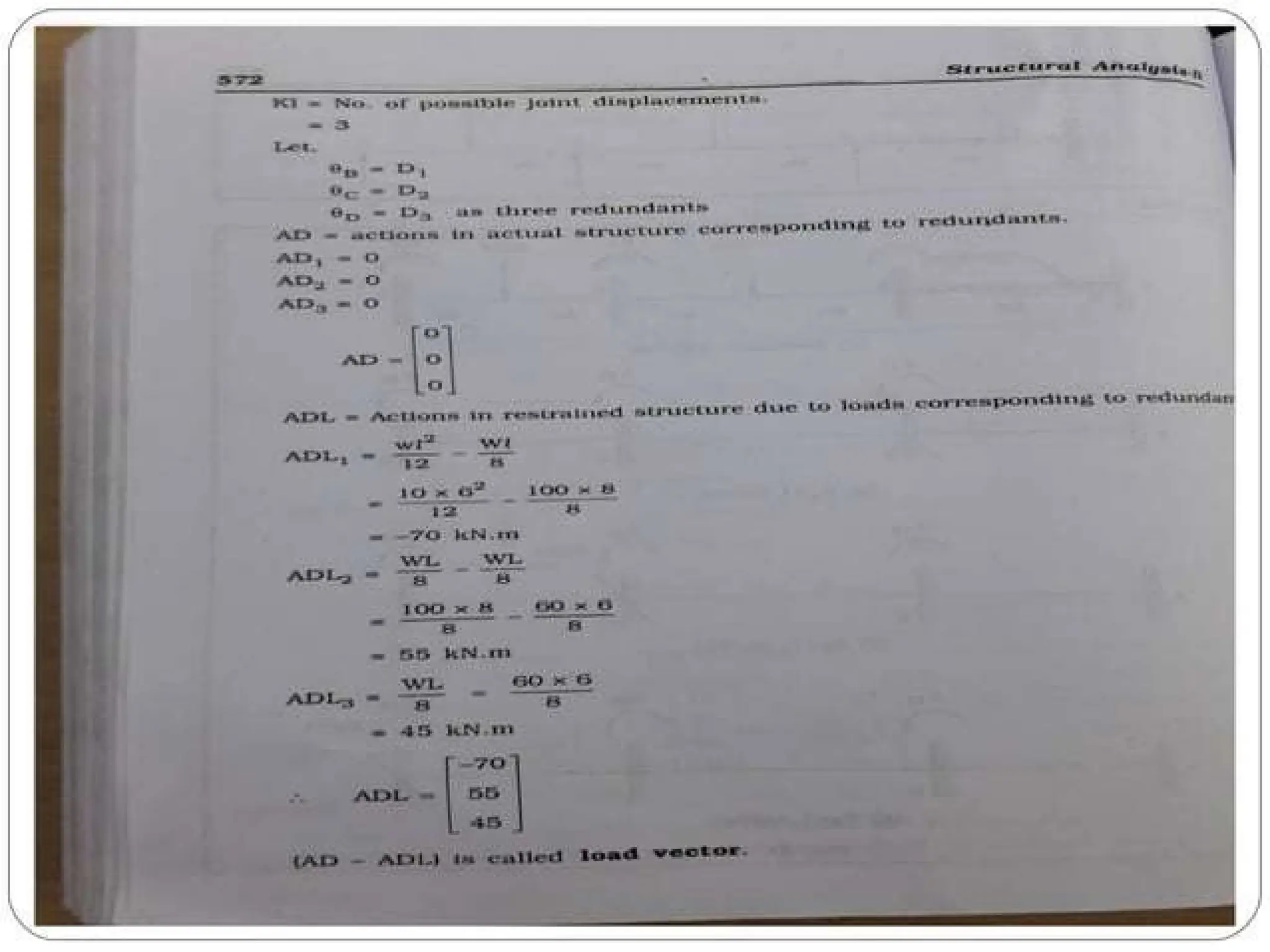
• The stiffness method, also known as the
displacement method or equilibrium method,
is a structural analysis technique that uses nodal
displacements as the primary unknowns to
determine the internal forces and stresses in a
structure. It's a systematic approach for analyzing
both determinate and indeterminate structures.
• Focus on Displacements:
• The method relies on the principle of
superposition, where displacements are used to
calculate member forces and stresses.
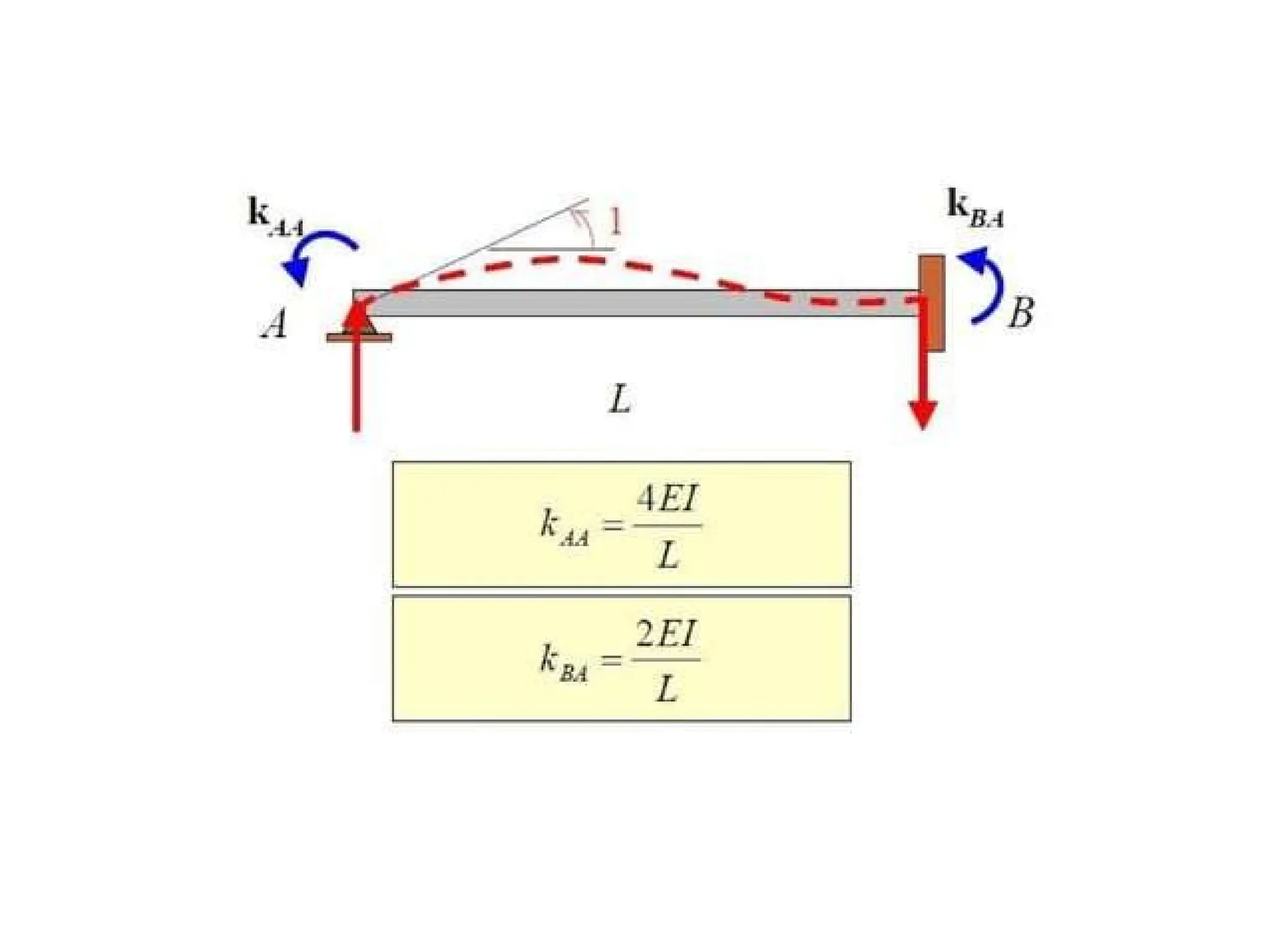
• Stiffness Matrices:
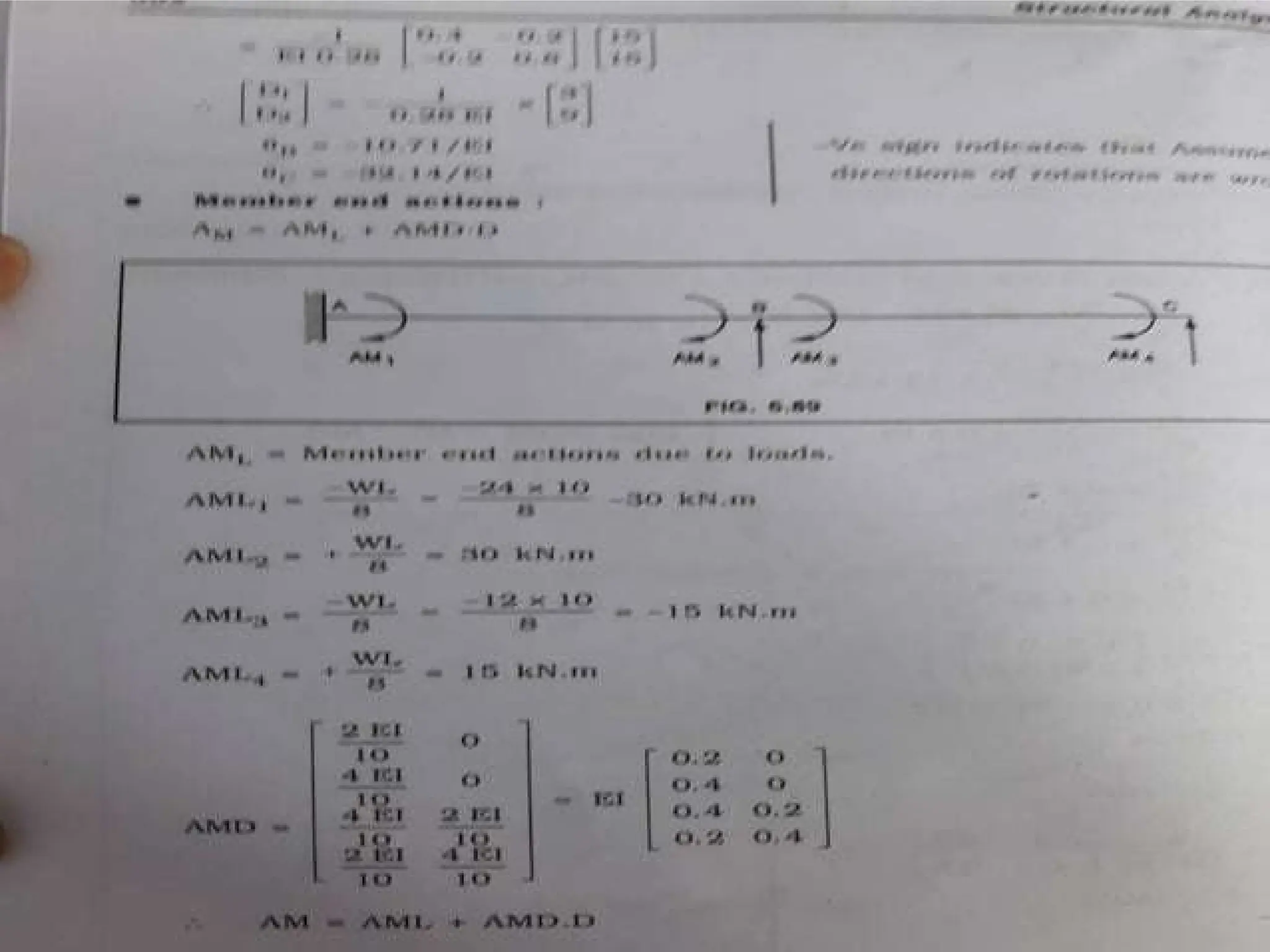
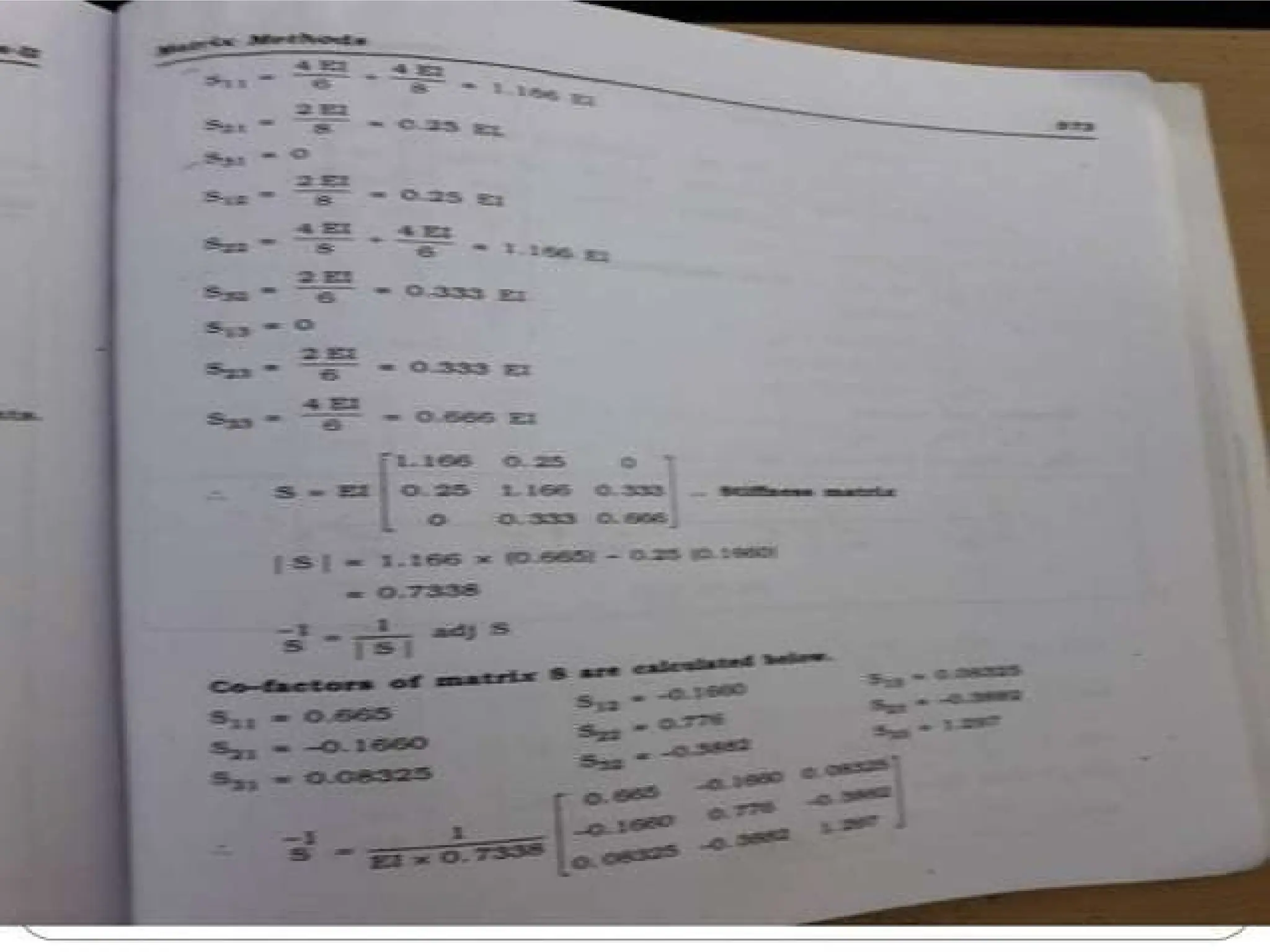
• The core of the method involves developing
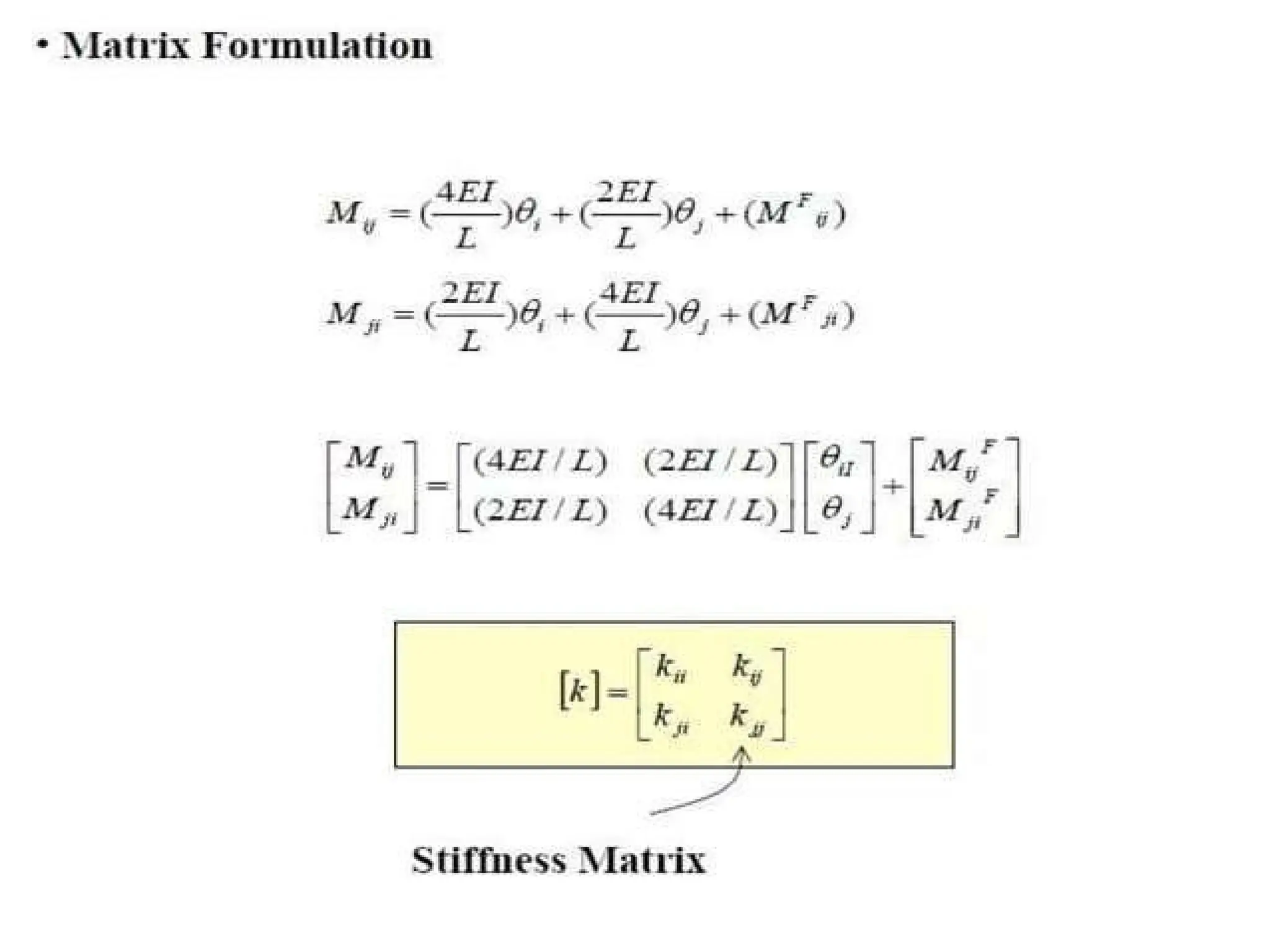
stiffness matrices for each member, which relate
the forces at the ends of a member to the
corresponding displacements.
• Global Equilibrium Equations:
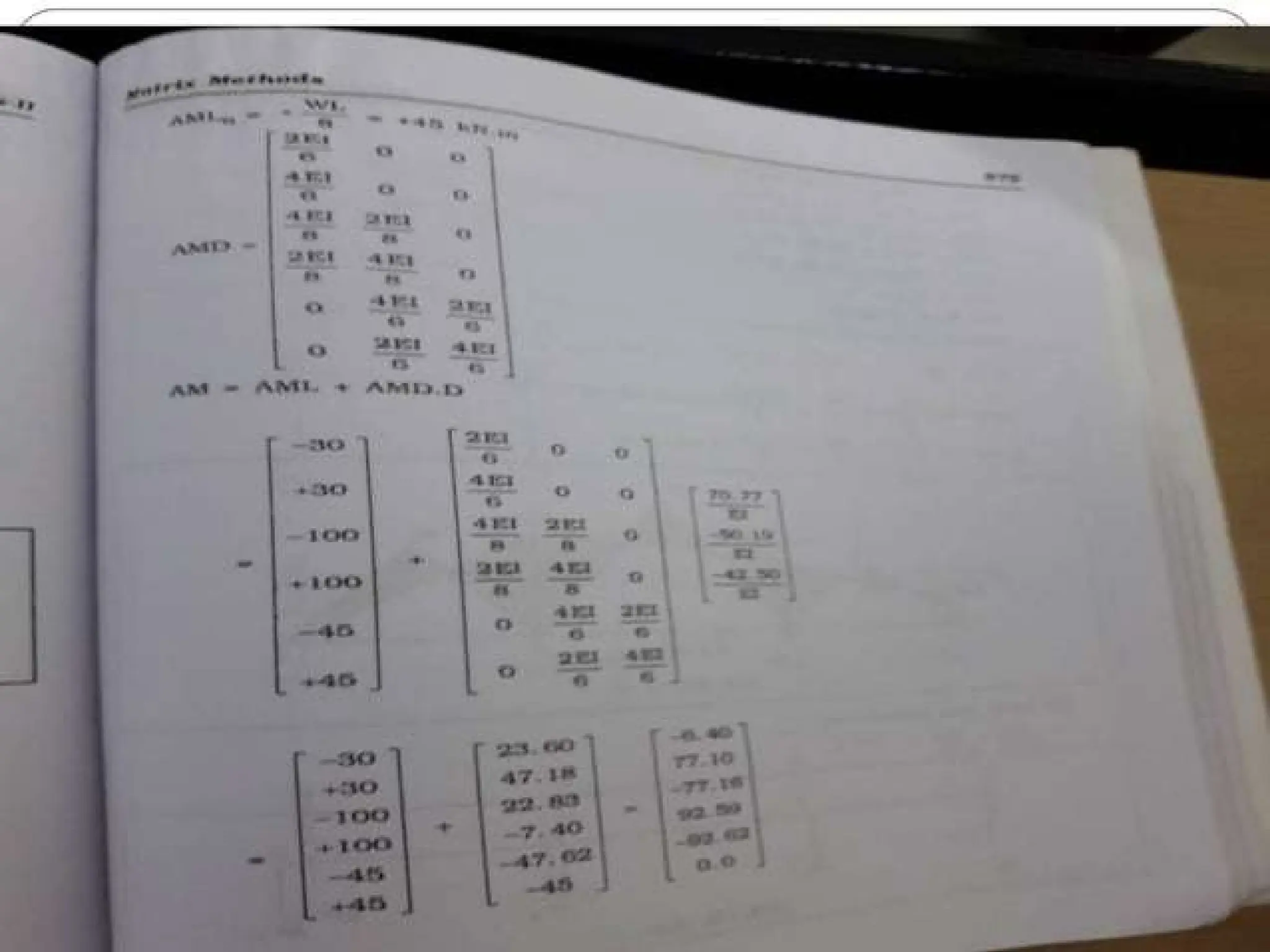
• By assembling the member stiffness matrices and
applying equilibrium conditions at the nodes, a
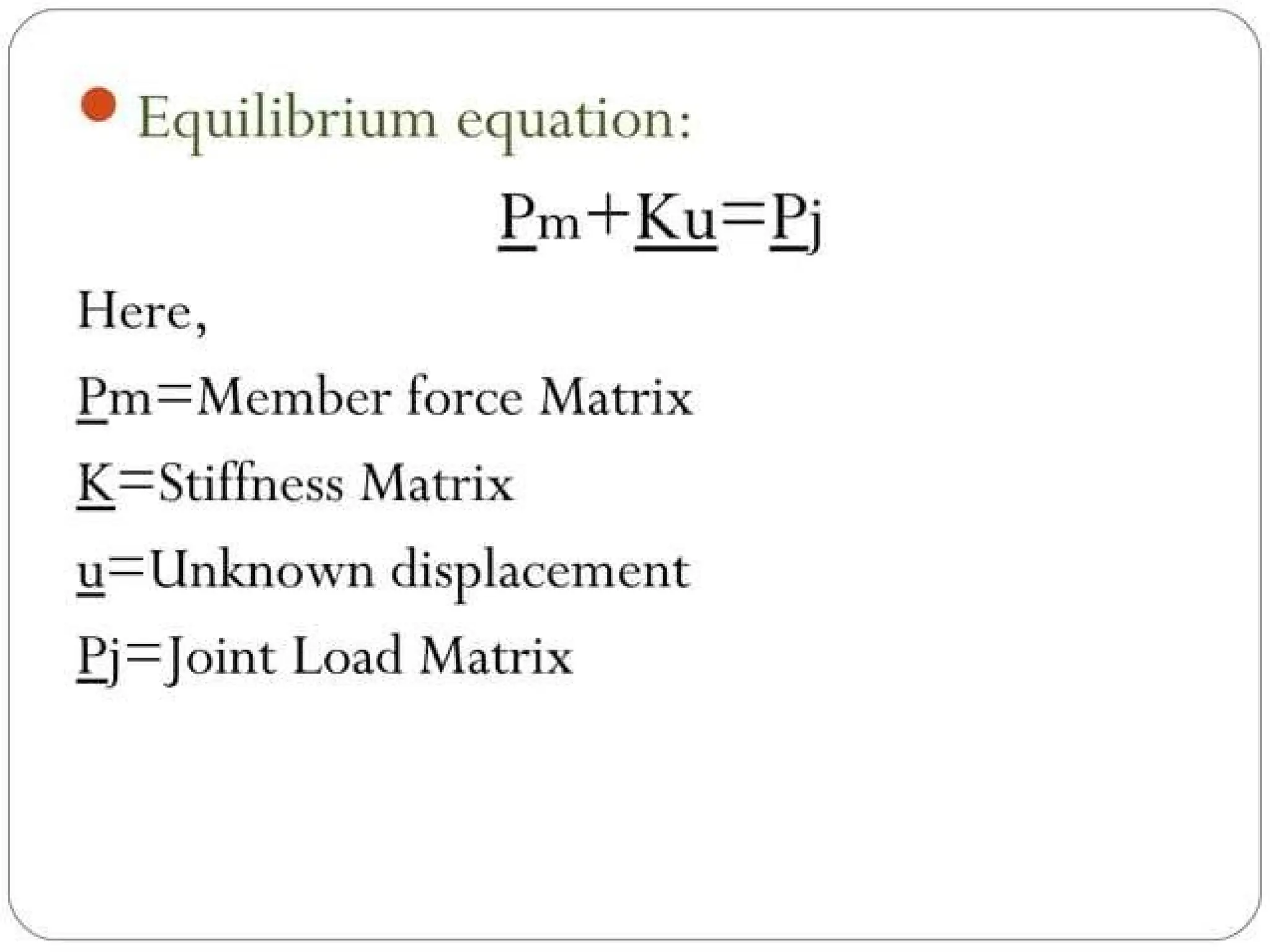
set of global equilibrium equations is established.
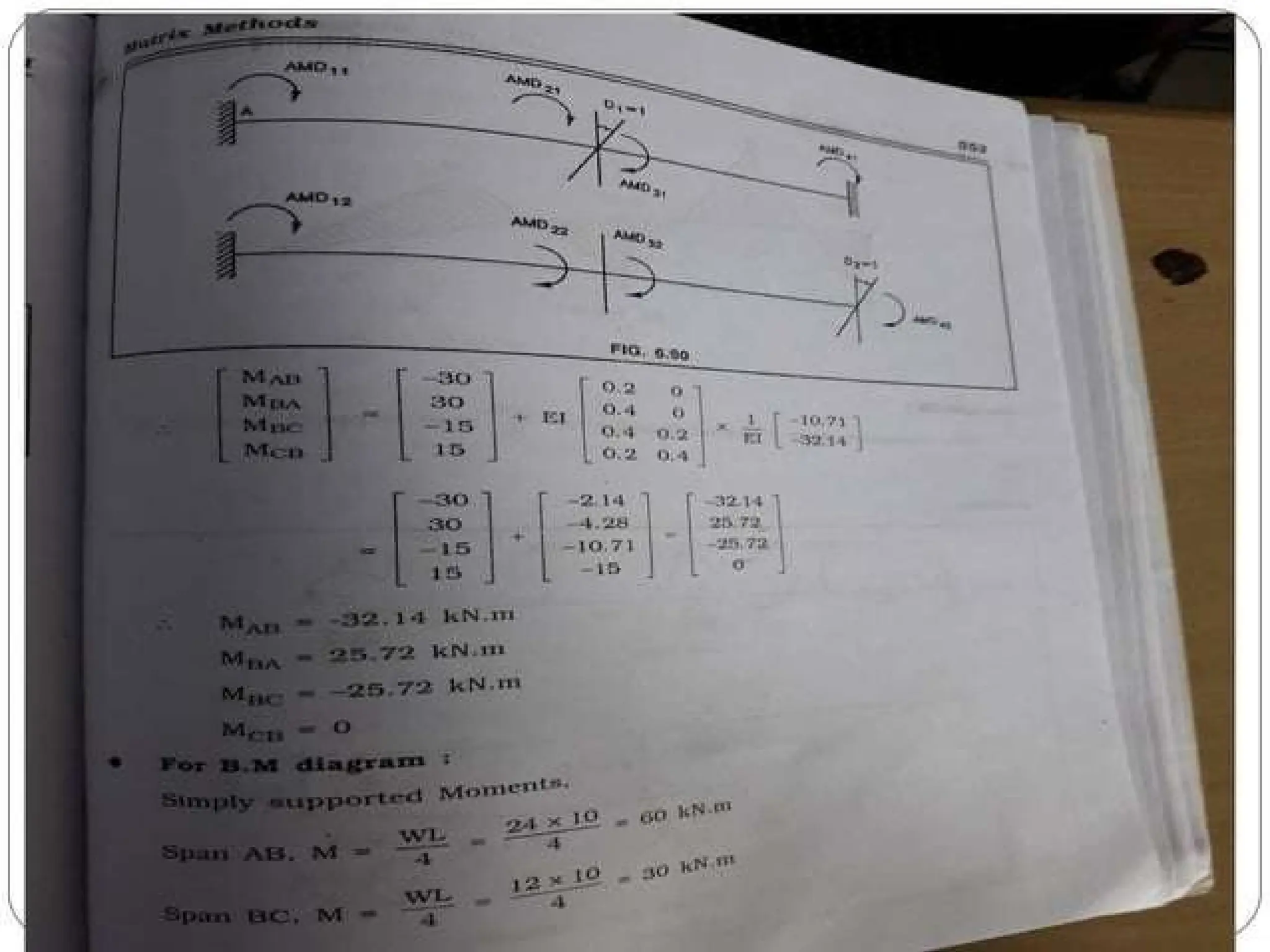
• Solving for Unknowns:
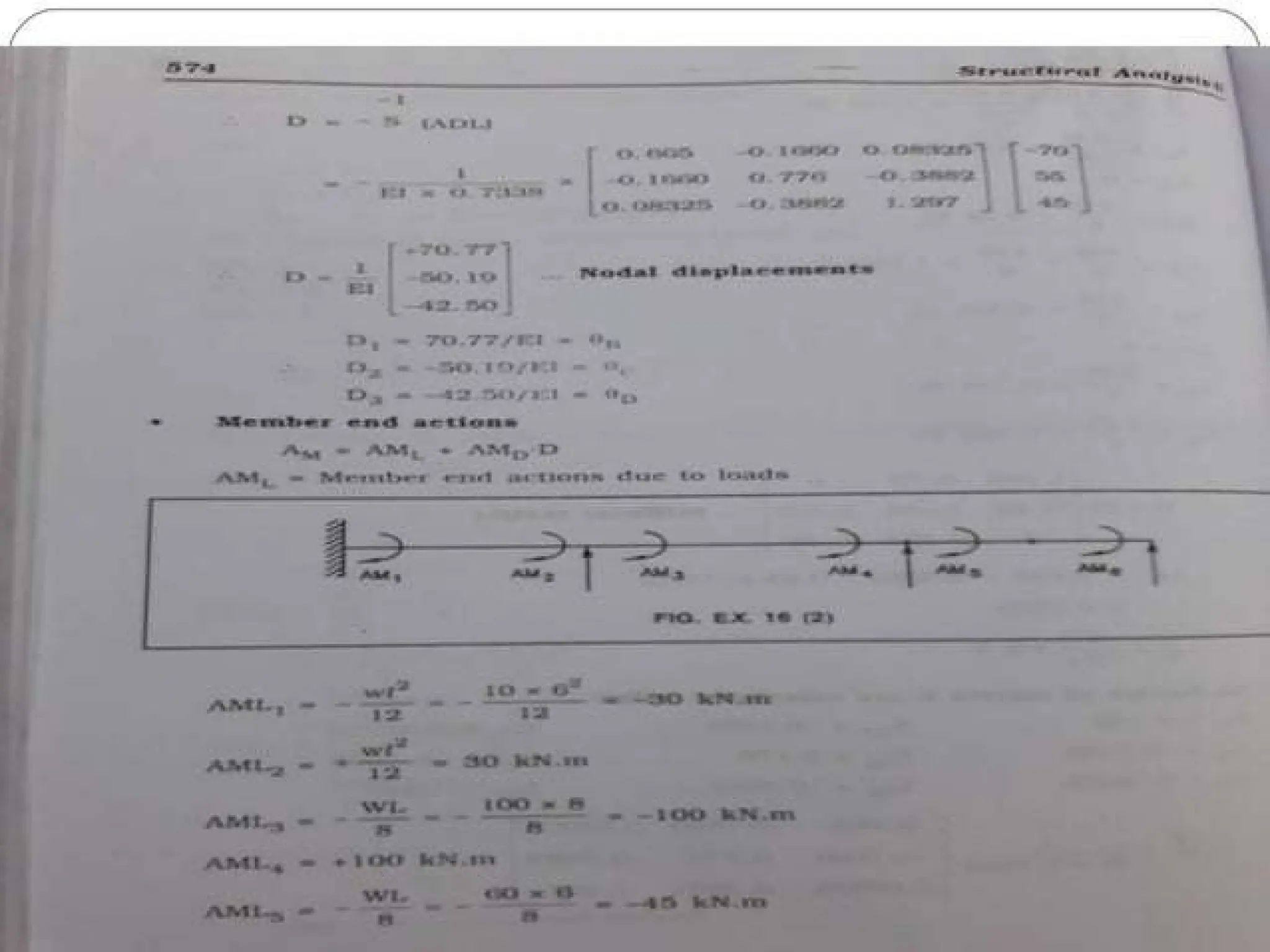
• Solving these equations yields the unknown nodal
displacements, which can then be used to
determine the internal forces and stresses within
the structure.
Applications:
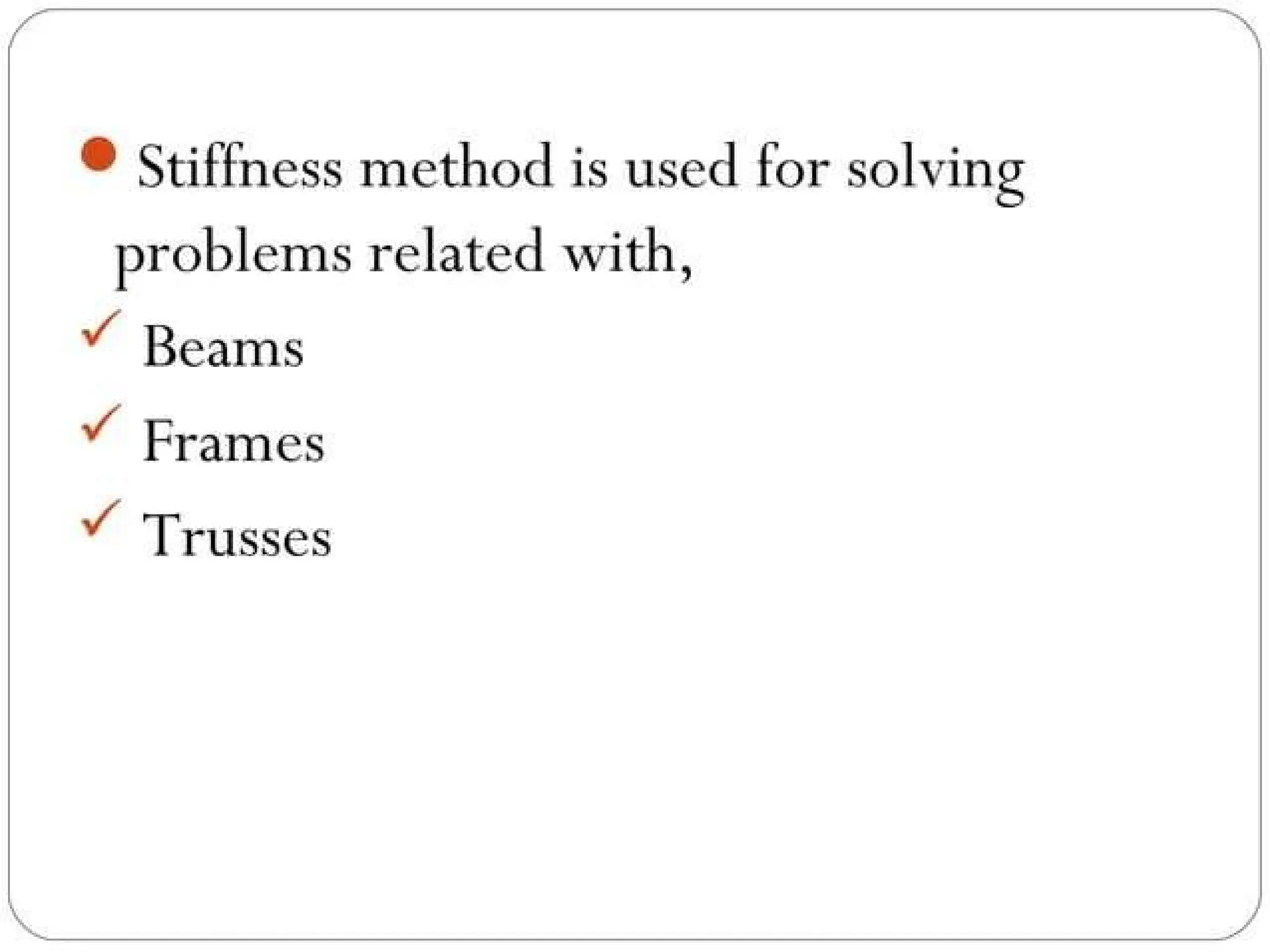
• Analyzing Trusses:
• The stiffness method is particularly well-suited for
analyzing truss structures, where each member
can be represented as a finite element.
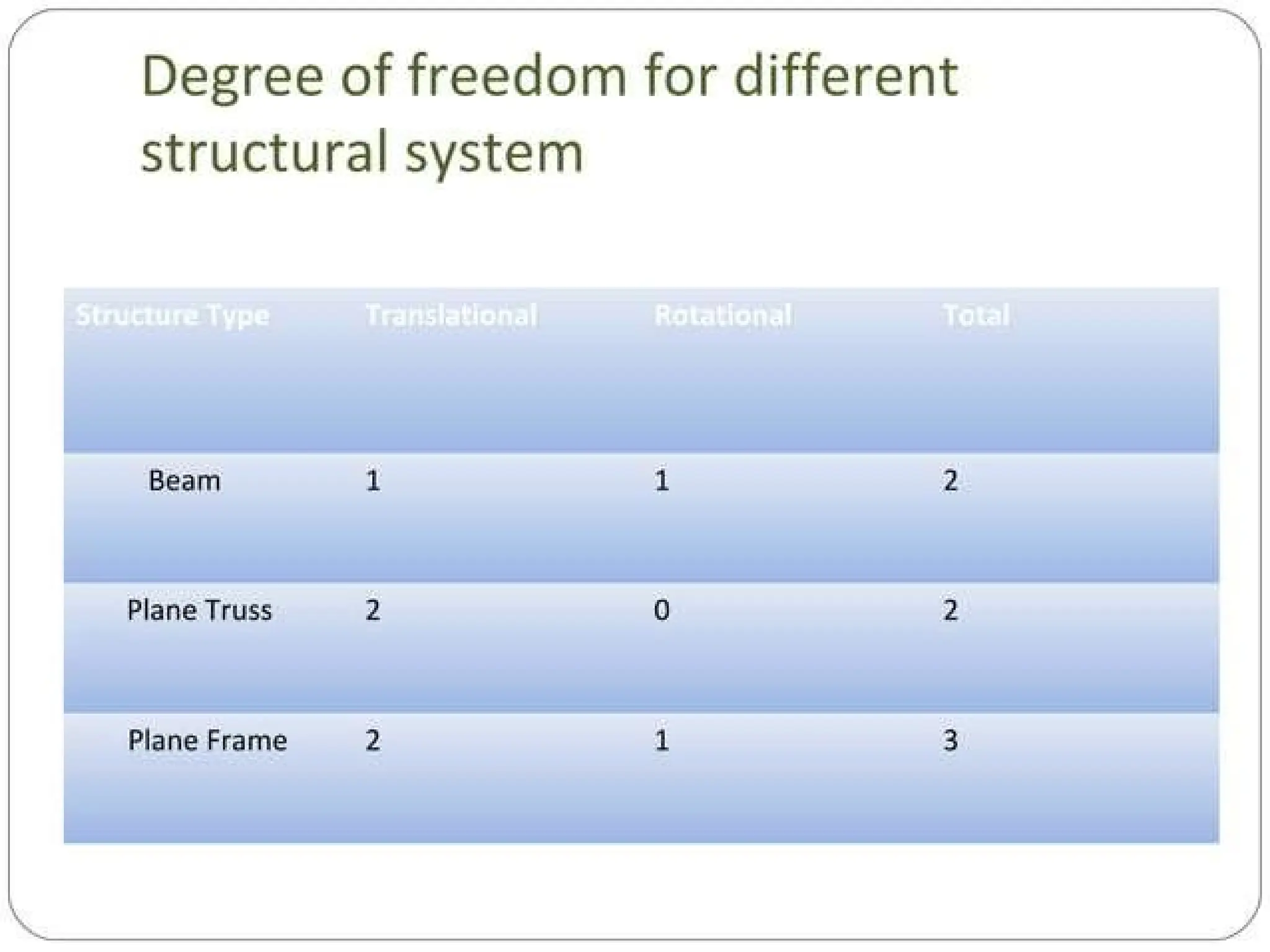
• Analyzing Beams and Frames:
• It can also be applied to more complex structures
like beams and frames, by considering the
degrees of freedom at each joint.
Computer-Aided Analysis:
• The stiffness method forms the basis for most
commercial structural analysis software, enabling the
analysis of complex structures with numerous
members.
• In essence, the stiffness method provides a powerful
and systematic approach for analyzing structures by
focusing on the relationship between displacements
and internal forces, making it a cornerstone of
modern structural engineering analysis.
FINITE ELEMENT METHOD
• Introduction – Discretization of a structure –
Displacement functions – Truss element –
Beam element – Plane stress and plane strain
– Triangular elements.
• The Finite Element Method (FEM) is a numerical technique for
solving boundary value problems by approximating a continuous
domain with a finite number of smaller, simpler elements
connected at nodes.
• This discretization allows for solving complex problems through a
series of smaller, more manageable equations.
• The method involves defining displacement functions,
formulating element equations, assembling them into a global
system, applying boundary conditions, and solving for unknown
nodal displacements and then calculating stresses and strains.
Introduction to Finite Element Method
• FEM is a numerical method for solving engineering
problems, particularly those involving complex
geometries, materials, and boundary conditions.
• It breaks down a continuous structure into a finite
number of elements connected at nodes.
• The core idea is to approximate the behavior of the
entire structure by analyzing the behavior of each
element.
• FEM is widely used in structural mechanics, heat
transfer, fluid dynamics, and electromagnetics.
Discretization of a Structure
• Discretization: The process of dividing a continuous domain into a
finite number of smaller, interconnected elements.
• Elements: Simple geometric shapes (e.g., triangles, quadrilaterals,
tetrahedra) that approximate the continuous domain.
• Nodes: Points where elements are connected and where
displacements are defined.
• Mesh: The overall arrangement of elements and nodes in the
discretized domain.
• Example: A complex structure like a bridge or an aircraft wing can
be discretized into a mesh of elements to model its behavior
under stress.
Displacement Functions
• Displacement Functions:
• Mathematical functions that describe the displacement of a point
within an element based on the displacements at the element's
nodes.
• Shape Functions:
• A set of functions that, when combined with node displacements,
provide a continuous approximation of the displacement field
within the element.
• Approximation:
• Displacement functions can be linear, quadratic, or higher-order
polynomials, depending on the element type and desired
accuracy.
Element Types
• Truss Element:
• A 1D element used to model structures under axial load, like a bridge
or a building frame.
• Beam Element:
• A 1D element used to model structures that can bend and twist, like a
beam in a bridge or a building floor.
• Plane Stress and Plane Strain Elements:
• 2D elements used to model structures under two-dimensional stress
conditions.
• Triangular Elements:
• 2D elements commonly used in plane stress and plane strain analysis,
particularly due to their flexibility in meshing complex geometries.
Formation of Element Equations
• Stiffness Matrix: A matrix that relates the
forces acting on an element to the resulting
displacements.
• Load Vector: A vector that represents the
applied loads on the element.
• Element Equations: Equations that describe
the behavior of each element, relating applied
forces to nodal displacements.
Assembly and Solution
• Assembly: Combining the element equations into a global
system of equations that represents the behavior of the
entire structure.
• Global Stiffness Matrix: The combined stiffness matrix for
the entire structure.
• Global Load Vector: The combined load vector for the entire
structure.
• Solution: Solving the global system of equations to
determine the unknown nodal displacements.
• Post-processing: Calculating stresses and strains within each
element based on the determined nodal displacements.
PLASTIC ANALYSIS OF STRUCTURES
• Statically indeterminate axial problems –
Beams in pure bending – Plastic moment of
resistance – Plastic modulus – Shape factor –
Load factor – Plastic hinge and mechanism –
Plastic analysis of indeterminate beams and
frames – Upper and lower bound theorems.
• Plastic analysis in structural engineering determines the
ultimate or collapse load of a structure by considering the
plastic behavior of materials after yielding.
• It focuses on the structure's capacity to carry load beyond
its elastic limit, utilizing the material's full strength in the
plastic range.
• This method is particularly relevant for steel structures,
where significant plastic deformation before failure is a
characteristic.
• Plastic Hinge:
• A region in a structure where the material
undergoes significant plastic deformation,
allowing for large rotations and redistribution
of moments.
• Plastic Moment (Mp):
• The maximum bending moment a cross-
section can withstand before yielding.
• Shape Factor:
• A value that describes the shape of a cross-section and
relates the plastic moment to the elastic moment.
• Collapse Mechanism:
• A failure mode where plastic hinges form, causing the
structure to collapse under load.
• Collapse Load:
• The load at which the structure reaches its ultimate
capacity and collapses.
Methods for Plastic Analysis
• Static/Equilibrium Method:
• This method assumes that the structure is in
equilibrium under the applied load and utilizes
the equilibrium conditions to determine the
collapse load.
• Kinematic/Mechanism Method:
• This method considers the possible collapse
mechanisms and uses the virtual work principle
to determine the collapse load.
Applications
• Steel Structures:
• Plastic analysis is widely used for designing steel structures, as
it allows for efficient utilization of material strength.
• Frames and Beams:
• Plastic analysis is particularly useful for analyzing frames and
beams, where plastic hinges can form and redistribute
moments.
• Ultimate Load Design:
• Plastic analysis is a basis for ultimate load design, where the
structure's strength is designed based on its ability to
withstand collapse loads.
Benefits of Plastic Analysis
• Efficient Material Utilization:
• It allows for a more rational and efficient use of structural
materials by considering their full plastic strength.
• Safety:
• It provides a more accurate assessment of the structure's
capacity and helps ensure safety under extreme loading
conditions.
• Design Optimization:
• It enables designers to optimize structural configurations
and achieve cost-effective designs.
SPACE AND CABLE STRUCTURES
• Analysis of Space trusses using method of
tension coefficients – Beams curved in plan –
Suspension cables – suspension bridges with
two and three hinged stiffening girders.
• The analysis of space trusses, beams curved in plan,
suspension cables, and suspension bridges with different
stiffening girder arrangements involves understanding
their behavior under various loads.
• Space trusses are three-dimensional structures analyzed
using methods like the tension coefficient method. Beams
curved in plan experience bending, shear, and torsion,
while suspension cables primarily experience tension.
• Suspension bridges, with two or three-hinged stiffening
girders, are analyzed to determine cable tension, girder
stresses, and influence lines for various loads.
Space Trusses
• Method of Tension Coefficients:
• This method is used to analyze the forces in
members of a space truss, taking into account
the three-dimensional nature of the structure.
• Analysis:
• The method involves solving equations of
equilibrium for each node, considering forces
in all three spatial directions.
• Beams Curved in Plan:
• Behavior:
• These beams experience bending, shear, and
torsional stresses due to their curved geometry.
• Analysis:
• The analysis involves determining bending
moments, shear forces, and torsional moments
at different points along the beam.
• Suspension Cables:
• Tension:
• Suspension cables are designed to withstand only
tensile forces, with no bending or compression.
• Analysis:
• The analysis focuses on determining the tension
in the cable under various loads, as well as the
cable's sag and length.
Suspension Bridges:
• Stiffening Girders: Suspension bridges utilize
stiffening girders to distribute loads from the
deck to the main cables.
• Two-Hinged Girders: These girders have two
hinges and are statically indeterminate.
• Three-Hinged Girders: These girders have
three hinges and are statically determinate.
• Analysis: The analysis involves determining the tension in the
cables, stresses in the stiffening girders, and influence lines for
various loads. Influence lines help determine the maximum
forces in different members under a moving load.
• Cable Tension: The tension in the cable is influenced by the load
on the bridge and the geometry of the bridge.
• Girder Stresses: The stresses in the stiffening girder are affected
by the load distribution and the geometry of the girder.
• Influence Lines: Influence lines for bending moment and shear
force in the girders are constructed to determine the maximum
values under a moving load.
20CE602 - Structural Analysis - II.pptx

  • 1.
  • 2.
    FLEXIBILITY METHOD • Equilibriumand compatibility – Determinate vs Indeterminate structures – Indeterminacy – Primary structure – Compatibility conditions – Analysis of indeterminate pin-jointed plane frames, continuous beams, rigid jointed plane frames (with redundancy restricted to two).
  • 3.
    Flexibility Method • Theflexibility method, also known as the force method or compatibility method, is a technique for analyzing statically indeterminate structures. • It involves determining the redundant forces by establishing force-displacement relationships for structural members and combining them to produce a relationship for the entire structure. • This method is suitable when kinematic indeterminacy is greater than static indeterminacy.
  • 4.
    • Determining StaticIndeterminacy: Identify the degree of static indeterminacy (DSI) of the structure. • Choosing Redundant Forces: Select the redundant forces to be analyzed. • Creating a Basic Determinate Structure: Remove the redundant restraints, creating a basic determinate structure. • Establishing Force-Displacement Relationships: Determine the displacements caused by a unit load at each redundant force location.
  • 5.
    • Compatibility Equation:Apply compatibility equations to ensure displacement compatibility at the redundant force locations. • Solving for Redundant Forces: Solve the compatibility equations to find the values of the redundant forces. • Calculating Member Forces: Determine member forces by combining the forces in the basic determinate structure and those caused by the redundant forces.
  • 6.
    • Flexibility Matrix: •The flexibility matrix is a square matrix that represents the displacement at coordinate i due to a unit force at coordinate j in a structure. • It's also known as the "flexibility coefficient". • The matrix elements are displacements, and it's always a symmetric matrix.
  • 7.
    • Advantages andLimitations: • Advantages: • Suitable for structures with a high degree of static indeterminacy and can provide an understanding of the structure's behavior.
  • 8.
    • Limitations: • Canbe more computationally intensive for complex structures compared to stiffness methods. •
  • 9.
    • Applications: • Beams,Frames, and Indeterminate structures with single or double degrees of indeterminacy. • In essence, the flexibility method provides a systematic approach to analyzing statically indeterminate structures by focusing on the relationship between forces and displacements, ultimately determining the redundant forces and internal forces in the structure.
  • 11.
    STIFFNESS METHOD • Elementand global stiffness matrices – Analysis of continuous beams – Co-ordinate transformations – Rotation matrix – Transformations of stiffness matrices, load vectors and displacements vectors – Analysis of pin-jointed plane frames and rigid frames (with redundancy limited to two).
  • 12.
    • The stiffnessmethod, also known as the displacement method or equilibrium method, is a structural analysis technique that uses nodal displacements as the primary unknowns to determine the internal forces and stresses in a structure. It's a systematic approach for analyzing both determinate and indeterminate structures.
  • 13.
    • Focus onDisplacements: • The method relies on the principle of superposition, where displacements are used to calculate member forces and stresses. • Stiffness Matrices: • The core of the method involves developing stiffness matrices for each member, which relate the forces at the ends of a member to the corresponding displacements.
  • 14.
    • Global EquilibriumEquations: • By assembling the member stiffness matrices and applying equilibrium conditions at the nodes, a set of global equilibrium equations is established. • Solving for Unknowns: • Solving these equations yields the unknown nodal displacements, which can then be used to determine the internal forces and stresses within the structure.
  • 15.
    Applications: • Analyzing Trusses: •The stiffness method is particularly well-suited for analyzing truss structures, where each member can be represented as a finite element. • Analyzing Beams and Frames: • It can also be applied to more complex structures like beams and frames, by considering the degrees of freedom at each joint.
  • 16.
    Computer-Aided Analysis: • Thestiffness method forms the basis for most commercial structural analysis software, enabling the analysis of complex structures with numerous members. • In essence, the stiffness method provides a powerful and systematic approach for analyzing structures by focusing on the relationship between displacements and internal forces, making it a cornerstone of modern structural engineering analysis.
  • 45.
    FINITE ELEMENT METHOD •Introduction – Discretization of a structure – Displacement functions – Truss element – Beam element – Plane stress and plane strain – Triangular elements.
  • 46.
    • The FiniteElement Method (FEM) is a numerical technique for solving boundary value problems by approximating a continuous domain with a finite number of smaller, simpler elements connected at nodes. • This discretization allows for solving complex problems through a series of smaller, more manageable equations. • The method involves defining displacement functions, formulating element equations, assembling them into a global system, applying boundary conditions, and solving for unknown nodal displacements and then calculating stresses and strains.
  • 47.
    Introduction to FiniteElement Method • FEM is a numerical method for solving engineering problems, particularly those involving complex geometries, materials, and boundary conditions. • It breaks down a continuous structure into a finite number of elements connected at nodes. • The core idea is to approximate the behavior of the entire structure by analyzing the behavior of each element. • FEM is widely used in structural mechanics, heat transfer, fluid dynamics, and electromagnetics.
  • 48.
    Discretization of aStructure • Discretization: The process of dividing a continuous domain into a finite number of smaller, interconnected elements. • Elements: Simple geometric shapes (e.g., triangles, quadrilaterals, tetrahedra) that approximate the continuous domain. • Nodes: Points where elements are connected and where displacements are defined. • Mesh: The overall arrangement of elements and nodes in the discretized domain. • Example: A complex structure like a bridge or an aircraft wing can be discretized into a mesh of elements to model its behavior under stress.
  • 49.
    Displacement Functions • DisplacementFunctions: • Mathematical functions that describe the displacement of a point within an element based on the displacements at the element's nodes. • Shape Functions: • A set of functions that, when combined with node displacements, provide a continuous approximation of the displacement field within the element. • Approximation: • Displacement functions can be linear, quadratic, or higher-order polynomials, depending on the element type and desired accuracy.
  • 50.
    Element Types • TrussElement: • A 1D element used to model structures under axial load, like a bridge or a building frame. • Beam Element: • A 1D element used to model structures that can bend and twist, like a beam in a bridge or a building floor. • Plane Stress and Plane Strain Elements: • 2D elements used to model structures under two-dimensional stress conditions. • Triangular Elements: • 2D elements commonly used in plane stress and plane strain analysis, particularly due to their flexibility in meshing complex geometries.
  • 51.
    Formation of ElementEquations • Stiffness Matrix: A matrix that relates the forces acting on an element to the resulting displacements. • Load Vector: A vector that represents the applied loads on the element. • Element Equations: Equations that describe the behavior of each element, relating applied forces to nodal displacements.
  • 52.
    Assembly and Solution •Assembly: Combining the element equations into a global system of equations that represents the behavior of the entire structure. • Global Stiffness Matrix: The combined stiffness matrix for the entire structure. • Global Load Vector: The combined load vector for the entire structure. • Solution: Solving the global system of equations to determine the unknown nodal displacements. • Post-processing: Calculating stresses and strains within each element based on the determined nodal displacements.
  • 53.
    PLASTIC ANALYSIS OFSTRUCTURES • Statically indeterminate axial problems – Beams in pure bending – Plastic moment of resistance – Plastic modulus – Shape factor – Load factor – Plastic hinge and mechanism – Plastic analysis of indeterminate beams and frames – Upper and lower bound theorems.
  • 54.
    • Plastic analysisin structural engineering determines the ultimate or collapse load of a structure by considering the plastic behavior of materials after yielding. • It focuses on the structure's capacity to carry load beyond its elastic limit, utilizing the material's full strength in the plastic range. • This method is particularly relevant for steel structures, where significant plastic deformation before failure is a characteristic.
  • 55.
    • Plastic Hinge: •A region in a structure where the material undergoes significant plastic deformation, allowing for large rotations and redistribution of moments. • Plastic Moment (Mp): • The maximum bending moment a cross- section can withstand before yielding.
  • 56.
    • Shape Factor: •A value that describes the shape of a cross-section and relates the plastic moment to the elastic moment. • Collapse Mechanism: • A failure mode where plastic hinges form, causing the structure to collapse under load. • Collapse Load: • The load at which the structure reaches its ultimate capacity and collapses.
  • 57.
    Methods for PlasticAnalysis • Static/Equilibrium Method: • This method assumes that the structure is in equilibrium under the applied load and utilizes the equilibrium conditions to determine the collapse load. • Kinematic/Mechanism Method: • This method considers the possible collapse mechanisms and uses the virtual work principle to determine the collapse load.
  • 58.
    Applications • Steel Structures: •Plastic analysis is widely used for designing steel structures, as it allows for efficient utilization of material strength. • Frames and Beams: • Plastic analysis is particularly useful for analyzing frames and beams, where plastic hinges can form and redistribute moments. • Ultimate Load Design: • Plastic analysis is a basis for ultimate load design, where the structure's strength is designed based on its ability to withstand collapse loads.
  • 59.
    Benefits of PlasticAnalysis • Efficient Material Utilization: • It allows for a more rational and efficient use of structural materials by considering their full plastic strength. • Safety: • It provides a more accurate assessment of the structure's capacity and helps ensure safety under extreme loading conditions. • Design Optimization: • It enables designers to optimize structural configurations and achieve cost-effective designs.
  • 60.
    SPACE AND CABLESTRUCTURES • Analysis of Space trusses using method of tension coefficients – Beams curved in plan – Suspension cables – suspension bridges with two and three hinged stiffening girders.
  • 61.
    • The analysisof space trusses, beams curved in plan, suspension cables, and suspension bridges with different stiffening girder arrangements involves understanding their behavior under various loads. • Space trusses are three-dimensional structures analyzed using methods like the tension coefficient method. Beams curved in plan experience bending, shear, and torsion, while suspension cables primarily experience tension. • Suspension bridges, with two or three-hinged stiffening girders, are analyzed to determine cable tension, girder stresses, and influence lines for various loads.
  • 62.
    Space Trusses • Methodof Tension Coefficients: • This method is used to analyze the forces in members of a space truss, taking into account the three-dimensional nature of the structure. • Analysis: • The method involves solving equations of equilibrium for each node, considering forces in all three spatial directions.
  • 63.
    • Beams Curvedin Plan: • Behavior: • These beams experience bending, shear, and torsional stresses due to their curved geometry. • Analysis: • The analysis involves determining bending moments, shear forces, and torsional moments at different points along the beam.
  • 64.
    • Suspension Cables: •Tension: • Suspension cables are designed to withstand only tensile forces, with no bending or compression. • Analysis: • The analysis focuses on determining the tension in the cable under various loads, as well as the cable's sag and length.
  • 65.
    Suspension Bridges: • StiffeningGirders: Suspension bridges utilize stiffening girders to distribute loads from the deck to the main cables. • Two-Hinged Girders: These girders have two hinges and are statically indeterminate. • Three-Hinged Girders: These girders have three hinges and are statically determinate.
  • 66.
    • Analysis: Theanalysis involves determining the tension in the cables, stresses in the stiffening girders, and influence lines for various loads. Influence lines help determine the maximum forces in different members under a moving load. • Cable Tension: The tension in the cable is influenced by the load on the bridge and the geometry of the bridge. • Girder Stresses: The stresses in the stiffening girder are affected by the load distribution and the geometry of the girder. • Influence Lines: Influence lines for bending moment and shear force in the girders are constructed to determine the maximum values under a moving load.