Situational Analysis: SWOT Analysis What is SWOT? SA=O/(S-W) SA= strategic alternative O= opportunities S= strengths W= weakness
SWOT Analysis: Criticisms Generates lengthy lists Uses no weights to reflect priorities Same factor can be placed in 2 categories Requires only a single level of analysis No logical link to strategy implementation
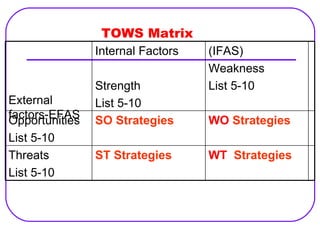
Generating Alternative Strategies: TOWS Matrix SWOT can be used to generate a no of possible alternative strategies TOWS is just another way of saying SWOT Illustrates how external opportunities & threats can be matched with firm’s internal strengths & weaknesses to result in 4-sets of possible strategies alternative
TOWS Matrix  WT  Strategies   ST Strategies   Threats List 5-10 WO   Strategies   SO Strategies   Opportunities List 5-10 (IFAS) Weakness List 5-10 Internal Factors Strength  List 5-10 External factors-EFAS
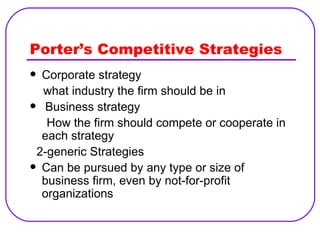
Porter’s Competitive Strategies Corporate strategy what industry the firm should be in Business strategy  How the firm should compete or cooperate in each strategy 2-generic Strategies Can be pursued by any type or size of business firm, even by not-for-profit organizations
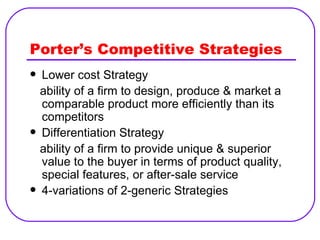
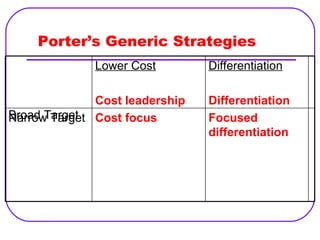
Porter’s Competitive Strategies Lower cost Strategy ability of a firm to design, produce & market a comparable product more efficiently than its competitors Differentiation Strategy ability of a firm to provide unique & superior value to the buyer in terms of product quality, special features, or after-sale service 4-variations of 2-generic Strategies
  Porter’s Generic Strategies Focused differentiation Cost focus Narrow Target Differentiation Differentiation Lower Cost Cost leadership Broad Target
Which is the best Generic Strategy? Before selecting one of Porter’s generic competitive  strategies, the management should assess its feasibility in terms of resources & capabilities Porter lists the following requirement for generic competitive  strategies
Requirement for Generic Competitive  Strategies: Overall Cost Leadership  Sustained capital investment Process engineering skills Low cost distribution systems Tight cost control Structured organization & responsibilities Incentives based on meeting targets
Requirement for Generic Competitive  Strategies: Differentiation Strong marketing abilities Product engineering Strong cooperation from channels Long tradition in industry R&D, product development, marketing- all well coordinated Ability to attract highly skilled labor
Market Location Tactics: Where to compete Offensive Tactics Frontal Assault Flanking Maneuver Bypass Attack Encirclement Guerrilla Warfare
 
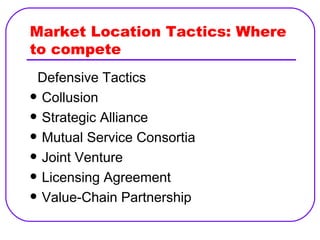
Market Location Tactics: Where to compete Defensive Tactics Collusion Strategic Alliance Mutual Service Consortia Joint Venture Licensing Agreement Value-Chain Partnership

Str Mgt Lesson 5 Str Formulation Situation Analysis & Business Str

  • 1.
    Situational Analysis: SWOTAnalysis What is SWOT? SA=O/(S-W) SA= strategic alternative O= opportunities S= strengths W= weakness
  • 2.
    SWOT Analysis: CriticismsGenerates lengthy lists Uses no weights to reflect priorities Same factor can be placed in 2 categories Requires only a single level of analysis No logical link to strategy implementation
  • 3.
    Generating Alternative Strategies:TOWS Matrix SWOT can be used to generate a no of possible alternative strategies TOWS is just another way of saying SWOT Illustrates how external opportunities & threats can be matched with firm’s internal strengths & weaknesses to result in 4-sets of possible strategies alternative
  • 4.
    TOWS Matrix WT Strategies ST Strategies Threats List 5-10 WO Strategies SO Strategies Opportunities List 5-10 (IFAS) Weakness List 5-10 Internal Factors Strength List 5-10 External factors-EFAS
  • 5.
    Porter’s Competitive StrategiesCorporate strategy what industry the firm should be in Business strategy How the firm should compete or cooperate in each strategy 2-generic Strategies Can be pursued by any type or size of business firm, even by not-for-profit organizations
  • 6.
    Porter’s Competitive StrategiesLower cost Strategy ability of a firm to design, produce & market a comparable product more efficiently than its competitors Differentiation Strategy ability of a firm to provide unique & superior value to the buyer in terms of product quality, special features, or after-sale service 4-variations of 2-generic Strategies
  • 7.
    Porter’sGeneric Strategies Focused differentiation Cost focus Narrow Target Differentiation Differentiation Lower Cost Cost leadership Broad Target
  • 8.
    Which is thebest Generic Strategy? Before selecting one of Porter’s generic competitive strategies, the management should assess its feasibility in terms of resources & capabilities Porter lists the following requirement for generic competitive strategies
  • 9.
    Requirement for GenericCompetitive Strategies: Overall Cost Leadership Sustained capital investment Process engineering skills Low cost distribution systems Tight cost control Structured organization & responsibilities Incentives based on meeting targets
  • 10.
    Requirement for GenericCompetitive Strategies: Differentiation Strong marketing abilities Product engineering Strong cooperation from channels Long tradition in industry R&D, product development, marketing- all well coordinated Ability to attract highly skilled labor
  • 11.
    Market Location Tactics:Where to compete Offensive Tactics Frontal Assault Flanking Maneuver Bypass Attack Encirclement Guerrilla Warfare
  • 12.
  • 13.
    Market Location Tactics:Where to compete Defensive Tactics Collusion Strategic Alliance Mutual Service Consortia Joint Venture Licensing Agreement Value-Chain Partnership