Learning Outcomes
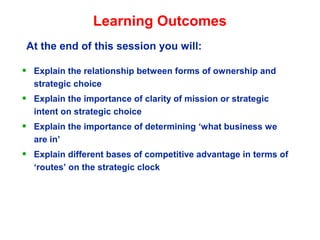
• Explain the relationship between forms of ownership and
strategic choice
• Explain the importance of clarity of mission or strategic
intent on strategic choice
• Explain the importance of determining ‘what business we
are in’
• Explain different bases of competitive advantage in terms of
‘routes’ on the strategic clock
At the end of this session you will:
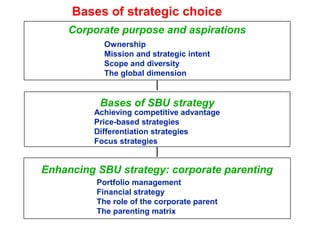
Ownership
Mission and strategic intent
Scope and diversity
The global dimension
Corporate purpose and aspirations
Bases of SBU strategy
Enhancing SBU strategy: corporate parenting
Portfolio management
Financial strategy
The role of the corporate parent
The parenting matrix
Achieving competitive advantage
Price-based strategies
Differentiation strategies
Focus strategies
Bases of strategic choice
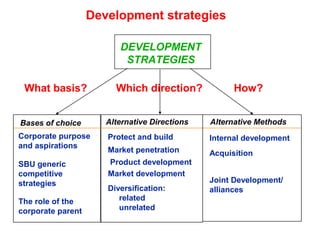
DEVELOPMENT
STRATEGIES
Which direction?
Market development
Product development
Diversification:
related
unrelated
Bases of choice Alternative Directions Alternative Methods
What basis? How?
Corporate purpose
and aspirations
SBU generic
competitive
strategies
The role of the
corporate parent
Internal development
Acquisition
Joint Development/
alliances
Protect and build
Market penetration
Development strategies
Source: Based on the work of Cliff Bowman.
See C.Bowman and D.Faulkner. Competitive and Corporate Strategy, Irwin, 1996.
PRICE HighLow
Differentiation
Focused
differentiation
Low price/
low added value
Strategies
destined for
ultimate failure
PERCEIVED
ADDED
VALUE
4
5
6
8
Hybrid
Low
price
7
High
Low
1
2
3
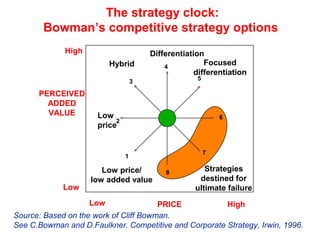
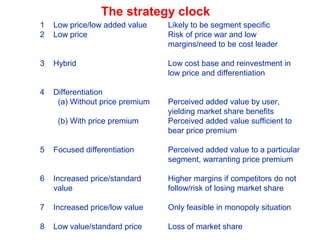
The strategy clock:
Bowman’s competitive strategy options
1 Low price/low added value Likely to be segment specific
2 Low price Risk of price war and low
margins/need to be cost leader
3 Hybrid Low cost base and reinvestment in
low price and differentiation
4 Differentiation
(a) Without price premium Perceived added value by user,
yielding market share benefits
(b) With price premium Perceived added value sufficient to
bear price premium
5 Focused differentiation Perceived added value to a particular
segment, warranting price premium
6 Increased price/standard Higher margins if competitors do not
value follow/risk of losing market share
7 Increased price/low value Only feasible in monopoly situation
8 Low value/standard price Loss of market share
The strategy clock
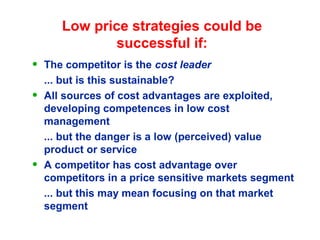
Low price strategies could be
successful if:
• The competitor is the cost leader
... but is this sustainable?
• All sources of cost advantages are exploited,
developing competences in low cost
management
... but the danger is a low (perceived) value
product or service
• A competitor has cost advantage over
competitors in a price sensitive markets segment
... but this may mean focusing on that market
segment
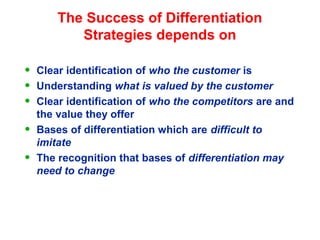
The Success of Differentiation
Strategies depends on
• Clear identification of who the customer is
• Understanding what is valued by the customer
• Clear identification of who the competitors are and
the value they offer
• Bases of differentiation which are difficult to
imitate
• The recognition that bases of differentiation may
need to change
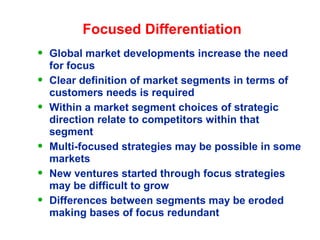
Focused Differentiation
• Global market developments increase the need
for focus
• Clear definition of market segments in terms of
customers needs is required
• Within a market segment choices of strategic
direction relate to competitors within that
segment
• Multi-focused strategies may be possible in some
markets
• New ventures started through focus strategies
may be difficult to grow
• Differences between segments may be eroded
making bases of focus redundant
Key Questions in Strategic Choice
• Strategic choices need to take account of the
environment and build on core competences
• Strategic choices need to take account of the
expectations and influence of stakeholders
• Strategic direction and methods should build on
broad strategic choices
• Resources and competences should be developed
to deliver and sustain the chosen strategies
Key Questions in Strategic Choice
• Strategic choices need to take account of the
environment and build on core competences
• Strategic choices need to take account of the
expectations and influence of stakeholders
• Strategic direction and methods should build on
broad strategic choices
• Resources and competences should be developed
to deliver and sustain the chosen strategies

Strategic choice

  • 1.
    Learning Outcomes • Explainthe relationship between forms of ownership and strategic choice • Explain the importance of clarity of mission or strategic intent on strategic choice • Explain the importance of determining ‘what business we are in’ • Explain different bases of competitive advantage in terms of ‘routes’ on the strategic clock At the end of this session you will:
  • 2.
    Ownership Mission and strategicintent Scope and diversity The global dimension Corporate purpose and aspirations Bases of SBU strategy Enhancing SBU strategy: corporate parenting Portfolio management Financial strategy The role of the corporate parent The parenting matrix Achieving competitive advantage Price-based strategies Differentiation strategies Focus strategies Bases of strategic choice
  • 3.
    DEVELOPMENT STRATEGIES Which direction? Market development Productdevelopment Diversification: related unrelated Bases of choice Alternative Directions Alternative Methods What basis? How? Corporate purpose and aspirations SBU generic competitive strategies The role of the corporate parent Internal development Acquisition Joint Development/ alliances Protect and build Market penetration Development strategies
  • 4.
    Source: Based onthe work of Cliff Bowman. See C.Bowman and D.Faulkner. Competitive and Corporate Strategy, Irwin, 1996. PRICE HighLow Differentiation Focused differentiation Low price/ low added value Strategies destined for ultimate failure PERCEIVED ADDED VALUE 4 5 6 8 Hybrid Low price 7 High Low 1 2 3 The strategy clock: Bowman’s competitive strategy options
  • 5.
    1 Low price/lowadded value Likely to be segment specific 2 Low price Risk of price war and low margins/need to be cost leader 3 Hybrid Low cost base and reinvestment in low price and differentiation 4 Differentiation (a) Without price premium Perceived added value by user, yielding market share benefits (b) With price premium Perceived added value sufficient to bear price premium 5 Focused differentiation Perceived added value to a particular segment, warranting price premium 6 Increased price/standard Higher margins if competitors do not value follow/risk of losing market share 7 Increased price/low value Only feasible in monopoly situation 8 Low value/standard price Loss of market share The strategy clock
  • 6.
    Low price strategiescould be successful if: • The competitor is the cost leader ... but is this sustainable? • All sources of cost advantages are exploited, developing competences in low cost management ... but the danger is a low (perceived) value product or service • A competitor has cost advantage over competitors in a price sensitive markets segment ... but this may mean focusing on that market segment
  • 7.
    The Success ofDifferentiation Strategies depends on • Clear identification of who the customer is • Understanding what is valued by the customer • Clear identification of who the competitors are and the value they offer • Bases of differentiation which are difficult to imitate • The recognition that bases of differentiation may need to change
  • 8.
    Focused Differentiation • Globalmarket developments increase the need for focus • Clear definition of market segments in terms of customers needs is required • Within a market segment choices of strategic direction relate to competitors within that segment • Multi-focused strategies may be possible in some markets • New ventures started through focus strategies may be difficult to grow • Differences between segments may be eroded making bases of focus redundant
  • 9.
    Key Questions inStrategic Choice • Strategic choices need to take account of the environment and build on core competences • Strategic choices need to take account of the expectations and influence of stakeholders • Strategic direction and methods should build on broad strategic choices • Resources and competences should be developed to deliver and sustain the chosen strategies
  • 10.
    Key Questions inStrategic Choice • Strategic choices need to take account of the environment and build on core competences • Strategic choices need to take account of the expectations and influence of stakeholders • Strategic direction and methods should build on broad strategic choices • Resources and competences should be developed to deliver and sustain the chosen strategies

Editor's Notes