STRATEGY FORMULATION:
SITUATION ANALYSIS AND
BUSINESS STRATEGY
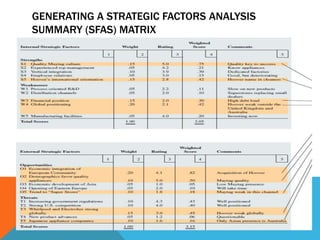
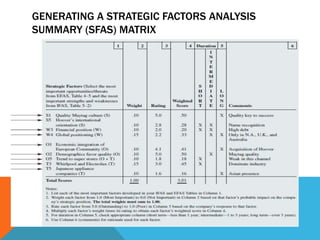
GENERATING A STRATEGIC FACTORS
ANALYSIS SUMMARY (SFAS) MATRIX
The EFAS and IFAS Tables plus the SFAS
Matrix have been developed to deal with
the criticisms of SWOT analysis.
GENERATING A STRATEGIC FACTORS ANALYSIS
SUMMARY (SFAS) MATRIX
GENERATING A STRATEGIC FACTORS ANALYSIS
SUMMARY (SFAS) MATRIX
QUANTITATIVE STRATEGIC PLANNING MATRIX (QSPM)
Quantitative Strategic Planning Matrix (QSPM) is a high-level strategic
management approach for evaluating possible strategies. Quantitative Strategic
Planning Matrix or a QSPM provides an analytical method for comparing feasible
alternative actions. The QSPM method falls within so-called stage 3 of the
strategy formulation analytical framework.
When company executives think about what to do, and which way to go, they usually
have a prioritized list of strategies. If they like one strategy over another one, they
move it up on the list. This process is very much intuitive and subjective.
The QSPM method introduces some numbers into this approach making it a
little more "expert" technique.
WHAT IS A QUANTITATIVE STRATEGIC PLANNING MATRIX OR A QSPM?
The Quantitative Strategic Planning Matrix or a QSPM approach attempts to
objectively select the best strategy using input from other management techniques
and some easy computations. In other words, the QSPM method uses inputs from
stage 1 analyses, matches them with results from stage 2 analyses, and then decides
objectively among alternative strategies.
Stage 1 strategic management tools...
The first step in the overall strategic management analysis is used to identify key strategic
factors. This can be done using, for example, the ESF matrix and ISF matrix.
WHAT IS A QUANTITATIVE STRATEGIC PLANNING MATRIX OR A QSPM?
Stage 2 strategic management tools...
After we identify and analyze key strategic factors as inputs for QSPM, we can
formulate the type of the strategy we would like to pursue. This can be done using the
stage 2 strategic management tools, for example the SWOT analysis (or
TOWS), SPACE matrix analysis, BCG matrix model, or the IE matrix model.( See
below details in notes)
Stage 3 strategic management tools...
The stage 1 strategic management methods provided us with key strategic factors. Based on their
analysis, we formulated possible strategies in stage 2. Now, the task is to compare in QSPM
alternative strategies and decide which one is the most suitable for our goals.
The stage 2 strategic tools provide the needed information for setting up the Quantitative Strategic
Planning Matrix - QSPM. The QSPM method allows us to evaluate alternative strategies
objectively.
Conceptually, the QSPM in stage 3 determines the relative attractiveness of various strategies based on
the extent to which key external and internal critical success factors are capitalized upon or
improved. The relative attractiveness of each strategy is computed by determining the cumulative
impact of each external and internal critical success factor.
FINDING A PROPITIOUS (FAVORABLE) NICHE
A niche is a need in the marketplace that is currently
unsatisfied. The goal is to find a propitious niche an
extremely favorable niche that is so well suited to the firm’s
internal and external environment that other corporations
are not likely to challenge or dislodge it. A niche is
propitious to the extent that it currently is just large enough
for one firm to satisfy its demand.
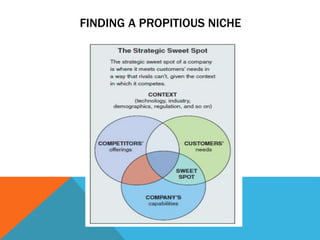
In Figure 6–2 where a company is able to satisfy customers’
needs in a way that rivals cannot, given the context in which
it operates.
FINDING A PROPITIOUS NICHE
REVIEW OF MISSION AND OBJECTIVES
• A reexamination of an organization’s current mission and
objectives must be made before alternative strategies can be
generated and evaluated.
• Problems in performance can derive from an inappropriate
statement of mission, which may be too narrow or too
broad.
• If the mission does not provide a common thread (a unifying
theme) for a corporation’s businesses, managers may be
unclear about where the company is heading.
GENERATING ALTERNATIVE STRATEGIES
BY USING A TOWS MATRIX
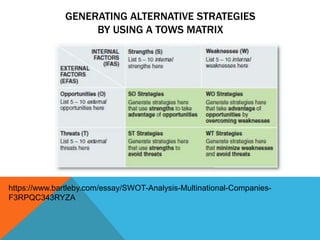
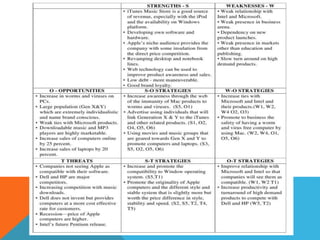
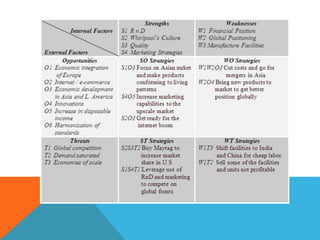
The TOWS Matrix (TOWS is just another way of saying SWOT)
illustrates how the external opportunities and threats facing a particular
corporation can be matched with that company’s internal strengths and
weaknesses to result in four sets of possible strategic alternatives.
GENERATING ALTERNATIVE STRATEGIES
BY USING A TOWS MATRIX
https://www.bartleby.com/essay/SWOT-Analysis-Multinational-Companies-
F3RPQC343RYZA
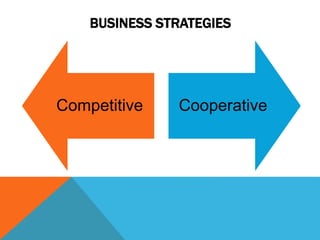
BUSINESS STRATEGIES
Competitive Cooperative
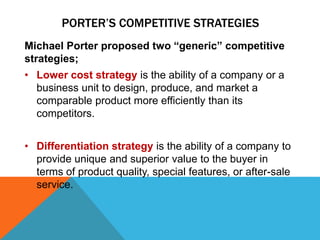
PORTER’S COMPETITIVE STRATEGIES
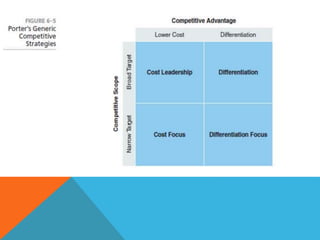
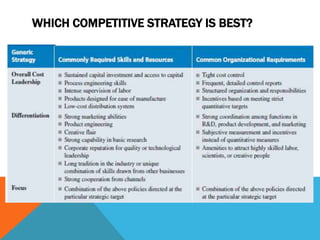
Michael Porter proposed two “generic” competitive
strategies;
• Lower cost strategy is the ability of a company or a
business unit to design, produce, and market a
comparable product more efficiently than its
competitors.
• Differentiation strategy is the ability of a company to
provide unique and superior value to the buyer in
terms of product quality, special features, or after-sale
service.
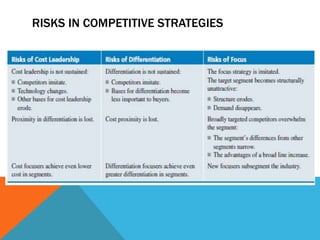
RISKS IN COMPETITIVE STRATEGIES
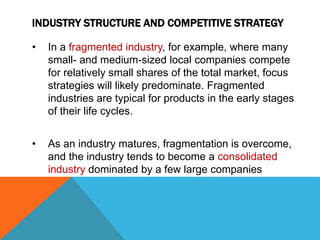
INDUSTRY STRUCTURE AND COMPETITIVE STRATEGY
• In a fragmented industry, for example, where many
small- and medium-sized local companies compete
for relatively small shares of the total market, focus
strategies will likely predominate. Fragmented
industries are typical for products in the early stages
of their life cycles.
• As an industry matures, fragmentation is overcome,
and the industry tends to become a consolidated
industry dominated by a few large companies
WHICH COMPETITIVE STRATEGY IS BEST?
COMPETITIVE TACTICS
A tactic is a specific operating plan that
details how a strategy is to be
implemented in terms of when and where it
is to be put into action. By their nature,
tactics are narrower in scope and shorter
in time horizon than are strategies.
TIMING TACTICS: WHEN TO COMPETE
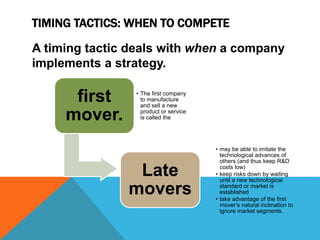
A timing tactic deals with when a company
implements a strategy.
first
mover.
• The first company
to manufacture
and sell a new
product or service
is called the
Late
movers
• may be able to imitate the
technological advances of
others (and thus keep R&D
costs low)
• keep risks down by waiting
until a new technological
standard or market is
established
• take advantage of the first
mover’s natural inclination to
ignore market segments.
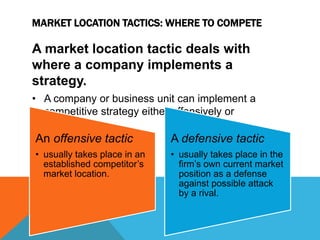
MARKET LOCATION TACTICS: WHERE TO COMPETE
A market location tactic deals with
where a company implements a
strategy.
• A company or business unit can implement a
competitive strategy either offensively or
defensively.
An offensive tactic
• usually takes place in an
established competitor’s
market location.
A defensive tactic
• usually takes place in the
firm’s own current market
position as a defense
against possible attack
by a rival.
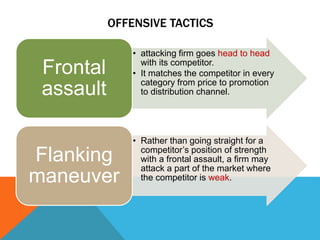
OFFENSIVE TACTICS
• attacking firm goes head to head
with its competitor.
• It matches the competitor in every
category from price to promotion
to distribution channel.
Frontal
assault
• Rather than going straight for a
competitor’s position of strength
with a frontal assault, a firm may
attack a part of the market where
the competitor is weak.
Flanking
maneuver
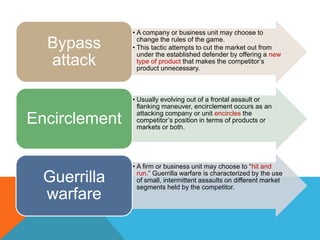
• A company or business unit may choose to
change the rules of the game.
• This tactic attempts to cut the market out from
under the established defender by offering a new
type of product that makes the competitor’s
product unnecessary.
Bypass
attack
• Usually evolving out of a frontal assault or
flanking maneuver, encirclement occurs as an
attacking company or unit encircles the
competitor’s position in terms of products or
markets or both.
Encirclement
• A firm or business unit may choose to “hit and
run.” Guerrilla warfare is characterized by the use
of small, intermittent assaults on different market
segments held by the competitor.
Guerrilla
warfare
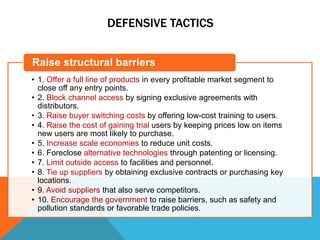
DEFENSIVE TACTICS
• 1. Offer a full line of products in every profitable market segment to
close off any entry points.
• 2. Block channel access by signing exclusive agreements with
distributors.
• 3. Raise buyer switching costs by offering low-cost training to users.
• 4. Raise the cost of gaining trial users by keeping prices low on items
new users are most likely to purchase.
• 5. Increase scale economies to reduce unit costs.
• 6. Foreclose alternative technologies through patenting or licensing.
• 7. Limit outside access to facilities and personnel.
• 8. Tie up suppliers by obtaining exclusive contracts or purchasing key
locations.
• 9. Avoid suppliers that also serve competitors.
• 10. Encourage the government to raise barriers, such as safety and
pollution standards or favorable trade policies.
Raise structural barriers
COOPERATIVE STRATEGIES
The two general types of cooperative strategies
are collusion and strategic alliances.
1. Collusion
It is the active cooperation of firms within an
industry to reduce output and raise prices in order
to get around the normal economic law of supply
and demand.
• Can be direct or indirect
2. Strategic Alliances
A strategic alliance is a long-term cooperative
arrangement between two or more independent firms
or business units that engage in business activities for
mutual economic gains.
 Companies or business units may form a
strategic alliance for a number of reasons,
including:
1. To obtain or learn new capabilities
2. To obtain access to specific markets
3. To reduce financial risk
4. To reduce political risk
COOPERATIVE STRATEGIES
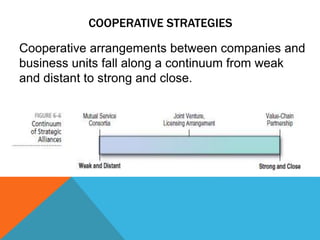
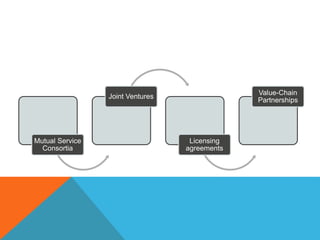
Cooperative arrangements between companies and
business units fall along a continuum from weak
and distant to strong and close.
COOPERATIVE STRATEGIES
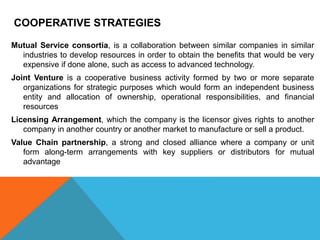
Mutual Service consortia, is a collaboration between similar companies in similar
industries to develop resources in order to obtain the benefits that would be very
expensive if done alone, such as access to advanced technology.
Joint Venture is a cooperative business activity formed by two or more separate
organizations for strategic purposes which would form an independent business
entity and allocation of ownership, operational responsibilities, and financial
resources
Licensing Arrangement, which the company is the licensor gives rights to another
company in another country or another market to manufacture or sell a product.
Value Chain partnership, a strong and closed alliance where a company or unit
form along-term arrangements with key suppliers or distributors for mutual
advantage
Mutual Service
Consortia
Joint Ventures
Licensing
agreements
Value-Chain
Partnerships

Chapter 4 - Strategy Formulation, Situation Analysis & Business Strategy (1).pptx

  • 1.
  • 3.
    GENERATING A STRATEGICFACTORS ANALYSIS SUMMARY (SFAS) MATRIX The EFAS and IFAS Tables plus the SFAS Matrix have been developed to deal with the criticisms of SWOT analysis.
  • 4.
    GENERATING A STRATEGICFACTORS ANALYSIS SUMMARY (SFAS) MATRIX
  • 5.
    GENERATING A STRATEGICFACTORS ANALYSIS SUMMARY (SFAS) MATRIX
  • 6.
    QUANTITATIVE STRATEGIC PLANNINGMATRIX (QSPM) Quantitative Strategic Planning Matrix (QSPM) is a high-level strategic management approach for evaluating possible strategies. Quantitative Strategic Planning Matrix or a QSPM provides an analytical method for comparing feasible alternative actions. The QSPM method falls within so-called stage 3 of the strategy formulation analytical framework. When company executives think about what to do, and which way to go, they usually have a prioritized list of strategies. If they like one strategy over another one, they move it up on the list. This process is very much intuitive and subjective. The QSPM method introduces some numbers into this approach making it a little more "expert" technique.
  • 7.
    WHAT IS AQUANTITATIVE STRATEGIC PLANNING MATRIX OR A QSPM? The Quantitative Strategic Planning Matrix or a QSPM approach attempts to objectively select the best strategy using input from other management techniques and some easy computations. In other words, the QSPM method uses inputs from stage 1 analyses, matches them with results from stage 2 analyses, and then decides objectively among alternative strategies. Stage 1 strategic management tools... The first step in the overall strategic management analysis is used to identify key strategic factors. This can be done using, for example, the ESF matrix and ISF matrix.
  • 8.
    WHAT IS AQUANTITATIVE STRATEGIC PLANNING MATRIX OR A QSPM? Stage 2 strategic management tools... After we identify and analyze key strategic factors as inputs for QSPM, we can formulate the type of the strategy we would like to pursue. This can be done using the stage 2 strategic management tools, for example the SWOT analysis (or TOWS), SPACE matrix analysis, BCG matrix model, or the IE matrix model.( See below details in notes) Stage 3 strategic management tools... The stage 1 strategic management methods provided us with key strategic factors. Based on their analysis, we formulated possible strategies in stage 2. Now, the task is to compare in QSPM alternative strategies and decide which one is the most suitable for our goals. The stage 2 strategic tools provide the needed information for setting up the Quantitative Strategic Planning Matrix - QSPM. The QSPM method allows us to evaluate alternative strategies objectively. Conceptually, the QSPM in stage 3 determines the relative attractiveness of various strategies based on the extent to which key external and internal critical success factors are capitalized upon or improved. The relative attractiveness of each strategy is computed by determining the cumulative impact of each external and internal critical success factor.
  • 10.
    FINDING A PROPITIOUS(FAVORABLE) NICHE A niche is a need in the marketplace that is currently unsatisfied. The goal is to find a propitious niche an extremely favorable niche that is so well suited to the firm’s internal and external environment that other corporations are not likely to challenge or dislodge it. A niche is propitious to the extent that it currently is just large enough for one firm to satisfy its demand. In Figure 6–2 where a company is able to satisfy customers’ needs in a way that rivals cannot, given the context in which it operates.
  • 11.
  • 12.
    REVIEW OF MISSIONAND OBJECTIVES • A reexamination of an organization’s current mission and objectives must be made before alternative strategies can be generated and evaluated. • Problems in performance can derive from an inappropriate statement of mission, which may be too narrow or too broad. • If the mission does not provide a common thread (a unifying theme) for a corporation’s businesses, managers may be unclear about where the company is heading.
  • 13.
    GENERATING ALTERNATIVE STRATEGIES BYUSING A TOWS MATRIX The TOWS Matrix (TOWS is just another way of saying SWOT) illustrates how the external opportunities and threats facing a particular corporation can be matched with that company’s internal strengths and weaknesses to result in four sets of possible strategic alternatives.
  • 14.
    GENERATING ALTERNATIVE STRATEGIES BYUSING A TOWS MATRIX https://www.bartleby.com/essay/SWOT-Analysis-Multinational-Companies- F3RPQC343RYZA
  • 17.
  • 18.
    PORTER’S COMPETITIVE STRATEGIES MichaelPorter proposed two “generic” competitive strategies; • Lower cost strategy is the ability of a company or a business unit to design, produce, and market a comparable product more efficiently than its competitors. • Differentiation strategy is the ability of a company to provide unique and superior value to the buyer in terms of product quality, special features, or after-sale service.
  • 20.
  • 21.
    INDUSTRY STRUCTURE ANDCOMPETITIVE STRATEGY • In a fragmented industry, for example, where many small- and medium-sized local companies compete for relatively small shares of the total market, focus strategies will likely predominate. Fragmented industries are typical for products in the early stages of their life cycles. • As an industry matures, fragmentation is overcome, and the industry tends to become a consolidated industry dominated by a few large companies
  • 22.
  • 23.
    COMPETITIVE TACTICS A tacticis a specific operating plan that details how a strategy is to be implemented in terms of when and where it is to be put into action. By their nature, tactics are narrower in scope and shorter in time horizon than are strategies.
  • 24.
    TIMING TACTICS: WHENTO COMPETE A timing tactic deals with when a company implements a strategy. first mover. • The first company to manufacture and sell a new product or service is called the Late movers • may be able to imitate the technological advances of others (and thus keep R&D costs low) • keep risks down by waiting until a new technological standard or market is established • take advantage of the first mover’s natural inclination to ignore market segments.
  • 25.
    MARKET LOCATION TACTICS:WHERE TO COMPETE A market location tactic deals with where a company implements a strategy. • A company or business unit can implement a competitive strategy either offensively or defensively. An offensive tactic • usually takes place in an established competitor’s market location. A defensive tactic • usually takes place in the firm’s own current market position as a defense against possible attack by a rival.
  • 26.
    OFFENSIVE TACTICS • attackingfirm goes head to head with its competitor. • It matches the competitor in every category from price to promotion to distribution channel. Frontal assault • Rather than going straight for a competitor’s position of strength with a frontal assault, a firm may attack a part of the market where the competitor is weak. Flanking maneuver
  • 27.
    • A companyor business unit may choose to change the rules of the game. • This tactic attempts to cut the market out from under the established defender by offering a new type of product that makes the competitor’s product unnecessary. Bypass attack • Usually evolving out of a frontal assault or flanking maneuver, encirclement occurs as an attacking company or unit encircles the competitor’s position in terms of products or markets or both. Encirclement • A firm or business unit may choose to “hit and run.” Guerrilla warfare is characterized by the use of small, intermittent assaults on different market segments held by the competitor. Guerrilla warfare
  • 28.
    DEFENSIVE TACTICS • 1.Offer a full line of products in every profitable market segment to close off any entry points. • 2. Block channel access by signing exclusive agreements with distributors. • 3. Raise buyer switching costs by offering low-cost training to users. • 4. Raise the cost of gaining trial users by keeping prices low on items new users are most likely to purchase. • 5. Increase scale economies to reduce unit costs. • 6. Foreclose alternative technologies through patenting or licensing. • 7. Limit outside access to facilities and personnel. • 8. Tie up suppliers by obtaining exclusive contracts or purchasing key locations. • 9. Avoid suppliers that also serve competitors. • 10. Encourage the government to raise barriers, such as safety and pollution standards or favorable trade policies. Raise structural barriers
  • 29.
    COOPERATIVE STRATEGIES The twogeneral types of cooperative strategies are collusion and strategic alliances. 1. Collusion It is the active cooperation of firms within an industry to reduce output and raise prices in order to get around the normal economic law of supply and demand. • Can be direct or indirect
  • 30.
    2. Strategic Alliances Astrategic alliance is a long-term cooperative arrangement between two or more independent firms or business units that engage in business activities for mutual economic gains.  Companies or business units may form a strategic alliance for a number of reasons, including: 1. To obtain or learn new capabilities 2. To obtain access to specific markets 3. To reduce financial risk 4. To reduce political risk
  • 31.
    COOPERATIVE STRATEGIES Cooperative arrangementsbetween companies and business units fall along a continuum from weak and distant to strong and close.
  • 32.
    COOPERATIVE STRATEGIES Mutual Serviceconsortia, is a collaboration between similar companies in similar industries to develop resources in order to obtain the benefits that would be very expensive if done alone, such as access to advanced technology. Joint Venture is a cooperative business activity formed by two or more separate organizations for strategic purposes which would form an independent business entity and allocation of ownership, operational responsibilities, and financial resources Licensing Arrangement, which the company is the licensor gives rights to another company in another country or another market to manufacture or sell a product. Value Chain partnership, a strong and closed alliance where a company or unit form along-term arrangements with key suppliers or distributors for mutual advantage
  • 33.

Editor's Notes

  • #12 The SPACE matrix is a management tool used to analyze a company. It is used to determine what type of a strategy a company should undertake. The BCG matrix or also called BCG model relates to marketing. The BCG model is a well-known portfolio management tool used in product life cycle theory. BCG matrix is often used to prioritize which products within company product mix get more funding and attention. The Internal-External (IE) matrix is another strategic management tool used to analyze working conditions and strategic position of a business. The Internal External Matrix or short IE matrix is based on an analysis of internal and external business factors which are combined into one suggestive model.
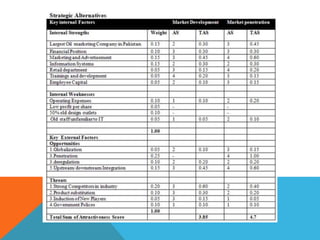
  • #13 Market penetration is a measure of how much a product or service is being used by customers compared to the total estimated market for that product or service. Attractiveness Scores (AS) in the QSPM indicate how each factor is important or attractive to each alternative strategy. Attractiveness Scores are determined by examining each key external and internal factor separately, one at a time.
  • #23 Cost focus is a low-cost competitive strategy that focuses on a particular buyer group or geographic market and attempts to serve only this niche, to the exclusion of others. In using cost focus, the company or business unit seeks a cost advantage in its target segment. Differentiation focus, like cost focus, concentrates on a particular buyer group, product line segment, or geographic market. In using differentiation focus, a company or business unit seeks differentiation in a targeted market segment.
  • #33 Frontal assault: diet Pepsi vs diet coke, telco, mobile phone industry Flanking maneuver: food panda, cheetay, jovi,
  • #34 Bypass attack: airpods, KnNs Encirclement: softwares/apps, easypaisa Guerrilla warfare:
  • #39 Faysal bank and FWBL Meezan with PICIC Sino-Pak NBP and Telenor microfinance Apple pay and mastercard IBM and Dell HP and intel