By Shea McInerney for EDU 533 at Gordon College
A Review of StoryTown
A Core Reading Program 
from Harcourt School Publishers
Description of StoryTownA core reading program for K-6 classrooms
Differentiated instruction and resource kits for
Challenge, Tier 2, and ELL
Intervention Station for Tier 3
Features theme organization
Respected authors: Isabel Beck and Roger Farr
Published by Harcourt in 2008
Instructional DesignAddresses the 5 essential elements of reading: phonemic
awareness, phonics, fluency, “robust vocabulary”, &
comprehension
Whole-group & small-group instruction, individual
conferences, & literacy centers
Divided by grade level (aimed at Tier 1) with differentiation
for students above or below level
2 + 2, Then Review
Ongoing assessments: lesson & theme tests, & benchmarks
Scope & Sequence
Explicit, systematic phonemic awareness & phonics
instruction K-2 with some phonics lessons in the
upper grades
“Spiraling” instruction & practice in skills &
strategies related to the 5 elements of reading
From pre-decodables, read-alouds, & decodables to
leveled readers, trade books, & content-area reading
Reading-writing connection with mentor texts,
instruction in the writing process & the 6 traits
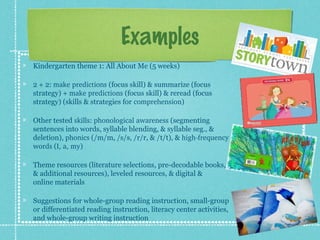
Examples
Kindergarten theme 1: All About Me (5 weeks)
2 + 2: make predictions (focus skill) & summarize (focus
strategy) + make predictions (focus skill) & reread (focus
strategy) (skills & strategies for comprehension)
Other tested skills: phonological awareness (segmenting
sentences into words, syllable blending, & syllable seg., &
deletion), phonics (/m/m, /s/s, /r/r, & /t/t), & high­frequency 
words (I, a, my)
Theme resources (literature selections, pre-decodable books,
& additional resources), leveled resources, & digital &
online materials
Suggestions for whole-group reading instruction, small-group
or differentiated reading instruction, literacy center activities,
and whole-group writing instruction
Research & Evaluation
Intervention Station “significantly increases the
reading skills and strategy use of lower achieving
readers” (ERIA, 2008)
“Robust vocabulary” selections & activities assessed for
fidelity to research by StoryTown authors Isabel Beck
and Margaret McKeown
Criticized for its reliance on large-group instruction for
phonemic awareness (the NRP found that small-group
instruction is more effective) and failure to incorporate
feedback on mouth movements (Dewitz, 2010)
References
Beck, I., Farr, R., & Strickland, D. (2008). StoryTown. Harcourt
School Publishers.
Dewitz, P. (2010). The Essential Guide to Selecting and Using Core 
Reading Programs. International Reading Association.
Beck, M., Cruse, K., & Fernandez, J. (2008). A control/experimental 
group study of the instructional effectiveness of harcourt storytown: 
intervention station program. Educational Research Institute of
America
Updegraff, N. (2008). Resource Notebook for Administrators and 
Coaches. Harcourt.
http://www.harcourtschool.com/storytown/storysampler/
index.html (2013).

Story town review

  • 1.
    By Shea McInerneyfor EDU 533 at Gordon College A Review of StoryTown A Core Reading Program  from Harcourt School Publishers
  • 2.
    Description of StoryTownAcore reading program for K-6 classrooms Differentiated instruction and resource kits for Challenge, Tier 2, and ELL Intervention Station for Tier 3 Features theme organization Respected authors: Isabel Beck and Roger Farr Published by Harcourt in 2008
  • 3.
    Instructional DesignAddresses the5 essential elements of reading: phonemic awareness, phonics, fluency, “robust vocabulary”, & comprehension Whole-group & small-group instruction, individual conferences, & literacy centers Divided by grade level (aimed at Tier 1) with differentiation for students above or below level 2 + 2, Then Review Ongoing assessments: lesson & theme tests, & benchmarks
  • 4.
    Scope & Sequence Explicit,systematic phonemic awareness & phonics instruction K-2 with some phonics lessons in the upper grades “Spiraling” instruction & practice in skills & strategies related to the 5 elements of reading From pre-decodables, read-alouds, & decodables to leveled readers, trade books, & content-area reading Reading-writing connection with mentor texts, instruction in the writing process & the 6 traits
  • 5.
    Examples Kindergarten theme 1:All About Me (5 weeks) 2 + 2: make predictions (focus skill) & summarize (focus strategy) + make predictions (focus skill) & reread (focus strategy) (skills & strategies for comprehension) Other tested skills: phonological awareness (segmenting sentences into words, syllable blending, & syllable seg., & deletion), phonics (/m/m, /s/s, /r/r, & /t/t), & high­frequency  words (I, a, my) Theme resources (literature selections, pre-decodable books, & additional resources), leveled resources, & digital & online materials Suggestions for whole-group reading instruction, small-group or differentiated reading instruction, literacy center activities, and whole-group writing instruction
  • 6.
    Research & Evaluation InterventionStation “significantly increases the reading skills and strategy use of lower achieving readers” (ERIA, 2008) “Robust vocabulary” selections & activities assessed for fidelity to research by StoryTown authors Isabel Beck and Margaret McKeown Criticized for its reliance on large-group instruction for phonemic awareness (the NRP found that small-group instruction is more effective) and failure to incorporate feedback on mouth movements (Dewitz, 2010)
  • 7.
    References Beck, I., Farr,R., & Strickland, D. (2008). StoryTown. Harcourt School Publishers. Dewitz, P. (2010). The Essential Guide to Selecting and Using Core  Reading Programs. International Reading Association. Beck, M., Cruse, K., & Fernandez, J. (2008). A control/experimental  group study of the instructional effectiveness of harcourt storytown:  intervention station program. Educational Research Institute of America Updegraff, N. (2008). Resource Notebook for Administrators and  Coaches. Harcourt. http://www.harcourtschool.com/storytown/storysampler/ index.html (2013).

Editor's Notes

  • #3 •  Roger C. Farr, a professor at Indiana University, is in the International Reading Associaton's Reading Hall of Fame :) •  Harcourt is a signature of Houghton Mifflin Publishers
  • #4 •  2 + 2, Then Review: Each 5 week theme includes 2 weeks of instruction on 1 key reading skill and 1 key reading strategy (that's 1 lesson, the program adds 2 weeks so 1 more skill and 1 more strategy!) plus a week of review of the skills and strategies with readers' theater, bridges to content area reading, and a test of skills practiced during the theme
  • #5 •  "spiraling" instruction & practice means that the 5 elements of reading are addressed at each grade level so that all pertinent elements are developed thoroughout the program
  • #7 •  The Educational Research Institute of America study was commissioned by Harcourt •  "Robust vocabulary" instruction in StoryTown features "student-friendly" explanations of vocabularly words •  From Peter Dewitz's 2010 book The Essential Guide to Selecting and Using Core Reading Programs. Positives: lessons & activities appropraite & engaging, concrete materials useful