JEN MCCARTY, ED.D.  READING SPECIALIST INDEPENDENT LITERACY CONSULTANT ROSEMOUNT, MN Supporting Adolescent Readers
Learning Targets I can recognize the need for literacy embedded into content area instruction. I can see the need for students to be better prepared with literacy skills for our ever changing workforce. I can participate in a Scaffolded Reading Experience. I can conceptualize how to support students in my class in getting into, through, and beyond the text.
Literacy Stampede WE ALL ARE STRIVING READERS AT SOME POINT!
Stampede Quiz  a.) Lie down, curl up, cover your head with your arms. b.) Run directly at the bulls, scream wildly, flail your arms in an attempt to scare them in another direction. c.) Turn and run like heck in the same direction the bulls are running (even though you know you can’t out run them) d.) Stand completely still; they will see you and run around you. e.) Scream bad words at your parents for insisting on a back to nature vacation in Wyoming.
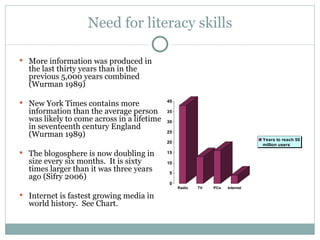
Need for literacy skills More information was produced in the last thirty years than in the previous 5,000 years combined (Wurman 1989) New York Times contains more information than the average person was likely to come across in a lifetime in seventeenth century England (Wurman 1989) The blogosphere is now doubling in size every six months.  It is sixty times larger than it was three years ago (Sifry 2006) Internet is fastest growing media in world history.  See Chart.
Need continued. . . Getting into college is more competitive than ever.  UCLA turned down over 7,000 students with a 4.0 GPA or higher in 2005 (College Board, 2006) Job market is changing 80% of companies in service, finance, insurance and real estate—corporations with greatest employment growth potential—assess writing during hiring. Unskilled jobs are disappearing Technology replacing menial jobs Outsourcing (National Commission on Writing 2004)
Literacy Stampede Quiz a.) Go home, curl up on the sofa, watch a lot of reality TV, and hope the demands go away. b.) Stare the Information Age in the face, screaming wildly and flailing your arms in an attempt to make it go away. c.) Elevate your reading and writing abilities to the point where you can run with the literacy stampede. d.)  Stand completely still. Pray that the Information Age will avoid you. e.)  Scream bad words at your parents for conceiving you in the shadow of a literacy stampede.
Reflection Part One How do you feel about your students’ futures and the literacy skills they currently possess?  Is it enough? t How will you approach your instruction in order to foster growth in your students’ reading, writing, speaking, and thinking skills?
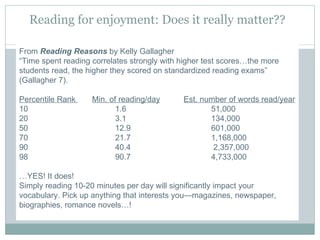
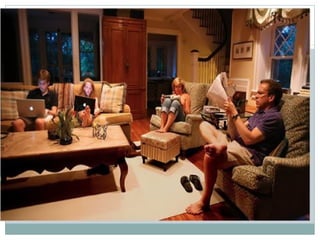
Reading for enjoyment: Does it really matter??   From  Reading Reasons  by Kelly Gallagher “ Time spent reading correlates strongly with higher test scores…the more students read, the higher they scored on standardized reading exams” (Gallagher 7).   Percentile Rank    Min. of reading/day   Est. number of words read/year 10 1.6 51,000 20 3.1 134,000 50 12.9 601,000 70 21.7 1,168,000 90 40.4  2,357,000 98 90.7 4,733,000   … YES! It does! Simply reading 10-20 minutes per day will significantly impact your vocabulary. Pick up anything that interests you—magazines, newspaper, biographies, romance novels…!
“ Kids need to read a lot if they are to become good readers.  Reading and writing [should] be integrated across all subject areas . . . . [A] plan should encompass grades K-12, not just the elementary grades.” Richard Allington McCarty Plucker, 2010
“ . . . Research has well demonstrated the need for students to have instructional texts that they can read accurately, fluently, and with good comprehension if we hope to foster academic achievement.” Richard Allington McCarty Plucker, 2010
Successful Content Area Reading— What is read Kids still use textbook as basic source of information but also venture far beyond it. Subject matter includes authentic, interesting, and current issues relevant for young people. Instead of relying upon a single authority, students consult a variety of sources and voices. Students sample a wide variety of genres. Reading selections have a range of lengths. Subjects Matter , p. 15 McCarty Plucker, 2010
Successful Content Area Reading— How it is read Purpose for reading is to gather information, construct meaning and apply knowledge (not to pass a test or complete a study guide). Teacher selects some, but not all, of the readings. Not every student reads the same texts—some common readings but also jigsaw and leveled texts. Teachers teach (and kids use) a repertoire of thinking strategies. Reading is seen as social, rather than solitary—partner, inquiry groups, teams, etc. Assessment of kids’ reading relies less on quizzes and worksheets and more on complex products. Subjects Matter , p. 16 McCarty Plucker, 2010
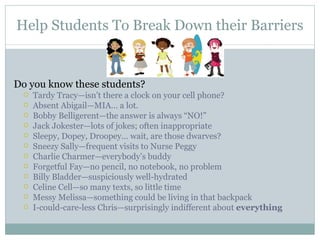
Help Students To Break Down their Barriers Do you know these students? Tardy Tracy—isn’t there a clock on your cell phone? Absent Abigail—MIA… a lot.  Bobby Belligerent—the answer is always “NO!” Jack Jokester—lots of jokes; often inappropriate Sleepy, Dopey, Droopey… wait, are those dwarves? Sneezy Sally—frequent visits to Nurse Peggy Charlie Charmer—everybody’s buddy Forgetful Fay—no pencil, no notebook, no problem Billy Bladder—suspiciously well-hydrated Celine Cell—so many texts, so little time Messy Melissa—something could be living in that backpack I-could-care-less Chris—surprisingly indifferent about  everything
Comprehension Continuum Pre-Reading:  Giving students an “in” to the text
 
“ In” to the text  a.k.a  Pre-Reading Activities Pre-teach vocabulary Picture Reading with a Question in Mind Video w/ Metacognition Notes Anticipation Guide Vary Text Options McCarty Plucker, 2011 Students Shouldn’t Read Anything Cold
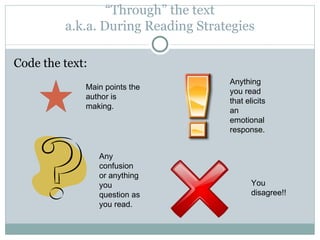
Code the text: “ Through” the text a.k.a. During Reading Strategies Main points the author is making. Any confusion or anything you question as you read. Anything you read that elicits an emotional response. You disagree!!
“ Through” the text a.k.a. During Reading Strategies Reading with a pen in hand Cornell Note taking Interactive Study Guide (whisper in their ear) Two Column notes/Critical Thinking/Metacognition notes Comprehension Continuum McCarty Plucker, 2011
Comprehension Continuum again! REWARD your READERS!!  Allow them to show what they know in a format in which they can be confident. “ Beyond” the text a.k.a. After Reading Strategies
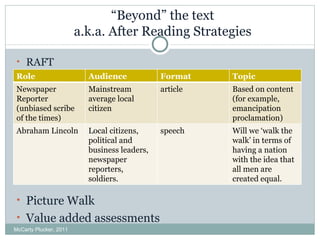
“ Beyond” the text a.k.a. After Reading Strategies RAFT  Picture Walk Value added assessments McCarty Plucker, 2011 Role Audience Format  Topic Newspaper Reporter (unbiased scribe of the times) Mainstream average local citizen  article Based on content (for example, emancipation proclamation) Abraham Lincoln Local citizens, political and business leaders, newspaper reporters, soldiers. speech Will we ‘walk the walk’ in terms of having a nation with the idea that all men are created equal.
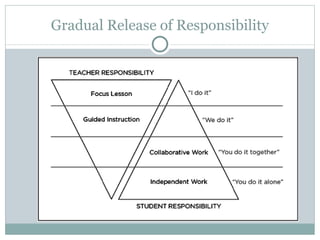
Gradual Release of Responsibility
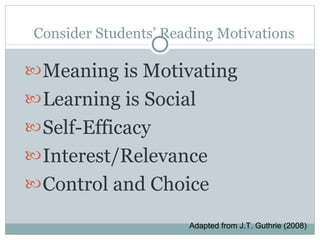
Consider Students’ Reading Motivations Meaning is Motivating Learning is Social Self-Efficacy Interest/Relevance  Control and Choice Adapted from J.T. Guthrie (2008)

SRE Osseo

  • 1.
    JEN MCCARTY, ED.D. READING SPECIALIST INDEPENDENT LITERACY CONSULTANT ROSEMOUNT, MN Supporting Adolescent Readers
  • 2.
    Learning Targets Ican recognize the need for literacy embedded into content area instruction. I can see the need for students to be better prepared with literacy skills for our ever changing workforce. I can participate in a Scaffolded Reading Experience. I can conceptualize how to support students in my class in getting into, through, and beyond the text.
  • 3.
    Literacy Stampede WEALL ARE STRIVING READERS AT SOME POINT!
  • 4.
    Stampede Quiz a.) Lie down, curl up, cover your head with your arms. b.) Run directly at the bulls, scream wildly, flail your arms in an attempt to scare them in another direction. c.) Turn and run like heck in the same direction the bulls are running (even though you know you can’t out run them) d.) Stand completely still; they will see you and run around you. e.) Scream bad words at your parents for insisting on a back to nature vacation in Wyoming.
  • 5.
    Need for literacyskills More information was produced in the last thirty years than in the previous 5,000 years combined (Wurman 1989) New York Times contains more information than the average person was likely to come across in a lifetime in seventeenth century England (Wurman 1989) The blogosphere is now doubling in size every six months. It is sixty times larger than it was three years ago (Sifry 2006) Internet is fastest growing media in world history. See Chart.
  • 6.
    Need continued. .. Getting into college is more competitive than ever. UCLA turned down over 7,000 students with a 4.0 GPA or higher in 2005 (College Board, 2006) Job market is changing 80% of companies in service, finance, insurance and real estate—corporations with greatest employment growth potential—assess writing during hiring. Unskilled jobs are disappearing Technology replacing menial jobs Outsourcing (National Commission on Writing 2004)
  • 7.
    Literacy Stampede Quiza.) Go home, curl up on the sofa, watch a lot of reality TV, and hope the demands go away. b.) Stare the Information Age in the face, screaming wildly and flailing your arms in an attempt to make it go away. c.) Elevate your reading and writing abilities to the point where you can run with the literacy stampede. d.) Stand completely still. Pray that the Information Age will avoid you. e.) Scream bad words at your parents for conceiving you in the shadow of a literacy stampede.
  • 8.
    Reflection Part OneHow do you feel about your students’ futures and the literacy skills they currently possess? Is it enough? t How will you approach your instruction in order to foster growth in your students’ reading, writing, speaking, and thinking skills?
  • 9.
    Reading for enjoyment:Does it really matter??   From Reading Reasons by Kelly Gallagher “ Time spent reading correlates strongly with higher test scores…the more students read, the higher they scored on standardized reading exams” (Gallagher 7).   Percentile Rank Min. of reading/day Est. number of words read/year 10 1.6 51,000 20 3.1 134,000 50 12.9 601,000 70 21.7 1,168,000 90 40.4 2,357,000 98 90.7 4,733,000   … YES! It does! Simply reading 10-20 minutes per day will significantly impact your vocabulary. Pick up anything that interests you—magazines, newspaper, biographies, romance novels…!
  • 10.
    “ Kids needto read a lot if they are to become good readers. Reading and writing [should] be integrated across all subject areas . . . . [A] plan should encompass grades K-12, not just the elementary grades.” Richard Allington McCarty Plucker, 2010
  • 11.
    “ . .. Research has well demonstrated the need for students to have instructional texts that they can read accurately, fluently, and with good comprehension if we hope to foster academic achievement.” Richard Allington McCarty Plucker, 2010
  • 12.
    Successful Content AreaReading— What is read Kids still use textbook as basic source of information but also venture far beyond it. Subject matter includes authentic, interesting, and current issues relevant for young people. Instead of relying upon a single authority, students consult a variety of sources and voices. Students sample a wide variety of genres. Reading selections have a range of lengths. Subjects Matter , p. 15 McCarty Plucker, 2010
  • 13.
    Successful Content AreaReading— How it is read Purpose for reading is to gather information, construct meaning and apply knowledge (not to pass a test or complete a study guide). Teacher selects some, but not all, of the readings. Not every student reads the same texts—some common readings but also jigsaw and leveled texts. Teachers teach (and kids use) a repertoire of thinking strategies. Reading is seen as social, rather than solitary—partner, inquiry groups, teams, etc. Assessment of kids’ reading relies less on quizzes and worksheets and more on complex products. Subjects Matter , p. 16 McCarty Plucker, 2010
  • 14.
    Help Students ToBreak Down their Barriers Do you know these students? Tardy Tracy—isn’t there a clock on your cell phone? Absent Abigail—MIA… a lot. Bobby Belligerent—the answer is always “NO!” Jack Jokester—lots of jokes; often inappropriate Sleepy, Dopey, Droopey… wait, are those dwarves? Sneezy Sally—frequent visits to Nurse Peggy Charlie Charmer—everybody’s buddy Forgetful Fay—no pencil, no notebook, no problem Billy Bladder—suspiciously well-hydrated Celine Cell—so many texts, so little time Messy Melissa—something could be living in that backpack I-could-care-less Chris—surprisingly indifferent about everything
  • 15.
    Comprehension Continuum Pre-Reading: Giving students an “in” to the text
  • 16.
  • 17.
    “ In” tothe text a.k.a Pre-Reading Activities Pre-teach vocabulary Picture Reading with a Question in Mind Video w/ Metacognition Notes Anticipation Guide Vary Text Options McCarty Plucker, 2011 Students Shouldn’t Read Anything Cold
  • 18.
    Code the text:“ Through” the text a.k.a. During Reading Strategies Main points the author is making. Any confusion or anything you question as you read. Anything you read that elicits an emotional response. You disagree!!
  • 19.
    “ Through” thetext a.k.a. During Reading Strategies Reading with a pen in hand Cornell Note taking Interactive Study Guide (whisper in their ear) Two Column notes/Critical Thinking/Metacognition notes Comprehension Continuum McCarty Plucker, 2011
  • 20.
    Comprehension Continuum again!REWARD your READERS!! Allow them to show what they know in a format in which they can be confident. “ Beyond” the text a.k.a. After Reading Strategies
  • 21.
    “ Beyond” thetext a.k.a. After Reading Strategies RAFT Picture Walk Value added assessments McCarty Plucker, 2011 Role Audience Format Topic Newspaper Reporter (unbiased scribe of the times) Mainstream average local citizen article Based on content (for example, emancipation proclamation) Abraham Lincoln Local citizens, political and business leaders, newspaper reporters, soldiers. speech Will we ‘walk the walk’ in terms of having a nation with the idea that all men are created equal.
  • 22.
    Gradual Release ofResponsibility
  • 23.
    Consider Students’ ReadingMotivations Meaning is Motivating Learning is Social Self-Efficacy Interest/Relevance Control and Choice Adapted from J.T. Guthrie (2008)

Editor's Notes

  • #12 You can’t learn from books you can’t read. science is one content area with particularly intense literacy expectations. “The sheer number of science concepts included in science texts almost precludes anything but listlike study of vocabulary that can only be cursorily explained in the space allowed. Often the vocabulary in a 1-week science unit is greater than that of a similar unit in a foreign language” (Elyon & Linn, 1988, as cited in Grossen, Ramance, & Vitale, p. 444).
  • #24 Introduce handouts (remind them objectives are there and then there are reflection/note taking boxes for each of these motivations) Jess