READING[module 5]
IntroductionDr. Janet Swaffar, Katherine Arens
Dr. Swaffar’s introductionTexts can provide optimal material for second/foreign language learningFour lessons:	ConsiderationsPrereading Structured reading activities and follow-upChallenges posed by holistic approach
Lesson 1:What is reading?
Definitions of readingReading is a process undertaken to reduce uncertainty about meanings a text conveys.The process results from a negotiation of meaning between the text and its reader.The knowledge, expectations, and strategies a reader uses to uncover textual meaning all play decisive roles way the reader negotiates with the text's meaning.Reading does not draw on one kind of cognitive skill, nor does it have a straightforward goal or outcome—most texts are understood in different ways by different readers.
Holistic approaches to readingHolistic approaches to education are concerned with connections in human experience.A holisitic curriculum then emphasizes how the parts relate to the whole.Reading, in turn, relates to speaking, writing, listening, comprehension, culture…
	  Discuss!Discuss the three stages of reading mentioned in the module and how they relate to each other:PREREADING :: READING :: REREADINGHow do these stages relate to a holistic approach to reading?
[Bloom’s taxonomy]
Lesson 2:From pre-reading to initial reading
Reading as a ProcessStudents believe they need to know/understand every word in a text before they can read proficiently.But only about 50% of what we understand when we read comes from the actual language (vocabulary and grammar) of that specific text. Where does the other 50% come from?
Pre-readingProcess of “discovery”.Prepare learners to engage with form and content of text.Identify possible sources of confusion.Student centered.BrainstormingSkimmingOther?
Initial readingIf pre-reading stressed the global issues, reading addes details, asks learners to engage in deciphering meaning.Use of genre to structure reading process.Instructor follows up initial reading with discussion of textual details, comparisons, justifications, etc.
Guided matrixSelect text that helps readers reconstruct logic of text.Requires precise cognitive and linguistic workHelps establish a correlation between horizon of expectation and semantic and syntactic elements of text.Encourages rereading, reinforcing language and content.Sample guided matrix
	  Discuss!To what extent have you utilized student-centered pre-reading strategies in your class? Were the effective? Explain.Have you ever used a guided matrix to help learners approach TL texts? Do you plan to?
Lesson 3:Re-reading
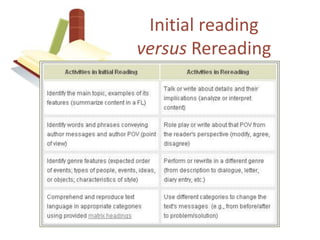
Importance of rereadingOngoing and repeated encounteres with a textSegments are revisited, rethoughtAllows learners to rethink messages, see features they had not noticed initiallyIncreases comprehension – not just of content but of style, language, genre, etc.
Initial reading versus Rereading
Rereading strategiesStrategies need to be taught.Models should be given.Repeated engagement with text.Can activate different learning goals.
	  Discuss!Discuss these reading activities. Are they effective means of achieving their goals? Are there more effective ways? What other goals and activities might you add to a reading task?
Lesson 4:Challenges of the holistic approach
ChallengesToo easy to trigger the use of the L1.Requires too much time.Too difficult to assess.
	  Discuss!In three small groups, each group will discuss one of the challenges mentioned above. For your topic, explain the concerns and why or why not they are valid for FL teachers. Finally, discuss how to address or handle these issues in class.Use of L1  |Time constraints  |Assessment
For next weekRead/Prepare Vocabulary module

Reading

  • 1.
  • 2.
  • 3.
    Dr. Swaffar’s introductionTextscan provide optimal material for second/foreign language learningFour lessons: ConsiderationsPrereading Structured reading activities and follow-upChallenges posed by holistic approach
  • 4.
  • 5.
    Definitions of readingReadingis a process undertaken to reduce uncertainty about meanings a text conveys.The process results from a negotiation of meaning between the text and its reader.The knowledge, expectations, and strategies a reader uses to uncover textual meaning all play decisive roles way the reader negotiates with the text's meaning.Reading does not draw on one kind of cognitive skill, nor does it have a straightforward goal or outcome—most texts are understood in different ways by different readers.
  • 6.
    Holistic approaches toreadingHolistic approaches to education are concerned with connections in human experience.A holisitic curriculum then emphasizes how the parts relate to the whole.Reading, in turn, relates to speaking, writing, listening, comprehension, culture…
  • 7.
    Discuss!Discussthe three stages of reading mentioned in the module and how they relate to each other:PREREADING :: READING :: REREADINGHow do these stages relate to a holistic approach to reading?
  • 8.
  • 9.
    Lesson 2:From pre-readingto initial reading
  • 10.
    Reading as aProcessStudents believe they need to know/understand every word in a text before they can read proficiently.But only about 50% of what we understand when we read comes from the actual language (vocabulary and grammar) of that specific text. Where does the other 50% come from?
  • 11.
    Pre-readingProcess of “discovery”.Preparelearners to engage with form and content of text.Identify possible sources of confusion.Student centered.BrainstormingSkimmingOther?
  • 12.
    Initial readingIf pre-readingstressed the global issues, reading addes details, asks learners to engage in deciphering meaning.Use of genre to structure reading process.Instructor follows up initial reading with discussion of textual details, comparisons, justifications, etc.
  • 13.
    Guided matrixSelect textthat helps readers reconstruct logic of text.Requires precise cognitive and linguistic workHelps establish a correlation between horizon of expectation and semantic and syntactic elements of text.Encourages rereading, reinforcing language and content.Sample guided matrix
  • 14.
    Discuss!Towhat extent have you utilized student-centered pre-reading strategies in your class? Were the effective? Explain.Have you ever used a guided matrix to help learners approach TL texts? Do you plan to?
  • 15.
  • 16.
    Importance of rereadingOngoingand repeated encounteres with a textSegments are revisited, rethoughtAllows learners to rethink messages, see features they had not noticed initiallyIncreases comprehension – not just of content but of style, language, genre, etc.
  • 17.
  • 18.
    Rereading strategiesStrategies needto be taught.Models should be given.Repeated engagement with text.Can activate different learning goals.
  • 19.
    Discuss!Discussthese reading activities. Are they effective means of achieving their goals? Are there more effective ways? What other goals and activities might you add to a reading task?
  • 20.
    Lesson 4:Challenges ofthe holistic approach
  • 21.
    ChallengesToo easy totrigger the use of the L1.Requires too much time.Too difficult to assess.
  • 22.
    Discuss!Inthree small groups, each group will discuss one of the challenges mentioned above. For your topic, explain the concerns and why or why not they are valid for FL teachers. Finally, discuss how to address or handle these issues in class.Use of L1 |Time constraints |Assessment
  • 23.
    For next weekRead/PrepareVocabulary module

Editor's Notes

  • #4 Instructional goals for reading:ULTIMATE GOAL: DISCOVERY OF NEW KNOWLEDGEaugmenting textbook readings with authentic materials,introducing new readings with interactivity to motivate and ease the comprehension process,providing activities to help students identify, to reproduce, or to interpret a text's information and messages,teaching strategies for comprehending authentic texts without reliance on a dictionary,comparing L1 and FL texts to uncover similarities and differences in approach and point of view,and recognizing that testing must reflect the teacher's learning goals and the activities practiced to achieve them.
  • #8 A curriculum built around these stages is considered holistic if they involve practice that integrates various kinds of language acquisition and fills multiple cognitive demands in interlocking activities that spiral learning. For example, a pre-reading for sub-topics of a subject, an initial reading to identify how topics are described, and a rereading to modify those descriptions by inserting them into a new genre or describing them for a different audience.
  • #9 A curriculum built around these stages is considered holistic if they involve practice that integrates various kinds of language acquisition and fills multiple cognitive demands in interlocking activities that spiral learning. For example, a pre-reading for sub-topics of a subject, an initial reading to identify how topics are described, and a rereading to modify those descriptions by inserting them into a new genre or describing them for a different audience.
  • #11 background knowledge about the topic or the medium (e.g. what kind of a hero Batman is, and what an action movie looks like)knowledge of a genre (e.g. what information is in a movie review and what importance is attached to who writes the review and where it's published)strategies for guessing and working with uncertainty ("I don't know this term, but it has been mentioned twice so it's probably important and I'll continue reading to see if I can figure it out.")strategies for identifying cognates and other textual clues (illustrations, subtitles, etc.).
  • #12 Overall, pre-reading helps studentsactivate their horizon of expectation (background knowledge, syntactic and semantic resources, cognitive strategies),take charge of their own learning, andbecome willing to tolerate ambiguity.“I can’t teach you German, but I can help you teach yourselves.”
  • #20 Also be sure to mention the value of writing/ note taking while reading – Good for processing, recall
  • #23 Use of L1: L1 as analyzing, cognitive tool – only if selectively usedTime constraints: tyranny of syllabus, how to fit “reading” in – depends on how to define reading; importance of authentic texts; consider bridges between areas, skillsAssessment: concern for accuracy?; test what you teach HOW you teach it;