Stop Motion Animation:
Another Way to Demonstrate Student Understanding
Stacia McFadden Boatwright
M.S. Director of Academic Technology
The Lovett School, Atlanta, GA
stacia.mcfadden@lovett.org; @slmteched
What is Stop Motion?
• Stop motion (also known as stop frame) is an
animation technique to make a physically
manipulated object appear to move on its own.!
• The object is moved in small increments
between individually photographed frames,
creating the illusion of movement when the
series of frames is played as a continuous
sequence.
Project Ideas for the Classroom
• Anything that goes through a process!
• Mitosis!
• Food Chain!
• Water Cycle!
• Mathematical Concepts!
• Creating Letters!
• Telling Time!
• Counting Money!
• Digital Storytelling!
• More ideas - Claymation and Stop Motion in the Classroom - University of San
Francisco
My FAIL (First Attempt in Learning)
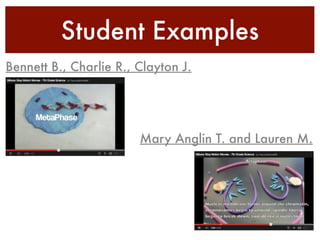
Student Examples
Bennett B., Charlie R., Clayton J.
Mary Anglin T. and Lauren M.
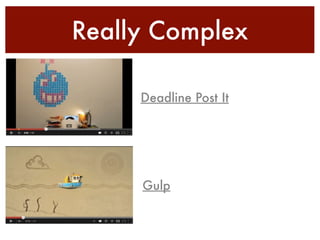
Really Complex
Deadline Post It
Gulp
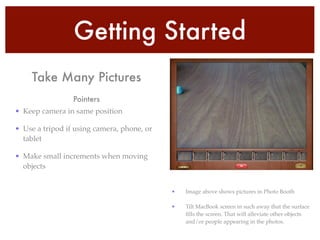
Getting Started
• Keep camera in same position!
• Use a tripod if using camera, phone, or
tablet!
• Make small increments when moving
objects
Pointers
• Image above shows pictures in Photo Booth!
• Tilt MacBook screen in such away that the surface
fills the screen. That will alleviate other objects
and/or people appearing in the photos.
Take Many Pictures
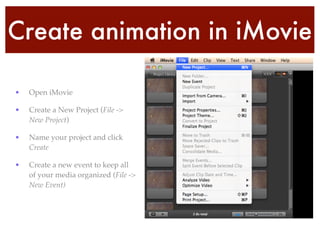
Create animation in iMovie
• Open iMovie!
• Create a New Project (File ->
New Project)!
• Name your project and click
Create!
• Create a new event to keep all
of your media organized (File ->
New Event)
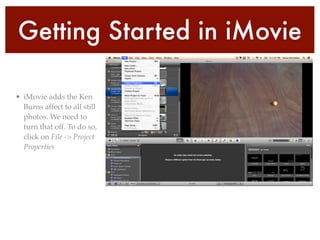
Getting Started in iMovie
• iMovie adds the Ken
Burns affect to all still
photos. We need to
turn that off. To do so,
click on File -> Project
Properties
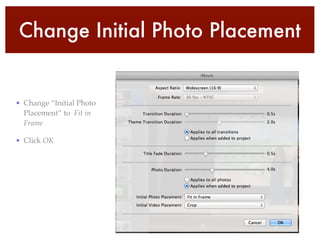
Change Initial Photo Placement
• Change “Initial Photo
Placement” to Fit in
Frame!
• Click OK
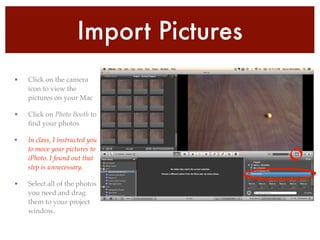
Import Pictures
• Click on the camera
icon to view the
pictures on your Mac!
• Click on Photo Booth to
find your photos !
• In class, I instructed you
to move your pictures to
iPhoto. I found out that
step is unnecessary. !
• Select all of the photos
you need and drag
them to your project
window.
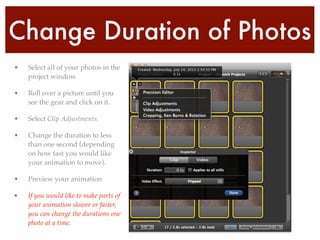
Change Duration of Photos
• Select all of your photos in the
project window.!
• Roll over a picture until you
see the gear and click on it.!
• Select Clip Adjustments.!
• Change the duration to less
than one second (depending
on how fast you would like
your animation to move).!
• Preview your animation!
• If you would like to make parts of
your animation slower or faster,
you can change the durations one
photo at a time.
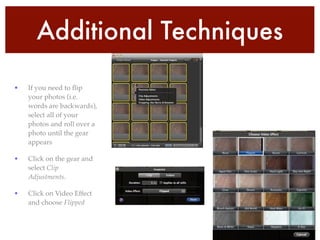
Additional Techniques
• If you need to flip
your photos (i.e.
words are backwards),
select all of your
photos and roll over a
photo until the gear
appears!
• Click on the gear and
select Clip
Adjustments.!
• Click on Video Effect
and choose Flipped
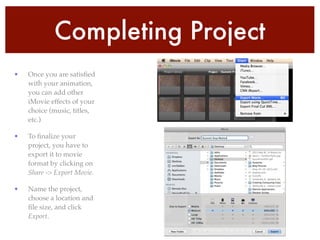
Completing Project
• Once you are satisfied
with your animation,
you can add other
iMovie effects of your
choice (music, titles,
etc.)!
• To finalize your
project, you have to
export it to movie
format by clicking on
Share -> Export Movie. !
• Name the project,
choose a location and
file size, and click
Export.
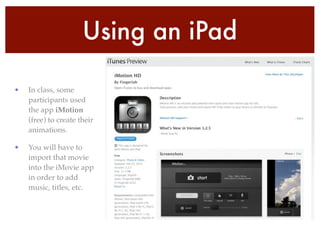
Using an iPad
• In class, some
participants used
the app iMotion
(free) to create their
animations.!
• You will have to
import that movie
into the iMovie app
in order to add
music, titles, etc.
Moving Pictures from Photo Booth to iPhoto
• As I stated on Slide 11, you do not have
to move your pictures from Photo
Booth to iPhoto. But just in case you do
not see Photo Booth from within
iMovie, the following slide shows you
the process.
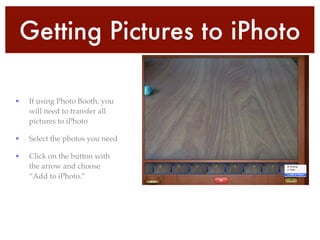
Getting Pictures to iPhoto
• If using Photo Booth, you
will need to transfer all
pictures to iPhoto!
• Select the photos you need!
• Click on the button with
the arrow and choose
“Add to iPhoto.”

Stop motion animation 2014

  • 1.
    Stop Motion Animation: AnotherWay to Demonstrate Student Understanding Stacia McFadden Boatwright M.S. Director of Academic Technology The Lovett School, Atlanta, GA stacia.mcfadden@lovett.org; @slmteched
  • 2.
    What is StopMotion? • Stop motion (also known as stop frame) is an animation technique to make a physically manipulated object appear to move on its own.! • The object is moved in small increments between individually photographed frames, creating the illusion of movement when the series of frames is played as a continuous sequence.
  • 3.
    Project Ideas forthe Classroom • Anything that goes through a process! • Mitosis! • Food Chain! • Water Cycle! • Mathematical Concepts! • Creating Letters! • Telling Time! • Counting Money! • Digital Storytelling! • More ideas - Claymation and Stop Motion in the Classroom - University of San Francisco
  • 4.
    My FAIL (FirstAttempt in Learning)
  • 5.
    Student Examples Bennett B.,Charlie R., Clayton J. Mary Anglin T. and Lauren M.
  • 6.
  • 7.
    Getting Started • Keepcamera in same position! • Use a tripod if using camera, phone, or tablet! • Make small increments when moving objects Pointers • Image above shows pictures in Photo Booth! • Tilt MacBook screen in such away that the surface fills the screen. That will alleviate other objects and/or people appearing in the photos. Take Many Pictures
  • 8.
    Create animation iniMovie • Open iMovie! • Create a New Project (File -> New Project)! • Name your project and click Create! • Create a new event to keep all of your media organized (File -> New Event)
  • 9.
    Getting Started iniMovie • iMovie adds the Ken Burns affect to all still photos. We need to turn that off. To do so, click on File -> Project Properties
  • 10.
    Change Initial PhotoPlacement • Change “Initial Photo Placement” to Fit in Frame! • Click OK
  • 11.
    Import Pictures • Clickon the camera icon to view the pictures on your Mac! • Click on Photo Booth to find your photos ! • In class, I instructed you to move your pictures to iPhoto. I found out that step is unnecessary. ! • Select all of the photos you need and drag them to your project window.
  • 12.
    Change Duration ofPhotos • Select all of your photos in the project window.! • Roll over a picture until you see the gear and click on it.! • Select Clip Adjustments.! • Change the duration to less than one second (depending on how fast you would like your animation to move).! • Preview your animation! • If you would like to make parts of your animation slower or faster, you can change the durations one photo at a time.
  • 13.
    Additional Techniques • Ifyou need to flip your photos (i.e. words are backwards), select all of your photos and roll over a photo until the gear appears! • Click on the gear and select Clip Adjustments.! • Click on Video Effect and choose Flipped
  • 14.
    Completing Project • Onceyou are satisfied with your animation, you can add other iMovie effects of your choice (music, titles, etc.)! • To finalize your project, you have to export it to movie format by clicking on Share -> Export Movie. ! • Name the project, choose a location and file size, and click Export.
  • 15.
    Using an iPad •In class, some participants used the app iMotion (free) to create their animations.! • You will have to import that movie into the iMovie app in order to add music, titles, etc.
  • 16.
    Moving Pictures fromPhoto Booth to iPhoto • As I stated on Slide 11, you do not have to move your pictures from Photo Booth to iPhoto. But just in case you do not see Photo Booth from within iMovie, the following slide shows you the process.
  • 17.
    Getting Pictures toiPhoto • If using Photo Booth, you will need to transfer all pictures to iPhoto! • Select the photos you need! • Click on the button with the arrow and choose “Add to iPhoto.”