STI, HIV AND AIDS
Genelyn A. Diaz
Tañong National High School-SDO Malabon City
WHAT IS STI, HIV AND AIDS?
-Diseases/Infections, Pathogens
and Condition that may occur to
a person who is indulged in the
so called UNPROTECTED SEX.
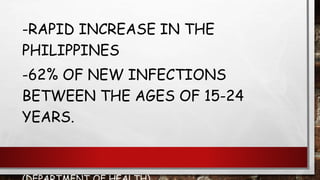
-RAPID INCREASE IN THE
PHILIPPINES
-62% OF NEW INFECTIONS
BETWEEN THE AGES OF 15-24
YEARS.
S
T
I
transmitted
exually
infection
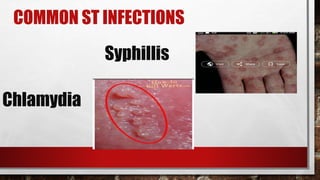
COMMON ST INFECTIONS
Syphillis
Chlamydia
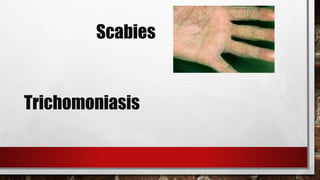
Scabies
Trichomoniasis
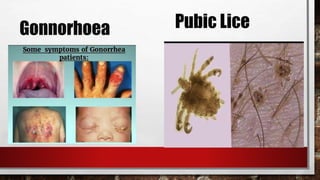
Gonnorhoea Pubic Lice
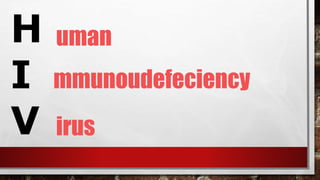
H
I
V
mmunoudefeciency
uman
irus
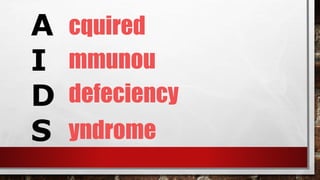
A
I
D
S
mmunou
cquired
defeciency
yndrome
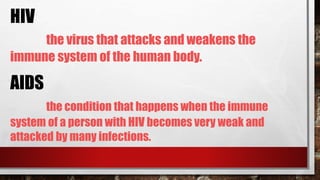
HIV
the virus that attacks and weakens the
immune system of the human body.
AIDS
the condition that happens when the immune
system of a person with HIV becomes very weak and
attacked by many infections.
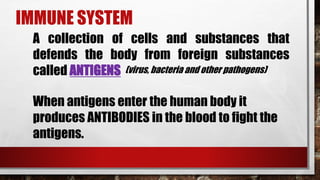
IMMUNE SYSTEM
A collection of cells and substances that
defends the body from foreign substances
called ANTIGENS (virus, bacteria and other pathogens)
When antigens enter the human body it
produces ANTIBODIES in the blood to fight the
antigens.
The immune system can be
compared to an army guarding the
country and protecting it from
foreign invasion.
It (the immune system) is composed of
blood cells called T-lymphocytes and
B-lymphocytes which protects the
body (just like an army).
Among the T-lymphocytes are cells
called CLUSTER OF DIFFERENTIATION
(CD4).
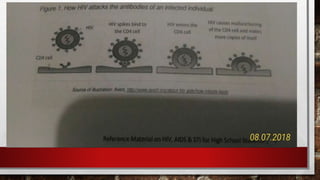
The HIV Virus attacks the CD4 and
weakens the immune system. Once
the HIV enters the cell, it uses this to
produce copies of itself. This process
is called REPLICATION.
-The copies of the virus increases in the
body which cause more CD4 cells to be
destroyed. When this happens, the immune
system can no longer defend the body from
antigens. And this may lead to the condition
called Acquired Immunodefeciency
Syndrome (AIDS).
Note:
-The normal CD4 cell count is >1000 cells/mm3
-Patients with HIV have decreasing CD4 cell
counts (which make the body become weaker
and prone OPPORTUNISTIC INFECTION)
-<200 cells/mm3
the lowest CD4 cell count
ACTING 101
QUESTION
What will happen if CD4 cells is
continuously decreasing?
SYMPTOMS OF HIV
Symptoms often begin to appear in the latter stage of
HIV infection. And these symptoms are not because
of HIV itself but due to certain infections caused by
bacteria and other pathogens.
Initially, there is NO specific symptoms of HIV
infection.
These infections that attack People Living with
HIV are often curable when immediately
treated with proper medications but HIV
infection itself cannot be cured.
Consult a doctor immediately for further
diagnosis if you experience any of these
symptoms.
1. Daily fever of more than 2 weeks/night
sweats
2. Tubercolosis/Pnuemonia
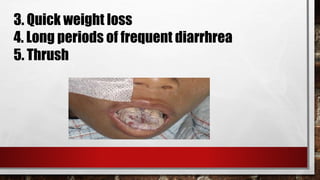
3. Quick weight loss
4. Long periods of frequent diarrhrea
5. Thrush
STAGES OF HIV
Stage 1: When the person is newly infected with HIV, the viral load or the
amount of HIV in the blood is high. At this time, the immune system of a
person is still ok, and the number of CD4 cells is still >1000 cells/mm3
. The
person with HIV has no symptoms and looks seemingly healthy during this
stage but very infectious.
Stage 2: The viral load goes down temporarily. HIV starts weakening the
immune system and the number of CD4 cells starts to decrease. This time,
the person may have occasional rashes, respiratory infections, (cough and
cold) and unexplained mild weight loss,
Stage 3: The viral load increases and continues to weaken the immune
system. The CD4 count is now low and continues to decrease. During this
stage, the person becomes sickly because the body is unable to fight off
infections like diarrhea, tuberculosis, pneumonia, and severe oral
candidiasis. (SINGAW) The person can also have severe weight loss and
prolonged fever.
Stage 4: The viral load is now very high and the number of CD4 cells is now
<200 cells/mm3
. This is the time when a person is said to have AIDS, which is
a constellation of infections due to a very weak immune system. The person
can now have a life-threatening pneumonia, chronic diarrhea, all kinds of
tuberculosis (affecting the bone and the brain), eye infections, a cancer called Kaposi’s
Sarcoma and many more Opportunistic Infections. (this does not lead to death)
TREATMENT FOR HIV
At present, there is NO VACCINE available to
prevent HIV infection. There is also NO CURE
for HIV infection. A person who gets infected
with HIV will have HIV for life. However, there is
a TREATMENT available that slows down the
spread of HIV.
ANTIRETROVIRAL THERAPY (ART)
A kind of medication that uses
ANTIRETROVIRALS (ARV). These medicines are
needed to slow down the replication of the
virus, preventing the CD4 cells to be
destroyed.
Without ARV, a person with HIV may
die of infections within 5 to 10 years.
Taking ARV will prolong the life of a
person with HIV.
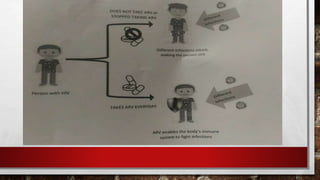
A person with HIV needs to take ARV
daily FOR LIFE.
If he/she stops taking ARV the virus
will again multiply and destroy the
functionality of the immune system.
ENDING THE STORY….
The person living with HIV
must REGULARLY take ARV so
that his/her CD4 cells can
continue fight the HIV.
WRAP UP!
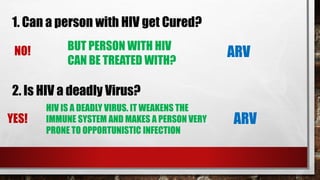
1. Can a person with HIV get Cured?
NO! BUT PERSON WITH HIV
CAN BE TREATED WITH?
ARV
2. Is HIV a deadly Virus?
YES!
HIV IS A DEADLY VIRUS. IT WEAKENS THE
IMMUNE SYSTEM AND MAKES A PERSON VERY
PRONE TO OPPORTUNISTIC INFECTION
ARV
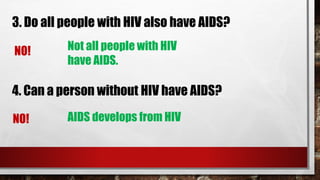
3. Do all people with HIV also have AIDS?
NO! Not all people with HIV
have AIDS.
4. Can a person without HIV have AIDS?
NO! AIDS develops from HIV
5. Of the things you learned today,
what will share with your friends
about HIV and AIDS?
END OF PRESENTATION
Reference: DOH, Handbook

STI, HIV and AIDS

  • 1.
    STI, HIV ANDAIDS Genelyn A. Diaz Tañong National High School-SDO Malabon City
  • 2.
    WHAT IS STI,HIV AND AIDS? -Diseases/Infections, Pathogens and Condition that may occur to a person who is indulged in the so called UNPROTECTED SEX.
  • 3.
    -RAPID INCREASE INTHE PHILIPPINES -62% OF NEW INFECTIONS BETWEEN THE AGES OF 15-24 YEARS.
  • 4.
  • 5.
  • 6.
  • 7.
  • 8.
  • 9.
  • 10.
    HIV the virus thatattacks and weakens the immune system of the human body. AIDS the condition that happens when the immune system of a person with HIV becomes very weak and attacked by many infections.
  • 11.
    IMMUNE SYSTEM A collectionof cells and substances that defends the body from foreign substances called ANTIGENS (virus, bacteria and other pathogens) When antigens enter the human body it produces ANTIBODIES in the blood to fight the antigens.
  • 12.
    The immune systemcan be compared to an army guarding the country and protecting it from foreign invasion.
  • 13.
    It (the immunesystem) is composed of blood cells called T-lymphocytes and B-lymphocytes which protects the body (just like an army). Among the T-lymphocytes are cells called CLUSTER OF DIFFERENTIATION (CD4).
  • 14.
    The HIV Virusattacks the CD4 and weakens the immune system. Once the HIV enters the cell, it uses this to produce copies of itself. This process is called REPLICATION.
  • 15.
    -The copies ofthe virus increases in the body which cause more CD4 cells to be destroyed. When this happens, the immune system can no longer defend the body from antigens. And this may lead to the condition called Acquired Immunodefeciency Syndrome (AIDS).
  • 17.
    Note: -The normal CD4cell count is >1000 cells/mm3 -Patients with HIV have decreasing CD4 cell counts (which make the body become weaker and prone OPPORTUNISTIC INFECTION) -<200 cells/mm3 the lowest CD4 cell count
  • 18.
  • 19.
    QUESTION What will happenif CD4 cells is continuously decreasing?
  • 20.
    SYMPTOMS OF HIV Symptomsoften begin to appear in the latter stage of HIV infection. And these symptoms are not because of HIV itself but due to certain infections caused by bacteria and other pathogens. Initially, there is NO specific symptoms of HIV infection.
  • 21.
    These infections thatattack People Living with HIV are often curable when immediately treated with proper medications but HIV infection itself cannot be cured.
  • 22.
    Consult a doctorimmediately for further diagnosis if you experience any of these symptoms. 1. Daily fever of more than 2 weeks/night sweats 2. Tubercolosis/Pnuemonia
  • 23.
    3. Quick weightloss 4. Long periods of frequent diarrhrea 5. Thrush
  • 24.
    STAGES OF HIV Stage1: When the person is newly infected with HIV, the viral load or the amount of HIV in the blood is high. At this time, the immune system of a person is still ok, and the number of CD4 cells is still >1000 cells/mm3 . The person with HIV has no symptoms and looks seemingly healthy during this stage but very infectious. Stage 2: The viral load goes down temporarily. HIV starts weakening the immune system and the number of CD4 cells starts to decrease. This time, the person may have occasional rashes, respiratory infections, (cough and cold) and unexplained mild weight loss,
  • 25.
    Stage 3: Theviral load increases and continues to weaken the immune system. The CD4 count is now low and continues to decrease. During this stage, the person becomes sickly because the body is unable to fight off infections like diarrhea, tuberculosis, pneumonia, and severe oral candidiasis. (SINGAW) The person can also have severe weight loss and prolonged fever. Stage 4: The viral load is now very high and the number of CD4 cells is now <200 cells/mm3 . This is the time when a person is said to have AIDS, which is a constellation of infections due to a very weak immune system. The person can now have a life-threatening pneumonia, chronic diarrhea, all kinds of tuberculosis (affecting the bone and the brain), eye infections, a cancer called Kaposi’s Sarcoma and many more Opportunistic Infections. (this does not lead to death)
  • 26.
    TREATMENT FOR HIV Atpresent, there is NO VACCINE available to prevent HIV infection. There is also NO CURE for HIV infection. A person who gets infected with HIV will have HIV for life. However, there is a TREATMENT available that slows down the spread of HIV.
  • 27.
    ANTIRETROVIRAL THERAPY (ART) Akind of medication that uses ANTIRETROVIRALS (ARV). These medicines are needed to slow down the replication of the virus, preventing the CD4 cells to be destroyed.
  • 28.
    Without ARV, aperson with HIV may die of infections within 5 to 10 years. Taking ARV will prolong the life of a person with HIV.
  • 29.
    A person withHIV needs to take ARV daily FOR LIFE. If he/she stops taking ARV the virus will again multiply and destroy the functionality of the immune system.
  • 31.
  • 32.
    The person livingwith HIV must REGULARLY take ARV so that his/her CD4 cells can continue fight the HIV.
  • 33.
  • 34.
    1. Can aperson with HIV get Cured? NO! BUT PERSON WITH HIV CAN BE TREATED WITH? ARV 2. Is HIV a deadly Virus? YES! HIV IS A DEADLY VIRUS. IT WEAKENS THE IMMUNE SYSTEM AND MAKES A PERSON VERY PRONE TO OPPORTUNISTIC INFECTION ARV
  • 35.
    3. Do allpeople with HIV also have AIDS? NO! Not all people with HIV have AIDS. 4. Can a person without HIV have AIDS? NO! AIDS develops from HIV
  • 36.
    5. Of thethings you learned today, what will share with your friends about HIV and AIDS?
  • 37.

Editor's Notes

  • #15 What happens during the Replication Process?
  • #22 Question.. Ano ang dapat gawin if you notice a recurring infection?
  • #27 NOTE: CURE IS A PEMANENT SOLUTION.
  • #35 FOLLOW UP QUESTION FOR NUMBER 2: CAN OPPORTUNISTIC INFECTION BE CURED?
  • #36 FOLLOW UP QUESTION FOR NUMBER 2: CAN OPPORTUNISTIC INFECTION BE CURED?