Poland Your name: PUPILS OF IES EDUARD FONTSERÈ Your teacher: Nuria de Salvador Your class: 4ºA
Climate, fauna and flora Dámaris Karen S Marina
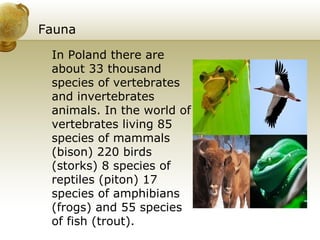
Fauna In Poland there are about 33 thousand species of vertebrates and invertebrates animals. In the world of vertebrates living 85 species of mammals (bison) 220 birds (storks) 8 species of reptiles (piton) 17 species of amphibians (frogs) and 55 species of fish (trout).
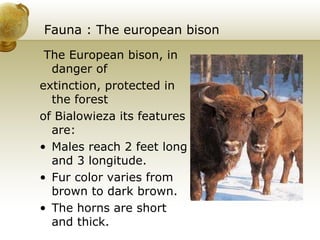
Fauna : The european bison The European bison, in danger of extinction, protected in the forest  of Bialowieza its features are: Males reach 2 feet long and 3 longitude. Fur color varies from brown to dark brown. The horns are short and thick.
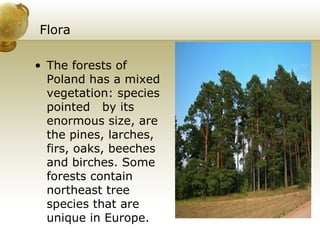
Flora  The forests of Poland has a mixed vegetation: species pointed  by its enormous size, are the pines, larches, firs, oaks, beeches and birches. Some forests contain northeast tree species that are unique in Europe.
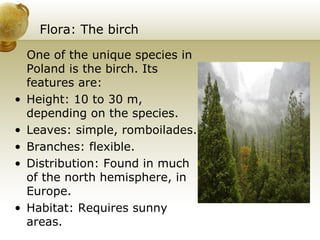
Flora: The birch   One of the unique species in Poland is the birch. Its features are: Height: 10 to 30 m, depending on the species. Leaves: simple, romboilades. Branches: flexible. Distribution: Found in much of the north hemisphere, in Europe. Habitat: Requires sunny areas.
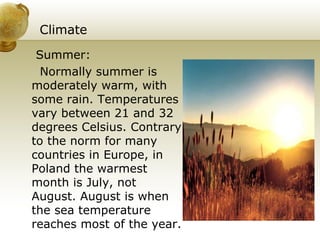
Climate Summer: Normally summer is moderately warm, with some rain. Temperatures vary between 21 and 32 degrees Celsius. Contrary to the norm for many countries in Europe, in Poland the warmest month is July, not August. August is when the sea temperature reaches most of the year.
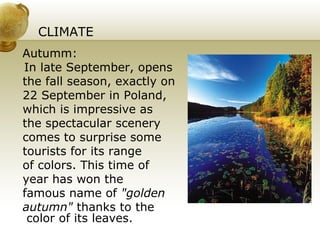
CLIMATE  Autumm: In late September, opens the fall season, exactly on 22 September in Poland, which is impressive as  the spectacular scenery  comes to surprise some tourists for its range  of colors. This time of year has won the famous name of  "golden autumn"  thanks to the color of its leaves.
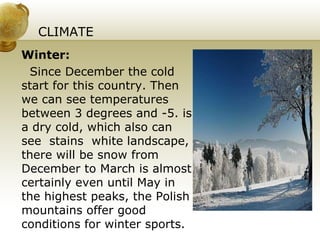
CLIMATE Winter: Since December the cold start for this country. Then we can see temperatures between 3 degrees and -5. is a dry cold, which also can see  stains  white landscape, there will be snow from December to March is almost certainly even until May in the highest peaks, the Polish mountains offer good conditions for winter sports.
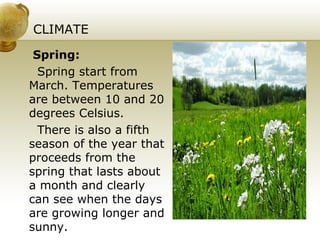
CLIMATE Spring: Spring start from March. Temperatures are between 10 and 20 degrees Celsius. There is also a fifth season of the year that proceeds from the spring that lasts about a month and clearly can see when the days are growing longer and sunny.
Poland’s History Karen L. Kevin Danis
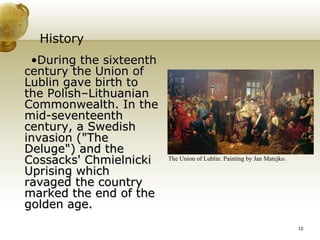
History During the sixteenth century the Union of Lublin gave birth to the Polish–Lithuanian Commonwealth. In the mid-seventeenth century, a Swedish invasion ("The Deluge") and the Cossacks' Chmielnicki Uprising which ravaged the country marked the end of the golden age. The Union of Lublin. Painting by Jan Matejko.
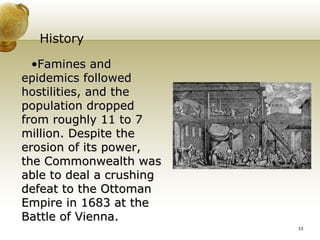
History Famines and epidemics followed hostilities, and the population dropped from roughly 11 to 7 million. Despite the erosion of its power, the Commonwealth was able to deal a crushing defeat to the Ottoman Empire in 1683 at the Battle of Vienna.
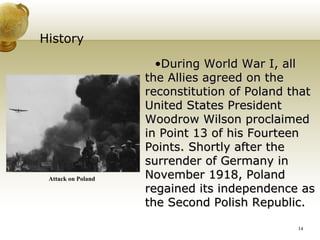
History During World War I, all the Allies agreed on the reconstitution of Poland that United States President Woodrow Wilson proclaimed in Point 13 of his Fourteen Points. Shortly after the surrender of Germany in November 1918, Poland regained its independence as the Second Polish Republic. Attack on Poland
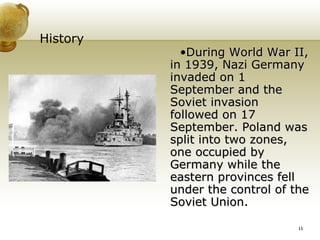
History During World War II, in 1939, Nazi Germany invaded on 1 September and the Soviet invasion followed on 17 September. Poland was split into two zones, one occupied by Germany while the eastern provinces fell under the control of the Soviet Union.
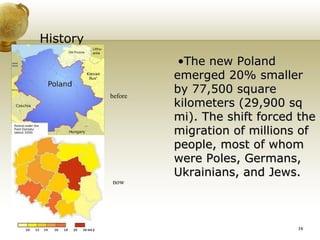
History The new Poland emerged 20% smaller by 77,500 square kilometers (29,900 sq mi). The shift forced the migration of millions of people, most of whom were Poles, Germans, Ukrainians, and Jews. before now
Education Karen L Kevin Danis
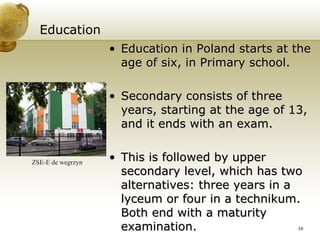
Education Education in Poland starts at the age of six, in Primary school. Secondary consists of three years, starting at the age of 13, and it ends with an exam. This is followed by upper secondary level, which has two alternatives: three years in a lyceum or four in a technikum. Both end with a maturity examination. ZSE-E de wegrzyn
Education The old marking system used up to the early 1990s was: 2 (insufficient) 3 (sufficient) 4 (good) 5 (very good) Getting a 2 meant that the student would have to  repeat  the year (in all subjects).  Grades 3 and higher were passing grades.
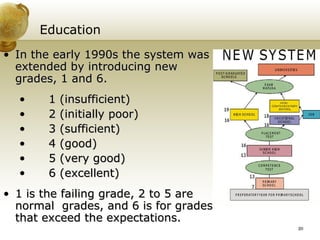
Education In the early 1990s the system was extended by introducing new grades, 1 and 6. 1 (insufficient) 2 (initially poor) 3 (sufficient) 4 (good) 5 (very good) 6 (excellent) 1 is the failing grade, 2 to 5 are normal  grades, and 6 is for grades that exceed the expectations.
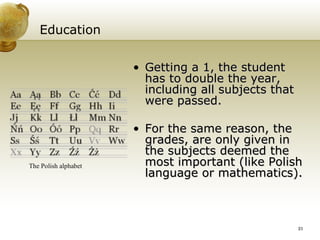
Education Getting a 1, the student has to double the year, including all subjects that were passed. For the same reason, the grades, are only given in the subjects deemed the most important (like Polish language or mathematics). The Polish alphabet
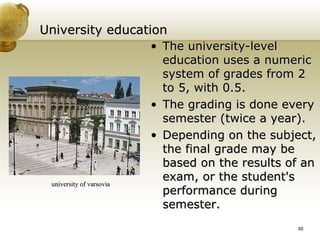
University education The university-level education uses a numeric system of grades from 2 to 5, with 0.5. The grading is done every semester (twice a year).  Depending on the subject, the final grade may be based on the results of an exam, or the student's performance during semester. university of varsovia
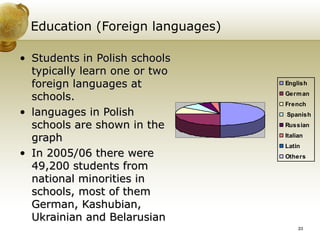
Education ( Foreign languages) Students in Polish schools typically learn one or two foreign languages at schools.  languages in Polish schools are shown in the graph In 2005/06 there were 49,200 students from national minorities in schools, most of them German, Kashubian, Ukrainian and Belarusian
Sports in Poland Dani Javi Joel
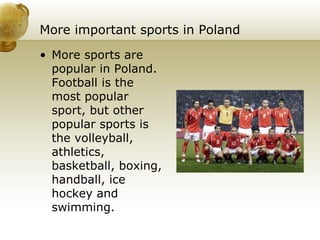
More important sports in Poland More sports are popular in Poland. Football is the most popular sport, but other popular sports is the volleyball, athletics, basketball, boxing, handball, ice hockey and swimming .
Important Sports people in Poland Dani Javi Joel
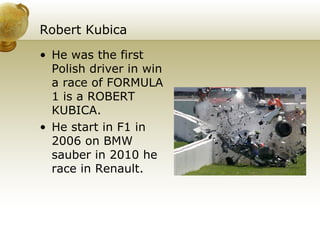
Robert Kubica He was the first Polish driver in win a race of FORMULA 1 is a ROBERT KUBICA. He start in F1 in 2006 on BMW sauber in 2010 he race in Renault.
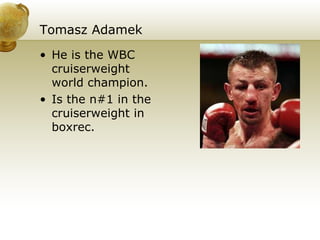
Tomasz Adamek He is the WBC cruiserweight world champion. Is the n#1 in the cruiserweight in boxrec.
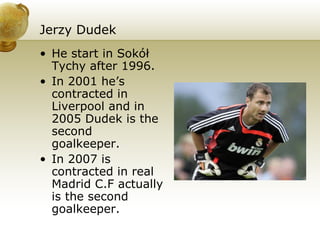
Jerzy Dudek He start in Sokół Tychy after 1996. In 2001 he’s contracted in Liverpool and in 2005 Dudek is the second  goalkeeper. In 2007 is contracted in real Madrid C.F actually is the second goalkeeper.
Important People in Poland Dani Javi Joel
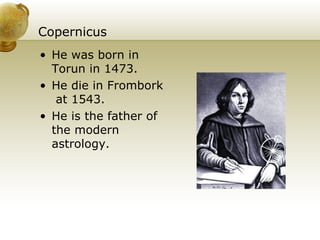
Copernicus He was born in Torun in 1473. He die in  Frombork  at  1543. He is the father of the modern astrology.
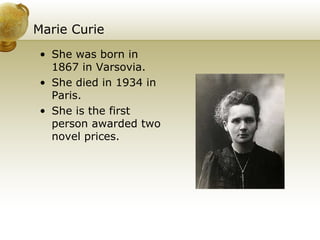
Marie Curie She was born in 1867 in Varsovia. She died in 1934 in Paris. She is the first person awarded two novel prices.
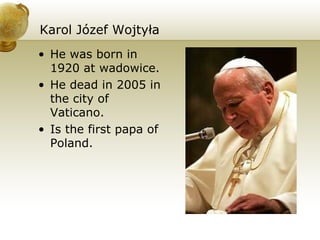
Karol Józef Wojtyła He was born in 1920 at wadowice. He dead in 2005 in the city of Vaticano. Is the first papa of Poland.
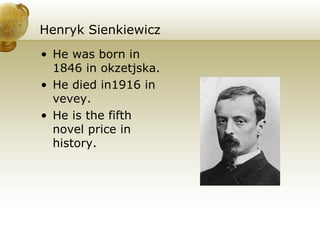
Henryk Sienkiewicz He  was born in 1846 in okzetjska. He died in1916 in vevey. He is the fifth novel price in history.
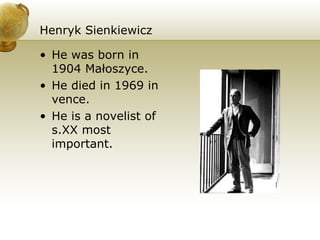
Henryk Sienkiewicz He was born in 1904 Małoszyce. He died in 1969 in vence. He is a novelist of s.XX most important.
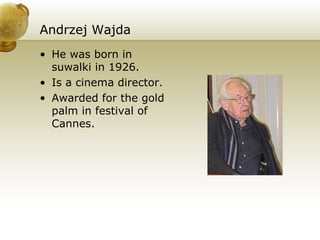
Andrzej Wajda He was born in suwalki in 1926. Is a cinema director. Awarded for the gold palm in festival of Cannes.
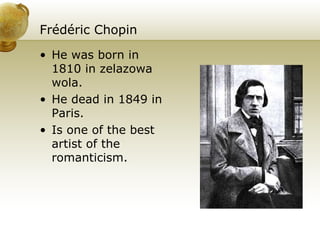
Frédéric Chopin He was born in 1810 in zelazowa wola. He dead in 1849 in Paris. Is one of the best artist of the romanticism.
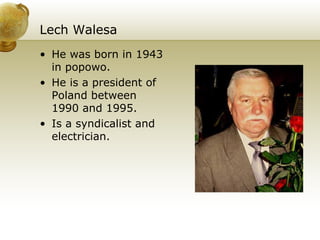
Lech Walesa He was born in 1943 in popowo. He is a president of Poland between 1990 and 1995. Is a syndicalist and electrician.
Celebrations in Poland Bryan Xaverie Sara
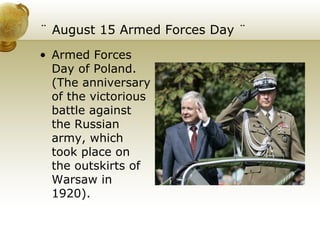
¨ August 15 Armed Forces Day ¨ Armed Forces Day of Poland. (The anniversary of the victorious battle against the Russian army, which took place on the outskirts of Warsaw in 1920).
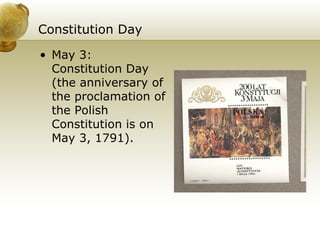
Constitution Day May 3: Constitution Day (the anniversary of the proclamation of the Polish Constitution is on May 3, 1791).
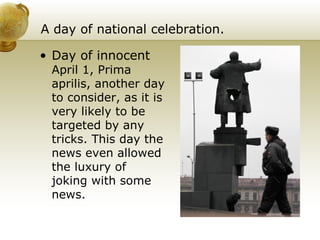
A day of national celebration. Day of innocent  April 1, Prima aprilis, another day to consider, as it is very likely to be targeted by any tricks. This day the news even allowed the luxury of joking with some news.
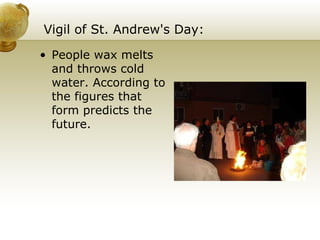
Vigil of St. Andrew's Day: People wax melts and throws cold water. According to the figures that form predicts the future.
Food in Poland Bryan Xaverie Sara
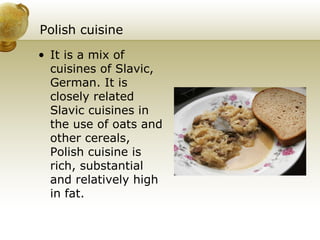
Polish cuisine It is a mix of cuisines of Slavic, German. It is closely related Slavic cuisines in the use of oats and other cereals, Polish cuisine is rich, substantial and relatively high in fat.
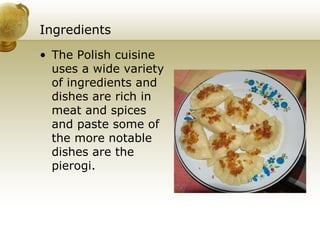
Ingredients The Polish cuisine uses a wide variety of ingredients and dishes are rich in meat and spices and paste some of the more notable dishes are the pierogi.
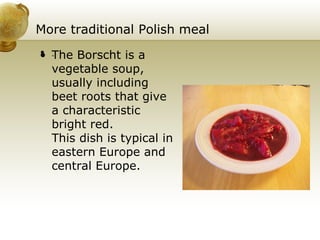
More traditional Polish meal .  The Borscht is a vegetable soup, usually including beet roots that give a characteristic bright red.  This dish is typical in eastern Europe and central Europe.
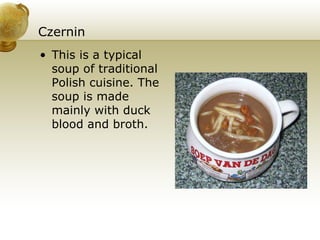
Czernin This is a typical soup of traditional Polish cuisine. The soup is made mainly with duck blood and broth.
Poland Your name: Pedro Toro, Ricardo Torres, Julian , Jordan Cordova Your teacher: Nuria Salvador Your class: 4 A
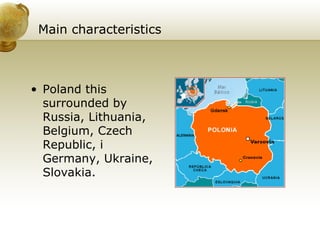
Main characteristics Poland this surrounded by Russia, Lithuania, Belgium, Czech Republic, i Germany, Ukraine, Slovakia.
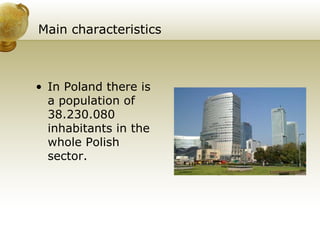
Main characteristics In Poland there is a population of 38.230.080 inhabitants in the whole Polish sector.
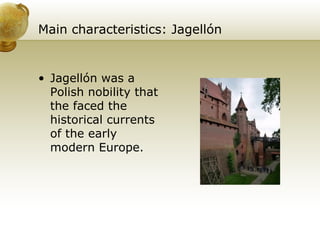
Main characteristics: Jagellón  Jagellón was a Polish nobility that the faced the historical currents of the early modern Europe.
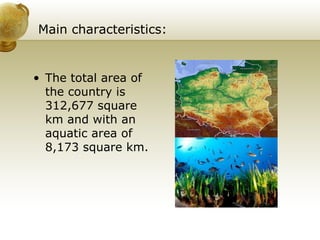
Main characteristics: The total area of the country is 312,677 square km and with an aquatic area of 8,173 square km.
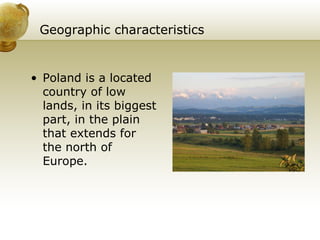
Geographic characteristics Poland is a located country of low lands, in its biggest part, in the plain that extends for the north of Europe.
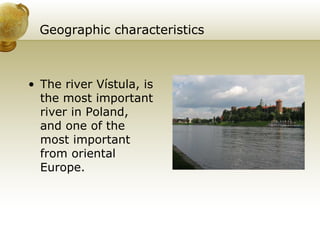
Geographic characteristics The river Vístula, is the most important river in Poland, and one of the most important from oriental Europe.
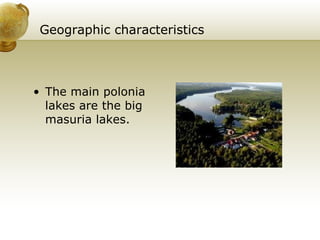
Geographic characteristics The main polonia lakes are the big masuria lakes.
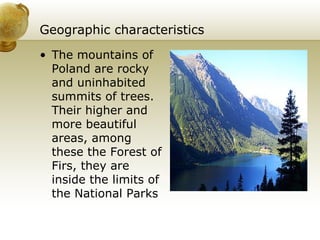
Geographic characteristics The mountains of Poland are rocky and uninhabited summits of trees. Their higher and more beautiful areas, among these the Forest of Firs, they are inside the limits of the National Parks
AT IES EDUARD FONTSERÉ WE ARE EXPERTS IN POLAND!

Poland

  • 1.
    Poland Your name:PUPILS OF IES EDUARD FONTSERÈ Your teacher: Nuria de Salvador Your class: 4ºA
  • 2.
    Climate, fauna andflora Dámaris Karen S Marina
  • 3.
    Fauna In Polandthere are about 33 thousand species of vertebrates and invertebrates animals. In the world of vertebrates living 85 species of mammals (bison) 220 birds (storks) 8 species of reptiles (piton) 17 species of amphibians (frogs) and 55 species of fish (trout).
  • 4.
    Fauna : Theeuropean bison The European bison, in danger of extinction, protected in the forest of Bialowieza its features are: Males reach 2 feet long and 3 longitude. Fur color varies from brown to dark brown. The horns are short and thick.
  • 5.
    Flora Theforests of Poland has a mixed vegetation: species pointed by its enormous size, are the pines, larches, firs, oaks, beeches and birches. Some forests contain northeast tree species that are unique in Europe.
  • 6.
    Flora: The birch One of the unique species in Poland is the birch. Its features are: Height: 10 to 30 m, depending on the species. Leaves: simple, romboilades. Branches: flexible. Distribution: Found in much of the north hemisphere, in Europe. Habitat: Requires sunny areas.
  • 7.
    Climate Summer: Normallysummer is moderately warm, with some rain. Temperatures vary between 21 and 32 degrees Celsius. Contrary to the norm for many countries in Europe, in Poland the warmest month is July, not August. August is when the sea temperature reaches most of the year.
  • 8.
    CLIMATE Autumm:In late September, opens the fall season, exactly on 22 September in Poland, which is impressive as the spectacular scenery comes to surprise some tourists for its range of colors. This time of year has won the famous name of "golden autumn" thanks to the color of its leaves.
  • 9.
    CLIMATE Winter: SinceDecember the cold start for this country. Then we can see temperatures between 3 degrees and -5. is a dry cold, which also can see stains white landscape, there will be snow from December to March is almost certainly even until May in the highest peaks, the Polish mountains offer good conditions for winter sports.
  • 10.
    CLIMATE Spring: Springstart from March. Temperatures are between 10 and 20 degrees Celsius. There is also a fifth season of the year that proceeds from the spring that lasts about a month and clearly can see when the days are growing longer and sunny.
  • 11.
  • 12.
    History During thesixteenth century the Union of Lublin gave birth to the Polish–Lithuanian Commonwealth. In the mid-seventeenth century, a Swedish invasion ("The Deluge") and the Cossacks' Chmielnicki Uprising which ravaged the country marked the end of the golden age. The Union of Lublin. Painting by Jan Matejko.
  • 13.
    History Famines andepidemics followed hostilities, and the population dropped from roughly 11 to 7 million. Despite the erosion of its power, the Commonwealth was able to deal a crushing defeat to the Ottoman Empire in 1683 at the Battle of Vienna.
  • 14.
    History During WorldWar I, all the Allies agreed on the reconstitution of Poland that United States President Woodrow Wilson proclaimed in Point 13 of his Fourteen Points. Shortly after the surrender of Germany in November 1918, Poland regained its independence as the Second Polish Republic. Attack on Poland
  • 15.
    History During WorldWar II, in 1939, Nazi Germany invaded on 1 September and the Soviet invasion followed on 17 September. Poland was split into two zones, one occupied by Germany while the eastern provinces fell under the control of the Soviet Union.
  • 16.
    History The newPoland emerged 20% smaller by 77,500 square kilometers (29,900 sq mi). The shift forced the migration of millions of people, most of whom were Poles, Germans, Ukrainians, and Jews. before now
  • 17.
    Education Karen LKevin Danis
  • 18.
    Education Education inPoland starts at the age of six, in Primary school. Secondary consists of three years, starting at the age of 13, and it ends with an exam. This is followed by upper secondary level, which has two alternatives: three years in a lyceum or four in a technikum. Both end with a maturity examination. ZSE-E de wegrzyn
  • 19.
    Education The oldmarking system used up to the early 1990s was: 2 (insufficient) 3 (sufficient) 4 (good) 5 (very good) Getting a 2 meant that the student would have to repeat the year (in all subjects). Grades 3 and higher were passing grades.
  • 20.
    Education In theearly 1990s the system was extended by introducing new grades, 1 and 6. 1 (insufficient) 2 (initially poor) 3 (sufficient) 4 (good) 5 (very good) 6 (excellent) 1 is the failing grade, 2 to 5 are normal grades, and 6 is for grades that exceed the expectations.
  • 21.
    Education Getting a1, the student has to double the year, including all subjects that were passed. For the same reason, the grades, are only given in the subjects deemed the most important (like Polish language or mathematics). The Polish alphabet
  • 22.
    University education Theuniversity-level education uses a numeric system of grades from 2 to 5, with 0.5. The grading is done every semester (twice a year). Depending on the subject, the final grade may be based on the results of an exam, or the student's performance during semester. university of varsovia
  • 23.
    Education ( Foreignlanguages) Students in Polish schools typically learn one or two foreign languages at schools. languages in Polish schools are shown in the graph In 2005/06 there were 49,200 students from national minorities in schools, most of them German, Kashubian, Ukrainian and Belarusian
  • 24.
    Sports in PolandDani Javi Joel
  • 25.
    More important sportsin Poland More sports are popular in Poland. Football is the most popular sport, but other popular sports is the volleyball, athletics, basketball, boxing, handball, ice hockey and swimming .
  • 26.
    Important Sports peoplein Poland Dani Javi Joel
  • 27.
    Robert Kubica Hewas the first Polish driver in win a race of FORMULA 1 is a ROBERT KUBICA. He start in F1 in 2006 on BMW sauber in 2010 he race in Renault.
  • 28.
    Tomasz Adamek Heis the WBC cruiserweight world champion. Is the n#1 in the cruiserweight in boxrec.
  • 29.
    Jerzy Dudek Hestart in Sokół Tychy after 1996. In 2001 he’s contracted in Liverpool and in 2005 Dudek is the second goalkeeper. In 2007 is contracted in real Madrid C.F actually is the second goalkeeper.
  • 30.
    Important People inPoland Dani Javi Joel
  • 31.
    Copernicus He wasborn in Torun in 1473. He die in Frombork at 1543. He is the father of the modern astrology.
  • 32.
    Marie Curie Shewas born in 1867 in Varsovia. She died in 1934 in Paris. She is the first person awarded two novel prices.
  • 33.
    Karol Józef WojtyłaHe was born in 1920 at wadowice. He dead in 2005 in the city of Vaticano. Is the first papa of Poland.
  • 34.
    Henryk Sienkiewicz He was born in 1846 in okzetjska. He died in1916 in vevey. He is the fifth novel price in history.
  • 35.
    Henryk Sienkiewicz Hewas born in 1904 Małoszyce. He died in 1969 in vence. He is a novelist of s.XX most important.
  • 36.
    Andrzej Wajda Hewas born in suwalki in 1926. Is a cinema director. Awarded for the gold palm in festival of Cannes.
  • 37.
    Frédéric Chopin Hewas born in 1810 in zelazowa wola. He dead in 1849 in Paris. Is one of the best artist of the romanticism.
  • 38.
    Lech Walesa Hewas born in 1943 in popowo. He is a president of Poland between 1990 and 1995. Is a syndicalist and electrician.
  • 39.
    Celebrations in PolandBryan Xaverie Sara
  • 40.
    ¨ August 15Armed Forces Day ¨ Armed Forces Day of Poland. (The anniversary of the victorious battle against the Russian army, which took place on the outskirts of Warsaw in 1920).
  • 41.
    Constitution Day May3: Constitution Day (the anniversary of the proclamation of the Polish Constitution is on May 3, 1791).
  • 42.
    A day ofnational celebration. Day of innocent April 1, Prima aprilis, another day to consider, as it is very likely to be targeted by any tricks. This day the news even allowed the luxury of joking with some news.
  • 43.
    Vigil of St.Andrew's Day: People wax melts and throws cold water. According to the figures that form predicts the future.
  • 44.
    Food in PolandBryan Xaverie Sara
  • 45.
    Polish cuisine Itis a mix of cuisines of Slavic, German. It is closely related Slavic cuisines in the use of oats and other cereals, Polish cuisine is rich, substantial and relatively high in fat.
  • 46.
    Ingredients The Polishcuisine uses a wide variety of ingredients and dishes are rich in meat and spices and paste some of the more notable dishes are the pierogi.
  • 47.
    More traditional Polishmeal . The Borscht is a vegetable soup, usually including beet roots that give a characteristic bright red. This dish is typical in eastern Europe and central Europe.
  • 48.
    Czernin This isa typical soup of traditional Polish cuisine. The soup is made mainly with duck blood and broth.
  • 49.
    Poland Your name:Pedro Toro, Ricardo Torres, Julian , Jordan Cordova Your teacher: Nuria Salvador Your class: 4 A
  • 50.
    Main characteristics Polandthis surrounded by Russia, Lithuania, Belgium, Czech Republic, i Germany, Ukraine, Slovakia.
  • 51.
    Main characteristics InPoland there is a population of 38.230.080 inhabitants in the whole Polish sector.
  • 52.
    Main characteristics: Jagellón Jagellón was a Polish nobility that the faced the historical currents of the early modern Europe.
  • 53.
    Main characteristics: Thetotal area of the country is 312,677 square km and with an aquatic area of 8,173 square km.
  • 54.
    Geographic characteristics Polandis a located country of low lands, in its biggest part, in the plain that extends for the north of Europe.
  • 55.
    Geographic characteristics Theriver Vístula, is the most important river in Poland, and one of the most important from oriental Europe.
  • 56.
    Geographic characteristics Themain polonia lakes are the big masuria lakes.
  • 57.
    Geographic characteristics Themountains of Poland are rocky and uninhabited summits of trees. Their higher and more beautiful areas, among these the Forest of Firs, they are inside the limits of the National Parks
  • 58.
    AT IES EDUARDFONTSERÉ WE ARE EXPERTS IN POLAND!

Editor's Notes

  • #4 Inserta un mapa de tu pa í s.
  • #5 Inserta una imagen de uno de los accidentes geogr á ficos de tu pa í s.
  • #6 Inserta una imagen que ilustre una de las estaciones del año en tu país.
  • #7 Inserta una imagen de un animal o una planta que pueda encontrarse en tu país.
  • #8 Inserta una imagen de un animal o una planta que pueda encontrarse en tu país.
  • #9 Inserta una imagen que ilustre una costumbre o tradición de tu país.
  • #10 Inserta una imagen que ilustre una costumbre o tradición de tu país.
  • #11 Inserta una imagen de uno de los puntos de interés de tu país.
  • #26 Inserta una imagen de uno de los accidentes geogr á ficos de tu pa í s.
  • #28 Inserta una imagen de un animal o una planta que pueda encontrarse en tu país.
  • #29 Inserta una imagen de un animal o una planta que pueda encontrarse en tu país.
  • #30 Agrega los principales puntos hist ó ricos de tu pa í s a la escala de tiempo.
  • #32 Inserta una imagen que ilustre una costumbre o tradición de tu país.
  • #33 Inserta una imagen de uno de los puntos de interés de tu país.
  • #34 Inserta una imagen que ilustre una costumbre o tradición de tu país.
  • #42 Inserta un mapa de tu pa í s.
  • #43 Inserta una imagen de uno de los accidentes geogr á ficos de tu pa í s.
  • #44 Inserta una imagen que ilustre una de las estaciones del año en tu país.
  • #46 Inserta una imagen de un animal o una planta que pueda encontrarse en tu país.
  • #47 Inserta una imagen de un animal o una planta que pueda encontrarse en tu país.
  • #48 Agrega los principales puntos hist ó ricos de tu pa í s a la escala de tiempo.
  • #49 Inserta una imagen que ilustre una costumbre o tradición de tu país.
  • #51 Inserta un mapa de tu pa í s.
  • #52 Inserta un mapa de tu pa í s.
  • #53 Inserta un mapa de tu pa í s.
  • #54 Inserta un mapa de tu pa í s.
  • #55 Inserta una imagen de uno de los accidentes geogr á ficos de tu pa í s.
  • #56 Inserta una imagen de uno de los accidentes geogr á ficos de tu pa í s.
  • #57 Inserta una imagen de uno de los accidentes geogr á ficos de tu pa í s.
  • #58 Inserta una imagen de uno de los accidentes geogr á ficos de tu pa í s.