PPOLISHOLISH HHISTORICALISTORICAL FFACTSACTS
Some main information about Polish Historical Background
Przedszkole Samorzadowe w ZPO w Woli Filipowskiej
on behalf of the project Erasmus+
„My Culture, Your Culture, Our Culture”
The Legend of Lech, Czech and Rus
Over a thousand years ago, there were three Slav brothers wandering with their tribes through the
lands of forests and fields stretching between two large rivers, Oder in the west and Dnieper in the
east, in search of the best place to settle. One day, after months of weary travel, a beautiful sight
appeared before their eyes: on a hill there stood a huge oak tree with a nest between its branches.
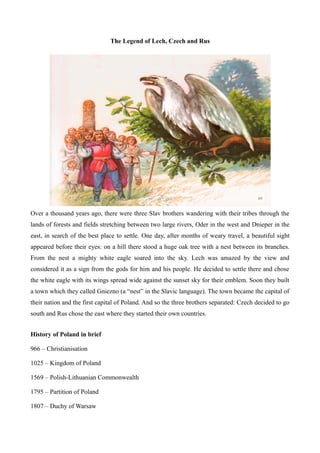
From the nest a mighty white eagle soared into the sky. Lech was amazed by the view and
considered it as a sign from the gods for him and his people. He decided to settle there and chose
the white eagle with its wings spread wide against the sunset sky for their emblem. Soon they built
a town which they called Gniezno (a “nest” in the Slavic language). The town became the capital of
their nation and the first capital of Poland. And so the three brothers separated: Czech decided to go
south and Rus chose the east where they started their own countries.
History of Poland in brief
966 – Christianisation
1025 – Kingdom of Poland
1569 – Polish-Lithuanian Commonwealth
1795 – Partition of Poland
1807 – Duchy of Warsaw
1815 – Congress Poland
1918 – Reconstitution of Poland
1939 – Invasion of Poland, World War II
1945 – Communist Poland
1989 – Republic of Poland
History of Poland in details
Poland has had a long and rich history. Over the past thousand years the country has defended its
freedom and sovereignty from foreign aggressions on numerous occasions. Due to country’s geo-
political location between the East and the West, Polish history is marked with wars and uprisings.
There was a time when Poland was the largest country in Europe but there was also a stage when it
was totally erased from the world map for over a hundred years. Thanks to the resilience and pride
of the people who value freedom above all, Poland has not only managed to overcome troubles but
also has been offering its own contribution to European history and culture.
Poland’s history dates back to prehistory times when Slavic tribes arrived on this territory and
settled down. The first documented ruler was Mieszko I (from Piast dynasty) in the 10th century. In
966 duke Mieszko I converted to Christianity and by baptism brought Poland to the community of
Western nations. The first coronation took place at Wawel Cathedral in Krakow in 1025 and the
Kingdom of Poland began to take shape.
The Jagiellonian dynasty phase brought close ties with the Grand Dutchy of Lithuania. In 1385
Lithuania accepted Christianity from Polish hands and Polish-Lithuanian union was formed, which
lasted for more than 400 years.
Over time a new threat emerged. The Teutonic Order directed their campaigns against Lithuania and
Poland. In 1410 at the Battle of Tannenberg (Grunwald) the united forces of Poland and Lithuania
completely destroyed the Teutonic Knights. It was one of the biggest and most important battles of
medieval times.
The 16th century was Poland’s “Golden Age”. The Renaissance currents brought about country’s
flourishing, Poland advanced culturally, arts and science developed. Polish astronomer, Nicolaus
Copernicus (1473-1543), formulated the first modern heliocentric theory of the solar system and
gave a start to modern astronomy. While Europe was absorbed with religious turmoil, Poland
proclaimed a policy of religious tolerance which attracted many refugees from religious persecution
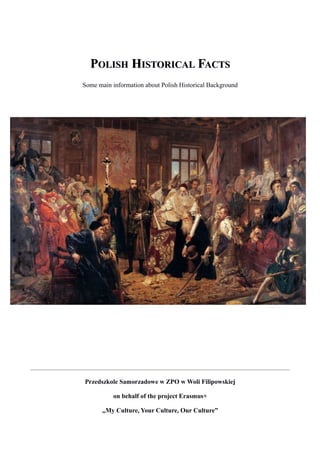
(Christians, Jews, Muslims). The country also expanded territorially. In 1569 the Union of Lublin
was signed forming the Polish-Lithuanian Commonwealth. From this time on Poland and Lithuania
were known as the Republic of Both Nations and prospered together on the territory of almost
1,000,000 square kilometers of central and eastern Europe. The Union was largely run by the
nobility but led by elected kings. This early democratic system (“a sophisticated noble democracy”)
was untypical and in contrast to the absolute monarchies prevailing at the time in the rest of Europe.
In 1596 king Zygmunt III Waza moved the capital from Krakow to Warsaw as the city was more
centrally located.
From the mid-17th century the Commonwealth entered a period of decline caused by internal
disorder and anarchy, and devastating wars. The state was invaded by Swedes; the so called
“Swedish Deluge” left the country in ruins. The last great victory was taken in 1683 when the allied
armies of Europe led by the Polish king John III Sobieski save Europe from invasion of Islam in the
huge battle of Vienna.
In the 18th century the Republic was in crisis. The state required reorganization. King Stanislaus
Augustus Poniatowski (the last king of Poland) introduced numerous reforms. On 3rd May 1791
Europe’s first and the world’s second constitution was signed. However, the reform process was not
enough to turn the tide of failing fortune. Poland gradually fell under foreign influence. The rulers
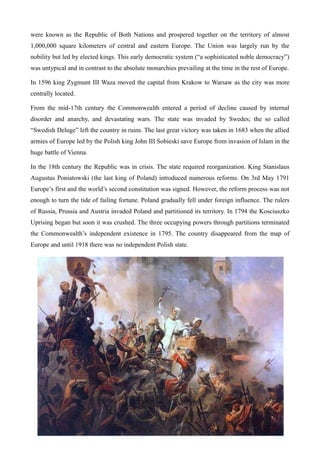
of Russia, Prussia and Austria invaded Poland and partitioned its territory. In 1794 the Kosciuszko
Uprising began but soon it was crushed. The three occupying powers through partitions terminated
the Commonwealth’s independent existence in 1795. The country disappeared from the map of
Europe and until 1918 there was no independent Polish state.
Despite the oppression, the idea of Polish independence was still alive in the nation and Poland
continued to exist as a spiritual and cultural community. Poles engaged in armed resistance. They
fought with Napoleon Bonaparte, organized November Uprising (1830-1831) and January Uprising
(1863-1864), all of which failed. But yet some great achievements in science and art were obtained
at that time: Frederic Chopin (1810-1849), the famous pianist and composer, who was born and
raised in Poland preserved the national heritage in music; in 1853 Ignacy Lukasiewicz made a
kerosene lamp, invented a way to refine kerosene from crude oil and built the first oil refinery in
1856; Maria Sklodowska-Curie (1867-1934), the famous physicist and chemist, discovered
radioactive elements and won two Nobel Prizes, the only one ever in two different sciences.
The outbreak of World War I gave Poland chance to regain freedom. On 11th November 1918
Poland reappeared on the map of Europe after 123 years. The Second Polish Republic was
established. In 1920 the young state stopped the massive Soviet invasion aimed at Western Europe
in the battle of Warsaw.
On 1st September 1939 Poland was invaded by the Nazi Germany and World War II began. On
September 17th the SovietUnion launch ed the unexpected attack and the country was again divided
between eastern and western powers. The Poles formed the strongest underground resistance
movement in the occupied territories (known as Home Army). Many Polish soldiers joined military
formations on the western and eastern fronts and fought together with the Allies against the German
aggressor. In 1944 the Warsaw Uprising broke out being the largest single military effort taken by
any European resistance movement of World War II. Six million of Polish citizens perished during
the war, including three million of Polish Jews; the country lay in ruins.
After World War II ended, Poland fell under Soviet control and the communist People’s Republic of
Poland was created as a Soviet satellite state. The country’s boundaries were radically changed and
shifted to the west, followed by mass movements of people of various nations. In consequence,
Poland lost its traditional multi-ethnic character and became a country with homogeneous Polish
population.
In the difficult years of communism, a new hope for Poles arose when Karol Wojtyla (John Paul II)
was chosen Pope in 1978. Two years later, in 1980, the “Solidarity” was founded, being the first
mass independent trade union in communist states. This reform movement, led by Lech Walesa,
eventually broke Soviet control in Eastern Europe. The first elections of the Third Polish Republic
were held in 1989 and the country entered a period of transition from a communist state to the
capitalist economic system and liberal parliamentary democracy. A modern Polish state arose.
Poland now has a new constitution which was signed in 1997. The country is a member of the
NATO since 1999 and joined the European Union in 2004. After years of turbulent history, the
country has finally found some stability and chance for growth in peace.
Detailed information with the devision on ages
MIDDLE AGES
There is a legend about the three forefathers of Slavonic nations. There were three brothers Lech,
Czech and Rus who wandered with their kin tribes away from the original Slavonic settlements in
the present area of Ukraine (between the Vistula and the Dnepr rivers). Rus moved to the east while
the other two wandered with their people westwards. Lech stayed in the lowlands and established
his town near a white eagle’s nest (the white eagle is the country’s coat of arms). Czech went more
to the south.
Slavonic tribes came to Poland in the 6th century AD. The first town of the Polan tribe was
Gniezno, along with Poznan, the oldest capital of Poland. It was there, where the first royal dynasty
resided, the Piasts, who drew their pedigree from the mythical Piast, a wheelwright who founded a
dynasty that ruled until 1370. The Polan tribe dwelled in the western areas of today’s Poland, in
Wielkopolska, whereas Krakow was the central settlement of the Wislan tribe.
966 Mieszko I, (a member of the Piast dynasty, the creator of the Polish state) was baptised at the
occasion of his marriage to the Czech princess Doubrava. What follows was the christening of the
previously pagan country.
997 Bishop Adalbert dies. St Adalbert – the bishop of Prague decided to bring to Christianity to
pagan Prussians living in Northern Poland. He founded Gdansk although he was later killed on that
mission. His remains were transferred to Gniezno. Adalbert became the first Polish saint and three
years later the first archbishopric was established in Gniezno.
1025 Boleslaw the Brave was crowned as the first Polish king, this mighty ruler deposed Otto III
(Roman Emperor) to become the lord of all Slavonic people. The two monarchs met at the famous
Gniezno summit in 1000. Boleslaw died one year after his coronation ceremony.
1038 – 1050 Poznan and Gniezno were ravaged during a punitive trip of a Czech prince wishing to
obtain the relics of St. Adalbert in Gniezno. Then the royal court under Kazimierz the Restorer
moved to Krakow.
1109 Boleslaw the Wrymouth gained successive victories against German troops. He managed to
incorporate large parts of Silesia and Pomerania. His political program of dominating western
provinces was repeated as late as post WWII in a campaign to regain the “originally” Polish areas.
1226 Mazovian Prince Conrad invited the Order of Teutonic Knights to Northern Poland in order to
gain their help against the adamantly pagan Prussians (a Baltic tribe). The knights were not very
successful during the Crusades and it was in Poland (and the Kaliningrad enclave), where their
dominions flourished. Teutonic Knights become later a dangerous challenge for the equally
expansive Polish state.
1241 The Mongols invaded Poland (after destroying Kiev and Russia) and did most damage to the
southern parts of the country, they were finally stopped in Silesia.
1333 Casimir the Great (III) came to the throne and started the golden era of the Polish Middle
Ages: Wawel Castle was largely rebuilt and Krakow University founded in 1364.
1386 To face the threat from the Teutonic knights, Polish and Lithuanian dynasties united in Creva.
Both independent states were ruled by one monarch coming from the Jagiellonian dynasty of
Lithuania, they made their capital Krakow.
1410 One of the biggest medieval battles was fought at Grunwald (Tannenberg), where the joint
Polish and Lithuanian forces stopped the aspirations of the Teutonic Knights.
1466 The treaty of Torun (Thorn) between Poland and the Teutonic Knights was signed and sworn,
and Poland at last dominates Prussia and the City of Gdansk (Danzig).
EARLY MODERN AGES
1525 The Teutonic Order is secularised and became the vassal of Poland. One century later the
Polish king grants the Brandenburg dukes the right to accede in Prussia, which led to the
establishment of an enormous Prussian power two centuries later.
1543 The Copernican Revolution. Polish scholar Nicolaus Copernicus (Mikolaj Kopernik)
published De Revolutionibus, he proposed the heliocentric theory, that the Earth rotates on an axis,
and goes round the sun once in a year. In the 16th century it was still widely accepted that the Earth
was the centre of the universe. The heliocentric theory was later proved by Galileo Galilei.
1550 (approx) Gdansk has more than 30,000 inhabitants, Krakow has 15,000 inhabitants and
Poznan 5,000. Wroclaw (Breslau) has 20,000 but Silesia belonged to the Czech Crown at that time.
Warsaw was still only a small capital of the Mazovia province. The majority of foreign trade was
done via Free Town of Gdansk and around 70% of Polish exports constituted of grains (rye) and
30% cattle and furs. Only Gdansk produces furniture, clocks, ovens and valuable products.
1569 Lublin: The Polish Kingdom and the Great Duchy of Lithuania are connected into one union.
The Ukraine was also a part of Poland. The union made Poland the largest country in Europe.
1587 Sigismund III Vasa (Zygmunt III), son of John III Vasa (King of Sweden), elected King of
Poland, moved the Parliament and the court to Warsaw to bring himself closer to Sweden and to the
centre of the kingdom.
1610 Battle of Klutsjino (Klusin) – The Russian Tsar was overthrown by Poles. Wladyslaw – son of
Sigismund, was crowned Tsar in Moscow – the zenith of Polish power. This was followed by a
series of wars against the Ukrainian Cossacks, the Swedes and the Turks. 90 % of state’s financial
resources were spent on warfare.
1652 The Liberum Veto introduced – a manifestation of the great freedoms, which were enjoyed by
the Polish nobility. One vote could obstacle the enactment of any bill in the Polish Parliament. The
Political system fiound itself in a prolonged crisis causing Poland to experiment with the republican
form of government. Eight per cent of population were often impoverished nobility and it is
estimated that 120,000 noblemen had no land or property.
1655 The Beginning of the Swedish Wars (the so called “Deluge”). Charles X (Karol X) takes
Warsaw and Krakow. Warsaw was captured and recaptured several times and 80% of its population
was killed. Czestochowa took a miraculous resistance and finally Peace was restored in Oliwa in
1660.
1683 The legendary Battle of Vienna (the second siege of Vienna). Polish King John III (Jan III.
Sobieski) managed to crush the Turks (Kara Mustafa), save the beleaguered city, and finally kill off
the expansion of the Ottoman Empire.
1721 The end of the Great Northern War, which was fought against Sweden. Although Sweden was
defeated, Poland became dependent on Russia.
1764 Stanislaus Poniatowski (Stanisław Poniatowski) elected King of Poland. He was an
enlightened ruler trying in vain to halt the collapse of the country.
1772 The first partition of Poland: the border areas were divided among Russia, Prussia and Austria.
THE MODERN AGE
1791 The New Constitution was (May 3) granted by King Stanislaus Poniatowski. It was second
achievement of such kind. Immediately after the American constitution, the throne was made
hereditary, and the liberum veto abolished.
1794 The Kosciuszko rebellion: Tadeusz Kosciusko had tough fights against Russians and
Prussians. The following year Warsaw and Krakow were lost to Russia and Austria. This is known
as the Third Partition of Poland, Poland was wiped off the map.
1807 Napoleon Bonaparte’s first invasion of Poland. Poles saw hope in Napoleon and supported
him during his attack on Russia. Napoleon becomes enamored to Maria Walewska in Warsaw. A
year afterwards a semi-independent Duchy of Warsaw proclaimed
1810 Fryderyk Chopin, the best known Polish piano composer, was born in Zelazowa Wola. After
1830 he had to spend last eighteen years of his life in exile.
1815 After Napoleon’s defeat at Waterloo came the period of the “Holy Alliance” between Russia,
Prussia and Austria. This association aimed to eliminate any radical movements. Tsar Alexander I
granted Poland a constitution and the so-called Warsaw Kingdom governed by Russia. Galicia (the
area around Krakow) was independent (until 1846) and then becomes a part of the Austrian (later
Austro-Hungarian) monarchy.
1824 Adam Mickiewicz – the most famous Polish poet was exiled and never returned back to
Poland, (he died 1855 in Crimea).
1830 The November Insurrection in Poland – an armed revolt against Russian rule quenched as late
as in September 1831.
1848 Warsaw connected with Vienna by rail. The end of serfdom in the Austrian part of Poland, also
happened in the same year.
1863 January Uprising in Poland against Russia – continuation of the adamant feeling towards
Russification.
1893 The Polish National League was formed in Warsaw.
THE 20th CENTURY
1914 First World War begins. Most fights take place on the eastern front fought on the territory of
the future Poland (Galicia).
1918 In November Poland was proclaimed as an independent country. Marshall Józef Pilsudski
becomes “chief of the state”. The young state has unstable boundaries and a series of wars, unrest
and uprisings with neighbouring countries, Bolshevik Ukraine, Germany, Lithuania and
Czechoslovakia takes place as there was a general trend to make countries as big as possible
(historical and national principles). In 1920, the “Warsaw miracle” took place, as the Polish army
stopped the advance of the Bolshevik army into central Europe. Poland gains big territories in the
east. Later it occupies Vilnius (Wilno) and halves the Austrian part of Silesia (the other half acceded
to Czechoslovakia).
1921 The Modern Polish constitution was formed. Poland was a republic (until 1926), the national
bank reformed, mining was developed in Silesia and the construction of the first Polish port in
Gdynia took place. The country was unstable though. The first President, Narutowicz, was
assassinated in Warsaw one year later. To introduce order, Józef Pilsudski organizes q coup in 1926.
1939 September 1st, Adolf Hitler’s Nazi’s begin bombing Westerplatte, Gdansk and WW II begins.
The Soviet Union invades eastern Poland on September 17. Within one month Poland defeated.
These happenings are a consequence of the Molotov – Ribbentrop Pact signed on August 23rd.T the
pact stipulated non-aggression between Germany and the USSR.
1943 The Warsaw Ghetto uprising (April 19th): It was the Heroic, yet hopeless action of Jews
besieged in the small Warsaw ghetto. It followed mass transports of Jews from Warsaw ghetto to the
Treblinka and Auschwitz concentration camps. Out of 450.000 people, which had originally been
squeezed into the small ghetto’s area a mere 300 survived. The ghetto area was turned into complete
rubble.
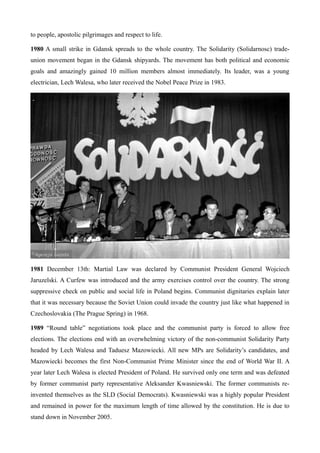
1944 The Warsaw Uprising against Nazi occupants breaks out on August 1st – The city fought back
for two months until all resistance is violently suppressed two and a half moths later. In an act of
revenge, the whole city is then systematically destroyed and completely flattened.
1945 Poland finally liberated by the Russian Red Army, the exiled government returns from
London, but the country finds itself gradually under the Soviet dominance. Following the Potsdam
agreement the borders change significantly – the whole country moves geographically 300 -500
kilometres to the west. Originally Polish areas in the east are incorporated into the USSR and their
inhabitants settle originally German cities in the West: Wroclaw (Breslau), Gdansk (Danzig) and
Szczecin (Stettin).
1955 The Warsaw Pact was signed with a goal to compete with NATO. It comprised of the USSR
and also Eastern Germany, Poland, Czechoslovakia, Hungary, Bulgaria and Romania. Albania was a
member just for a short time. The huge Palace of Culture (Stalin’s apologetic gift to Poland) was
completed at the same time.
1956 Mass anti-Soviet riots in Poznan. The era of socialist revisionism begins and the truth about
Stalin’s action’s revealed.
1967 Rolling Stones play at the Palace of Culture in Warsaw.
1978 The Bishop of Krakow, Karol Wojtyla is elected as Pope John Paul II, becoming the first non-
Italian pope since the 15th century. His pontificate is marked by attempts to bring the church closer
to people, apostolic pilgrimages and respect to life.
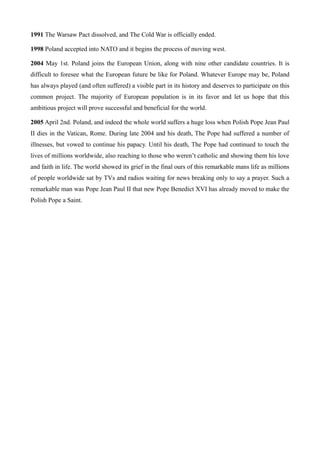
1980 A small strike in Gdansk spreads to the whole country. The Solidarity (Solidarnosc) trade-
union movement began in the Gdansk shipyards. The movement has both political and economic
goals and amazingly gained 10 million members almost immediately. Its leader, was a young
electrician, Lech Walesa, who later received the Nobel Peace Prize in 1983.
1981 December 13th: Martial Law was declared by Communist President General Wojciech
Jaruzelski. A Curfew was introduced and the army exercises control over the country. The strong
suppressive check on public and social life in Poland begins. Communist dignitaries explain later
that it was necessary because the Soviet Union could invade the country just like what happened in
Czechoslovakia (The Prague Spring) in 1968.
1989 “Round table” negotiations took place and the communist party is forced to allow free
elections. The elections end with an overwhelming victory of the non-communist Solidarity Party
headed by Lech Walesa and Taduesz Mazowiecki. All new MPs are Solidarity’s candidates, and
Mazowiecki becomes the first Non-Communist Prime Minister since the end of World War II. A
year later Lech Walesa is elected President of Poland. He survived only one term and was defeated
by former communist party representative Aleksander Kwasniewski. The former communists re-
invented themselves as the SLD (Social Democrats). Kwasniewski was a highly popular President
and remained in power for the maximum length of time allowed by the constitution. He is due to
stand down in November 2005.
1991 The Warsaw Pact dissolved, and The Cold War is officially ended.
1998 Poland accepted into NATO and it begins the process of moving west.
2004 May 1st. Poland joins the European Union, along with nine other candidate countries. It is
difficult to foresee what the European future be like for Poland. Whatever Europe may be, Poland
has always played (and often suffered) a visible part in its history and deserves to participate on this
common project. The majority of European population is in its favor and let us hope that this
ambitious project will prove successful and beneficial for the world.
2005 April 2nd. Poland, and indeed the whole world suffers a huge loss when Polish Pope Jean Paul
II dies in the Vatican, Rome. During late 2004 and his death, The Pope had suffered a number of
illnesses, but vowed to continue his papacy. Until his death, The Pope had continued to touch the
lives of millions worldwide, also reaching to those who weren’t catholic and showing them his love
and faith in life. The world showed its grief in the final ours of this remarkable mans life as millions
of people worldwide sat by TVs and radios waiting for news breaking only to say a prayer. Such a
remarkable man was Pope Jean Paul II that new Pope Benedict XVI has already moved to make the
Polish Pope a Saint.

History

  • 1.
    PPOLISHOLISH HHISTORICALISTORICAL FFACTSACTS Somemain information about Polish Historical Background Przedszkole Samorzadowe w ZPO w Woli Filipowskiej on behalf of the project Erasmus+ „My Culture, Your Culture, Our Culture”
  • 2.
    The Legend ofLech, Czech and Rus Over a thousand years ago, there were three Slav brothers wandering with their tribes through the lands of forests and fields stretching between two large rivers, Oder in the west and Dnieper in the east, in search of the best place to settle. One day, after months of weary travel, a beautiful sight appeared before their eyes: on a hill there stood a huge oak tree with a nest between its branches. From the nest a mighty white eagle soared into the sky. Lech was amazed by the view and considered it as a sign from the gods for him and his people. He decided to settle there and chose the white eagle with its wings spread wide against the sunset sky for their emblem. Soon they built a town which they called Gniezno (a “nest” in the Slavic language). The town became the capital of their nation and the first capital of Poland. And so the three brothers separated: Czech decided to go south and Rus chose the east where they started their own countries. History of Poland in brief 966 – Christianisation 1025 – Kingdom of Poland 1569 – Polish-Lithuanian Commonwealth 1795 – Partition of Poland 1807 – Duchy of Warsaw
  • 3.
    1815 – CongressPoland 1918 – Reconstitution of Poland 1939 – Invasion of Poland, World War II 1945 – Communist Poland 1989 – Republic of Poland History of Poland in details Poland has had a long and rich history. Over the past thousand years the country has defended its freedom and sovereignty from foreign aggressions on numerous occasions. Due to country’s geo- political location between the East and the West, Polish history is marked with wars and uprisings. There was a time when Poland was the largest country in Europe but there was also a stage when it was totally erased from the world map for over a hundred years. Thanks to the resilience and pride of the people who value freedom above all, Poland has not only managed to overcome troubles but also has been offering its own contribution to European history and culture. Poland’s history dates back to prehistory times when Slavic tribes arrived on this territory and settled down. The first documented ruler was Mieszko I (from Piast dynasty) in the 10th century. In 966 duke Mieszko I converted to Christianity and by baptism brought Poland to the community of Western nations. The first coronation took place at Wawel Cathedral in Krakow in 1025 and the Kingdom of Poland began to take shape. The Jagiellonian dynasty phase brought close ties with the Grand Dutchy of Lithuania. In 1385 Lithuania accepted Christianity from Polish hands and Polish-Lithuanian union was formed, which lasted for more than 400 years. Over time a new threat emerged. The Teutonic Order directed their campaigns against Lithuania and Poland. In 1410 at the Battle of Tannenberg (Grunwald) the united forces of Poland and Lithuania completely destroyed the Teutonic Knights. It was one of the biggest and most important battles of medieval times. The 16th century was Poland’s “Golden Age”. The Renaissance currents brought about country’s flourishing, Poland advanced culturally, arts and science developed. Polish astronomer, Nicolaus Copernicus (1473-1543), formulated the first modern heliocentric theory of the solar system and gave a start to modern astronomy. While Europe was absorbed with religious turmoil, Poland proclaimed a policy of religious tolerance which attracted many refugees from religious persecution (Christians, Jews, Muslims). The country also expanded territorially. In 1569 the Union of Lublin was signed forming the Polish-Lithuanian Commonwealth. From this time on Poland and Lithuania
  • 4.
    were known asthe Republic of Both Nations and prospered together on the territory of almost 1,000,000 square kilometers of central and eastern Europe. The Union was largely run by the nobility but led by elected kings. This early democratic system (“a sophisticated noble democracy”) was untypical and in contrast to the absolute monarchies prevailing at the time in the rest of Europe. In 1596 king Zygmunt III Waza moved the capital from Krakow to Warsaw as the city was more centrally located. From the mid-17th century the Commonwealth entered a period of decline caused by internal disorder and anarchy, and devastating wars. The state was invaded by Swedes; the so called “Swedish Deluge” left the country in ruins. The last great victory was taken in 1683 when the allied armies of Europe led by the Polish king John III Sobieski save Europe from invasion of Islam in the huge battle of Vienna. In the 18th century the Republic was in crisis. The state required reorganization. King Stanislaus Augustus Poniatowski (the last king of Poland) introduced numerous reforms. On 3rd May 1791 Europe’s first and the world’s second constitution was signed. However, the reform process was not enough to turn the tide of failing fortune. Poland gradually fell under foreign influence. The rulers of Russia, Prussia and Austria invaded Poland and partitioned its territory. In 1794 the Kosciuszko Uprising began but soon it was crushed. The three occupying powers through partitions terminated the Commonwealth’s independent existence in 1795. The country disappeared from the map of Europe and until 1918 there was no independent Polish state.
  • 5.
    Despite the oppression,the idea of Polish independence was still alive in the nation and Poland continued to exist as a spiritual and cultural community. Poles engaged in armed resistance. They fought with Napoleon Bonaparte, organized November Uprising (1830-1831) and January Uprising (1863-1864), all of which failed. But yet some great achievements in science and art were obtained at that time: Frederic Chopin (1810-1849), the famous pianist and composer, who was born and raised in Poland preserved the national heritage in music; in 1853 Ignacy Lukasiewicz made a kerosene lamp, invented a way to refine kerosene from crude oil and built the first oil refinery in 1856; Maria Sklodowska-Curie (1867-1934), the famous physicist and chemist, discovered radioactive elements and won two Nobel Prizes, the only one ever in two different sciences. The outbreak of World War I gave Poland chance to regain freedom. On 11th November 1918 Poland reappeared on the map of Europe after 123 years. The Second Polish Republic was established. In 1920 the young state stopped the massive Soviet invasion aimed at Western Europe in the battle of Warsaw. On 1st September 1939 Poland was invaded by the Nazi Germany and World War II began. On September 17th the SovietUnion launch ed the unexpected attack and the country was again divided between eastern and western powers. The Poles formed the strongest underground resistance
  • 6.
    movement in theoccupied territories (known as Home Army). Many Polish soldiers joined military formations on the western and eastern fronts and fought together with the Allies against the German aggressor. In 1944 the Warsaw Uprising broke out being the largest single military effort taken by any European resistance movement of World War II. Six million of Polish citizens perished during the war, including three million of Polish Jews; the country lay in ruins. After World War II ended, Poland fell under Soviet control and the communist People’s Republic of Poland was created as a Soviet satellite state. The country’s boundaries were radically changed and shifted to the west, followed by mass movements of people of various nations. In consequence, Poland lost its traditional multi-ethnic character and became a country with homogeneous Polish population. In the difficult years of communism, a new hope for Poles arose when Karol Wojtyla (John Paul II) was chosen Pope in 1978. Two years later, in 1980, the “Solidarity” was founded, being the first mass independent trade union in communist states. This reform movement, led by Lech Walesa, eventually broke Soviet control in Eastern Europe. The first elections of the Third Polish Republic were held in 1989 and the country entered a period of transition from a communist state to the capitalist economic system and liberal parliamentary democracy. A modern Polish state arose. Poland now has a new constitution which was signed in 1997. The country is a member of the NATO since 1999 and joined the European Union in 2004. After years of turbulent history, the country has finally found some stability and chance for growth in peace. Detailed information with the devision on ages MIDDLE AGES There is a legend about the three forefathers of Slavonic nations. There were three brothers Lech, Czech and Rus who wandered with their kin tribes away from the original Slavonic settlements in the present area of Ukraine (between the Vistula and the Dnepr rivers). Rus moved to the east while the other two wandered with their people westwards. Lech stayed in the lowlands and established his town near a white eagle’s nest (the white eagle is the country’s coat of arms). Czech went more to the south. Slavonic tribes came to Poland in the 6th century AD. The first town of the Polan tribe was Gniezno, along with Poznan, the oldest capital of Poland. It was there, where the first royal dynasty resided, the Piasts, who drew their pedigree from the mythical Piast, a wheelwright who founded a dynasty that ruled until 1370. The Polan tribe dwelled in the western areas of today’s Poland, in
  • 7.
    Wielkopolska, whereas Krakowwas the central settlement of the Wislan tribe. 966 Mieszko I, (a member of the Piast dynasty, the creator of the Polish state) was baptised at the occasion of his marriage to the Czech princess Doubrava. What follows was the christening of the previously pagan country. 997 Bishop Adalbert dies. St Adalbert – the bishop of Prague decided to bring to Christianity to pagan Prussians living in Northern Poland. He founded Gdansk although he was later killed on that mission. His remains were transferred to Gniezno. Adalbert became the first Polish saint and three years later the first archbishopric was established in Gniezno. 1025 Boleslaw the Brave was crowned as the first Polish king, this mighty ruler deposed Otto III (Roman Emperor) to become the lord of all Slavonic people. The two monarchs met at the famous Gniezno summit in 1000. Boleslaw died one year after his coronation ceremony. 1038 – 1050 Poznan and Gniezno were ravaged during a punitive trip of a Czech prince wishing to obtain the relics of St. Adalbert in Gniezno. Then the royal court under Kazimierz the Restorer moved to Krakow. 1109 Boleslaw the Wrymouth gained successive victories against German troops. He managed to incorporate large parts of Silesia and Pomerania. His political program of dominating western provinces was repeated as late as post WWII in a campaign to regain the “originally” Polish areas. 1226 Mazovian Prince Conrad invited the Order of Teutonic Knights to Northern Poland in order to gain their help against the adamantly pagan Prussians (a Baltic tribe). The knights were not very successful during the Crusades and it was in Poland (and the Kaliningrad enclave), where their dominions flourished. Teutonic Knights become later a dangerous challenge for the equally expansive Polish state. 1241 The Mongols invaded Poland (after destroying Kiev and Russia) and did most damage to the southern parts of the country, they were finally stopped in Silesia. 1333 Casimir the Great (III) came to the throne and started the golden era of the Polish Middle Ages: Wawel Castle was largely rebuilt and Krakow University founded in 1364. 1386 To face the threat from the Teutonic knights, Polish and Lithuanian dynasties united in Creva. Both independent states were ruled by one monarch coming from the Jagiellonian dynasty of Lithuania, they made their capital Krakow. 1410 One of the biggest medieval battles was fought at Grunwald (Tannenberg), where the joint Polish and Lithuanian forces stopped the aspirations of the Teutonic Knights. 1466 The treaty of Torun (Thorn) between Poland and the Teutonic Knights was signed and sworn,
  • 8.
    and Poland atlast dominates Prussia and the City of Gdansk (Danzig). EARLY MODERN AGES 1525 The Teutonic Order is secularised and became the vassal of Poland. One century later the Polish king grants the Brandenburg dukes the right to accede in Prussia, which led to the establishment of an enormous Prussian power two centuries later. 1543 The Copernican Revolution. Polish scholar Nicolaus Copernicus (Mikolaj Kopernik) published De Revolutionibus, he proposed the heliocentric theory, that the Earth rotates on an axis, and goes round the sun once in a year. In the 16th century it was still widely accepted that the Earth was the centre of the universe. The heliocentric theory was later proved by Galileo Galilei. 1550 (approx) Gdansk has more than 30,000 inhabitants, Krakow has 15,000 inhabitants and Poznan 5,000. Wroclaw (Breslau) has 20,000 but Silesia belonged to the Czech Crown at that time. Warsaw was still only a small capital of the Mazovia province. The majority of foreign trade was done via Free Town of Gdansk and around 70% of Polish exports constituted of grains (rye) and 30% cattle and furs. Only Gdansk produces furniture, clocks, ovens and valuable products. 1569 Lublin: The Polish Kingdom and the Great Duchy of Lithuania are connected into one union. The Ukraine was also a part of Poland. The union made Poland the largest country in Europe. 1587 Sigismund III Vasa (Zygmunt III), son of John III Vasa (King of Sweden), elected King of Poland, moved the Parliament and the court to Warsaw to bring himself closer to Sweden and to the centre of the kingdom. 1610 Battle of Klutsjino (Klusin) – The Russian Tsar was overthrown by Poles. Wladyslaw – son of Sigismund, was crowned Tsar in Moscow – the zenith of Polish power. This was followed by a series of wars against the Ukrainian Cossacks, the Swedes and the Turks. 90 % of state’s financial resources were spent on warfare. 1652 The Liberum Veto introduced – a manifestation of the great freedoms, which were enjoyed by the Polish nobility. One vote could obstacle the enactment of any bill in the Polish Parliament. The Political system fiound itself in a prolonged crisis causing Poland to experiment with the republican form of government. Eight per cent of population were often impoverished nobility and it is estimated that 120,000 noblemen had no land or property. 1655 The Beginning of the Swedish Wars (the so called “Deluge”). Charles X (Karol X) takes Warsaw and Krakow. Warsaw was captured and recaptured several times and 80% of its population was killed. Czestochowa took a miraculous resistance and finally Peace was restored in Oliwa in 1660.
  • 9.
    1683 The legendaryBattle of Vienna (the second siege of Vienna). Polish King John III (Jan III. Sobieski) managed to crush the Turks (Kara Mustafa), save the beleaguered city, and finally kill off the expansion of the Ottoman Empire. 1721 The end of the Great Northern War, which was fought against Sweden. Although Sweden was defeated, Poland became dependent on Russia. 1764 Stanislaus Poniatowski (Stanisław Poniatowski) elected King of Poland. He was an enlightened ruler trying in vain to halt the collapse of the country. 1772 The first partition of Poland: the border areas were divided among Russia, Prussia and Austria. THE MODERN AGE 1791 The New Constitution was (May 3) granted by King Stanislaus Poniatowski. It was second achievement of such kind. Immediately after the American constitution, the throne was made hereditary, and the liberum veto abolished. 1794 The Kosciuszko rebellion: Tadeusz Kosciusko had tough fights against Russians and Prussians. The following year Warsaw and Krakow were lost to Russia and Austria. This is known as the Third Partition of Poland, Poland was wiped off the map. 1807 Napoleon Bonaparte’s first invasion of Poland. Poles saw hope in Napoleon and supported him during his attack on Russia. Napoleon becomes enamored to Maria Walewska in Warsaw. A year afterwards a semi-independent Duchy of Warsaw proclaimed 1810 Fryderyk Chopin, the best known Polish piano composer, was born in Zelazowa Wola. After 1830 he had to spend last eighteen years of his life in exile. 1815 After Napoleon’s defeat at Waterloo came the period of the “Holy Alliance” between Russia, Prussia and Austria. This association aimed to eliminate any radical movements. Tsar Alexander I granted Poland a constitution and the so-called Warsaw Kingdom governed by Russia. Galicia (the area around Krakow) was independent (until 1846) and then becomes a part of the Austrian (later Austro-Hungarian) monarchy. 1824 Adam Mickiewicz – the most famous Polish poet was exiled and never returned back to Poland, (he died 1855 in Crimea). 1830 The November Insurrection in Poland – an armed revolt against Russian rule quenched as late as in September 1831. 1848 Warsaw connected with Vienna by rail. The end of serfdom in the Austrian part of Poland, also happened in the same year.
  • 10.
    1863 January Uprisingin Poland against Russia – continuation of the adamant feeling towards Russification. 1893 The Polish National League was formed in Warsaw. THE 20th CENTURY 1914 First World War begins. Most fights take place on the eastern front fought on the territory of the future Poland (Galicia). 1918 In November Poland was proclaimed as an independent country. Marshall Józef Pilsudski becomes “chief of the state”. The young state has unstable boundaries and a series of wars, unrest and uprisings with neighbouring countries, Bolshevik Ukraine, Germany, Lithuania and Czechoslovakia takes place as there was a general trend to make countries as big as possible (historical and national principles). In 1920, the “Warsaw miracle” took place, as the Polish army stopped the advance of the Bolshevik army into central Europe. Poland gains big territories in the east. Later it occupies Vilnius (Wilno) and halves the Austrian part of Silesia (the other half acceded to Czechoslovakia). 1921 The Modern Polish constitution was formed. Poland was a republic (until 1926), the national bank reformed, mining was developed in Silesia and the construction of the first Polish port in Gdynia took place. The country was unstable though. The first President, Narutowicz, was assassinated in Warsaw one year later. To introduce order, Józef Pilsudski organizes q coup in 1926. 1939 September 1st, Adolf Hitler’s Nazi’s begin bombing Westerplatte, Gdansk and WW II begins. The Soviet Union invades eastern Poland on September 17. Within one month Poland defeated. These happenings are a consequence of the Molotov – Ribbentrop Pact signed on August 23rd.T the pact stipulated non-aggression between Germany and the USSR. 1943 The Warsaw Ghetto uprising (April 19th): It was the Heroic, yet hopeless action of Jews besieged in the small Warsaw ghetto. It followed mass transports of Jews from Warsaw ghetto to the Treblinka and Auschwitz concentration camps. Out of 450.000 people, which had originally been squeezed into the small ghetto’s area a mere 300 survived. The ghetto area was turned into complete rubble.
  • 11.
    1944 The WarsawUprising against Nazi occupants breaks out on August 1st – The city fought back for two months until all resistance is violently suppressed two and a half moths later. In an act of revenge, the whole city is then systematically destroyed and completely flattened. 1945 Poland finally liberated by the Russian Red Army, the exiled government returns from London, but the country finds itself gradually under the Soviet dominance. Following the Potsdam agreement the borders change significantly – the whole country moves geographically 300 -500 kilometres to the west. Originally Polish areas in the east are incorporated into the USSR and their inhabitants settle originally German cities in the West: Wroclaw (Breslau), Gdansk (Danzig) and Szczecin (Stettin). 1955 The Warsaw Pact was signed with a goal to compete with NATO. It comprised of the USSR and also Eastern Germany, Poland, Czechoslovakia, Hungary, Bulgaria and Romania. Albania was a member just for a short time. The huge Palace of Culture (Stalin’s apologetic gift to Poland) was completed at the same time. 1956 Mass anti-Soviet riots in Poznan. The era of socialist revisionism begins and the truth about Stalin’s action’s revealed. 1967 Rolling Stones play at the Palace of Culture in Warsaw. 1978 The Bishop of Krakow, Karol Wojtyla is elected as Pope John Paul II, becoming the first non- Italian pope since the 15th century. His pontificate is marked by attempts to bring the church closer
  • 12.
    to people, apostolicpilgrimages and respect to life. 1980 A small strike in Gdansk spreads to the whole country. The Solidarity (Solidarnosc) trade- union movement began in the Gdansk shipyards. The movement has both political and economic goals and amazingly gained 10 million members almost immediately. Its leader, was a young electrician, Lech Walesa, who later received the Nobel Peace Prize in 1983. 1981 December 13th: Martial Law was declared by Communist President General Wojciech Jaruzelski. A Curfew was introduced and the army exercises control over the country. The strong suppressive check on public and social life in Poland begins. Communist dignitaries explain later that it was necessary because the Soviet Union could invade the country just like what happened in Czechoslovakia (The Prague Spring) in 1968. 1989 “Round table” negotiations took place and the communist party is forced to allow free elections. The elections end with an overwhelming victory of the non-communist Solidarity Party headed by Lech Walesa and Taduesz Mazowiecki. All new MPs are Solidarity’s candidates, and Mazowiecki becomes the first Non-Communist Prime Minister since the end of World War II. A year later Lech Walesa is elected President of Poland. He survived only one term and was defeated by former communist party representative Aleksander Kwasniewski. The former communists re- invented themselves as the SLD (Social Democrats). Kwasniewski was a highly popular President and remained in power for the maximum length of time allowed by the constitution. He is due to stand down in November 2005.
  • 13.
    1991 The WarsawPact dissolved, and The Cold War is officially ended. 1998 Poland accepted into NATO and it begins the process of moving west. 2004 May 1st. Poland joins the European Union, along with nine other candidate countries. It is difficult to foresee what the European future be like for Poland. Whatever Europe may be, Poland has always played (and often suffered) a visible part in its history and deserves to participate on this common project. The majority of European population is in its favor and let us hope that this ambitious project will prove successful and beneficial for the world. 2005 April 2nd. Poland, and indeed the whole world suffers a huge loss when Polish Pope Jean Paul II dies in the Vatican, Rome. During late 2004 and his death, The Pope had suffered a number of illnesses, but vowed to continue his papacy. Until his death, The Pope had continued to touch the lives of millions worldwide, also reaching to those who weren’t catholic and showing them his love and faith in life. The world showed its grief in the final ours of this remarkable mans life as millions of people worldwide sat by TVs and radios waiting for news breaking only to say a prayer. Such a remarkable man was Pope Jean Paul II that new Pope Benedict XVI has already moved to make the Polish Pope a Saint.