P H A S E F O U R E V A L U A T I O N
S T E P 9 E V A L U A T I N G T H E S T R A T E G I C P L A N
Public Relations & Advertising
Campaigns
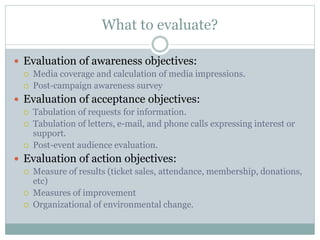
What to evaluate?
 Evaluation of awareness objectives:
 Media coverage and calculation of media impressions.
 Post-campaign awareness survey
 Evaluation of acceptance objectives:
 Tabulation of requests for information.
 Tabulation of letters, e-mail, and phone calls expressing interest or
support.
 Post-event audience evaluation.
 Evaluation of action objectives:
 Measure of results (ticket sales, attendance, membership, donations,
etc)
 Measures of improvement
 Organizational of environmental change.
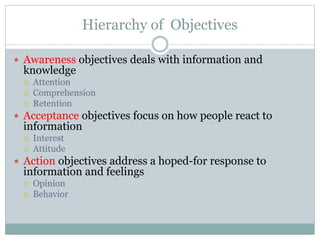
Hierarchy of Objectives
 Awareness objectives deals with information and
knowledge
 Attention
 Comprehension
 Retention
 Acceptance objectives focus on how people react to
information
 Interest
 Attitude
 Action objectives address a hoped-for response to
information and feelings
 Opinion
 Behavior
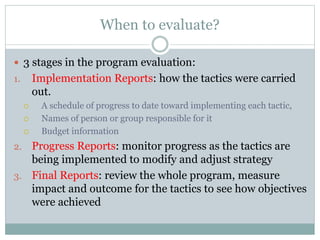
When to evaluate?
 3 stages in the program evaluation:
1. Implementation Reports: how the tactics were carried
out.
 A schedule of progress to date toward implementing each tactic,
 Names of person or group responsible for it
 Budget information
2. Progress Reports: monitor progress as the tactics are
being implemented to modify and adjust strategy
3. Final Reports: review the whole program, measure
impact and outcome for the tactics to see how objectives
were achieved
Research Design
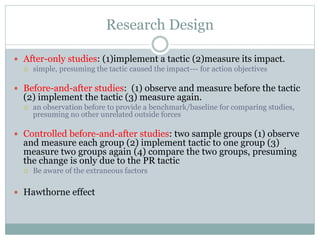
 After-only studies: (1)implement a tactic (2)measure its impact.
 simple, presuming the tactic caused the impact--- for action objectives
 Before-and-after studies: (1) observe and measure before the tactic
(2) implement the tactic (3) measure again.
 an observation before to provide a benchmark/baseline for comparing studies,
presuming no other unrelated outside forces
 Controlled before-and-after studies: two sample groups (1) observe
and measure each group (2) implement tactic to one group (3)
measure two groups again (4) compare the two groups, presuming
the change is only due to the PR tactic
 Be aware of the extraneous factors
 Hawthorne effect
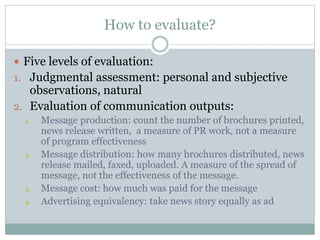
How to evaluate?
 Five levels of evaluation:
1. Judgmental assessment: personal and subjective
observations, natural
2. Evaluation of communication outputs:
1. Message production: count the number of brochures printed,
news release written, a measure of PR work, not a measure
of program effectiveness
2. Message distribution: how many brochures distributed, news
release mailed, faxed, uploaded. A measure of the spread of
message, not the effectiveness of the message.
3. Message cost: how much was paid for the message
4. Advertising equivalency: take news story equally as ad
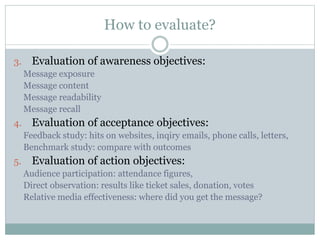
How to evaluate?
3. Evaluation of awareness objectives:
Message exposure
Message content
Message readability
Message recall
4. Evaluation of acceptance objectives:
Feedback study: hits on websites, inqiry emails, phone calls, letters,
Benchmark study: compare with outcomes
5. Evaluation of action objectives:
Audience participation: attendance figures,
Direct observation: results like ticket sales, donation, votes
Relative media effectiveness: where did you get the message?
Research Methods
 Quantitative: survey, content analysis, readership
studies, head count, direct observation
 Qualitative: interview, focus group, case study
Data analysis and Report
 Data analysis
 Evaluation report
Ultimate Evaluation:
Value-added Public Relations
 Most evaluation focus on objectives and tactics:
 What did we do?
 What did we accomplished by doing it?
 How effectively did this achieve what we set out to do?
 What did public relations do for the organization as a
whole?
 To enhance the relationship between an organization and its
various public, e.g. help organization survive, make money,
save money, weaken opposition, save lives….

Step 9 Evaluating the Strategic Plan

  • 1.
    P H AS E F O U R E V A L U A T I O N S T E P 9 E V A L U A T I N G T H E S T R A T E G I C P L A N Public Relations & Advertising Campaigns
  • 2.
    What to evaluate? Evaluation of awareness objectives:  Media coverage and calculation of media impressions.  Post-campaign awareness survey  Evaluation of acceptance objectives:  Tabulation of requests for information.  Tabulation of letters, e-mail, and phone calls expressing interest or support.  Post-event audience evaluation.  Evaluation of action objectives:  Measure of results (ticket sales, attendance, membership, donations, etc)  Measures of improvement  Organizational of environmental change.
  • 3.
    Hierarchy of Objectives Awareness objectives deals with information and knowledge  Attention  Comprehension  Retention  Acceptance objectives focus on how people react to information  Interest  Attitude  Action objectives address a hoped-for response to information and feelings  Opinion  Behavior
  • 4.
    When to evaluate? 3 stages in the program evaluation: 1. Implementation Reports: how the tactics were carried out.  A schedule of progress to date toward implementing each tactic,  Names of person or group responsible for it  Budget information 2. Progress Reports: monitor progress as the tactics are being implemented to modify and adjust strategy 3. Final Reports: review the whole program, measure impact and outcome for the tactics to see how objectives were achieved
  • 5.
    Research Design  After-onlystudies: (1)implement a tactic (2)measure its impact.  simple, presuming the tactic caused the impact--- for action objectives  Before-and-after studies: (1) observe and measure before the tactic (2) implement the tactic (3) measure again.  an observation before to provide a benchmark/baseline for comparing studies, presuming no other unrelated outside forces  Controlled before-and-after studies: two sample groups (1) observe and measure each group (2) implement tactic to one group (3) measure two groups again (4) compare the two groups, presuming the change is only due to the PR tactic  Be aware of the extraneous factors  Hawthorne effect
  • 6.
    How to evaluate? Five levels of evaluation: 1. Judgmental assessment: personal and subjective observations, natural 2. Evaluation of communication outputs: 1. Message production: count the number of brochures printed, news release written, a measure of PR work, not a measure of program effectiveness 2. Message distribution: how many brochures distributed, news release mailed, faxed, uploaded. A measure of the spread of message, not the effectiveness of the message. 3. Message cost: how much was paid for the message 4. Advertising equivalency: take news story equally as ad
  • 7.
    How to evaluate? 3.Evaluation of awareness objectives: Message exposure Message content Message readability Message recall 4. Evaluation of acceptance objectives: Feedback study: hits on websites, inqiry emails, phone calls, letters, Benchmark study: compare with outcomes 5. Evaluation of action objectives: Audience participation: attendance figures, Direct observation: results like ticket sales, donation, votes Relative media effectiveness: where did you get the message?
  • 8.
    Research Methods  Quantitative:survey, content analysis, readership studies, head count, direct observation  Qualitative: interview, focus group, case study
  • 9.
    Data analysis andReport  Data analysis  Evaluation report
  • 10.
    Ultimate Evaluation: Value-added PublicRelations  Most evaluation focus on objectives and tactics:  What did we do?  What did we accomplished by doing it?  How effectively did this achieve what we set out to do?  What did public relations do for the organization as a whole?  To enhance the relationship between an organization and its various public, e.g. help organization survive, make money, save money, weaken opposition, save lives….